Box 5
Folder 3. Treasure – Wyoming
Item 1. Newspaper Clippings
Transcribed Text (OCR)
GARY MANGIACOPA ARCHIVE
============================================================
Title:      B5F3I1
Slug:       b5f3i1
Categories: Lost Treasure
Source:     https://garymangiacopraarchive.com/b5f3i1
Pages:      4 scanned, 4 extracted
OCR:        Google Vision API (document_text_detection)
Processed:  2026-06-06
============================================================

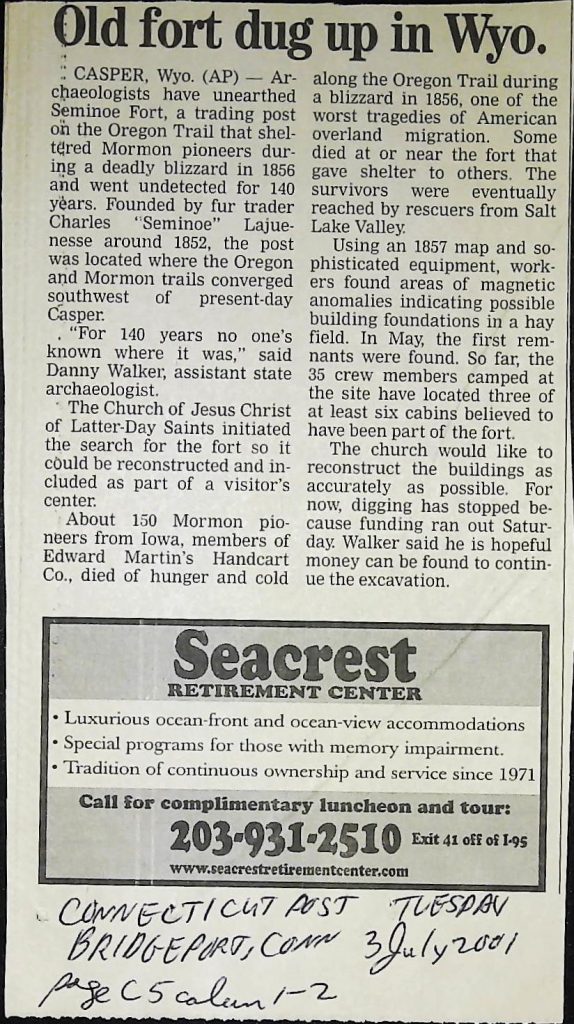
Old fort dug up in Wyo.
CASPER, Wyo. (AP) Ar-
chaeologists have unearthed
Seminoe Fort, a trading post
on the Oregon Trail that shel-
tered Mormon pioneers dur-
ing a deadly blizzard in 1856
and went undetected for 140
years. Founded by fur trader
Charles "Seminoe" Lajue
nesse around 1852, the post
was located where the Oregon
and Mormon trails converged
southwest of present-day
Casper.
"For 140 years no one's
known where it was," said
Danny Walker, assistant state
archaeologist.
The Church of Jesus Christ
of Latter-Day Saints initiated
the search for the fort so it
could be reconstructed and in-
cluded as part of a visitor's
center.
About 150 Mormon pio-
neers from Iowa, members of
Edward Martin's Handcart
Co., died of hunger and cold
along the Oregon Trail during
a blizzard in 1856, one of the
worst tragedies of American
overland migration. Some
died at or near the fort that
gave shelter to others. The
survivors were eventually
reached by rescuers from Salt
Lake Valley.
Using an 1857 map and so-
phisticated equipment, work-
ers found areas of magnetic
anomalies indicating possible
building foundations in a hay
field. In May, the first rem-
nants were found. So far, the
35 crew members camped at
the site have located three of
at least six cabins believed to
have been part of the fort.
The church would like to
reconstruct the buildings as
accurately as possible. For
now, digging has stopped be-
cause funding ran out Satur-
day. Walker said he is hopeful
money can be found to contin-
ue the excavation.
Seacrest
RETIREMENT CENTER
•Luxurious ocean-front and ocean-view accommodations
Special programs for those with memory impairment.
• Tradition of continuous ownership and service since 1971
Call for complimentary luncheon and tour:
[AD] 203-931-2510
www.seacrestretirementcenter.com
Exit 41 off of I-95
CONNECTICUT POST TUESDAY
BRIDGEPORT, COM 3 July 2001
page C5 calan 1-2

[PAGE BREAK]

CONN
TICUT POST, BRIDGEPORT, CONN_3 July 2001
page c5cal 1-2
Old fort dug up in Wyo.
CASPER, Wyo. (AP) Ar-
chaeologists have unearthed
Seminoe Fort, a trading post
on the Oregon Trail that shel-
tered Mormon pioneers dur-
ing a deadly blizzard in 1856
and went undetected for 140
years. Founded by fur trader
Charles "Seminoe" Lajue-
nesse around 1852, the post
was located where the Oregon
and Mormon trails converged
southwest of present-day
Casper.
"For 140 years no one's
known where it was," said
Danny Walker, assistant state
archaeologist.
The Church of Jesus Christ
of Latter-Day Saints initiated
the search for the fort so it
could be reconstructed and in-
cluded as part of a visitor's
center.
About 150 Mormon pio-
neers from Iowa, members of
Edward Martin's Handcart
Co., died of hunger and cold
along the Oregon Trail during
a blizzard in 1856, one of the
worst tragedies of American
overland migration. Some
died at or near the fort that
gave shelter to others. The
survivors were eventually
reached by rescuers from Salt
Lake Valley.
Using an 1857 map and so-
phisticated equipment, work-
ers found areas of magnetic
anomalies indicating possible
building foundations in a hay
field. In May, the first rem-
nants were found. So far, the
35 crew members camped at
the site have located three of
at least six cabins believed to
have been part of the fort.
The church would like to
reconstruct the buildings as
accurately as possible. For
now, digging has stopped be-
cause funding ran out Satur-
day. Walker said he is hopeful
money can be found to contin-
ue the excavation.

[PAGE BREAK]

Hawaii Tribune-Herald, Monday, July 28, 2002-9
Prospectors lured by gold, gems
Wyoming invites
folks to stake their
claim and dig away
By Krystyn Freidlin
Associated Press
They
GILLETTE, Wyo.
sparkle, they dazzle, they're valu-
able and Wyoming has them in and
on the ground almost everywhere.
Gold and precious gems abound
in the Cowboy State where
prospectors can still stake claims
and dig for natural treasure
as long as they know what to
look for.
Diamonds, iolites, rubies, sap-
phires, aquamarine, emeralds,
jade and gold are only a few of the
treasures discovered in Wyoming
by geologists, and recreational
and commercial prospectors.
Wyoming is one of 19 states left
in the United States with federal
lands where mining sites still can
be discovered and claimed.
Gillette resident Larry
McEachron and friend Darrel
Layton have a joint claim near
Associated Press
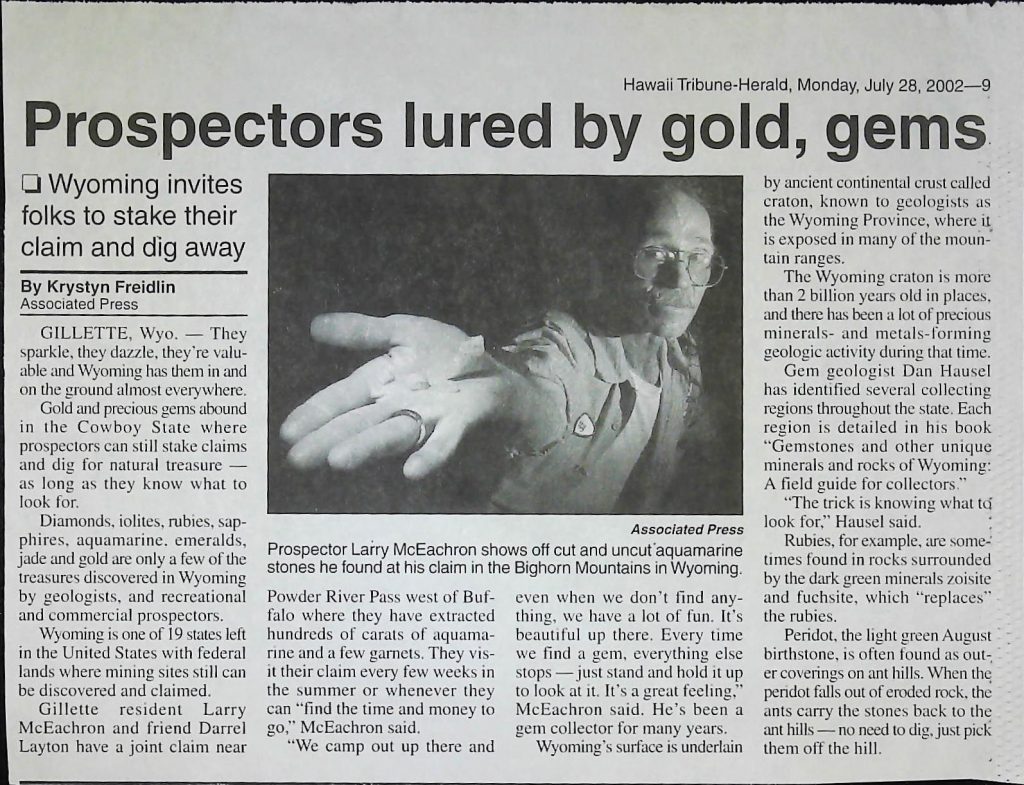
Prospector Larry McEachron shows off cut and uncut aquamarine
stones he found at his claim in the Bighorn Mountains in Wyoming.
Powder River Pass west of Buf-
falo where they have extracted
hundreds of carats of aquama-
rine and a few garnets. They vis-
it their claim every few weeks in
the summer or whenever they
can "find the time and money to
go," McEachron said.
"We camp out up there and
even when we don't find any-
thing, we have a lot of fun. It's
beautiful up there. Every time
we find a gem, everything else
stops just stand and hold it up
to look at it. It's a great feeling,"
McEachron said. He's been a
gem collector for many years.
Wyoming's surface is underlain
by ancient continental crust called
craton, known to geologists as
the Wyoming Province, where it
is exposed in many of the moun-
tain ranges.
The Wyoming craton is more
than 2 billion years old in places.
and there has been a lot of precious
minerals and metals-forming
geologic activity during that time.
Gem geologist Dan Hausel
has identified several collecting
regions throughout the state. Each
region is detailed in his book
"Gemstones and other unique
minerals and rocks of Wyoming:
A field guide for collectors.
"The trick is knowing what to
look for," Hausel said.
Rubies, for example, are some-
times found in rocks surrounded
by the dark green minerals zoisite
and fuchsite, which "replaces"
the rubies.
Peridot, the light green August
birthstone, is often found as out-
er coverings on ant hills. When the
peridot falls out of eroded rock, the
ants carry the stones back to the
ant hills- - no need to dig, just pick
them off the hill.

[PAGE BREAK]

Who needs diamonds?
Associated Press
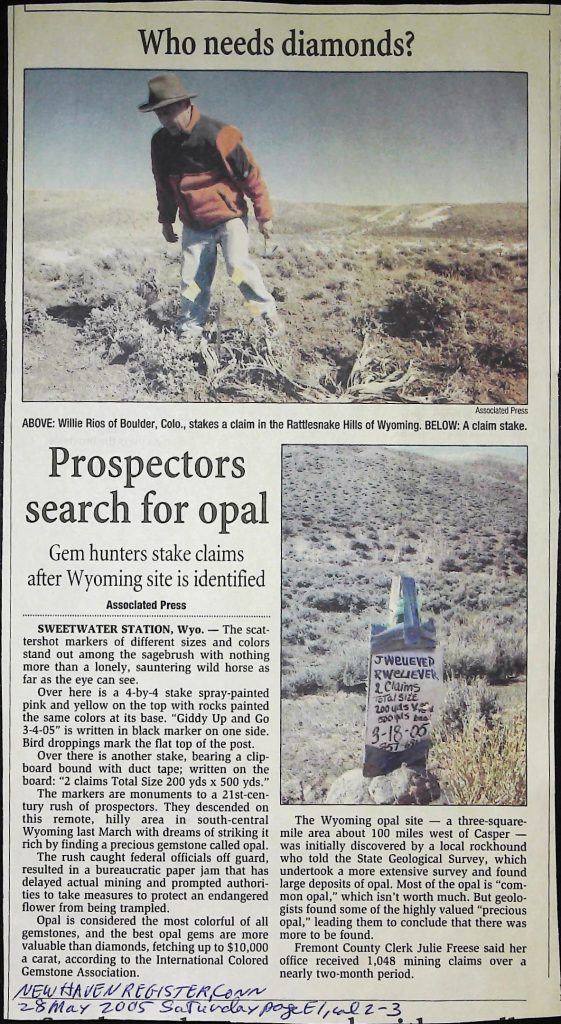
ABOVE: Willie Rios of Boulder, Colo., stakes a claim in the Rattlesnake Hills of Wyoming. BELOW: A claim stake.
Prospectors
search for opal
Gem hunters stake claims
after Wyoming site is identified
Associated Press
The scat-
SWEETWATER STATION, Wyo.
tershot markers of different sizes and colors
stand out among the sagebrush with nothing
more than a lonely, sauntering wild horse as
far as the eye can see.
Over here is a 4-by-4 stake spray-painted
pink and yellow on the top with rocks painted
the same colors at its base. "Giddy Up and Go
3-4-05" is written in black marker on one side.
Bird droppings mark the flat top of the post.
Over there is another stake, bearing a clip-
board bound with duct tape; written on the
board: "2 claims Total Size 200 yds x 500 yds."
The markers are monuments to a 21st-cen-
tury rush of prospectors. They descended on
this remote, hilly area in south-central
Wyoming last March with dreams of striking it
rich by finding a precious gemstone called opal.
The rush caught federal officials off guard,
resulted in a bureaucratic paper jam that has
delayed actual mining and prompted authori-
ties to take measures to protect an endangered
flower from being trampled.
Opal is considered the most colorful of all
gemstones, and the best opal gems are more
valuable than diamonds, fetching up to $10,000
a carat, according to the International Colored
Gemstone Association.
NEW HAVEN REGISTER CONN
JWeUEVER
RWCLIEVER
1 Claims
TOTAL SIZE
2004ds
500s bea
3-18-05
51
The Wyoming opal site - a three-square-
mile area about 100 miles west of Casper
was initially discovered by a local rockhound
who told the State Geological Survey, which
undertook a more extensive survey and found
large deposits of opal. Most of the opal is "com-
mon opal," which isn't worth much. But geolo-
gists found some of the highly valued "precious
opal," leading them to conclude that there was
more to be found.
Fremont County Clerk Julie Freese said her
office received 1,048 mining claims over a
nearly two-month period.
28 May 2005 Saturday pageEl, cl 2-3