Box 5
Folder 4. Treasure – Minnesota
Item 1. Newspaper Clippings
Transcribed Text (OCR)
GARY MANGIACOPA ARCHIVE
============================================================
Title:      B5F4I1
Slug:       b5f4i1
Categories: Lost Treasure
Source:     https://garymangiacopraarchive.com/b5f4i1
Pages:      2 scanned, 2 extracted
OCR:        Google Vision API (document_text_detection)
Processed:  2026-06-06
============================================================

28 Sept 1984
24
New Have Register, Coun
POTP
IMA
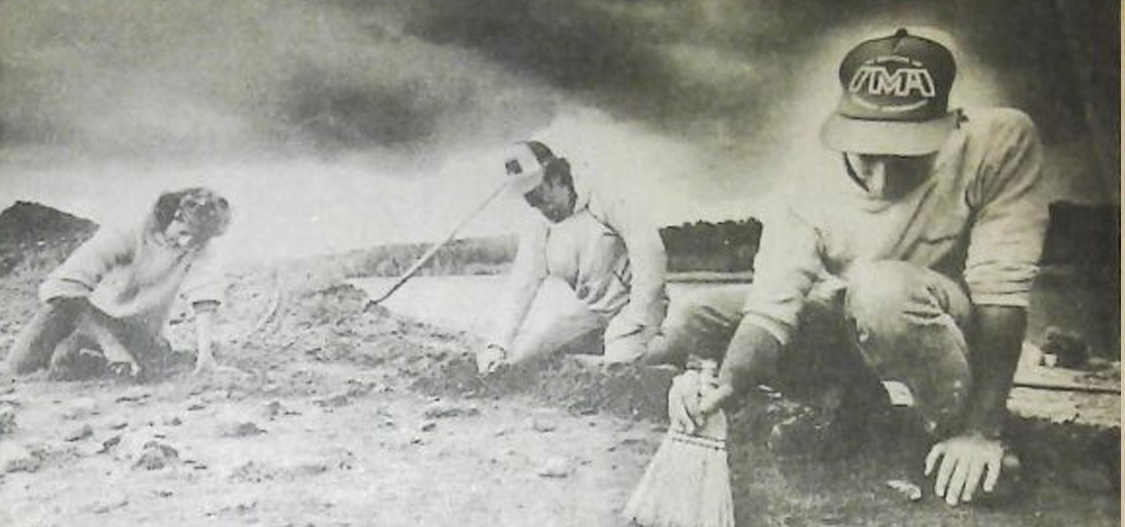
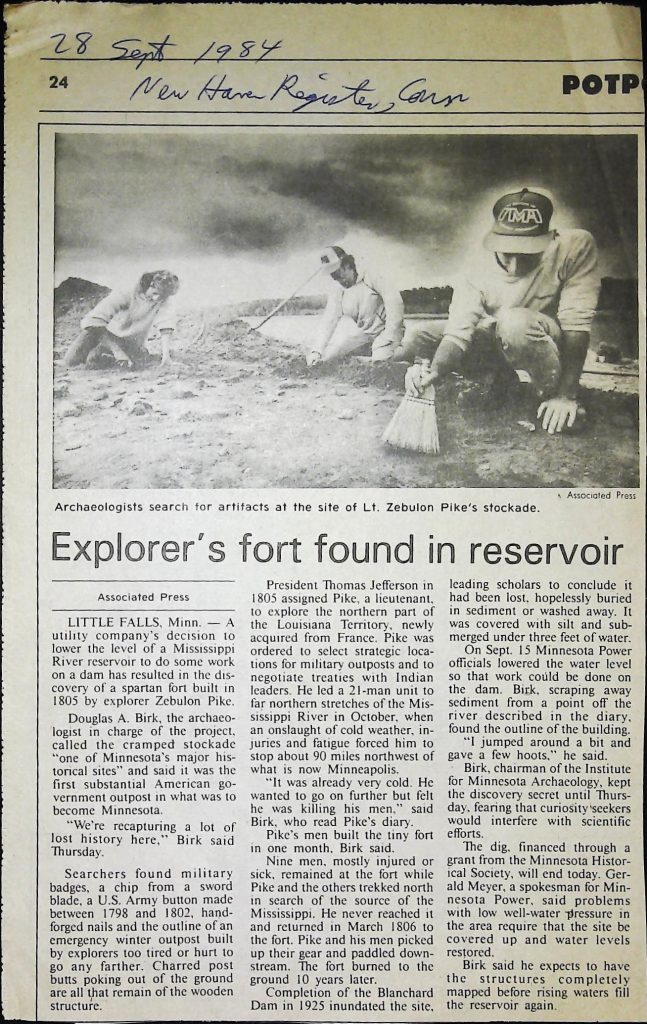
Archaeologists search for artifacts at the site of Lt. Zebulon Pike's stockade.
Associated Press
Explorer's fort found in reservoir
Associated Press
LITTLE FALLS, Minn. - A
utility company's decision to
lower the level of a Mississippi
River reservoir to do some work
on a dam has resulted in the dis-
covery of a spartan fort built in
1805 by explorer Zebulon Pike.
Douglas A. Birk, the archaeo-
logist in charge of the project,
called the cramped stockade
"one of Minnesota's major his-
torical sites" and said it was the
first substantial American go-
vernment outpost in what was to
become Minnesota.
"We're recapturing a lot of
lost history here," Birk said
Thursday.
Searchers found military
badges, a chip from a sword
blade, a U.S. Army button made
between 1798 and 1802, hand-
forged nails and the outline of an
emergency winter outpost built
by explorers too tired or hurt to
go any farther. Charred post
butts poking out of the ground
are all that remain of the wooden
structure.
President Thomas Jefferson in
1805 assigned Pike, a lieutenant,
to explore the northern part of
the Louisiana Territory, newly
acquired from France. Pike was
ordered to select strategic loca-
tions for military outposts and to
negotiate treaties with Indian
leaders. He led a 21-man unit to
far northern stretches of the Mis-
sissippi River in October, when
an onslaught of cold weather, in-
juries and fatigue forced him to
stop about 90 miles northwest of
what is now Minneapolis.
"It was already very cold. He
wanted to go on further but felt
he was killing his men," said
Birk, who read Pike's diary.
Pike's men built the tiny fort
in one month, Birk said.
Nine men, mostly injured or
sick, remained at the fort while
Pike and the others trekked north
in search of the source of the
Mississippi. He never reached it
and returned in March 1806 to
the fort. Pike and his men picked
up their gear and paddled down-
stream. The fort burned to the
ground 10 years later.
Completion of the Blanchard
Dam in 1925 inundated the site,
leading scholars to conclude it
had been lost, hopelessly buried
in sediment or washed away. It
was covered with silt and sub-
merged under three feet of water.
On Sept. 15 Minnesota Power
officials lowered the water level
so that work could be done on
the dam. Birk, scraping away
sediment from a point off the
river described in the diary,
found the outline of the building.
"I jumped around a bit and
gave a few hoots," he said.
Birk, chairman of the Institute
for Minnesota Archaeology, kept
the discovery secret until Thurs-
day, fearing that curiosity'seekers
would interfere with scientific
efforts.
The dig, financed through a
grant from the Minnesota Histor-
ical Society, will end today. Ger-
ald Meyer, a spokesman for Min-
nesota Power, said problems
with low well-water pressure in
the area require that the site be
covered up and water levels
restored.
Birk said he expects to have
the structures completely
mapped before rising waters fill
the reservoir again.

[PAGE BREAK]

[AD] $28/984
Pike fort peaks their interest
LITTLE FALLS, Minn. (UPI) Archeologists have discovered
the well preserved remains of an 1805 stockade built by explorer Zebu-
lon Pike who was exploring territory acquired in the Louisiana Pur-
chase.
The stockade was revealed when the Blanchard Dam reservoir
was drained in mid September for repairs.
Douglas Birk, project director for the Minnesota Institute of Arche-
ology, said Thursday the stockade was built in October 1805 when Pike
explored the northern part of the Louisiana Purchase acquired from
France in 1803.
Birk said they have found about 200 artifacts, including prehistoric
pottery, a U.S. military button made between 1798 and 1802, and two
varieties of nails-hand forged and round wire.
By Monday, sediments had been cleared from one blockade house
Parea revealing the outline of the building and collapsed fireplace as
well as two sides of the stockade.
Visitors will not be able to view the remains since the reservoir is
being filled again. All artifacts have been removed from the site.