Lost Treasure

B5F7I1

Box 5

Folder 7. Treasure – Nebraska

Item 1. Newspaper Clippings


Transcribed Text (OCR)

GARY MANGIACOPA ARCHIVE
============================================================
Title:      B5F7I1
Slug:       b5f7i1
Categories: Lost Treasure
Source:     https://garymangiacopraarchive.com/b5f7i1
Pages:      1 scanned, 1 extracted
OCR:        Google Vision API (document_text_detection)
Processed:  2026-06-06
============================================================

26 NOV 1985
28 New Have
1985 Truesday
Register,
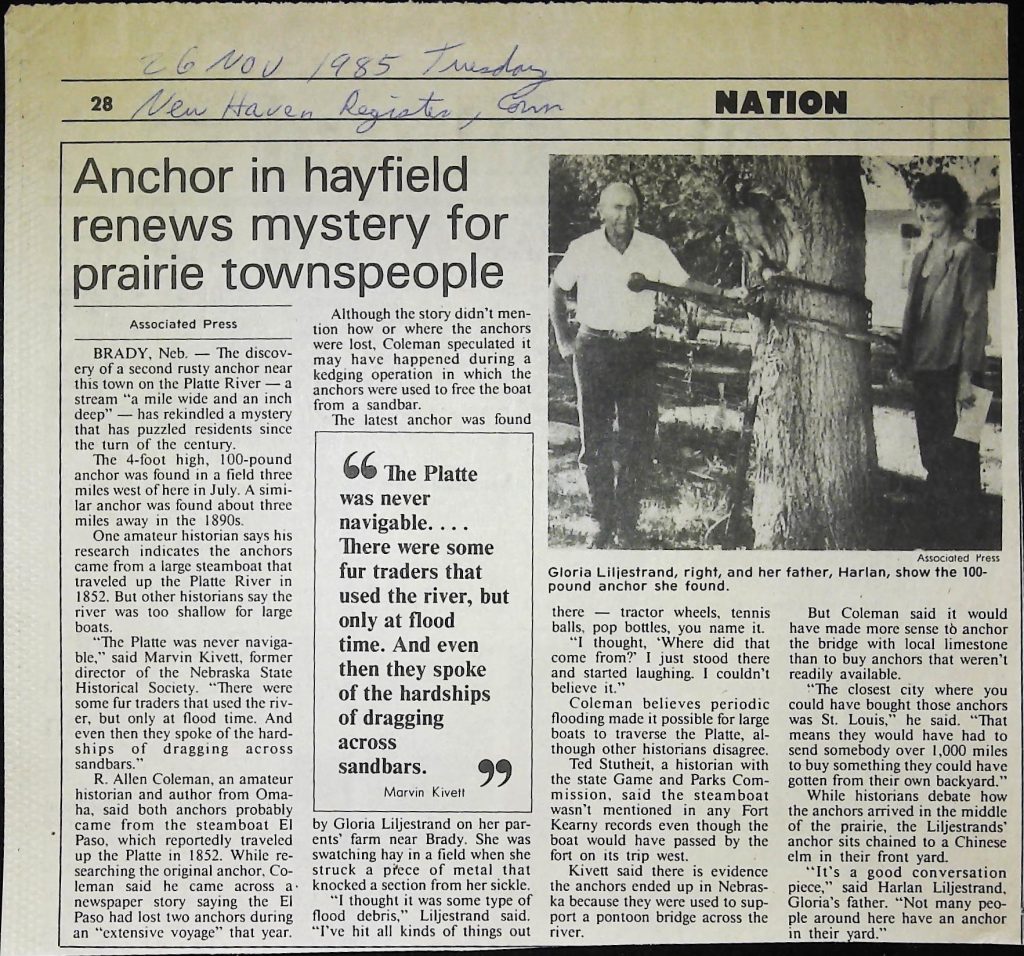
Anchor in hayfield
renews mystery for
prairie townspeople
Associated Press
BRADY, Neb. The discov-
ery of a second rusty anchor near
this town on the Platte River
<- a
stream "a mile wide and an inch
deep"
has rekindled a mystery
that has puzzled residents since
the turn of the century.
The 4-foot high, 100-pound
anchor was found in a field three
miles west of here in July. A simi-
lar anchor was found about three
miles away in the 1890s.
One amateur historian says his
research indicates the anchors
came from a large steamboat that
traveled up the Platte River in
1852. But other historians say the
river was too shallow for large
boats.
"The Platte was never naviga-
ble," said Marvin Kivett, former
director of the Nebraska State
Historical Society. "There were
some fur traders that used the riv-
er, but only at flood time. And
even then they spoke of the hard-
ships of dragging across
sandbars.
R. Allen Coleman, an amateur
historian and author from Oma-
ha, said both anchors probably
came from the steamboat El
Paso, which reportedly traveled
up the Platte in 1852. While re-
searching the original anchor, Co-
leman said he came across a
newspaper story saying the El
Paso had lost two anchors during
an "extensive voyage" that year.
Although the story didn't men-
tion how or where the anchors
were lost, Coleman speculated it
may have happened during a
kedging operation in which the
anchors were used to free the boat
from a sandbar.
The latest anchor was found
66 The Platte
was never
navigable.
There were some
fur traders that
used the river, but
only at flood
time. And even
then they spoke
of the hardships
of dragging
across
sandbars.
Marvin Kivett
99
by Gloria Liljestrand on her par-
ents' farm near Brady. She was
swatching hay in a field when she
struck a přece of metal that
knocked a section from her sickle.
"I thought it was some type of
flood debris,' Liljestrand said.
"I've hit all kinds of things out
NATION
Associated Press
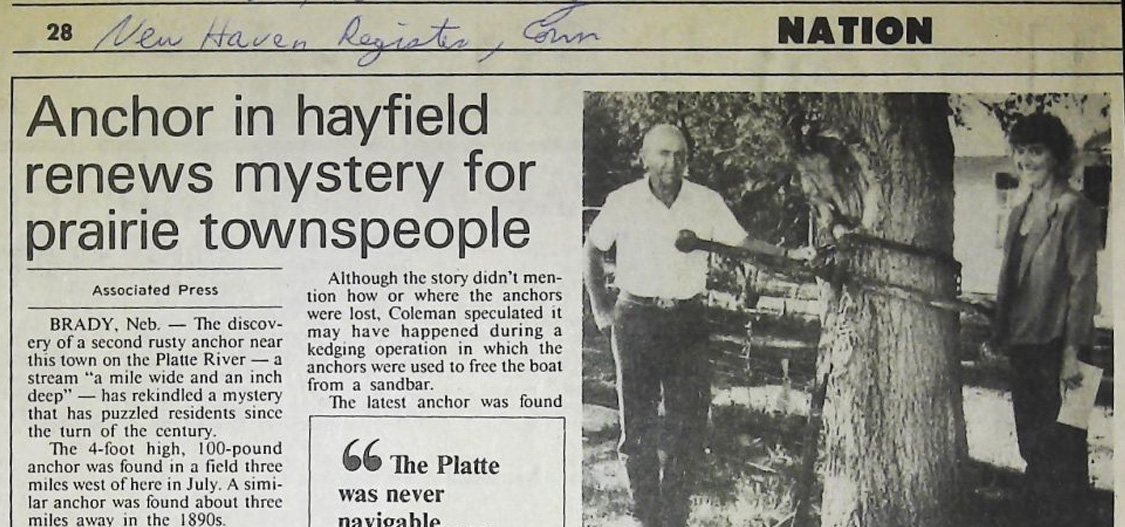
Gloria Liljestrand, right, and her father, Harlan, show the 100-
pound anchor she found.
there
tractor wheels, tennis
balls, pop bottles, you name it.
"I thought, 'Where did that
come from?" I just stood there
and started laughing. I couldn't
believe it.'
Coleman believes periodic
flooding made it possible for large
boats to traverse the Platte, al-
though other historians disagree.
Ted Stutheit, a historian with
the state Game and Parks Com-
mission, said the steamboat
wasn't mentioned in any Fort
Kearny records even though the
boat would have passed by the
fort on its trip west.
Kivett said there is evidence
the anchors ended up in Nebras-
ka because they were used to sup-
port a pontoon bridge across the
river.
But Coleman said it would
have made more sense to anchor
the bridge with local limestone
than to buy anchors that weren't
readily available.
"The closest city where you
could have bought those anchors
was St. Louis, he said. "That
means they would have had to
send somebody over 1,000 miles
to buy something they could have
gotten from their own backyard.'
While historians debate how
the anchors arrived in the middle
of the prairie, the Liljestrands'
anchor sits chained to a Chinese
elm in their front yard.
"It's a good conversation
piece," said Harlan Liljestrand,
Gloria's father. "Not many peo-
ple around here have an anchor
in their yard."

Leave a Reply

Your email address will not be published. Required fields are marked *