Lost Treasure

B5F16I1

Box 5

Folder 16. Treasure – Pennsylvania

Item 1. Newspaper Clippings


Transcribed Text (OCR)

GARY MANGIACOPA ARCHIVE
============================================================
Title:      B5F16I1
Slug:       b5f16i1
Categories: Lost Treasure
Source:     https://garymangiacopraarchive.com/b5f16i1
Pages:      7 scanned, 7 extracted
OCR:        Google Vision API (document_text_detection)
Processed:  2026-06-06
============================================================

TIVE
POINTS
RINGTOWN
(Jeffersonville)
TOPTON
East Pan
009
FARMINGTON
KUNE'S CORNER
OREVILLE
009-
888, shows
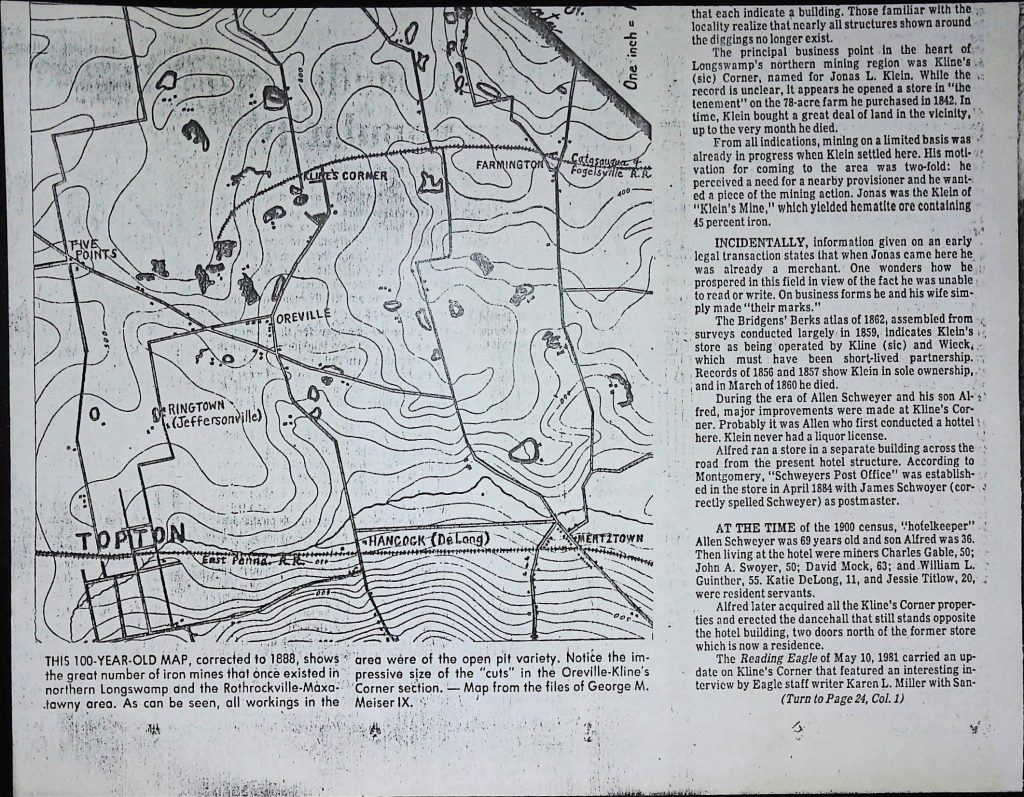
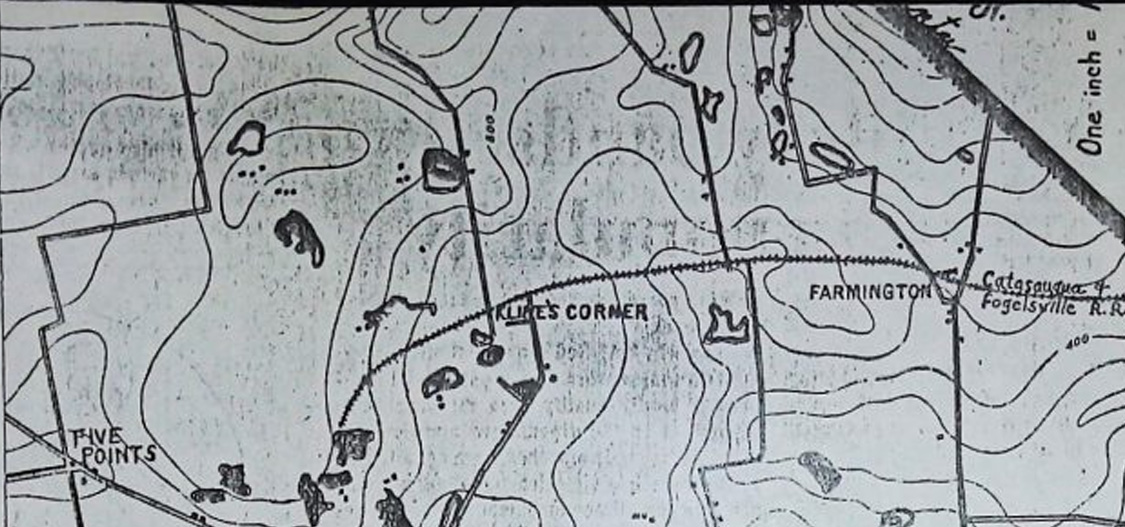
THIS 100-YEAR-OLD MAP, corrected to 1888, s
the great number of iron mines that once existed in
northern Longswamp and the Rothrockville-Maxa-
tawny area. As can be seen, all workings in the
HANCOCK (DeLang)
One inch =
Catasauqua t
Fogelsville R.R
400.
MERTZTOWN
area were of the open pit variety. Notice the im-
pressive size of the "cuts" in the Oreville-Kline's
Corner section. - Map from the files of George M.
Meiser IX.
that each indicate a building. Those familiar with the
locality realize that nearly all structures shown around
the diggings no longer exist.
The principal business point in the heart of
Longswamp's northern mining region was Kline's.
(sic) Corner, named for Jonas L. Klein. While the
record is unclear, it appears he opened a store in "the
tenement" on the 78-acre farm he purchased in 1842. In
time, Klein bought a great deal of land in the vicinity,
up to the very month he died.
From all indications, mining on a limited basis was
already in progress when Klein settled here. His moti-ve
vation for coming to the area was two-fold: he
perceived a need for a nearby provisioner and he want-
ed a piece of the mining action. Jonas was the Klein of
"Klein's Mine," which yielded hematite ore containing
45 percent iron.
INCIDENTALLY, information given on an early
legal transaction states that when Jonas came here he
was already a merchant. One wonders how he
prospered in this field in view of the fact he was unable
to read or write. On business forms he and his wife sim-.
ply made "their marks."
The Bridgens' Berks atlas of 1862, assembled from
surveys conducted largely in 1859, indicates Klein's
store as being operated by Kline (sic) and Wieck,
which must have been short-lived partnership.
Records of 1856 and 1857 show Klein in sole ownership,.
and in March of 1860 he died.
During the era of Allen Schweyer and his son Al-
fred, major improvements were made at Kline's Cor-
ner. Probably it was Allen who first conducted a hottel
here. Klein never had a liquor license.
Alfred ran a store in a separate building across the
road from the present hotel structure. According to
Montgomery, "Schweyers Post Office" was establish-
ed in the store in April 1884 with James Schwoyer (cor-
rectly spelled Schweyer) as postmaster.
AT THE TIME of the 1900 census, "hotelkeeper"
Allen Schweyer was 69 years old and son Alfred was 36.
Then living at the hotel were miners Charles Gable, 50;
John A. Swoyer, 50; David Mock, 63; and William L.
Guinther, 55. Katie DeLong, 11, and Jessie Titlow, 20,
were resident servants.
Alfred later acquired all the Kline's Corner proper-
ties and erected the dancehall that still stands opposite
the hotel building, two doors north of the former store
which is now a residence.
The Reading Eagle of May 10, 1981 carried an up-
date on Kline's Corner that featured an interesting in-
terview by Eagle staff writer Karen L. Miller with San-
(Turn to Page 24, Col. 1)

[PAGE BREAK]

The Reading Eagle, Penn Sept 2 1981
Wed

[PAGE BREAK]

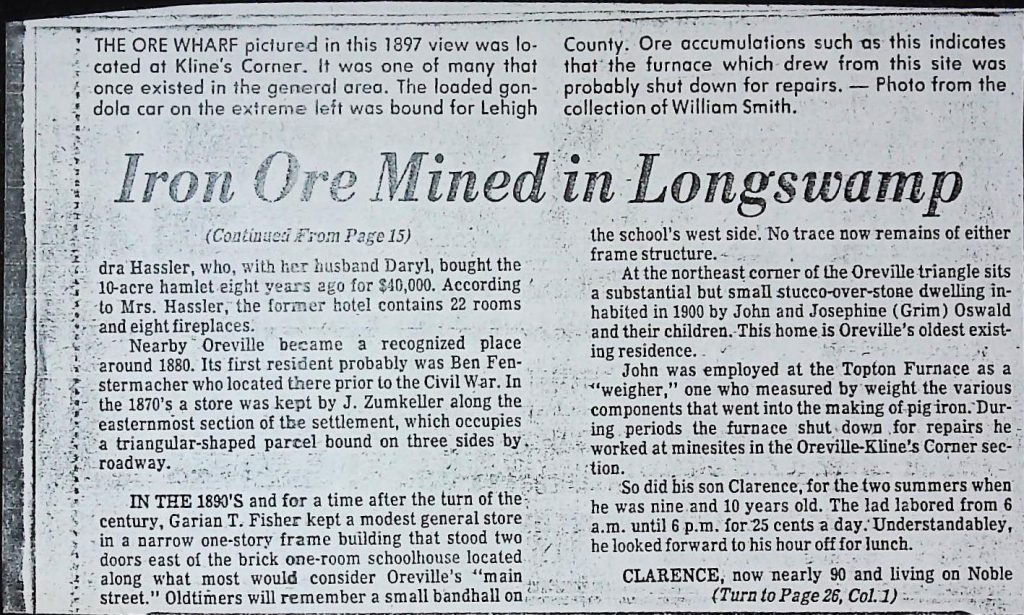
THE ORE WHARF pictured in this 1897 view was lo-
cated at Kline's Corner. It was one of many that
conce existed in the general area. The loaded gon-
dola car on the extreme left was bound for Lehigh
County. Ore accumulations such as this indicates
that the furnace which drew from this site was
probably shut down for repairs. Photo from the
collection of William Smith.
Iron Ore Mined in Longswamp
(Continued From Page 15)
dra Hassler, who, with her husband Daryl, bought the
10-acre hamlet eight years ago for $40,000. According
to Mrs. Hassler, the former hotel contains 22 rooms
and eight fireplaces.
Nearby Oreville became a recognized place
around 1880. Its first resident probably was Ben Fen-
stermacher who located there prior to the Civil War. In
the 1870's a store was kept by J. Zumkeller along the
easternmost section of the settlement, which occupies
a triangular-shaped parcel bound on three sides by.
roadway.
IN THE 1890'S and for a time after the turn of the
century, Garian T. Fisher kept a modest general store
in a narrow one-story frame building that stood two
doors east of the brick one-room schoolhouse located.
along what most would consider Oreville's "main
street." Oldtimers will remember a small bandhall on:
the school's west side. No trace now remains of either
frame structure.
At the northeast corner of the Oreville triangle sits
a substantial but small stucco-over-stone dwelling in-
habited in 1900 by John and Josephine (Grim) Oswald
and their children. This home is Oreville's oldest exist-
ing residence.
John was employed at the Topton Furnace as a
"weigher," one who measured by weight the various
components that went into the making of pig iron. Dur-
ing periods the furnace shut down for repairs he
worked at minesites in the Oreville-Kline's Corner sec-
tion.
So did his son Clarence, for the two summers when
he was nine and 10 years old. The lad labored from 6
a.m. until 6 p.m. for 25 cents a day. Understandabley,
he looked forward to his hour off for lunch.
CLARENCE, now nearly 90 and living on Noble
(Turn to Page 26, Col.1)

[PAGE BREAK]

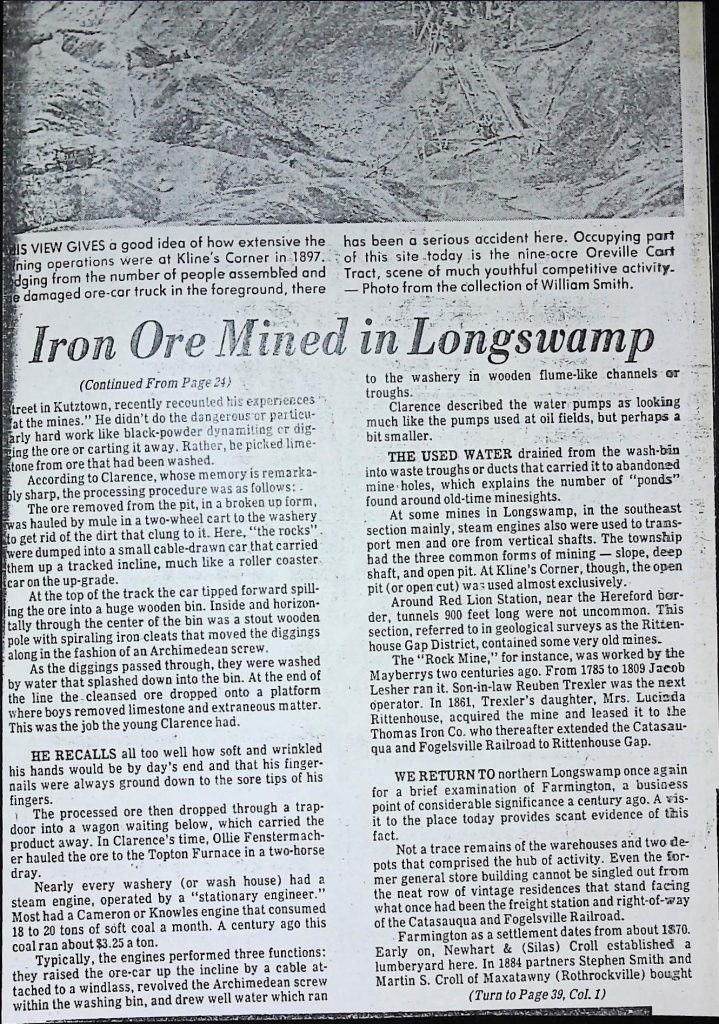
IS VIEW GIVES a good idea of how extensive the
ning operations were at Kline's Corner in 1897.
dging from the number of people assembled and
e damaged ore-car truck in the foreground, there
has been a serious accident here. Occupying part
of this site today is the nine-acre Oreville Cart
Tract, scene of much youthful competitive activity.
Photo from the collection of William Smith.
Iron Ore Mined in Longswamp
(Continued From Page 24)
treet in Kutztown, recently recounted his experiences
at the mines." He didn't do the dangerous or particu-
arly hard work like black-powder dynamiting or dig-
ging the ore or carting it away. Rather, he picked lime-
stone from ore that had been washed.
According to Clarence, whose memory is remarka-
bly sharp, the processing procedure was as follows: .
The ore removed from the pit, in a broken up form,
was hauled by mule in a two-wheel cart to the washery
to get rid of the dirt that clung to it. Here, "the rocks".
were dumped into a small cable-drawn car that carried
them up a tracked incline, much like a roller coaster
car on the up-grade.
At the top of the track the car tipped forward spill-
ing the ore into a huge wooden bin. Inside and horizon-
tally through the center of the bin was a stout wooden
pole with spiraling iron cleats that moved the diggings
along in the fashion of an Archimedean screw.
As the diggings passed through, they were washed
by water that splashed down into the bin. At the end of
the line the cleansed ore dropped onto a platform
where boys removed limestone and extraneous matter.
This was the job the young Clarence had.
HE RECALLS all too well how soft and wrinkled
his hands would be by day's end and that his finger-
nails were always ground down to the sore tips of his
fingers.
The processed ore then dropped through a trap-
door into a wagon waiting below, which carried the
product away. In Clarence's time, Ollie Fenstermach-
er hauled the ore to the Topton Furnace in a two-horse
dray.
Nearly every washery (or wash house) had a
steam engine, operated by a "stationary engineer.'
Most had a Cameron or Knowles engine that consumed
18 to 20 tons of soft coal a month. A century ago this
coal ran about $3.25 a ton.
Typically, the engines performed three functions:
they raised the ore-car up the incline by a cable at-
tached to a windlass, revolved the Archimedean screw
within the washing bin, and drew well water which ran
to the washery in wooden flume-like channels or
troughs.
Clarence described the water pumps as looking
much like the pumps used at oil fields, but perhaps a
bit smaller.
THE USED WATER drained from the wash-bin
into waste troughs or ducts that carried it to abandoned
mine holes, which explains the number of "ponds"
found around old-time minesights.
At some mines in Longswamp, in the southeast
section mainly, steam engines also were used to trans-
port men and ore from vertical shafts. The township
had the three common forms of mining. slope, deep
shaft, and open pit. At Kline's Corner, though, the open
pit (or open cut) was used almost exclusively..
Around Red Lion Station, near the Hereford bør-
der, tunnels 900 feet long were not uncommon. This
section, referred to in geological surveys as the Ritten-
house Gap District, contained some very old mines.
The "Rock Mine," for instance, was worked by the
Mayberrys two centuries ago. From 1785 to 1809 Jacob
Lesher ran it. Son-in-law Reuben Trexler was the next
operator. In 1861, Trexler's daughter, Mrs. Lucinda
Rittenhouse, acquired the mine and leased it to the
Thomas Iron Co. who thereafter extended the Catasau-
qua and Fogelsville Railroad to Rittenhouse Gap.
WE RETURN TO northern Longswamp once again
for a brief examination of Farmington, a business
point of considerable significance a century ago. A vis-
it to the place today provides scant evidence of this
fact.
Not a trace remains of the warehouses and two de-
pots that comprised the hub of activity. Even the for-
mer general store building cannot be singled out from
the neat row of vintage residences that stand facing
what once had been the freight station and right-of-way
of the Catasauqua and Fogelsville Railroad.
Farmington as a settlement dates from about 1870.
Early on, Newhart & (Silas) Croll established a
lumberyard here. In 1884 partners Stephen Smith and
Martin S. Croll of Maxatawny (Rothrockville) bought
(Turn to Page 39, Col. 1)

[PAGE BREAK]

The Reading Eagle, Penn Sept 2 1981 Wed

[PAGE BREAK]

d
Christoper
prison to-
e wants to
fe behind
rike, was
ashington
t to a fed-
on," said
tin, Calif.
s back to
o, former
neth Gib-
filed with
as secur-
ng in Port
this sum-
an aque-
was fired
prosecu-
did any
er said in
ttle work
d
orp. offi-
's charge
has been
ant.
e Nation-
ored Peo-
asked to
iscuss the
Nearly a century ago istorialli, L. Montgomery
wrote that "iron ore has been found in this county in
very great quantities. It is not known exactly when iron
mining began but doubtlèss it originated in Colebrook-
dale and Caernarvon townships.
"It's rich deposits have been a source of great.
wealth to Berks. They have caused forges and furnaces
to be erected in every section, which have been worked
almost constantly.
"The Boyertown Mines and the Jones Mines (of the
Morgantown area) are particularly prominent. The
East Penn Valley has also supplied immense quanti-
ties of the ore. In 1882 there were over one hundred
mines in successful operation whose annual production
exceeded 300,000 tons. They furnished employment to
over 1,000 men.'
The 1880 census report placed Berks third in the
list of ore-producing counties in the state Lehigh
having been first and Lebanon second. In the entire na-
tion Berks ranked seventh.
WITHIN OUR COUNTY,Longswamp Township in
extreme eastern Berks contained the greatest number
of mine sites. Montgomery wrote that in Longswamp
along "at least 100 have been opened." The Pennsylva-
nia Second Geological Survey, in its 1882 summary,
makes specific mention of over 40.
As indicated on the accompanying map, a concen-
tration of major "cuts" existed in the short stretch be-
tween Oreville and Kline's Corner, in the northern
reaches of Longswamp along the Maxatawny.border.
Our story today focuses on this section..
Photographs taken around 1900 by expert lensman
William Smith, recently and providentially made
available by the photographer's grandson, reveal that
at that late date considerable mining activity still con-
tinued. One view clearly shows four separate opera-
tions being conducted a stone's throw from one another
in the vicinity of Kline's Corner.
CENSUS RECORDS for 1900 report 161 full-time
PRESENT PROUTE
ROTHROCKVILLE
(Maxatawny)
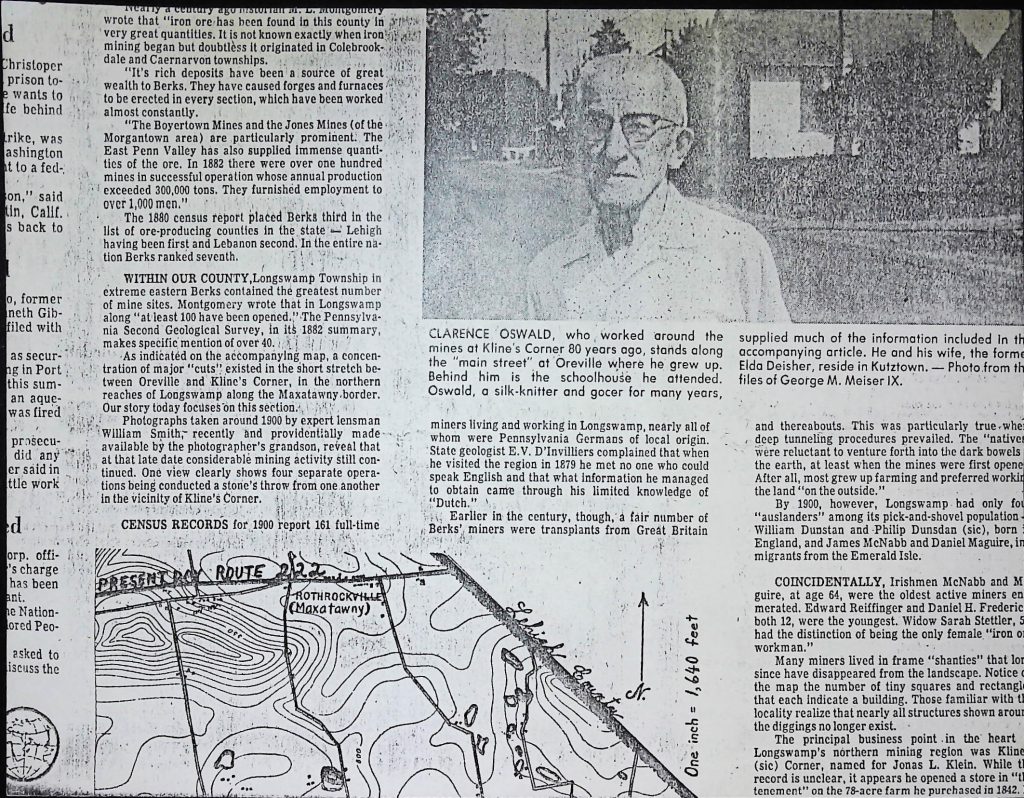
CLARENCE OSWALD, who worked around the
mines at Kline's Corner 80 years ago, stands along
the "main street" at Oreville where he grew up.
Behind him is the schoolhouse he attended.
Oswald, a silk-knitter and gocer for many years,
miners living and working in Longswamp, nearly all of
whom were Pennsylvania Germans of local origin.
State geologist E.V. D'Invilliers complained that when
he visited the region in 1879 he met no one who could
speak English and that what information he managed
to obtain came through his limited knowledge of
"Dutch.
Earlier in the century, though, a fair number of
Berks' miners were transplants from Great Britain
One inch = 1,640 feet
supplied much of the information included in th
accompanying article. He and his wife, the forme
Elda Deisher, reside in Kutztown. - Photo from th
files of George M. Meiser IX.
and thereabouts. This was particularly true whe
deep tunneling procedures prevailed. The "natives
were reluctant to venture forth into the dark bowels
the earth, at least when the mines were first opene
After all, most grew up farming and preferred workin
the land "on the outside."
By 1900, however, Longswamp had only fou
"auslanders" among its pick-and-shovel population-
William Dunstan and Philip Dunsdan (sic), born i
England, and James McNabb and Daniel Maguire, in
migrants from the Emerald Isle.
COINCIDENTALLY, Irishmen McNabb and M
guire, at age 64, were the oldest active miners en
merated. Edward Reiffinger and Daniel H. Frederic
both 12, were the youngest. Widow Sarah Stettler, 5
had the distinction of being the only female "iron on
workman."
Many miners lived in frame "shanties" that lor
since have disappeared from the landscape. Notice c
the map the number of tiny squares and rectangl
that each indicate a building. Those familiar with th
locality realize that nearly all structures shown aroun
the diggings no longer exist.
The principal business point in the heart
Longswamp's northern mining region was Kline
(sic) Corner, named for Jonas L. Klein. While t
record is unclear, it appears he opened a store in "t
tenement" on the 78-acre farm he purchased in 1842. -

[PAGE BREAK]

The Reading Eagle, Penn Sept 2, 1981 Wed

Leave a Reply

Your email address will not be published. Required fields are marked *