Box 5
Folder 34. Treasure – Code to Map
Item 1. Newspaper Clippings
Transcribed Text (OCR)
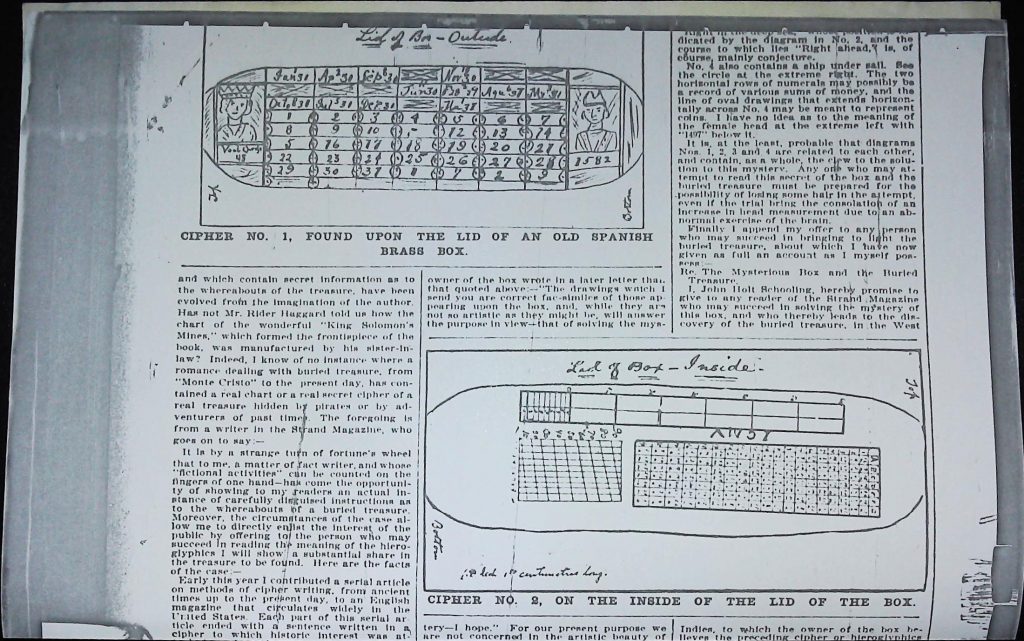
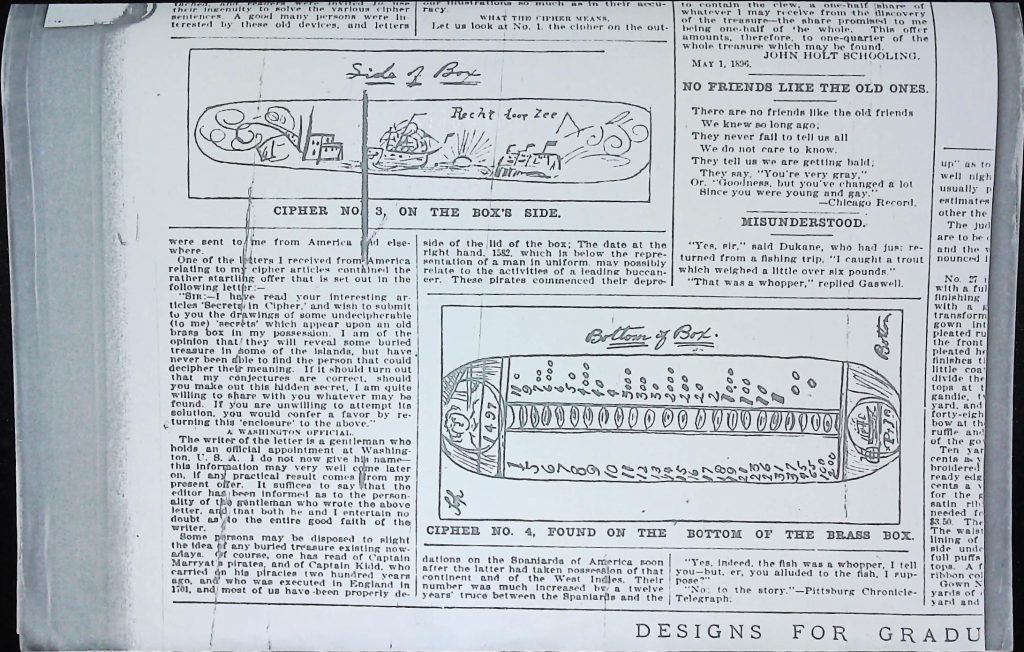
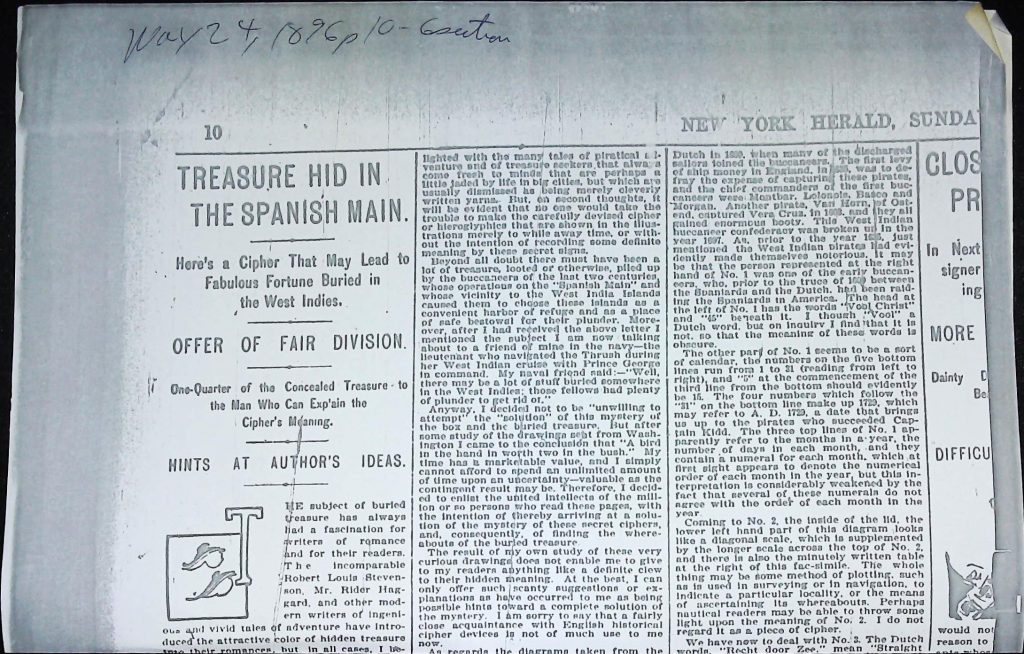
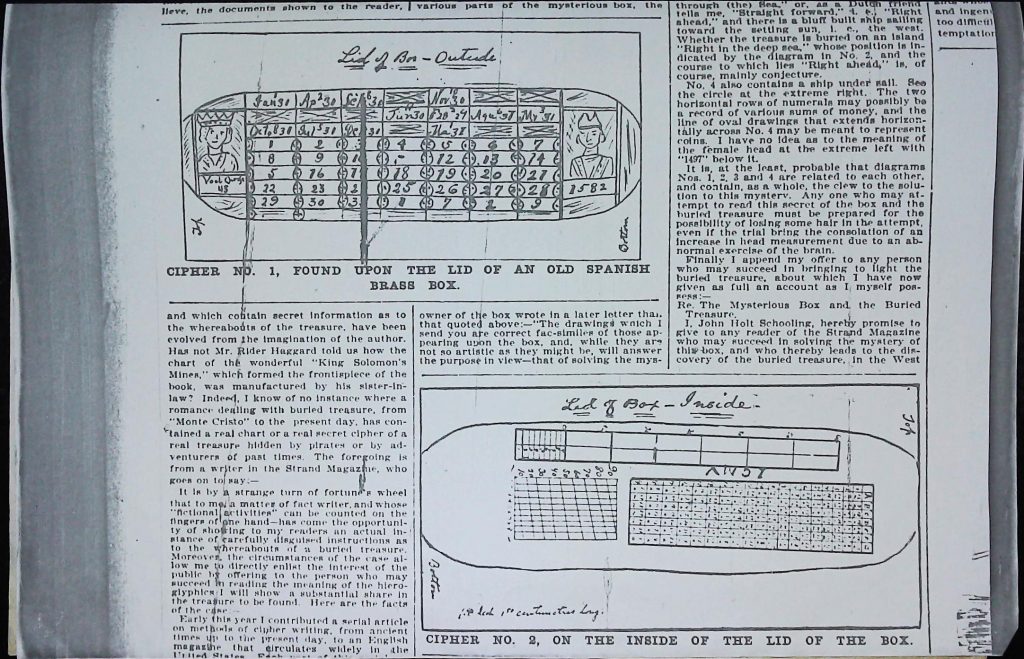
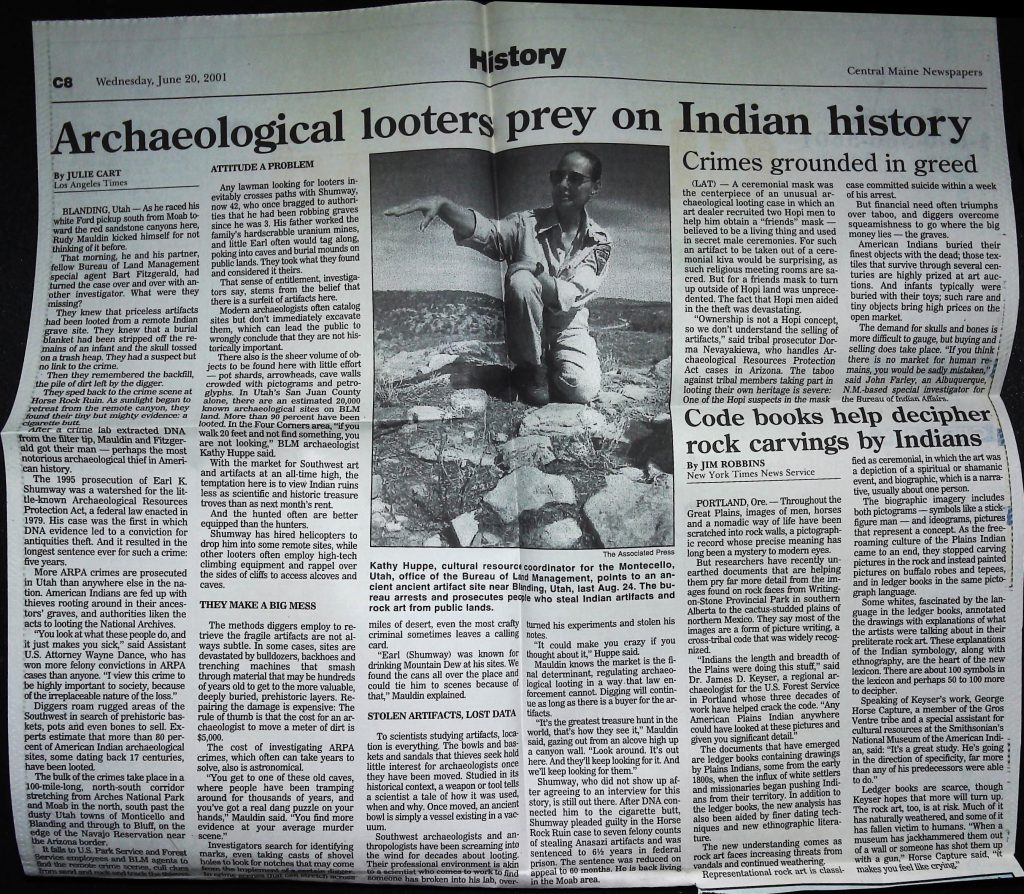
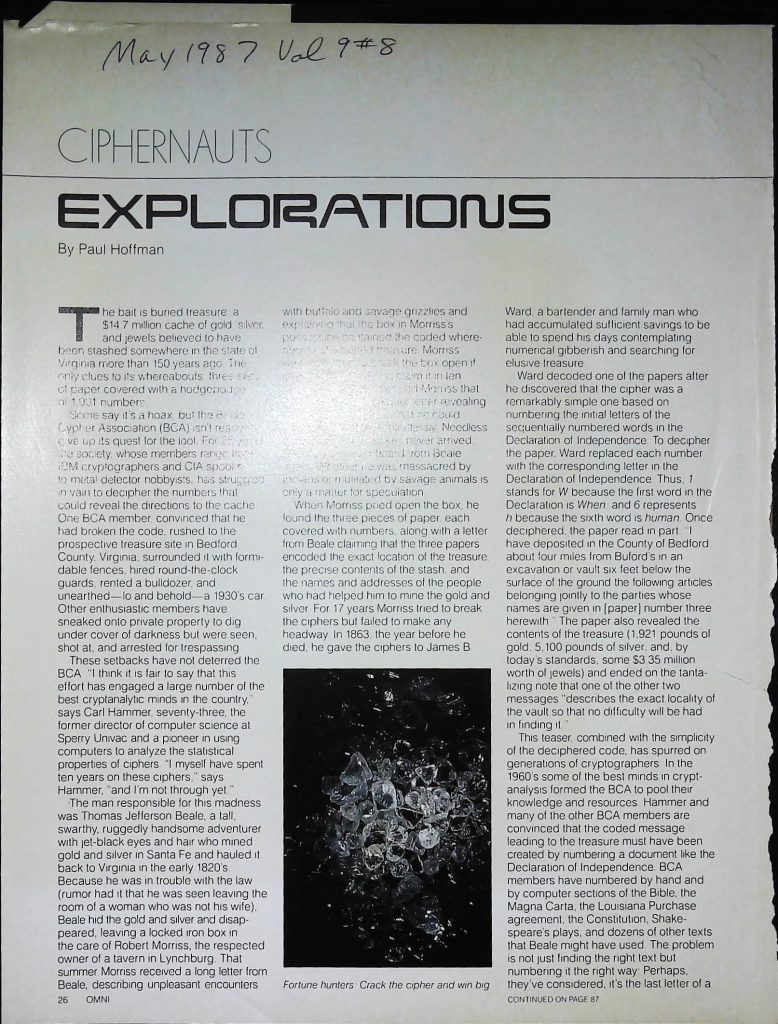
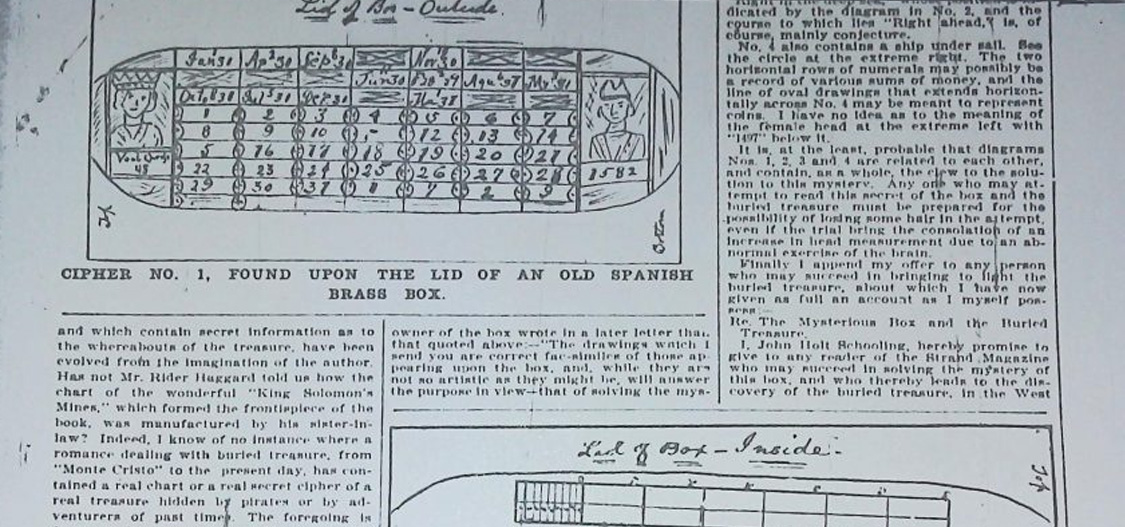
GARY MANGIACOPA ARCHIVE ============================================================ Title: B5F34I1 Slug: b5f34i1 Categories: Lost Treasure Source: https://garymangiacopraarchive.com/b5f34i1 Pages: 8 scanned, 8 extracted OCR: Google Vision API (document_text_detection) Processed: 2026-06-06 ============================================================ NEW YORK HERALD, NY. NY. SUNDAY 24 May 1896 page 10 6th section column 1-3 [PAGE BREAK] If Vool r 45 CIPHER Lid of Bos - Outerde. Fans Apso Sep 3 Oct. 430 431 DC230 Worke Juno B 29 Agus Myky 0 2 0 3 004 737 69 6101),- (172 49.03 474 4 [AD] 5676 077 018 01920 927 22 23 29 30 NO. 1, FOUND [AD] 24 25 (6) 26 (1) 27286 1582 37 (19) 0157 0 UPON THE LID OF AN OLD SPANISH BOX. BRASS and which contain secret information as to the whereabouts of the treasure, have been evolved from the imagination of the author. Has not Mr. Rider Haggard told us how the chart of the wonderful "King Solomon's Mines," which formed the frontispiece of the book, was manufactured by his sister-in- law? Indeed, I know of no instance where a romance dealing with burled treasure. from "Monte Cristo" to the present day, has con- tained a real chart or a real secret cipher of a real treasure hidden by pirates or by ad- venturers of past time. The foregoing is from a writer in the Strand Magazine, who Koes on to say:- It is by a strange turn of fortune's wheel that to me, a matter of fact writer, and whose fictional activities" can be counted on the fingers of one hand-has come the opportuni- ty of showing to my readers an actual in- stance of carefully disguised instructions an to the whereabouts of a burled treasure. Moreover, the circumstances of the case al- low me to directly enlist the interest of the public by offering to the person who may succeed In reading the meaning of the hiero- glyphics I will show a substantial share in the treasure to be found. Here are the facts of the case:- Early this year I contributed a serial article on methods of cipher writing. from ancient times up to the present day, to an English magazine that United States. ticle ended with cipher to which circulates widely in the Each part of this serial ar a sentence written in a historic Interest was at- owner of the box wrote in a later letter tha. that quoted above:-"The drawings watch I send you are correct fac-similem of those ap- pearing upon the box, and, while they ar not no artistic as they might be, will answer the purpose in view--that of solving the mya- Botton Lad Box. (it lach18 centimetres long. dicated by the diagram in No. 2, and the course to which lies "Right ahead, is, of course, mainly conjecture. No. 4 also contains a ship under sall. Bee the circle at the extreme right. The two horizontal rows of numerals may possibly be a record of various sums of money, and the line of oval drawings that extends horizon- tally across No. 4 may be meant to represent colns. I have no idea as to the meaning of the female head at the extreme left with 1497" below it. It is, at the least, probable that diagrams Non. 1, 2, 3 and 4 are related to each other, and contain, an n whole, the clew to the solu- tion to this mystery. Any or who may at- tempt to read this secret of the box and the buried treasure must be prepared for the possibility of losing some hair in the attempt, even if the trial bring the consolation of an Increase In head measurement due to an ab- normal exercise of the brain. CIPHER NO. 2, ON THE INSIDE tery-I hope." For our present purpose we are not concerned in the artistic beauty of Finally append my offer to any person who may succeed in bringing to fight the burled treasure, about which I have now given as full an account as I myself pos- Re. The Mysterious Box and the Burled Trensure. 1. John Holt Schooling, hereby promise to Kive to any reader of the Strand Magazine who may succeed in solving the mystery of this box, and who thereby leads to the dis- covery of the buried treasure, in the West Inside. AWST Jof OF THE LID OF THE BOX. Indles, to which the owner of the box be- lleves the preceding cipher or hieroglyphics [PAGE BREAK] their ingenuity to solve the various cipher sentences. A good many persons were in- terested by these old devices, and letters OUR THUstratioILS racy. SO much as in their accu- WHAT THE CIPHER MEANS. Let us look at No. 1. the cipher on the out- Side of Box CIPHER NO ON were sent to me from America Ad elge- where. One of the letters I received from America relating to my cipher articles contained the rather startling offer that is set out in the following letter:- "Sin: I have read your interesting ar- ticles 'Secret in Cipher,' and wish to submit to you the drawings of some undecipherable (to me) 'secrets' which appear upon an old brass box in my possession. I am of the opinion that they will reveal some burled treasure in some of the islands, but have never been able to find the person that could decipher their meaning. If it should turn out that my conjectures are correct. should you make out this hidden secret, I am quite willing to share with you whatever may he found. If you are unwilling to attempt its solution, you would confer a favor by re- turning this 'enclosure' to the above." A WASHINGTON OFFICIAL. The writer of the letter is a gentleman who holds an official appointment at Washing- ton, U. 8. A. I do not now give his name this information may very well come later on, if any practical result comes from my present offer. It suffices to say that the editor has been informed as to the person- ality of the gentleman who wrote the above Jetter, and that both he and I entertain no doubt as to the entire good faith of the writer. Some parsons may be disposed to slight the idea of any buried treasure existing now- adays. Of course, one has read of Captain Marryat's piratea, and of Captain Kidd, who carried on his piracies two hundred years ago, and who was executed in England In 1701, and most of us have been properly de- Recht door Zee A THE BOX'S SIDE. side of the lid of the box; The date at the right hand. 1582. which is below the repre- sentation of a man in uniform. may possibly relate to the activities of a leading buccan- eer. These pirates coininenced their depre 1000 Botto 000 to contain the clew, IL one-half share of whatever I may receive from the discovery of the treasure--the share promised to me being one-half of the whole. This offer amounts, therefore, to one-quarter of the whole treasure which may be found. MAY 1, 1836. JOHN HOLT SCHOOLING. NO FRIENDS LIKE THE OLD ONES. There are no friends like the old friends We knew so long ago; They never fail to tell us all We do not care to know. They tell us we are getting bald; They say, "You're very gray," Or. "Goodness, but you've changed a lot Since you were young and gay.' -Chicago Record, MISUNDERSTOOD. "Yes, sir," sald Dukane, who had just re- turned from a fishing trip, "I caught a trout which weighed a little over six pounds." "That was a whopper," replied Gaswell. 5000 300 2000 200 [AD] 2000000000000 00000000001 CIPHER NO. 4, FOUND ON THE dations on the Spaniards of America Boon after the latter had taken possession of that continent and of the West Indies. Their number was much increased by a twelve years' truce between the Spaniards and the 20 Botton BOTTOM OF THE BRASS BOX. "Yes, indeed, the fish was a whopper, I tell you-but, er, you alluded to the fish, I pup- pose?" "No: to the story."-Pittsburg Chronicle- Telegraph. DESIGNS FOR up" as to well nigh usually p estimates other the The jud are to be and the v nounced 1 No. 27 i with a full finishing with a R transform gown int pleated ru the front pleated he finishes t little coa divide the topa at t gandie, t yard, and forty-eigh bow at th ruffle and of the go Ten yar centa y broidered ready edg cents a v for the F satin rib needed fo [AD] $3.50. The The waist lining of side unde full puffs tops. A f ribbon col Gown N yards of yard and GRADU [PAGE BREAK] Way 24, 1896p10-action 10 TREASURE HID IN. THE SPANISH MAIN. lighted with the many tales of piratical 1. venture and of treasure seekers that always como fresh to minds that are perhapa a Little jaded by life in big cities, but which are usually dismissed as being merely cleverly written yarna. But, on second thoughts, it will be evident that no one would take the trouble to make the carefully devised cipher or hieroglyphics that are shown in the lus trations merely to while away time, or with- out the intention of recording some definite Here's a Cipher That May Lead to meaning by these secret algns. Fabulous Fortune Buried in the West Indies.. OFFER OF FAIR DIVISION. One-Quarter of the Concealed Treasure - to the Man Who Can Explain the Cipher's Meaning. HINTS AT AUTHOR'S IDEAS. HE subject of burled treasure has always lad a fascination for vritera of romance and for their readers. The incomparable Robert Louis Steven- son, Mr. Rider Hag- gard, and other mod- ern writers of ingeni- ous and vivid tales of adventure have Intro- duced the attractive color of hidden treasure their romances, but in all cases, I - Beyond all doubt there must have been a lot of treasure, looted or otherwise, piled up by the buccaneers of the last two centuries, whose operatious on the "Spanish Main" and whose vicinity to the West India Islands caused them to choose these islands as a convenient harbor of refuge and as a place of safe bestowal for their plunder. More- over, after I had received the above letter I mentioned the subject I am now talking about to a friend of mine in the navy-the lleutenant who navigated the Thrush during her West Indian cruise with Prince George in command. My naval friend sald:-"Well, there may be a lot of stuff burled somewhere In the West Indlea; those fellows had plenty of plunder to get rid of." Anyway, I decided not to be "unwilling to attempt the "solution" of this mystery of the box and the buried treasure, But after some study of the drawinga sebt from Wash- Ington I came to the conclusion that "A bird in the hand in worth two in the bush." My time has a marketable value, and I simply cannot afford to spend an unlimited amount of time upon an uncertainty-valuable as tho contingent result may be. Therefore, I decid- ed to enlist the united Intellecto of the mill- lon or no persons who read these pages, with the intention of thereby arriving at a solu- tion of the mystery of these necret ciphers, and, consequently. of finding the where- abouts of the burled treasure. The result of my own study of these very curious drawings does not enable me to give to my readers anything like a definite clew to their hidden meaning. At the beat, I can only offer such scanty suggestions or ex- planations an have occurred to me as being possible hints toward a complete solution of the mystery. I am sorry to say that a fairly close acquaintance with English historical cipher devices in not of much use to me now. the the NEW YORK HERALD, SUNDA Dutch in 1000, when many of the discharged sallora foined the buccaneers. The first levy of ship money In England, In, was to de- fray the expense of capturing these pirates, and the chief commanders of the first buc caneers were Mantbar. Lolonols. Basco and Morgan. Another pirate, Van Horn, of Ost. end. captured Vera Cruz. in 1003. and they all gained enormous booty. This West Indian huccaneer confederacy was broken u In the year 1697. An. prior to the year 16, just CLOS PR mentioned the In Next dently made themselves notorious. It may be that the person represented at the right hand of No. 1 was one of the early buccan- cors, who, prior to the truce of 100 between the Spaniards and the Dutch. had been rald- Ing the Spaniards in America. The head at the left of No. 1 has the words "Vool Christ" and "45" beneath it. I though Vool" a Dutch word, but on inquiry I find that it is signer ing not. so that the meaning of these words is MORE obscure. The other part of No. 1 seems to be a sort of calendar, the numbers on the five bottom lines run from 1 to 31 (reading from left to right), and "5" at the commencement of the third line from the bottom should evidently be 15. The four numbers which follow the "31" on the bottom line make up 1729, which may refer to A. D. 1720, a date that brings us up to the pirates who succeeded Cap- tain Kidd. The three top lines of No. 1 ap- parently refer to the months in a year, the number of days in each month, and they Dainty C Be contain a numeral for each month, which at DIFFICU first sight appears to denote the numerical order of each month in the year, but this in- terpretation is considerably weakened by the fact that several of these numerals do not agree with the order of each month in the year. Coming to No. 2, the inside of the lid, the lower left hand part of this diagram looks like a diagonal scale, which is supplemented by the longer scale across the top of No. 2, and there is also the minutely written table at the right of this fac-simile. The whole thing may be some method of plotting, such as is used in surveying or in navigation, to Indiente a particular locality, or the means of ascertaining Its whereabouts. Perhaps nautical readers may be able to throw some light upon the meaning of No. 2. I do not regard it as a plece of cipher., We have now to deal with No. 3. The Dutch words. "Recht door Zee." mean "Straight would not reason to [PAGE BREAK] lleve, the documents shown to the reader, various parts of the mysterious box, the H Vool 45 Lid of Bor - Outude Fans Ap230 Se 7,830 Jul 30 9630 69 5 76 22 29 Jun30 2829 Aquis My 51 31 0 2 0 3 45 (B) 6 ( 70 40.- (072 49.03 474 € 7 78 979 920 (927 ( [AD] 20252627286 1582 30 (31) 77 (19 7 0 2 (99 23 CIPHER NO. 1, FOUND UPON THE LID OF AN OLD SPANISH BRASS and which cofitain secret Information as to the whereabouts of the treasure, have been evolved from the imagination of the author. Has not Mr. Rider Haggard told us how the chart of the wonderful "King Solomon's Mines," which formed the frontisplece of the book, was manufactured by his sister-in- law? Indeed, I know of no instance where a romance dealing with burled treasure, from "Monte Cristo" to the present day, has con- tained a real chart or a real secret cipher of a real treasure hidden by pirates or by ad- venturers of past times. The foregoing is from a writer in the Strand Magazine, who goes on to say:- It is by a strange turn of fortune's wheel that to me a matter of fact writer, and whose "nctional activities" can be counted on the fingers of one hand-has come the opportuni- ty of shoing to my renders an actual in- stance of carefully disguised instructions as to the whereabouts of a buried treasure. Moreover, the circumstances of the case al- low me to directly enlist the interest of the public by offering to the person who may succeed in reading the meaning of the hiero- glyphics 1 will show a substantial share in the treasure to be found. Here are the facts of the cas Early this year I contributed a serial article on methods of cipher writing, from ancient times up to the present day, to an English magazine that circulates widely in the United States BOX. owner of the box wrote in a later letter thai. that quoted above:-"The drawings which I send you are correct fac-similes of those ap- pearing upon the box, and, while they are not so artistic as they might be, will answer the purpose in view-that of solving the mys- Botton Lad of Box jie lach100 centimetres Long. through (the) Bea," or, as a Dutch triend tells me, "Straight forward.". "Right ahead," and there is a bluft bullt ship sailing toward the setting sun, 1. c., the west. Whether the treasure is buried on an Island "Right in the deep sea," whose position is in- dicated by the diagram in No. 2, and the course to which lies "Right ahead," is, of course, mainly conjecture. No. 4 also contains a ship under sail. See the circle at the extreme right. The two horizontal rows of numerals may possibly be a record of various sums of money, and the line of oval drawings that extends horizon- tally across No. 4 may be meant to represent colns. I have no idea as to the meaning of the female head at the extreme left with "1497" below it. It is, at the least, probable that diagrams Nos. 1, 2, 3 and 4 are related to each other. and contain, as a whole, the clew to the solu- tion to this mystery. Any one who may at- tempt to read this secret of the box and the buried treasure must be prepared for the possibility of losing some hair in the attempt, even if the trial bring the consolation of an increase in head measurement due to an ab- normal exercise of the brain. Finally I append my offer to any person who may succeed in bringing to light the buried treasure, about which I have now given as full an account as I myself pos- Fess:- Re. The Mysterious Box and the Buried Treasure. 1. John Holt Schooling, hereby promise to give to any reader of the Strand Magazine who may succeed in solving the mystery of this box, and who thereby leads to the dis- covery of the buried treasure, in the West Inside AWS Jop CIPHER NO. 2, ON THE INSIDE OF THE LID OF THE BOX. and Ingen too difficul temptation [PAGE BREAK] C8 Wednesday, June 20, 2001 History Central Maine Newspapers Archaeological looters prey on Indian history By JULIE CART Los Angeles Times BLANDING, Utah - As he raced his white Ford pickup south from Moab to- ward the red sandstone canyons here, Rudy Mauldin kicked himself for not thinking of it before. That morning, he and his partner, fellow Bureau of Land Management special agent Bart Fitzgerald, had turned the case over and over with an- other investigator. What were they missing? They knew that priceless artifacts had been looted from a remote Indian grave site. They knew that a burial blanket had been stripped off the re- mains of an infant and the skull tossed on a trash heap. They had a suspect but no link to the crime. Then they remembered the backfill, the pile of dirt left by the digger. They sped back to the crime scene at Horse Rock Ruin. As sunlight began to retreat from the remote canyon, they found their tiny but mighty evidence: a cigarette butt. After a crime lab extracted DNA from the filter tip, Mauldin and Fitzger- ald got their man- perhaps the most notorious archaeological thief in Ameri- can history. The 1995 prosecution of Earl K. Shumway was a watershed for the lit- tle-known Archaeological Resources Protection Act, a federal law enacted in 1979. His case was the first in which DNA evidence led to a conviction for antiquities theft. And it resulted in the longest sentence ever for such a crime: five years. More ARPA crimes are prosecuted in Utah than anywhere else in the na- tion. American Indians are fed up with thieves rooting around in their ances- tors' graves, and authorities liken the acts to looting the National Archives. "You look at what these people do, and it just makes you sick," said Assistant U.S. Attorney Wayne Dance, who has won more felony convictions in ARPA cases than anyone. "I view this crime to be highly important to society, because of the irreplaceable nature of the loss." Diggers roam rugged areas of the Southwest in search of prehistoric bas- kets, pots and even bones to sell. Ex- perts estimate that more than 80 per- cent of American Indian archaeological sites, some dating back 17 centuries, have been looted. The bulk of the crimes take place in a 100-mile-long, north-south corridor stretching from Arches National Park and Moab in the north, south past the dusty Utah towns of Monticello and Blanding and through to Bluff, on the edge of the Navajo Reservation near the Arizona border. It falls to U.S. Park Service and Forest Service employees and BLM agents to find the remote crime scenes, cull clues from sand and rock and track the tes ATTITUDE A PROBLEM Any lawman looking for looters in- evitably crosses paths with Shumway, now 42, who once bragged to authori- ties that he had been robbing graves since he was 3. His father worked the family's hardscrabble uranium mines, and little Earl often would tag along, poking into caves and burial mounds on public lands. They took what they found and considered it theirs. That sense of entitlement, investiga- tors say, stems from the belief that there is a surfeit of artifacts here. Modern archaeologists often catalog sites but don't immediately excavate them, which can lead the public to wrongly conclude that they are not his- torically important. There also is the sheer volume of ob- jects to be found here with little effort - pot shards, arrowheads, cave walls crowded with pictograms and petro- glyphs. In Utah's San Juan County alone, there are an estimated 20,000 known archaeological sites on BLM land. More than 90 percent have been looted. In the Four Corners area, "if you walk 20 feet and not find something, you are not looking," BLM archaeologist Kathy Huppe said. With the market for Southwest art and artifacts at an all-time high, the temptation here is to view Indian ruins less as scientific and historic treasure troves than as next month's rent. And the hunted often are better equipped than the hunters. Shumway has hired helicopters to drop him into some remote sites, while other looters often employ high-tech climbing equipment and rappel over the sides of cliffs to access alcoves and caves. THEY MAKE A BIG MESS The methods diggers employ to re- trieve the fragile artifacts are not al- ways subtle. In some cases, sites are devastated by bulldozers, backhoes and trenching machines that smash through material that may be hundreds of years old to get to the more valuable, deeply buried, prehistoric layers. Re- pairing the damage is expensive: The rule of thumb is that the cost for an ar- chaeologist to move a meter of dirt is [AD] $5,000. The cost of investigating ARPA crimes, which often can take years to solve, also is astronomical. "You get to one of these old caves, where people have been tramping around for thousands of years, and you've got a real dang puzzle on your hands," Mauldin said. "You find more evidence at your average murder scene." Investigators search for identifying marks, even taking casts of shovel holes to look for notches that may come from the implement of ag Main digger In crime scenes must cart stretch across The Associated Press Kathy Huppe, cultural resource coordinator for the Montecello, Utah, office of the Bureau of Land Management, points to an an- cient ancient artifact site near Blanding, Utah, last Aug. 24. The bu- reau arrests and prosecutes people who steal Indian artifacts and rock art from public lands. miles of desert, even the most crafty turned his experiments and stolen his criminal sometimes leaves a calling notes. card. "Earl (Shumway) was known for drinking Mountain Dew at his sites. We found the cans all over the place and could tie him to scenes because of that," Mauldin explained. "It could make you crazy if you thought about it," Huppe said. Mauldin knows the market is the fi- nal determinant, regulating archaeo- logical looting in a way that law en- forcement cannot. Digging will contin- ue as long as there is a buyer for the ar- STOLEN ARTIFACTS, LOST DATA tifacts. To scientists studying artifacts, loca- tion is everything. The bowls and bas- kets and sandals that thieves seek hold little interest for archaeologists once they have been moved. Studied in its historical context, a weapon or tool tells a scientist a tale of how it was used, when and why. Once moved, an ancient bowl is simply a vessel existing in a vac- uum. Southwest archaeologists and an- thropologists have been screaming into the wind for decades about looting. Their professional environment is akin to a scientist who comes to work to find someone has broken into his lab, over- "It's the greatest treasure hunt in the world, that's how they see it," Mauldin said, gazing out from an alcove high up a canyon wall. "Look around. It's out here. And they'll keep looking for it. And we'll keep looking for them." Shumway, who did not show up af- ter agreeing to an interview for this story, is still out there. After DNA con- nected him to the cigarette butt, Shumway pleaded guilty in the Horse Rock Ruin case to seven felony counts of stealing Anasazi artifacts and was sentenced to 6½ years in federal prison. The sentence was reduced on appeal to 60 months. He is back living in the Moab area. Crimes grounded in greed (LAT) - A ceremonial mask was the centerpiece of an unusual ar- chaeological looting case in which an art dealer recruited two Hopi men to help him obtain a "friends" mask believed to be a living thing and used in secret male ceremonies. For such an artifact to be taken out of a cere- monial kiva would be surprising, as such religious meeting rooms are sa- cred. But for a friends mask to turn up outside of Hopi land was unprece- dented. The fact that Hopi men aided in the theft was devastating. "Ownership is not a Hopi concept, so we don't understand the selling of artifacts," said tribal prosecutor Dor- ma Nevayakiewa, who handles Ar- chaeological Resources Protection Act cases in Arizona. The taboo against tribal members taking part in looting their own heritage is severe: One of the Hopi suspects in the mask case committed suicide within a week of his arrest. But financial need often triumphs over taboo, and diggers overcome squeamishness to go where the big money lies the graves. American Indians buried their finest objects with the dead; those tex- tiles that survive through several cen- turies are highly prized at art auc- tions. And infants typically were buried with their toys; such rare and tiny objects bring high prices on the open market. The demand for skulls and bones is more difficult to gauge, but buying and selling does take place. "If you think there is no market for human re- mains, you would be sadly mistaken, said John Farley, an Albuquerque, N.M.-based special investigator for the Bureau of Indian Affairs. Code books help decipher rock carvings by Indians By JIM ROBBINS New York Times News Service PORTLAND, Ore. - Throughout the Great Plains, images of men, horses and a nomadic way of life have been scratched into rock walls, a pictograph- ic record whose precise meaning has long been a mystery to modern eyes. But researchers have recently un- earthed documents that are helping them pry far more detail from the im- ages found on rock faces from Writing- on-Stone Provincial Park in southern Alberta to the cactus-studded plains of northern Mexico. They say most of the images are a form of picture writing, a cross-tribal code that was widely recog- nized. "Indians the length and breadth of the Plains were doing this stuff," said Dr. James D. Keyser, a regional ar- chaeologist for the U.S. Forest Service in Portland whose three decades of work have helped crack the code. "Any American Plains Indian anywhere could have looked at these pictures and given you significant detail." The documents that have emerged are ledger books containing drawings by Plains Indians, some from the early 1800s, when the influx of white settlers and missionaries began pushing Indi- ans from their territory. In addition to the ledger books, the new analysis has also been aided by finer dating tech- niques and new ethnographic litera- ture. The new understanding comes as rock art faces increasing threats from vandals and continued weathering. Representational rock art is classi- fied as ceremonial, in which the art was a depiction of a spiritual or shamanic event, and biographic, which is a narra- tive, usually about one person. The biographic imagery includes both pictograms-symbols like a stick- figure man- and ideograms, pictures that represent a concept. As the free- roaming culture of the Plains Indian came to an end, they stopped carving pictures in the rock and instead painted pictures on buffalo robes and tepees, and in ledger books in the same picto- graph language. Some whites, fascinated by the lan- guage in the ledger books, annotated the drawings with explanations of what the artists were talking about in their preliterate rock art. These explanations of the Indian symbology, along with ethnography, are the heart of the new lexicon. There are about 100 symbols in the lexicon and perhaps 50 to 100 more to decipher. Speaking of Keyser's work, George Horse Capture, a member of the Gros Ventre tribe and a special assistant for cultural resources at the Smithsonian's National Museum of the American Indi- an, said: "It's a great study. He's going in the direction of specificity, far more than any of his predecessors were able to do." Ledger books are scarce, though Keyser hopes that more will turn up. The rock art, too, is at risk. Much of it has naturally weathered, and some of it has fallen victim to humans. "When a museum has jackhammered them out of a wall or someone has shot them up with a gun," Horse Capture said, "it makes you feel like crying" r [PAGE BREAK] May 1987 Vol 9#8 CIPHERNAUTS EXPLORATIONS By Paul Hoffman he bait is buried treasure a [AD] $14 7 million cache of gold silver. and jewels believed to have been stashed somewhere in the state of Virginia more than 150 years ago. The only clues to its whereabouts three sh ct paper covered with a hodgepodge 1,901 numbers. Some say it's a hoax, but the Pia Cypher Association (BCA) isn't ready Cve up its quest for the loot. For 26 y the society, whose members range fro IBM cryptographers and CIA spooks to metal detector nobbyists, has strugg's in vain to decipher the numbers that could reveal the directions to the cache One BCA member, convinced that he had broken the code, rushed to the prospective treasure site in Bedford County, Virginia, surrounded it with formi- dable fences, hired round-the-clock guards, rented a bulldozer, and unearthed-lo and behold-a 1930's car Other enthusiastic members have sneaked onto private property to dig under cover of darkness but were seen, shot at, and arrested for trespassing These setbacks have not deterred the BCA "I think it is fair to say that this effort has engaged a large number of the best cryptanalytic minds in the country," says Carl Hammer, seventy-three, the former director of computer science at Sperry Univac and a pioneer in using computers to analyze the statistical properties of ciphers "I myself have spent ten years on these ciphers," says Hammer, "and I'm not through yet. The man responsible for this madness was Thomas Jefferson Beale, a tall, swarthy, ruggedly handsome adventurer with jet-black eyes and hair who mined gold and silver in Santa Fe and hauled it back to Virginia in the early 1820's. Because he was in trouble with the law (rumor had it that he was seen leaving the room of a woman who was not his wife), Beale hid the gold and silver and disap- peared, leaving a locked iron box in the care of Robert Morriss, the respected owner of a tavern in Lynchburg. That summer Morriss received a long letter from Beale, describing unpleasant encounters 26 OMNI with buffalo and savage grizzlies and explaining that the box in Morriss's possists contained the coded where- 320d treasure Morriss break the box open if cam it in len pist Momise that cter revealing se could alessiv Needless Enever arrived. heard from Beale a ha! ile was massacred by indians or mullated by savage animals is only a matter for speculation When Morriss pried open the box, he found the three pieces of paper each covered with numbers, along with a letter from Beale claiming that the three papers encoded the exact location of the treasure, the precise contents of the stash, and the names and addresses of the people who had helped him to mine the gold and silver For 17 years Morriss tried to break the ciphers but failed to make any headway In 1863, the year before he died, he gave the ciphers to James B Fortune hunters Crack the cipher and win big Ward, a bartender and family man who had accumulated sufficient savings to be able to spend his days contemplating numerical gibberish and searching for elusive treasure Ward decoded one of the papers after he discovered that the cipher was a remarkably simple one based on numbering the initial letters of the sequentially numbered words in the Declaration of Independence. To decipher the paper. Ward replaced each number with the corresponding letter in the Declaration of Independence Thus, 1 stands for W because the first word in the Declaration is When: and 6 represents h because the sixth word is human. Once deciphered, the paper read in part. "I have deposited in the County of Bedford about four miles from Buford's in an excavation or vault six feet below the surface of the ground the following articles belonging jointly to the parties whose names are given in [paper] number three herewith The paper also revealed the contents of the treasure (1.921 pounds of gold. 5,100 pounds of silver, and, by today's standards, some $3 35 million worth of jewels) and ended on the tanta- lizing note that one of the other two messages "describes the exact locality of the vault so that no difficulty will be had in finding it. This teaser, combined with the simplicity of the deciphered code, has spurred on generations of cryptographers In the 1960's some of the best minds in crypt- analysis formed the BCA to pool their knowledge and resources Hammer and many of the other BCA members are convinced that the coded message leading to the treasure must have been created by numbering a document like the Declaration of Independence. BCA members have numbered by hand and by computer sections of the Bible, the Magna Carta, the Louisiana Purchase agreement, the Constitution, Shake- speare's plays, and dozens of other texts that Beale might have used. The problem is not just finding the right text but numbering it the right way: Perhaps, they've considered, it's the last letter of a CONTINUED ON PAGE 87 [PAGE BREAK] MYERS'S WORLD FAMGL IMPORT MYERS