Box 5
Folder 61. Treasure – Delaware
Item 1. Newspaper Clippings
Transcribed Text (OCR)
GARY MANGIACOPA ARCHIVE
============================================================
Title:      B5F61I1
Slug:       b5f61i1
Categories: Lost Treasure
Source:     https://garymangiacopraarchive.com/b5f61i1
Pages:      16 scanned, 16 extracted
OCR:        Google Vision API (document_text_detection)
Processed:  2026-06-06
============================================================

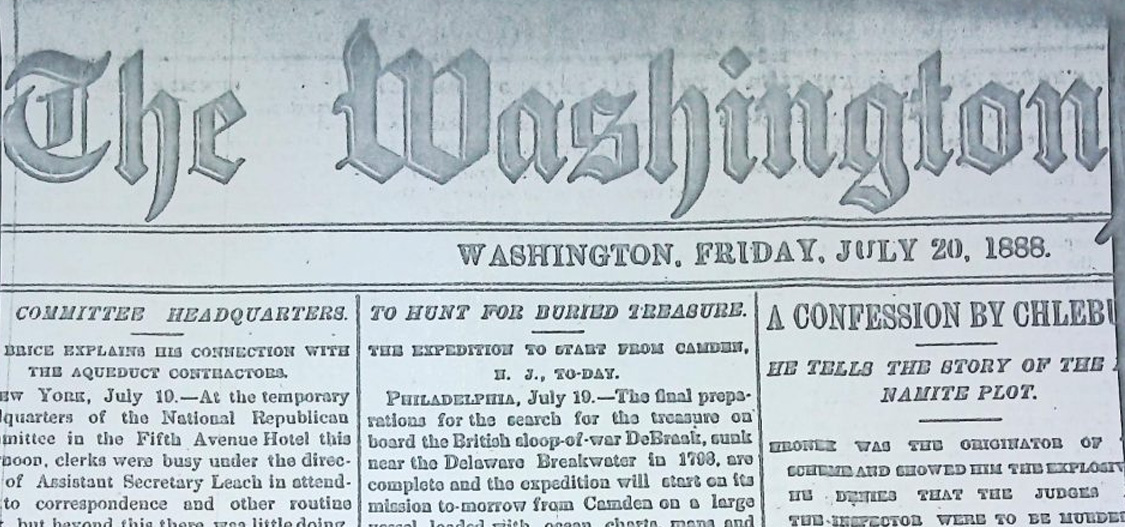
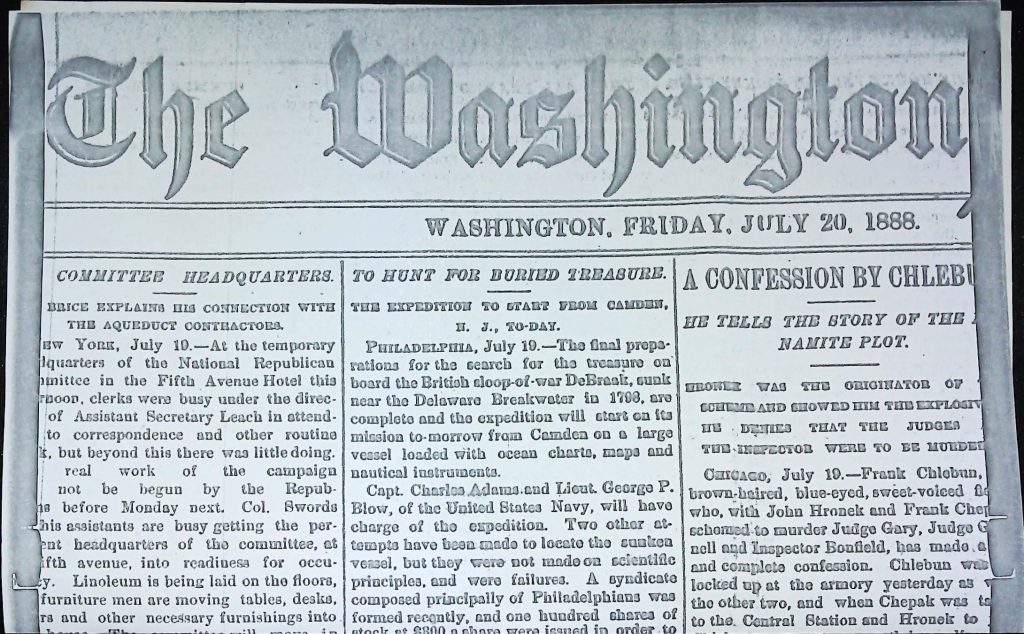
The Washington
WASHINGTON, FRIDAY, JULY 20, 1888.
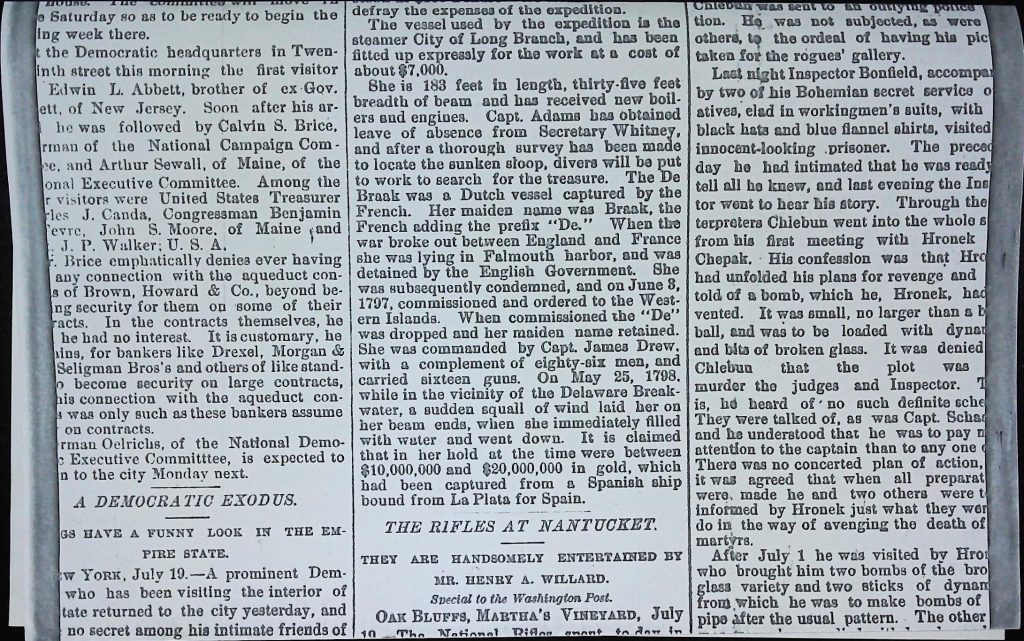
COMMITTEE HEADQUARTERS. TO HUNT FOR BURIED TREASURE. A CONFESSION BY CHLEB
BRICE EXPLAINS HIS CONNECTION WITH THE EXPEDITION TO START FROM CAMDEN,
THE AQUEDUCT CONTRACTORS.
EW YORK, July 10.-At the temporary
quarters of the National Republican
mittee in the Fifth Avenue Hotel this
rnoon, clerks were busy under the direc-
of Assistant Secretary Leach in attend-
to correspondence and other routine
, but beyond this there was little doing.
real work of the campaign
not be begun by the Repub-
s before Monday next. Col. Swords
his assistants are busy getting the per-
ent headquarters of the committee, at
ifth avenue, into readiness for occu-
Linoleum is being laid on the floors,
furniture men are moving tables, desks,
rs and other necessary furnishings into
cy.
1. J., TO-DAY.
PHILADELPHIA, July 19.-The final prepa-
rations for the cearch for the treasure on
board the British sloop-of-war DeBraak, sunk
near the Delaware Breakwater in 1708, are
complete and the expedition will start on its
mission to-morrow from Camden on a large
vessel loaded with ocean charts, maps and
nautical instruments.
Capt. Charlen Adams.and Lieut. George P.
Blow, of the United States Navy, will have
charge of the expedition. Two other at-
tempts have been mado to locate the sunken
vesel, but they were not made on scientific
principles, and were failures. A syndicate
composed principally of Philadelphians was
formed recently, and one hundred shares of
atack at £800 a share were issued in order to
HE TELLS THE STORY OF THE
NAMITE PLOT.
BRONEE WAS THE ORIGINATOR OF
COHEM AND SHOWED HIM THE EXPLOSIV
HU DEMIES THAT THE JUDGES
THE INSPECTOR WERE TO BE MURDE
CHICAGO, July 10.-Frank Chlobun,
brown-haired, blue-eyed, sweet-voiced f
who, with John Hronek and Frank Che
schomed to murder Judge Gary, Judge G
nell and Inspector Bonfield, has made.a
and complete confession. Chlebun w
locked up at the armory yesterday as
the other two, and when Chepak was to
to the. Central Station and Hronek to

[PAGE BREAK]

MOYO
o Saturday so as to be ready to begin the defray the expenses of the expedition.
Ing week there.
t the Democratic headquarters in Twen-
inth street this morning the first visitor
Edwin L. Abbett, brother of ex Gov.
ett, of New Jersey. Soon after his ar-
he was followed by Calvin S. Brice.
rman of the National Campaign Com
ee, and Arthur Sewall, of Maine, of the
onal Executive Committee. Among the
r visitors were United States Treasurer
les J. Canda, Congressman Benjamin
evre, John S. Moore. of Maine and
J. P. Walker; U. S. A.
Brice emphatically denies ever having
any connection with the aqueduct con-
s of Brown, Howard & Co., beyond be-
ng security for them on some of their
racts. In the contracts themselves, he
he had no interest. It is customary, he
ins, for bankers like Drexel, Morgan &
Seligman Bros's and others of like stand-
o become security on large contracts,
his connection with the aqueduct con-
was only such as these bankers assume
on contracts.
rman Oelrichs, of the National Demo-
c Executive Committtee, is expected to
n to the city Monday next.
A DEMOCRATIC EXODUS.
GS HAVE A FUNNY LOOK IN THE EM-
PIRE STATE.
W YORK, July 19.-A prominent Dem-
who has been visiting the interior of
tate returned to the city yesterday, and
no secret among his intimate friends of
The vessel used by the expedition is the
steamer City of Long Branch, and has been
fitted up expressly for the work at a cost of
about $7,000.
She is 183 feet in length, thirty-five feet
breadth of beam and has received new boil-
ers and engines. Capt. Adams has obtained
leave of absence from Secretary Whitney,
and after a thorough survey has been made
to locate the sunken sloop, divers will be put
to work to search for the treasure. The De
Braak was a Dutch vessel captured by the
French. Her maiden name was Braak, the
French adding the prefix "De." When the
war broke out between England and France
she was lying in Falmouth harbor, and was
detained by the English Government. She
was subsequently condemned, and on June 8,
1797, commissioned and ordered to the West-
ern Islands. When commissioned the "De"
was dropped and her maiden name retained.
She was commanded by Capt. James Drew;
with a complement of eighty-six men, and
carried sixteen guns. On May 25, 1798.
while in the vicinity of the Delaware Break-
water, a sudden squall of wind laid her on
her beam ends, when she immediately filled
with water and went down. It is claimed
that in her hold at the time were between
[AD] $10,000,000 and $20,000,000 in gold, which
had been captured from a Spanish ship
bound from La Plata for Spain.
THE RIFLES AT NANTUCKET.
THEY ARE HANDSOMELY ENTERTAINED BY
MR. HENRY A. WILLARD.
10
Special to the Washington Post.
Chleban was sent to an outlying ponce
tion. He was not subjected, as were
others, to the ordeal of having his pic
taken for the rogues' gallery.
The preced
Last night Inspector Bonfield, accompa
by two of his Bohemian secret service of
atives, elad in workingmen's suits, with
black hats and blue flannel shirts, visited
innocent-looking prisoner.
day he had intimated that he was ready
tell all he knew, and last evening the Ins
tor went to hear his story. Through the
terpreters Chlebun went into the whole s
from his first meeting with Hronek
Chepak. His confession was that Hro
had unfolded his plans for revenge and
told of a bomb, which he, Hronek, had
vented. It was small, no larger than & b
ball, and was to be loaded with dyna
and bits of broken glass. It was denied
Chlebun that the plot W&S
murder the judges and Inspector. T
is, he heard of no such definite sche
They were talked of, as was Capt. Scha
and he understood that he was to pay n
attention to the captain than to any one
There was no concerted plan of action,
it was agreed that when all preparat
were, made he and two others were t
informed by Hronek just what they wer
do in the way of avenging the death of
martyrs.
After July 1 he was visited by Hro
who brought him two bombs of the bro
glass variety and two sticks of dynam
from which he was to make bombs of
OAK BLUFFS, MARTHA'S VINEYARD, July pipe after the usual pattern. The other
The
National RiAna ament en dan in

[PAGE BREAK]

pl-3 post
The Washington Post, P.C.
5654 SE

[PAGE BREAK]

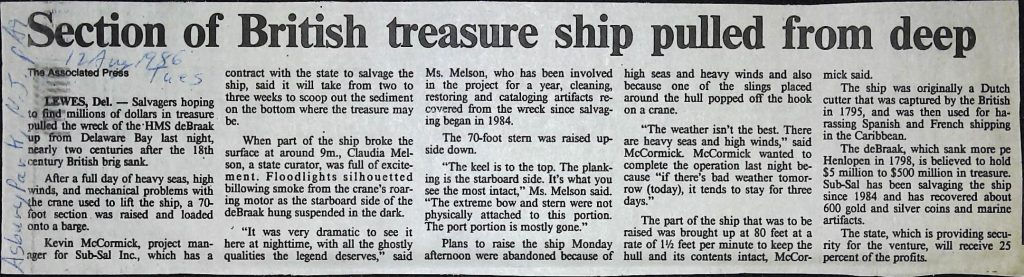
Section of British treasure ship pulled from deep
12 Au
The Associated Press
86
Ge
LEWES, Del. Salvagers hoping
to find millions of dollars in treasure
pulled the wreck of the HMS deBraak
up from Delaware Bay last night,
nearly two centuries after the 18th
Scentury British brig sank.
Asbury Pa
After a full day of heavy seas, high
winds, and mechanical problems with
the crane used to lift the ship, a 70-
foot section was raised and loaded
onto a barge.
Kevin McCormick, project man-
ager for Sub-Sal Inc., which has a
contract with the state to salvage the
ship, said it will take from two to
three weeks to scoop out the sediment
on the bottom where the treasure may
be.
When part of the ship broke the
surface at around 9m., Claudia Mel-
son, a state curator, was full of excite-
ment. Floodlights silhouetted
billowing smoke from the crane's roar-
billowing smoke from the crane's roar-
ing motor as the starboard side of the
deBraak hung suspended in the dark.
"It was very dramatic to see it
here at nighttime, with all the ghostly
qualities the legend deserves," said
Ms. Melson, who has been involved
in the project for a year, cleaning,
restoring and cataloging artifacts re-
covered from the wreck since salvag-
ing began in 1984.
The 70-foot stern was raised up
side down.
"The keel is to the top. The plank-
ing is the starboard side. It's what you
see the most intact," Ms. Melson said.
"The extreme bow and stern were not
physically attached to this portion.
The port portion is mostly gone."
Plans to raise the ship Monday
afternoon were abandoned because of
high seas and heavy winds and also
because one of the slings placed
around the hull popped off the hook
on a crane.
"The weather isn't the best. There
are heavy seas and high winds," said
McCormick. McCormick wanted to
complete the operation last night be-
cause "if there's bad weather tomor-
cause "if there's bad weather tomor-
row (today), it tends to stay for three
row (today), it tends to stay for three
days."
The part of the ship that was to be
raised was brought up at 80 feet at a
rate of 1% feet per minute to keep the
hull and its contents intact, McCor-
mick said.
The ship was originally a Dutch
cutter that was captured by the British
in 1795, and was then used for ha-
rassing Spanish and French shipping
in the Caribbean.
The deBraak, which sank more pe
Henlopen in 1798, is believed to hold
[AD] $5 million to $500 million in treasure.
Sub-Sal has been salvaging the ship
since 1984 and has recovered about
600 gold and silver coins and marine
artifacts.
The state, which is providing secu-
rity for the venture, will receive 25
percent of the profits.

[PAGE BREAK]

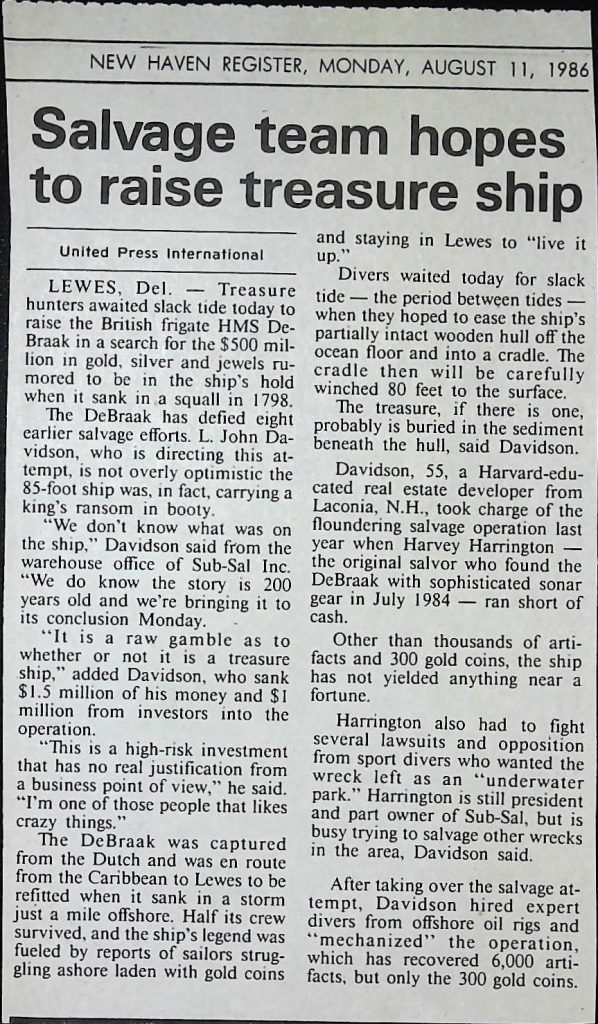
NEW HAVEN REGISTER, MONDAY, AUGUST 11, 1986
Salvage team hopes
to raise treasure ship
United Press International
LEWES, Del. Treasure
hunters awaited slack tide today to
Braak in a search for the $500 mil-
raise the British frigate HMS De-
lion in gold, silver and jewels ru-
mored to be in the ship's hold
when it sank in a squall in 1798.
earlier salvage efforts. L. John Da-
The DeBraak has defied eight
vidson, who is directing this at-
tempt, is not overly optimistic the
85-foot ship was, in fact, carrying a
king's ransom in booty.
"We don't know what was on
the ship," Davidson said from the
warehouse office of Sub-Sal Inc.
"We do know the story is 200
years old and we're bringing it to
its conclusion Monday.
"It is a raw gamble as to
whether or not it is a treasure
ship," added Davidson, who sank
[AD] $1.5 million of his money and $1
million from investors into the
operation.
"This is a high-risk investment
that has no real justification from
a business point of view," he said.
"I'm one of those people that likes
crazy things.'
The DeBraak was captured
from the Dutch and was en route
from the Caribbean to Lewes to be
refitted when it sank in a storm
just a mile offshore. Half its crew
survived, and the ship's legend was
fueled by reports of sailors strug-
gling ashore laden with gold coins
and staying in Lewes to "live it
up.
Divers waited today for slack
tide the period between tides
when they hoped to ease the ship's
partially intact wooden hull off the
ocean floor and into a cradle. The
cradle then will be carefully
winched 80 feet to the surface.
The treasure, if there is one,
probably is buried in the sediment
beneath the hull, said Davidson.
Davidson, 55, a Harvard-edu-
cated real estate developer from
Laconia, N.H., took charge of the
floundering salvage operation last
year when Harvey Harrington
the original salvor who found the
DeBraak with sophisticated sonar
gear in July 1984 ran short of
cash.
Other than thousands of arti-
facts and 300 gold coins, the ship
has not yielded anything near a
fortune.
Harrington also had to fight
several lawsuits and opposition
from sport divers who wanted the
wreck left as an "underwater
park." Harrington is still president
and part owner of Sub-Sal, but is
busy trying to salvage other wrecks
in the area, Davidson said.
After taking over the salvage at-
tempt, Davidson hired expert
divers from offshore oil rigs and
"mechanized" the operation,
which has recovered 6,000 arti-
facts, but only the 300 gold coins.

[PAGE BREAK]

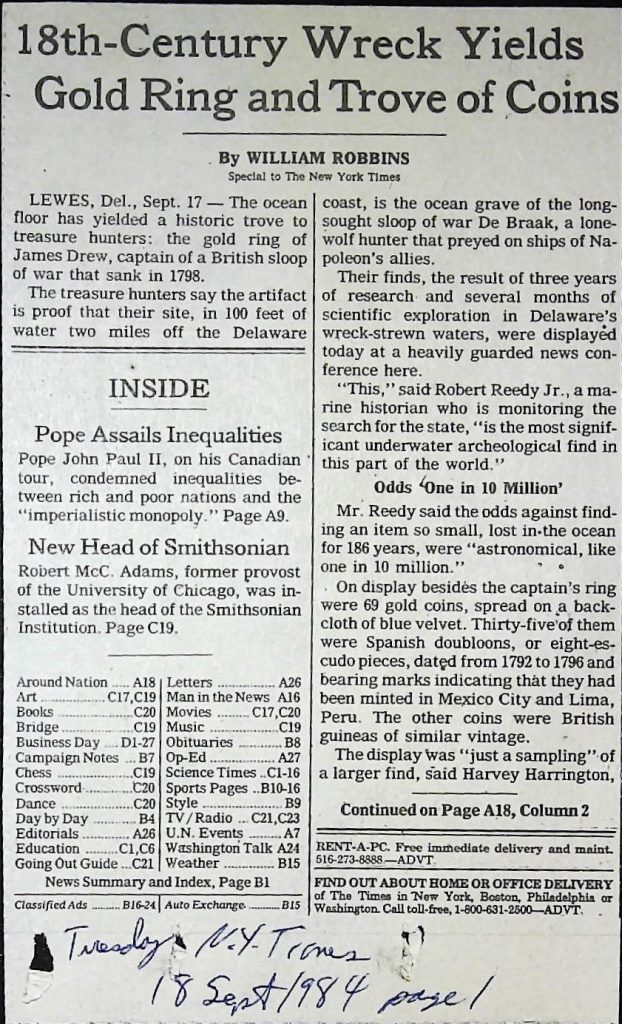
18th-Century Wreck Yields
Gold Ring and Trove of Coins
By WILLIAM ROBBINS
Special to The New York Times
LEWES, Del., Sept. 17 The ocean
floor has yielded a historic trove to
treasure hunters: the gold ring of
James Drew, captain of a British sloop
of war that sank in 1798.
The treasure hunters say the artifact
is proof that their site, in 100 feet of
water two miles off the Delaware
INSIDE
Pope Assails Inequalities
Pope John Paul II, on his Canadian
tour, condemned inequalities be-
tween rich and poor nations and the
"imperialistic monopoly." Page A9.
New Head of Smithsonian
Robert McC. Adams, former provost
of the University of Chicago, was in-
stalled as the head of the Smithsonian
Institution. Page C19.
A26
C19
B8
A27
Around Nation..... A18 | Letters
Art
Books
C17,C19 Man in the News A16
C20 Movies
C17,C20
Bridge.
C19 Music
Business Day
D1-27 Obituaries
Campaign Notes
B7 Op-Ed
Chess
Crossword-
Dance
..C19 Science Times C1-16
...C20 Sports Pages ..B10-16
C20 Style
B9
Day by Day
Editorials
Education
B4 TV/Radio ... C21,C23
A26 U.N. Events
C1,C6 Washington Talk A24
A7
Going Out Guide ...C21 | Weather.
News Summary and Index, Page Bl
Classified Ads
B16-24 Auto Exchange
B15
coast, is the ocean grave of the long-
sought sloop of war De Braak, a lone-
wolf hunter that preyed on ships of Na-
poleon's allies.
Their finds, the result of three years
of research and several months of
scientific exploration in Delaware's
wreck-strewn waters, were displayed
today at a heavily guarded news con-
ference here.
"This," said Robert Reedy Jr., a ma-
rine historian who is monitoring the
search for the state, "is the most signif-
icant underwater archeological find in
this part of the world."
Odds 'One in 10 Million'
Mr. Reedy said the odds against find-
ing an item so small, lost in the ocean
for 186 years, were "astronomical, like
one in 10 million.
. On display besides the captain's ring
were 69 gold coins, spread on a back-
cloth of blue velvet. Thirty-five of them
were Spanish doubloons, or eight-es-
cudo pieces, dated from 1792 to 1796 and
bearing marks indicating that they had
been minted in Mexico City and Lima,
Peru. The other coins were British
guineas of similar vintage.
The display was "just a sampling" of
a larger find, said Harvey Harrington,
Continued on Page A18, Column 2
RENT-A-PC. Free immediate delivery and maint.
[AD] 516-273-8888-ADVT
FIND OUT ABOUT HOME OR OFFICE DELIVERY
of The Times in New York, Boston, Philadelphia or
[AD] B15 Washington. Call toll-free, 1-800-631-2500-ADVT.
Tuesday Net-Troms
18 Sept 1984 page

[PAGE BREAK]

NEW HAVEN REGISTER, TUESDAY, JULY 31, 1984 NATION
KE
CLA
R
L
Associated Press
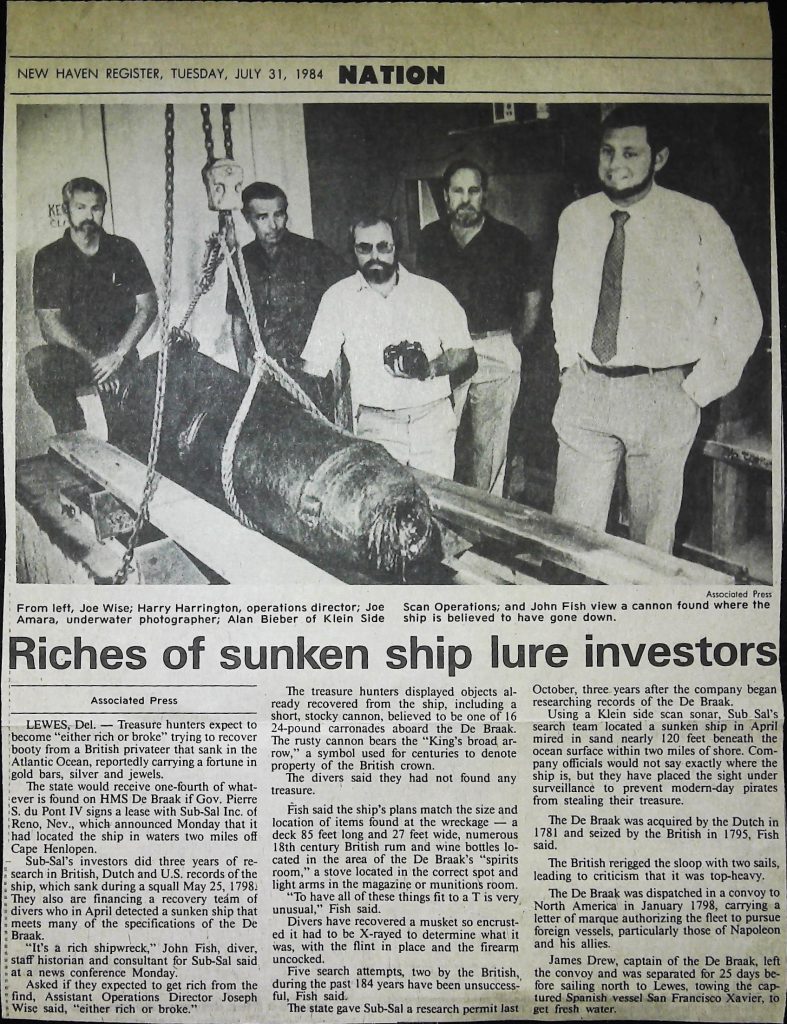
From left, Joe Wise; Harry Harrington, operations director; Joe
Amara, underwater photographer; Alan Bieber of Klein Side
Scan Operations; and John Fish view a cannon found where the
ship is believed to have gone down.
Riches of sunken ship lure investors
Associated Press
LEWES, Del. Treasure hunters expect to
become "either rich or broke" trying to recover
booty from a British privateer that sank in the
Atlantic Ocean, reportedly carrying a fortune in
gold bars, silver and jewels.
The state would receive one-fourth of what-
ever is found on HMS De Braak if Gov. Pierre
S. du Pont IV signs a lease with Sub-Sal Inc. of
Reno, Nev., which announced Monday that it
had located the ship in waters two miles off
Cape Henlopen.
Sub-Sal's investors did three years of re-
search in British, Dutch and U.S. records of the
ship, which sank during a squall May 25, 1798.
They also are financing a recovery team of
divers who in April detected a sunken ship that
meets many of the specifications of the De
Braak.
"It's a rich shipwreck," John Fish, diver,
staff historian and consultant for Sub-Sal said
at a news conference Monday.
Asked if they expected to get rich from the
find, Assistant Operations Director Joseph
Wise said, "either rich or broke."
The treasure hunters displayed objects al-
ready recovered from the ship, including a
short, stocky cannon, believed to be one of 16
24-pound carronades aboard the De Braak.
The rusty cannon bears the "King's broad ar-
row," a symbol used for centuries to denote
property of the British crown.
The divers said they had not found any
treasure.
- a
Fish said the ship's plans match the size and
location of items found at the wreckage
deck 85 feet long and 27 feet wide, numerous
18th century British rum and wine bottles lo-
cated in the area of the De Braak's "spirits
room," a stove located in the correct spot and
light arms in the magazine or munitions room.
"To have all of these things fit to a T is very,
unusual," Fish said.
Divers have recovered a musket so encrust-
ed it had to be X-rayed to determine what it
was, with the flint in place and the firearm
uncocked.
Five search attempts, two by the British,,
during the past 184 years have been unsuccess-
ful, Fish said.
The state gave Sub-Sal a research permit last
October, three years after the company began
researching records of the De Braak.
Using a Klein side scan sonar, Sub Sal's
search team located a sunken ship in April
mired in sand nearly 120 feet beneath the
ocean surface within two miles of shore. Com-
pany officials would not say exactly where the
ship is, but they have placed the sight under
surveillance to prevent modern-day pirates
from stealing their treasure.
The De Braak was acquired by the Dutch in
1781 and seized by the British in 1795, Fish
said.
The British rerigged the sloop with two sails,
leading to criticism that it was top-heavy.
The De Braak was dispatched in a convoy to
North America in January 1798, carrying a
letter of marque authorizing the fleet to pursue
foreign vessels, particularly those of Napoleon
and his allies.
James Drew, captain of the De Braak, left
the convoy and was separated for 25 days be-
fore sailing north to Lewes, towing the cap-
tured Spanish vessel San Francisco Xavier, to
get fresh water.

[PAGE BREAK]

A18
THE NEW YORK TIMES, TUESDAY, SEPTEMBER 18, 1984
18th-Century British Wreck Yields a Coin Trove
Continued From Page 1
president of Sub-Sal Inc., of Reno, the
salvage company that is conducting the
search. For security reasons, he said
that he would not say how much more
treasure had been found, but added
that the site was expected to yield
"anywhere from $5 million to $500 mil-
lion" in treasure.
The doubloons, he said, are "in mint
condition" and "not pocketworn." That
and the number found indicate to him,
he said, that vessels captured by the De
Braak might have been transporting
the coins from a Spanish mint.
Joseph Wise, vice president of Sub-
Sal, said privately that the number of
additional coins already found has been
"substantial." There is evidence, he
said, that the site may also yield gold
bullion.
Spanish doubloons in good condition
are normally worth from $800 to $1,200,
Mr. Wise said, and the old guineas
from $125 to $250. But for collectors, he
said, the history of a coin, such as its
recovery from a noted wreck, can add
substantially to its value.
The proof authenticating the find was
an inscription on the heavy gold ring
found, indicating its ownership by
Capt. James Drew, who went down
with the ship and about half of his 38-
member crew.
Inscription on Ring
"In memory of my brother, Capt.
John Drew, drowned 11 January 1798,
aged 47," said the inscription.
Capt. John Drew, skipper of the frig-
ate Cerberus, drowned in Plymouth
Sound, according to news accounts of
the period. About five months later, on
May 25, 1798, Capt. James Drew's sloop
sank in a storm.
Items bearing a ship's name are
rarely found in an old wreck, said Ar-
nold Carr, a marine historian who is a
consultant to Sub-Sal. Usually struc-
tural details provide proof of identity.
Both the ring and the coins were
found in sand, scattered but in a con-
centrated area. They were near a part
of the wreck believed to be the cap-
tain's cabin, Mr. Wise said, although
little of the ship's structure remains ex-
cept the keel.
The display included slide photo-
graphs of eight-real silver coins, the
"pieces of eight" of pirate lore, but
those found were heavily oxidized,
blackened and eaten away as if by cor-
rosion, Mr. Wise said.
Diver Sees Gleaming Gold
Both the ring and the first of the gold
were found by Joseph Amaral, a diver
who was in the search team of more
than a dozen members present at the
news conference.
The gold gleamed in the sand, "just
as you see it here, just as they came
from the mint," Mr. Amaral said.
In an interview, he said he had found
PENNSYLVANIA
Philadelphia,
NEW
JERSEY
Wilmington
Atlantic
City
MARYLAND
Baltimore
Dover
DELAWARE
Bay
Delaware)
Cape
Lo May
Lewes
Atlantic
Ocean
Miles 40
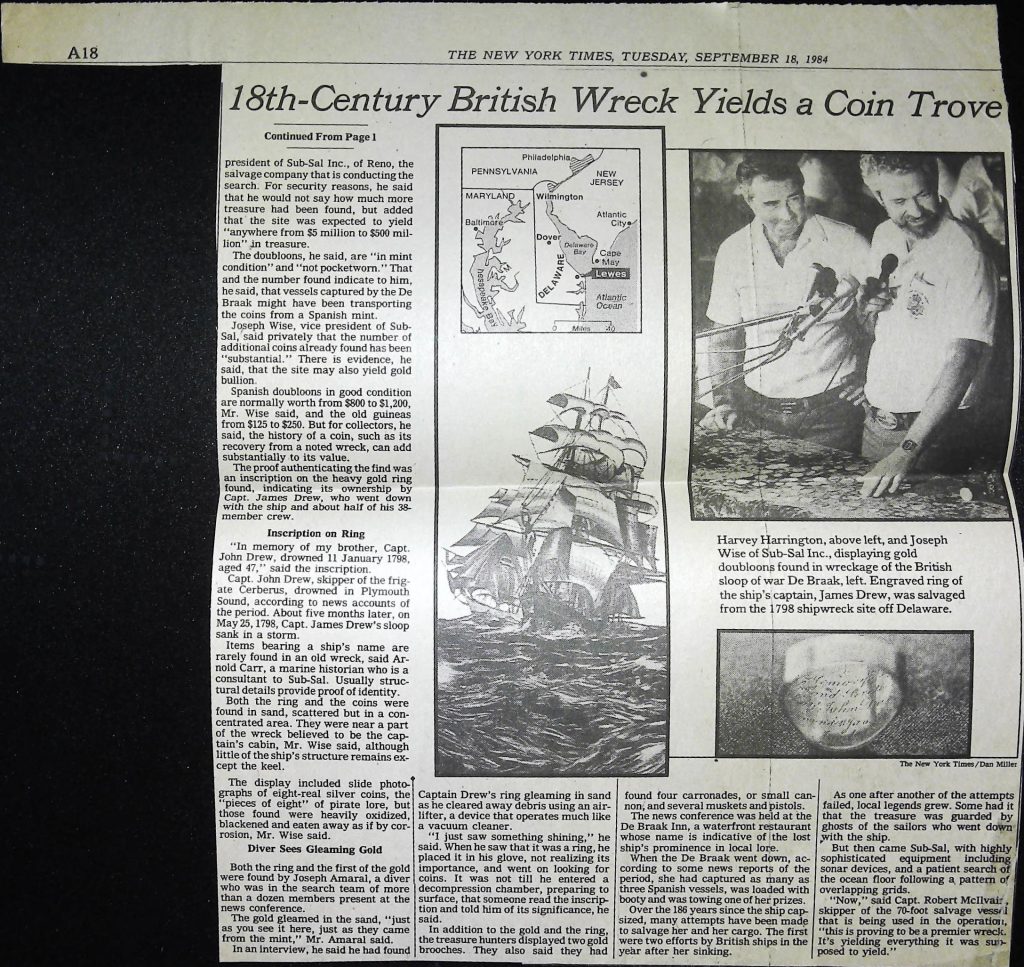
Captain Drew's ring gleaming in sand
as he cleared away debris using an air-
lifter, a device that operates much like
a vacuum cleaner.
"I just saw something shining," he
said. When he saw that it was a ring, he
placed it in his glove, not realizing its
importance, and went on looking for
coins. It was not till he entered a
decompression chamber, preparing to
surface, that someone read the inscrip-
tion and told him of its significance, he
said.
In addition to the gold and the ring,
the treasure hunters displayed two gold
brooches. They also said they had
Harvey Harrington, above left, and Joseph
Wise of Sub-Sal Inc., displaying gold
doubloons found in wreckage of the British
sloop of war De Braak, left. Engraved ring of
the ship's captain, James Drew, was salvaged
from the 1798 shipwreck site off Delaware.
found four carronades, or small can-
non, and several muskets and pistols.
The news conference was held at the
De Braak Inn, a waterfront restaurant
whose name is indicative of the lost
ship's prominence in local lore.
When the De Braak went down, ac-
cording to some news reports of the
period, she had captured as many as
three Spanish vessels, was loaded with
booty and was towing one of her prizes.
Over the 186 years since the ship cap-
sized, many attempts have been made
to salvage her and her cargo. The first
were two efforts by British ships in the
year after her sinking.
The New York Times/Dan Miller
As one after another of the attempts
failed, local legends grew. Some had it
that the treasure was guarded by
ghosts of the sailors who went down
with the ship.
But then came Sub-Sal, with highly
sophisticated equipment including
sonar devices, and a patient search of
the ocean floor following a pattern of
overlapping grids.
"Now," said Capt. Robert McIlvai
skipper of the 70-foot salvage vessel
that is being used in the operation,
"this is proving to be a premier wreck.
It's yielding everything it was su
posed to yield."

[PAGE BREAK]

The Philadelphia Inquirer
Special to The Inquirer / DAN MILLER
e hopes, holds pirate treasure
general news
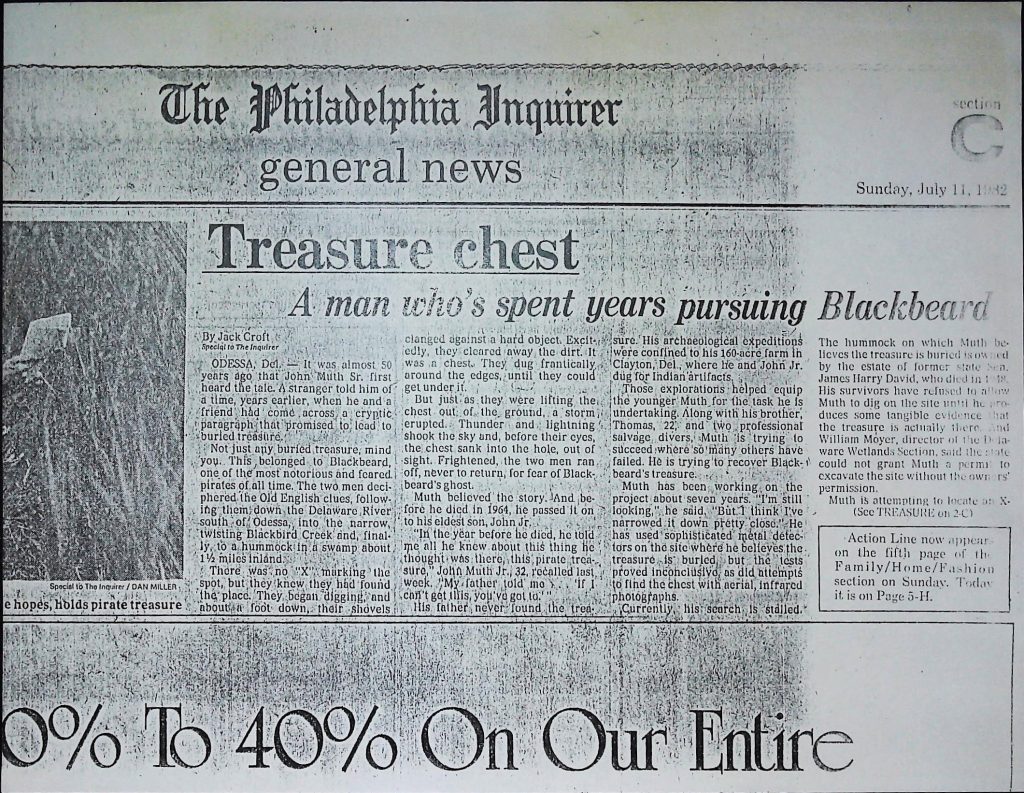
Treasure chest
By Jack Croft
Special to The Inquirer
section
C
Sunday, July 11, 1982
A man who's spent years pursuing Blackbeard
ODESSA, Del. It was almost 50
years ago that John Muth Sr. first
heard the tale. A stranger told him of
a time, years earlier, when he and a
friend had come across a cryptic
paragraph that promised to lead to
buried treasure.
clanged a
nged against a hard object. Excit
jedly, they cleared away the dirt. It
was a chest. They dug frantically
around the edges, until they could
get under it.
But just as they were lifting the
chest out of the ground, a storm,
erupted. Thunder and lightning
shook the sky and, before their eyes,
the chest sank into the hole, out of
sight. Frightened, the two men ran,
off, never to return, for fear of Black-
beard's ghost.
Not just any buried treasure, mind
you. This, belonged to Blackbeard,
one of the most notorious and feared
pirates of all time. The two men deci-
phered the Old English clues, follow-Muth believed the story. And be-
ing them down the Delaware River
south of Odessa, into the narrow,
twisting Blackbird Creek and, final
ly, to a hummock in a swamp about
1½ miles inland.
There was no "X" marking the
spot, but they knew they had found,
the place. They began digging, and
about a foot down, their shovels
fore he died in 1964, he passed it on
to his eldest son, John Jr.
"In the year before he died, he told
me all he knew about this thing he
thought was there, this, pirate trea-,
sure," John Muth Jr., 32, recalled last
sure. His archaeological expeditions
were confined to his 160-acre farm in
Clayton, Del., where he and John Jr.
dug for Indian artifacts.
Those explorations helped equip
the younger Muth for the task he is
undertaking. Along with his brother,
Thomas, 22, and two professional
salvage divers, Muth is trying to
succeed where so many others have
failed. He is trying to recover Black
beard's treasure.
Muth has been working on the
project about seven years. "I'm still
looking, "he said, "But I think I've
narrowed it down pretty close." He
has used sophisticated metal détec-
tors on the site where he believes the
treasure is buried, but the "iests
proved inconclusivo, as did attempts
week. "My father told me if 1 to find the chest with aerial, infrared
can't get this, you've got to."
His father never found the trea
photographs.
¡Currently, his search is stalled.
The hummock on which Muth be
lieves the treasure is buried is owned
by the estate of former state ben.
James Harry David, who died in 1 18.
His survivors have refused to allow
Muth to dig on the site until he pro-
duces some tangible evidence that
the treasure is actually there. And
William Moyer, director of the D-la-
ware Wetlands Section, said the state
could not grant Muth a permi to
excavate the site without the owners'
permission.
Muth is attempting to locate an X-
(See TREASURE on 2-C)
Action Line now appear
on the fifth page of the
Family/Home/Fashion
section on Sunday. Today
it is on Page 5-H.
0% To 40% On Our Entire

[PAGE BREAK]

odel your home.
r home, be sure to check with
rt We'll do it quickly, efficiently
one of the numbers listed below
to your home with samples and
s on the spot with no obligation.
BATHROOMS
rovements John
ens bathrooms recreation
iding aluminum casing
conversions prime
storm screen windows and
stone fronts garages
☐ electrical wiring window
Otiling painting
d fiberglass patio and window
t work blown-in
cabinet doors.
648 Contractor's License 17076 John Wanamaker
stown NJ and #35314, Deptford NJ) City of Wilmington
0005
ROOSEVELT MALL
COTTMAN & BLVD. DE 2-5600
OPEN EVERY EVE OPEN SAT.
LAWRENCE PARK CENTER
LAWRENCE & SPROUL RD. BROOMALL
OPEN SAT EL 3-7700
OPEN MON, WED, FRL EVES.
CE EVER! SALE
Computer
ealer
SAVE $550
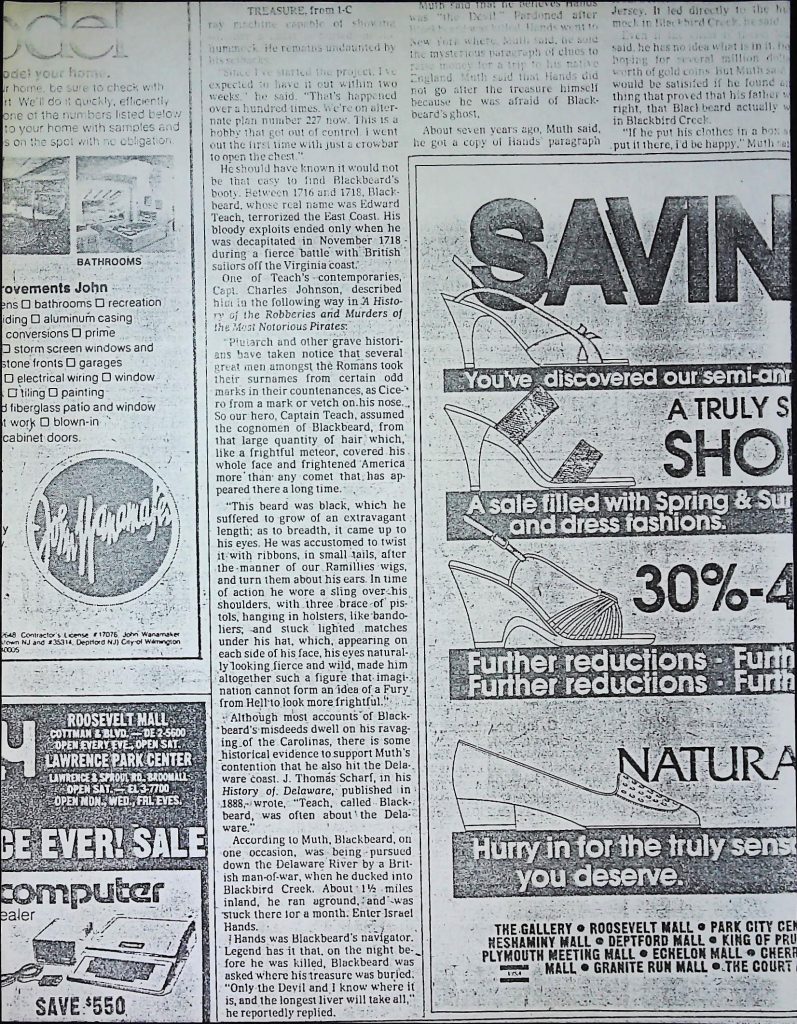
TREASURE, from 1-C
ray rischine capable of showing
hummock. He remains undaunted by
his sharks.
"Since I ve started the project, Ive
expected to have it out within two
weeks." he said. "That's happened
over a hundred times. We're on alter-
nate plan number 227 now. This is a
hobby that got out of control. I went
out the first time with just a crowbar
to open the chest."
He should have known it would not
be that casy to find Blackbeard's
booty. Between 1716 and 1718, Black-
beard, whose real name was Edward
Teach, terrorized the East Coast. His
bloody exploits ended only when he
was decapitated in November 1718
during a fierce battle with British
sailors off the Virginia coast.
One of Teach's contemporaries,
Capt. Charles Johnson, described
hia in the following way in A Histo-
ry of the Robberies and Murders of
the Most Notorious Pirates:
Plutarch and other grave histori-
ans have taken notice that several
great men amongst the Romans took
their surnames from certain odd
marks in their countenances, as Cice-
ro from a mark or vetch on.his nose...
So our hero, Captain Teach, assumed
the cognomen of Blackbeard, from
that large quantity of hair which,
like a frightful meteor, covered his
whole face and frightened America
more than any comet that has ap-
peared there a long time.
"This beard was black, which he
suffered to grow of an extravagant
length; as to breadth, it came up to
his eyes. He was accustomed to twist
it with ribbons, in small tails, after
the manner of our Ramillies wigs,
and turn them about his ears. In time
of action he wore a sling over his
shoulders, with three brace of pis-
tols, hanging in holsters, like bando-
liers; and stuck lighted matches
under his hat, which, appearing on
each side of his face, his eyes natural-
ly looking fierce and wild, made him
altogether such a figure that imagi
nation cannot form an idea of a Fury
from Hell to look more frightful."
Although most accounts of Black-
beard's misdeeds dwell on his ravag-
ing of the Carolinas, there is some
historical evidence to support Muth's
contention that he also hit the Dela-.
ware coast. J. Thomas Scharf, in his
History of. Delaware, published in
1888, wrote, "Teach, called Black-
beard, was often about the Dela-a
ware.
According to Muth, Blackbeard, on
one occasion, was being pursued
down the Delaware River by a Brit-
ish man-of-war, when he ducked into
Blackbird Creek. About 1½ miles
inland, he ran aground, and was
stuck there lor a month. Enter Israel
Hands.
Hands was Blackbeard's navigator."
Legend has it that, on the night be-.
fore he was killed, Blackbeard was
asked where his treasure was buried.
"Only the Devil and I know where it
is, and the longest liver will take all,"
he reportedly replied.
Muth said that he wereves manus
was "the Devil" Pardoned after
Pas killed Hands went to
New York where Math said, be sure
the mysterious paragraph of clues to
raise money for a trip to his native
England. Muth said that Hands did
not go after the treasure himself
because he was afraid of Black-
beard's ghost,
About seven years ago, Muth said,
he got a copy of Hands paragraph
Jersey. It led directly to the bu
mock in Blackbird Crock. He said
Event
said, he has no idea what is in it. he
hoping for several million do
worth of gold coins but Muth sad
would be satisifed if he found an
thing that proved that his father w
right, that Black beard actually w
in Blackbird Creek.
"If he put his clothes in a box a
put it there, I'd be happy." Mutha
SAVIN
You've discovered our semi-ant
A TRULY S
SHO
sale filled with Spring & Sur
and dress fashions.
30%-4
Further reductions - Furth
Further reductions
Furth
NATURA
Hurry in for the truly sens
you deserve.
THE GALLERY ROOSEVELT MALL PARK CITY CEN
RESHAMINY MALL DEPTFORD MALL KING OF PRU
PLYMOUTH MEETING MALL ECHELON MALL CHERR
MALL GRANITE RUN MALL THE COURTI
USA

[PAGE BREAK]

Penn sentin C-pl-zc
The Philadelphia Inquirer
11 July
1982 Sun

[PAGE BREAK]

24
WEST
NEW HAVEN REGISTER, THURSDAY, AUGUST 9, 1984
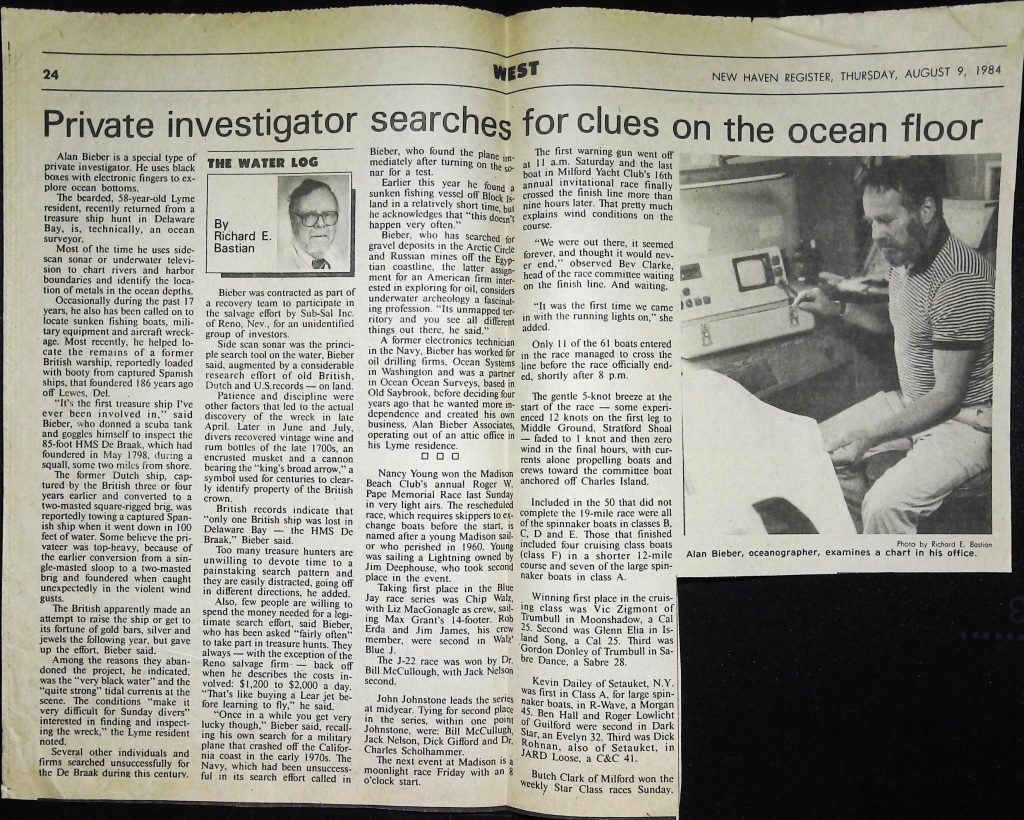
Private investigator searches for clues on the ocean floor
of
Alan Bieber is a special type
private investigator. He uses black
boxes with electronic fingers to ex-
plore ocean bottoms.
The bearded, 58-year-old Lyme
resident, recently returned from a
treasure ship hunt in Delaware
Bay, is, technically, an ocean
surveyor.
Most of the time he uses side-
scan sonar or underwater televi-
sion to chart rivers and harbor
boundaries and identify the loca-
tion of metals in the ocean depths.
Occasionally during the past 17
years, he also has been called on to
locate sunken fishing boats, mili-
tary equipment and aircraft wreck-
age. Most recently, he helped lo-
cate the remains of a former
British warship, reportedly loaded
with booty from captured Spanish
ships, that foundered 186 years ago
off Lewes, Del.
"It's the first treasure ship I've
ever been involved in," said
Bieber, who donned a scuba tank
and goggles himself to inspect the
85-foot HMS De Braak, which had
foundered in May 1798, during a
squall, some two miles from shore.
The former Dutch ship, cap-
tured by the British three or four
years earlier and converted to a
two-masted square-rigged brig, was
reportedly towing a captured Span-
ish ship when it went down in 100
feet of water. Some believe the pri-
vateer was top-heavy, because of
the earlier conversion from a sin-
gle-masted sloop to a two-masted
brig and foundered when caught
unexpectedly in the violent wind
gusts.
The British apparently made an
attempt to raise the ship or get to
its fortune of gold bars, silver and
jewels the following year, but gave
up the effort, Bieber said.
Among the reasons they aban-
doned the project, he indicated,
was the "very black water" and the
"quite strong" tidal currents at the
scene. The conditions "make it
very difficult for Sunday divers"
interested in finding and inspect-
ing the wreck," the Lyme resident
noted.
Several other individuals and
firms searched unsuccessfully for
the De Braak during this century.
THE WATER LOG
By
Richard E.
Bastian
Bieber was contracted as part of
a recovery team to participate in
the salvage effort by Sub-Sal Inc.
of Reno, Nev., for an unidentified
group of investors.
Side scan sonar was the princi-
ple search tool on the water, Bieber
said, augmented by a considerable
research effort of old British,
Dutch and U.S.records - on land.
Patience and discipline were
other factors that led to the actual
discovery of the wreck in late
April. Later in June and July,
divers recovered vintage wine and
rum bottles of the late 1700s, an
encrusted musket and a cannon
bearing the "king's broad arrow," a
symbol used for centuries to clear-
ly identify property of the British
crown.
British records indicate that
"only one British ship was lost in
Delaware Bay the HMS De
Braak," Bieber said.
Too many treasure hunters are
unwilling to devote time to a
painstaking search pattern and
they are easily distracted, going off
in different directions, he added.
Also, few people are willing to
spend the money needed for a legi-
timate search effort, said Bieber,
who has been asked "fairly often"
to take part in treasure hunts. They
always with the exception of the
Reno salvage firm- back off
when he describes the costs in-
volved: $1,200 to $2,000 a day.
"That's like buying a Lear jet be-
fore learning to fly," he said.
"Once in a while you get very
lucky though," Bieber said, recall-
ing his own search for a military
plane that crashed off the Califor-
nia coast in the early 1970s. The
Navy, which had been unsuccess-
ful in its search effort called in
Bieber, who found the plane im-
mediately after turning on the so-
nar for a test.
a
Earlier this year he found
sunken fishing vessel off Block Is-
land in a relatively short time, but
he acknowledges that "this doesn't
happen very often.'
Bieber, who has searched for
gravel deposits in the Arctic Circle
and Russian mines off the Egyp-
ment for an American firm inter-
tian coastline, the latter assign-
ested in exploring for oil, considers
underwater archeology a fascinat-
ing profession. "Its unmapped ter-
ritory and you see all different
things out there, he said."
The first warning gun went off
at 11 a.m. Saturday and the last
boat in Milford Yacht Club's 16th
annual invitational race finally
crossed the finish line more than
nine hours later. That pretty much
explains wind conditions on the
course.
"We were out there, it seemed
forever, and thought it would nev-
er end," observed Bev Clarke,
head of the race committee waiting
on the finish line. And waiting.
"It was the first time we came
in with the running lights on," she
added.
A former electronics technician Only 11 of the 61 boats entered
in the Navy, Bieber has worked for in the race managed to cross the
oil drilling firms, Ocean Systems line before the race officially end-
in Washington and was a partner ed, shortly after 8 p.m.
in Ocean Ocean Surveys, based in
Old Saybrook, before deciding four
years ago that he wanted more in-
dependence and created his own
business, Alan Bieber Associates,
operating out of an attic office in
his Lyme residence.
□ □ □
The gentle 5-knot breeze at the
start of the race some experi-
enced 12 knots on the first leg to
Middle Ground, Stratford Shoal
faded to 1 knot and then zero
wind in the final hours, with cur-
rents alone propelling boats and
crews toward the committee boat
anchored off Charles Island.
Nancy Young won the Madison
Beach Club's annual Roger W.
Pape Memorial Race last Sunday
in very light airs. The rescheduled
Included in the 50 that did not
race, which requires skippers to ex- complete the 19-mile race were all
change boats before the start, is of the spinnaker boats in classes B,
named after a young Madison sail- C, D and E. Those that finished
or who perished in 1960. Young included four cruising class boats
was sailing a Lightning owned by (class F) in a shorter 12-mile
Jim Deephouse, who took second course and seven of the large spin-
place in the event.
naker boats in class A.
Taking first place in the Blue
Jay race series was Chip Walz, Winning first place in the cruis-
with Liz MacGonagle as crew, sailing class was Vic Zigmont of
ing Max Grant's 14-footer. Rob Trumbull in Moonshadow, a Cal
Erda and Jim James, his crew 25. Second was Glenn Elia in Is-
member, were second in Walz' land Song, a Cal 25. Third was
Gordon Donley of Trumbull in Sa-
bre Dance, a Sabre 28.
Blue J.
The J-22 race was won by Dr.
Bill McCullough, with Jack Nelson
second.
John Johnstone leads the series
at midyear. Tying for second place
in the series, within one point
Johnstone, were: Bill McCullugh,
Jack Nelson, Dick Gifford and Dr.
Charles Scholhammer.
The next event at Madison is a
moonlight race Friday with an 8
o'clock start.
Kevin Dailey of Setauket, N.Y.
was first in Class A, for large spin-
naker boats, in R-Wave, a Morgan
45. Ben Hall and Roger Lowlicht
of Guilford were second in Dark
Star, an Evelyn 32. Third was Dick
Rohnan, also of Setauket, in
JARD Loose, a C&C 41.
Butch Clark of Milford won the
weekly Star Class races Sunday.
Photo by Richard E. Bastian
Alan Bieber, oceanographer, examines a chart in his office.
E

[PAGE BREAK]

Plot, 22 NOV 1984 Jounal & Courier,
Haven, Con Thursday
Shipwreck yields gold
By CHARLES HILLINGER
Los Angeles Times Service
LEWES, Del. - Veteran deep-
sea diver Harvey Harrington slipped
the heavy gold band off his finger to
show its inscription. "I get very emo-
tional about this ring,' "he said,
his voice breaking.
Harrington is the first person to
wear the ring since it went to the
bottom of the Atlantic Ocean with its
owner 186 years ago. Then it was
worn by Capt. James Drew, the 47-
year-old skipper of the British man-
of-war De Braak, which sank
in a storm on June 10, 1798.
Today it is a symbol of Harring-
ton's success in locating the ill-fat-
ted sloop, which for almost two cen-
turies had eluded treasure
hunters seeking its rumored horde
of gold pillaged from Spanish ships.
Divers from Harrington's com-
pany, Sub Sal Inc., discovered the
wreck last April about 1½ miles off
Cape Henlopen. But until they
read the inscription on James
Drew's ring, they could not be sure
they had found the De Braak.
"In memory of my brother, Capt.
John Drew, drowned 11 January
1798, aged 47," it reads, recounting
the death of the skipper's twin four
months before his own.
"I have dived on at least 100
shipwrecks and have never found
gold coins," said diver Joseph
Amaral, who scooped up the ring in
late August with a handful of doblas.
"I didn't really think all that much of
the ring when I sent it up in the
goodie bag with the coins.
"It wasn't until I was in the de-
compression chamber later and
heard the crew screaming and yell-
ing that I found out the ring was an
even greater discovery than the
coins. The crew on the ship had
gone completely crazy."
11
Since July, seven divers working
around the clock in 80 feet of water
have brought up tons of artifacts, in-
cluding more than 100 18th-
century escudo pieces, doblas and
pieces of eight. Each coin is worth
[AD] $1,000 to $5,000, and Harrington
hopes to find enough to make a
profit on the $500,000 that the Neva-
da company has already poured
into the search.
Under Sub Sal's contract with the
state, Delaware will get 25 percent
of the wreck's salvage value, after
expenses. With 27 persons
including seven divers and a securi-
ty force working on land and
aboard the salvage vessel Mariner,
those costs have been enormous.
But the lure of untold riches has
made the project seem worth while.
"It was the British government's
initial reaction to the sinking of the
De Braak that has triggered contin-
uous and intensive interest in
this particular wreck for nearly 200
years and why I came here," Har-
rington, 51, said.
Britain sent an expedition to Lew-
es within days after word was re-
ceived in London that the De Braak
had sunk. When that expedition
failed to salvage the contents of the
ship, whose 95-foot main mast stuck
out of the water for several years,
another expedition was
mounted
results.
with the same negative
The De Braak was towing a
Spanish ship it had captured. Surviv-
ing crew (18 perished in the wreck)
and Spanish prisoners told residents
of Lewes that the De Braak
had been loaded with chests of gold
and silver taken from a number of
Spanish vessels that it had inter-
cepted in the Caribbean. Harrington
said his records show that the De
Braak raided 16 ships.
Harrington believes that the near-
perfect condition of the gold coins
found so far indicates that they
were being transported from mints
in Mexico City and Lima, Peru, to
Spain.

[PAGE BREAK]

NEW HAVEN REGISTER, TUESDAY, AUGUST 12, 1986
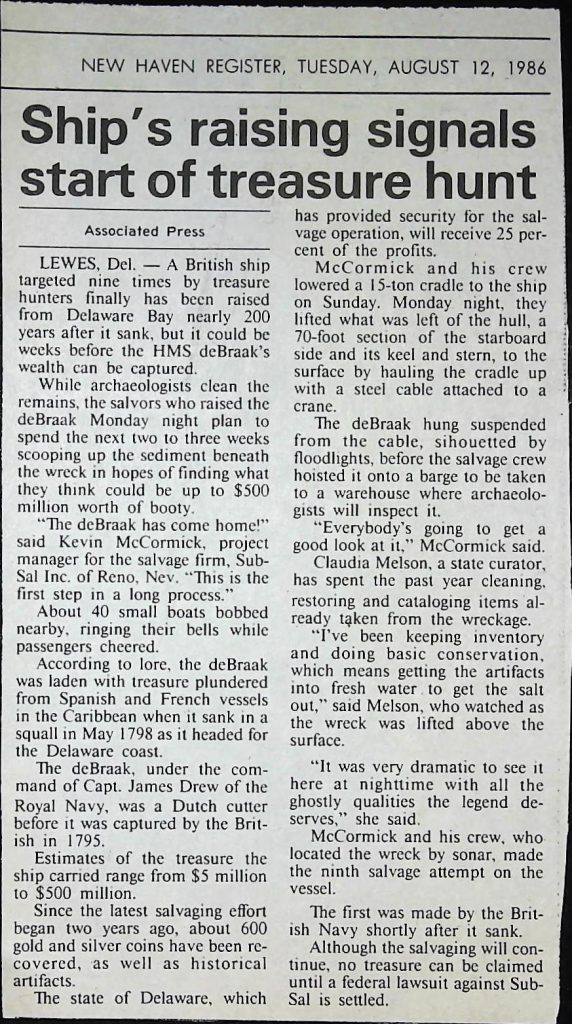
Ship's raising signals
start of treasure hunt
Associated Press
LEWES, Del. A British ship
targeted nine times by treasure
hunters finally has been raised
from Delaware Bay nearly 200
years after it sank, but it could be
weeks before the HMS deBraak's
wealth can be captured.
While archaeologists clean the
remains, the salvors who raised the
deBraak Monday night plan to
spend the next two to three weeks
scooping up the sediment beneath
the wreck in hopes of finding what
they think could be up to $500
million worth of booty.
"The deBraak has come home!"
said Kevin McCormick, project
manager for the salvage firm, Sub-
Sal Inc. of Reno, Nev. "This is the
first step in a long process.
About 40 small boats bobbed
nearby, ringing their bells while
passengers cheered.
According to lore, the deBraak
was laden with treasure plundered
from Spanish and French vessels
in the Caribbean when it sank in a
squall in May 1798 as it headed for
the Delaware coast.
The de Braak, under the com-
mand of Capt. James Drew of the
Royal Navy, was a Dutch cutter
before it was captured by the Brit-
ish in 1795.
Estimates of the treasure the
ship carried range from $5 million
to $500 million.
Since the latest salvaging effort
began two years ago, about 600
gold and silver coins have been re-
covered, as well as historical
artifacts.
The state of Delaware, which
has provided security for the sal-
vage operation, will receive 25 per-
cent of the profits.
McCormick and his crew
lowered a 15-ton cradle to the ship
on Sunday. Monday night, they
lifted what was left of the hull, a
70-foot section of the starboard
side and its keel and stern, to the
surface by hauling the cradle up
with a steel cable attached to a
crane.
The deBraak hung suspended
from the cable, sihouetted by
floodlights, before the salvage crew
hoisted it onto a barge to be taken
to a warehouse where archaeolo-
gists will inspect it.
"Everybody's going to get a
good look at it," McCormick said.
Claudia Melson, a state curator,
has spent the past year cleaning,
restoring and cataloging items al-
ready taken from the wreckage.
"I've been keeping inventory
and doing basic conservation,
which means getting the artifacts
into fresh water to get the salt
out," said Melson, who watched as
the wreck was lifted above the
surface.
"It was very dramatic to see it
here at nighttime with all the
ghostly qualities the legend de-
serves," she said.
McCormick and his crew, who
located the wreck by sonar, made
the ninth salvage attempt on the
vessel.
The first was made by the Brit-
ish Navy shortly after it sank.
Although the salvaging will con-
tinue, no treasure can be claimed
until a federal lawsuit against Sub-
Sal is settled.

[PAGE BREAK]

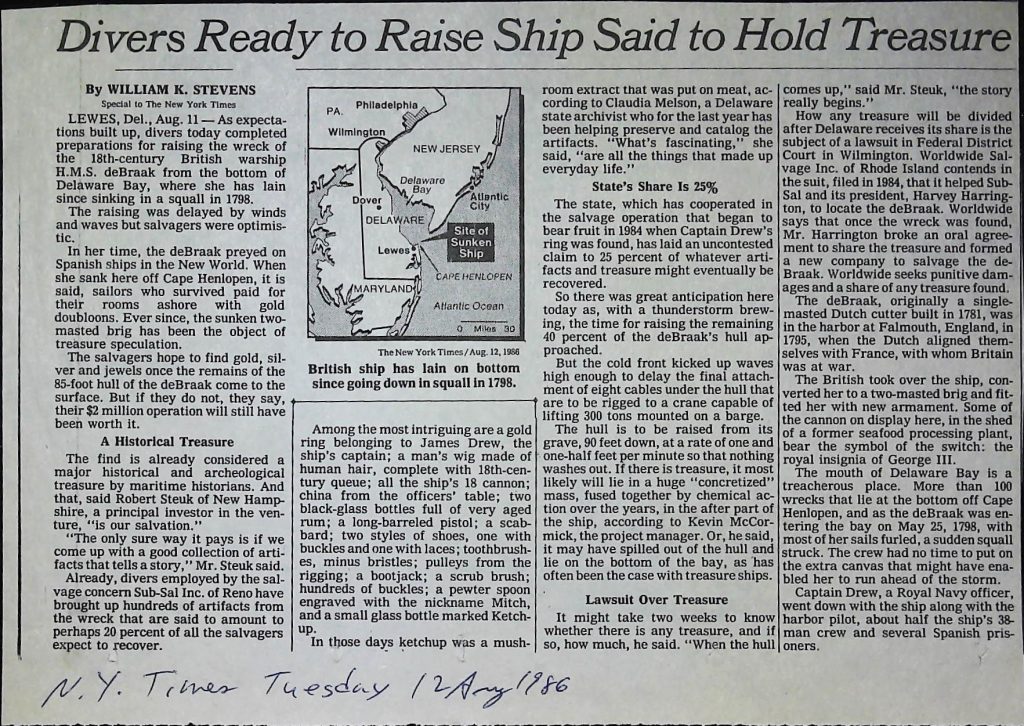
Divers Ready to Raise Ship Said to Hold Treasure
By WILLIAM K. STEVENS
Special to The New York Times
LEWES, Del., Aug. 11- As expecta-
tions built up, divers today completed
preparations for raising the wreck of
the 18th-century British warship
H.M.S. deBraak from the bottom of
Delaware Bay, where she has lain
since sinking in a squall in 1798.
The raising was delayed by winds
and waves but salvagers were optimis-
tic.
In her time, the deBraak preyed on
Spanish ships in the New World. When
she sank here off Cape Henlopen, it is
said, sailors who survived paid for
their rooms ashore with gold
doubloons. Ever since, the sunken two-
masted brig has been the object of
treasure speculation.
The salvagers hope to find gold, sil-
ver and jewels once the remains of the
85-foot hull of the deBraak come to the
surface. But if they do not, they say,
their $2 million operation will still have
been worth it.
Philadelphia
PA.
Wilmington
NEW JERSEY
Delaware
Bay
Dover
DELAWARE
Lewes
MARYLAND
Atlantic
City
Site of
Sunken
Ship
CAPE HENLOPEN
Atlantic Ocean
0 Miles 30
The New York Times/Aug. 12, 1986
British ship has lain on bottom
since going down in squall in 1798.
Among the most intriguing are a gold
A Historical Treasure
ring belonging to James Drew, the
The find is already considered a
ship's captain; a man's wig made of
major historical and archeological human hair, complete with 18th-cen-
treasure by maritime historians. And tury queue; all the ship's 18 cannon;
china from the officers' table; two
shire, a principal investor in the ven-
that, said Robert Steuk of New Hamp-black-glass bottles full of very aged
ture, "is our salvation."
rum; a long-barreled pistol; a scab-
bard; two styles of shoes, one with
buckles and one with laces; toothbrush-
es, minus bristles; pulleys from the
rigging; a bootjack; a scrub brush;
hundreds of buckles; a pewter spoon
engraved with the nickname Mitch,
and a small glass bottle marked Ketch-
up.
"The only sure way it pays is if we
come up with a good collection of arti-
facts that tells a story," Mr. Steuk said.
Already, divers employed by the sal-
vage concern Sub-Sal Inc. of Reno have
brought up hundreds of artifacts from
the wreck that are said to amount to
perhaps 20 percent of all the salvagers
expect to recover.
room extract that was put on meat, ac-
cording to Claudia Melson, a Delaware
state archivist who for the last year has
been helping preserve and catalog the
artifacts. "What's fascinating," she
said, "are all the things that made up
everyday life.'
State's Share Is 25%
comes up," said Mr. Steuk, "the story
really begins."
How any treasure will be divided
after Delaware receives its share is the
subject of a lawsuit in Federal District
Court in Wilmington. Worldwide Sal-
vage Inc. of Rhode Island contends in
the suit, filed in 1984, that it helped Sub-
Sal and its president, Harvey Harring-
ton, to locate the deBraak. Worldwide
says that once the wreck was found,
Mr. Harrington broke an oral agree-
ment to share the treasure and formed
a new company to salvage the de-
Braak. Worldwide seeks punitive dam-
ages and a share of any treasure found.
So there was great anticipation here
The deBraak, originally a single-
today as, with a thunderstorm brew-masted Dutch cutter built in 1781, was
ing, the time for raising the remaining in the harbor at Falmouth, England, in
40 percent of the deBraak's hull ap- 1795, when the Dutch aligned them-
proached.
selves with France, with whom Britain
was at war.
The state, which has cooperated in
the salvage operation that began to
bear fruit in 1984 when Captain Drew's
ring was found, has laid an uncontested
claim to 25 percent of whatever arti-
facts and treasure might eventually be
recovered.
But the cold front kicked up waves
high enough to delay the final attach-
ment of eight cables under the hull that
are to be rigged to a crane capable of
lifting 300 tons mounted on a barge.
The hull is to be raised from its
grave, 90 feet down, at a rate of one and
one-half feet per minute so that nothing
washes out. If there is treasure, it most
likely will lie in a huge "concretized"
mass, fused together by chemical ac-
tion over the years, in the after part of
the ship, according to Kevin McCor-
mick, the project manager. Or, he said,
it may have spilled out of the hull and
lie on the bottom of the bay, as has
often been the case with treasure ships.
Lawsuit Over Treasure
It might take two weeks to know
whether there is any treasure, and if
In those days ketchup was a mush- | so, how much, he said. "When the hull
N.Y. Times Tuesday 12 Any 1986
The British took over the ship, con-
verted her to a two-masted brig and fit-
ted her with new armament. Some of
the cannon on display here, in the shed
of a former seafood processing plant,
bear the symbol of the switch: the
royal insignia of George III.
The mouth of Delaware Bay is a
treacherous place. More than 100
wrecks that lie at the bottom off Cape
Henlopen, and as the deBraak was en-
tering the bay on May 25, 1798, with
most of her sails furled, a sudden squall
struck. The crew had no time to put on
the extra canvas that might have ena-
bled her to run ahead of the storm.
Captain Drew, a Royal Navy officer,
went down with the ship along with the
harbor pilot, about half the ship's 38-
man crew and several Spanish pris-
oners.

[PAGE BREAK]

1998
an
Page? N=Y_Rest?
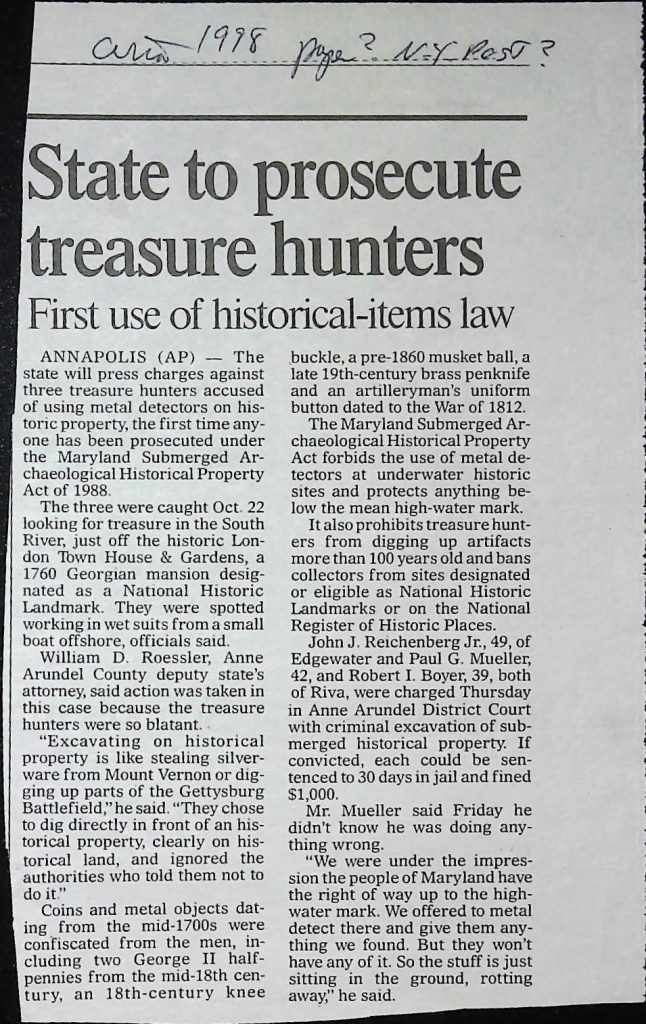
State to prosecute
treasure hunters
First use of historical-items law
ANNAPOLIS (AP)
The
state will press charges against
three treasure hunters accused
of using metal detectors on his-
toric property, the first time any-
one has been prosecuted under
the Maryland Submerged Ar-
chaeological Historical Property
Act of 1988.
The three were caught Oct. 22
looking for treasure in the South
River, just off the historic Lon-
don Town House & Gardens, a
1760 Georgian mansion desig-
nated as a National Historic
Landmark. They were spotted
working in wet suits from a small
boat offshore, officials said.
William D. Roessler, Anne
Arundel County deputy state's
attorney, said action was taken in
this case because the treasure
hunters were so blatant.
"Excavating on historical
property is like stealing silver-
ware from Mount Vernon or dig-
ging up parts of the Gettysburg
Battlefield," he said. "They chose
to dig directly in front of an his-
torical property, clearly on his-
torical land, and ignored the
authorities who told them not to
do it."
Coins and metal objects dat-
ing from the mid-1700s were
confiscated from the men, in-
cluding two George II half-
pennies from the mid-18th cen-
tury, an 18th-century knee
buckle, a pre-1860 musket ball, a
late 19th-century brass penknife
and an artilleryman's uniform
button dated to the War of 1812.
The Maryland Submerged Ar-
chaeological Historical Property
Act forbids the use of metal de-
tectors at underwater historic
sites and protects anything be-
low the mean high-water mark.
It also prohibits treasure hunt-
ers from digging up artifacts
more than 100 years old and bans
collectors from sites designated
or eligible as National Historic
Landmarks or on the National
Register of Historic Places.
John J. Reichenberg Jr., 49, of
Edgewater and Paul G. Mueller,
42, and Robert I. Boyer, 39, both
of Riva, were charged Thursday
in Anne Arundel District Court
with criminal excavation of sub-
merged historical property. If
convicted, each could be sen-
tenced to 30 days in jail and fined
[AD] $1,000.
Mr. Mueller said Friday he
didn't know he was doing any-
thing wrong.
"We were under the impres-
sion the people of Maryland have
the right of way up to the high-
water mark. We offered to metal
detect there and give them any-
thing we found. But they won't
have any of it. So the stuff is just
sitting in the ground, rotting
away," he said.