Box 3
Folder 17. Family Circle
Item 1. June 1940



Transcribed Text (OCR)
GARY MANGIACOPA ARCHIVE
============================================================
Title:      B3F17I1
Slug:       b3f17i1
Categories: Cryptozoology
Source:     https://garymangiacopraarchive.com/b3f17i1
Pages:      6 scanned, 6 extracted
OCR:        Google Vision API (document_text_detection)
Processed:  2026-06-06
============================================================

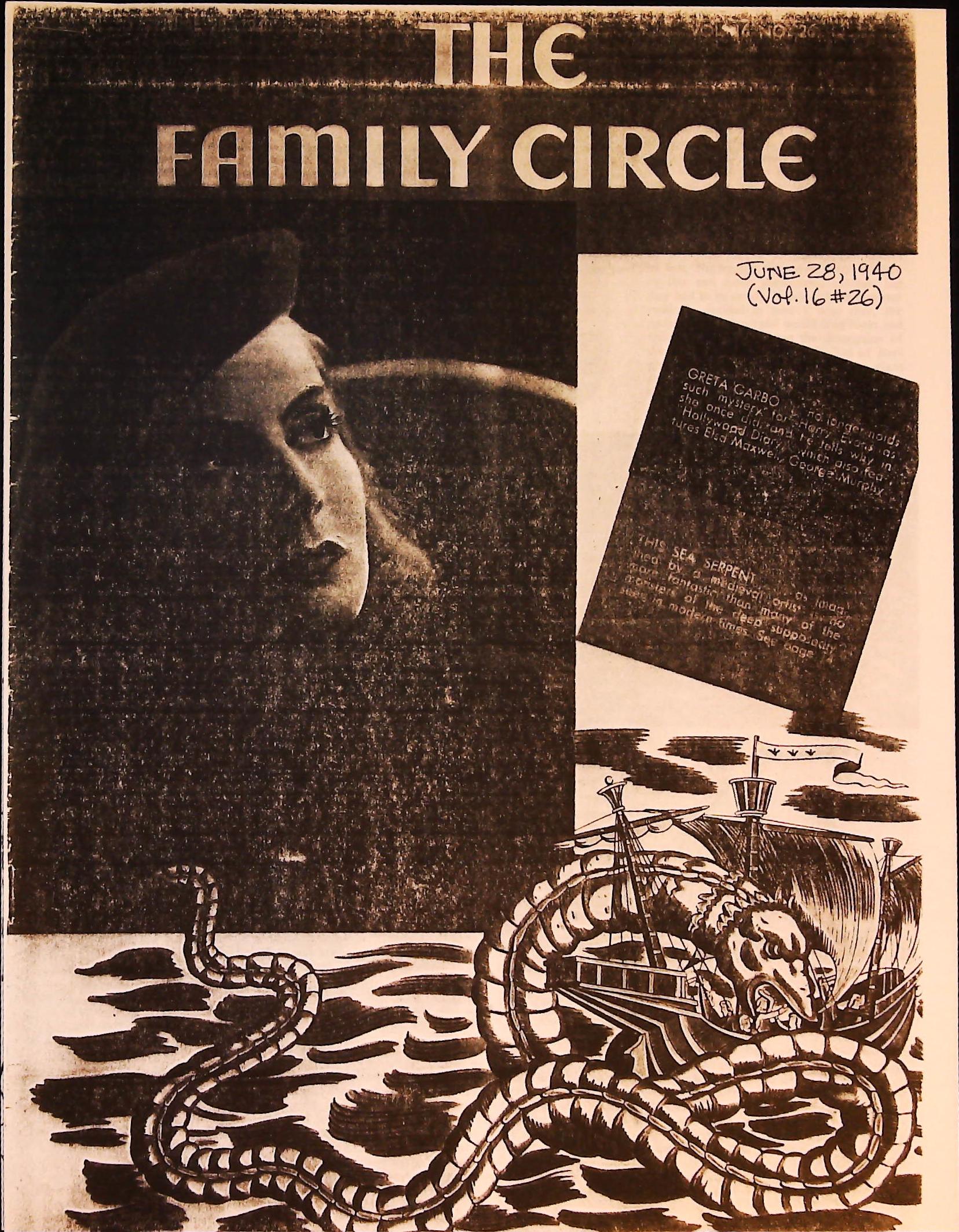
THE
FAMILY CIRCLE
JUNE 28, 1940
(Vol. 16 #26)
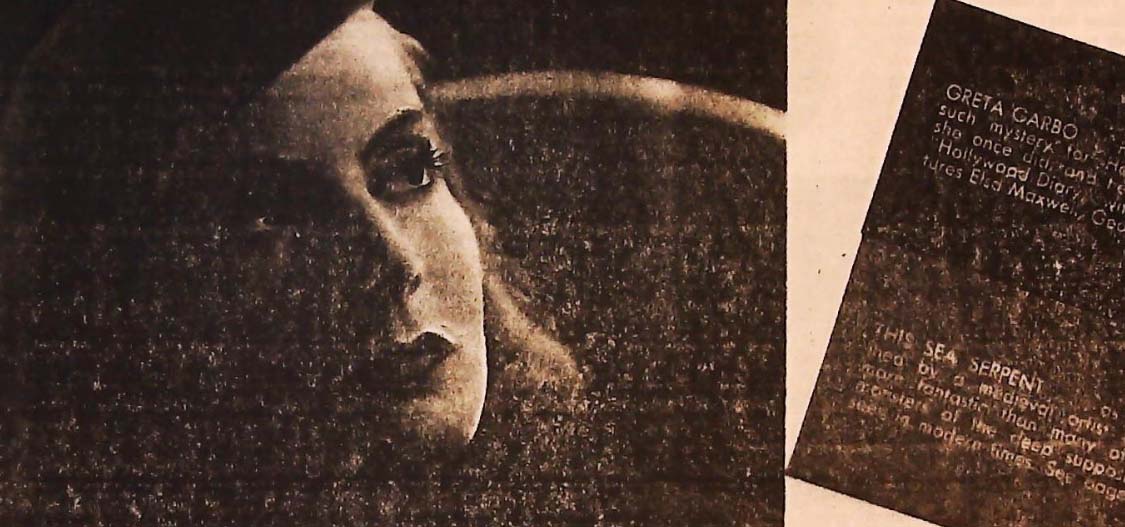
GRETA CARBON no longer noids
such mystery for Herry Evans was
she once did, and he tells way in
"Hollywood Diary which also fea
tures Elsa Maxwell, George Murphy
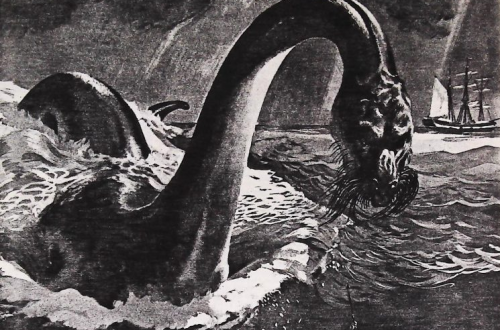
THIS SEA SERPENT
do
hed by a medievaloris
more fantastic than many of the
aoisters of the deep supposedly
sees in modern times. Ser age

[PAGE BREAK]

SEEING
THE LILY CIRCLE
THINGS AT
be a mile and a half in circumference, so that
it looked more like a group of islands than
a continuous creature. It had horns as high
as the masts of a vessel and it could lift its
head out of the water higher than the main-
mast. Its body was four times the size of a
ship and was covered with shellwork, and it
had great broad paws and arms capable of
dragging down a sizable vessel. It spouted
like a whale and gloried in a musky odor
so powerful that it attracted great shoals
of fish. Norwegian fishermen often profited
by this and made phenomenal catches, but
they had to be careful because if the monster
suddenly decided to take a nose dive, the
suction as it submerged would drag boats and
men down with it. From the description of
the Kraken as given by the Bishop of Ber-
gen, it now seems likely that it was a giant
squid of a variety known to science for only
the past 50 years or so.
AT
T five o'clock in the afternoon of Au-
gust 6, 1848, H.M.S. Daedalus was run-
ning along prettily on her way from the Cape
of Good Hope to St. Helena. Her captain,
Peter M'Quhae, was walking the deck with
two of his officers when a midshipman came
up to them in a state of considerable excite-
* ment and reported that something very ex-
traordinary was approaching the ship. The
four men hurried to the prow of the boat
where they were joined by three men of the
crew, and there they stayed for about 20
minutes watching an enormous creature like
a serpent, its head and shoulders about four
feet out of the water, with a neck more than
a foot in diameter and a mane like that of
a horse. It seemed to be about 60 feet long,
. was dark brown in color with a yellowish-
white throat, and was traveling at the rate of
about 12 knots an hour, though how it pro-
pelled itself the watchers could not make
out. Afterward the captain said it came so
close to the ship that had it been a man, he
could have made out the features.
When the captain berthed his ship in Eng-
land in October, he reported what they had
seen to the Admiralty office. His report,
printed in the newspapers, made a stir, and
the first thing the reporters did was inter-
view a prominent scientist, Sir Richard
Owen, later described as the most ponderous
naturalist of his day. He made a statement
about the captain's report that was entirely
in character. He said flatly and definitely that
what Captain M'Quhae had seen was a seal,
and that the reason he had mistaken it for a
sea serpent and described it as such was prob-
ably because he had been reading accounts of
the Kraken, Norway's fabulous monster, the
most famous sea serpent of its own and per-
haps of all time.
But Captain M'Quhae was a man who
knew his own mind and trusted his own eyes,
and he replied to Sir Richard Owen saying
that what he had seen was not a seal; as a
seafaring man he knew a seal when he saw
one. What he had seen was a sea serpent and
he had six good men and true to back him
up. And as for the Kraken, he had never
heard of the beast until Sir Richard men-
tioned him. So dignified and reasonable-
sounding was the captain's answer to the pro-
fessor that to this day it is the captain's
14
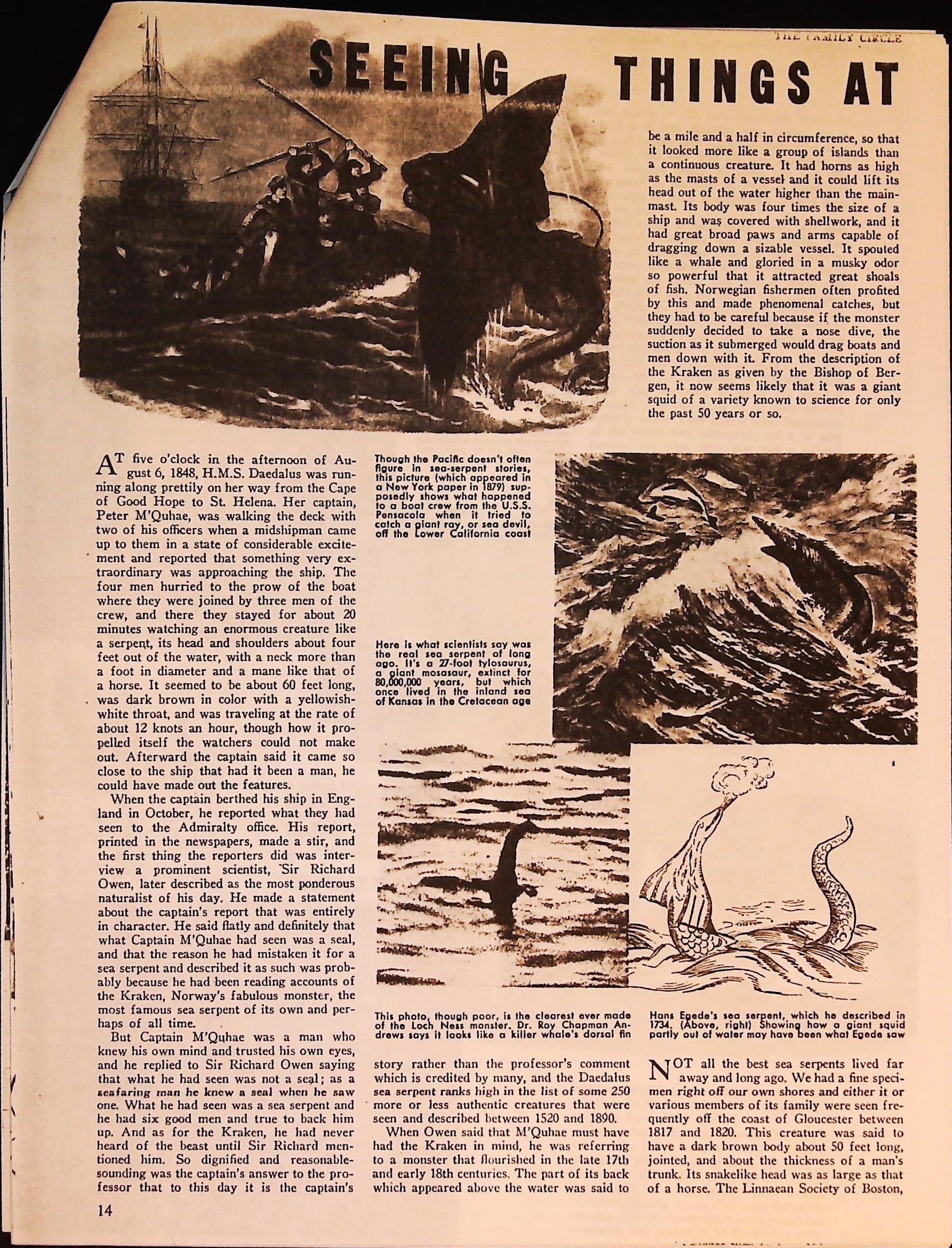
Though the Pacific doesn't often
figure in sea-serpent stories,
this picture (which appeared in
a New York paper in 1879) sup-
posedly shows what happened
to a boat crew from the U.S.S.
Pensacola when it tried to
catch a giant ray, or sea devil,
off the Lower California coast
Here is what scientists say was
the real sea serpent of long
ago. It's a 27-foot tylosaurus,
a giant mosasaur, extinct for
80,000,000 years, but which
once lived in the inland sea
of Kansas in the Cretacean age
This photo, though poor, is the clearest ever made
of the Loch Ness monster. Dr. Roy Chapman An-
drews says it looks like a killer whale's dorsal fin
story rather than the professor's comment
which is credited by many, and the Daedalus
sea serpent ranks high in the list of some 250
more or less authentic creatures that were
seen and described between 1520 and 1890.
When Owen said that M'Quhae must have
had the Kraken in mind, he was referring
to a monster that flourished in the late 17th
and early 18th centuries. The part of its back
which appeared above the water was said to
Hans Egede's sea serpent, which he described in
1734, (Above, right) Showing how a giant squid
partly out of water may have been what Egede saw
No
OT all the best sea serpents lived far
away and long ago. We had a fine speci-
men right off our own shores and either it or
various members of its family were seen fre-
quently off the coast of Gloucester between
1817 and 1820. This creature was said to
have a dark brown body about 50 feet long,
jointed, and about the thickness of a man's
trunk. Its snakelike head was as large as that
of a horse. The Linnaean Society of Boston,

[PAGE BREAK]

EA
ARE THERE SUCH THINGS AS
SEA MONSTERS? MOST SCIEN-
TISTS SAY NO, AND YET
BY JO PENNINGTON
a body of naturalists, sent a committee of
three to take the testimony of eyewitnesses,
and as all the men selected to give evidence
were reputable, the Gloucester sea serpent has
even today a fairly good standing. It was said-
to have been seen again in 1822, 1826, and
1849, and then finally in 1875, after which it
vanished forever from the sight of man.
Unless, of course, the Pasture Pond sea
serpent which turned up in 1886 was the same
creature. This monster came up out of the
sea near Provincetown, Cape Cod, in 1886,
walked across the dunes, and disappeared in
the depths of Pasture Pond. The pond was
all drained except for a hole in the middle
which seemed to be bottomless (the lead did
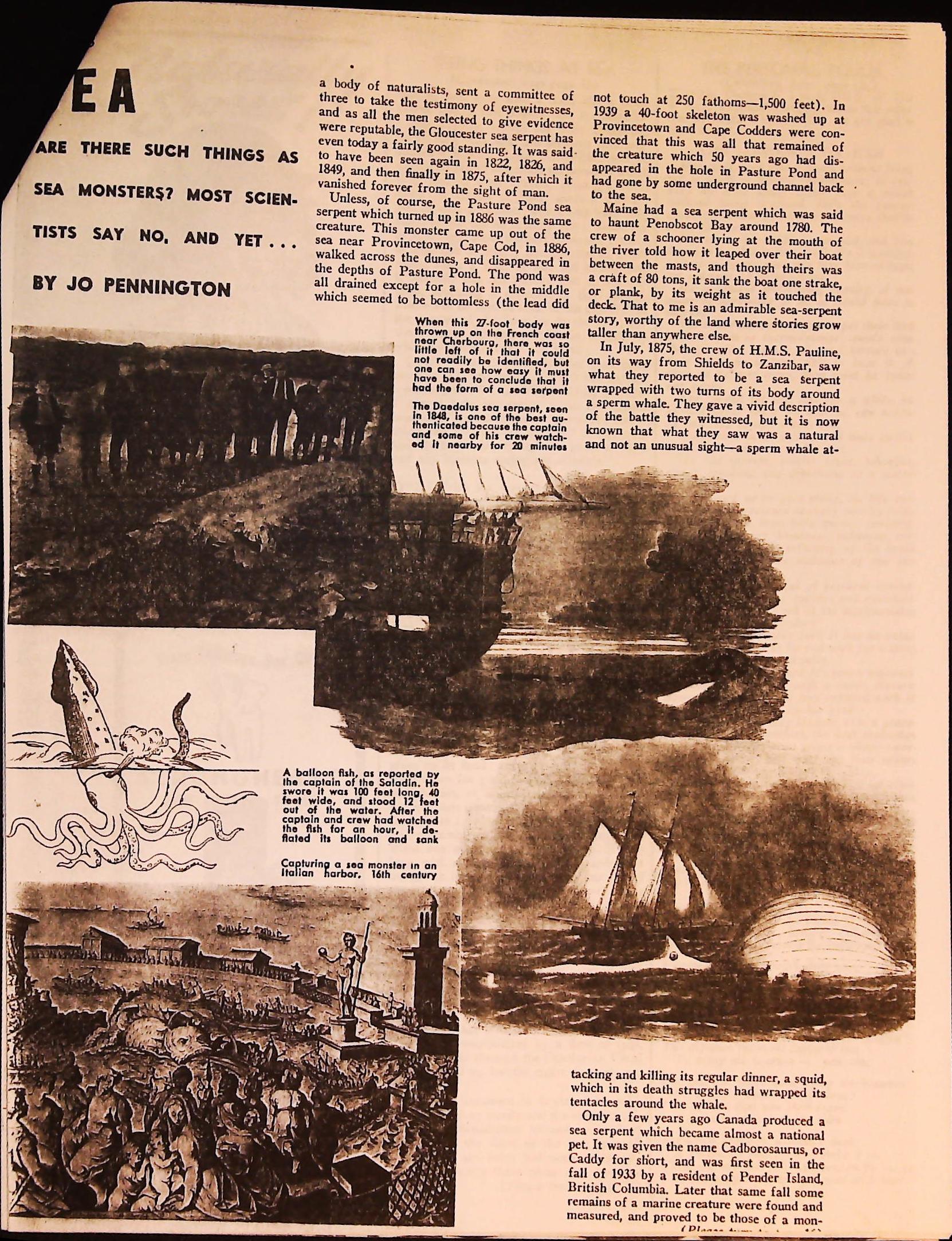
When this 27-foot body was
thrown up on the French coast
near Cherbourg, there was so
little left of it that it could
not readily be identifled, but
one can see how easy it must
have been to conclude that it
had the form of a sea serpent
The Daedalus sea serpent, seen
in 1848, is one of the best au-
thenticated because the captain
and some of his crew watch-
ed it nearby for 20 minutes
not touch at 250 fathoms-1,500 feet). In
1939 a 40-foot skeleton was washed up at
Provincetown and Cape Codders were con-
vinced that this was all that remained of
the creature which 50 years ago had dis-
appeared in the hole in Pasture Pond and
had gone by some underground channel back
to the sea.
Maine had a sea serpent which was said
to haunt Penobscot Bay around 1780. The
crew of a schooner lying at the mouth of
the river told how it leaped over their boat
between the masts, and though theirs was
a craft of 80 tons, it sank the boat one strake,
or plank, by its weight as it touched the
deck. That to me is an admirable sea-serpent
story, worthy of the land where stories grow
taller than anywhere else.
In July, 1875, the crew of H.M.S. Pauline,
on its way from Shields to Zanzibar, saw
what they reported to be a sea serpent
wrapped with two turns of its body around
a sperm whale. They gave a vivid description
of the battle they witnessed, but it is now
known that what they saw was a natural
and not an unusual sight-a sperm whale at-
A balloon fish, as reported by
the captain of the Saladin. He
swore it was 100 feet long, 40
feet wide, and stood 12 feet
out of the water. After the
captain and crew had watched
the fish for an hour, it de-
flated its balloon and sank
Capturing a sea monster in an
Italian harbor. 16th century
tacking and killing its regular dinner, a squid,
which in its death struggles had wrapped its
tentacles around the whale.
Only a few years ago Canada produced a
sea serpent which became almost a national
pet. It was given the name Cadborosaurus, or
Caddy for short, and was first seen in the
fall of 1933 by a resident of Pender Island,
British Columbia. Later that same fall some
remains of a marine creature were found and
measured, and proved to be those of a mon-
(Plan

[PAGE BREAK]

Suturally
Mother Nature twice-blessed the
lertile valley that nurtures luscious
Concords for Church's Grape Juice.
First she gave it sunshine. Then ahe
added a special volcanic soll that
makes Church's Grape Julce natur-
ally sweet. Unlike others. no sugar is
ever added. Try a bottle soon!
NO SUGAR ADDED!
CHURCH'S
GRAPE JUICE
CHURCH'S
GRAPE JUICE
More Tailwags Per Can
STRONGHEART
DOG
STRO
LOG CAT FO
FOOD
BOYLE PACKING CO., LOS ANGELES, CALIFORNIA
MOMENCE, ILLINOIS KANSAS CITY, MISSOURI
MERRY
MARSHMALLOW MEN
Graduates and grooms-professors and perambulators parad-
ing across your table! And you make them yourself-with
marshmallows! A clever booklet, PARTY FRILLS has original
ideas, instructions and illustrations for making favors for en-
gagement, graduation, baby showers, and 4th of July parties.
Also included are delicious recipes for marshmallow desserts
and salads. Send your name, address and 10c to JULIA LEE
WRIGHT, Homemakers' Bureau, Box 660MP, Oakland, Calif.
16
SEEING THINGS AT SEA
(Continued from page 15)
ster 40 feet long with a head like a horse
except that it had neither ears nor nostrils.
The English, except for their ponderous
naturalists, take their sea serpents seriously.
Rudyard Kipling, Lord Northcliffe, and A.
Conan Doyle all described sea serpents which
they met in their travels. Kipling's short
story "A Matter of Fact" gives a descrip-
tion of such a monster, which may have been
based on the one he actually saw: "Some six
or seven feet above the port bulwarks, framed
in fog, and as utterly unsupported as a full
moon, hung a face. It was not human and
it certainly was not animal. The mouth was
open, revealing a ridiculously tiny tongue.
There was no sign of teeth in the mouth; but
the horror of the face lay in the eyes, for
those were sightless-white, in sockets as
white as scraped bone, and blind.
Queen Victoria's yacht Osborne came back
home in 1877 and reported that it had sighted
a sea serpent off Cape Vita in Sicily in June.
I cannot help wondering what the Queen
said when she heard the story-maybe some-
thing like "We are not amused." It may well
have been that she thought no yacht of hers
had any business seeing sea serpents.
T
HE Irish sea serpent is, naturally, just
a bit more remarkable than that pro-
duced by any other nation. It appeared in
Ballycottin Bay near Cork, attacked a party
of fishermen, and, on being shot, disappeared
after disgorging a whole shoal of fish. And
those fish, whèn handled by the men in the
boats, gave them terrific electric shocks!
But it is the Scotch who have produced
what is the finest sea serpent of modern
times. And not only did they do it once, but
they have kept on producing it almost every
summer. It was first seen in Loch Ness, a
long, narrow body of water actually part of
the Caledonian Canal, which cuts across the
Scottish Highlands in a diagonal line from
Moray Firth on the east coast southwest to
the Firth of Lorne on the other side. Loch
Ness has always had a rather sinister repu-
tation. It is believed that this loch never
gives up its dead; anyone who drowns in it
stays down for good and all. The kelpies, or
waterhorses, of Scottish legend are said to
make it their headquarters. Such stories make
Loch Ness an ideal setting for a sea serpent
and certainly no Highlander was surprised
when one appeared in 1933-40 to 50 feet
long with a large whiskery head and eight
humps on its back. It apparently can travel
about 40 miles per hour but never comes
nearer the shore than 100 yards.
FR
THE FAMILY CIRCLE
THE PERSONAL TOUCH
(Continued from page 12B)
ROM Thomas F. Lynch, 726 S. W. 11t
Ave., Portland, Oregon, comes this selec
tion by Mark Twain, which we are glad t
reprint.
THE LOWDOWN ON MAN
Man can't sleep out-of-doors without freez
ing to death or getting rheumatism; he can'
keep his nose under water over a minut
without being drowned. He's the poores
clumsiest excuse of all the creatures that in
habit the earth.
He has to be coddled, swathed, and ban
daged to be able to live at all. He is a ricket
sort of thing any way you take him-a regu
lar museum of inferiorities.
He is always undergoing repairs. A ma
chine as unreliable as he is would have n
market.
The lower animals appear to get their teeli
without pain or inconvenience; man's con
through after months of cruel torture at
time when he is least able to bear it. A
soon as he gets them, they must be pulle
out again.
The second set will last for a while, bu
he will never get a set that he can depen
on until the dentist makes one.
Man starts in as a child and lives on dis
case to the end as a regular diet.
He has mumps, scarlet fever, whooping
cough, tonsilitis, and diphtheria as a matte
of course.
Afterward, as he goes along, his life con
tinues to be threatened at every turn by colds
coughs, asthma, bronchitis, quinsy, consump
tion, yellow fever, blindness, influenza, car-
buncles, pneumonia, softening of the brain
and a thousand other maladies of one sor.
and another.
He's just a basketful of pestilent corrup
tion provided for the support and entertain
ment of microbes. Look at the workmanshi
of him in some particulars.
What's the appendix for? It has no value
Its sole interest is to lie and wait for a stray
grape seed and breed trouble.
What is his beard for? It's just a nuisance
All nations persecute with a razor. Nature
however, always keeps him supplied with it
instead of putting it on his head.
A man wants to keep his hair. It is a grace-
ful ornament, a comfort, the best protection
against weather, and he prizes it above emer-
alds and rubies, and half the time nature
puts it on so it won't stay.
Man isn't even handsome, and as for style
look at the Bengal tiger-that ideal of grace.
physical perfection, and majesty.
Think of the lion, the leopard-then think
of man, that poor thing. The animal of the
wig, the ear trumpet, the glass eye, the por-
celain teeth, the wooden leg, the silver wind-
pipe-a creature that is mended all from.
top to bottom.
-MARK TWAIN
Many doubtful persons have gone to Inver- WE are indebted to Helen G. Groshart,
ness, a summer resort on the shore of the
loch, expecting to scoff at the story, but
they have often come back complete converts
to a belief in the creature. There was even
talk of capturing it until Commander R. T.
Gould, R. N. (Retired), author of a book
called "The Case for the Sea Serpent,"
pointed out that it would require a net 3,000
by 900 feet manipulated by a fleet of tugs,
and that traffic through the Caledonian Canal
would be tied up for the entire time of cap-
ture.
The chief argument in favor of its exis-
tence is that four monks and the abbot emeri-
tus of the Benedictine monastery at Fort
Augustus on the shore of the loch have all
given sound and sober testimony as eyewit-
nesses. Obviously these pious men have no
(Please turn to page 20)
2065 Holly St., Denver, Colorado, for
the opportunity to reprint the following poem.
I know within my heart, dear one,
That there are rare sweet moments when
For just your fleeting hand in mine
God's heaven will send you back again.
I know that when tempestuous days
Make tatters of my dreams, you'll span
The distance from the farthest star
To bring me courage-if you can.
Oh, yes, but years have made me brave-
Grim life I dare to face alone;
I do not ask that you shall leave
A paradise for that, my own.
But when, through autumn's dusk
A thread of hearth-fire smoke I see,
Then, oh, my dear, though heaven be sweet,
Please walk that twilight road with me!

[PAGE BREAK]

HOW TO BE POPULAR
WITH YOUR FAMILY
Do you serve Canada Dry only
when guests drop in? Or do you
serve it to your family regularly
-to prove to them they're the
nicest "company" of all?
Try it. Treat your family as you
do your guests-with delicious
Canada Dry "The Champagne
of Ginger Ales"!
And don't forget Sparkling
Canada Dry Water. Its pin-point
carbonation lasts 24 hours after
the bottle is opened.
Keep both these beverages
always on hand... and be popu-
lar in your own home!
CLUB
Sparklin
CANADA DR
WATER
CANADA DR
LE GINGER A
CANADA DRY
BEVERAGES
SEEING THINGS AT SEA
(Continued from page 16)
reason either to lie or exaggerate, and the
abbot has lived on or near the loch for the
better part of 50 years. Naturalists, after
reading reports and studying drawings of
the Ness Monster, have pronounced it a giant
squid, an elephant seal, an enormous croco-
dile, a German blimp that has been floating
around since 1918, or a hippopotamus. A
crocodile or a hippopotamus swimming
around in a Scottish loch is almost harder to
believe in than a sea serpent. Roy Chapman
Andrews studied the photograph which a
London newspaper correspondent took of it
and said that what appeared to be the head
and shoulders of a sea serpent bore a striking
resemblance to the dorsal fin of a killer
whale.
When a young man whose name is not re-
vealed went to Dr. W. Reid Blair, the direc-
tor of the New York Zoological Park, and
offered to go to Loch Ness, capture the mon-
ster, and bring it back alive, Dr. Blair said
he would pay $25,000 for it if it was in good
health and at least 40 feet long. Dr. Blair
later said he made the offer as a joke, but he
THE FAMILY CIRCLE
For example, he might have seen porpoises
swimming one behind the other, rising regu-
larly to take breath and so giving the appear-
ance of a snakelike creature moving in ver-
tical undulations. He might have seen a slight
of seafowl or a brood of ducks swimming on
the water, or masses of seaweed half awash.
He might have seen basking sharks, which
when not basking often swim in pairs one
behind the other with the dorsal fin and
upper lobe of the tail just above the surface,
thus giving the appearance of a body 50 to
60 feet long. He might have seen a ribbon-
fish or an oarfish, which often grow to be
20 to 30 feet long, are snakelike in form, and
abound in the Mediterranean. And he might
have seen sea lions breaking the surface of
the water to breathe.
But what he most probably and most fre-
quently saw and took for a sea serpent-at
least in the old days-was the giant squid, not
long known to science. These abound on the
coasts of Scandinavia, the British Isles, and
the eastern coast of North America, in all of
which places, as you have seen, the best sea
serpents are found.
cannot be entirely skeptical about the pos- ADMITTING that any of the above-named
sible existence of the sea serpent because he
also said, "Seriously, there's no doubt in
my mind that some unusual and unknown
creature is showing itself in that lake."
The town of Inverness has profited by its
serpent. Shops in the town are full of repro-
ductions of it-wooden monsters for chil-
dren to ride like hobbyhorses; rubber ones
to blow up and cling to when swimming;
and little bronze objects of the unnamable
species known as novelties. The monster even
had its portrait painted and exhibited-ap-
propriately enough in water color. A recent
shortage of salmon in the lake was attributed
to the creature, who was presumably taking
more than his share. The Scotch govern-
ment has seriously warned visitors that they
would be punished if they harmed their
marine attraction.
F
OR some reason it is always slightly dis-
creditable to have seen a sea serpent. The
author of "Mysteries of the Sea," J. G. Lock-
hart, wonders why this should be so, and
Kipling's "A Matter of Fact" is based on
the unbelief invariably shown toward any de-
scription of such a phenomenon. Plenty of
people believe in ghosts and are not only said
to be psychic but get good money for their
ghostly messages. The Irish believe in fairies
and the Scotch in changelings and are ac-
cordingly thought charming and romantic.
The Chinese and other Oriental races be-
lieve in dragons and that seems sinister and
fascinating. But let any man say he has seen
a sea serpent and he is immediately called a
poor deluded being.
Especially by the naturalists. And more
attention would be paid to their doubting
comments if they could themselves agree as
to what actually is seen. But when they see
a drawing or photograph or are told a story
or shown the remains of a sea monster, they
all begin to give different opinions. Basking
shark, says one; bottlenosed whale, says, an-
other; fur-bearing seal, sea cow (which are
may have been taken for a sea serpent,
there is still the question: Is there such a
thing? "When, however, all these and similar
possibilities have been explored, there still
remain a number of independent and appar-
ently credible stories which are not satisfac-
torily explained." That is what H. W. Parker,
B.A., of the Natural History Museum of
South Kensington says in his article in the
14th edition of the Encyclopedia Britannica.
And he makes this further comment: "In the
depths of the sea there still may exist gigan-
tic creatures of which we have no knowledge
and without this knowledge, remote though
it may be in the background, it is unwise
to deny the existence of sea serpents." Louis
Agassiz, one of the greatest American natural-
ists, and Philip Gosse and Henry Lee, well
known British naturalists, all of whom lived
in the latter part of the 19th century-these
and many other sound men of science say
that there may well be such a creature as
a sea serpent.
A distinguished British naturalist and
traveler, Malcolm Burr, in 1934 wrote that
no known creature fulfills all the conditions
given in descriptions of the sea serpent-the
reptilian appearance, the spouting like that
of a whale, the frill or mane around the
neck, the notched crest on the back. But
there may be in the sea a huge lizardlike
creature (a tailed batrachian related to the
newts) which would come very near to hav-
ing all those attributes. The land species, of
small, but there is no reason why
the marine variety may not be large, and
the most curious point of resemblance is that
the male of the former species has a notched
crest along the neck which dries up after
the mating season. In any event, no one be-
lieves any longer, as they did in the last
century, that the sea serpent is a survival
from prehistoric times of some creature like
the plesiosaurus, a marine reptile which has
been extinct for 60,000,000 years.
course,
supposed to be extinct), blackfish, ribbonfish, NOTHING the sea can ever produce is
German blimp, hippopotamus-what are we
to think of these learned men who are so un-
able to agree among themselves?
Of course, it is probable that many times
when a traveler brings home a story of a
sea serpent he has mistaken some known
creature for the more questionable species.
likely to rival in horror and strange-
ness the giant squid which was taken aboard
a Gloucester schooner in 1870. Parts of this
creature were sent to the Peabody Museum
at Harvard and from them the entire animal
was reconstructed-a monster 42 feet long,
weighing about 2,000 pounds, with eight arms
extending from its head and two tentacles
20
20

[PAGE BREAK]

30 feet long and eyes eight inches in
ter. It is believed that squid sometimes
na length of 60 feet. The smaller ones
fast swimmers and have been known to
amp over rowboats in their paths. It may
have been a squid, therefore, which caused
such a commotion by jumping across the deck
of the schooner in Penobscot Bay. At any
rate, no sea serpent, however fearsome, could
be any more unpleasant to meet in the open
waters than this authenticated monster of
the deep.
One reason scientists sneer at sea ser-
pents is probably because several times they
have been the victim of hoaxes. About 1820
a "Dr." Albert Koch produced a gigantic
skeleton which he said he had found in Ala-
bama. Professor Silliman, a leading natural-
ist of his time, commented that it differed
essentially from any existing or fossil ser-
pent and rather timidly and vaguely said that
it just might be the remains of a sea serpent.
The pseudo Dr. Koch took his "Hydrargos,"
which was 114 feet long, all over Europe
and made a tidy fortune out of it. It was
ultimately shown to be made up of the hones
of half a dozen skeletons, probably of whales,
ingeniously put together by the exhibitor.
Professor Silliman must have felt very much
like his name when this report reached him.
In 1855 a sea serpent was reported to have
been seen in an inland lake in New York
State at the town of Perry and was de-
scribed as a hideous reptilian creature almost
100 feet long. A company was organized with
a capital stock of $1,000 to devise ways and
means of capturing it. And then it came out
that an enterprising hotelkeeper named
Walker had made it out of painted canvas
and inflated it to make it float.
Parenthetically, mermaids and mermen
have always been as popular as sea serpents
and they were once supposed not only to
have been seen, but to have been captured,
baptized into the Christian faith, killed, and
eaten. In 1822 a mummified "mermaid" was
exhibited in London and 300 people a day
paid a shilling apiece to see it. But the ex-
hibitor got into trouble and the mermaid
vanished for quite a time, only to reappear
in the museum of our own Phineas T. Bar-
num, where it was shown as the Feejee Mer-
maid. Barnum made a neat sum out of her,
but later in his life, when he grew pious, he
worried a lot about this and other fakes of
his, fearing that he would roast in hell for
them. Because all the time he knew that his
Feejee Mermaid was made of the upper part
of a monkey's body joined to the lower part
of a fish's tail so cleverly that it was not de-
tected by any visitor to the museum.
That is the case for and against the sea
serpent. Is there such a thing? Is it a serpent,
a ribbonfish, a blackfish, a seal, a whale, a
sea cow, a marine lizard, a survivor from
prehistoric times, or is it simply a figment
of the human imagination? It may be appro-
priate to quote what Barnum said about hum-
bugs and surely no one was better qualified
than he to speak on that subject: "If the
fact could be definitely determined," he said,
"I think it would be discovered that in this
wide-awake country there are more persons
humbugged by believing too little than too
much." And, as has so often been said in
another connection, maybe Barnum was right.
At least when one begins to study marine life
-from a squid weighing a ton or more to
a seahorse no bigger than your finger-one
cannot help thinking that there may be
stranger fish still in the sea than ever came
out of it.
HERE'S WHY I
INSIST ON CERTO
...THE "TRIED AND TRUE" PECTIN
THAT TAKES THE GUESSWORK
OUT OF JELLY-MAKING
says Mrs.F.B. Tillou, Jr.
of Orford, New Jersey, ret-
cran Jelly Champion who has
won over 150 prizes for jams
and jellies made with Certo!
Watch Mrs. Tillou demonstrate to her neigh-
bors how Corto saves time, money and work!
1. "There's no excuse for jelly fallure nowa-
days. says Mrs. Tillon. "With Certo, any
woman can make perfect jelly from any fruit
she sets her hand to-even hard-to-jell fruits
like strawberries and pineapple
3. " glasses Instead of 7-and all
from only 4 cups of juice! You can
see for yourself that Certo gives you
actually half again more jam or jelly.
For due to that short boil, no costly
fruit juices boil off in steam.
Copyright, General Foods Corp., 1940
2. "No slaving over a hot stove-
when you use Certo! You boil your
fruit mixture only 2 minute-and
you're through in 15 minutes from
the time your fruit was prepared.
4. "Better tasting jam and jelly you never
ate! That short boil saves flavor, too-so jam
and jelly have the full flavor of fresh fruit.
And Certo alone gives you 77 recipes-another
important reason why jelly champions insist
on this 'tried and true' pectin!"
A product of General Foods
Jelly
Look for the tested recipes under the label of every bottle of Certo.
CERTO
21
21