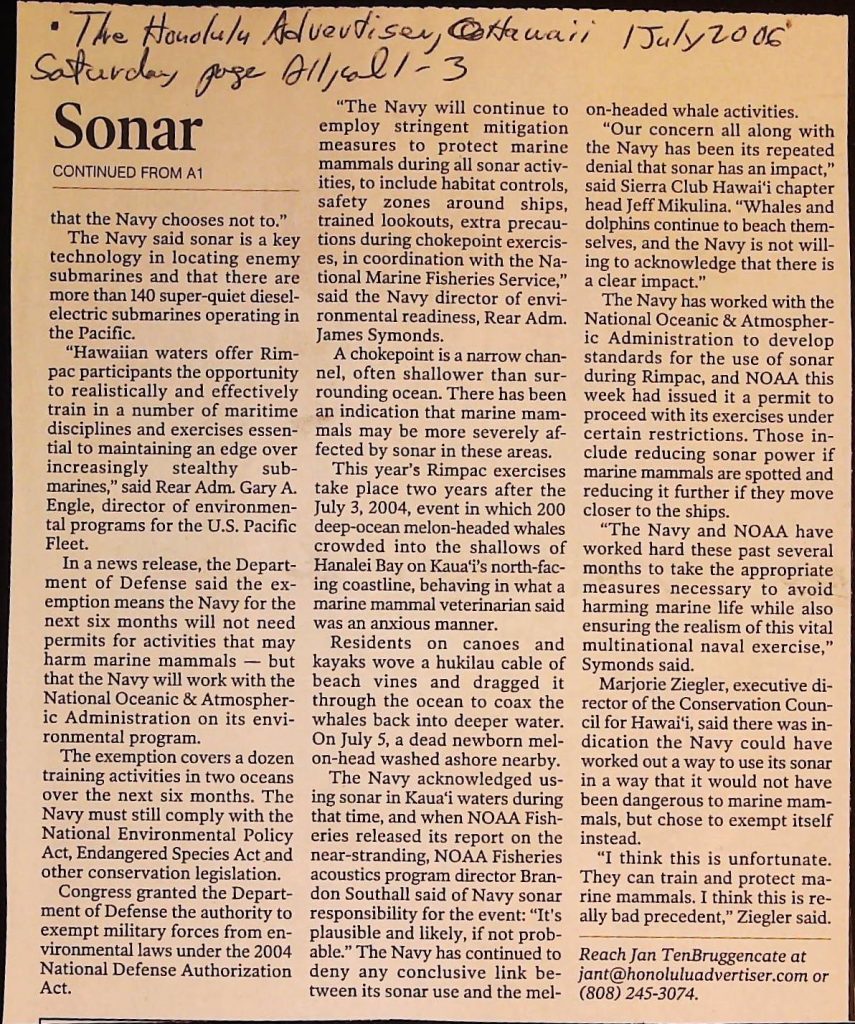
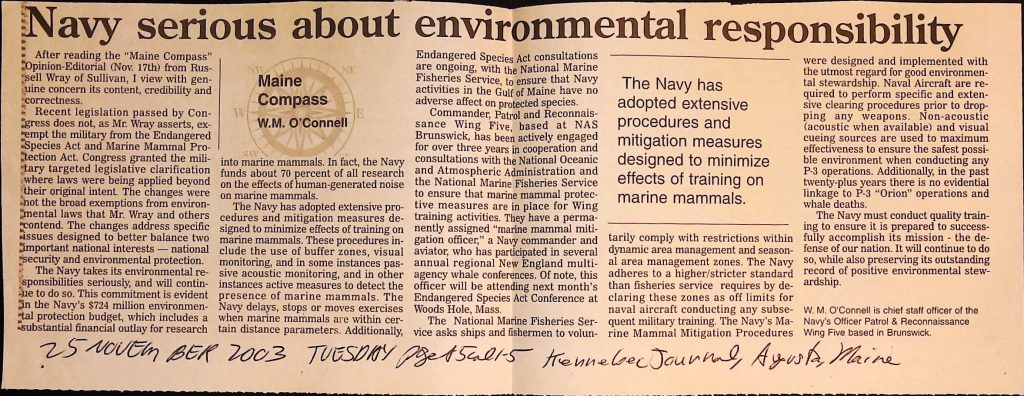
Box 4
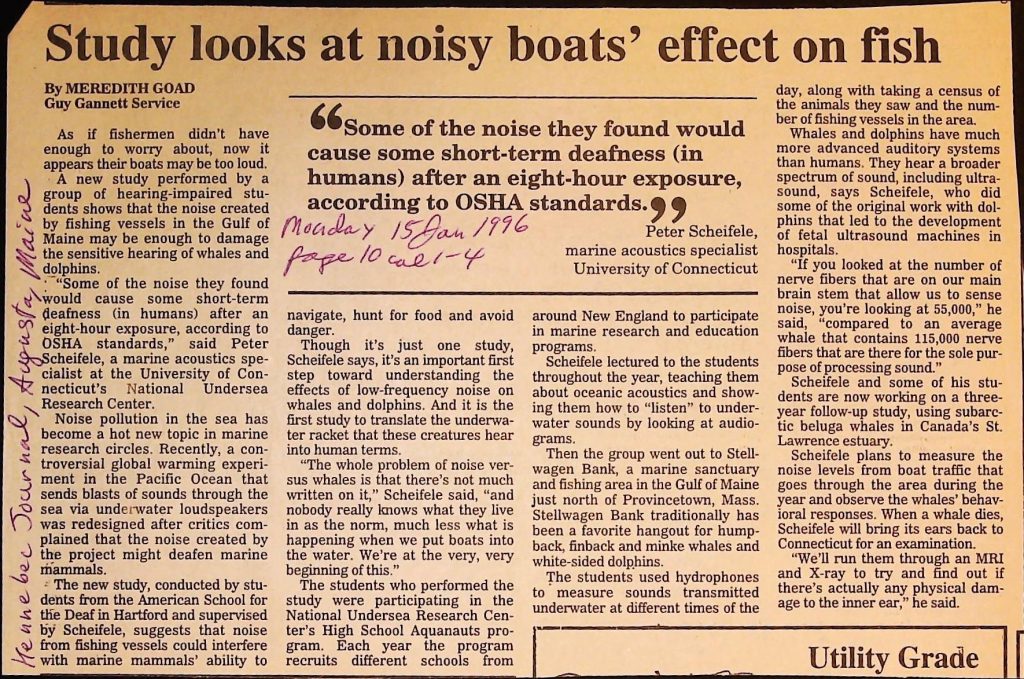
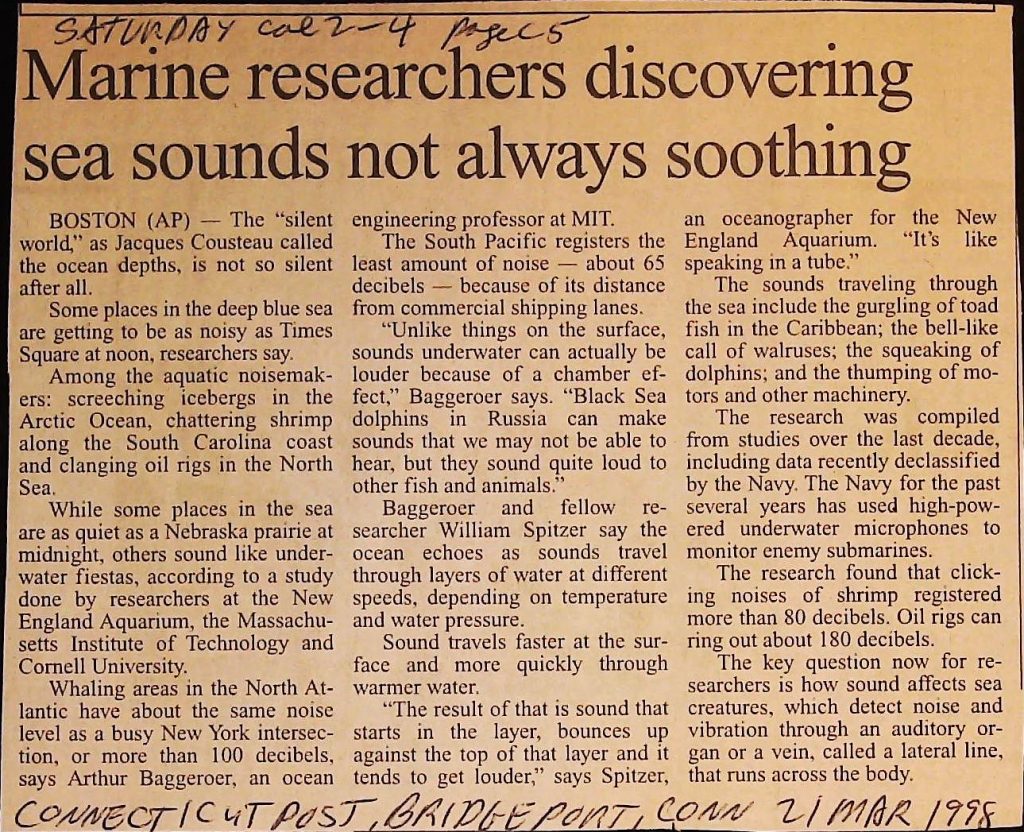
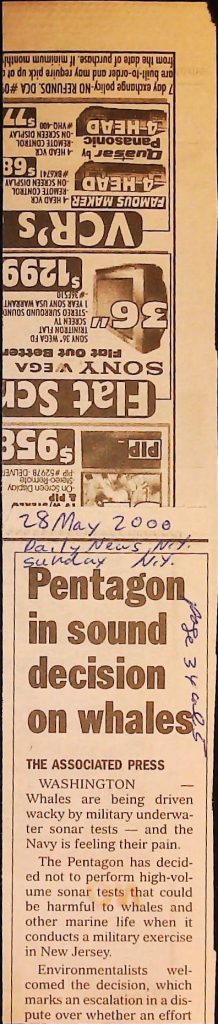
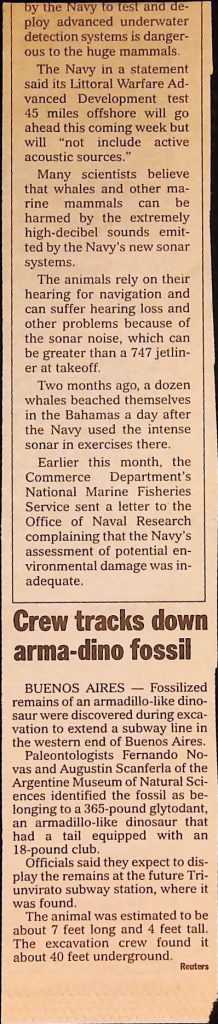
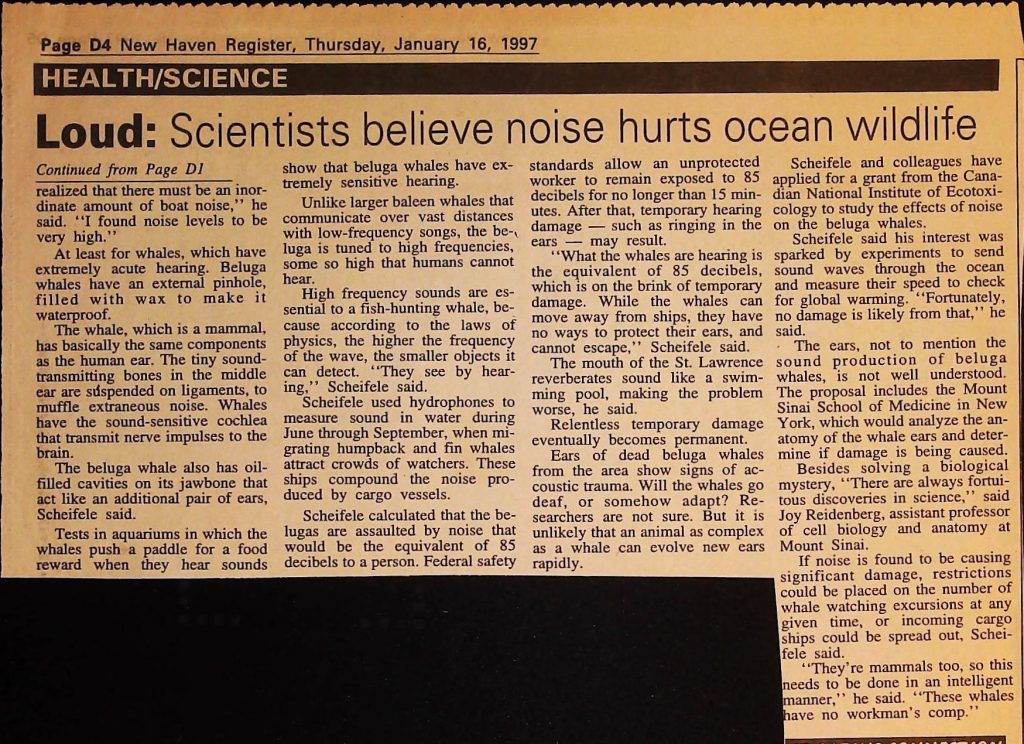
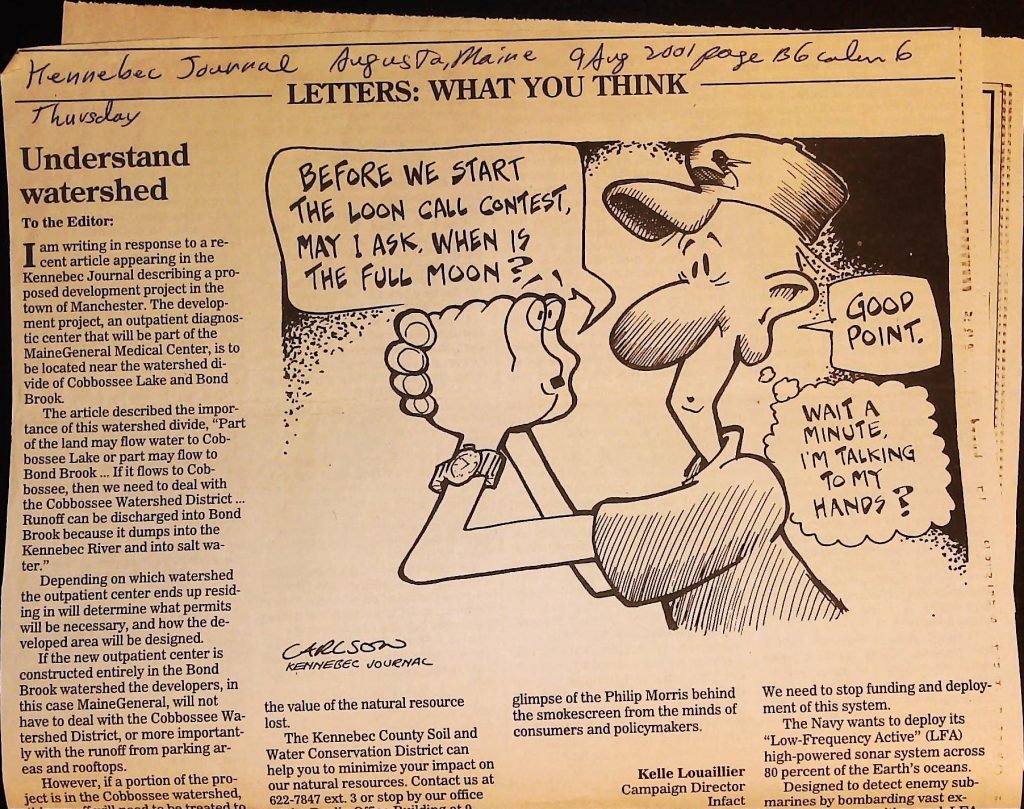
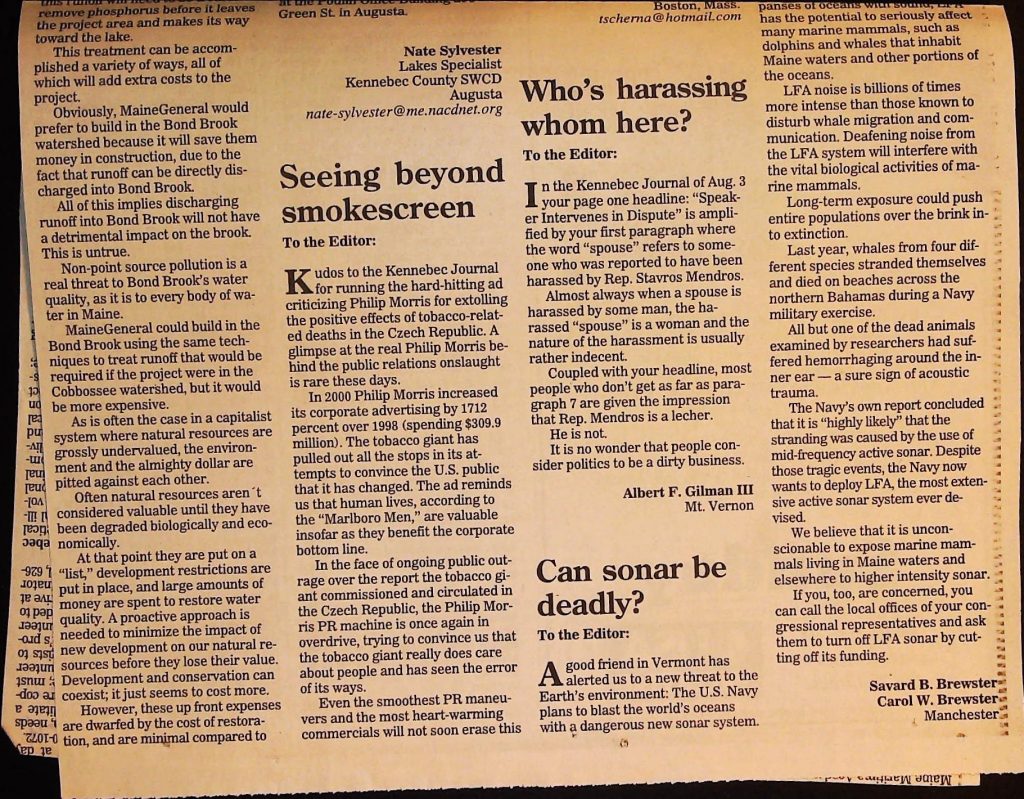
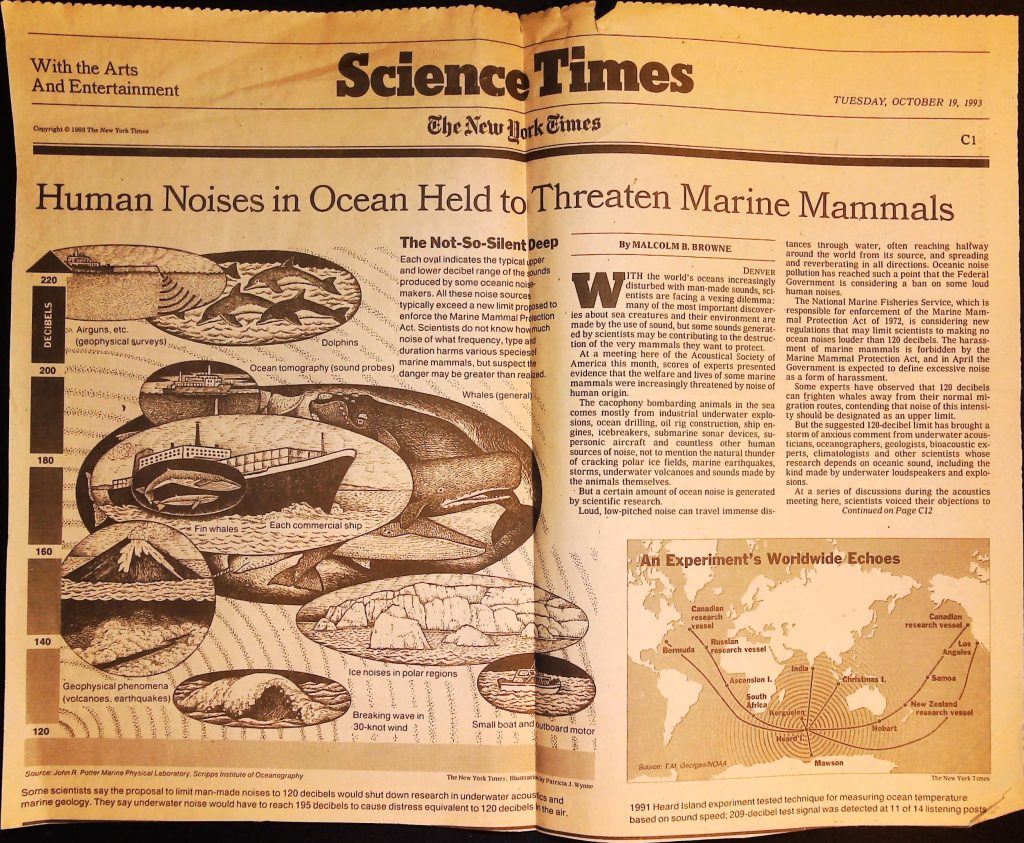
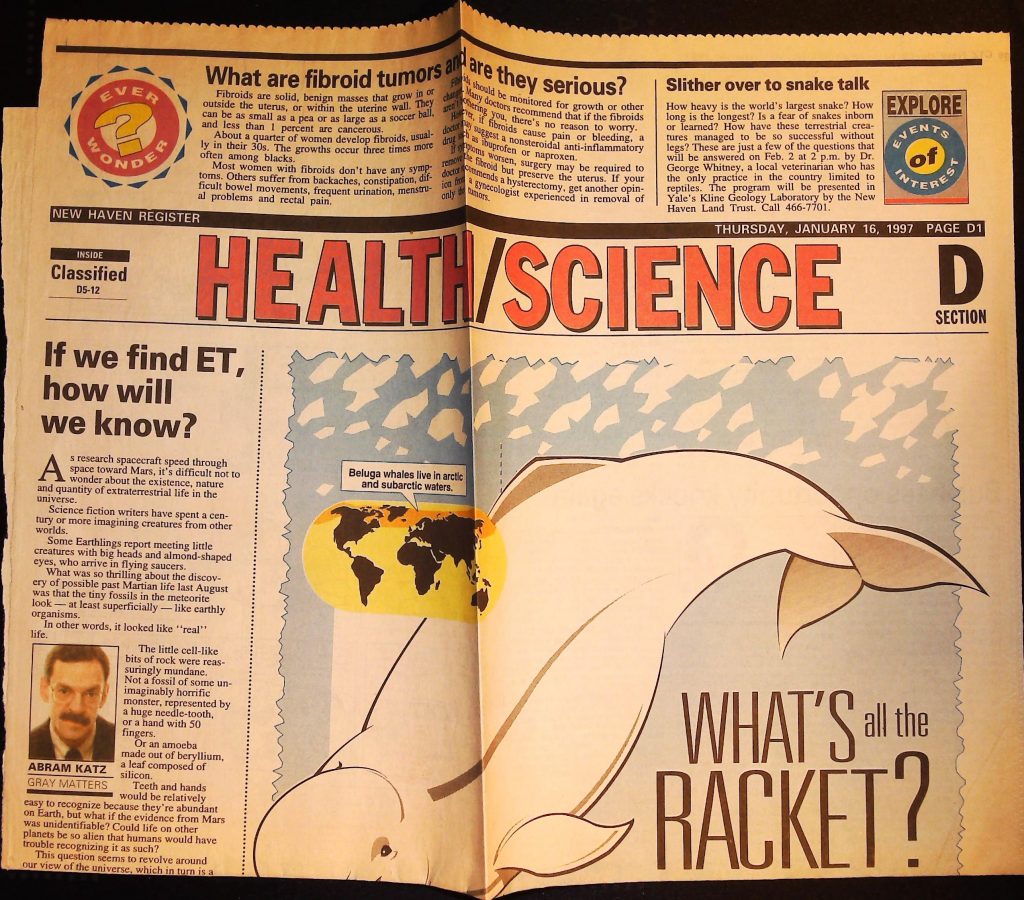
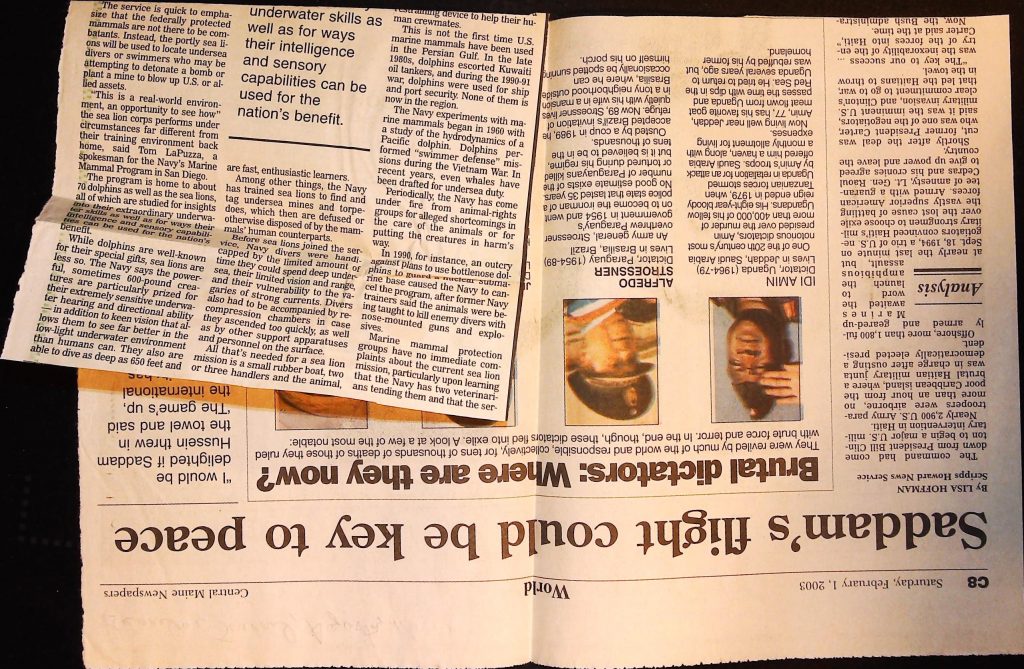
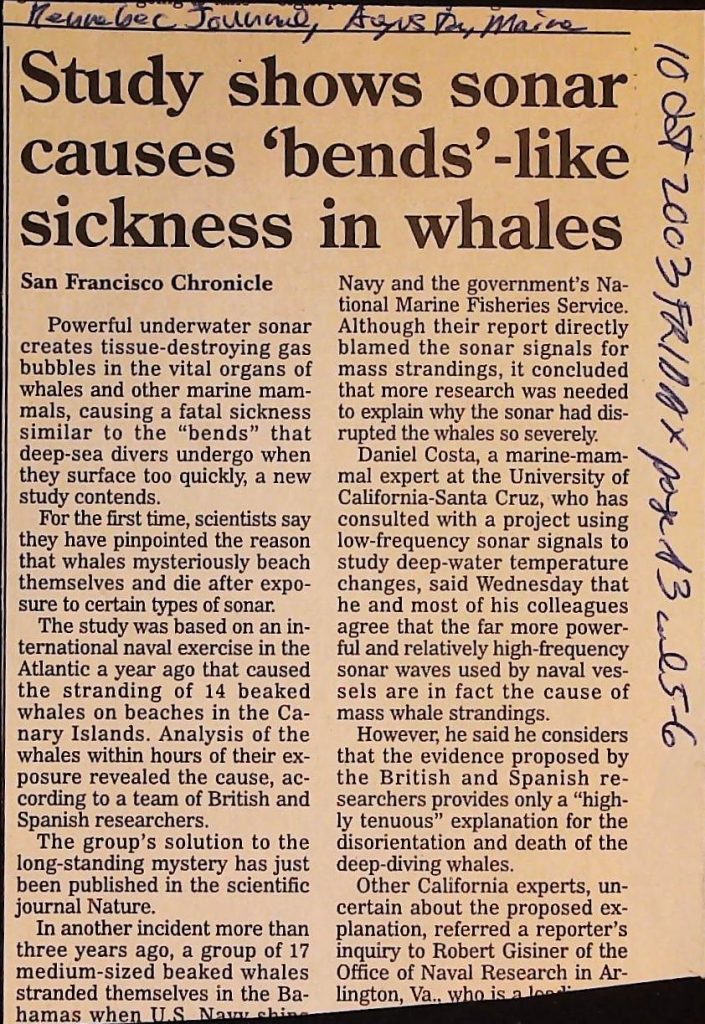
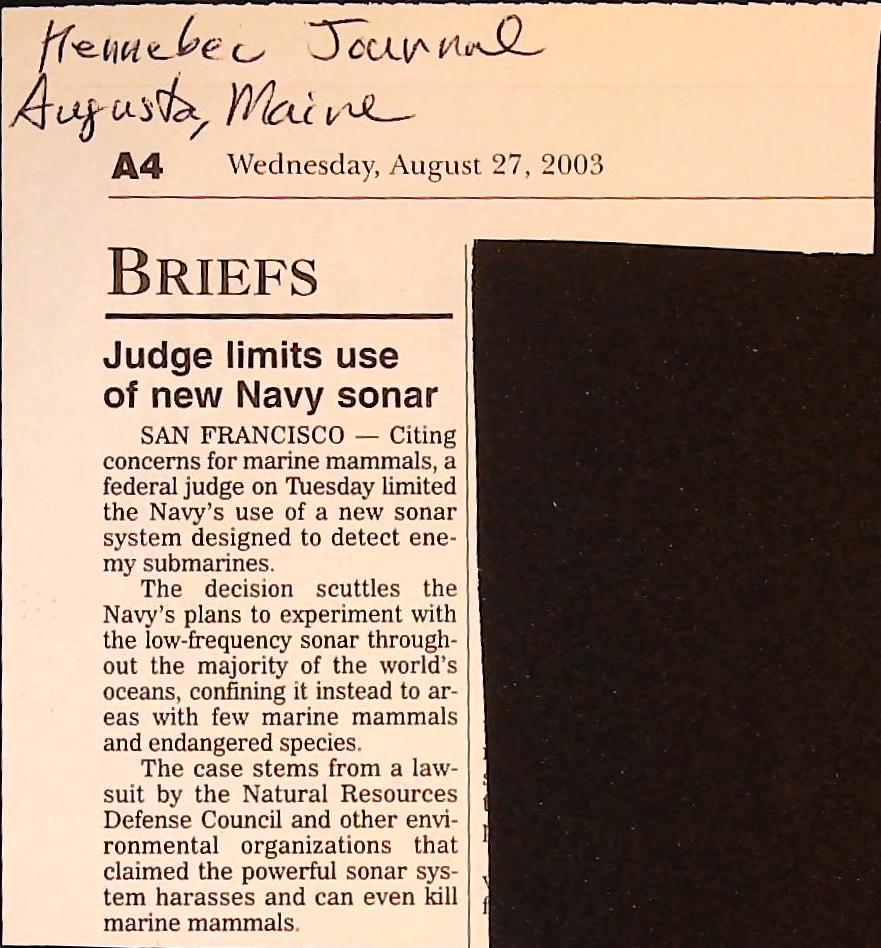
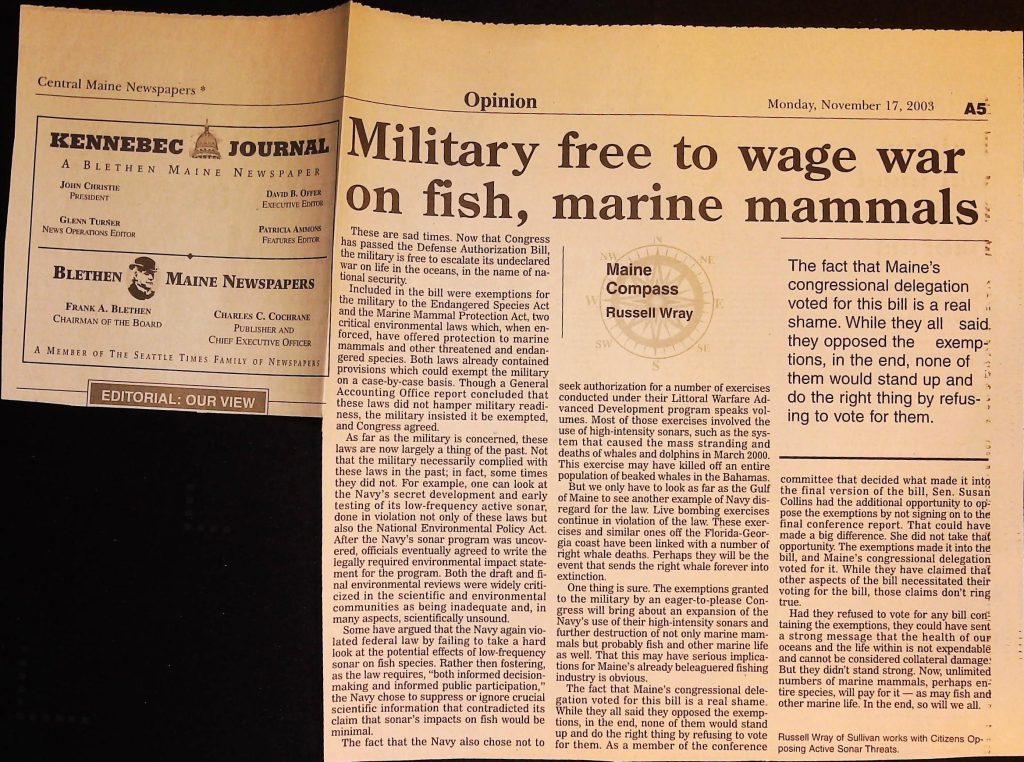
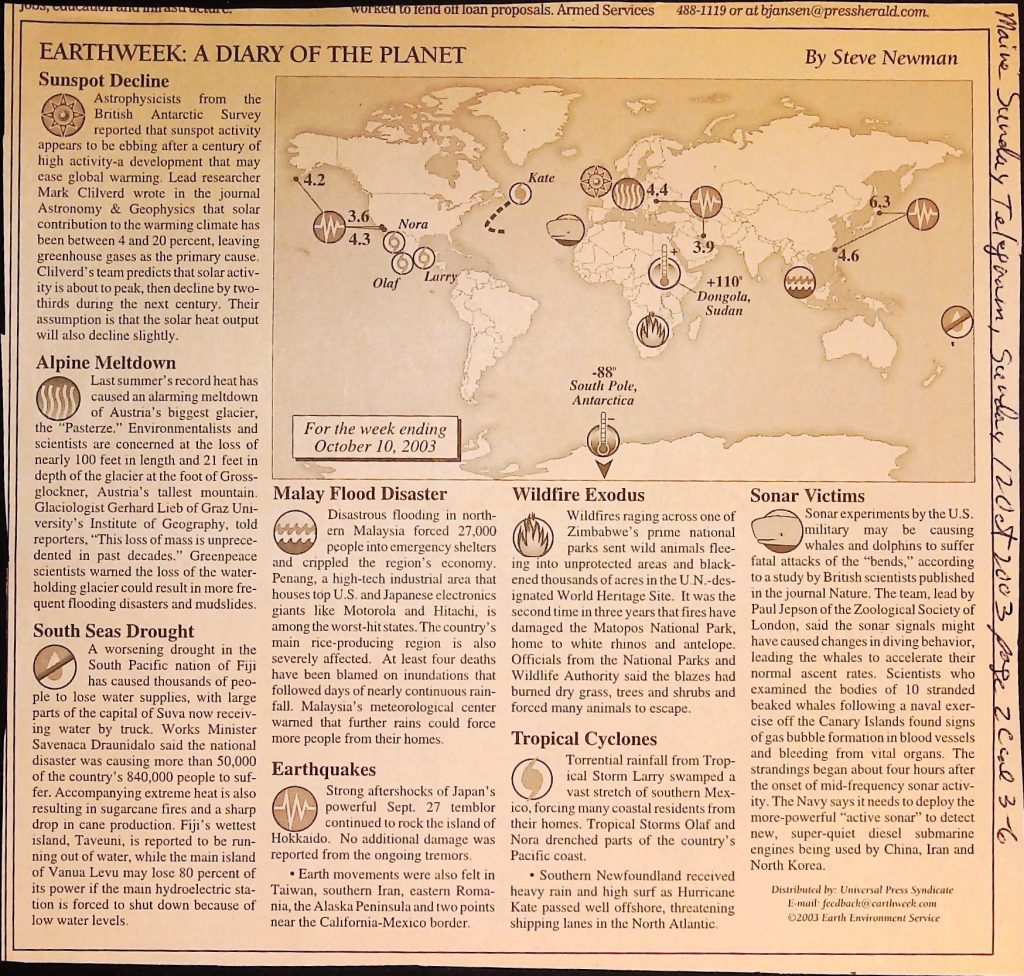
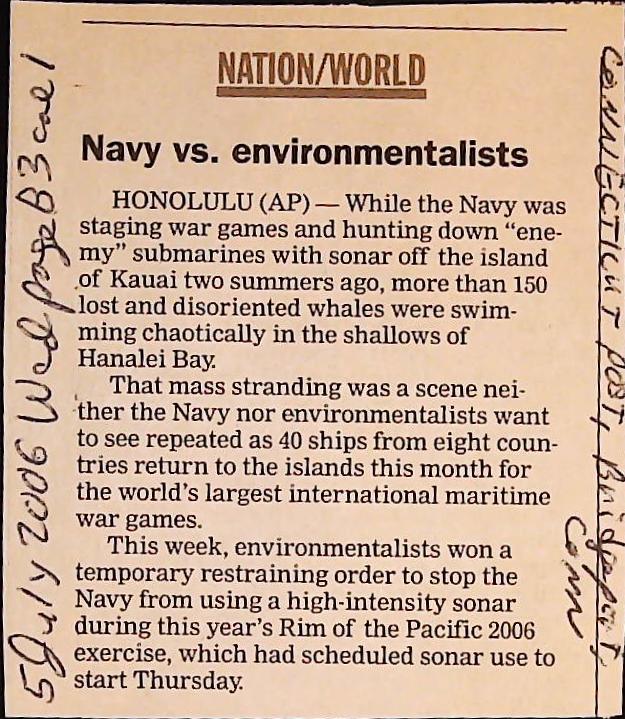
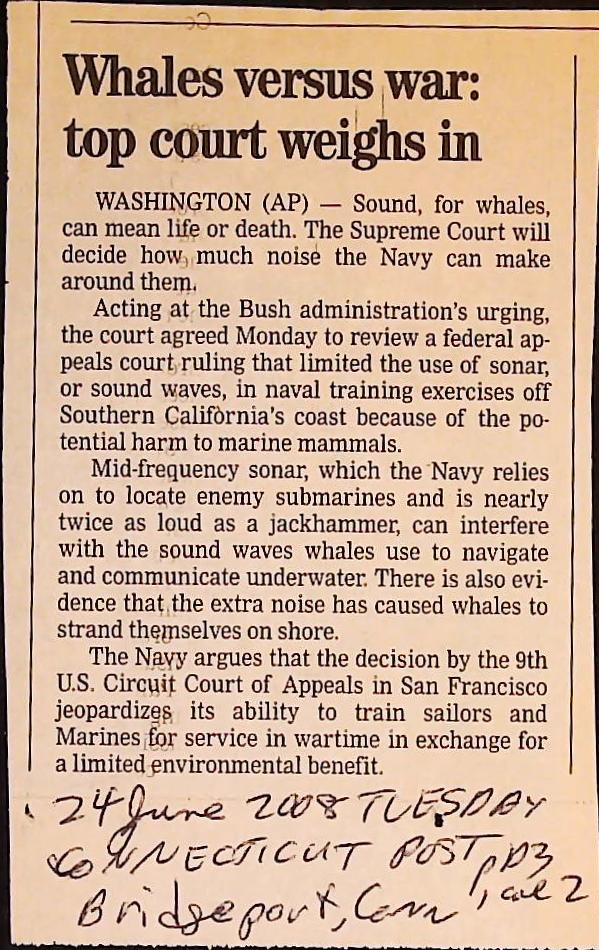
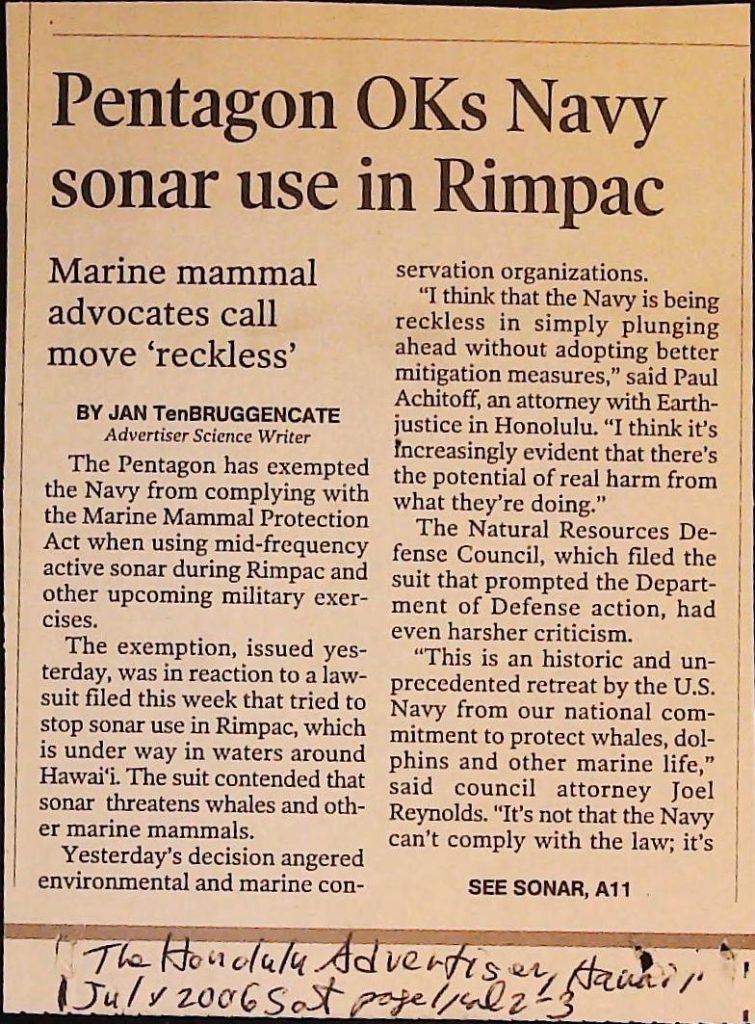
Folder 45. Marine Mammals Effects of Experimental Underwater Sound
Item 1. Newspaper Clippings
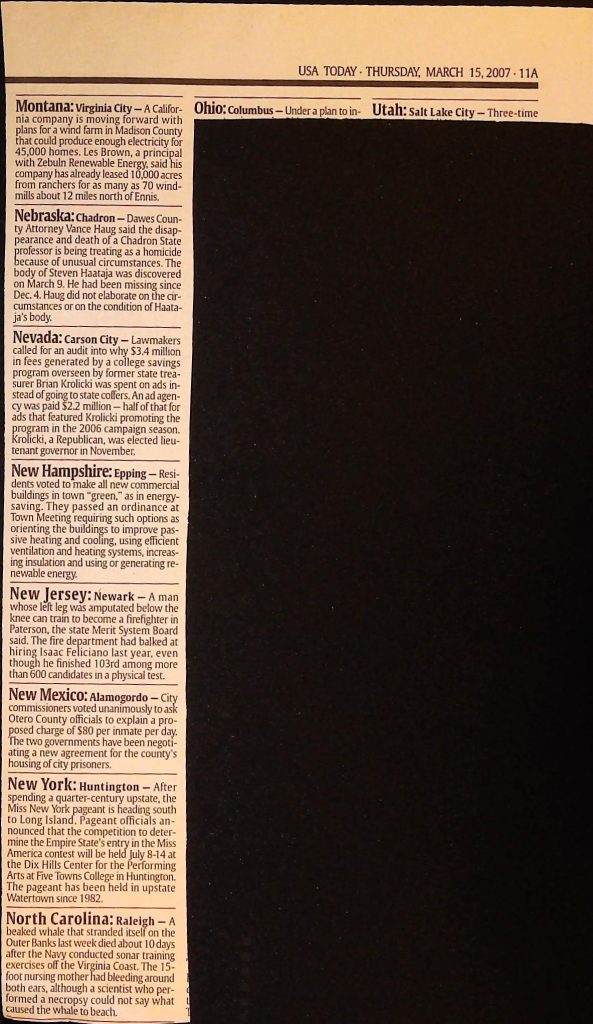
Transcribed Text (OCR)
GARY MANGIACOPA ARCHIVE ============================================================ Title: B4F45I1 Slug: b4f45i1 Categories: Uncategorized Source: https://garymangiacopraarchive.com/b4f45i1 Pages: 30 scanned, 30 extracted OCR: Google Vision API (document_text_detection) Processed: 2026-06-06 ============================================================ USA TODAY THURSDAY, MARCH 15, 2007-11A Montana: Virginia City-A Califor- Ohio: Columbus - Under a plan to in- Utah: Salt Lake City - Three-time nia company is moving forward with plans for a wind farm in Madison County that could produce enough electricity for 45,000 homes. Les Brown, a principal with Zebuln Renewable Energy, said his company has already leased 10,000 acres from ranchers for as many as 70 wind- mills about 12 miles north of Ennis. Nebraska: Chadron-Dawes Coun- ty Attorney Vance Haug said the disap- pearance and death of a Chadron State professor is being treating as a homicide because of unusual circumstances. The body of Steven Haataja was discovered on March 9. He had been missing since Dec. 4. Haug did not elaborate on the cir- cumstances or on the condition of Haata- ja's body. Nevada: Carson City - Lawmakers called for an audit into why $3.4 million in fees generated by a college savings program overseen by former state trea- surer Brian Krolicki was spent on ads in- stead of going to state coffers. An ad agen- cy was paid $2.2 million - half of that for ads that featured Krolicki promoting the program in the 2006 campaign season. Krolicki, a Republican, was elected lieu- tenant governor in November. New Hampshire: Epping – Resi- dents voted to make all new commercial buildings in town "green," as in energy- saving. They passed an ordinance at Town Meeting requiring such options as orienting the buildings to improve pas- sive heating and cooling, using efficient ventilation and heating systems, increas- ing insulation and using or generating re- newable energy. New Jersey: Newark - A man whose left leg was amputated below the knee can train to become a firefighter in Paterson, the state Merit System Board said. The fire department had balked at hiring Isaac Feliciano last year, even though he finished 103rd among more than 600 candidates in a physical test. New Mexico: Alamogordo - City commissioners voted unanimously to ask Otero County officials to explain a pro- posed charge of $80 per inmate per day. The two governments have been negoti- ating a new agreement for the county's housing of city prisoners. New York: Huntington - After spending a quarter-century upstate, the Miss New York pageant is heading south to Long Island. Pageant officials an- nounced that the competition to deter- mine the Empire State's entry in the Miss America contest will be held July 8-14 at the Dix Hills Center for the Performing Arts at Five Towns College in Huntington. The pageant has been held in upstate Watertown since 1982. North Carolina: Raleigh - A beaked whale that stranded itself on the Outer Banks last week died about 10 days after the Navy conducted sonar training exercises off the Virginia Coast. The 15- foot nursing mother had bleeding around both ears, although a scientist who per- formed a necropsy could not say what caused the whale to beach. [PAGE BREAK] Whale deaths tied to sonar tests By RICK WEISS The Washington Post The mysterious mass stranding of 16 whales in the Bahamas in March 2000 was caused by U.S. Navy tests in which intense underwater sounds were generated for 16 hours, accord- ing to a new government report com- piled by civilian and military scientists. The report's conclusions mark the first time that underwater noise other than from an explosion has been shown to cause fatal trauma in marine mam- mals. The military's acknowledgment of responsibility also marks a sharp de- parture from earlier statements by the Navy, which had denied responsibility for the Bahamian beachings and other mass strandings of marine mammals that coincided with sonar exercises. Experts said the study which re- lied on an elaborate airlift of frozen whale heads from the Bahamas to a Harvard Medical School X-ray facility places the Navy on notice that it will have to balance more carefully its need to conduct underwater sonar tests against the need to protect ma- rine mammals. The report, approved by Navy Secretary Gordon R. England, concludes that the Navy should "put into place mitigation measures that will protect animals to the maximum extent practical" during peacetime training and research efforts. But the report also allows for the sus- pension of such protections in the inter- rloaf/usa. 26 LIFT TICKETS mber 19 through March 27, ase lift tickets for $26 each. must show valid Maine ID. One ticket per person, per day. HE-LOAF info@sugarloaf.com est of "national security," a broad ex- emption that has yet to be defined in practice. And it does not answer the contentious question of whether marine wildlife may also be imperiled by a dif- ferent kind of sonar test proposed by the Navy, one that would involve much low- er-frequency sound waves in the ocean. The latest report, a joint project of the Navy and the National Marine Fisheries Service, grew out of the beaching of 16 whales and a spotted dolphin on Bahamian shores over 36 hours starting March 15, 2000. Seven of the animals five Cuvier's beaked whales, one Blainville's beaked whale and the dolphin - died. Ten other whales were pushed back to sea, and their fates are unknown. The strandings coincided with a nearby Navy exercise meant to im- prove coordination among ships sailing through enemy-infested channels. The test involved middle-frequency (about 3,000 to 7,000 cycles per second) sonar studies in which underwater noises of about 230 decibels were generated. Shalel Way psychic [AD] 474-1425 or 474-1209 "Why try the rest, when you can have the best?" As seen in the' New York Times, Washington Post, Baltimore Sun, etc. Tarot Card Readings Astrology GIFT DONATIONS Have New Windows & Siding Installed VINYL REPLACEMENTA WINDOWS Save up to 25% Lifetime Manufacturers, Guarantee VINYL SIDING Save up to 22% Installed year-round WINTER SAVINGS ORDER NOW AND SAVE Vinyl Siding Replacement Windows Gutters Storm Doors Interior Renovations Roofing Garages Additions • Decks Call [AD] 1-800-464-3039 [AD] Augusta 626-3039 www.all-season.com ALL SEASON HOME IMPROVEMENT CO. Free Estimates 100% Financing 1 Janzoor TUESDAY Kengebec Journal TUESD page 8'3 and 2-4 Augusta, Maine [PAGE BREAK] une bec Journal, Augusta, Ma Study looks at noisy boats' effect on fish By MEREDITH GOAD Guy Gannett Service As if fishermen didn't have enough to worry about, now it appears their boats may be too loud. A new study performed by a group of hearing-impaired stu- dents shows that the noise created 66S Some of the noise they found would cause some short-term deafness (in humans) after an eight-hour exposure, according to OSHA standards. 99 by fishing vessels in the Gulf of Monday 15 Jan 1996 Maine may be enough to damage the sensitive hearing of whales and dolphins. "Some of the noise they found would cause some short-term deafness (in humans) after an eight-hour exposure, according to OSHA standards, said Peter Scheifele, a marine acoustics spe- cialist at the University of Con- necticut's National Undersea Research Center. Noise pollution in the sea has become a hot new topic in marine research circles. Recently, a con- troversial global warming experi- ment in the Pacific Ocean that sends blasts of sounds through the sea via underwater loudspeakers was redesigned after critics com- plained that the noise created by the project might deafen marine mammals. The new study, conducted by stu- dents from the American School for the Deaf in Hartford and supervised by Scheifele, suggests that noise from fishing vessels could interfere with marine mammals' ability to Page 10 cal 1-4 navigate, hunt for food and avoid danger. Though it's just one study, Scheifele says, it's an important first step toward understanding the effects of low-frequency noise on whales and dolphins. And it is the first study to translate the underwa- ter racket that these creatures hear into human terms. "The whole problem of noise ver- sus whales is that there's not much written on it," Scheifele said, "and nobody really knows what they live in as the norm, much less what is happening when we put boats into the water. We're at the very, very beginning of this." The students who performed the study were participating in the National Undersea Research Cen- ter's High School Aquanauts pro- gram. Each year the program recruits different schools from Peter Scheifele, marine acoustics specialist University of Connecticut around New England to participate in marine research and education programs. Scheifele lectured to the students throughout the year, teaching them about oceanic acoustics and show- ing them how to "listen" to under- water sounds by looking at audio- grams. Then the group went out to Stell- wagen Bank, a marine sanctuary and fishing area in the Gulf of Maine just north of Provincetown, Mass. Stellwagen Bank traditionally has been a favorite hangout for hump- back, finback and minke whales and white-sided dolphins. The students used hydrophones to measure sounds transmitted underwater at different times of the day, along with taking a census of the animals they saw and the num- ber of fishing vessels in the area. Whales and dolphins have much more advanced auditory systems than humans. They hear a broader spectrum of sound, including ultra- sound, says Scheifele, who did some of the original work with dol- phins that led to the development of fetal ultrasound machines in hospitals. "If you looked at the number of nerve fibers that are on our main brain stem that allow us to sense " he noise, you're looking at 55,000,' said, "compared to an average whale that contains 115,000 nerve fibers that are there for the sole pose of processing sound." pur- Scheifele and some of his stu- dents are now working on a three- year follow-up study, using subarc- tic beluga whales in Canada's St. Lawrence estuary. Scheifele plans to measure the noise levels from boat traffic that goes through the area during the year and observe the whales' behav- ioral responses. When a whale dies, Scheifele will bring its ears back to Connecticut for an examination. "We'll run them through an MRI and X-ray to try and find out if there's actually any physical dam- age to the inner ear," he said. Utility Grade [PAGE BREAK] SATURDAY cal 2-4 pagec 5 Marine researchers discovering sea sounds not always soothing BOSTON (AP) - The "silent world," as Jacques Cousteau called the ocean depths, is not so silent after all. Some places in the deep blue sea are getting to be as noisy as Times Square at noon, researchers say. Among the aquatic noisemak- ers: screeching icebergs in the Arctic Ocean, chattering shrimp along the South Carolina coast and clanging oil rigs in the North Sea. While some places in the sea are as quiet as a Nebraska prairie at midnight, others sound like under- water fiestas, according to a study done by researchers at the New England Aquarium, the Massachu- setts Institute of Technology and Cornell University. Whaling areas in the North At- lantic have about the same noise level as a busy New York intersec- tion, or more than 100 decibels, says Arthur Baggeroer, an ocean engineering professor at MIT. The South Pacific registers the least amount of noise about 65 decibels because of its distance from commercial shipping lanes. "Unlike things on the surface, sounds underwater can actually be louder because of a chamber ef- fect," Baggeroer says. "Black Sea dolphins in Russia can make sounds that we may not be able to hear, but they sound quite loud to other fish and animals." Baggeroer and fellow re- searcher William Spitzer say the ocean echoes as sounds travel through layers of water at different speeds, depending on temperature and water pressure. Sound travels faster at the sur- face and more quickly through warmer water. "The result of that is sound that starts in the layer, bounces up against the top of that layer and it tends to get louder," says Spitzer, an oceanographer for the New England Aquarium. "It's like speaking in a tube." The sounds traveling through the sea include the gurgling of toad fish in the Caribbean; the bell-like call of walruses; the squeaking of dolphins; and the thumping of mo- tors and other machinery. The research was compiled from studies over the last decade, including data recently declassified by the Navy. The Navy for the past several years has used high-pow- ered underwater microphones to monitor enemy submarines. The research found that click- ing noises of shrimp registered more than 80 decibels. Oil rigs can ring out about 180 decibels. The key question now for re- searchers is how sound affects sea creatures, which detect noise and vibration through an auditory or- gan or a vein, called a lateral line, that runs across the body. CONNECTICUT POST, BRIDGEPORT, CONN ZIMAR 1998 [PAGE BREAK] Daily News, Not. 28 May 2008 ter sonar tests wacky by military underwa- Whales are being driven WASHINGTON THE ASSOCIATED PRESS on whales decision in sound Pentagon Sunday and the Environmentalists in New Jersey. conducts a military exercise other marine life when it be harmful to whales and ume sonar tests that could ed not to perform high-vol- The Pentagon has decid- Navy is feeling their pain. wel- pute over whether an effort marks an escalation in a dis- comed the decision, which PIP & PIP On Screen Display Stereo-Remote PIP #52978-DELIVER [AD] $958 Flat Scr SONY VEGA Flat Out Better 36" SONY 36° WEGA FD TRINITRON FLAT SCREEN TV -STEREO SURROUND SOUND 1 YEAR SONY USA WARRANT #36E510 [AD] $1299 VCR's -REMOTE CONTROL FAMOUS MAKERHEAD VCR 4-HEAD ON SCREEN DISPLAY 899 Quasar by 4 HEAD VCR Panasonic REMOTE CONTROL -ON SCREEN DISPLAY 4-HEAD VHQ-400 [AD] $77 7 day exchange policy-NO REFUNDS. DCA #0 ambare built-to-order and may require pick up at from the date of purchase. If minimum monthl [PAGE BREAK] by the Navy to test and de- ploy advanced underwater detection systems is danger- ous to the huge mammals. The Navy in a statement said its Littoral Warfare Ad- vanced Development test 45 miles offshore will go ahead this coming week but will "not include active acoustic sources." Many scientists believe that whales and other ma- rine mammals mammals can be harmed by the extremely high-decibel sounds emit- ted by the Navy's new sonar systems. The animals rely on their hearing for navigation and can suffer hearing loss and other problems because of the sonar noise, which can be greater than a 747 jetlin- er at takeoff. Two months ago, a dozen whales beached themselves in the Bahamas a day after the Navy used the intense sonar in exercises there. Earlier this month, the Commerce Department's National Marine Fisheries Service sent a letter to the Office of Naval Research complaining that the Navy's assessment of potential en- vironmental damage was in- adequate. Crew tracks down arma-dino fossil BUENOS AIRES Fossilized remains of an armadillo-like dino- saur were discovered during exca- vation to extend a subway line in the western end of Buenos Aires. Paleontologists Fernando No- vas and Augustin Scanferla of the Argentine Museum of Natural Sci- ences identified the fossil as be- longing to a 365-pound glytodant, an armadillo-like dinosaur that had a tail equipped with an 18-pound club. Officials said they expect to dis- play the remains at the future Tri- unvirato subway station, where it was found. The animal was estimated to be about 7 feet long and 4 feet tall. The excavation crew found it about 40 feet underground. Reuters [PAGE BREAK] Page D4 New Haven Register, Thursday, January 16, 1997 HEALTH/SCIENCE Loud: Scientists believe noise hurts ocean wildlife Continued from Page DI realized that there must be an inor- dinate amount of boat noise," he said. "I found noise levels to be very high." At least for whales, which have extremely acute hearing. Beluga whales have an external pinhole, filled with wax to make it waterproof. The whale, which is a mammal, has basically the same components as the human ear. The tiny sound- transmitting bones in the middle ear are suspended on ligaments, to muffle extraneous noise. Whales have the sound-sensitive cochlea that transmit nerve impulses to the brain. The beluga whale also has oil- filled cavities on its jawbone that act like an additional pair of ears, Scheifele said. Tests in aquariums in which the whales push a paddle for a food reward when they hear sounds show that beluga whales have ex- standards allow an unprotected tremely sensitive hearing. Unlike larger baleen whales that communicate over vast distances with low-frequency songs, the be-, luga is tuned to high frequencies, some so high that humans cannot hear. High frequency sounds are es- sential to a fish-hunting whale, be- cause according to the laws of physics, the higher the frequency of the wave, the smaller objects it can detect. "They see by hear- ing,' Scheifele said. Scheifele used hydrophones to measure sound in water during June through September, when mi- grating humpback and fin whales attract crowds of watchers. These ships compound the noise pro- duced by cargo vessels. Scheifele calculated that the be- lugas are assaulted by noise that would be the equivalent of 85 decibels to a person. Federal safety worker to remain exposed to 85 decibels for no longer than 15 min- utes. After that, temporary hearing damage such as ringing in the may result. ears "What the whales are hearing is the equivalent of 85 decibels, which is on the brink of temporary damage. While the whales can move away from ships, they have no ways to protect their ears, and Scheifele said. cannot escape," The mouth of the St. Lawrence reverberates sound like a swim- ming pool, making the problem worse, he said. Relentless temporary damage eventually becomes permanent. Ears of dead beluga whales from the area show signs of ac- coustic trauma. Will the whales go deaf, or somehow adapt? Re- searchers are not sure. But it is unlikely that an animal as complex as a whale can evolve new ears rapidly. Scheifele and colleagues have applied for a grant from the Cana- dian National Institute of Ecotoxi- cology to study the effects of noise on the beluga whales. Scheifele said his interest was sparked by experiments to send sound waves through the ocean and measure their speed to check for global warming. "Fortunately, no damage is likely from that," he said. The ears, not to mention the sound production of beluga whales, is not well understood. The proposal includes the Mount Sinai School of Medicine in New York, which would analyze the an- atomy of the whale ears and deter- mine if damage is being caused. Besides solving a biological mystery, "There are always fortui- tous discoveries in science,' " said Joy Reidenberg, assistant professor of cell biology and anatomy at Mount Sinai. If noise is found to be causing significant damage, restrictions could be placed on the number of whale watching excursions at any given time, or incoming cargo ships could be spread out, Schei- fele said. "They're mammals too, so this needs to be done in an intelligent " he said. "These whales manner, have no workman's comp. [PAGE BREAK] Hennebec Journal Thursday Understand watershed To the Editor: am writing in response to a re- I cent article appearing in the Kennebec Journal describing a pro- posed development project in the town of Manchester. The develop- ment project, an outpatient diagnos- tic center that will be part of the MaineGeneral Medical Center, is to be located near the watershed di- vide of Cobbossee Lake and Bond Brook The article described the impor- tance of this watershed divide, "Part of the land may flow water to Cob- bossee Lake or part may flow to Bond Brook... If it flows to Cob- bossee, then we need to deal with the Cobbossee Watershed District. Runoff can be discharged into Bond Brook because it dumps into the Kennebec River and into salt wa- ter." Depending on which watershed the outpatient center ends up resid- ing in will determine what permits will be necessary, and how the de- veloped area will be designed. If the new outpatient center is constructed entirely in the Bond Brook watershed the developers, in this case MaineGeneral, will not have to deal with the Cobbossee Wa- tershed District, or more important- ly with the runoff from parking ar- eas and rooftops. However, if a portion of the pro- ject is in the Cobbossee watershed, ** Augusta, Maine 101 page 16 calen 6. 9 Aug 2001 LETTERS: WHAT YOU THINK BEFORE WE START THE LOON CALL CONTEST, MAY I ASK, WHEN IS THE FULL MOON CARLSON KENNEBEC JOURNAL the value of the natural resource lost. The Kennebec County Soil and Water Conservation District can help you to minimize your impact on our natural resources. Contact us at [AD] 622-7847 ext. 3 or stop by our office glimpse of the Philip Morris behind the smokescreen from the minds of consumers and policymakers. Kelle Louaillier Campaign Director Infact GOOD POINT. WAIT A MINUTE, I'M TALKING TO MY HANDS? 10 15 72 We need to stop funding and deploy-* ment of this system. The Navy wants to deploy its "Low-Frequency Active" (LFA) high-powered sonar system across 80 percent of the Earth's oceans. Designed to detect enemy sub- marines by bombarding vast ex- [PAGE BREAK] HIS TUTION remove phosphorus before it leaves the project area and makes its way toward the lake. This treatment can be accom- plished a variety of ways, all of which will add extra costs to the project. Obviously, MaineGeneral would prefer to build in the Bond Brook watershed because it will save them money in construction, due to the fact that runoff can be directly dis- charged into Bond Brook. All of this implies discharging at the Fou Green St. in Augusta. Nate Sylvester Lakes Specialist Kennebec County SWCD Boston, Mass. tscherna@hotmail.com Augusta Who's harassing whom here? nate-sylvester@me.nacdnet.org Seeing beyond runoff into Bond Brook will not have smokescreen a detrimental impact on the brook. This is untrue. Non-point source pollution is a real threat to Bond Brook's water quality, as it is to every body of wa- ter in Maine. MaineGeneral could build in the Bond Brook using the same tech- niques to treat runoff that would be required if the project were in the 10 Cobbossee watershed, but it would ud be more expensive. rea pu -AД m- Teun As is often the case in a capitalist system where natural resources are grossly undervalued, the environ- ment and the almighty dollar are jeu pitted against each other. -10 Often natural resources aren't -II! I considered valuable until they have jean been degraded biologically and eco- qa nomically. be a -old o S At that point they are put on a -9791 "list," development restrictions are To put in place, and large amounts of money are spent to restore water o pap quality. A proactive approach is needed to minimize the impact of new development on our natural re- sources before they lose their value. snu Development and conservation can -doo ar coexist; it just seems to cost more. However, these up front expenses dwarfed by the cost of restora- Z201-0 tion, and are minimal compared to ep je are To the Editor: udos to the Kennebec Journal Kfor running the hard-hitting ad criticizing Philip Morris for extolling the positive effects of tobacco-relat- ed deaths in the Czech Republic. A glimpse at the real Philip Morris be- hind the public relations onslaught is rare these days. In 2000 Philip Morris increased its corporate advertising by 1712 percent over 1998 (spending $309.9 million). The tobacco giant has pulled out all the stops in its at- tempts to convince the U.S. public that it has changed. The ad reminds us that human lives, according to the "Marlboro Men," are valuable insofar as they benefit the corporate bottom line. In the face of ongoing public out- rage over the report the tobacco gi- ant commissioned and circulated in the Czech Republic, the Philip Mor- ris PR machine is once again in overdrive, trying to convince us that the tobacco giant really does care about people and has seen the error of its ways. Even the smoothest PR maneu- vers and the most heart-warming commercials will not soon erase this To the Editor: I n the Kennebec Journal of Aug. 3 your page one headline: "Speak- er Intervenes in Dispute" is ampli- fied by your first paragraph where the word "spouse" refers to some- one who was reported to have been harassed by Rep. Stavros Mendros. Almost always when a spouse is harassed by some man, the ha- rassed "spouse" is a woman and the nature of the harassment is usually rather indecent. Coupled with your headline, most people who don't get as far as para- graph 7 are given the impression that Rep. Mendros is a lecher. He is not. It is no wonder that people con- sider politics to be a dirty business. Albert F. Gilman III Mt. Vernon Can sonar be deadly? To the Editor: good friend in Vermont has A alerted us to a new threat to the Earth's environment: The U.S. Navy plans to blast the world's oceans with a dangerous new sonar system. panses of oceans with sound, & has the potential to seriously affect many marine mammals, such as dolphins and whales that inhabit Maine waters and other portions of the oceans. LFA noise is billions of times more intense than those known to disturb whale migration and com- munication. Deafening noise from the LFA system will interfere with the vital biological activities of ma- rine mammals. Long-term exposure could push entire populations over the brink in- to extinction. Last year, whales from four dif- ferent species stranded themselves and died on beaches across the northern Bahamas during a Navy military exercise. All but one of the dead animals examined by researchers had suf- fered hemorrhaging around the in- ner ear- a sure sign of acoustic trauma. The Navy's own report concluded that it is "highly likely" that the stranding was caused by the use of mid-frequency active sonar. Despite those tragic events, the Navy now wants to deploy LFA, the most exten- sive active sonar system ever de- vised. We believe that it is uncon- scionable to expose marine mam- mals living in Maine waters and elsewhere to higher intensity sonar. If you, too, are concerned, you can call the local offices of your con- gressional representatives and ask them to turn off LFA sonar by cut- ting off its funding. Savard B. Brewster Carol W. Brewster. Manchester pray can [PAGE BREAK] With the Arts And Entertainment Copyright 1993 The New York Times Science Times The New York Times TUESDAY, OCTOBER 19, 1993 Human Noises in Ocean Held to Threaten Marine Mammals 220 DECIBELS Dolphins Airguns, etc. (geophysical surveys), 200 Ocean tomography (sound probes) 180 The Not-So-Silent Deep Each oval indicates the typical upper and lower decibel range of the sounds produced by some oceanic noise- makers. All these noise sources typically exceed a new limit proposed to enforce the Marine Mammal Protection Act. Scientists do not know how much noise of what frequency, type and duration harms various species of marine mammals, but suspect the danger may be greater than realized. Whales (general) W By MALCOLM B. BROWNE DENVER ITH the world's oceans increasingly disturbed with man-made sounds, sci- entists are facing a vexing dilemma: ies about sea creatures and their environment are many of the most important discover made by the use of sound, but some sounds generat- ed by scientists may be contributing to the destruc- tion of the very mammals they want to protect. At a meeting here of the Acoustical Society of America this month, scores of experts presented evidence that the welfare and lives of some marine mammals were increasingly threatened by noise of human origin. The cacophony bombarding animals in the sea comes mostly from industrial underwater explo- sions, ocean drilling, oil rig construction, ship en- gines, icebreakers, submarine sonar devices, su- personic aircraft and countless other human sources of noise, not to mention the natural thunder of cracking polar ice fields, marine earthquakes, storms, underwater volcanoes and sounds made by the animals themselves. . But a certain amount of ocean noise is generated by scientific research. Loud, low-pitched noise can travel immense dis- C1 tances through water, often reaching halfway around the world from its source, and spreading and reverberating in all directions. Oceanic noise pollution has reached such a point that the Federal Government is considering a ban on some loud human noises. The National Marine Fisheries Service, which is responsible for enforcement of the Marine Mam- mal Protection Act of 1972, is considering new regulations that may limit scientists to making no ocean noises louder than 120 decibels. The harass- ment of marine mammals is forbidden by the Marine Mammal Protection Act, and in April the Government is expected to define excessive noise as a form of harassment. Some experts have observed that 120 decibels can frighten whales away from their normal mi- gration routes, contending that noise of this intensi- ty should be designated as an upper limit. But the suggested 120-decibel limit has brought a storm of anxious comment from underwater acous- ticians, oceanographers, geologists, bioacoustic ex- perts, climatologists and other scientists whose research depends on oceanic sound, including the kind made by underwater loudspeakers and explo- sions. At a series of discussions during the acoustics meeting here, scientists voiced their objections to Continued on Page C12 Fin whales Each commercial ship 160 140 An Experiment's Worldwide Echoes Canadian research Vessel Russlan Bermuda research vessel Canadian research vessel Los Angeles Samoa Ice noises in polar regions India Ascension I. Christmas 1. Geophysical phenomena (volcanoes, earthquakes) South Africa New Zealand 120 ANCE Breaking wave in 30-knot wind Small boat and outboard motor Kerguelen research vessel Hobart Heard I Source: John R. Potter Marine Physical Laboratory, Scripps Institute of Oceanography The New York Times; Illustratida by Patricia J. Wynne Some scientists say the proposal to limit man-made noises to 120 decibels would shut down research in underwater acoustics and marine geology. They say underwater noise would have to reach 195 decibels to cause distress equivalent to 120 decibels in the air. Source: T.M. Georges NOAA Mawson The New York Times 1991 Heard Island experiment tested technique for measuring ocean temperature based on sound speed; 209-decibel test signal was detected at 11 of 14 listening posts [PAGE BREAK] EVER LONDER NEW HAVEN REGISTER INSIDE Classified D5-12 are they serious? What are fibroid tumors and Fib chang Fibroids are solid, benign masses that grow in or outside the uterus, or within the uterine wall. They can be as small as a pea or as large as a soccer ball, aren' and less than 1 percent are cancerous. Ho About a quarter of women develop fibroids, usual- doctor ly in their 30s. The growths occur three times more drugs often among blacks. ids ch as ibuprofen should be monitored for growth or other Many doctors recommend that if the fibroids othering you, there's no reason to worry. ver, if fibroids cause pain or bleeding, a nay suggest a nonsteroidal anti-inflammatory ptoms worsen, surgery may be required to the fibroid but preserve the uterus. If your commends a hysterectomy, get another opin- gynecologist experienced in removal of If sy Most women with fibroids don't have any symp- remove toms. Others suffer from backaches, constipation, dif- doctor ficult bowel movements, frequent urination, menstru- ion ag al problems and rectal pain. only the tumors. or naproxen. Slither over to snake talk How heavy is the world's largest snake? How long is the longest? Is a fear of snakes inborn or learned? How have these terrestrial crea- tures managed to be so successful without legs? These are just a few of the questions that will be answered on Feb. 2 at 2 p.m. by Dr. George Whitney, a local veterinarian who has the only practice in the country limited to reptiles. The program will be presented in Yale's Kline Geology Laboratory by the New [AD] Haven Land Trust. Call 466-7701. EXPLORE EVENTS of INTERES THURSDAY, JANUARY 16, 1997 PAGE D1 HEALTH/SCIENCE D If we find ET, how will we know? s research spacecraft speed through space toward Mars, it's difficult not to A space toward and quantity of extraterrestrial life in the universe. Science fiction writers have spent a cen- tury or more imagining creatures from other worlds. Some Earthlings report meeting little creatures with big heads and almond-shaped eyes, who arrive in flying saucers. What was so thrilling about the discov- ery of possible past Martian life last August was that the tiny fossils in the meteorite look-at least superficially - organisms. life. like earthly In other words, it looked like "real" ABRAM KATZ GRAY MATTERS The little cell-like bits of rock were reas- suringly mundane. Not a fossil of some un- imaginably horrific monster, represented by a huge needle-tooth, or a hand with 50 fingers. Or an amoeba made out of beryllium, a leaf composed of silicon. Teeth and hands would be relatively easy to recognize because they're abundant on Earth, but what if the evidence from Mars was unidentifiable? Could life on other planets be so alien that humans would have trouble recognizing it as such? This question seems to revolve around our view of the universe, which in turn is a Beluga whales live in arctic and subarctic waters. WHAT'S all the RACKET? [PAGE BREAK] reflection of ourselves. Science has shown progressively over the centuries that Earth is not the center of the universe, nor the sole planet; that the sun is one of trillions of stars, and that the Milky Way is but one galaxy out of millions. Astronomers determined that the laws of physics - the laws of nature are the same throughout the visible universe. So how much latitude can life have, and why should it be any different on any other world? Stars millions of light years away oper- ate on exactly the same principles that govern stars in our galactic neighborhood. Regard- less of the planet, a rock falls down, like electrical charges repel, photons travel at the speed of light and elements undergo the same reactions. Could this homogeneity extend to life? Why shouldn't it? Earth is the only planet on which we can observe life, and our planet suggests that there may be a limited number of animate designs. Convergent evolution has rendered birds, insects and mammals with wings. A spider is about as different from a human as you can get without going microscopic, yet it's easy to identify its eyes, enzymes and ge- netic material. How stunning, how shocking it would be to discover that other planets are not pop- ulated by totally alien life forms, but essen- tially the same flora and fauna as on Earth. That would have devastating philosophical and religious implications. We consider life miraculous. Maybe it's nothing special. Or, extraterrestrial life could be com- pletely different. So different that it is not ea- sily recognizable as life. Carl Sagan, the late and great supporter of the search for extraterrestrial life, said the "I'll know it when I see it" approach is too limiting. On the other hand, defining "life" in a most general sense is not so simple. Does life consume, metabolize and ex- crete? Perhaps, but so does a car. Could life be characterized by a change in thermo- dynamic equilibrium (it's warmer than its surroundings, for instance)? That's insufficient because many natural phenomena are out of balance, such as rust and many inorganic reactions. Sagan pre- fered the definition of life as anything that re produces, mutates and reproduces the mutation. This could make recognition difficult. The organisms might only reproduce every millenium, and mutations could be rare. Recently Japanese scientists implanted tiny computers on the backs of cockroaches, which allowed the humans to steer and control the insects. Suppose one of these cockroach/robots becomes fossilized, and through some cos- mic cataclysm, ends up on another planet with intelligent life. Which part would they think had been alive? How could they tell? Beluga bio Characteristics: ►Its thick blubber, white color and lack of dorsal fin allow the beluga to move freely among ice floes in freezing water. The beluga's body is thick, muscular and tapered at each end. The seven vertebrae in the beluga's neck are free, allowing it to nod and turn its head. It is one of the most vocal cetaceans, earning it the name "sea canary" from early whalers. Size: ► Adult males average 14-16 feet and weigh 3,300 pounds. Adult females average 13-14 feet and weigh 3,000 pounds. Source: American Cetacean Society TELL L.NOG D Jon http://macnelly. I Ship noise may be harming rare beluga whales and I other marine life By Abram Katz Register Science Editor The ocean brims with sounds besides the swish of waves, the songs of cetaceans and the splash of sea fowl. There's the drumming of cargo ship engines, the whine of trawlers and other ships, the clatter of off-shore oil platforms and numerous oth- er artificial claps, clunks, bangs and pings. Marine biologists are now beginning to realize that this marine sound pollution may have a profound and un- healthy effect on whales, oth- er sea mammals and fish. Nowhere has this become clearer than in the St. Law- rence River estuary in Canada. The pod of unique subarc- tic beluga whales that lives near the entrance to the heav- ily traveled St. Lawrence Seaway experiences the tha- lassic equivalent of standing next to a roaring lawn mower several hours a day. Peter M. Scheifele, direc- tor of bio-acoustic research at the Marine Science and Tech- nology Center at the Univer- sity of Connecticut at Avery Point, made this finding while researching the racket that these whales must endure. Marine biologists are stud- ying the St. Lawrence belu- gas because the toothed whales have been decimated by pollution and are the last 500 members of this sub-spe- cies. Another 22,000 beluga whales of a different sub-spe- cies live in the Arctic. Besides the chemical as- sault, the St. Lawrence whales also could be mal- nourished and less able to re- produce because their hearing may be impaired, Scheifele said. This is because like many whales, the beluga depends on a sound-emitting sonar system and a complex hear- ing mechanism to avoid ob- stacles, locate fish and mate. A deaf beluga whale is al- most as good as dead. Scheifele is working with Canadian marine biologists to devise a plan to save the whales from extinction and build population. Pollution from paper mills and other industries has been largely curtailed, he said. "We have further mitigate to difficulties. Scheifele, a former subma- rine sonar officer in the U.S. Navy, was naturally inter- ested in the sounds at the mouth of the St. Lawrence. From observing whale watching boats and the steady stream of commercial ship- ping to the Great Lakes, "I Please see Loud, Page D4 me to u ure 8 e 'pe op best cool was a t - to be an c) a KRT, Register staff s (8 as to ex p A to me on the I as a fun to a b c d e a b c d open a spot e f a se do Au a po - (шoм pш) ш spшesnoч Au to be Aq s t HAVEN BRO G'W My son was no sy pads are a ps no oдdo pa se -шdoлdde uе Á a b c d e 1 od up a to pursu -jou moдч put II! Si aдo I - pue ш BEETLE B MAN OF CARE OF ORIGIN SH reserved OLE FOR SIHL CHEMI Asdoiq pa se po ps of anal p sabi ko p r s t Z66 9 jener Kepsin a ta med [PAGE BREAK] 2cal 3 Death of whales halts experiment SAN FRANCISCO (LAT) - A con- troversial ocean sound experiment off Half Moon Bay has been halted indefinitely after the discovery of three dead humpback whales in the area, Scripps Institution of Oceanography officials said Wednesday. The whale carcasses were found just days after the ocean-floor loud- speaker was turned on repeatedly, apparently before required steps were taken to ensure the safety of the whales and other marine life. The cause of the whales' death has not been determined, but Scripps scientists insist their repeat- ed 20-minute, 195-decibel transmis- sions were conducted properly and are not to blame. Critics of the project, however, accused the scientists of acting in "bad faith" by broadcasting the low, rumbling sound without monitoring the effect on marine mammals as required under their federal permit. "What is most disturbing is that Scripps violated the conditions of their permit and turned on the sound source," said Sara Wan, vice chairwoman of the League for Coastal Protection. "None of the pro- tocols that were agreed to were fol- lowed." Three humpback whales dying in the same area at the same time is very unusual, and because of the cir- cumstances, the cause of their deaths may be difficult to pin down. KENNEBEC JOURNAL MAINE'S OLDEST NEWSPAPER November 16, 1995 Vol. CLXX (USPS 143-620) 32 pages No. 307 Published daily except Christmas Day at 274 Western Ave., Augusta, Maine 04330 by Guy Gannett Communications. Second-class postage paid at Augusta, ME. Postmaster: Send address changes to KENNEBEC JOURNAL, 274 Western Ave., P.O. Box 1052, [AD] Augusta, Maine 04332-1052. [AD] Subscription Rates, home delivery: one year, $148.00, six months, $78.00; three months, $39.00, one month, $13.00; one week, $3.00 By mail in Maine: six days: one year, $156.00; six months, $78.00; three months, $39.00; one month, $13.00; seven days. one year, [AD] $168.00; six months, $84.00; three months, [AD] $42.00; one month, $14.00 By mail outside Maine: six days: $16.00 per month; seven days: $17.00 per month. Single copy price, 50 cents Monday through Saturday; $1.25 on Sunday Member of the Associated Press The Associated Press is entitled exclusively to the use for reproduction of all the local news printed in the newspa- per, as well as all AP dispatches. [AD] TELEPHONES-Augusta: 623-3811 [AD] Gardiner: 582-6000 [AD] TOLL-FREE in Maine: 1-800-537-5508 TYPOGRAPHICA UNIONLABEL 643 WATERVILLE Kennebec Journal Augusta, Maine Thursday 16 NOV 1995 [PAGE BREAK] EC12 THE NEW YORK TIMES, TUESDAY, OCTOBER 19, 1993 Human Noises in Ocean Held to Threaten Marine Mammals Continued From Page Cl *Carol Fairfield, an official of the Na- tional Marine Fisheries Service. The agency exercises veto power over experiments deemed harmful to J2Whales and seals. Another agency, the Fish and Wildlife Service, is re- sponsible for enforcing rules to pro- tect sea otters, walruses, manatees 2nd polar bears. Among the scientists opposing a noise limit of 120. decibels was Dr. John R. Potter of the Scripps Institu- Gion of Oceanography at La Jolla, Calif. "In many ocean regions, sound sviat a level of 120 decibels is the natural rakbackground," he said. "Dolphin calls are far louder up to 220 decibels. Fin whale calls and commercial ships opat out about 180 decibels. The noise * from polar ice packs is about 150, and breaking waves produce 130. OCHA "A legal limit of 120 decibels im- toposed on the sounds scientists use vwould effectively close down re- search in underwater acoustics and marine geology, as well as offshore oil prospecting and drilling and many other activities." Well-meaning but ill-informed Gov- ernment regulation could make mat- ters worse, some scientists argued. Dr. William C. Cummins, an acous- tics consultant in San Diego, said that the National Marine Fisheries Serv- Gue itself recently engaged him to study the effects of underwater explo- sions on Kemp's ridley turtles in the Gulf of Mexico, only to cancel the experiment when officials discovered it would violate the agency's own regulations. Dr. Ann Bowles, the senior re- search biologist at the Hubbs-Sea World Research Institute in San Die- go, noted that decibels measured in ewater are very different from decibel r measurements taken in air, where a bise of 110 to 120 decibels causes pain to human ears. In water, equiva- lent discomfort to a human diver would be caused by about 195 deci- bels. Ms. Fairfield said that no rigid noise limit had yet been decided for the future regulations, but she told average may reflect long-term tem- perature changes of the global atmos- phere, and could reveal the "green- house" warming from carbon dioxide pollution that some scientists believe has begun. The sound used for this experiment came from an underwater speaker broadcasting from deep water near Heard Island in the Indian Ocean at an intensity of 209 decibels, roughly equivalent to 270 decibels in air, about as loud as a jetliner taking off. The Heard Island experiment pro- duced such promising results that a new and more ambitious experiment based on the same idea, called Acous- tic Thermometry of Ocean Climate, began in January. The three-year project, sponsored by the Defense Advanced Research Projects Agen- illalen nonorate noise that could ing on plankton in Chance Cove near Bull Arm, the site of heavy blasting last year to deepen a channel and remove underwater obstructions for passing tankers. Whales often become trapped by fish nets in the area, and scientists free them whenever possible. But last year during the blasting, the number of trapped whales increased sharply, Dr. Todd reported. Moreover, two of the whales, after being cut free, be- came trapped a second time, the first such instance ever recorded by sci- entists observing whale behavior in the region. (The group was able to keep track of each whale in the area by the distinctive color pattern of its flukes.) "Normally, it's the young whales that blunder into the fish nets," Dr. Todd said, "and after one bad experi- ence, they know enough to stay clear of the nets, which they may be able to Dr. Sean Todd/Whales Research Group detect by acoustic echolocation. But this was different. One possibility is that their hearing was impaired by the explosions, and they could no longer spot the nets by echolocation." Two whales were killed during the scientists' sojourn at Chance Cove by the underwater detonation of five tons of explosives. One whale was apparently killed immediately and the other survived for two days be- fore stranding. One of the leading scientists in the group, Dr. Darlene R. Ketten, a hear- ing specialist at Harvard Medical School, flew to Newfoundland to dis- sect and examine the whale's head, using antique flensing knives bor- rowed from the descendants of whal- ers living in the area. Essential parts of the whale's gigantic ears were filled with blood and pus, she report- ed, and were so badly injured that the animals would have been totally deaf Scientists dissecting the head of a humpback whale on a Newfoundland beach after an underwater explosion found that its ears were filled with blood and pus and that it would have been deaf had it survived. The researchers were Dr. Darlene R. Ketten, left, and Jon Lien. The bony structure of a humpback whale's ear is shown above. if they had survived. The whale that briefly survived the explosion may have succumbed to meningitis, a fa- tal infection caused by the ear dam- age. Scientists do not know how much noise of what frequency, type and duration is enough to harm various species of marine mammals, but they suspect that the danger may be greater than hitherto realized. It was once assumed, for example, that the atmospheric shock wave gen- erated by transport planes flying faster than the speed of sound could not project sound into the ocean be- low, but this assumption was dashed by one of the reports given at the acoustics meeting. Dr. Victor W. Sparrow of Pennsyl- vania State University presented a mathematical analysis that showed the shock wave from a plane flying at Mach 2.1, or 2.1 times the speed of sound, would send an acoustic pulse into the ocean below. The sound would be sharp and intense to a depth of about 8 feet, and would be audible to animals at a depth of 300 to 400 feet. Enforcement of oceanic noise pol- lution bans would be next to impossi- ble, however. Regulations promulgat- ed by the United States Government apply only to American waters and to American citizens throughout the world; other nations cannot be com- pelled to observe them on the high seas. Still, scientists hope that some of the worst abuses of noise at sea can be curbed. "It may be that the inconvenience of noise to marine mammals will remain unavoidable,' Dr. Potter said, "but we must try to prevent noise that causes substantive dam- age. MZ Kep y Joy 27 [PAGE BREAK] Central Maine Newspapers KENNEBEC _ A BLETHEN JOHN CHRISTIE PRESIDENT DAVID WARREN CITY EDITOR BLETHEN MAINE DAVID B. OFFER EXECUTIVE EDITOR JOURNAL NEWSPAPER GLENN TURNER NEWS OPERATIONS EDITOR FRANK A. BLETHEN CHAIRMAN OF THE BOARD JACK BEAUDOIN OPINION PAGE EDITOR PATRICIA AMMONS FEATURES EDITOR MAINE NEWSPAPERS CHARLES C. COCHRANE PUBLISHER AND CHIEF EXECUTIVE OFFICER A MEMBER OF THE SEATTLE TIMES FAMILY OF NEWSPAPERS EDITORIAL: OUR VIEW COPER Opinion Monday, November 4, 2002 A7 Sonar is killing whales NATO should stop using deadly force against the sea We've seen it before, a number of times. Then we see it again, like a recurring dream, or nightmare. The whales begin swimming ashore, right up onto the beach. They lay scattered, singly or in small groups, across long stretches of coastline. Then the whales begin dying. In the far distance, many miles away, groups of navy ships ply the seas, in preparation for war. Now we've seen it once again. On Sept. 24 and 25, at least 15 whales stranded them- selves on two of the Canary Islands. Res- cuers pushed six still-living whales back out to sea. It's not known if they survived, but at least nine other whales died. The whales were beaked whales from three different species. Necropsies were conducted on eight of the dead whales by faculty of the Veterinary Department of the University of Las Palmas de Gran Canaria and members of a local whale research organization. The prelimi- nary report states that the whales had been healthy and had fed recently, but they had suffered from cranial hemorrhaging. Michel Andre, a veterinary researcher said "autop- sies on the dead whales found brain damage consistent with impacts from military sonar signals." At the time of the stranding, NATO ma- neuvers called Neo Tapon 2002 were taking place off the Canary Islands. Large numbers of ships, submarines and airplanes, includ- ing U.S. Navy ships, were involved. Although military officials have acknowledged that acoustic exercises were being carried out, the types of sonar in use has not been made public. six Whales have become stranded en masse upon Canary Islands beaches before other times since 1985. It has been docu- mented that in at least four of these, naval maneuvers were taking place offshore at the time. Naval maneuvers have been closely linked with mass strandings in a number of other places as well. While strandings of whales have been occurring for ages, they generally involve whales from a single species. Strandings that involve several species are more unusual. There have now been 10 recorded mixed-species mass strandings involving beaked whales. In each case, naval maneuvers were occurring in the area at the time. A great many whales have likely been killed by sonar, but far from any shore, they simply sank, unknown to us. Naval high-intensity sonar is killing whales. The U.S. Navy and National Marine Community Compass Russell Way NE Fisheries Service admitted as much in a joint report on a mass stranding involving four species of dolphins and whales that took place in the Bahamas in 2000. It acknowl- edged that the Navy's mid-range tactical sonar caused the stranding and deaths of these whales. While it's obvious that high-intensity sonar is killing whales, its effect on the rest of ocean life is unknown, as no studies have been done. However, we do know some things. Research has shown that hearing in fish has been damaged by even moderate levels of noise. One study has found that sound levels of 40-50 decibels above that of the normal environment have caused both the viability of fish eggs and the growth rates of fry to decrease significantly. Fisherman in the United Kingdom have re- cently become concerned that Royal Navy sonar exercises may be causing a decline in fish stocks, and are calling for an investiga- tion into the sonar's effect on fish. Concern was expressed in a report by the National Re- search Council on the potential effects of loud, low-frequency sound on ocean life, in- cluding zooplankton, fish and turtles. It went on to say that if the food chain is affected, all of life in the oceans will be adversely affected. The U.S. Navy may soon be broadcasting tremendous amounts of very loud, low-fre- quency sound when it begins deployment of its Low Frequency Active sonar. It was given approval by the fisheries service to do this in July. Ironically, the fisheries service is the agency charged with protecting marine species. While the agency's decision was supposed to have been scientifically based, it's clear that science had very little to do with it. In a pathetic attempt to justify its de- cision, the agency stated that marine mam- mals were "unlikely to be injured." Low Fre- quency Active sonar will be deployed at an effective source level of around 240 decibels, and will fill tens of thousands of square miles of ocean with extremely loud, dangerous lev- els of sound. It was NATO's Low Frequency Active sonar exercises that most likely caused the mass stranding and deaths of Low Frequency Active sonar will be deployed at an effective source level of around 240 decibels, and will fill tens of thousands of square miles of ocean with extremely loud, dangerous levels of sound. whales on the coast of Greece in 1996. While awareness of some of the problems caused by naval deployment of high-intensi- ty sonar is increasing, so is concern - and with this concern, a determination to protect the oceans upon which all life depends. The Natural Resources Defense Council, joined by a coalition of organizations, has filed a lawsuit to stop Navy deployment of Low Fre- quency Active sonar. In another suit, the council is challenging a Navy program that tests new sonar, such as the one used in the Bahamas incident, arguing that such tests first must undergo a full environmental re- view, as required by law. There is little question that deployment of naval high-intensity sonar also is in viola- tion, in a number of specific ways, of the United Nations Law of the Sea Convention, which states that all countries have "an obligation to protect and preserve the ma- rine environment." The United States did not ratify this U.N. convention, but it is still obliged to follow its principles, as are all na- tions, as it has become international law. There is a growing awareness that all life depends upon the oceans. If ocean life is be- ing threatened by use of high-intensity sonar, then we are all less secure. Join with others who are taking action to protect the oceans. Please contact your congressional delegation and strongly urge them to take meaningful action to stop assaults upon ocean life by these sonars. Maybe then we will see an end to the recurring nightmare. Russell Wray of Sullivan works with the national organization Citizens Opposing Active Sonar Threats. [PAGE BREAK] Bridge pont, CONN B3 CONNECTICUT POST Thursday, November 21, 2002 Agriculture Dept. begins fight against listeria The government is tightening scrutiny of companies that process beef, pork and poultry for deli meats and hot dogs but don't test countertops, equipment and other parts of their plants for listeria. The Agriculture Department issued a directive Monday to its inspectors ordering increased oversight for companies that don't have testing programs of their own or who keep the results of such tests to themselves. "What inspectors will do is this intensified testing- environmental testing -in those plants that do not do their own environmental testing or that don't share their data with us," said Dr. Elsa Murano, USDA undersecretary for food safety. Until now, the government has required meat processors to test their products for presence of the pathogen but not their plants and equipment. Those plants that did do such environmental testing did not have to share the results with federal inspectors. The directive is in response to outbreaks of listeriosis in the Northeast and in New England states this summer that killed seven people and sickened another 52. Heart fixed with tissue from self New research suggests doctors may someday fix hopelessly damaged hearts with bits of tissue from other parts of the body. Preliminary studies conducted in the United States and Europe raise the possibility that cells taken from bone marrow or muscles can be used to revive seemingly dead patches of heart muscle. "If this proves efficacious, we will improve the quality of life of our patients and their survival. This will replace heart transplants," said Dr. Nabil Dib of the Arizona Heart Institute. The inability of the heart to pump forcefully enough, a condition called heart failure, is a large and growing health problem afflicting an estimated 5 million people in the United States alone. Two years ago, a French doctor described a novel alternative: He put millions of immature muscle cells into the badly damaged heart of a 72-year-old man. His heart began to pump more powerfully, although it was unclear whether the benefit came from the new cells or from bypass surgery he received at the same time. That physician, Dr. Philippe Manasche of Bichat Hospital in Paris, has now repeated the approach on 10 patients, and similar experiments are being conducted by teams in the United States, Germany, England and Poland. Soccer headgear uncool to researchers, too [PAGE BREAK] B 4 CONNECTICUT POST Death Notices Louise Virelli Ciaramella BRIDGEPORT Joseph Hailey Eddie Davis D CLARKE ols Clark Dorothy T. Sturdivant Lee F. Verner b DERBY James P. Austin MILFORD Stephen Kertesz Emest Hillman Jr. Steven Hidu James M. Gallagher FAIRFIELD Dickson Glass Vincent J. Esposito William Gabor Treszi Jr. John Jack Nicolson III NORWALK died Frid in Bridge Bridgepo therapist Home. S the late F ney Nich River, Colo., and field, Sve daughters Edlund of Wesley C Survivors ation and the Greyh M Stephen J. Kochiss Jr. Maine; ni Frederick STAMFORD several n Wilma Brudnak McNamara Friends a STRATFORD Edward J. Dembowski Sr. Ednamae Nichols Clarke Rose Didio Michael J. Zuber Gertrude Laneville Paige Dr. John F. McGarry Edith J. Hideg Kennedy hours. Th Milford. T St. Peter Novembe memorial make cor ory to the 1058 N. Padded soccer headbands and foam helmets aren't very popular with the kids they're aimed at. Now a new study suggests young players may not benefit from wearing them: They do little to reduce the impact on the brain when a player heads the ball. Researcher Philip V. Bayly at Washington University in St. Louis concludes that wearing headgear may provide a "false sense of security." Using a machine that tossed soccer balls at a head-shaped metal form equipped with sensors and mounted on a rubber neck, the researchers found that four types of soccer headgear provided "no measurable protection" at ball speeds of 20 and 26 mph, common in soccer heading. Only at 34 mph did the headgear reduce the impact even slightly, by about 10 percent. Navy scales back ocean sonar tests The U.S. Navy agreed to temporarily scale back the testing of a new sonar system designed to detect enemy submarines, two weeks after a federal magistrate blocked the testing, citing concerns about marine life. The Navy agreed to the move under significant pressure from environmentalists. U.S. Magistrate Judge Elizabeth Laporte had blocked the Navy from experimenting with the system, which was to be routinely tested throughout the majority of the world's oceans. The accord, a compromise between the government and the ecologists who filed a lawsuit, lasts seven months while the Navy's operating permit is being challenged in federal court. -WIRE REPORTS e st n DI ild 10 Ce ce of a UP DA rvi ro y. m [PAGE BREAK] SCIENCE & TECHNOLOGY SOUND AND FURY A whale that beached itself in the Bahamas in 2000 BY BETSY CARPENTER W hale biologist Ken Balcomb always gave what he calls the "standard disclaimer" to the Earthwatch vol- unteers who would come to the Bahamas to help him and his collaborator and wife, Diane Claridge, study Cuvier's beaked whales. The ani- mals are elusive, he would warn them, usually over morning coffee at the beach house he and Claridge rented each sea- son. The odds were pretty slim that they 50 would spot one of these small whales during their 10-day visit. But on March 15, 2000, before the new crew had even heard the disclaimer, they'd seen their first beaked whale. "Ken, come quick!" shouted a research assistant who'd gone out for an early- morning walk. As Balcomb and Claridge ran down to the beach they could see a young whale stuck in the sand around its midsection, still sweeping its tail and up down, as if to complete its suicide run up onto dry land. The tide was dropping, so Balcomb, Claridge, and their Earthwatch crew got to work quickly, pivoting the 16- U.S.NEWS & WORLD REPORT, DECEMBER 23, 2002 foot creature and then, with each wave, nudging it deeper into the water. Once freed, it swam strongly out to sea. But before they could raise a cheer, the whale turned and headed back to the beach. Balcomb and his team had plunged back in the water to try to herd the whale out to sea again when a local fisherman came by with the news that another whale had beached itself a mile and a half down the shore. Then a frantic neighbor called, asking to borrow a sea kayak-he, too, had been trying to keep a disoriented whale off the sand. And so it went all day long. Whale deaths blamed on sonar have triggered a heated debate about man-made noise in the sea Depth charge Potent beams of sound from Navy sonar, used to detect-submarines, apparently injured and confused beaked whales, leading these small cetaceans to beach themselves and die. Beaked whales can dive to depths of almost a mile to feed on squid; no one knows how deep they were when they were injured. In this 3-D image, hemorrhages (red) are evident in the head of an injured whale. In the end, a total of 14 beaked whales, along with two minke whales and a spot- ted dolphin, ran aground across a hun- dred miles of Bahamas coast. Seven are known to have died. The shy, deep-diving beaked whales have met similar sad ends on beaches worldwide, from the Galápa- gos Islands and the Lesser Antilles to Cor- sica and Greece. In September, a pair of beaked whales came ashore in the Gulf of California, and 15 in the Canary Islands, off northwest Africa. And while so-called strandings of other kinds of whales are common, they are usually blamed on dis- orientation and illness. In this case, the cause is suspected to be man-made noise. In the Bahamas, the whales flopped up onto Balcomb's doorstep while, offshore, the U.S. Navy was conducting exercises with powerful sonars. In the Canaries, a multinational fleet comprising at least 58 boats and six submarines was engaged in maneuvers when the whales began fleeing the sea. In he Gulf of California, a seismic research vesseltowing an array of air guns was probe Earth's crust with powerful pro x-frequency sound. In fact, masstrandings in volving beaked what appear to be link TIM AYLEN AP GRAPHIC BY DOUG STERN USNSW (NET) D. NETTEN, WOODS HOLE OCEANDA INSTITUTION recent decade sources of los U.S.N sound in the ocean, says Charlie Potter, an expert on marine mammal strandings at the Smithsonian Institution in Wash- ington, D.C. The incidents have fed an in- creasingly raucous debate about the threat posed to whales and other marine mammals by all sorts of noisy machines at work in the oceans-from super- tankers and cruise ships to oil rigs. Quiet, please. The Navy itself has ac- knowledged that the earsplitting, 235- decibel-plus screeches emitted by its sonar played a role in the Bahamas strandings. But the Navy and others who inject loud sounds into the ocean now face wider concerns that could mute their equipment, at least for now. Last October, an environmental or- ganization filed suit against the Nation- al Science Foundation, which funds the seismic research vessel that was operat- ing in the Gulf of California, for failing to conduct a review of the blasts' impact on marine mammals. A judge issued a re- straining order halting research with the towed array until the analysis could be completed. The Navy has come under fire from environmentalists over a low-fre- quency sonar system it is developing to detect a new generation of quiet, diesel- electric submarines. The Navy says the system has never harmed whales, but last month a judge limited tests of the system to a 1 million-square-mile zone of the Pa- cific off the Philippines and Japan pend- ing a trial. Noise, it seems, has joined toxics, oil spills, and overfishing as a rec- ognized threat to sea life, even though the extent of the danger is still unclear. Ken Balcomb's quick action on March 15 helped pin down the link, long sus- pected, between sonar and strandings. After getting word of a third beached whale that day, Balcomb put in a call to Bob Gisiner, manager of marine mam- mal science and technology programs at the Office of Naval Research in Wash- ington. To document the sounds that the whales had been exposed to, Balcomb urged him to save acoustic records from Navy hydrophones positioned in local waters. When Balcomb said he would try to freeze the ears of whales that died, Gisiner suggested that he cut off whole heads instead. More detailed dissections could be conducted, Gisiner said, by other whale-acoustics scientists. The upshot of the investigation was a report issued by the Navy and the De- partment of Commerce that described herrhages "consistent with acoustic Sa in and around the ears of the ked whales. The reput con- we intensive active se am gets the most [PAGE BREAK] sonable explanation for the injuries, the sounds the animals heard were not in- tense enough to have killed them direct- ly. Instead, the pings drove the whales up onto beaches, where they died from over- heating and cardiovascular collapse. Few scientists dispute that it was the whales' response to the noise that did them in, not the noise itself. The Smith- sonian's Potter points out that a lethal blast would have caused all kinds of an- imals-from fish to pygmy whales-to wash ashore. Darlene Ketten, a biologist with the Harvard Medical School and Woods Hole Oceanographic Institution, performed three-dimensional CT scans on the whales' heads to look for trauma. She says that had the pings been at deadly levels she would have seen "blowouts of membranes in the inner and middle ear," among other injuries. If the whales hadn't beached them- selves, she says, "I would have expected them to recover." Some scientists take issue, however, with what they argue is the report's impli- cation that the Bahamas strandings were a rare misfortune. The report suggests, for example, that unusual water conditions that day may have channeled the pings and that beaked whales are especially sensitive to sonar. Narrowing the focus of concern in that way is unwarranted, asserts Lindy Weilgart of Dalhousie University in Nova Scotia, who studies sperm whales. It "re- ally oversteps what we know about whale hearing and behavior." assump- The din below. Indeed, scientists con- cur, there's a lot that isn't known about whale acoustics. Giving a whale a hear- ing test, says Ketten, "is not a trivial prob- lem." So they have had to make a tions. One of them is reassuring: Whales' ears cannot be preternaturally fragile be- cause the environment in which they evolved is a naturally noisy one. Winds riffling the surface, raindrops, and snap- ping shrimp all contribute noise beneath the waves. Lightning strikes produce the loudest sounds in the ocean, as high as 260 decibels at the source. Many of the big whales themselves produce aston- ishingly loud noises. Some baleen whales produce low-frequency calls that can reach 180 decibels or more, intense enough at close range to bruise human lung tissue. Yet whale biologists also assume that most cetaceans can hear-and thus can potentially be harmed by-midfrequency sonars like the one used in the Bahamas. That's because it's generally thought that animals' hearing is tuned to the same fre- quency range at which they vocalize, and most cetaceans, from great whales to dol- 52 SCIENCE & TECHNOLOGY Collateral damage? Dozens of multiple strandings of beaked whales have been reported in recent decades. At least nine occurred when naval or other ships were said to be maneuvering nearby: DATE April 1974 Dec. 1974 Feb. 1985 LOCATION Bonaire Corsica Canary Islands NUMBER 13 Nov. 1988 Oct. 1989 May 1996 March 2000 Sept. 2002 Sept. 2002 Canary Islands Canary Islands Greece Bahamas Canary Islands Mexico 25 12 14 15 phins, emit at least some midrange sound. Indeed, whalers have long known that midrange pings can impel frightened whales to run at the surface instead of div- ing. By the same argument, blue, finback, humpback, and other baleen whales, which make low-frequency sounds, might be most vulnerable to the very low "booms" emitted by the Navy's new, long- range sonar system, called SURTASS LFA, for "surveillance towed array sensor sys- tem low frequency active." The Navy, however, says it is encour- aged by studies it funded in 1997 and 1998, which exposed blue, finback, humpback, and gray whales off the coasts of California and Hawaii to signals from a test array. The sonar has a remarkable U.S.NEWS & WORLD REPORT, DECEMBER 23, 2002 range. Under the right water conditions, its signal will travel hundreds of miles be- fore dropping below 120 decibels, which many scientists thought might be the threshold at which the sound would begin disrupting whale behavior. Yet the whales turned out to be relatively toler- ant of the signals. In one experiment, the array was placed a mile and a quarter from the shore, in the middle of the whales' his- torical migration corridor. When the sonar began broadcasting at 180 decibels, the whales deviated from their path, but by only a mile or so. When the test array was placed outside the corridor, about 3 miles from the shore, the whales stayed right on track. In another study, singing humpbacks exposed to signals between 120 and 150 decibels sang longer songs instead of quitting the area. "Yes, we saw reactions," says Christopher Clark, di- rector of the bioacoustics lab at Cornell University, "but not all the time. And when we did see them, the animals seemed to resume their normal activities within tens of minutes and a couple of miles [of the signal source]." To Clark, what's known so far suggests sonar will not be the "death knell of the oceans." But the problem of noise is big- ger than sonar, he says. Sonar is part of a man-made "acoustic smog" that could be threatening marine mammals in ways that are not fully understood. One major contributor is the air guns and drilling rigs of the offshore oil industry. "I can't hear blue whales off the Grand Banks anymore because there's so much seis- mic exploration in Canadian waters," Clark says, "It's 'ka-bam, ka-bam, ka- bam' every 11 seconds, 24 hours a day, for days on end." Shipping is another big source of acoustic smog. Supertankers, icebreak- ers, cruise ships, even tugboats and fer- ries have helped boost the level of ambi- ent noise 10-fold in the past 40 years in the frequency band that whales use to communicate, says John Hildebrand of the University of California-San Diego and the Scripps Institution of Oceanog- raphy. Many scientists suspect that the noise has shrunk the range over which the big whales can hear one another from about 1,000 miles to 100. Many industries that inject a lot of noise into the ocean have gotten used to operating in an out-of-sight, out-of-mind fashion, says Cornell's Clark. But he's not entirely despairing. Now that regulators are coming to grips with the idea that noise can be a pollutant, innovative peo- ple will begin devising ways to quiet the cacophony under the seas.. IGOR ZAREMBO-ITAR/TASS NOOVER STORY A Christian dynasty S WORLD REPORT U.S.News NEWS YOU CAN USE DECEMBER 23, 2002 VOLUME 133 NUMBER 24 WWW.USNEWS.COM ordrams son Hond his AC Graham *Cenerging eir father's long ow to make their mark. But will they be able to preserve the Graham dynasty? By Jeffery L. Sheler PAGE 36 NATION & WORLD 14 L.A. story Bill Bratton, the city's new top cop, worked wonders in New York. How will his script read now? 18 One war at a time North Korea remains part of the "axis of evil" 19 After the fall With Cardinal Law's resignation, will the crisis be stemmed at last? 23 Trent Lott: "I was winging it" After a presidential rebuke, the Missis- sippi Republican does some explaining 24 Those Dixiecrat days "All the worst morons in the South" supported Strom Thurmond 26 Getting out of jail free Fines and restitution go uncollected MONEY & BUSINESS 30 Putting a new face forward Is Bush's new economic team more than a cosmetic enhancement? 32 Yowza! You go, girl The sassy editor of Us Weekly has sparked a new style of tabloid war CULTURE & IDEAS FROM TOP CHARLIE ARCHAMBAULT FOR USNAWR, DAVID BUTOW-CORBIS SABA FOR USNAWR, ELECTRONIC ARTS 36 Cover story: All in the family As Billy Graham steps down, will his kids shape the future of evangelism? HEALTH & MEDICINE 44 The smallpox conundrum What's the best way to protect our- selves against bioterrorist attack? 46 Exercise rights-and wrongs An hour workout or 30 minutes? Walk or run? Does gardening count? 49 Vital signs: Rating hospital quality Java jitters; blocking Internet health sites; untreated kids in jail SCIENCE & TECHNOLOGY 50 Sound and fury in the sea Whale deaths blamed on sonar have triggered a heated debate 53 Joystickineme The latest video games rival movie in rich detail and lifelike chica 54 Futures: The Detecing fanciful in gene ther planet Mars; Sight; COVER: PHOTOGRAPH BY JE ALLAN RADCSIS SY (INSET, FROM LEFT) MIK ADASKAVE G-BOSTON DEPARTMENTS & COLUMNS Washington Whispers 26 People Letters John Leo On Society 10 Top of the Week 25 Gloria Borger On Politics 34 Lou Dobbs The Dobbs Report 55 Bernadine Healy, M.D. On Health 56 Mortimer B. Zuckerman Editorial Copyright ©2002, by US News & World Report Inc. All [AD] rights reserved. US News & World Report (SSN 0041-5537) is published weekly with combined issues on January 28, February 25 July B, August 26, and December 30 by US News & World Report Inc., 450 W 33rd Street, 11th Floor New York, NY 10001 Periodicals postage paid at New York, NY, and a additional mailing offices POSTMASTERS: Send aadress changes to US News & [AD] World Report, PO Box 421197 Palm Coast, FL 32142-1197 US News may allow others to use its mailing list, If you do not want your name noided, please contact our Soon Department by mail or phone USNAS & WORLD PEPORT US NEWS WORLD REPORT NEWS YOU CAN URE WASHINGTON WCanadian Pont alional Publications HC Dimputic Sum Agreument No ASTOUN, Canan Goods and Service Tax No. 2345 Now 5 Word Repo pulverap Printed in the USA [PAGE BREAK] Kennebec Journal, Aigusta, Maine Central Maine Newspapers Nation Saturday, February 1, 2003 C7 Navy dispatches sea lions to detect enemies in Gulf Many marine mammals at work in military effort By LISA HOFFMAN Scripps Howard News Service It may be unknown whether the Navy will tap its elite SEALS for any coming war with Iraq, but an- other crew of sleek underwater op- eratives-sea lions-has already deployed to the Persian Gulf. The Navy has dispatched sever- al of its 20 California sea lions to Bahrain, where they are demon- strating their skill at detecting ene- mies bent on sabotaging a warship or port The program is home to about 70 dolphins as well as the sea lions, all of which are studied for insights into their extraordinary La Puzza said. When the boat ar- vice intends to keep the creatures Irives at the search point, the ani- out of combat and well-monitored mal jumps over the side and hunts in the Gulf environment. for mines or other objects. Once In fact, Jennifer Witherspoon of The Associate Press the item is found, the sea lion at- The Marine Mammal Center, a taches a strong line to it and then Sausalito, Calif., nonprofit group bolts back to the surface, ready for that rescues and rehabilitates sick the reward of a couple of fish for and injured sea lions and dolphins, A Mark 5 Marine Mammal System sea lion, top photo, attaches hopes the mission will help edu- a recovery line to an object to be recovered from the sea floor. the effort. In Bahrain, the sea lions will be cate the public about sea lions' Above, a sea lion from the Navy's project trains in the Shallow- smarts and heart. hunting both explosives and hu- man swimmers. If they find either, they will tag them or even attack Water Intruder Detection program. [PAGE BREAK] C8 Saturday, February 1, 2003 World Central Maine Newspapers be key Saddam's flight could be democratically elected presi- was in charge after ousting a brutal Haitian military junta poor Caribbean island, where a more than an hour from the troopers were airborne, no Nearly 2,900 U.S. Army para- tary intervention in Haiti. ton to begin a major U.S. mili- down from President Bill Clin- The command had come Scripps Howard News Service By LISA HOFFMAN dent. ly Offshore, more than 1,800 ful- armed awaited the Marines and geared-up Analysis word launch the to assault, but amphibious Now, the Bush administra- Carter said at the time. try of the forces into Haiti," was the inexorability of the en- "The key to our success... in the towel. that led the Haitians to throw clear commitment to go to war, military invasion, and Clinton's said it was the imminent U.S. who was one of the negotiators, cut, former President Carter, Shortly after the deal was country. to give up power and leave the Cedras and his cronies agreed tee of amnesty, Lt. Gen. Raoul forces. Armed with a guaran- the vastly superior American over the lost cause of battling itary strongmen to choose exile gotiators convinced Haiti's mil- Sept. 18, 1994, a trio of U.S. ne- at nearly the last minute on with brute force and terror. In the end, though, these dictators fled into exile. A look at a few of the most They were reviled by much of the world and responsible, collectively, for tens of thousands of deaths of those they ruled Brutal dictators: Where are they now? key to peace IDI AMIN was rebuffed by his former Uganda several years ago, but Red Sea. He tried to retum to passes the time with dips in the meat flown from Uganda and Amin, 77, has his favorite goat Now living well near Jeddah, expenses. a monthly allotment for living offered him a haven, along with by Amin's troops. Saudi Arabia Uganda in retaliation for an attack Tanzanian forces stormed reign ended in 1979, when Ugandans. His eight-year bloody more than 400,000 of his fellow presided over the murder of notorious dictators, Amin One of the 20th century's most Lives in Jeddah, Saudi Arabia Dictator, Uganda (1964-79) homeland. ALFREDO Lives in Brasilia, Brazil Dictator, Paraguay (1954-89) STROESSNER D J notable: the international 'The game's up, the towel and said Hussein threw in delighted if Saddam "I would be has The service is quick to empha- size that the federally protected mammals are not there to be com- batants. Instead, the portly sea li- ons will be used to locate undersea divers or swimmers who may be attempting to detonate a bomb or plant a mine to blow up U.S. or al- lied assets. "This is a real-world environ- ment, an opportunity to see how" the sea lion corps performs under circumstances far different from their training environment back home, said Tom LaPuzza, a Mammal Program in San Diego. spokesman for the Navy's Marine The program is home to about 70 dolphins as well as the sea lions, all of which are studied for insights ter skills as well as for ways their into their extraordinary underwa- benefit. intelligence and sensory capabili- ties can be used for the nation's underwater skills as well as for ways their intelligence and sensory capabilities can be used for the nation's benefit. are fast, enthusiastic learners. Among other things, the Navy has trained sea lions to find and tag undersea mines and torpe- does, which then are defused or mals' human counterparts. otherwise disposed of by the mam- Before sea lions joined the ser- vice, Navy divers were handi- capped by the limited amount of sea, their limited vision and range, and their vulnerability to the va- time they could spend deep under garies of strong currents. Divers compression chambers in case they ascended too quickly, as well also had to be accompanied by re- and personnel on the surface. able to dive as deep as 650 feet and as by other support apparatuses All that's needed for a sea lion mission is a small rubber boat, two or three handlers and the While dolphins are well-known for their special gifts, sea lions are less so. The Navy says the power- -in addition to keen vision that al- ful, sometimes 600-pound crea- their extremely sensitive underwa- ter hearing and directional ability tures are particularly prized for low-light underwater environment than humans can. They also are lows them to see far better in the animal, man crewmates. Restraining device to help their hu- This is not the first time U.S. marine mammals have been used in the Persian Gulf. In the late 1980s, dolphins escorted Kuwaiti oil tankers, and during the 1990-91 and port security. None of them is now in the region. war, dolphins were used for ship apisano poi The Navy experiments with ma- rine mammals began in 1960 with a study of the hydrodynamics of a Pacific dolphin. Dolphins per- formed "swimmer defense" mis- sions during the Vietnam War. In recent years, even whales have been drafted for undersea duty. Periodically, the Navy has come under fire from animal-rights groups for alleged shortcomings in the care of the animals or for putting the creatures in harm's way. In 1990, for instance, an outcry against plans to use bottlenose dol- phins to guard a nuclear subma- rine base caused the Navy to can- cel the program, after former Navy trainers said the animals were be- ing taught to kill enemy divers with sives. nose-mounted guns and explo- Marine mammal protection groups have no immediate com- plaints about the current sea lion mission, particularly upon learning that the Navy has two veterinari- ans tending them and that the ser- himself on his porch. Brasilia, where he can quietly with his wife in a mansion refuge. Now 89, Stroessner lives accepted Brazil's invitation of Ousted by a coup in 1989, he occasionally be spotted sunning tens of thousands. but it is believed to be in the or tortured during his regime, number of Paraguayans killed No good estimate exists of the police state that lasted 35 years. on to become the ironman of a government in 1954 and went overthrew Paraguay's An army general, Stroessner [PAGE BREAK] 10 dat 2003 FRIDAX page 13 wal5-6 Kennebec Journal, Augusta, Main Study shows sonar causes 'bends'-like sickness in whales San Francisco Chronicle Powerful underwater sonar creates tissue-destroying gas bubbles in the vital organs of whales and other marine mam- mals, causing a fatal sickness similar to the "bends" that deep-sea divers undergo when they surface too quickly, a new study contends. say For the first time, scientists they have pinpointed the reason that whales mysteriously beach themselves and die after expo- sure to certain types of sonar. The study was based on an in- ternational naval exercise in the Atlantic a year ago that caused the stranding of 14 beaked whales on beaches in the Ca- nary Islands. Analysis of the whales within hours of their ex- posure revealed the cause, ac- cording to a team of British and Spanish researchers. The group's solution to the long-standing mystery has just been published in the scientific journal Nature. In another incident more than three years ago, a group of 17 medium-sized beaked whales stranded themselves in the Ba- hamas when US Navy chine Navy and the government's Na- tional Marine Fisheries Service. Although their report directly blamed the sonar signals for mass strandings, it concluded that more research was needed to explain why the sonar had dis- rupted the whales so severely. Daniel Costa, a marine-mam- mal expert at the University of California-Santa Cruz, who has consulted with a project using low-frequency sonar signals to study deep-water temperature changes, said Wednesday that he and most of his colleagues agree that the far more power- ful and relatively high-frequency sonar waves used by naval ves- sels are in fact the cause of mass whale strandings. However, he said he considers that the evidence proposed by the British and Spanish re- searchers provides only a "high- ly tenuous" explanation for the disorientation and death of the deep-diving whales. Other California experts, un- certain about the proposed ex- planation, referred a reporter's inquiry to Robert Gisiner of the Office of Naval Research in Ar- lington, Va., who is a lo [PAGE BREAK] Hennebec Journal Augusta, Maine A4 Wednesday, August 27, 2003 BRIEFS Judge limits use of new Navy sonar SAN FRANCISCO Citing concerns for marine mammals, a federal judge on Tuesday limited the Navy's use of a new sonar system designed to detect ene- my submarines. The decision scuttles the Navy's plans to experiment with the low-frequency sonar through- out the majority of the world's oceans, confining it instead to ar- eas with few marine mammals and endangered species. The case stems from a law- suit by the Natural Resources Defense Council and other envi- ronmental organizations that claimed the powerful sonar sys- tem harasses and can even kill marine mammals. [PAGE BREAK] Central Maine Newspapers * A JOURNAL KENNEBEC BLETHEN MAINE NEWSPAPER JOHN CHRISTIE PRESIDENT GLENN TURNER NEWS OPERATIONS EDITOR BLETHEN FRANK A. BLETHEN CHAIRMAN OF THE BOARD DAVID B. OFFER EXECUTIVE EDITOR PATRICIA AMMONS FEATURES EDITOR MAINE NEWSPAPERS CHARLES C. COCHRANE PUBLISHER AND CHIEF EXECUTIVE OFFICER A MEMBER OF THE SEATTLE TIMES FAMILY OF NEWSPAPERS EDITORIAL: OUR VIEW Opinion Monday, November 17, 2003 A5 Military free to wage war on fish, marine mammals These are sad times. Now that Congress has passed the Defense Authorization Bill, the military is free to escalate its undeclared war on life in the oceans, in the name of na- tional security. Included in the bill were exemptions for the military to the Endangered Species Act and the Marine Mammal Protection Act, two critical environmental laws which, when en- forced, have offered protection to marine mammals and other threatened and endan- gered species. Both laws already contained provisions which could exempt the military on a case-by-case basis. Though a General Accounting Office report concluded that these laws did not hamper military readi- ness, the military insisted it be exempted, and Congress agreed. As far as the military is concerned, these laws are now largely a thing of the past. Not that the military necessarily complied with they did not. For example, one can look at these laws in the past; in fact, some times the Navy's secret development and early testing of its low-frequency active sonar, done in violation not only of these laws but also the National Environmental Policy Act. After the Navy's sonar program was uncov- ered, officials eventually agreed to write the ment for the program. Both the draft and fi- legally required environmental impact state- nal environmental reviews were widely criti- cized in the scientific and environmental many aspects, scientifically unsound. communities as being inadequate and, in Some have argued that the Navy again vio- lated federal law by failing to take a hard look at the potential effects of low-frequency as the law requires, "both informed decision- sonar on fish species. Rather then fostering, making and informed public participation,' the Navy chose to suppress or ignore crucial scientific information that contradicted its claim that sonar's impacts on fish would be minimal. The fact that the Navy also chose not to NW Maine IN NE Compass Russell Wray SW SE seek authorization for a number of exercises conducted under their Littoral Warfare Ad- vanced Development program speaks vol- umes. Most of those exercises involved the use of high-intensity sonars, such as the sys- tem that caused the mass stranding and deaths of whales and dolphins in March 2000. This exercise may have killed off an entire population of beaked whales in the Bahamas. But we only have to look as far as the Gulf of Maine to see another example of Navy dis- regard for the law. Live bombing exercises continue in violation of the law. These exer- cises and similar ones off the Florida-Geor- gia coast have been linked with a number of right whale deaths. Perhaps they will be the extinction. event that sends the right whale forever into One thing is sure. The exemptions granted to the military by an eager-to-please Con- gress will bring about an expansion of the Navy's use of their high-intensity sonars and further destruction of not only marine mam- mals but probably fish and other marine life as well. That this may have serious implica- industry is obvious. tions for Maine's already beleaguered fishing The fact that Maine's congressional dele- gation voted for this bill is a real shame. While they all said they opposed the exemp- tions, in the end, none of them would stand up and do the right thing by refusing to vote for them. As a member of the conference The fact that Maine's congressional delegation voted for this bill is a real shame. While they all said. they opposed the exemp- tions, in the end, none of them would stand up and do the right thing by refus- ing to vote for them. committee that decided what made it into the final version of the bill, Sen. Susan Collins had the additional opportunity to op- pose the exemptions by not signing on to the final conference report. That could have made a big difference. She did not take that opportunity. The exemptions made it into the bill, and Maine's congressional delegation voted for it. While they have claimed that other aspects of the bill necessitated their voting for the bill, those claims don't ring true. Had they refused to vote for any bill con- taining the exemptions, they could have sent a strong message that the health of our oceans and the life within is not expendable and cannot be considered collateral damage: But they didn't stand strong. Now, unlimited numbers of marine mammals, perhaps en- tire species, will pay for it - as may fish and other marine life. In the end, so will we all. Russell Wray of Sullivan works with Citizens Op- posing Active Sonar Threats. [PAGE BREAK] Maine Sunday Telegram, Sunday 120Oct 2003 page 2 Cl 3-6 Jobs, Caucation and mastu [AD] worked to fend off loan proposals. Armed Services 488-1119 or at bjansen@pressherald.com. EARTHWEEK: A DIARY OF THE PLANET Sunspot Decline Astrophysicists from the British Antarctic Survey reported that sunspot activity appears to be ebbing after a century of high activity-a development that may ease global warming. Lead researcher Mark Clilverd wrote in the journal Astronomy & Geophysics that solar contribution to the warming climate has been between 4 and 20 percent, leaving greenhouse gases as the primary cause. Clilverd's team predicts that solar activ- ity is about to peak, then decline by two- thirds during the next century. Their assumption is that the solar heat output will also decline slightly. Alpine Meltdown Last summer's record heat has caused an alarming meltdown of Austria's biggest glacier, the "Pasterze." Environmentalists and scientists are concerned at the loss of nearly 100 feet in length and 21 feet in depth of the glacier at the foot of Gross- glockner, Austria's tallest mountain. Glaciologist Gerhard Lieb of Graz Uni- versity's Institute of Geography, told reporters, "This loss of mass is unprece- dented in past decades." Greenpeace scientists warned the loss of the water- holding glacier could result in more fre- quent flooding disasters and mudslides. South Seas Drought A worsening drought in the South Pacific nation of Fiji ple to lose water supplies, with large has caused thousands of peo- parts of the capital of Suva now receiv- ing water by truck. Works Minister Savenaca Draunidalo said the national disaster was causing more than 50,000 of the country's 840,000 people to suf- fer. Accompanying extreme heat is also resulting in sugarcane fires and a sharp drop in cane production. Fiji's wettest island, Taveuni, is reported to be run- ning out of water, while the main island of Vanua Levu may lose 80 percent of its power if the main hydroelectric sta- tion is forced to shut down because of low water levels. 4.2 3.6 Nora 4.3 Larry Olaf For the week ending October 10, 2003 Malay Flood Disaster --- Disastrous flooding in north- ern Malaysia forced 27,000 people into emergency shelters and crippled the region's economy. Penang, a high-tech industrial area that houses top U.S. and Japanese electronics giants like Motorola and Hitachi, is among the worst-hit states. The country's main rice-producing region is also severely affected. At least four deaths have been blamed on inundations that followed days of nearly continuous rain- fall. Malaysia's meteorological center warned that further rains could force more people from their homes. Earthquakes Strong aftershocks of Japan's powerful Sept. 27 temblor continued to rock the island of Hokkaido. No additional damage was reported from the ongoing tremors. •Earth movements were also felt in Taiwan, southern Iran, eastern Roma- nia, the Alaska Peninsula and two points near the California-Mexico border. Kate 4,4 -88" South Pole, Antarctica Wildfire Exodus 3.9 By Steve Newman +110° 4.6 Dongola, Sudan Wildfires raging across one of Zimbabwe's prime national parks sent wild animals flee- ing into unprotected areas and black- ened thousands of acres in the U.N.-des- ignated World Heritage Site. It was the second time in three years that fires have damaged the Matopos National Park, home to white rhinos and antelope. Officials from the National Parks and Wildlife Authority said the blazes had burned dry grass, trees and shrubs and forced many animals to escape. Tropical Cyclones ical Storm Larry swamped a Torrential rainfall from Trop- vast stretch of southern Mex- ico, forcing many coastal residents from their homes. Tropical Storms Olaf and Nora drenched parts of the country's Pacific coast. • Southern Newfoundland received heavy rain and high surf as Hurricane Kate passed well offshore, threatening shipping lanes in the North Atlantic. Sonar Victims Sonar experiments by the U.S. military may be causing whales and dolphins to suffer fatal attacks of the "bends," according to a study by British scientists published in the journal Nature. The team, lead by Paul Jepson of the Zoological Society of London, said the sonar signals might have caused changes in diving behavior, leading the whales to accelerate their normal ascent rates. Scientists who examined the bodies of 10 stranded beaked whales following a naval exer- cise off the Canary Islands found signs of gas bubble formation in blood vessels and bleeding from vital organs. The strandings began about four hours after the onset of mid-frequency sonar activ- ity. The Navy says it needs to deploy the more-powerful "active sonar" to detect new, super-quiet diesel submarine engines being used by China, Iran and North Korea. Distributed by: Universal Press Syndicate E-mail: feedback@carthweck.com ©2003 Earth Environment Service [PAGE BREAK] 5 July 2006 Wed page 83 call NATION/WORLD Navy vs. environmentalists HONOLULU (AP)-While the Navy was staging war games and hunting down "ene- my" submarines with sonar off the island of Kauai two summers ago, more than 150 lost and disoriented whales were swim- ming chaotically in the shallows of Hanalei Bay. That mass stranding was a scene nei- ther the Navy nor environmentalists want to see repeated as 40 ships from eight coun- tries return to the islands this month for the world's largest international maritime war games. This week, environmentalists won a temporary restraining order to stop the Navy from using a high-intensity sonar during this year's Rim of the Pacific 2006 exercise, which had scheduled sonar use to start Thursday. CONNECTICUT POST, Bridgeport, CONN [PAGE BREAK] Whales versus war: top court weighs in Sound, for whales, WASHINGTON (AP) can mean life or death. The Supreme Court will decide how much noise the Navy can make around them. Acting at the Bush administration's urging, the court agreed Monday to review a federal ap- peals court ruling that limited the use of sonar, or sound waves, in naval training exercises off Southern Califòrnia's coast because of the po- tential harm to marine mammals. Mid-frequency sonar, which the Navy relies on to locate enemy submarines and is nearly twice as loud as a jackhammer, can interfere with the sound waves whales use to navigate and communicate underwater. There is also evi- dence that the extra noise has caused whales to strand themselves on shore. The Navy argues that the decision by the 9th U.S. Circuit Court of Appeals in San Francisco jeopardizes its ability to train sailors and Marines for service in wartime in exchange for a limited environmental benefit. 24 June 2008 TUESDAY CONNECTICUT POSTOP3 Bridgeport, Carnave 2 PD3 [PAGE BREAK] Pentagon OKs Navy sonar use in Rimpac Marine mammal advocates call move 'reckless' BY JAN TenBRUGGENCATE Advertiser Science Writer The Pentagon has exempted the Navy from complying with the Marine Mammal Protection Act when using mid-frequency other upcoming military exer- active sonar during Rimpac and cises. The exemption, issued yes- terday, was in reaction to a law- suit filed this week that tried to stop sonar use in Rimpac, which is under way in waters around Hawai'i. The suit contended that sonar threatens whales and oth- er marine mammals. Yesterday's decision angered environmental and marine con- servation organizations. "I think that the Navy is being reckless in simply plunging ahead without adopting better mitigation measures," said Paul Achitoff, an attorney with Earth- justice in Honolulu. "I think it's Increasingly evident that there's the potential of real harm from what they're doing." The Natural Resources De- fense Council, which filed the suit that prompted the Depart- ment of Defense action, had even harsher criticism. "This is an historic and un- precedented retreat by the U.S. Navy from our national com- mitment to protect whales, dol- phins and other marine life," said council attorney Joel Reynolds. "It's not that the Navy can't comply with the law; it's SEE SONAR, A11 July 2006 Sat pagel/l2. The Honduly Adventis er, savair [PAGE BREAK] • The Honolulu Advertiser, Cottanari 1 July 2006 Saturday page Allical1-3 Sonar CONTINUED FROM A1 that the Navy chooses not to." The Navy said sonar is a key technology in locating enemy submarines and that there are more than 140 super-quiet diesel- electric submarines operating in the Pacific. "Hawaiian waters offer Rim- pac participants the opportunity to realistically and effectively train in a number of maritime disciplines and exercises essen- tial to maintaining an edge over increasingly stealthy sub- marines," said Rear Adm. Gary A. Engle, director of environmen- tal programs for the U.S. Pacific Fleet. In a news release, the Depart- ment of Defense said the ex- emption means the Navy for the next six months will not need permits for activities that may harm marine mammals but that the Navy will work with the National Oceanic & Atmospher- ic Administration on its envi- ronmental program. The exemption covers a dozen training activities in two oceans over the next six months. The Navy must still comply with the National Environmental Policy Act, Endangered Species Act and other conservation legislation. Congress granted the Depart- ment of Defense the authority to exempt military forces from en- vironmental laws under the 2004 National Defense Authorization Act. "The Navy will continue to employ stringent mitigation measures to protect marine mammals during all sonar activ- ities, to include habitat controls, safety zones around ships, trained lookouts, extra precau- tions during chokepoint exercis- es, in coordination with the Na- tional Marine Fisheries Service," said the Navy director of envi- ronmental readiness, Rear Adm. James Symonds. A chokepoint is a narrow chan- nel, often shallower than sur- rounding ocean. There has been an indication that marine mam- mals may be more severely af- fected by sonar in these areas. This year's Rimpac exercises take place two years after the July 3, 2004, event in which 200 deep-ocean melon-headed whales crowded into the shallows of Hanalei Bay on Kaua'i's north-fac- ing coastline, behaving in what a marine mammal veterinarian said was an anxious manner. Residents on canoes and kayaks wove a hukilau cable of beach vines and dragged it through the ocean to coax the whales back into deeper water. On July 5, a dead newborn mel- on-head washed ashore nearby. on-headed whale activities. "Our concern all along with the Navy has been its repeated denial that sonar has an impact," said Sierra Club Hawai'i chapter head Jeff Mikulina. "Whales and dolphins continue to beach them- selves, and the Navy is not will- ing to acknowledge that there is a clear impact." The Navy has worked with the National Oceanic & Atmospher- ic Administration to develop standards for the use of sonar during Rimpac, and NOAA this week had issued it a permit to proceed with its exercises under certain restrictions. Those in- clude reducing sonar power if marine mammals are spotted and reducing it further if they move closer to the ships. "The Navy and NOAA have worked hard these past several months to take the appropriate measures necessary to avoid harming marine life while also ensuring the realism of this vital multinational naval exercise," Symonds said. Marjorie Ziegler, executive di- rector of the Conservation Coun- cil for Hawai'i, said there was in- dication the Navy could have worked out a way to use its sonar in a way that it would not have been dangerous to marine mam- mals, but chose to exempt itself instead. The Navy acknowledged us- ing sonar in Kaua'i waters during that time, and when NOAA Fish- eries released its report on the near-stranding, NOAA Fisheries acoustics program director Bran- don Southall said of Navy sonar responsibility for the event: "It's plausible and likely, if not prob- able." The Navy has continued to Reach Jan TenBruggencate at deny any conclusive link be- jant@honoluluadvertiser.com or [AD] tween its sonar use and the mel- (808) 245-3074. "I think this is unfortunate. They can train and protect ma- rine mammals. I think this is re- ally bad precedent," Ziegler said. [PAGE BREAK] Navy serious about environmental responsibility After reading the "Maine Compass" Opinion-Editorial (Nov. 17th) from Rus- sell Wray of Sullivan, I view with gen- uine concern its content, credibility and correctness. Recent legislation passed by Con- gress does not, as Mr. Wray asserts, ex- empt the military from the Endangered Species Act and Marine Mammal Pro- tection Act. Congress granted the mili- tary targeted legislative clarification where laws were being applied beyond their original intent. The changes were not the broad exemptions from environ- mental laws that Mr. Wray and others contend. The changes address specific issues designed to better balance two Simportant national interests-national security and environmental protection. The Navy takes its environmental re- sponsibilities seriously, and will contin- ue to do so. This commitment is evident in the Navy's $724 million environmen- tal protection budget, which includes a "substantial financial outlay for research W SW Maine NE Compass W.M. O'Connell into marine mammals. In fact, the Navy funds about 70 percent of all research on the effects of human-generated noise on marine mammals. The Navy has adopted extensive pro- cedures and mitigation measures de- signed to minimize effects of training on marine mammals. These procedures in- clude the use of buffer zones, visual monitoring, and in some instances pas- sive acoustic monitoring, and in other instances active measures to detect the presence of marine mammals. The Navy delays, stops or moves exercises when marine mammals are within cer- tain distance parameters. Additionally, Endangered Species Act consultations are ongoing, with the National Marine Fisheries Service, to ensure that Navy activities in the Gulf of Maine have no adverse affect on protected species. Commander, Patrol and Reconnais- sance Wing Five, based at NAS Brunswick, has been actively engaged for over three years in cooperation and consultations with the National Oceanic and Atmospheric Administration and the National Marine Fisheries Service to ensure that marine mammal protec- tive measures are in place for Wing training activities. They have a perma- nently assigned "marine mammal miti- gation officer," a Navy commander and aviator, who has participated in several annual regional New England multi- agency whale conferences. Of note, this officer will be attending next month's Endangered Species Act Conference at Woods Hole, Mass. The National Marine Fisheries Ser- vice asks ships and fishermen to volun- The Navy has adopted extensive procedures and mitigation measures designed to minimize effects of training on marine mammals. were designed and implemented with the utmost regard for good environmen- tal stewardship. Naval Aircraft are re- quired to perform specific and exten- sive clearing procedures prior to drop- ping any weapons. Non-acoustic (acoustic when available) and visual cueing sources are used to maximum effectiveness to ensure the safest possi- ble environment when conducting any P-3 operations. Additionally, in the past twenty-plus years there is no evidential linkage to P-3 "Orion" operations and whale deaths. The Navy must conduct quality train- ing to ensure it is prepared to success- tarily comply with restrictions within dynamic area management and season- al area management zones. The Navy adheres to a higher/stricter standard than fisheries service requires by de- claring these zones as off limits for naval aircraft conducting any subse- quent military training. The Navy's Ma- rine Mammal Mitigation Procedures Wing Five based in Brunswick. fully accomplish its mission - the de- fense of our nation. It will continue to do so, while also preserving its outstanding record of positive environmental stew- ardship. W. M. O'Connell is chief staff officer of the Navy's Officer Patrol & Reconnaissance 25 NOVEMBER 2003 TUESDAY getcall-5 Kennebec Journal, Agusta, Maine