Box 5
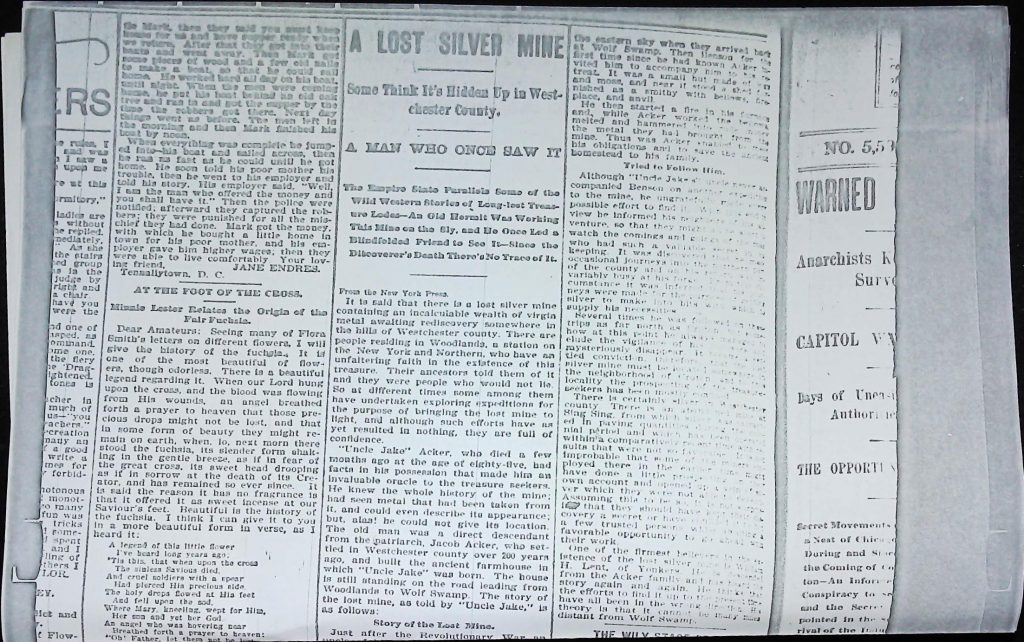
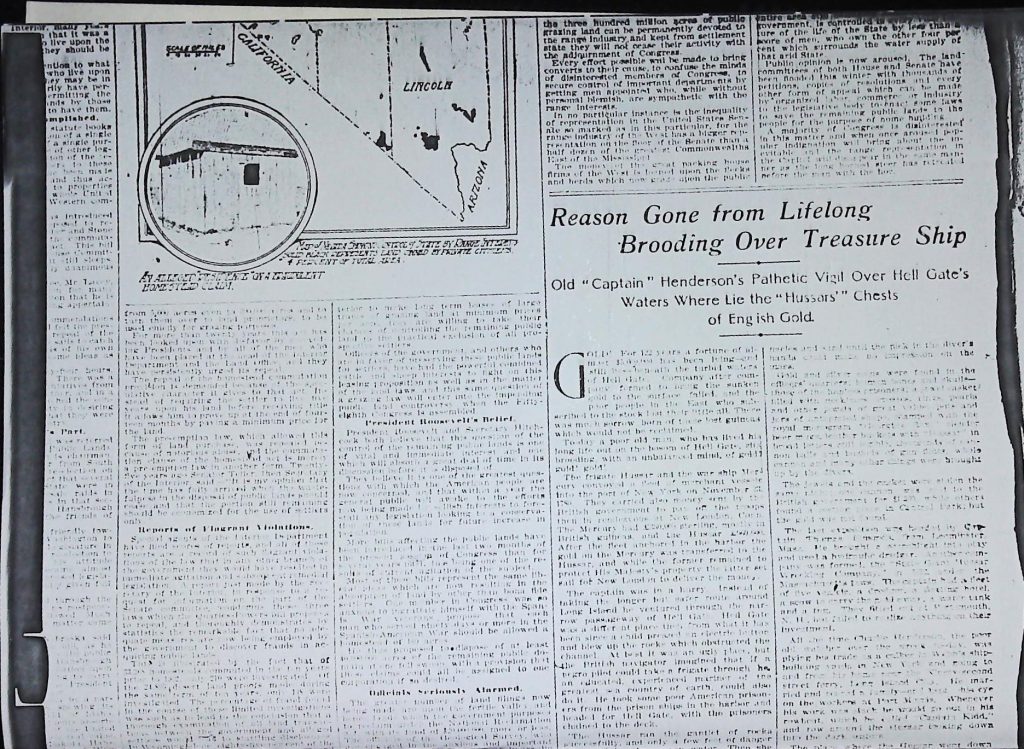
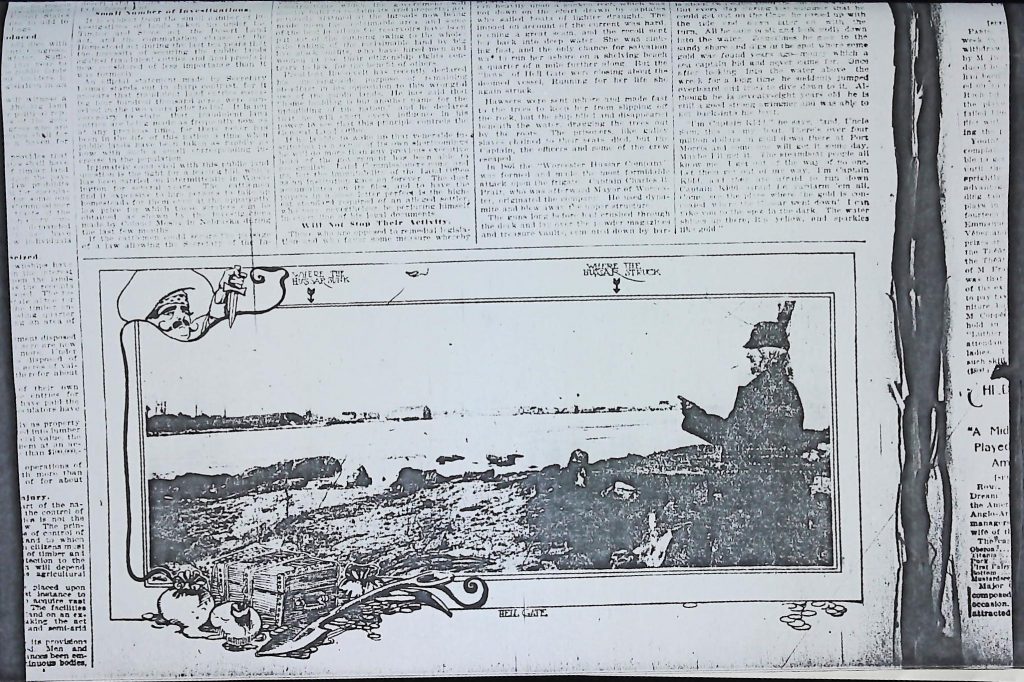
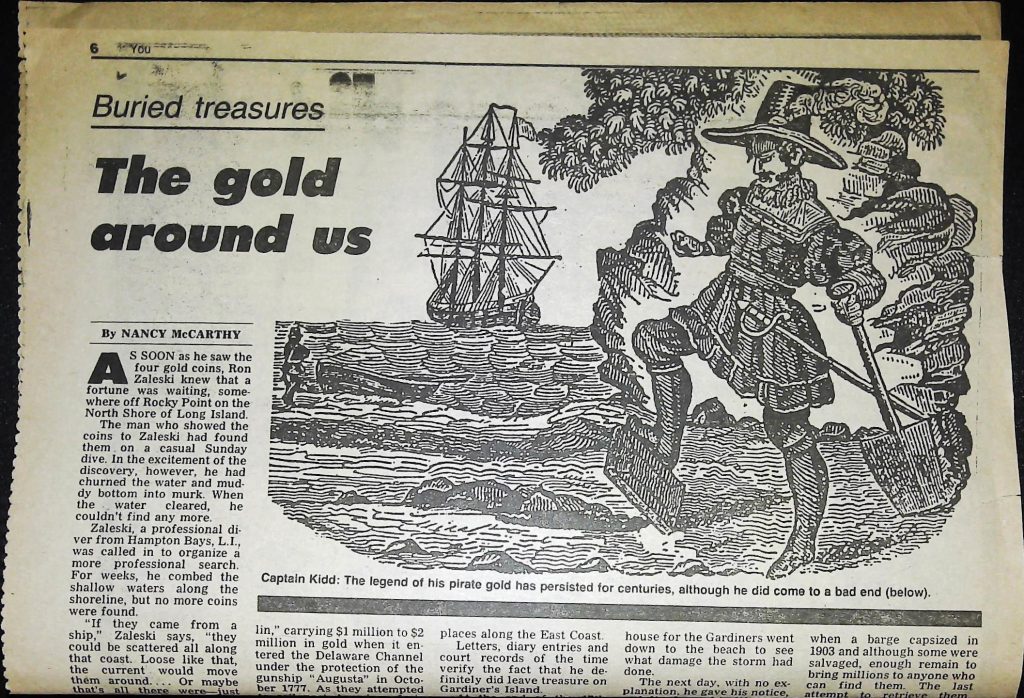
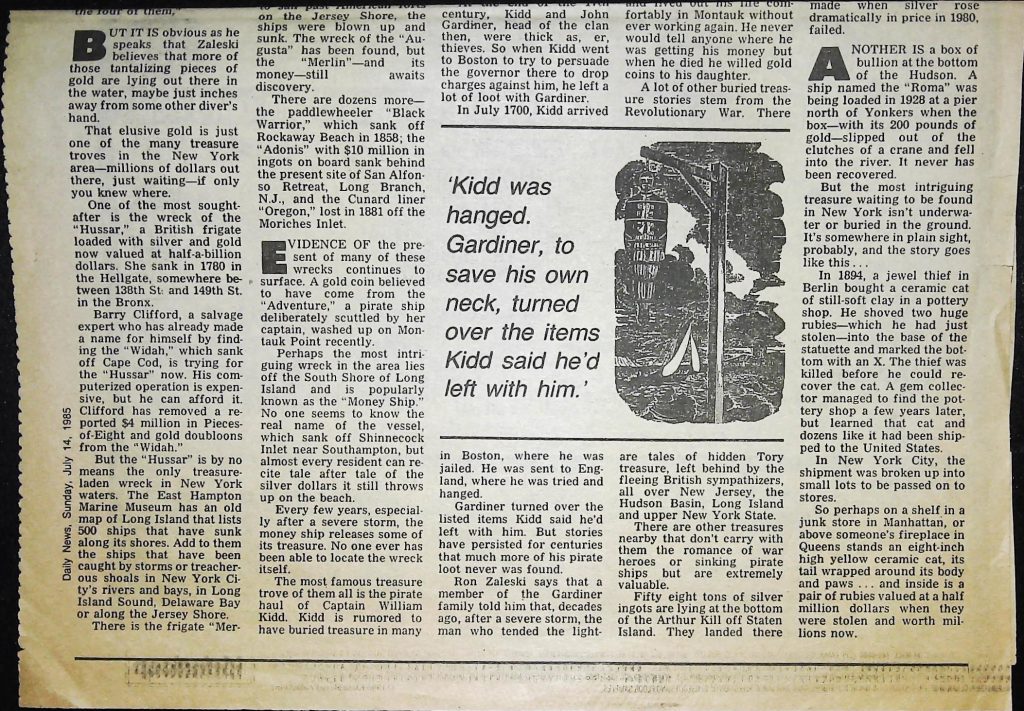
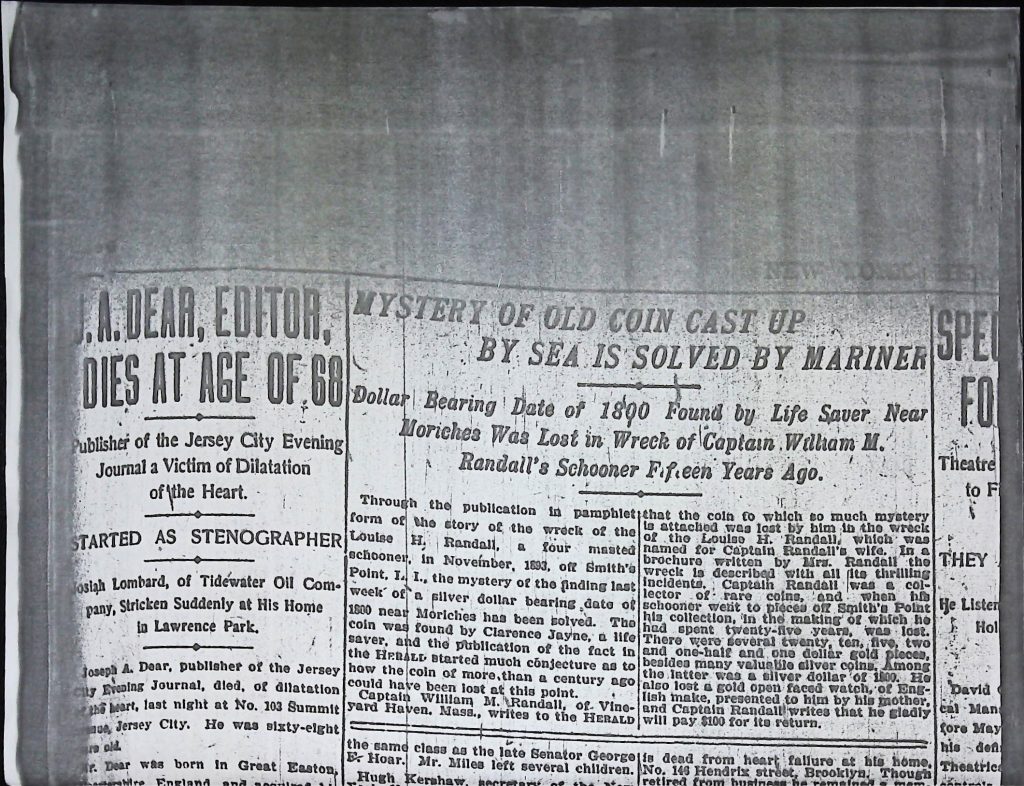
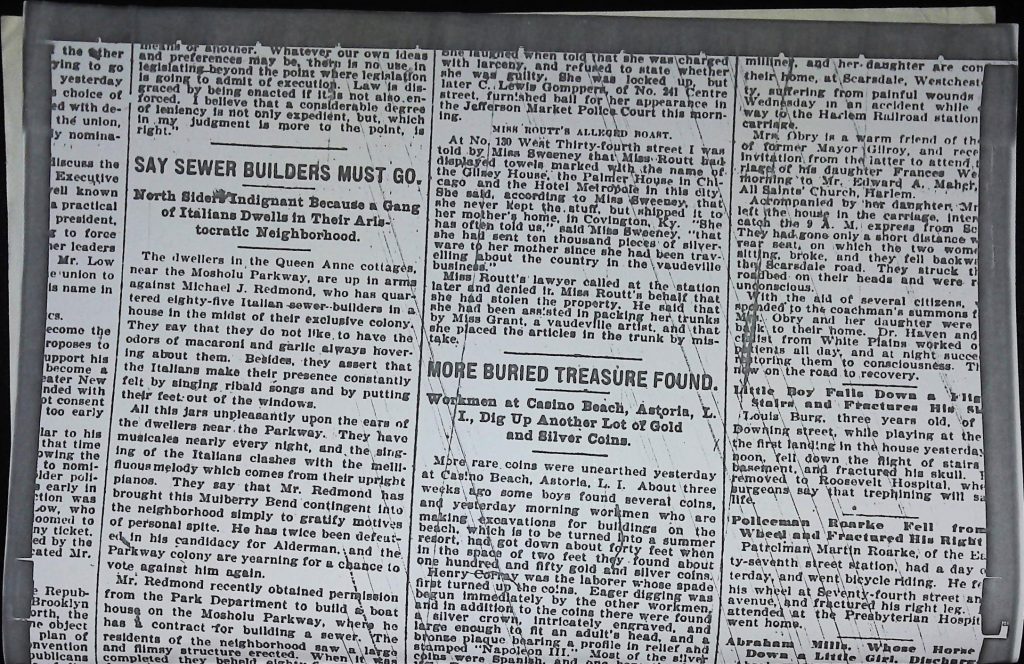
Folder 12. Treasure – New York
Item 1. Newspaper Clippings
Transcribed Text (OCR)
GARY MANGIACOPA ARCHIVE ============================================================ Title: B5F12I1 Slug: b5f12i1 Categories: Lost Treasure Source: https://garymangiacopraarchive.com/b5f12i1 Pages: 40 scanned, 40 extracted OCR: Google Vision API (document_text_detection) Processed: 2026-06-06 ============================================================ 24 Nov 1895 11-4 N.Y. Herald [PAGE BREAK] TREASURE MAY BE IN THIS CAVE. A Cavern at Bar Harbor Which May Have Been a Retreat of Captain Kidd. FOUND AN ANCIENT ANCHOR. The Place Was Infested with Hundreds of Snakes, Into Which the Explorers Fired Several Volleys. ONLY A PARTIAL EXPLORATION. 797 [BY TELEGRAPH TO THE HERALD) BAR HARBOR, Nov 23, 1835. EN rambling over Bald Porcupine Isl- and. In Frenchman's Ray, a few days ago discovered a big cave on the southern side of the 150 acres of rocky Boll where the government is now building a breakwater to protect the harbor. Harvey Hodgkins and Eri Bunker made the discovery They had rolled away a big boulder, which went crashing down the cliff, and disclosed to their astonished night an opening large enough to admit of the en- trance of a person standing erect. A vol- ume of foul air rushed out, as if the en- trance had been closed for centuries, and it was several minutes before the discoverers dared enter the narrow passage, which ap- peared to lead downward for a dozen feet from where they stood Captain Kidd is reported to have hurted treasure near Ellsworth, only a score of miles away, and it required only a small flight of imagination to convince them that the famous pirate could not have selected a better place than the cave on Ball Porcu- pine, which guards the entrance of a harbor fitted by nature for a pirate's retreat PLEDGED TO DIVIDE THE TREASURE Bunker and Hodgkins pledged each other that they would divide equally whatever wealth should be found in the cave, and then they consented to take a few friends to the spot In the party were Serenus II. Rodick, Milton Rollck and Fountain Rodick. The ours of Rodick, or Bar Island, which les near by Bald Porcupine, and who know every spol about Frenchman's Bay. They were enjoined to secrecy and con- sented to share in the treasure equally When the party entered the chamber the light from their half dozen torches and a bonfire illuminated a bavern which extend half a hundred feet, in one direction, up- ward to the height, or twenty feet and was about twenty feet in width As they stepped into the room they sank In the mud a foot or more and cautiously they poked their way along the floor, often- times knee deep in slime On the side walls little scintillating glimmers cautioned them that there were snakes in the cave, and gradually a hissing noise all about the cave cause the men to stop and listen One of the party fired a rifle shot at a glimmer and It was immediately extinguished, only to appear in greater brilliancy all about the Tavern accompanied by a chorus of hisses that told the explorers that the cave was alive with snakes There was a dryer space after they had advanced thirty feet, and colled in a corner Was a huge bunch of snakes of all colors and sizes The men fired u volley from their guns and blazed away at them with revolvers until the corner was strewn with brightly colored bits of snakes and writhing rem- nants of talls. It is estimated that there were 3 snakes in the bunch Suddenly one of the party stumbled across at eaten anchor and chain The links of thain parted on being lifted and the Aner crumbled at a touch Further on were several shelves, apparent- ly hewn out of the stone, and near hy was a Passage extending beyond the celling which appeared to lead to the top A few pleces of of crumbling iron and half a short sword revarded the searchers This part of the cave had unmistakably once been used for a fireplace WHAT CAUSED THE MUD At another part of the rave a stream of water trickled through from the mountain site and this explained the mud bottom and Lave evidence that the original floor in some parts was several feet beneath the present level. They drove their picks down through the soft mud until they rank to the eye of the pleks, and a few ambitious ones began dig- Ring in dark corners of the cavern On one end the roof sloped into a dark. narrow passage, through which Milton R dick squeezed himself, against the protests of his comraden. When he emerged he said that the passage led on down a steep hole and that he was compelled to retreat, but that he believed that it led to another room as big an the one they were then In A battered pewter mug was found in a crevice on the southern side of the cave The explorers grew impatient in their fall- re to light upon the personal estate of the Inte Captain Kidd, and some of them com- plained of blisters on their hands caused by the plek, so they voted to go home and come another day with bigger excavating Emple- ments. Although the five men in the secret have of late maile their discovery known, they are [PAGE BREAK] Mach 1 1903 N.X. Heald ps-st [PAGE BREAK] CALIFORNIA LINCOLN ARIZONA Map of WN STRETTE BY RANGE INTERA SOUD HACK SEVENTS LANDED BY PRIVATE CHAN 4 PERCENT OF TUTAL AREA. the three hundred millon acres of public grazing land can be permanently devoted to the range industry and kept from settlement state they will not cease their activity with the adjournment of Congress. Every effort possible wil be made to bring converts to their cnuse, to confuse the minds of disinterested members of Congres secure control of important departments by getting men appoints who, while without personal blemish, are sympathetic with the range Interests. In no particular instance is the inequality of representation in the United States Sen- ale so marked as in this particular, for the rang Industry of the West has a heger p resentation on the floor of the Senate than t half dozen of the greats Commonwealths East of the Mississip The money that packing house Arina of the West is end upon the Perks and herds which now gag apon the public entire overnment, la controued ure of the Ife of the State by lee than Boore of men, who own the other four per tent which surrounds the water supply of that arid State. Public opinion is now arousel, The land- committers of both House and Senate have heen Boaded this winter with thousands of petitions, copies of resolutions and every other form of appeal which can be made by organized Jabar, commere Or Industry to the legislative dy to enact some s to save the remaining public lands to the people for the free of home hung A majority of Congress is disinterested In this matter and when once arouse 1 pop- ular Indignation will bring about the in- rept station in evitable in the range the Cirl! will fir in the ume mi her as the long host ter has retreated before the man with the he Reason Gone from Lifelong Brooding Over Treasure Ship Old "Captain" Henderson's Pathetic Vigil Over Hell Gate's Waters Where Lie the "Hussars'" Chests Interior, many ye I that it wa o live upon the hey should be ntion to what who live upon hey may be in rily have pr ermitting, the inds by those to have them. mplished. statute books on of a single a single IT- of other log- ton of the T these jen male and thus - w Unit 1 Western com- is Introducet Te- commuti This bill it 1 sleeps unanimou Mr 1, on that he is from ALLE GET HOME STEE oners even t turn them over to t usty for rink Fe of the been looked on with for y ine Presidents and by all of the me have been placed at t to make long term lease of tree are willing to tak their land to the practice luston of all pro-s chaters of strolling the remaining public b is of the government, and others who ate in favor of preserving the public lands of Engish Gold. fr bers There was L nativ from I in a 1 siring at they were l'art. Wit terrest Tebetin of WITH 17 they partment and the Land offer have persist tly uret Its repeal The reped of the hosted citation aracter it gives to that at IT- of ring to sitter to years upon his land by fore It allows him to prove up at the end of four- teen months by paving a minimum price for the land. The pre-emption lw, which allowed this form of land pure tlen of notorious abuse. in the commit lanse of the home is in roy 3 preemption law in at other form Tynty ve years nesta the Interior, said the time his In that sain Hanshrough the frinds of frier fly tow- Teller, then Seir Lay It is my optation thit in the disposal of public tantul! ce and that the portion still remaine should hemzel for the use of setters only on to Reports of Flagrant Violations. In patiment Sg's of the fert tion to generts are of such t tions of the low that in any othe the government they world haste test in. ritory of the arsh the L President Laws which the these to repeal, and thoroughly demonstrate statisth the remark de ft that pa de quate mares are in employed by at to discover frauds in the serum Tray the fet that of 121 st land proofs mi during the Was such is The percent get front found for settlers, have had the powerful combined indeptnterests to Bight on this leasing proposition as well as in the matter of the st laws and this same question of 1 glow will enter into the impedit a iz when the Fifty- puoli fand controv eighth Congress is assembled President Roosevelt's Belief. President Rosy and Scores Hitch- cock both that this question of the control of the remain ng pate lands is one interest which will absorgt deal of time in its desalon before it disposed of They lleve It te one of the greatest ques tion with which the Amerian people are how concerned, and that within 24 wake to the efforts Ish fratrests to fore- 1wling made! any legislation looking to a conserva- 17 these latis for future increase in hills affecting the pobite lands have 1: lucit the last two months of 1 of Congress than for 1. The being one of the re fagitation of the subject, the blits represent the same b- how resulting in the art of Find by other than bona fide Cem nher in Congress was O to trattate himself with the Span that who serye ntnets diye or more in the American War should be allowed a propese to dispose of at least remaining pubile do- at fell wp with a provision that lime could all assigned to one COLORATION if so destr Oleinis Seriousts Alarmed. of land tiling now The and Cell Survey, w G OLD' For 12 years a fortune of al- mt $5 been ling-end still at the turbid waters Company after com- E the sunken and the gold to the surface poor people in the East who sub- serihed to the stock at their title all. The was much sorrow born of ere togt gulnes which would not be recitmet. To-day a poor old man who has led hi long life out on the bosom of Hell Gate, brooding, with an unbalanced mind, of gridi Fold gold! The frigate Hier and the war ship Merd into the port of N. & York on Novembr They carried also money sent by th 178) Betish government to peor the t then in rendezvous w had Catering, mot Mi Kuthas and Lite His. British After the feet anchore! In the harbour gold on the Merry was transferred to the Hussar, and while the former remained to protect His Malars's property the latter set wall for New London to deliver the mone TOW The captain was in a hurry. Instead of taking the longer but safer route crmund Long Island he ventured through the TIAF- passageway of el Ga Hell Gate was a differnt place the from what it has heen siree a child presse h obstructed the and blew up the rocks which At best it was an ugly place, but channel the Pritish mavigator imagined that if gro pilot could take in frigate through ha an educated, experienced mariner a country of earth, could also Freated He took some poor American prison. do st ers from the prison ships in the harbor and head for the Gate, with the prisoners chutined to the deck. The Hussur ran sircesfully, and only the the gantlet of rocka few for danger Then whe ntil the nick in the diver's han la compression on the were found in the those of the carket? royal in web:ught The Jas nd the waren the others Eatk, but Th Mas ment for FC Tom Leominster The beat tot play 77 RBCOW L pau Investment. Alle old plying a trades a h A hotel. water tink mouth. stri on the the poor 119 ship- boiling voren 1 and ring to and fr street ferry. ried and re on the worker at Part inar- huryc Whenever bis work was lack be would not in his Cam Kidd." row het. and row run the king down hire the west dow TH [PAGE BREAK] the with seized wships ho ** the T Small Sumber of Investiuntions, mide of the In s of less importance than t form is think any [ for the pet bli fans have bet tok as rapidly cres in the por alation Iimately with this tile land And it homestead. fem mle by Closet Mes the last few months iw allowing the T Niska ring the la- med at the Int and now h mming wing to the whole for the lot of others purpose of maining in its poiden to this worgal d. He hill that and h. it this principle contrels the to ako up that venerade fa missioners en of the land en The dust and to have the etter perfo is the high- - require of an alleged settler, Will Not Stop Their Activity who are opposed to remedial legish- dwfr some mesure whe ch drawn try But every The the tum. All heist and Into the wate not down on the wh walled boats of lighter draught. Impact on account of the current was hard, and the recall ent ching a Tam. She was in- tuck into deep water he foot, and the only chance for salvation wt run her ashore on a shelving bearh a quarter of a mile further long of The Cite were closing about the doomed vessel, Running for her life sh again struck that he 1 up with k is down 7211s he to the windy shar rds the pot where me gold was found years which a 552 a captain hid and never came for But the to king Into the water above the wrek for a bag time he addenly jumped 11 to dive down to it. Al- everbird though he is eaty-eight years old he is till got stimmer um is ably to back into his t Hawsers were sent ashore and made fast to the trees to keep her from slipping off the rock, but the ship fille and disappear, beneath the water, dragging the trees out The prisoners, like kaley by the roots slave chained to air seats died, but the Captain, the otheers and some of the crew In to the "Worcester Hussar Company" was formed and mil the faust formidable Captain Charles 1: attack upon the frigate Prait, who was afterward Mayor of Wor ter, originated the company He used dyna mite and blew was toper structure The runs long before hd crushed through over the water magazine the deck and s and treasure vault, cemented down by bir In plain !!! he save, nd, Inela There's over four acid down there at Port will it som day. Morris and Maybe ti The steambo the way Captain hi PART work in with draw by Mi ing the le all one. way. I'm pin afraid to run down antarmen all. The geld is (71 ar went down' Icin The spin the dark The water shen up there, It's yellow, and sparkles gold ble to k Until Pprightly WHERE HUS APSUK ment disposed ere are W isposed of therefor about of their own entries for have paid the ulators have I ns property - Int lumber hem at an ar than $)- operations of th more than of for about njury. art of the na- the control of in is not the The prin- W a of control of and to which i cliizens meat of timber ani tection to the will depend agricultural placed upon st instance to quire rast The facilities and on an ex. aking the act and semi-arid Its providons 7. Slen and inces been em- Inuous bodies, HEIL GATE WHERE THE BUKKAKE STRUCK plays in fourte Emme Vater prizes t 1 T the Thea of M Fro WA- that of the ex to pay tax niture M Copper hold "Luther attendin ladies I such skil HID "A Mid Played RON Am (-1) Dreami the Amer Anglo-At manager wife of th The eas Oberon.... Titania Park. Irst Fairy Bottem Mustard Major composed occasion. attracted [PAGE BREAK] New Haven Register, Conn 30 Oct 1983 PB12 CAPITOL CITY The Capitol City, one of the most popular steamboats on the Connecticut River and Long Island Sound in the early 1800s. Wreck recalls era of steamboat By HAROLD HORNSTEIN Steamboat travel on Long Island Sound and the Connecticut River was recalled re- cently by the reported discovery of the wreck of the Lexington. A marine research team announced that it had found the charred remains of the silver-laden, elegant cargo and passenger ship that burned and sank on Jan. 13, 1840 in Long Island Sound as it steamed toward Stonington. The Lexington was built under the per- sonal direction of Commodore Cornelius Vanderbilt. He was competing against four boats running between New York and Pro- vidence. They ferried wealthy New Yorkers to resort communities in Connecticut and Rhode Island. The divers say they found the 205-foot Lexington after having searched for two years the waters between Port Jefferson and Stony Brook, Long Island. The wreck was in three parts and the ship was sitting upright in water 80 feet deep. The ship's cargo, according to records, included a great deal of silver and a con- signment of cotton. The divers say they have records showing the ship had been car- rying $20,000 in bills and between $18,000 and $40,000 in silver coins. So far, the ma- rine searchers say, they haven't brought the silver to the surface. They figure it's now worth more than $100,000. It was the cargo of cotton that may have sealed the doom of the Lexington. One the- ory is that 150 bales were stacked too close to the funnels and caught fire. The steering ropes burned off and the ship went around in circles, the wind feeding the fire. All but four of the 150 passengers per- ished. The disaster occurred about 7:30 in the evening off Eaton's Neck. It was one of the most disastrous marine fires in the his- tory of this area. Ironically, the Lexington represented Vanderbilt's major entry into the keen steamboat competition on the Sound. For the first four months after its appearance on the Providence run, the Lexington ran as a day boat, leaving New York on Tuesday, Thursday and Saturday, with direct connec- tions by rail for Boston and the East, and Providence on the alternate days. The fare was fixed at $4 with meals ex- tra. The older lines immediately lowered their rate to $5, including meals. Vander- bilt, instead of withdrawing his rate, an- nounced a round-trip ticket for the one-way fare. This was the beginning of excursion rates for regular service. For a while, the Lexington plied the Con- necticut River and was faster than anything OUR CONNECTICUT the opposition companies had to pit against it. Attempts were made to build ships that could beat it. The Narrangansett was con- structed for this purpose. But both the Lex- ington and the Cleopatra, another Vander- bilt craft, could easily outrun it. Another boat, the John W. Richmond, also was built with the aim of besting the Lexington. The owners of the Richmond were so sure that it would beat the Lexington that they offered to give Vanderbilt $60,000 for his boat, if it proved to be the faster of the two vessels. But the issue never was re- solved. Finally, the Lexington was sold to another line for $72,000 after it had been fitted with staterooms. Other steamboats also were destroyed or badly damaged by accidents. The State of New York came onto the Connecticut River in 1866, sunk in 1881 and later was raised and named the City of Springfield. It ran un- der that name until of 1895. The Capitol City ran aground at Rye Neck in a dense fog and was completely wrecked. The Granite City was one of the favorites on the river for about 30 years until it was overtaken by disaster. In June, 1883, it was making ready for its stop at Goodspeed's Landing when a fire broke out that spread so rapidly that the passengers had to slide down from the upper decks in an awning. Three people lost their lives and the boat drifted down the river like so much charred timber - a total wreck. The William G. Edgerton, one of a fleet of excursion steamers, was renamed the Glen Island, under which name she was burned while running from New Haven. Travel by steamboat entailed a certain amount of risk. The public was quite willing to take the risk for the pleasure and speed of sailing. The Connecticut was built in 1847 and had a reputation for great speed. The Trav- eler, built in 1845, for Commodore Vander- bilt, was one of the most popular boats that ever ran on the river. It was 225 feet long, 29 feet wide and 9 1/2 feet deep. The boat had two iron boilers on the guards furnishing steam for a powerful beam engine with a 52-inch cylinder and an 11-foot stroke. It was said that on Saturday, June 26, 1846, the Traveler and the Oregon, one of the fastest steamboats ever built, ran side by side for 25 miles, covering the distance in 57 minutes. In 1850, the Traveler was bought for use on the New Haven line. At first the Traveler ran as a day boat between New Haven and New York, carrying mail. But later, an arrangement was made by which the day boat between the two cities was discontinued to force to passengers pa- tronize the railroad. Author Charles Dickens was less than thrilled by his sail from New Haven to New York in 1842. He likened the New York to a floating bathhouse. In his "Notes" he wrote: "This was the first American steamboat of any size that I had seen; and certainly to an English eye it was infinitely less a steam- boat than a huge floating bath. I could hard- ly persuade myself that, indeed, but that the bathing establishment off Westminster Bridge, which I left a baby, had not suddenly grown to an enormous size; run away from home; and set up in foreign parts as a steamer. Being in America, too, which our vagabonds do so particularly favor, it seemed the more probable. "The great difference in appearance between these packets and ours, is, that there is so much of them out of the water; the main deck being enclosed on all sides, and filled with casks and goods, like any sec- ond or third floor in a stack of warehouses; and the promenade or hurricane deck being a-top of that again. A part of the machinery is always above this deck; where the con- necting rod, in a strong and lofty frame, is seen working away like an iron top-sawyer. There is seldom any mast or tackle; nothing aloft but two tall black chimneys. The man at the helm is shut up in a little house in the fore part of the boat (the wheel being con- nected with the rudder by iron chains, work- ing the whole length of the deck) and the passengers unless the weather be very fine. indeed, usually congreagate below. Directly you have left the wharf, all the life, and stir, and bustle of the packet cease. You wonder for a long time how she goes on, for there seems to be nobody in charge of her; and when another of those dull machines comes splashing by, you feel quite indignant with it, as a sullen, cumbrous, ungraceful, unshi- plike leviathan; quite forgetting that the vessel you are on board of, is its very coun- terpart.' [PAGE BREAK] 38- DAILY NEWS EXCLUSIVE BOOK EXCERPT Capt. Kidd sunk PIRATE HUNTER The True Story of Capcath Kidd RICHARD ZACKS THE PIRATE HUNTER: THE TRUE STORY OF CAPTAIN KIDD By Richard Zacks Hyperion 406 pages [AD] $25.95 the English colonies in North America. "It is certain that these villains," wrote an East India Company official, "frequently say that they carry their unjust gains to New- York, where they are permitted egress and regress without control, spending such coin there in the usual lavish manner of such persons." The pirates boosted the sagging local economy. New York merchants, Dutchman Frederick Flypse and Frenchman Steven Delancy, financed ships that sailed halfway around the world to sell provisions and arms to New York pirates operating out of St. Mary's Island, Madagascar. And shares in these voyages some promising a twenty-fold return on investment-were openly trad- ed in taverns not too far from the town wall that still stood on Wall Street [PAGE BREAK] Sunday, August 25, 2002 DAILY NEWS Seafaring legend was no pirate more a misunderstood mariner T The swashbuckling legend of Captain Kidd is one thing, but historically, the life of William Kidd, New York sea captain, may have been something else. And Richard Zacks is a stu- dent of history. The author of "The Pirate Hunter," Zacks has spent untold hours in libraries and archives, having written two prior de- lightful books on historical oddities and trivia. His time has paid off well in his new work, which argues that Kidd the archetyp- al bloodthirsty pirate. was more misunderstood than mean, more framed than frightening. Kidd, Zacks says, was actually a pirate hunter who was double-crossed by his backers. It's a complicated but fascinating tale. Today's exclusive excerpt begins with Kidd's time in old New York, trying to round up a crew for the sail that would lead eventually to his doom. New York in the summer of 1696 was an ink spot on the tip of the map of Manhattan, a struggling seaport with a meager population of 5,000, about a fifth of them African slaves. A public whipping post stood just off the dock, and New Yorkers wanting their slaves "corrected" were expected by law to tip 18 pence to both the town whipper and to the bell- ringer who drew the crowds. While London boasted 300,000 inhabi- tants and the architectural marvels of Christopher Wren, New York claimed only a handful of paved streets and a rundown city hall building. Hungry pigs helped the city's one sanitation man, a Mr. Vanderspiegle. "[New Yorkers] seem not very strict in keeping the Sabbath," wrote a doctor venturing south from Puritan New England. "You should see some shelling peas at their door, children play- ing at their usual games in the streets and ye taverns filled." Dutch women wore scandalously short dresses extending to just below the knee, showing off their homemade blue or red stockings. Dutch girls even into their teens generally went barefoot in long white morning gowns with nothing underneath as they lugged laundry through the Land Gate at Wall Street to do their wash at a stream by Maiden Lane. Women of a dif- ferent sort, often French Huguenot desmoiselles escaping the persecutions of Catholic Louis, plied their trade on Petticoat Lane just off Beaver Street. NEW YORK A PIRATE PORT And, 300 years ago, pirates in gaudy col- orful silks with pistols in their waistcoat pockets walked the streets of New York City, and local merchants, some Dutch, some English, bargained for their goods and lined up to back their larcenous voy- ages. Shares were bought and sold over rum punch at Hawdon's Tavern and the King's Arms. For a decade or so from the early 1690s on, New York edged out Carolina and Rhode Island as the pirate port of choice in While merchants, barkeeps, and broth- el owners back then welcomed pirates and tried to lighten their coin-heavy pouches, piracy in this small English colony of New York was still officially illegal. Choicely placed gold prompted the temporary blindness of customs officials. It was all "Wink, wink." The current governor still wrote home to the Lords of Trade and Plantation that he was rooting out piracy. Governor Fletcher - a pious man who arrived at church in a coach and six-pre- ferred his bribes to be delivered not in cash but in objets d'art; silversmiths thrived during his administration. On the fourth of July 1696, Captain Kidd in the Adventure Galley glided into the harbor, and greeted the people of Manhattan with a couple of shots from his cannon to announce his triumphant return home. As he had hoped, the boom of his guns stirred the merchants and the sailors out of their smoky lethargy in the taverns, away from the rent-a-pipe racks and tankards of cider, to come down to water's edge. Captain William Kidd - a Scottish striv- er who often felt he never got his due in this mostly Dutch and English town proudly guided the Adventure Galley, an immense warship studded with 32 cannon, into Manhattan harbor. Kidd, who called New York his home port, had left 10 months earlier in a dinky 10-gun merchant ship, and now he was returning in this magnificent private man-of-war. The Adventure's sails were furled and men below deck leaned on long oars, called sweeps, to propel the ship forward. New Yorkers, lining the dock, were some- what shocked to see the oars; almost no one in the 1690s-with glorious huge sails to catch the wind-put oars on a warship, but they had come to realize that Kidd always did things differently. The captain, peacocking a bit in his [PAGE BREAK] 39 DAILY NEWS O EXCLUSIVE BOOK EXCERPT in old New York government to attack ships of an enemy nation in exchange for a piece of the spoils. Royal navies couldn't be every- where, so countries in times of war turned to profit-hungry freelancers. Privateering, at its best, was a per- fectly honorable profession, a unique blend of profit and patriotism. Typically, a group of investors band- ed together to finance a privateer mission to capture enemy ships and bring them back to port to be con- demned as prizes and sold. The king might receive a tenth for granting the original privilege; the Admiralty might siphon off as much as a third for doing the paperwork and applying the stamp of legality. The investors would receive the rest and dole it out to themselves and the crew, according to a formula agreed upon before the voyage. Pirates, on the other hand, thumbed their noses at all these niceties; they weren't sanctioned by any government; they readily attacked ships of all nations and they didn't share their booty with any admirals or kings. They were ship- borne thieves, the "enemies of mankind and the trading nations. GOD'S [PAGE BREAK] DAILY NEWS Sunday, August 25, 2002 mancio waistcoat on the quarterdeck, tucked the Adventure Galley into a neat opening amid the forest of masts of idle merchant ships. His quartermaster barked out orders; the men on deck played out the anchor cables - ropes as thick as a sailor's bicep - until the anchor hit bottom and the flukes grabbed. Small ships clustered about, and quickly learned that Captain Kidd had come here looking to line up 150 hardy men to go on a mission to hunt down pirates. In essence, Captain Kidd had entered a pirate stronghold in search of a crew to chase pirates. Only a man with towering self-confidence (or a death wish) would dare to load his ship with former pirates or friends of pirates who, mid-voyage, with any ill luck, might find themselves shooting at cousins or neighbors. Captain Kidd, on this summer day in 1696, was 42 years old, in the prime of his life, physically vigorous, able to outmuscle most of his crew. His face was ruddy from decades of winds at sea. The only surviving portrait of Kidd catches him in half profile: penetrating brown eyes arced by strong brows, a somewhat large nose. His lips seemed curled at the edge with a certain cockiness. He wears a wig, as did most successful men of his generation. (A 1703 wig tax would show that about 50 New Yorkers donned this succinct status symbol.) Kidd's choice in borrowed hair is a fairly subdued shoulder-length affair, in stark contrast to some of the "big wigs," i.e., the giant cascades of curls favored by some crotchety bald English businessmen. Kidd was surprisingly literate in a most- ly illiterate age. Sober, he showed a terse Scot's wit; with a couple of rums in him, he could turn boisterous, then argumenta- tive or worse. M. OKSENHENDLER DAILY NEWS town outhouse. The hub and meeting place for all colonial shipping back then were the town's numerous taverns offer- ing penny-a-glass rum and wads of fresh Long Island tobacco to pack into long clay pipes. So Kidd, over the next few days and especially nights, wandered to these pop- ular "tippling houses" to tack the ship's articles - a kind of "Help Wanted" poster - to the walls. He also sent out some of his current crew to talk up the voyage; these Adventure Galley men whispered that the newly appointed (but not yet arrived) governor of New York, Lord Bellomont, was a backer of the voyage, as was Admiral Russel. These were big-wig names to impress illiterate seamen. independent, a hard taskmaster, ambi- tious, distrustful. In this lone portrait, the artist seems to be trying to capture Kidd's temper in the clenched mouth, the slightly flared nostrils. Kidd was defiantly CAPTAIN KIDD, PRIVATEER Captain Kidd on this July day was rowed ashore, then he walked the length of the city dock past the recently rebuilt William Kidd, to this point, was a com- pletely respectable individual; he was a privateer, not a pirate. (His life would later depend on the not always clear distinction between the two.) A privateer was a kind of independent nautical mercenary, commissioned by a ward many times over many rums in Hawdon's and elsewhere - provided sailors with a unique legal opportunity to steal from pirates and from the hated French. And yet almost no one signed up for Kidd's voyage. No employee surveys were done at the time, but apparently it boiled down to money: Kidd wasn't offering any wages, just a share of the future profits from captures. The sailors back then nicknamed this approach: "No prey, no pay." If they didn't catch a pirate ship or French vessel, they might callus their hands reefing sails for years for absolutely nothing. However, it wasn't the "No prey, no pay" that bothered them; it was the division of spoils. Kidd's Articles, his "Help Wanted" poster, specified that the 150 crewmen would split up only a quarter of the treasure, after expenses that is, after they had repaid all the food, medicine, and weapons at prices set by the owners. (The weapons charge alone was £6 or three months of typical sailor wages.) Kidd told them the split was ordained by his blue- blood owners in London; he said it fol- lowed more along the lines favored by the Royal Navy that first rewarded admirals, commodores, captains, lieutenants, before finding perhaps 10% for the crew. The New York sailors weren't the least bit swayed. Pirates, they knew, kept 100% and shared with no one back at the dock; en masse, the Manhattan mates opted to ignore the appeals of Kidd. So, despite being blessed with a brand- new warship and a potentially lucrative commission, Captain Kidd couldn't go anywhere without a crew. The man was landlocked in sweltering New York City. Excerpted from THE PIRATE HUNTER by Richard Zacks. Copyright © 2002 Richard Zacks. Published by Hyperion. [PAGE BREAK] 30 GenSlorow Flames engulf the General Slo- cum as frantic passengers jump off the steamboat while others struggle to stay afloat and des- perately try to save others in art- ist's rendering of the 1904 catas- trophe, one of city's most horrific. Captain William Henry Van Schaik [PAGE BREAK] Sunday, June 13, 2004 DAILY NEWS Visitors snap pictures yesterday of memorial in Lutheran All Faiths Cemetery in Queens honoring 61 Slocum victims. A second memo- rial is in Tompkins Square Park. 1905 SUSANA BATES 100 years ago, By CARRIE MELAGO SPECIAL TO THE NEWS E leven of her ancestors perished amid the flames and smoke of the doomed Gen- eral Slocum. Her grandfather scoured city hospitals and makeshift morgues for days, searching for loved ones among the survivors and the dead. Her great-aunt escaped death only because she slipped away for a day-long dalli- ance with her fiancé. Come Tuesday, 100 years will have passed since the steamboat General Slocum burst into a fiery cauldron, killing more than 1,000 people headed for a day of pic- nicking at Locust Grove, L.I. One of the greatest tragedies the city had ever known shaped Karen Lamberton's family, and for most of her life, she never even knew it. "It was something too painful for them to talk about. It's almost like a huge extended family that had this disaster happen to them. It's almost insurmount- able," said Lamberton, who lives in Suffern, Rockland County, and who did not know of her relatives' deep connections to the maritime disaster until the late 1990s. "There were a lot of people who didn't get past it." The horror of the tragedy has been muted by the passing decades and eclipsed by the atrocity of the Sept. 11 terrorist attack-some New Yorkers have ei- ther never even heard of the Slocum or have forgot- ten it. But for Lamberton, the Slocum is more than just history. That sunny Wednesday morning in 1904, about 1,300 New Yorkers most from the Little Germany section of the city-boarded the steamship at the Third St. pier, heading for St. Mark's Evangelical Lutheran Church's 17th annual picnic. Fourteen of Lamberton's ancestors were there, too. Only three would survive. A series of errors led to the disaster. A crewman spilled oil onto bails of hay, which were ignited by the heat of a nearby furnace. While passengers screamed for their lives, the ship's captain chose to forge for- ward toward North Brother island instead of turning around. The lifeboats were wired in place and the life jackets were useless, filled with rotting cork. Despite the enormous toll the disaster took on Lam- berton's family, the name Slocum was never so much as uttered. Not even by her own now-deceased moth- er-whose father, Conrad Muth, went to his job as a real estate broker that day and spent the next week searching for family around Manhattan. "She must have known the story, but it was some- thing very close to home, something she didn't want to talk about," Lamberton says. Several years ago, Lamberton reconnected with a cousin, who mentioned casually that relatives in a family photo had survived the Slocum. The revelation prompted Lamberton to plunge into heart-wrenching genealogical research, spending hours in front of a mi- crofilm machine at her local library. Soon, by cobbling together the newspaper clippings, her newfound fam- ily history emerged. "I'd crank the handle, feed a quarter, photocopy and cry," she says. Lamberton's great-uncle, John Muth, a tailor on the lower East Side, took his wife, mother, son and three daughters aboard. He had even sewn his infant son a new bright red jacket for the occasion. But amid the smoke and confusion of the fire, John Muth lost [PAGE BREAK] 13 June 2004 Sunday page 31, cl1-2 E ej 5/ Rows of corpses from the catas- trophe line the morgue at Bellev- ue Hospital. Top, the General Slo- cum sinks beneath the waves. 'S aq Helmeted police carry off victim of one of the greatest tragedies [PAGE BREAK] our own Titanic sight of his family. but he saw a single flash of red and grabbed for his son. The pair fell overboard but were rescued. "They were home by that night," said Lamberton. "The others nev- er came home. » Her newly engaged great- aunt, Anna Muth, had planned to go on the pic- nic with her family but instead sneaked away for a day with her fiancé, Hen- ry Schreiber. Their romance saved them. "I wonder what it was like for her that night. I can't imagine, to come home af- ter a day with your fiancé and find out what happened. That must have been horrendous," said Lamberton. Her great- aunt went on to have two sons with the love that saved her and lived to be 96. Another distant relative was BRYAN SMITH Karen Lamberton looks at exhibit of the 1904 disaster, which killed more than 1,000 people, imcluding 11 of her ancestors. a police officer who responded to the fire only to re- alize it was the boat on which his wife and two chil- dren were spending the day. He identified their bod- ies in the morgue. Of all these tales, the vision of her grandfather hunting for relatives stays with Lamberton the most. He found his own son, but his mother, niec- es, sister-in-law and countless friends were lost. Though he died before her birth, Lamberton's grandfather had been described by her mother al- most mythically as a man of immense strength and kindness. Though he did not die aboard the Slocum, Lamberton is convinced the tragedy prematurely aged her grandfather. In a photo of him playing with his children at a beach in Keensburg, N.J., less than 20 years after the trage- dy, Conrad Muth no longer sports a youthful handlebar mustache or pomade-laden hair. He looks, as Lamber- ton points out, much older than his 60 years. "I have a feeling that on the outside he handled it well, but it caused him to die younger than he would have," she says. On Sept. 11, as pan- icked relatives flooded low- er Manhattan and triage centers emerged to care for the wounded, Lamberton could not help but relive the similarities between the two tragedies. And, again, she turned to her grandfather's own heart- breaking search. "It revealed to me a different facet of him. To know that they might all be gone, then to spend two days trying to solidify whether that's true. I can't read about it without its taking my breath away," she said. "I feel like I almost walked beside him as he did this." Nit. Nix Daily News [PAGE BREAK] RAISING THE HUSSAR E SOUNDINGS For Barry Clifford, it'll take more than luck to recover the ancient ship and its treasure-it'll take a deal with the state. BY RANDY BANNER T HE WATER WAS RISING FAST AS THE SHACKLED prisoners struggled to escape the bonds that would surely condemn them to death. One foot, two feet, with every second the waves surged three feet faster and higher into the belly of the wooden whale until the incarcerates, rebels who had dared to go against the crown, could no longer hold their heads high enough to take a last desperate gasp of air. Above them was a riotous stampede of pounding wooden heels and clanging silver belt buckles as their panicked captors raced to the few mast lines that could be lowered into the water. Many, not knowing what else to do, dived into the cold and brutal water of Hell Gate, praying that the rocks of the treacherous passage, the same rocks that had cast the proud frigate to her doom, would offer refuge. Thus the H.M.S. Hussar went down on Nov. 23, 1780, in New York Harbor, the East River. and with her a fortune in gold which some believe still shimmers at the bottom of The latest in a long line of such believers is Barry Clifford, a professional salvor from Cape Cod, who is undertaking a project of several million dollars to raise the Hussar from the waters just north of the Triborough Bridge. The ship's estimated value of nearly $600 million. treasure―960,000 gold coins, according to most historical accounts-has an But the task of salvaging the Hussar will take more than just stout- heartedness, a taste for adventure or even greed. Throughout the past two DAILY NEWS MAGAZINE NEW YORK MARCH 16, 1986 Da Many men hav life and limb to the $600 millio beneath the East none were more a than Barry Clifford RAISI THE HUSS BY RANDY BANNER [PAGE BREAK] SHACKLED that would F two feet, aves surged oden whale ared to go their heads of air. of pounding kles as their s that could owing what ater of Hell cks that had ork Harbor, he bottom of professional on dollars to ge. The ship's unts has an n just stout- the past two DNIUNIOS DAILY NEWS MAGAZINE NEW YORK MARCH 16, 1986 SPECIAL TRAVEL PULLOUT Daily News Magazine Many men have risked life and limb to recover the $600 million treasure sunk beneath the East River, but none were more determined than Barry Clifford. RAISING THE HUSSAR ESTF BY RANDY BANNER NEW YORK MARCH 16, 1986 [PAGE BREAK] s Magazine H 16, 1986 COVER and pleary of others have risked lives at disappeared on Nov. 23, 1780, when ka reef and sank almost immediately in a more determined than Barry Clifford, a tts who's willing to spend millions to raise orth of the Triborough Bridge. Clifford has a sunken pirate ship off Cape Cod. Now he's ot. Estimated value: $600 million. S eaton tripped over his own two feats. E OSCARS rounds of ammo, and other awards that don't stand DEPARTMENTS 10 Dave Barry Crossword nble. 16 18 24 26 26 ort ART DIRECTOR: Janet Froelich ASSOCIATE ART DIRECTOR: Randy Dunbar PHOTO BY ERIC ROTH DAILY NEWS MAGAZINE NEW YORK MARCH 16, 1986 WHIDAH The Bounty Hunter: Barry Clifford, left, unearthed $14 million in treasure from the Widah, a pirate ship he recovered off Cape Cod. Using state-of-the art sonar and a crew of archeological divers, he believes he can do the same with the Hussar, a British payroll ship (historical builder's sketch, left), which sunk in the East River in 1780. patagonia centuries, there have been dozens of unsuccessful attempts to retrieve it- including one by Thomas Jefferson and two by the British government. Disappointed treasure hunters have blamed the rocks, the cold or the violent currents that plague the north- ern end of the East River where the ship sank. Cynics say the ship has not been found because it's not there. Clifford, who was well aware of the difficulties when he staked a claim to the Hussar in 1984, is returning to New York this spring with state-of- the art sonar, computers and a team of 30 archeologists and divers who intend to raise not only the gold but the ship as well. Clifford believes he will succeed where others have failed not only because of his resources but because of his uncanny instinct for foraging treasure, a talent which has already unearthed $14 million from the Widah, an 18th-century pirate ship off the coast of Cape Cod. Success, however, could pose as many problems as failure-Clifford and the state of Massachusetts have been in litigation over the Widah for the past five years. Since Revolution- ary times, there has been an ongoing controversy between salvors and state governments as to the ownership of property salvaged from underwater sites. The salvors contend that they are entitled to nearly all of what they find after having risked life, limb and bank account to get it. States, whose salvage laws vary, claim that at least a portion of the property is owned by the public if it is retrieved within state boundaries. New York State does not have a continued on page 14 [PAGE BREAK] RAISING THE HUSSAR continued from page 9 D₁₁ GA 20 Fo M Go Ma onl, law governing underwater archeologi- cal salvage. For Clifford, that is a positive happenstance which will al- low him to negotiate a deal for the Hussar free of precedent. "If there's a way to get this ship up, we'll do it," Clifford said as he scribbled drawings of ship bows on a paper place mat in a dining room at the Sheraton Hotel in Eastham, Mass. "But what we do and the way we do it has a lot to do with what the state says about it," he continued. "I'm not going to go in and spend five million dollars without knowing what's going to happen once we bring the stuff up. It's happened too many times before with people like Mel Fisher in Florida, where the salvor risks his life and his money and then the greedy state comes in and says it wants its share. "It's not that we're in it just for the money. You have to have a certain passion for the adventure of the thing to get involved in this kind of business in the first place. But it is a business. And like any other busi- ness, you want to make sure that you're going to get a reasonable return on your investment and that nobody is going to steal from you." Treasure Island: Clockwise, from top, Thomas Jefferson recovered nails and copper from the Hussar, in 1811; Clif- ford and crew member in the East River with state-of-the-art salvaging equipment; relics, pieces of eight and gold doubloons from the Widah, the pirate ship Clifford retrieved off Cape Cod; the list of American prisoners who went down with the Hussar. Clifford's interest in the Hussar dates from a childhood love affair with relics. The son and grandson of antique dealers, he spent much of his youth collecting shells, Indian heads and other extraneous artifacts that would wash up on the shores of Cape Cod. Throughout college and later as a professional fund-raiser and high- school teacher, his interests in mari- time history and, particularly, ship- wrecks, grew to the point where he would spend all his spare time either researching them or working as a professional diver. Clifford, 40, salvaged his first historic wreck, the General Benedict Arnold, an American Revolutionary privateer, off the coast of Plymouth, Mass., in 1976. In 1983, under the auspices of Maritime Explorations, Inc., a firm he founded with 30 of his friends, he undertook one of the most successful ventures in the history of shipwreck salvage. Sunk off the coast of Wellfleet, Bounty paid. Prisoners borne at Gwe thirds Allowance. N° 80 Appear- Whence Entry. Year ance. and whether Preft or not. Place and County where Born. 1780 10 Sepitinelly it funding 26 Qate Pilome Age at Time of Entry in this Ship. No and D. Tine cl Letter MENS NAMES. 1.D. Qualitics. of or Difchang Tickets R. Jacob Mansac Midas Mizan chord breedley Rebel Buation. But Mr Levan Mic! Pepper. Dom » Jauzise P Throughout the past two centuries, there have been dozens of unsuccessful attempts to retrieve it—including one by Thomas Jefferson. Disappointed treasure hunters blamed the rocks, the cold or the violent currents that plague the northern end of the East River. 14 Photo by Eric Roth DAILY NEWS MAGAZINE NEW YORK MARCH 16, 1986 [PAGE BREAK] AMES. Qualitiez dby Pepper D. Time of D.D. Difchang R. there attempts omas Jefferson. hed the rocks, plague Photo by Eric Roth DAILY NEWS MAGAZINE NEW YORK MARCH 16, 1986 Photo by Eric Roth Mass., the Widah had long been a fixture in the region's folklore and in Clifford's imagination. In fact, it was the first pirate ship ever raised. Using a magnetometer (a computerized in- strument which detects objects by disturbances they cause in the earth's magnetic field), Clifford found the Widah a year after he started-50 feet off shore. So far, $14 million worth of gold and silver coins, in numismatic value, has been brought up from a small section of the ship. Much more is expected by the time the project is completed in another 10 years. Under Massachusetts law, the state must approve periodic progress reports be- fore further salvage work can con- tinue. Clifford began his efforts to find the Hussar with a second team of divers and archeologists in the sum- mer of 1984. Despite his success in Massachusetts, he knew that the New York wreck would be much more difficult to locate because of both the hazards of the river and the history of the ship itself. The H.M.S. Hussar was a 28-gun Revolutionary War frigate sent to the colonies by the British as an army payroll ship in the fall of 1780, accord- ing to most early accounts. Her orders were to dock at the British Pay Office near Beekman's Wharf at the southern tip of Manhattan and take on 14 carts of gold and 80 American prisoners. The Hussar was then to leave New York, which was being evacuated by the British, and sail to Newport, R.I., to establish a new pay station. Conditions for the voyage seemed favorable as the Hussar sailed up river toward Long Island Sound on Nov. 23. However, as the ship passed what was then known as Barren Island, now Wards Island, she struck a jag- ged reef and started to leak. Because of the river's violent currents, the rupture in her hull expanded so quickly that she sank almost im- mediately. Some accounts say that crew members who went over the side tried to keep her afloat by tying her lines to a nearby tree. Most of the crew's 107 men sur- continued on page 20 15 [PAGE BREAK] RAISING THE HUSSAR continued from page 15 vived the disaster, but all of the American prisoners, still locked in- side their shackles, went down with the ship. Although the legend of the Hus- sar grew from that day on, efforts to recover the ship did not begin until well after the end of the Revolution- ary War. In the spring of 1794, the British government sent two brigs, a diving bell and an underwater team back to New York in the hope of reclaiming its gold. The project yielded nothing and after two years was abandoned. The British, howev- remained confident that the er, money could be retrieved at some point and offered large rewards for British (Another its recovery. attempt was made during the War of 1812.) The second documented salvage operation was financed by Thomas Jefferson in 1811. Jefferson, who also used a diving bell, was not interested nails and copper which were also believed to have been on board. Like many of his endeavors, the project was mocked as yet another folly by the former President who by that time was considered an eccentric elder statesman. Oddly, the venture was perhaps the most successful of all Hussar salvage efforts in that it did recover the nails and copper it had set out to find as well as the ship's rudder. As salvage efforts continued throughout the century, there was a great deal of speculation as to whether the Hussar treasure ever existed, and if so, was it intact. In 1827, Fletcher Betts, who claimed to have been one of the Hussar's petty officers, wrote a letter to the editor of a New York newspaper saying that all of the ship's gold had been landed in New York two days before the ship sank. "(No one) will be so fortunate as to find the 'large treasure' said to have been lost in her," Betts wrote. "There was, indeed, 22,000 pounds sterling on board the ship two days before she was lost. But on that day the money was safely landed and delivered into the custody of Commis- sary General Delancy." More than 50 years later, a reader of the New York Sun responded to Betts' claim in a letter to the editor saying that the 22,000 pounds was 20 Sea hunt: A view of the dredging equipment used in diver Ray Jay Wagner's 1967 attempt to recover the Hussar. only a small portion of the 250,000 pounds that the Hussar was carrying. uestions about the owner- ship of the Hussar also arose early. In 1884, salvor George W. Thomas of New Jersey signed a con- tract with the U.S. Treas- ury Department in which he agreed to give the fed- eral government 10% of whatever he found on the ship. The New York State government protested the con- tract on the basis of state's rights, contending that the ship was imbed- ded in state soil and as such belonged solely to New York. Although Wash- ington was prepared to hold its ground in the matter, Thomas aban- doned his claim before any litigation came to pass. The most recent efforts to salvage the Hussar were made by Simon Lake, one of the inventors of the submarine, in 1937, and Ray Wagner, a freelance writer who undertook three separate attempts in the 1960s. As always, their search proved futile. So why does Clifford think he'll succeed when others failed? Because, he said, "I've seen it. When we were towing the sonar fish down the river last year, just as we got over the wreck I said to my crew, 'Right now.' And as soon as I said 'now,' the edge of the ship popped onto the sonar screen. That's how precise you can be with your research. We found seven other wrecks within a mile, but only one that's 114 feet long and 34 feet wide, and that's the size the Hussar's supposed to be." (The Hussar is one of two major wrecks in the Hell Gate area. The other, the steamer General Slocum, caught fire in 1904 near North Brother Island, and more than 1,000 people, mostly immigrants, died.) Clifford's sonar "fish" is part of a newly developed side-scan system that determines the nature of objects by hitting both the objects and the surfaces around them with electronic impulses which then bounce back to a computer where the impulses are analyzed. The sonar, which was re- sponsible for finding the Titanic in the north Atlantic last year, also meas- ures shadows to determine angles at which objects rest. Using the system, Clifford has pinpointed the ship as lying 80 feet beneath the surface somewhere be- tween 130th and 140th Streets, not far from the Bronx shore-a site (he won't divulge the exact location) he and his crew will reconfirm upon arriving this spring in New York. Divers will then measure the ship, check the soundness of the wood and explore it from the inside. Depending on what they find, the team will then decide how to remove the artifacts. If the ship is solid, Clifford said that he will raise the wreck in one piece using a huge crane, called the Century, manufactured by the Witte Marine Equipment Co. of Staten Island. The crane will lift the ship via a cradle and a series of straps girdling the wreck from its underside. If the Hussar is too brittle for such continued on page 22 DAILY NEWS MAGAZINE NEW YORK MARCH 16, 1986 SENSATIONAL S MARCH AVINGS Was $1499. Now $1199. A. 2 ct. tw* Diamond Dinner Ring B. 1 ct. tw* Diamond Dinner Ring Was $995. Now $799. B Your Choice $395. B A. 14K Three Piece Two Tone Bridal Set B. 14K Three Piece Bridal Set HOGSIDE A VILLAGE D Anniversary Rings A. 4 ct. tw Diamond Was $195. Now $149. B. 4 ct. tgw** Diamond and Emerald Was $195. Now $149. C. ct. tgw** Diamond and Ruby Was $179. Now $129. D. ct. tgw** Diamond and Sapphire Was $179. Now $129. All Merchandise Subject to Prior Sale Your Choice $8 A. 1 ct. tw* Diamon B. 1 ct. tw Diamon C Your Choice $149. Fashion Stack Rings A. Ruby and Diamond B. Sapphire and Diamond C. Emerald and Diamond Paul Breguette Watches Lifetim ranty and Lifetime Battery Repla A. Man's Stainless and Gold Tone Fashion Watch Was $350. Now $19 Now $1. B. Ladies' Classic Oval Bracelet Was $225. Sale Ends March 31. [AD] KONGS PLAZA BROOKLYALNY 204, (718) 255-0800 ROOSEVELT HELL GALLERIA, 100 MAIN STREE BUNRISE MAL BARDER CITY ANNY 11530, APEQUA LIN 41-00 [AD] (954) 997-8243 WOODHNOGE [PAGE BREAK] RAISING THE HUSSAR continued from page 20 a maneuver, whatever is found will have to be brought up by divers. Clifford estimates that the operation could take as little as two months if the ship is in reasonable condition. "If it's possible to bring the ship up in one piece, we could do it in a day," Clifford said. "Then we could put it right into a dry dock and salvage it from there, which would be the easiest way to go. Realistically, I think we'll probably have to take a lot of the stuff out before we even think of moving the hull." In addition to potential problems with the ship, the crew will also face the treachery of the river, the major stumbling block in all previous attempts. The Hussar is believed to be at the point where tides from New York Harbor and Long Island Sound converge. The currents are fierce, sometimes reaching speeds as high as five knots (7.5 mph). That, along with contamination, debris and river traf- fic, will make salvaging the Hussar an extremely dangerous proposition for even the most experienced. "The water is so dark down there that the divers won't be able to see their own hand in front of them," said Freeman (Skip) Wheeler III, crew chief for the project. "When you undertake something like this, you have to be extremely professional or you could lose the whole thing, in- cluding your life." D espite the risks, those who will be working with Clifford are extremely anxious to begin. That includes the investors, who have the most to gain if the project succeeds. While their primary motive is profit, they say the enticement goes beyond the financial. "It's pretty damn interesting," said Bob Gunn, owner of a real-estate development and syndication firm in Boston, who has invested with Mari- time Explorations. "I mean it's got sex appeal. I don't have enough money to throw $120,000 bucks around just for the fun of it. But you don't invest in this kind of thing like you would buy GM stock. It's a funny sort of mix. I believe that the possibil- ity of a very large hit exists in New York. This one's a flyer." Burgett Woodcock, vice president of a major savings-and-loan corpora- tion in Denver, said he invested in "Our concern has nothing to do with profit,' says Philip Lord, senior scientist for New York State's archeological office. 'Our concern is to treat the site in the best possible way. It's possible that it would be better to leave the Hussar where it is for another 200 years.' Maritime because of his confidence in Clifford's ability and ideas. "The projects are always fascinat- ing and they give me a chance to be involved in something that very few people ever will," said Woodcock. "It's an adventure. Most of those who invested don't have enormous a- mounts of cash in it or great expecta- tions of getting wealthy. If we had to write it off, it wouldn't feel good, but it wouldn't hurt us either." T hose who have the most to lose are Clifford, who invested a half-million dollars of his own money, and Maritime vice presi- dent Bob Lazier, a lead- ing Colorado entrepreneur. "I really don't consider it to be a high-risk circumstance," said Lazier. "Barry was absolutely correct in his estimation of what was on the Widah, and there's no reason to doubt his judgment of the New York wreck. I think we'll all do fine. During the past few months, Clif- ford has approached several New York firms in the hope of gaining additional financing for the wreck. One large corporation, he said, has offered to underwrite the entire proj- ect, which Clifford is considering. But before the Hussar project can begin, Clifford and his company must strike a deal with the state to deter- mine how the ship is to be salvaged, who will take possession of whatever artifacts are found, and what will happen to the treasure if, in fact, a treasure exists. Litigation with the state of Mas- sachusetts over the Widah has been protracted, to say the least. Under current Massachusetts law, the state owns everything that is brought up during an underwater salvage opera- tion, with the salvor being entitled to 75% of the value of his find. Clif- ford's company is disputing the con- stitutionality of the statute contending that it conflicts with federal admiralty law, which has historically encour- aged salvors to recover abandoned property by offering them huge re- wards for their efforts. This is backed up by the definitive legal text on the subject, Martin J. Norris' "The Law of Salvage." Ac- cording to Norris, when the state makes a claim on salvaged property, it is decreasing the award the federal government has historically wanted the salvor to have and, as such, is "in conflict with the policy of maritime law and may raise a constitutional question." It is a question, however, that has never been resolved. Most salvors who have recovered treasure within U.S. waters have either not found enough to merit embarking on a legal battle or have won cases based on other criteria. Mel Fisher, perhaps the best-known American treasure hunter, won a federal case against the State of Florida in 1981 when he proved that the treasure which he salvaged from the Spanish galleons Atocha and Marguerita, off the Flor- ida Keys, lay beyond Florida's geo- graphical jurisdiction. Clifford says he will take his case as far as the Supreme Court if Mas- sachusetts persists in its claim on the Widah. In terms of the Hussar, he is hoping to avoid such a conflict by coming to an agreement before any work is done. Philip Lord, senior scientist for the state's archeological office a division of the New York State Education Department which has the power to either approve or deny Clifford's application said that he could not speculate on the terms of the agreement. Explaining that his primary concern was the preservation of the wreck and its artifacts, he said that the state could reject the project altogether if it did not feel that the salvage attempt was in the best pres- ervationist interests of the Hussar. "Our concern has nothing to do with business or profit or anything like that," Lord said. "Our concern is to treat this site in the best way we know how. It's possible that it would be better to leave the Hussar where it is for another 200 years or until the government has the ability to fund an excavation without getting involved in a profit-making venture. This is no reflection on Clifford, who has proven himself to be a responsible salvor, but there is really no way of knowing what will happen until after both sides sit down and talk.'" 17 However, the state may be the least of Clifford's problems, if and when he succeeds in raising the Hus- sar. According to federal law, lost property retrieved in the United States belongs to its original owner in perpetuity, hence the British could legally sue Maritime Exploration for the ship and everything on it. "Gee," said Clifford, "I never thought of that.'" writer. Randy Banner is a New York freelance 22 [PAGE BREAK] You Buried treasures The gold around us By NANCY MCCARTHY S SOON as he saw the four gold coins, Ron Zaleski knew that a fortune was waiting, some- where off Rocky Point on the North Shore of Long Island. The man who showed the coins to Zaleski had found them on a casual Sunday dive. In the excitement of the discovery, however, he had churned the water and mud- dy bottom into murk. When the water cleared, he couldn't find any more. Zaleski, a professional di- ver from Hampton Bays, L.I., was called in to organize a more professional search. For weeks, he combed the shallow waters along the shoreline, but no more coins were found. a "If they came from ship," Zaleski says, "they could be scattered all along that coast. Loose like that, the current would them around. move Or maybe that's all there were just Captain Kidd: The legend of his pirate gold has persisted for centuries, although he did come to a bad end (below). lin," carrying $1 million to $2 million in gold when it en- tered the Delaware Channel under the protection of the gunship "Augusta" in Octo- ber 1777. As they attempted places along the East Coast. Letters, diary entries and court records of the time verify the fact that he de- finitely did leave treasure on Gardiner's Island. house for the Gardiners went down to the beach to see what damage the storm had done. The next day, with no ex- planation, he gave his notice, when a barge capsized in 1903 and although some were salvaged, enough remain to bring millions to anyone who can find them. The last attempt to. etrieve [PAGE BREAK] the four of them, UT IT IS obvious as he speaks that Zaleski believes that more of those tantalizing pieces of gold are lying out there in the water, maybe just inches away from some other diver's hand. Daily News, Sunday, July 14, 1985 That elusive gold is just one of the many treasure troves in the New York area-millions of dollars out there, just waiting-if only you knew where. One of the most sought- after is the wreck of the "Hussar," a British frigate loaded with silver and gold now valued at half-a-billion dollars. She sank in 1780 in the Hellgate, somewhere be tween 138th St: and 149th St. in the Bronx. Barry Clifford, a salvage expert who has already made a name for himself by find- ing the "Widah," which sank off Cape Cod, is trying for the "Hussar" now. His com- puterized operation is expen- sive, but he can afford it. Clifford has removed a re- ported $4 million in Pieces- of-Eight and gold doubloons from the "Widah." But the "Hussar" is by no means the only treasure- laden wreck in New York waters. The East Hampton Marine Museum has an old map of Long Island that lists 500 ships that have sunk along its shores. Add to them the ships that have been caught by storms or treacher- ous shoals in New York Ci- ty's rivers and bays, in Long Island Sound, Delaware Bay or along the Jersey Shore. There is the frigate "Mer- Past on the Jersey Shore, the ships were blown up and sunk. The wreck of the "Au- gusta" has been found, but the "Merlin"-and its money-still awaits discovery. There are dozens more- the paddlewheeler "Black Warrior,' which sank off Rockaway Beach in 1858; the "Adonis" with $10 million in ingots on board sank behind the present site of San Alfon- so Retreat, Long Branch, N.J., and the Cunard liner "Oregon," lost in 1881 off the Moriches Inlet. century, Kidd and John Gardiner, head of the clan then, were thick as, er, thieves. So when Kidd went to Boston to try to persuade the governor there to drop charges against him, he left a lot of loot with Gardiner. In July 1700, Kidd arrived 'Kidd was hanged. VIDENCE OF the pre- Gardiner, to sent of many of these wrecks continues to surface. A gold coin believed to have come from the save his own "Adventure," a pirate ship neck, turned deliberately scuttled by her captain, washed up on Mon- tauk Point recently. Perhaps the most intri- guing wreck in the area lies off the South Shore of Long over the items Kidd said he'd Island and is popularly left with him. known as the "Money Ship. No one seems to know the real name of the vessel, which sank off Shinnecock Inlet near Southampton, but almost every resident can re- cite tale after tale of the silver dollars it still throws up on the beach. Every few years, especial- ly after a severe storm, the money ship releases some of its treasure. No one ever has been able to locate the wreck itself. The most famous treasure trove of them all is the pirate haul of Captain William Kidd. Kidd is rumored to have buried treasure in many in Boston, where he was jailed. He was sent to Eng- land, where he was tried and hanged. Gardiner turned over the listed items Kidd said he'd left with him. But stories have persisted for centuries that much more of his pirate loot never was found. Ron Zaleski says that a member of the Gardiner family told him that, decades ago, after a severe storm, the man who tended the light- Tived out mis The CoMF fortably in Montauk without ever working again. He never would tell anyone where he was getting his money but when he died he willed gold coins to his daughter. A lot of other buried treas- ure stories stem from the Revolutionary War. There are tales of hidden Tory treasure, left behind by the fleeing British sympathizers, all over New Jersey, the Hudson Basin, Long Island and upper New York State. There are other treasures nearby that don't carry with them the romance of war heroes or sinking pirate ships but are extremely valuable. Fifty eight tons of silver ingots are lying at the bottom of the Arthur Kill off Staten Island. They landed there rose made when silver dramatically in price in 1980, failed. A NOTHER IS a box of bullion at the bottom of the Hudson. A ship named the "Roma" was being loaded in 1928 at a pier north of Yonkers when the box-with its 200 pounds of gold-slipped out of the clutches of a crane and fell into the river. It never has been recovered. But the most intriguing treasure waiting to be found in New York isn't underwa- ter or buried in the ground. It's somewhere in plain sight, probably, and the story goes like this In 1894, a jewel thief in Berlin bought a ceramic cat of still-soft clay in a pottery shop. He shoved two huge rubies-which he had just stolen-into the base of the statuette and marked the bot- tom with an X. The thief was killed before he could re- cover the cat. A gem collec- tor managed to find the pot- tery shop a few years later, but learned that cat and dozens like it had been ship- ped to the United States. In New York City, the shipment was broken up into small lots to be passed on to stores. So perhaps on a shelf in a junk store in Manhattan, or above someone's fireplace in Queens stands an eight-inch high yellow ceramic cat, its tail wrapped around its body and paws... and inside is a pair of rubies valued at a half million dollars when they were stolen and worth mil- lions now. JAFTEY WHE 232200KAZU [PAGE BREAK] NEWTO A.DEAR, EDITOR, MYSTERY OF OLD COIN CAST UP DIES AT AGE OF 68 Publisher of the Jersey City Evening Journal a Victim of Dilatation of the Heart. BY SEA IS SOLVED BY MARINER Dollar Bearing Date of 1890 Found by Life Saver Near Moriches Was Lost in Wreck of Captain William M. Randall's Schooner Fifteen Years Ago. STARTED AS STENOGRAPHER Louise H. Randall, a four SPE FO Theatre to F Through the publication in pamphlet that the coln to which to much mystery is attached was lost by him in the wreck form of the story of the wreck of the of the Louise H. Randall, which was masted named for Captain Randall's wife. In a brochure written by Mrs. Randall the THEY schooner. In Noveinber, 1893, off Smith's wreck is described with all its thrilling Point. I I., the mystery of the finding last incidents. Captain Randall was a col- oslah Lombard, of Tidewater Oil Com-week of a silver d pany, Stricken Suddenly at His Home in Lawrence Park. Evening Journal, died, of dilatation Joseph A. Dear, publisher of the Jersey ue Jersey City. He was sixty-eight the heart, last night at No. 103 Summit ra old r. Dear was born in Great Easton, Hire England end Hol when h lector of rare coins, and dollar bearing date of schooner went to pieces of Smith's Point He Listen his collection, in the making of which ho 1800 near Moriches has been solved. The had spent twenty-five years, was lost. coin was found by Clarence Jayne, a life There were several twenty, ten, five, two saver, and the publication of the fact in and one-half and one dollar gold plecen, the HERALD started much conjecture as to besides many valuable silver coins. Among the latter was a silver dollar of 1800. HO make, presented to him by his how the coin of more than a century ago also lost a gold open faced walls mother. Captain William M. Randall, of Vine- and Captain Randall writes that he gladly cal Man Fard Haven. Mass., writes to the HERALD will pay $100 for its return. could have been lost at this point. David fore May his def the same class as the late Senator George is dead from heart fallure at his home. Theatric Hoar. Mr. Miles left several children. No. 148 Hendrix street, Brooklyn Though Hugh Kershaw, hecre retired from business he [PAGE BREAK] the ther yesterday ying to go choice of ed with de- the union, ly nomina- Executive ell known Iscuss the a practical president, to force her leaders Mr. Low e union to is name in CS. ecome the roposes to upport his become a eater New nded with ot consent too early lar to his that time owing the to nomi- lder poli- early in ction was ow, who loomed to ny ticket. ed by the cated Alr. orth, the ne object Repub- Brooklyn plan of nvention bublicans and preferences may be, there is no use in means or another. Whatever our own Ideas legislating beyond the point where legislation is going to admit of execution. Law la dis- graced by being enacted if it is not also.en- forced. I believe that a considerable degree of leniency is not only expedient, but, which right." In my judgment is more to the point, is SAY SEWER BUILDERS MUST GO. North Side Indignant Because a Gang of Italians Dwells in Their Aris- tocratic Neighborhood. Besides, they assert that The dwellers in the Queen Anne cottages, near the Mosholu Parkway, are up in arma against Michael J. Redmond, who has quar tered eighty-five Italian sewer--builders in a house in the midst of their exclusive colony. They say that they do not like, to have the ing about them. odors of macaroni and garlic always hover- the Itallans make their presence constantly their feet out of the windows. felt by singing ribald songs and by putting All this jars unpleasantly upon the ears of the dwellers near the Parkway. They have musicales nearly every night, and the sing- ing of the Italians clashes with the melll. pianos. They say that Mr. Redmond has brought this Mulberry Bend contingent into fluous melody which comes from their upright the neighborhood simply to gratify motives of personal spite. He has twice been defeat- ed in his candidacy for Alderman, and the Parkway colony are yearning for a chance to vote against him again. Mr. Redmond recently obtained permission from the Park Department to build boat house on the Mosholu Parkway, where he residents of the neighborhood saw a large has contract for building a sewer. The completed they beheld and flimsy structure erected. When I WAS with larceny, and refused to state whether Sheu died when told that she was charged she was guilty. She was locked up, but later C. Lewis Gomppers, of No. 241 Centre street, furnished ball for her appearance in ing. the Jefferson Market Police Court this morn- MINH ROUTT'S ALLEGED ROAST. milline, and her daughter are con their home, at Scarsdale, Westchest ty, suffering from painful wounds Wednesday in an accident while way to the Harlem Railroad station carriage. Mr Obry is a warm friend of th of former Mayor Gilroy, and rece Invitation from the latter to attend,t At No, 130 West Thirty-fourth street I was told by Mian Sweeney that Miss Routt bad displayed towels, marked with the name oflage of his daughter Frances We the Gilsey House, the Palmer House in Chi- ago and the Hotel Metropole in this city She said, according to Miss Sweeney, that she never kept the stuff, but shipped it to her mother's home, in Covington, Ky. "She has often told us," said Miss Sweeney, "that she had sent ten thousand pieces of silver. ware to her mother since she had been trav- business." elling about the country in the vaudeville Miss Routt's lawyer called at the station later and denied Ir. Miss Routt's behalf that she had been assisted in by Miss Grant, a vaudevpacking her trunks she had stolen the property. He said that artist, and that take. she placed the articles in the trunk by mis- MORE BURIED TREASURE FOUND. Workmen at Casino Beach, Astoria, L. I., Dig Up Another Lot of Gold and Silver Coins. at Casino Beach, Astoria, L. I. About three More rare coins were unearthed yesterday Thorning to Mr. Edward A. Maher, All Saints' Church, Harlem. Accompanied by her daughter, Mr left the house in the carriage. Inter catch the 9 A. M. express from Sc They had gone only a short distance rear seat, on which the two wom altting, broke, and they fell backwa the Scarsdale road. They struck th roadbed on their heads and were r unconscious. With the aid of several citizens, spended to the coachman's summons t M Obry and her daughter were bak to their home. Dr. Haven and cist from White Plains worked o tients all day, and at night succe restoring them to consciousness. Th now on the road to recovery. Little Boy Falls Down a l SL Stairs and Fractures Hi Louis Burg, three years old, of Downing street, while playing at the the first landing in the house yesterday boon, fell down the night of stairs basement, and fractured his skull. removed to Roosevelt Hospital, whe lre burgeons say that trephining will sa Polleeman Roarke Fell from Wheel and Fractured His Right Patrolman Martin Roarke, of the E ty-seventh street station, had a day d weeks ago some boys found several colns, and yesterday morning workmen who are making excavations for buildings on the beach, which is to be turned Into a summer resort, had got down about forty feet when in the space of two feet they found about Henry Corray was the laborer whose spade one hundred and fifty gold and silver coins.terday, and went bicycle riding. He f first turned up the coins. Eager digging was begun immediately by the other workmen, and in addition to the coins there were found Asilver crown, Intricately engraved, and large enough to fit an adult's head, and a stamped "Napoleon III." bronze plaque bearing a profile in relief and coins were Spanish. and Most of the silver his wheel at Seventy-fourth street an avenue, and fractured his right leg. went home.. attended at the Presbyterian Hospit Abraham Down MIII. Whose Horne Little Girl. Discha [PAGE BREAK] ty This F. Worth scussion rence in not Mr. ering. In his andidato ovement rt of all of party zed yes [oodruff, 1. Senator if Presi- coming fusion known w York ith the r coun- hat olde nt said. Hive Italians, Dreased in corduroy and with red handker chiefs around their necks, move their lug gage and stewpans into the new house. The subtle odor of garlic soon filled the air. dents. "Who are these men?" "What does this mean?" asked the real- "Gondollera." replied Mr. Redmond. later and ordered the rhanty to be removed. dispossessed the sewer builders a few days Captain Collins and a squad of Park police Mr. Redmond then rented a large building in Bainbridge avenue, just back of the place where the "boat house' had been, and in- stalled the Itallans there. The house is back of exclusive north siders all around it. of the Ursuline Convent, and there are homes The residents of the neighborhood bay that diately vacate the premises. The threaten Mr. Redmond and his laborers must imme- to move away unless the Italians go. Percy E. Dowe, of Travers street, is one of the most outspoken in his protests. Mr. Redmond says that he will keep the Italians there as long as he has work for them to do. BOTO Le date Awo Englah gold pieces were dated 152 ton. And 1599. All of the coins were in good cond- Casino Beach was formerly a part of the state of the late Edward D. Woolsey and was sold by his widow, Mrs. Kate Woolsey, to a syndicate who intend making a summer resort of it. Mrs. Woolsey lives in a hand- some mansion on the remainder of the es- dred acrea in size. State, which altogether was about four hun- The finders of the coins took them imme- diately to Mrs. Woolsey, who ordered her carriage and drove to a well known jewel- ler's in New York, who pronounced the cu- lou crown to be of solid silver and gave it as his opinion that the coins were genuine. Mrs. Woolsey says that the beach does not belong to her, and that the coins are the proper property of the laborers who un- earthed them, and that she will return the Mrs. Woolsey declared herself as not greatly colns, crown and plaque to the men to-day. surprised at the find, as other coins had been unearthed before. Rella hunters had infested the beach regularly, she said, but were sel- dom rewarded, as coins were rarely found less than forty or fifty feet below the surface. Tradition has it that Captain Kidd, the pi- rate, burled his booty near Hell Gate, where he went to attack and capture British mer- stamped "Napoleon III." would indicate chantmen, but the finding of the plaque long after Kidd. that the treasure belonged to one who lived LOST MONEY THIS TIME. John Payne, of Boston, who on Wednesday evening entered the Tenderloin station house children in Madison square, was a prisoner in and reported having "cat" his wife and three with intoxication. He was fined Police- the Jefferson Market Court yesterday charged man Doyle told the Court ho found Payne at Forty-second street and Fifth avenue collect- ing a crowd by his wild shouts. He threat. ened to arrest the policeman unless he took him in. ONLY THE HERALD PRINTED IT. TO THE EDITOR OF THE HERALD:- As you frankly say that you are glad to publish any criticisms of the HERALD which iberty of calling your attentio readers may be pleased to make" I take the Auranam Wills, a wool broker, who at No. 116 East Twenty-ninth street, w raigned in the Harlem Police Court day because his horse knocked down a verely injured Clara Reinhardt, seven old, of No. 127 West 103d street, on the side Drive bridle path on Wednesday little girl is in the Manhattan Hospita will recover. Mr. Mills sald that the child ran acro path so suddenly that it was beyond h power to atop the horse in time. Mag Hedges sald that there was no eviden criminal intent on the part of Mr. Mill discharged him. He told the child's f who is a policeman attached to, the Thirtieth street station, that he might redress in the civil courts. Mr. Mills ment of the child. would pay all expenses attending the Knocked Down by a Team and Cra Between Trolley Car and "L PI Thomas Montgomery, thirty-two year of No. 804 Melrose avenue, met with a s street. accident last night at Third avenue and Montgomery was crossing the avenue a furniture team, which was standing the curb, became frightened and dashed denly toward him. The horses struck and threw him against north bound tr car No. 160, which was passing. Montgo struck the side of the car and rebou against an "L" post. He was stunned. fell between the post and car. Befor Dr. could be rescued he was badly crushed. Mittlestaedt, of Fordham Hos found that two of the man' ribs broken and that he had sustained st contusions on the head and body. He w moved to the hospital. House Burgeon E non says he will recover. MORE WINEBURGH TROUBL Two of the Brothers Held on Bookk or's Charge of Assault. The! Wingburgh brothers advert agent, at No. 41 Park row, had their tro aired somewhat in the Centre Street Court yesterday afternoon, when He Abraham and Jesse were arraigned charge of assault, made by Edmund D [PAGE BREAK] June 4, 1897 p4 Mitteld [PAGE BREAK] LU OUR OWN TITANIC A few cut corners cost 1,300 lives in the General Slocum steamboat disaster of 1904 BY DAVID HINCKLEY "inety-nine years after the steamboat General Slo- cum turned into a float- ing blast furnace on the East River, incinerat- ing or drowning some 1,300 urban day-trippers on their way to a Long Island picnic, "Ship Ablaze" author Edward T. O'Donnell doesn't suggest any new information has surfaced to intensify the horror. No secret documents point to vil- SHIP ABLAZE The Tragls of the ea EDWARD T O DONNELL STEVE MCAFEE lains who had heretofore slipped SHIP ABLAZE aphor anyway. The Gener- through history's cracks. Nor has O'Donnell elected to focus on one heartbreaking or wistful tale as a touchstone for the rest. O'Donnell aims only to retell the story, fearing that if we do not it will disappear. By Edward T. O'Donnell Broadway, [AD] $24.95 What happened on June 15, 1904, he argues, was the kind of thing we should never forget 1,300 people died because a dozen or so men with power and money decided it would be inconvenient to take the modest precautions that would have kept them alive. And when the infer- no ended, leaving hundreds of New York homes with an emptiness so palpable you could touch and breathe it, they shrugged, hired lawyers and went about their lives. So in the end O'Donnell creates a met- al Slocum victims died for the same reason the Trian- gle Shirtwaist workers died, or passengers die today when overcrowded ferries sink in the China Sea. Someone has calculated the odds of a disas- ter and figured they're small enough to risk, because what's at risk is other people's lives. Fueled by outrage, O'Donnell does not paint his pictures in soft focus. His victims scream. Heat fuses their hands to railings. When they jump in the water, they sink be- cause the cork in their life preservers had long ago crumbled to dust, which becomes mud and turns a flotation device into a 20- pound anchor. The center third of the book is a litany of death, including a medical dissection of what happens when a person drowns. Be- fore that, O'Donnell sets the scene: how Ger- mans emigrated to America, how in New York they began to prosper and build their lives around community institutions like St. Mark's Church, which hired the Gener- al Slocum. This sociology is his strong suit and he dives it into so energetically that at times his prose shifts into the florid style of the era he is conjuring. This makes the book at times uneven, though style is overpowered by con- tent once he gets to the fire. That's strong stuff - so strong it is presumably a major reason the story of the General Slocum is not told more often. ♦ E-mail: dhinckley@edit.nydailynews.com Slune 2003 Sunday N.Y.N.Y. Daily News SHOWTIME P13 [PAGE BREAK] NEWS Bridgeport, CONN CONNECTICUT POST Sunday, March 27, 2005 Remembering worst steamship disaster on Hudson River ALBANY, N.Y. (AP) - In the were pleasant," Lange said mid-19th century, when steam- boat accidents killed hundreds of Americans every year, few disasters drew more attention or sparked more outrage than the one that destroyed the passenger steamboat Henry Clay. The Henry Clay, a double paddle-wheeler nearly 200 feet long, caught fire on a hot sum- mer day in 1852 while en route from Albany to New York City. Within minutes, scores of men, women and children were dead, victims of the intense flames or the choppy waters of the Hud- son. "The trains tended to be dirtier and hotter." The Clay's three owners, who included the captain, were also making the trip. Once south of Albany, Hansen said, the Clay and the Armenia, the fastest steamboat on the river, engaged in a race that ended only when the ves- sels collided near Kingston. The impact caused little damage but rattled the Clay's passengers, some of whom con- fronted the crew. Co-owner Thomas Collyer assured them they were in no danger and the ship's clerk was reported to have said he "wished people would mind their own busi- Among them were members of several prominent American families, among them the ness. granddaughter of former Pres- ident John Adams and the sis- ter of author Nathaniel Hawthorne. A month later, Congress, un- der renewed public pressure af- ter doing little to stem years of steamboat disasters, finally passed stricter safety standards to rein in the maverick indus- try. "As a result, a whole steam- boat inspection service was created. From this time on, pi- lots had to have licenses," said retired Hofstra University his- tory professor Ed Dunbaugh. By the time the Henry Clay was launched in 1851, the Hud- son already had a thriving and often cutthroat steam- boat business that carried pas- sengers on the 150-mile run between Albany and Manhat- tan. But more travelers were choosing trains, which could make the same journey in about four hours, half of what even the fastest steamboats could do. To attract customers and win bragging rights, steamboat companies allowed their ves- sels to race other steamers, a dangerous stunt that could overwork boilers, setting off explosions and fires. "They were always trying to be the star boat, the fastest boat, the most beautiful boat," said Allynne Lange, curator of the Hudson River Maritime Museum in Kingston. "It was sort of like a sports rivalry." Steamboat travel was haz- ardous enough, even when the vessels weren't going head-to- head. Storms, collisions, sand bars and submerged trees The Armenia backed off af- ter the collision, and the Clay continued steaming south at high speed. At midafternoon, as the ship passed the Westch- ester shore, a fire broke out be- low deck. Later, it was theorized that the doors on the boiler's furnace weren't sealed tightly, allowing flames to lash out and set fire to the wooden ship. Flames quickly spread to the upper decks, engulfing the en- tire middle section of the ship HENRY CLAY. A Associated Press Dark chapter: The cover of the book "Death Passage on the Hudson, The Wreck of the Henry Clay" by Kris A. Hansen features Nathaniel Currier's engraving of the July 1852 disaster "Burning of the Henry Clay Near Yonkers." A month after the tragedy, Congress finally passed stricter safety standards. in a roaring blaze. Most passen- gers were told to head aft, while others fled to the bow. The ship's pilot turned the Clay to ward the river's east bank, where the burning vessel ran aground on at an estate Riverdale, near what is now the Bronx-Yonkers line. Passengers on the bow made the short leap to the beach be low, but those huddled at the stern were still in deep water. Forced to choose between a wall of flames and the Hudson, many jumped overboard and drowned. Others managed to make it to shore on their own or were aided by other sur- vivors and bystanders. When it was over, more than 80 people had died and many more were injured. The Hud- son's estuary carried some bod- ies miles upriver; others were found months later as far south as the New Jersey shore. Until then, most of the na- tion's worst steamship disas- ters had occurred on remote western rivers. The Clay disas- ter, however, occurred virtually on New York's door step. Hun- dreds of people watched the tragedy from the river bank, while reporters from Manhat- tan newspapers were able to reach the scene while the wreck still smoldered. "The next day there were all these sad, horrible accounts the reporters were able to find out almost immediately after the fire," Hansen said. Survivors told of the race with the Armenia and accused the ship's owners and officers of dereliction of duty. The articles, reprinted na- tionwide, fueled public outrage with their heartbreaking de- tails: husbands watching wives slip beneath the waves and mothers losing children to the flames. Former New York City May- or Stephen Allen was among the dead, as was Andrew Jack son Downing, a famous land- scape architect of the era who planned the grounds of the U.S. B5 Capitol and the White House. Others included Caroline DeWint, Downing's mother-in- law and a granddaughter of the nation's second president, and Maria Hawthorne, sister of the author of "The Scarlet Letter." "It caused a national out- rage," Hansen said. "When the list of the dead came out, peo- ple were just appalled that all these prestigious people were killed." The Clay's three owners and the ship's officers were charged with manslaughter for creating a dangerous situation by racing the Armenia. All were acquit- ted. A month after the disaster, Congress passed the Steamboat Act of 1852, which toughened the industry's safety regula- tions. For the first time, steamship engineers and pilots had to be licensed, steamboat races were outlawed and inspection re- quirements were beefed up. Steamboat disasters still oc- curred after the legislation's enactment, but their frequency diminished. In 1851, more than 1,000 people died in steamboat accidents. 45. In 1853, that number fell to [PAGE BREAK] EWS dow of its female counterpart REAST CANCER Associated Press information," Brooks said. have this sort of micronutrient $699 million. The pattern is I'm familiar with where we "This is the only cancer that more than $50 million to fight breast cancer. He now is trying to bring the same attention to prostate cancer. rooms at Kaiser's Point West facility in Sacramento, Calif. The stamp, which Bodai promoted, has raised poses with a poster of the breast cancer awareness U.S. postage stamp set on a table in one of the surgery Giving help: Dr. Ernie Bodai, director of breast surgery at Kaiser Permanente, California's largest HMO, lion, but trailed breast canc spending had risen to $390 mil- the vow AT Can diet prevent prostate Society, which made 175 gra [AD] vo- #6923 $752525 **** &22 253 529252 652 353 32303 49 claimed called snags dreds of steamers plying the and nation's rivers, lakes coastal waters in the 19th cen- tury. Fires and boiler explosions were a constant threat, often claiming 100 or more lives in a single, horrific blast. Just months before the Clay disas- ter, more than 100 Mormon im- migrants were killed when the boiler aboard the Missouri Riv- er steamer Saluda exploded. The newly built Henry Clay was considered one of the classier steamboats on the Hud- son, said Kris Hansen, author of the new book, "Death Pas- sage on the Hudson, The Wreck of the Henry Clay." The 350-plus passengers who boarded the steamer at the Al- bany docks on the morning of July 28, 1852, included mer- chants with upstate business interests, lawyers working the state's capital and other well- heeled travelers, some from as far away as New Orleans, Cincinnati and Chicago. Many were accompanied by their families. 27 "There was a certain glam- re ure se te bes our factor with the boats. They [PAGE BREAK] Sunc CN YOUR NEIGHBORHOOD METRO NEIGHBORHOOD REPORT Bronx River grant Some federal largess has flowed to the Wildlife Conser- vation Society to benefit the Bronx River. The $916,000 grant from the National Oceanic and Atmospheric Administration will be used to continue Bronx River environmental education programs and restoration projects, said Rep. Jose Serrano (D-South Bronx), who pushed for the funding. The funds also will support the Bronx River Conservation Crew, a group of Bronx youths who act as river stewards by doing plantings, litter cleanup OCEANIC CUT [PAGE BREAK] DAILY NEWS Sunday, September 26, 2004 and removal of invasive species along the banks. "The river and its adjacent parks and marshlands are priceless resources for our urban community," said Serrano. Caribbean honors Caribbean-American Heri- tage will be celebrated tomor- row at City Hall. Manhattan Borough Presi- dent Virginia Fields is hosting an event in City Council chambers from 6 p.m. to 8 p.m. to honor prominent Caribbean-Americans in the city. Honored will be John Noel, a reporter for NBC, actress Hazelle Goodman, artist Ademola Olugebefola and Dr. Basil Wilson, provost of John Jay College. Health campaign North Central Bronx Hospi- tal will host a day-long health education and outreach campaign next Saturday at Kossuth Ave. and 210th St. In its second year, Take Care NY Day is organized by the city's Health and Hospi- tals Corporation. Free and low-cost screen- ings will be available, includ- ing mammograms with same- day results, blood pressure tests and stroke screenings. For information, call (718) [AD] 519-4741. JENNIFER SZYMASZEK Matthew Conrad (I.) and Spartacus Shapiro, working on dig under Hudson River at Croton Point Park, add scuba gear to list of tools needed in search. Stony Brook team found more than 100 ancient stone artifacts during three-week project. Students dig Hudson Underwater search adds to challenge IT WAS TOUGH digging for archeology students Erin Head and Matt Napolitano. Cold seeped through their wet suits. Scooping up the sub- merged muck roiled the water like stirred coffee. And the visi- bility beyond their masks was just a few inches. "Some days you can't see your hand in front of your face," said Head, standing waist-deep in a Hudson River bay. So it goes in the submerged world of underwater archeolo- gy. Instead of wearing khakis, dig- gers at Croton Point Park this summer donned wet suits and scuba gear as they dug up dis- coveries beyond the reach of landlocked archeologists. Daria Merwin and a team of students found buckets of sub- merged stone artifacts where the Croton River flows into the Hudson, about 30 miles north of New York City. "I know it's stone tools, but it's stone tools people haven't BY ASSOCIATED PRESS seen in a few thousand years, said Merwin, an adjunct profes- sor at Stony Brook University. The prehistoric tool makers didn't live underwater. Creeping sea levels over thousands of years are believed to have sub- merged settlements that were by the water's edge. The dig site was on a peninsu- lar park near a commuter train station and the suburban bustle of Westchester County. But thou- sands of years ago, it was a wild area with easy access to stur- geon, berries, oysters and fresh water a great spot for hunters and gatherers, according to Merwin. A local man's success in finding stone artifacts washed up on the beach is what drew her to the site. Merwin, whose underwater work has included shipwreck searches in the Hudson, devoted the first half of a six-week sum- mer course in underwater arche- ology to the Croton site. The work is typical archeolo- gy sites are meticulously mapped into grids and methodi- cally dug out. The work is com- plicated because it's done under- water. Pairs of divers follow a tape line about 150 feet out, then dig exploratory holes every 15 feet along the line as they work back to shore. The bottom is dug up with the same type of scoops found in hotel ice machines. Scooped up silt is sifted out in metal screens. Results are logged on waterproof Mylar in- stead of paper. Divers wear scuba gear, al- though low tide on the Hudson allows them to work on their knees with snorkels. More than 100 stone artifacts were bagged and tagged over the three-week period. Many of the artifacts are "cores," the heavy stones used as raw materi- al for spear points or other tools. Others, "flakes," are the unused bits that are chipped off. Merwin notes that finding arti- facts in the water does not neces- sarily mean there was a settle- ment at that spot. Objects could have washed up there. But she says these artifacts have mini- mal signs of wear, which points to little or no movement through the water. After the Hudson River dig, Merwin's group moved its explo- rations off New Jersey's Sandy Hook, which juts out into the At- lantic Ocean just south of New York. Merwin notes that it was a Hudson site thousands of years ago when sea levels were lower. A recent dredging project turned up prehistoric artifacts, and her divers went 50 feet down to find more. Eventually, she'd like to make it back upriver. "This is essentially a pilot study," "Merwin said. "I'd like to take another look." [PAGE BREAK] Washington D.C. 13 July 1893 p14-1 Treasurest Capt hidd Wash Past P.C. orado Good r a wist and. Disp 43 yan. And de foot oder lo rida 4 throug ox bi go velo 4904 ly ared ime 800g. bia cit sh CHINAN standin plished land OLD M Ave [PAGE BREAK] day us was baster was go Its Cono and AS NAMED BY God trols out of the view of a Mack of riched color in sumar, bus wes the red turns to a dark Ya bele numbere and plants that are be and va Every place holds up come wort sa attractive hanner to the breesse, and asiated leaves and patais add that the woods and Belds seam like a cloth DEVELOPED FOR WILD FRUITE des Allhere'd sickly studded with bright world and our surroundings. hab celor and seauty to the landscape try lets took The fragrance of she balmy air appeals to our sense of smell, and our Nearly all of car Americas fraise bave bolo natere seema at peace with the esta of June con developed from wild nas tbai at sta tos vegears were very promising to Saver and month of roads," Aaa besa eulogized by and Colds many wild fralta that sos ats the blossoms or tesia Wa bare is the woods, swamps, Boot end painter, ead the lovers of flowere be of stale vaina, bat ebica are suscepti nasily do it bewage by journeying to the folds and wools to ga upoa ita ble of enitivation and improvement. The work of desaloping them is gotes o quite extensively in many parts of the sels were broken ebrang oras e ac orito at the on was number all That she trained to ded started as soon the Ta se pot escape except to de as se horses bad she, add the cbancos were very ads. But they had, to do it, and the wagon d was forced esejende wotil the Jack lended squarely on broke. turtles bo wa roady to start. tell ther were sale 'black is tack, bat Mag spot in between two of them, and it was several moments before Then they jumped from ose tertle to Anggar for some time and it areas to the bed as if they covered the earth. Not ther kept on, and knew that unless they Boja there began to be a little apnee be. hey were gettoed of the bend. but quer dicovered that tha turtles mera Dassenger folt a rible Kid had bea of the country withle bouge caretal driving was in any pieces it was only a scratch valne side of bowldara, and it ra rary carefully so as to make They accordingly our cultivated American fraits extended ca for t Ti the Contes crab 61. ther V quie Traits of large and The Jollien be kept them as apples igand or close the wip from w they are a choiceat prolacta, veices in W. ia theated apples prane, and with New York Evenlog Post 14b greed Bas later the ceases the landscape changes The delicato blossoms of Juus bave Lean seared and blighted by the hot winda of Juir, and the bright green of the follage bes faded to a brown and yellow. Ugly looking seed pode ha vation they outube fruit that some chituriata claim arcy to an come the most valuable of our cultivated The wild Probabiy yar be selves. are bei datale Day of anme delletons qualities peraller to e trees are small, but the froita have to them trapidir by cultiva We have maar wild pluma that ivation. 4ome planta sein to have luat all traces of their brief promises of fruitage. There la a sad dearth of color and beauty, and formed where before the dowers grew, and •Beach good to the and Aude a ready market in Chick awi very due and th the wild goose thia ars at any toe ao rough was the i tweep the turties, and it appeared as fiba wanderer regrets the change that has of the Soulb is a variety a sokolug in the same direction they were. been so gaickly effectel. 22 SERIES it beat. Old (dose, souded news of the upian fe there is Rojo was a hack bigbt, and the vehicle and 7*** jou at sot Le sean except whoot ny pa tige and were slibcotted **ky, and then they formed more than a shapeless blot of too much sense to all A ify kid, aa that bil attract A relegala 1 diau be - po' Needle P to the sy about an bourse o When eve this point both use felt be ay weta Relling tear a aain place. the korest yo at a reir raid, and vabilo rolled and plated, n AUTO as it would go into a che along the roadside ** chests were there, at point there was absolute rolled on for half an hour. to plat of pine thaber at piren of ground. A celiat, ad although 916 right anul 1 was hey had got oil the nan ut couli and as they were keie ki tcamp for bdirection Tost so a tbay kept. vedou (be) Keral It was carnir possible to see, but the *1 ther They hea Vike geting our of the pl forest, though the want erat, step on to a ca tare forward seal the edge of (Poe were both aware that they were. 170 to a large rock t of ra bohet a Jiere they had chance to lock around to of t Hut there was a lice around under the ten Weid n the their tier But that pering to al Most of the theck they were drected to adas M ke aust Jack tuule to leave their place on a od dear Letter than Aust, asteer sal for an hour watching * 1m on the way to the dun and daylight had made its appear After the last turlie had passed ther batem eft cas, the rapuared the turtles were fore time tre where the Allow the aleren to put their ther in the at the bottom of statching the turtle one an denly there was a roar like a crcloue fricabel Water CIAL Teatro bonder Imth that it cause natambang top of ared and moved an und Lervousy. turtles A Niagara, at be and they feed of the endon and S w the tock (AUTOO 41 Francisco wad vt to look WITH TENDER MEMORIES. Have Made West e has been called America 16 tt Puscam you uib of Y at Chip quite a veids Je red and yellow markets. Bott These plums have of to he snapford even ther boy would Kelly and excellence. wels and awa na ers e States, four Eastern tound in the flavor, but the p noy of them pro uise a future. an ir na da new beag'y of cature which is often us Het bid away iu the awamps and in si appreciated by the practical ero. Hang- Jug in red, black, and purple clustere the wild fruits of July and August appeal to the taste artist, for there is a beauty about iter appearance that is offerenter time of the delicate Loans from which they aprang In many localities hundreds of square acres of low woodisal *te litera ly covered to the berry busi with the Trea and matured one tve a bich tinge to the scape. The half-ripened verries contrast vily are still more impressive serial varieties wowing side by wide Ape of wild berries in the wds during July and August is fuil s IACOV And interesting as that of the WHEN BARRI EN point of view fat e vallalo." will dower a June. Frem, a practical in early Juir, and the casou continues well up into the autumn, ending with toe! clusters of wild grapes that bang in uch te apting form from the tires and anplug of te swampe There is so country so here are some speciest at a sta ex, and oveu the list of species and va rieties ronit occupy considerable pace t are watered The luscious wild berries begin to ripen prolific to wid naure fruita pa the United and orchards bustes are so all over the country. A plains and woods to our worden few ite proved very susceptible of call abituals for market, and thousands of ure and are transferred from the will inreatest perfection. A tall bush Al of value foste tab and for preserv from the our coltival vated ex cultivated and the wild red currant tants to what have over yet been robrum is a native of the country, whire variet cave been derived And and Hitio covation The got curtant of the produces The Havor 1* beat unol cusi, and the **ack ops of Micso produ monta a currant found growing to the Leries one third larger than the cult not very A. tuitivo a present condon, but A angat work word The wild bica core bac handsomer than the cultivated ones. fruit that highis prized by those who 10: Are native species of will car Anew and the berries are larger and LA INDIANS HIS AUDIENCE. The Face Washed hr Atlasde War Die Indian Land and Cheer Sh It le Now Visited Only by Fishermen the Credalous Sparere After the Calt M to tone, cover e concludes atory. in the story of sola pletarenque YTH and fact are so interwovef land taet the strande are almost indistiogalabable, says a Pla Island letter to the New York Preez Legend begins the tale and alsrostes with bistory in contla elag it, while blainey Blow ex-Mayor Hewit found the island an elephant on bis bands after be bad purchased it and pas a mort Gags ca is in the Auals of the latereating polat of loog Islaa The situation of the island is enough to inspire a Bight of fascy that the bistorian calabt dod it hard to realat. Its so nerea of windswept blaff and uneadow rise from a waste of watera about a mile east of Orient Polat, the extreme northeastare gatora às Plum Gut. On the sastera abore thanders the At- lantic, the northern is washed by the Souad. Gardiner'a Day aarges among the bage tower lighthouse rocks of the coathera ohore, and between the western shore and Long Island tea that torturous channel known to navi On the bluff front. ing the Got looms one of Uncle Sam's A Calerman's but and a dilapidated old farmhones are the only other signa of civilization on the High, grassy bluffs command the every elda. Have for a small patch of woods (bat is clustered aboat a crees, which creeps into the island from the ar dius: Har alde, it is treeless and bashleas It is the haunt of wild fowi in their san And the waters abound with the finay mago Geent marius views that open ou laland ir be AINA a CHRISTENED THENDRIK HUDSON crew to ad and gather some of the fruit I has been from that day to this Pum Island The island was among the prop evare it to one James 'ret. atty granted to Lord Sterling not in 1841 Farret Samuel the Hendrik Hu laun gare the laland The plum trees with which the and then treme allured him and his Maror Hea Myras, to whora te mortgage is and for alle, foreclosed the mor The good will of Waack chef of the Montauk ladina, was purchased by yas for a barrel of biscuits, a coat, and w 0h books After passing through an ber of hands it was and in 1994 to ex wbieb be Lona bat be Are the sho dog and she p rook's at th of t Tge b IL bnation Ling fo was given lon of hin, and be again to the cat loso pla claba ord. Tbrea paather fore and at while the fourth and last plew through his skin, but failing sim. With ammnolios all gone tall pausiber atii abie to the tu dedance frous the limb of th abou then baid a consultation as to mainta hida into exocation home wish aid he Joe, and faasir declled po go home aniess they could take the r The Taklog a lartat fra dually bic upon a plan, and at once put t Tan, securing a poe late end of it The anima head. of spaw ever, and every and quarters, of the horses, they made a running troose Smith cimbed the tree sad endeavored to p the nonse over the panther's head wsa to sharp for him, bow tair Lue rope and pole rane var be seut Lawas with A stroke as done to protect he that forgot a broken leg dangla telow the m he slipping the ooze over at tig for, seeing this leg. Smith led knew bot the tea be was dealing with, it just where the break incurred, the of boken bone keeping the rope bowever. 107 carelessly egetation began to pull, and the c greand the dog was turned ione The end of the rope was carried to the e the strain. seemed antile, but Le endurance w mir and of bulling a hotel cessib y precluded tha uring the island to a summer news prevented it from being mel The latter the u of anybody at all. the vacancy The southwestern Stage Comp ny needed a mau to take care of the relay station down in No Man's Land, known on their backs na No 13 As no Q we Hence it knew the country could be persuaded to "Fiddling Jimale, freat, from an go there for love or money it was a cer lie was tall, en kaosas farm, was cant down to haired, and be carried a tack satetoi in oLe hand and care Experience of a Fiddler with a Party of AVA erst Was In 11 eX 1 e interest of So after b No on of the r kolle.) irly Good np be dan hifilical use of classe recore was carried home 4 one for both pan Hunter's rich. cow Alie was out Market were Splendor Dad of the mare who p mai, bus f failed to the bins Coming o le red shot at the ani- to hit it, it escaped lo toward home Iollow the brand ALTOS & pantues •ther at the farmer Smith discovered to patheT WAS bthouse after th Coose who p red ing the pirat Demo In some dense aplaud the bilberry, Vac elena: crepitosum will be found grow. ether, sage that Louis The office people told him it was a lone some place, and he dido care au to that kept him in grab, and his fla die string stall who him. They failed to it him that the last man there bad teet: Joond with a bullet ble in bia head a few yards from he dugout, and that all for minikri The greater part of the country they call saada of bushion are picard ever ad be found great quantitier, an thou herry, whica In f, die beiry is my favored full of the blue berries is a bractiful many localities somewhat add to the Canadian tuv *** and cuters of fruit bears Au abundance of bine fuels av red berries These es "pread over is getracts *, and cover the ground with their Tue common low blueberry V. Pearl Taulum found only and rocky nlaces warket of the flors And it Torches high The wilt grcely more tha sock de se Aiches that ather en A.X FOW 10 if au inch in deter to move around wit onttrad az O GEART of them hean berries vary from verr small one when to the that excred mles Territory reservations cold of this but he was not, uut per siste so the matter mnica had been ran off either by rustlers er loans straying up from the it might bare difference had Jimme been No 13 w a backboard cal The in-c3 mal The mira were changed, a sack of flour of a base of Bay was duped off, a dhea I was left to himself and Quince Te astion consisted ply of corral al a dugout in a he Daverick a deep water tole lu a cart a lie the hole a d wave bash for det. He suot wild anal (ie and the repoti ran arons Jutes a week each waY e by with the driver and * The drivere tint biained tool 13 was getting lat and Ita-b in his Reza or faine. DAT SNACK kit bigebert Y hose bi to ap the crior, A viry variety of this species, atleber AT iles lie sty tance bitor extreme (abile, m to met e to their alive const lar A [1a] Da tis uns be ured wround win itoi et the bisaliva fare you, trifaciof the best hail They grow pr fectivo to locates where the wollight OAD, Bandy, and where there lo con BUCKBERRYS OF THE SWAMP. en we down to tor awampy lands, *ancter species of bineberry that had tror, and which is con best de cinus Yesy tea! bfui article of dirt bushel are a busbes from live to ten fes produce large bine her ra As favor been picked SUCALS nd the sight of dowa with the clus land but the bee ceas to draw sues. The berrien Are 1 (4 them on some lo ased the com be expe ablateralt. tries found the rar bo LAV ALIVE a v ote acroa hest on cat i strall N. kind and weweral or irr The Indiana 1. Yet fresh for the reservation, bow and atare thlovery of any the dogcu trat Juntale oy bad time to opria vye vyed roan the varnished surface of the natio ment we to fragrance of their Tay holy and wily did they lie in waa e years lied be ille interior. citly squatted in a circiv Around b., and Big Jooth, patting na With who band, po bied i 10 e rary auton wood m ings went on until the summat passed Was t Jiuntur iad eaten per and was s came stealing Pg Tooth, Dataty o awit away for On e v11 a pene s t we up the ch tretern of Yellow tte er at prunted at ay tone" the vinin and aclemnly mue Jule pinged at once with energy. Asather composanded, BED I wasted to stop, another buck. wilbi esale Biovent, made the same command, and Jiame payed aga The nient Advanced Theu ther Luthera Occasion- trayed, a coyote The Arkans Jiana cayed. nodes in mole's repertory The dugout and the early hours of daw. and all the 2 a late innet rese, still it was "play tune," and Midnight passed away It urat grew gray, theu rosa colored, over is the east, and still the strains of a closed out from the open manth of Just when it grew good day. Hig lacts and his compauten arose. ution and gun, and also of aundry p Dosented 11oussirea of man's Aminu 1. Stalno cessation to 1 at 10 ayed Joa," abe articles, and with a parting URL Godt Die fa balook themselves off to other ong about 10 o'clock the man who ran en N1 down on the Beaver, bap (to 100x out of the open doorway of He saw a biark dol way up to Ta dot was moving. it 6000 Geit isto a larger shape, and na aud legs became discernibis became manitral bat is was dead Islat as oa a very tired to ale rid as the door, the 2004 maleatepped. Ha bad a sad a bow la the other were broken and the d been used on the 7 and vim. "Vid sod. napolis P.ch.) at dane polla fastrustion lass for tcoats could get a story runs that by nebina par hotsearch to apt the sarete teenth auchored in Gardi A long the which were a large lomse'f imo bappened to be watch were exptured before the They e chest and were made to carre I bich wavy mirr M gold and wilver, to a remote soaded wit at of the te led to d wanted in a the war. One vi ho which the ne for a lou who he been Nolded, were com wbie waruve! All traces of the hole were really effaced ite ere theit coussected to the foot, ad, aller he the bear ing tied hated and foot, were trow into toward the Ceeded a gelere cerded in reng overboard, baring loos distance under water juries d not follow it, and be suc shots which were fired at u, atawan Hated the KROPS THE TREASURE NEVER FOUND. AUC seriv other negro was afterward, during ailed away after the tour of ton washed asbure with a Cannon ball ted to is feet. A bough tirasure to cover up their the spero search ong and caretu s for t buried treasure he was never aba to And Then work ave did it direct those wo dg to en ouK AWAY of the Ian kerjet Capt. d vessel, for such it was, A. though hundreds have for it No one found a trace of i exp10 Jou a legend the +131 atory - at times hovert denenter. Tlf too was got l'e southing in her at to the land and dug up the treasure. * that apt Kald afted returned there Over a pot on the Nory Ad lle was brought in the glost of reting a white mat Cirk eot unlike a woman's dy 14 to be to the FA dank a Por of the cards the aba captured a white boy. Connecticut River eta along the shit up an oben county, be caught sight of if i!! log him, and, watchtow for a good oppor place, and by a well directed shot stopped Lilver nod received s Aile witted we of col Mike her a the Southerner, wa to piecas in the Confede was a Verancle writer, bo: *luation line Onancially, when te cas would wak chief of that paper ville, and the ledger svudies e sing war he go on the The members of the sixt tenet oppen of t throw ddww tr Breckinr another vier of the love nal give his views by WT Prien wasid Tote Bin, 14* * cine batch of editorial matter w rive from the Hen John care from the two writers store ed Coring on, making **vetidas different and put in whpe for r ing into the other and 11 ter os bis able to be properir thing less than a barrel of mon Ten (o (neker wil nie bese He won then disaperar the paper came ont He wouir add a life to one take anete from w other and wit out **y careful speccion would place them all toget send the batch np stairs to the contouring room would die vor the fict tout ju A wait sat be visible arnaud the ice again ! Ry. ibra the close. bars of the for et al flcting upon existed to the seed I nu! call the league road. female that mean ita further progress ibem up. easure! right feet long It proved to be a aring the midde of the week a Coll, while coming up from Patol Rive HAW three panthers along the Maving but a pol, he failed to hit an f them, though he took severa soliter te retorant with rifle. but the rain had obliterated the tracks 17 the animals and he was unable to tran!, LONG NECKS OF BIRDS. The Definite Proses for Which They "How's that, Bieb lega have to have a long neck. "Riah says that are having long ng down." "Way, you see, if they didn't have a longck they couldn't drink witsentsit and abort legs How is that?" Well, ish, sme bird bave long necks You'll fod these things are all calca- lated on, the birds having look neck. having use for them. You are thinking about the swan Well he likes a hit now and then fr in the bottom of the water. and his long neck to able hint to sat- art any jorment out of eating 1 sides long necked birda irtoon food of a pues quality that in it cujoyable, ng neck to enauie them to tesis teng enough to ma How at al W4 outs to the some of them haren't very long necks to be sure, bit they ha a long -And they are rigged as that they can Now ADOW cata has the longest tip up to take up for the rest aidlust, tuli of the log neck lea, "tba of any bird i noch: It easily 4 to the ur According to the elephant this propoxition? And his legs are strong enough to hold apa 240, a henne a alba As All Duning al and le aimilar trip aunting trip on om sin be insta love with Wyaudank's daughter, who has acculapa led her father on a aco Ded the young though she ber cousin. oepen paid to his The aub chief and Wyandack would not listen to the out of be sub ef, and naisted that a daughter marty Wyab- dank's daughter plauued aa elopenient lle was to ovat her on a dark niebt and paddle ber across to Long Island, where they would be met by oue of bis tribe, BILD WITH HER LOVER the tribe on the ebores of Pecunio Bay. and they could escape to the fastnesses of Wandink, lokever, looked with far.r upon the actuations which bis would s to a place Oo the light determined noa be bad a bootsg like an owl Catea hidden under some hasies in the Lool Wyandank's nephew discovered the He stabbed bla in the back as ba wa leaving the canos to meek Wyandaok'a daughter, who bad signaled to bim by Hadragged to body here WyandADA a daughter sue it when she went to the canoe. ibes the murderer hid in the bushes and casa and walled for the recente eblet gave an abawering owl bot. The waiting Kiri Lasteued the canoe, caly to alam b.o across the bloody buty of ber lover. Be the gave a wild abrak sad the with- with the body loss toe pool. drawing the knife, which was still sticking In her lover'a back, picked up his body and carried it to the edge of the pool plangel the Life isto per beart and sash Ina lodian Burderer confessed bis crime and was hacked to places by the orders of Wyan. Old Story of the Ill Wind ¡From the 4. Laula Post-Dieg The shutting down of Colorado p) the state is show was will have at least one good r In tha sh step of Calilerais cotouree the develo o't a lonked bird! Speaking of the elephant continued I mean Bis, and teck at all, and amal out for him than his trook?' ne la so beavy that he cant alt dow every (ie de wasta a drink or a routaful of See how these things are calculatet Could auytulug be bandier How about acakes?' All neck. They can reach anywhere for food or drink. Returaing to birds," aid Bish, did it ever secur to you tha birds that roost can't fall over backward?" No, dead low do you explaid tha Scientific Ataericau. Well, you see, their claws reach around the parch, so that when they begin to AD pair of pipe tongs. Itail you." said lab, theas things are all calculated out."- over barkward their claws tighten like a bere the Boath bao th The Supreme Court and the South. [From the At abla Coasutatoo ) Vairness and equality of repressstaties de ose and abeold bare io are manjio more justises fram e saib, and one chaald be a boas de restiest of the diela ereul at of a cables of obtinem three, and out of a Supreme Chart of a as members the seals bas sow only AN OLD FOOY. Beneath the lazy day. I sit opon my ex team, calm, And parvees l And are contented throu And pusder le The theorbital os by And let the world go t One foot And the: make box Auke tail Dictiune d sclude tr of New Morris War er whose name Ica (i) next way the sale tulelane would occur ratic writer, of Indianapitt Harding, the giftet bater Atba: Harry driwo!, ! of others web 6. ditorial w arters who be ceve esta$a week. ers of the cal stall, all of tr Njesi weiter te art editart ler br got writer, BAW Le (part o Camelpat re pt. recap A o wr WITH UD x coral or sa Ate enterin taet the take is royal style read it destion tentere the A #11 Ales* Phupet spoke over. a deset P wales aptare te Bon. Siera cattle rue. To her country *xt woretog to the enger wa p.ce of work that he had ever seen ite i am told toxi abandone journals, and now re in lets the ouer of a lar We all this wonderful display talent was refire tog britt light of the irenal rons and revolte pei and all tear of po tout a diaper and ev 6. weary of paying bi stockholder alter aan onte, becaine the paper to lie for sarb a light to I would suspossible kerut as contin a potning paper 2005 bepaper to purify the he cuchy Demeer-cy hat fuit to get C AMAY with about a max out attempt to touch. Raliard Smith, who, it The altarofæedger never tonated thought, conil perform joareaitstic mir leaving the ledger he went to N *cles in Kratory then, left the Courier Journal and tried to revive the co itor o calef of the Inter He only wet with disappoint 21 York. waere be has store woo dialloc int * A and O. Journaler. Daringite last dba wa. Rotuacker was managing editor. Stripes waved From the land Ah Fonz's Accomplished A REMARKABLE CHINAM His Standin abort time b la this eit Food cho urnitur 20 EPILEPSY OR F Canada beret: Maspal for 3 park st v 41rt have found doed by ope MF Express ***ty fee for tria Prol. W. U. RE, Dr New Y B INDAPO YOURSELF "INDAPO MADE A WELL [PAGE BREAK] 17 June 1894 pz [PAGE BREAK] 4-1 Washington Post, Washington P.C. [PAGE BREAK] RS me re at this rmitory." Ladles are without be replied. mediately, As the the stairs ed group 1 1a the Judge by right and a chair. have you were the nd one of asped. na ominand Mark, then they said you it keep for s kad bare supper ready when After that that into their and went away. deces of wood and Bont. He worked har be put he and ran in and the robbers got went as before. Buy Onth the upper by the there. Next day The then left orning and then Mark finished his by noon, A LOST SILVER MINE the eastern sky when they arrived ba et Wolf Swamp. Then lenson for th first time since he had known Acker vited him to accompany him to his to treat. It was a small hut made of n and moss, and near it stood a sh nished as a roitby with bellows, Gre Some Think It's Hidden Up in West place, and anvil chester County. He then started a fire in a f and, while Acker work-1 the melted and hammered by the metal they had brought from the mine. Thus was Acker habit t bis obligations and to save the ancest ed into-his boat and called across, then When everything was complete be fump A MAN WHO ONCE SAW IT Lomestead to his family. be ruas fast as he could until he pot home. He soon told his poor mother his trouble, then be went to his employer and I am the man who offered the money and told his story. His employer sald, "Well, you shall have it." Then the pollee were notined, afterward they captured the rob- bera; they were punished for all the mis- chief they had done. Marit got the money. with which he bought a little home in town for his poor mother, and his e- ployer gave him higher wages, then they were able to live comfortably Your lov- ing friend, JANE ENDRES. Tenuallytown, D. C. AT THE FOOT OF THE CEO053. Fair Fuchsia. The Empire Stato Parallels Some of the Wild Western Stories of Long-lost Treas uro Lodes-An Old Hermit Was Working This Mine on the Gly, and Lo Onco led a Blindfolded Friend to Seo I-Since the Dibcoverer's Death Thore's No Trace of It. From the New York Press. It to sald that there is a lost silver mine Minale Lester Belates the Origin of the containing an incalculable wealth of virgin metal awaiting rediscovery somewhere in the hilla of Westchester county. There are people residing in Woodlands, a station on the New York and Northern, who have an unfaltering faith in the existence of this treasure. Their ancestors told them of it Dear Amateurs: Seeing many of Flora Smith's letters on different flowers, I will Give the bistory of the fuchola. It is one of the most beautiful of flow- ome one. the flery he 'Drag- ghtened tones 23 legend regarding it. When our Lord hung upon the cross, and the blood was flowing cher in from His wounds, an angel breathed ere, though odorless. There is a beautiful much of us-"you achers. creation many an f a good write a men for forbid- hotonous monot- to many fun was tricks come- I spent and I ling of thers I LOR EY. ict and ( Flow- and they were people who would not lle. So at different times some among them have undertaken exploring expeditions for the purpose of bringing the lost mine to forth a prayer to heaven that those pre-light, and although such efforts have as in some form of beauty they might re- cious drops might not be lost, and that main on earth, when, lo, next morn there stood the fuchsia, its slender form shak- Ing in the gentle breeze, as if in fear of the great cross, Its sweet head drooping ator, and has remained so ever since. as if in sorrow at the death of its Cre- it that it offered it as sweet incense at our is said the reason it has no fragrance is Saviour's feet. Beautiful is the history of the fuchsia. I think I can give it to you in a more beautiful form in verse, as I heard it: A legend of this little flower I've heard long years ago. Tis this, that when upon the cross The sinless Savious died. And cruel soldiers with a spear Had plerced His precious aide, The holy drops Lowed at His feet And fell upon the sod, Where Mary, kneellag. wept for Him, Her son and yet her God An angel who was hovering Dear Breathed forth a prayer to heaven: "Oh Father, let them not be yet resulted in nothing, they are full of confidence. "Uncle Jake" Acker, who died a few months ago at the age of eighty-five, had facts in his posseaalon that made him an invaluable oracle to the treasure seekers. He knew the whole history of the mine; had seen metal that had been taken from it, and could even describe its appearance; but, alas! he could not give its location. The old man was 13 direct descendant from the patriarch, Jacob Acker, who set- tled in Westchester county over 200 years ago, and bullt the ancient farmhouse in which "Uncle Jake" was born. The house is still standing on the road leading from Woodlands to Wolf Swamp. The story of the lost mine, as told by "Uncle Juke," is as follows: Story of the Lost Mine. Just after the Revolutionary ex Tried to Follow Him. Although "Uncle Jakes" uncle ma companied Benson on an to the mine, he ungrateful Dossible effort to find it view be informed his nigh venture, so that they migr watch the comings and gir. who had such a keeping. It was disivered occasional Journeys in the of the county and on variably busy at his for cumst ince it was inferr neys were made for the silver to make into bits supply bla necessities 714 Neveral times he was f trips as far north as how at this pint he always elude the vigilance of h mysteriously disappear tled conviction. NO. 5,53 WARNED Anarchists K Surve CAPITOL W it Pilver mine must be locate the neighborhood of roton locality the prospecting of seekers has been mostly cont There is certainly county There is J Sing Sing, from which wil ed In paving quantities nial period and which ha within a comparatively re sults that were not so fay improbable that some of ployed there in the have done a little prov. own account and opened up ver which they were not al Assuming this to 10 that they should have k covery a Recret or have a few trusted persons whe not their work, favorable opportunity to al is W a One of the firmest bellevers in the istence of the lost silver H. Lent, of Yonker. from the Acker family and story again and again. He the efforts to find it up to th have all been in the wrong r theory is that It cannt distant from Wolf Swamp. be THE WILY STAGE thinks that many s Days of Unes Authori e THE OPPORT Secret Movements Neat of Chica d During and Sine the Coming of to ton-An Infor Conspiracy to se and the Secre pointed in the s rival of the [PAGE BREAK] pressed valley 3. This origin me say fever a Venus beloved of the was a lit- wherein ived a I was nd of many e was int he things, # pil- who Bene- rs the man ade in oiceth to the very $ gar- than Dedict Jeal- e ab- 2 pil- I him sured pride ve no r his ul in r. for and alike ed to e he who mes- us, t is a Lily aller. d if Tums Aropa so freely given. Eat in come forra of beauty still Let them remain on earth. And here upon this rugged hill Give me sweet flower birth." And forth from the ensanguined and A fuchnia sprang next morn. Rich crimason dyed with Christian blood. Wrapt in His robe of scorn Droping in sorrow still it bows Ever its graceful form, Shivering in the slightest breeze. Trembling with fear and dread, For the dark shadow of the croes Can ne er forgotten be. Where all the perfume of its breath Was left on Calvary. Yea, offering ita sweet fragrance there As Incense at His feet, The fuchsia, though so beautiful, Can never more be sweet. MINNIE LESTER. Tennallytown, D. C. "CHOCOLATE-E. CLAIR'S, purchased the Acker home- stead and took up his abode there. During his first years of farming he was often sorely in need of money. One day during these troublous times in Wolf Swamp a man suddenly emerged while he was searching for a strayed helfer "What brings you here?" he asked. from the bushes and accosted him roughly. When Acker explained the nature of his fore: errand the man's countenance brightened and he said in a tone more civil than be- "Neighbor, you don't meddle in other folk's affairs, and I like you for it. You bog. name's Benson, and I live yonder never asked me who I be, so I'll you the My "It doesn't matter where I came from nor when I am going away. there, and as I ain't a farmer myself, I jest live there are some things I shall ask you to Or Bather Postic "Taffy" for the Amateur supply me with. For instance, corn meal; Writors. Dear Amateur Writers: If e'er you espy A poet who writeth for fame Just please recollect that a rhymer am I, Though I hardly dare use such a name. But treat me with mercy, is all that I cry; Yet if with this favor you do not comply, I'm sure you're in no way to blama In no way implying sarcastic insult, For I know he's created to reign. I gayly admit our reporter, Gus Schuldt Excels me in writing. And this I maintain, That this is a reason he ought to exult- Extravagant happiness should be the result- At being named in my refrain Fer, being a poet, Independent I am, And affect to scorn all this world, And a person who darea to call me a "clam," Or such other term (by giddiness whirled) Must tremble and fear lest at him I ram (Aroused from my seemingly being a lamb) A plece of my poetry, rapidly buried. But if I am flattered In terms very soft By a well-meaning. good little girl- Like our vice president-well. then will I oft At her charming verses with gentleness hurl; If they're not as sweet as the angels aloft, I'll run off and bury myself in a croft, And consider myself as a churl Admitting with grace I in no way compare With any of you whom I hall. Yet still as I scribble and clutch at my hair, (The little that'e left) there's naught I bewall, For I am as blithe as a great millionaire. And I am as free as the birds in the air, And there's nothing before which I qualL ndls- hath ving the gels chil- the The not I know I've now got into a scrape By writing this-oh! bon viveurs, But it's the only way that my thoughts I can shape, While you listen like great connoisseurs! But before you throw that egg or that grape Allow me the time, I implore, to escape. Thank you-good-by, Amateura! E CLAIR able to pay for it." could you spare me a bushel now? I am Thrusting a hand into pocket, he drew out several pieces of shin- his breeches ing white metal, and began counting them. "One, two, three, four, five bits," he muttered. Then, turning to Acker: "I reckon, neighbor, ve bits' is about what a bushel of meal is worth." Virgin Silver Money. The farmer took the pieces and sup- square, flat wafers of silver, plied Benson with the meal. They were from side to side with a cross, the kind of grooved money that was current during Colonial then. These particular pieces, or "bits," times, and not wholly out of circulation as they were called, had evidently been recently forged. "I wonder where the fellow got them," mused Acker. "During the next two or three months he saw a great deal of Benson. anything, he invariably went to Acker. ever the latter had occasion to purchase He seemed to be supplied with an ex- haustless hoard of his queer money; so that Acker, who was not above the super- stitions of his time, began to regard him with suspicion. His wife begged him not to devil," she said. may be sure he is in league with the have anything to do with the man. "You When- But Acker was in no position to refuse money from whatever So he continued trading with Benson source it came. and hoarding away the sliver he received fall due in September of that year. to meet a payment of interest that would of August. So matters ran along until the last week Notwithstanding the most rigid economy. Acker saw that he would never be able to meet the payment. This him morose and unsociable. The change thought weighed upon his mind and made SIMUL DRIVER Ho Wanted It Enderstood that He Wa Wide Awake. From the Lewiston Journal There were three of us who were pas sengers on the stage that night-the l was a short one into the country from a Maine railroad station. A man and woma sat on the back seat and the driver h me on the front seat along with the mal bags. I smelled his breath when I au-! him the way to Sewage corner, as stood on the station platform. After that a man took him out behind the stati a and they sampled the contents of an press package. I know this, because t invited me to join them and apparel pu zled when I declined. 'Bcuse me." said the man with the express package, "I tho ight reporters al lus took sunthin'." and they talked t over sotto vose, finally arriving at the taken the Keeley cure. conclusion that yours truly must have When the driver came out of the post- office, had dumped his mail bags unde the seat, and had clambered aboard with salled me. difficulty, a very unpleasant suspicion a It seemed impossible that a man with a breath like that could be ber, and to be explicit, he wasn't. B fore we had proceeded a mile in the dark- ness he ceased his rambling dissertat on "hoshes," and, leaning his head agai the canopy support, he cominenced s ing. Well, that wasn't pleasant- broncos plunging along in the dark and the stage driver blind to the wid The man and the woman on the bas Beat suld never a word. Down a hill went the team, no brakes on, and the broncos galloping I pued the driver. He evidently thought that be was at home, and growled. "Le' up, ol' woman, er I'll kick ye o silent. Still the people on the back seat les There was only one thing to do. I g tly extracted the reins from the limp fo gers, drove, and as the man wabbie! - siderably while upright, the new hand at the reins jack-knifed him with his heal between his knees. Not a word was spoken. Sorn some lights appeared, and the bronens turned up at a little store and post-office of their own accord. A sleepy-looking man case out, walked up to the wagon, and sid "Come out hard, do they, Sam" H- evidently thought the driver was stooping over tugging at the bags. "Here, lemme me help." said he, and be twitched out the bag and dissappeared The horses seemed to know what was -T- pected of them and jogged on. At cros roads they took the right turn and at& second post-office haul-d up. The jol seemed to awaken the driver a Mttle and reins the new man mutatly when he commenced grasping for the Attended with s Cover of Whi pallah Their Desig A plot which object the Stol and buildings has to head weeks past. F ice and the p kept Inform the arrival of t menta and plans. tions have be conspirators, approach the t Only once, ab the channel, of Inf edly interrupt District author e did not know at w might be made Capitol, the Tr House, and th But as the dat done the auth t their vigilance munication wh and were able spirator and anarchistic mor where. It will be ret was about to at little handful were taken for Two hundred placed on fut stationed at th n T and especially at ment. Stands of u the Treasury and w When instant use. the first day of May dent other than the itul people were, extraordinary pr taken. They se and the public were maintained Not g These precaut and United State son that & wide- archistic origin reached headquar about the RAM. H [PAGE BREAK] d in his ar flowers than her Benedict hat his jeal- when the ab- made a pll- and told him hit reassured nd thy pride self, have no and for his own soul in fter; for, for hd pains and shall alike returned to lgrimage he abbot, who s and a mes- on with us, llest. It is a as the Lily uch smaller. rdy. and if left undis- eed. It hath and having lks up the the angels ommon chil- n." id read the eeking! The em, and not beyond the the side of never fail- hed. t's soul had ery and its the les of ere so com- LS weeds. ble came to they pur- alled black lowers. But houses, and hed for the their own no heed to way. or to hey left be- that there left in all rch which who had and one ell as the ne day he Benedict d the peo- bught some away and they grew blossomed. he remem- & sure you're in no way to blame La no way implying sarcastic insult, For I know he's created to reign. I gayly admit our reporter, Gus Schuldt Excels me in writing. And this I maintain, That this is a reason he ought to exalt- Extravagant happiness should be the result- At being named in my refrain Fer. being a poet. Independent I am, And affect to scora all this world. And a person who dares to call me a "clam," Or such other terra (by giddiness whirled) Murt tremble and fear leat at him I ram (Aroused from my seemingly being a lamb) A plece my poetry, rapidly burled. of But if I am flattered in terms very soft By & well-meaning, good little girl- Like our vice prealdent-well. then will I oft At her charming verses with gentlenean burl; If they're not as sweet as the angela aloft, I'll run off and bury myself in a croft, And consider myself as a churl Admitting with grace I in no way compare With any of you whom I hail, Yet still an 1 scribble and clutch at my hair. (The little that'e left) there a naught I bewall, For I am as blithe an a great millionaire, And I am as free as the birda in the air, And there's nothing before which I quall I know I've to got into a scrapo By writing this oh! bon viveura, But It's the only way that my thoughts I can shape, While you linten like great connoisseurs But before you throw that eag or that grapo. Allow me the time, I Implore, to escape. Thank you-good-by, Amateura! One Small Recruit. CLAIR. Dear Editor: I wish to become a member of your Post club. Please send me badge. Address LILLIE DAVISON, Tennally town, D. C. A BRIDAL JOKE. B COMOVAL ATC US bout what a bushel of meal is worth." grooved Virgin Sliver Money. The farmer took the pleces and sup- square, flat wafers of silver, plled Benson with the meal. They were from side to side with a cross, the kind of money that was current during Colonial times, and not wholly out of circulation then. These particular pieces, or "bits," as they were called, had evidently been recently forged. "I wonder whero fellow got them," mused Acker. the "During the next two or three months he saw a great doal of Benson. When- ever the latter had occasion to purchase anything, he invariably went to Acker. He seemed to ecessed his rambing dis on hoshes," and, leaning his head aga the canopy support, he commenced mar ing. Well, that wasn't pleasant- broncos plunging along in the dark and the stage driver blind to the w The man and the woman on the h Beat Bald never a word. Down a hill went the team, no nis on, and the bronces galloping I puadel the driver. He evidently thought that t was at home, and growled. "Le' up, ol' woman, er I'll kick ve out" Still the people on the back seat kep ollent. There was only one thing to do. I g tly extracted the reins from the limp f gera, drove, and as the man watible be supplied with an ex-alderably while upright, the new has! a haustless hoard of his queer money; so the reins Jack-knifed him with heal that Acker, who was not above the super- between his knees. stitions of his time, began to regard him with suspicion. His wife begged him not to have anything to do with the man. "You may be sure he is in league with the devil," she said. source the money But Acker was in no poaltion to refuse from whatever it came. So he continued trading with Benson and hoarding away the silver he received to meet a payment of intereat that would fall due in September of that yeur. of August. So matters ran along until the last week Notwithstanding most rigid economy, Acker saw that he would never be able to meet the payment. This thought weighed upon his mind and made him morose and unsoclable. The change If there did not escape the observation of Benson. an individual living for whom the recluse had a shadow of af- fection, it was Acker. He came to Acker, therefore, and said to him in his usual brusque way: was could help you." "If it was money you was in need of I Acker grasped the hermit's hand and shook it again and again. "You'll help me, will you?" he cried, Joyfully. "God bless you for saying so." When his delight had subalded in some How a Young Couple Turned the Tables on degree. Benson made known his plan. Their Friends. From the Detroit Free Press. Last week two familles were greatly sturbed over gono a telegram. To go back these familles had married and away on a little further, a gon and a daughter of a bridal tour of three weeks or a month, as the case might be. Two days after the three weeks were up, tho bride's parents received a telegram from which read: a country place on the Hudson River, to Am coming home. KITTY." "Have had a row with my husband. To say this was not startling would bo what say was not true, and the of the groom's parents, only to bride's parents at once hastened to the find there a similar message, except that it read: "Have hud a row with my wife." Messages were wired at once, but no replies were received. home CA the cos "You may have noticed, neighbor," he sald, "that I am always pretty well nup- plled with 'blta.' If you'll come with me you where I get them. Po-night and do exactly an Iony, lahow Have two horses ready saddled by moonrise on the road alone." west of Wolf Swamp, and be sure to come A Mysterious Journey. Just as the moon rose over the Butter- milk bills Acker turned into the road dea- ignated by Benson and proceeded slowly toward Wolf Swamp. What was the ob- Ject of this nocturnal expedition? Was it a rendezvous with the devil? While there thoughts were passing in his mind he heard a crackling of bunehs and a swash- ing of water in the swamp, and a moment afterward Benson made his appearance. tern. He had a hammer, a chisel, and a lun- "All ready, neighborho Not a word Was spoken. So som lights appeared, and the brancos turse! up at a little store and post-office of ther own accord. A sleepy-looking man can out, walked up to the wagon, and "Come out hard. they, Sam He evidently thought the driver whs stooping over tugging at the bags. do At 4 "Here, lemme me help." said he, and to twitched out the bag and dissappeare The horses seemed to know what I pected of them and Jogged on roads they took the right turn and at a Becond post-office haul 1 up The seemed to awaken the driver a little and when he commenced Krasping for the rolna the now man quietly laid them the dasher. The nap appeared to have done the driver considerall good, and for the lant stage of the journey he was part ly conscious. He was very apprehensive too. "It'o mighty tetchy business, this carry. ing United States mails, sand he "I ve heard so. "Yes; have to be broken of our rest and then ogin they'll rs ar tas tr dodgut around when you dont expect him." and the driver turue! qu aretad and looked long at the lily spen man on the back "You folks might have thought I was asleep a little while ago ad the with growing nervous just like un inspector to think you may be inspectors, and taps y may be mall robbers, I know bu I tell you there ain't a sharper feiler co the road than I h. You thought I was arleen, p'raps, but I was just so on an' makin' belleve That to a If you are an inspector." continget he turning to the silent man in the back "you can see just how foxy I am. If you Was a mall robber I with y mall baga wuz under my feet and the first move any one they'd u got this ere without a ngufyin'.' and he pulled out a was looking bulldog revolver Therefore, my travelink friend, if ya und the driver trave by night. Bleep, let him alone and d the mall bae Heaven preve their vigiance, munication with and were able spirator and to anarchistic mom where. 11 It will be retr was about to little handful were taken for Two hundret placed on dut stationed at 14. and especially at ment. Stands of u the Treasury and w instant T une. When the first day of May dent other than the itul people were extraordinary r taken. They Bri and the public were maintained Not These precat and United State Bon that a wile archistic orig reached headq about the sam t the country ha movement 144 L they had lo Pervice offlcer formation! t plot to blow Chicago poli words of wat in During the w Coxey exciteme Washington ht tives from vario One of thes Pittsburg, WILS friend that he anarchists her. inen who march ington were M of Chicago " 1s Chief of P at the time Y these rumors H chiato were kno Bald that there At that very th p'otung has co their plans 1 h nlal was imp ru der that the F son to suspect their every [PAGE BREAK] PmQem paska Or of ser lilles," bella e to dwell the valley. question BMITH. a once lived Mark, with her was very sh boy in on what Wa some Avmenty started home immediately after they had sent their communications. Then there followed an anxious waiting, and thirty-six hours later, the happy couple that it was a row on the river they were talking about, and they weren't to blame turned up smiling, with the explanation correctly. if the telegraph didn't pronounce words CHINESE TAILORS. into Without Waiting for an answer, he vaulted the saddle of the horse Acker had brought for him and started off. leading proceeding about the way In a northerly direction. After a mile in allence, he said: suddenly drew up, and, turning to Acker, blindfolded." "From this point you must consent to be Acker passively consented. His compan- fon tled a cloth bandage over his eyes and then fastening a halter to the bridle of his horse proceeded to lead him onward. Benson made so many turns and doubles They Will Make a Sult of Clothes to Order that Acker soon became completely te- for Ton Dollars. From the St. Louis Globe-Democrat. cost. "It is wonderful how cheap clothing ia in Japan," said H. Milton Smithe, of Chicago, to a reporter. "I have recently bbers and been in Toklo, Yokohama, and other Jap- anese cities and I found I could buy Eng- leh made clothing at about the same retail prices it brings in London. The England only 5 per cent. duty is charged reason of this is that by a treaty with does and the freight on a large consignment not materially add to the Clothes made to order are equally cheap. The tailoring is done by Chinese by piece work at prices an American could not satisfied with the fit you do not take It. make a Uving at. and if you are not You can get a good business suit, 02 A fur-lined overcoat, with beaver collar, imported cloth, made to order. for $10. can be had for $30, which amount would not pay for the material in this country. week's Ladles cloths, silk and other dress goods crepe gowns can be obtained cheaper than waiting are equally cheap, and embroidered silk in so cheap that anybody can save the bread, the commonest of dresses here. Clothing pull they strange cost of the trip by laying in a supply. bout five nto and to P at as his dhim to It was n he had forest a ted if he would get She Know the Judge. From the Drackiya Standard Union. thought Every police court justice has come po- uite sur- nitting regular habitues become acquainted more en they cullar trait of character, with which the tle cap- Walsh is known among the Women or less in due time. For instance, Justice So they "rounders' as a severe judge on woman straw in the delinquenta, for be metes out punishment sleep, mercy. Justice Tighe, on the other hand, to these unfortunate seemingly without others acts as though he were a woman suffragist oul of the Kod Go wildered. After proceeding in this way for nearly two hours they dlemounted and Benson, after securing the horses, toolt his companion's hand and led him into the forest. The way was rough and dit- cult. At last they brambles, crawl after me,' came to a wall of "Get down on your hands and knees and said Benson. Acker did as he was directed and after a short, flerce battle with the thornu, emerged upon an open platform of rock. Bald Bonson, "you can stand again. Give me your hand. "Now,' A Vela of Virgin liver. In this manner they descended about a dozen rude steps cut in the rock and groped their way for some distance along a parrow passage. When they had reach- ed the end of it, Benson removed the cheerily: bandage from his friend's eyes and cald "Here we are at last, neighbor. I reci- on you can get enough silver out of this place to help you out of your troublca. What do you think about it? and looked around him. As his sight be- Acker rubbed his eyes with his knuckles came accustomed to the light of Benson's smoky lantern he perceived that be wa in a small, narrow cavern, hewn out of the solid rock. The roof was cut in the form of a rude arch, and in the wall fur. test from the passage was a broad band of a dull, leaden color extending from the floor upward. Then it suddenly dawned apon him that he was in a silver mine. and that the leaden colored band in the Ball was a vein of virgin metal. Benson began working busily at the vein with hammer and chisel. The pieces that he broke of he deposited in a bag that he had brought with him. When he had secured what he deemed was a cul- friend's obligation ho desisted. no dreams that you do 224 Chicago Morald Proverb Weak parents bre-) Incrate Free lunches rob masY 4 A thing in print is past Hatan can make bates of What time leada de a Petty expennea bave rate The devil's dirt makes a poor data. Euccean has no tune a b The maler a golden pla Thero is no lifting power k The richeat men are but th Too much reat bas tired to The pulpit is supposed to Even fear laugh at si aks h Tealb may not end all. but it * Few mea care to marry a lap Durve. Some fathers kill alteether to pay calvea. The weakest mother will face the great! car. It is seldoma naary to prescanty poor. The bonds of good follow tip cat pay Interest Few preachers are priced call ff to bar a Doa't bo too anxious to c writing rot The American worst of allons The devil netimes cly builder. 12 N the Some mes are too atupendously wise to stand themselves to made up of tong bata The life that la stuffed caly with ma It would take AD fable man Absolutely trapartial Frima donnas ften appear to care m to cattle than to By doing your experimenta telur bir Flage you may save fails tome man seem to la cociety depends on the GRATEFUL-COMFORTING EPPS'S COCOA BREAKFAST-SUPPER. a thorough scowledge of the natural which covers the operations of digestand Con, and by a careful application of the b Mr. Epps properties of well-elected Come did not and treats women as leniently hacient amount of the metal to pay is provided for car breakfast and cupper a calcu turns up at the Butler street court with does the man. One of the women who "There," he said, "that is enough for in the "dragnet" a few days age. While again." unfelling regularly happened to be caught one time. If we want more we can come. in the cell with come other unfortunates Acker was again blindfolded, and the Just not awaiting arraignment she hosting journey was commenced. It was to her companions that the would be cut charcterized by the same turnings wild Tiver just then and raid: In a few daya One of them, who had just been sentenced, returned to the cell "Judge Walsh ta on the bench." -lit- who she man L "My Godr exclaimed the rounder, "ng Cavoured baverage which may save t Costera' Mallo. It in by the judicus of constitala may eld of let that a bulls up tatil strong enough to rest tendancy to disease Hundreds of eble lab [AD] $30 foating around a ready to attack wher We may pay point. fua bleed and a properly nourished trans"- Mads simply with boiling water or m erward resembered when he undertools to hell and tins by Omeer a JAMES EPPS & CO., L'e'd., Homeopath doubling as marked their coming, only it did not seems to be quite as long. This Castia We circumstance that the farmer aft to fnd the mine himself CRATE the of men that the v ter so well un l While Gen. O the unemploy d ington was yet it provi law-hatero they saw in other Indust n a tion of a gener Bombs coult created, and rl ites would t of it all. It is Fald on the ir The prime plot-tbat is, t according to r Was Honore Je cago, and is r professional been a distur of the Hay if caped being spirator, an tectives for memorable. a Jaxon is a ne origin. He : ve feet ei t high cheek ton of the black and long, and a -5 Cown on his e He has sm. Il and shrewd Lieutenants 10me years E KO Lilla newspret Bassed him f Chicago Tiu Jaxon car ahead of 1, that he can 16 cord on hors Fly to show th without begr ha was an Treasury I aled visited and offered T of a horse is the article Undying here Newspapers car Banating Dow Then Coxes amora of an on to the Om with