Box 5
Folder 11. Treasure – New Mexico
Item 2. Magazine Articles

Transcribed Text (OCR)
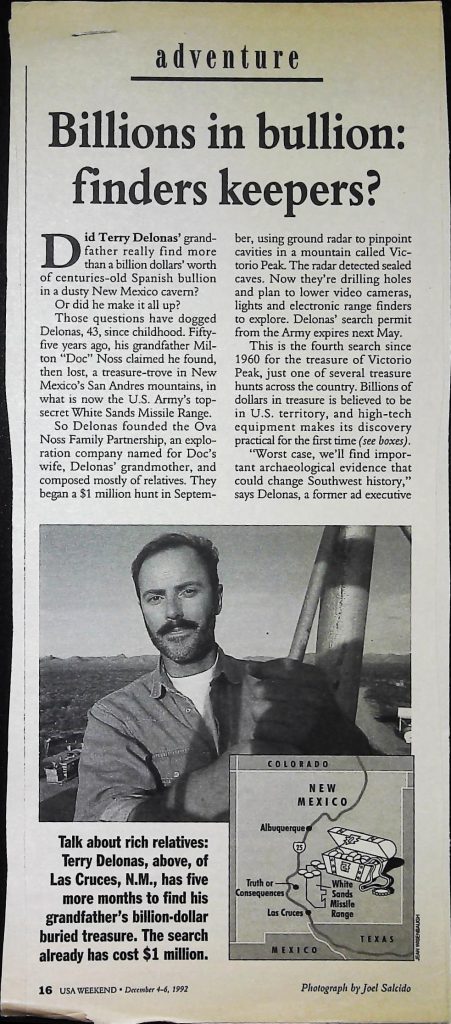
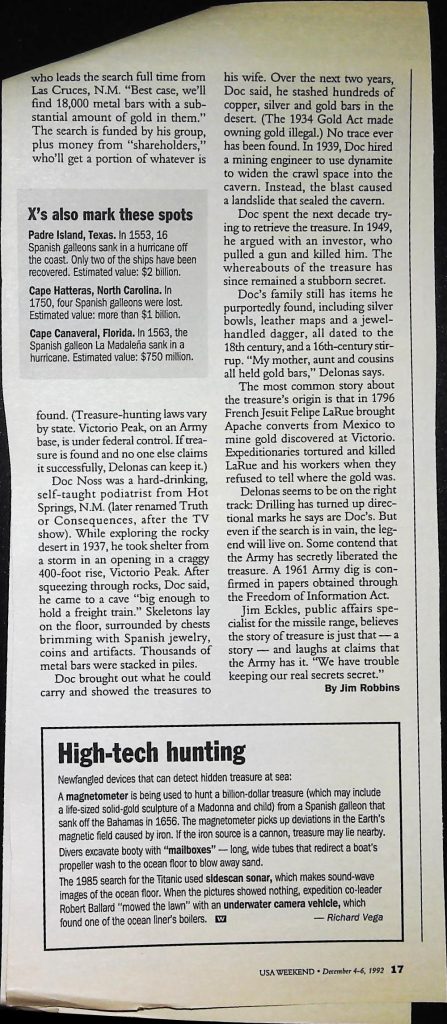
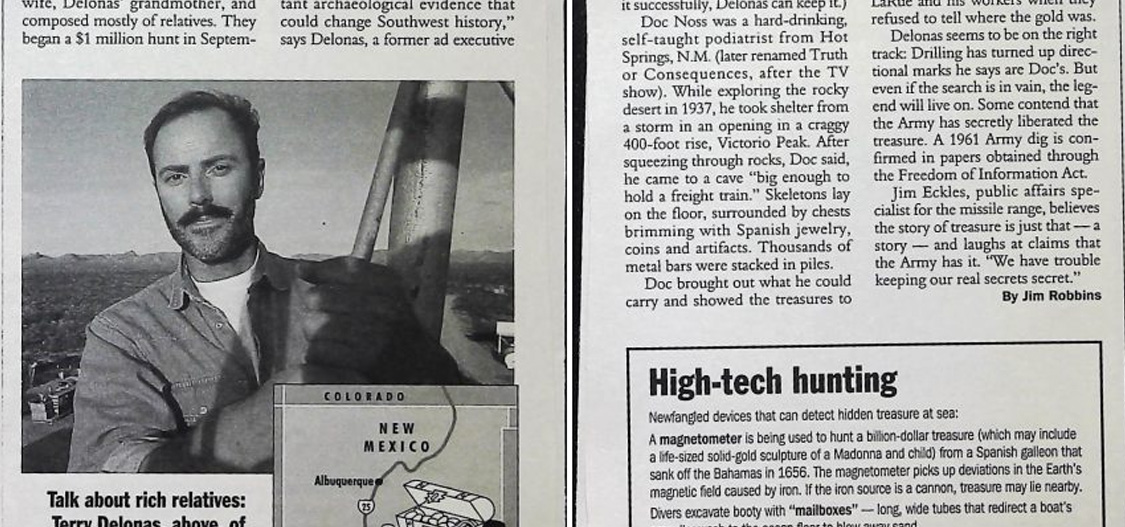
GARY MANGIACOPA ARCHIVE ============================================================ Title: B5F11I2 Slug: b5f11i2 Categories: Lost Treasure Source: https://garymangiacopraarchive.com/b5f11i2 Pages: 2 scanned, 2 extracted OCR: Google Vision API (document_text_detection) Processed: 2026-06-06 ============================================================ adventure Billions in bullion: finders keepers? D id Terry Delonas' grand- father really find more than a billion dollars' worth of centuries-old Spanish bullion in a dusty New Mexico cavern? Or did he make it all up? Those questions have dogged Delonas, 43, since childhood. Fifty- five years ago, his grandfather Mil- ton "Doc" Noss claimed he found, then lost, a treasure-trove in New Mexico's San Andres mountains, in what is now the U.S. Army's top- secret White Sands Missile Range. So Delonas founded the Ova Noss Family Partnership, an explo- ration company named for Doc's wife, Delonas' grandmother, and composed mostly of relatives. They began a $1 million hunt in Septem- ber, using ground radar to pinpoint cavities in a mountain called Vic- torio Peak. The radar detected sealed caves. Now they're drilling holes and plan to lower video cameras, lights and electronic range finders to explore. Delonas' search permit from the Army expires next May. This is the fourth search since 1960 for the treasure of Victorio Peak, just one of several treasure hunts across the country. Billions of dollars in treasure is believed to be in U.S. territory, and high-tech equipment makes its discovery practical for the first time (see boxes). "Worst case, we'll find impor- tant archaeological evidence that could change Southwest history," says Delonas, a former ad executive Talk about rich relatives: Terry Delonas, above, of Las Cruces, N.M., has five more months to find his grandfather's billion-dollar buried treasure. The search already has cost $1 million. 16 USA WEEKEND December 4-6, 1992 COLORADO NEW MEXICO Albuquerque 25 Truth or Consequences White Sands Missile Las Cruces Range TEXAS MEXICO Photograph by Joel Salcido [PAGE BREAK] who leads the search full time from Las Cruces, N.M. "Best case, we'll find 18,000 metal bars with a sub- stantial amount of gold in them." The search is funded by his group, plus money from "shareholders," who'll get a portion of whatever is X's also mark these spots Padre Island, Texas. In 1553, 16 Spanish galleons sank in a hurricane off the coast. Only two of the ships have been recovered. Estimated value: $2 billion. Cape Hatteras, North Carolina. In 1750, four Spanish galleons were lost. Estimated value: more than $1 billion. Cape Canaveral, Florida. In 1563, the Spanish galleon La Madaleña sank in a hurricane. Estimated value: $750 million. found. (Treasure-hunting laws vary by state. Victorio Peak, on an Army base, is under federal control. If trea- sure is found and no one else claims it successfully, Delonas can keep it.) Doc Noss was a hard-drinking, self-taught podiatrist from Hot Springs, N.M. (later renamed Truth or Consequences, after the TV show). While exploring the rocky desert in 1937, he took shelter from a storm in an opening in a craggy 400-foot rise, Victorio Peak. After squeezing through rocks, Doc said, he came to a cave "big enough to hold a freight train." Skeletons lay on the floor, surrounded by chests brimming with Spanish jewelry, coins and artifacts. Thousands of metal bars were stacked in piles. Doc brought out what he could carry and showed the treasures to his wife. Over the next two years, Doc said, he stashed hundreds of copper, silver and gold bars in the desert. (The 1934 Gold Act made owning gold illegal.) No trace ever has been found. In 1939, Doc hired a mining engineer to use dynamite to widen the crawl space into the cavern. Instead, the blast caused a landslide that sealed the cavern. Doc spent the next decade try- ing to retrieve the treasure. In 1949, he argued with an investor, who pulled a gun and killed him. The whereabouts of the treasure has since remained a stubborn secret. Doc's family still has items he purportedly found, including silver bowls, leather maps and a jewel- handled dagger, all dated to the 18th century, and a 16th-century stir- rup. "My mother, aunt and cousins all held gold bars," Delonas says. The most common story about the treasure's origin is that in 1796 French Jesuit Felipe LaRue brought Apache converts from Mexico to mine gold discovered at Victorio. Expeditionaries tortured and killed LaRue and his workers when they refused to tell where the gold was. Delonas seems to be on the right track: Drilling has turned up direc- tional marks he says are Doc's. But even if the search is in vain, the leg- end will live on. Some contend that the Army has secretly liberated the treasure. A 1961 Army dig is con- firmed in papers obtained through the Freedom of Information Act. <-a Jim Eckles, public affairs spe- cialist for the missile range, believes story of treasure is just that- and laughs at claims that the Army has it. "We have trouble keeping our real secrets secret.' the story By Jim Robbins High-tech hunting Newfangled devices that can detect hidden treasure at sea: A magnetometer is being used to hunt a billion-dollar treasure (which may include a life-sized solid-gold sculpture of a Madonna and child) from a Spanish galleon that sank off the Bahamas in 1656. The magnetometer picks up deviations in the Earth's magnetic field caused by iron. If the iron source is a cannon, treasure may lie nearby. Divers excavate booty with "mailboxes" - long, wide tubes that redirect a boat's propeller wash to the ocean floor to blow away sand. The 1985 search for the Titanic used sidescan sonar, which makes sound-wave images of the ocean floor. When the pictures showed nothing, expedition co-leader Robert Ballard "mowed the lawn" with an underwater camera vehicle, which found one of the ocean liner's boilers. W - Richard Vega USA WEEKEND ⚫ December 4-6, 1992 17