Box 5
Folder 13. Treasure – North Carolina
Item 3. Monitor

Transcribed Text (OCR)
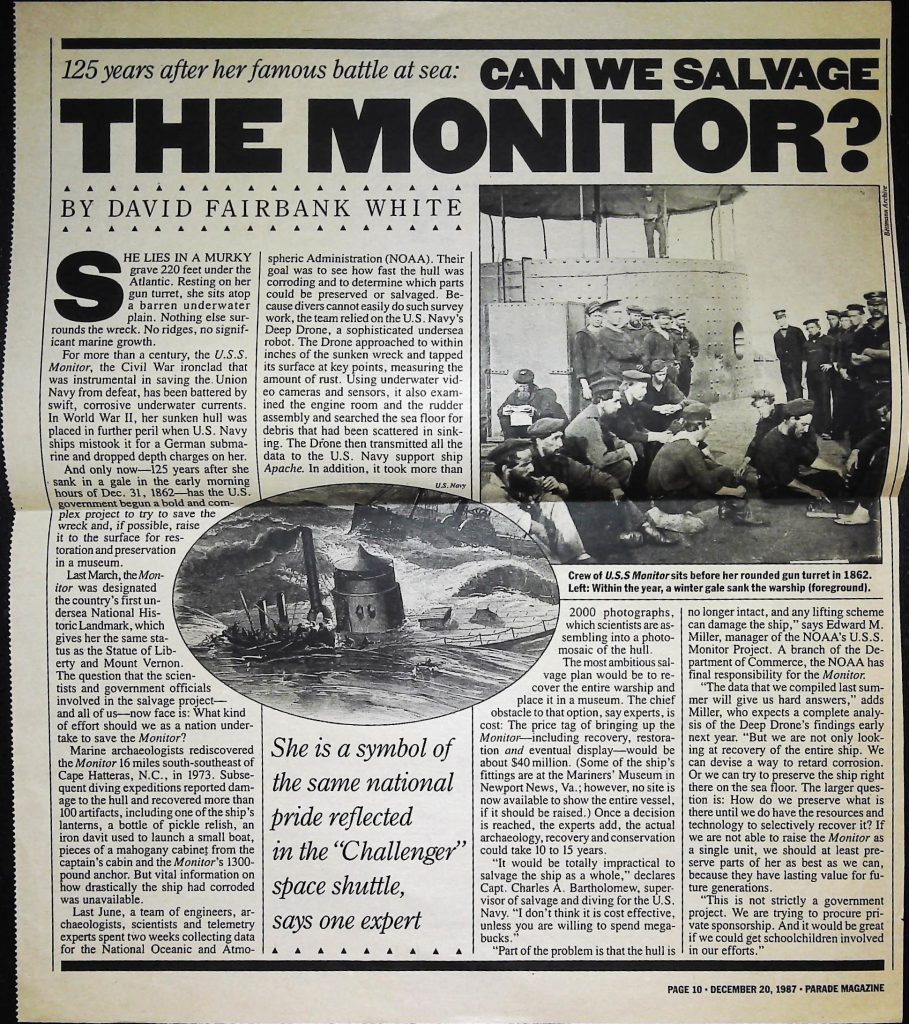
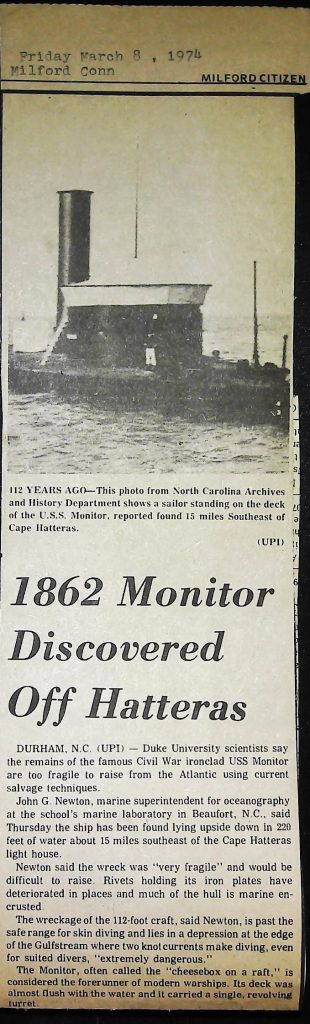
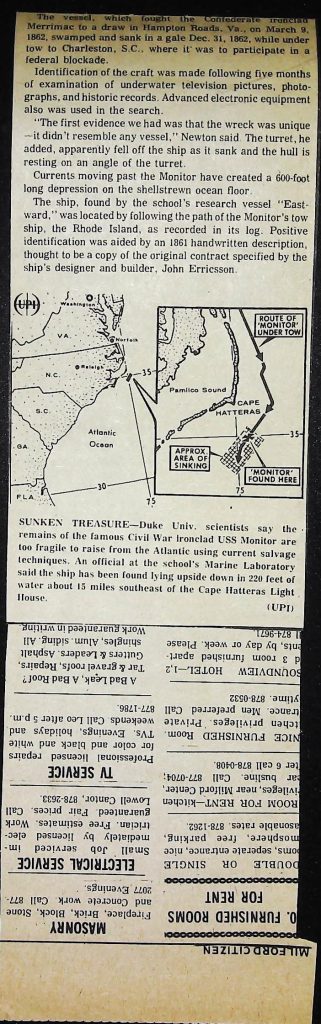
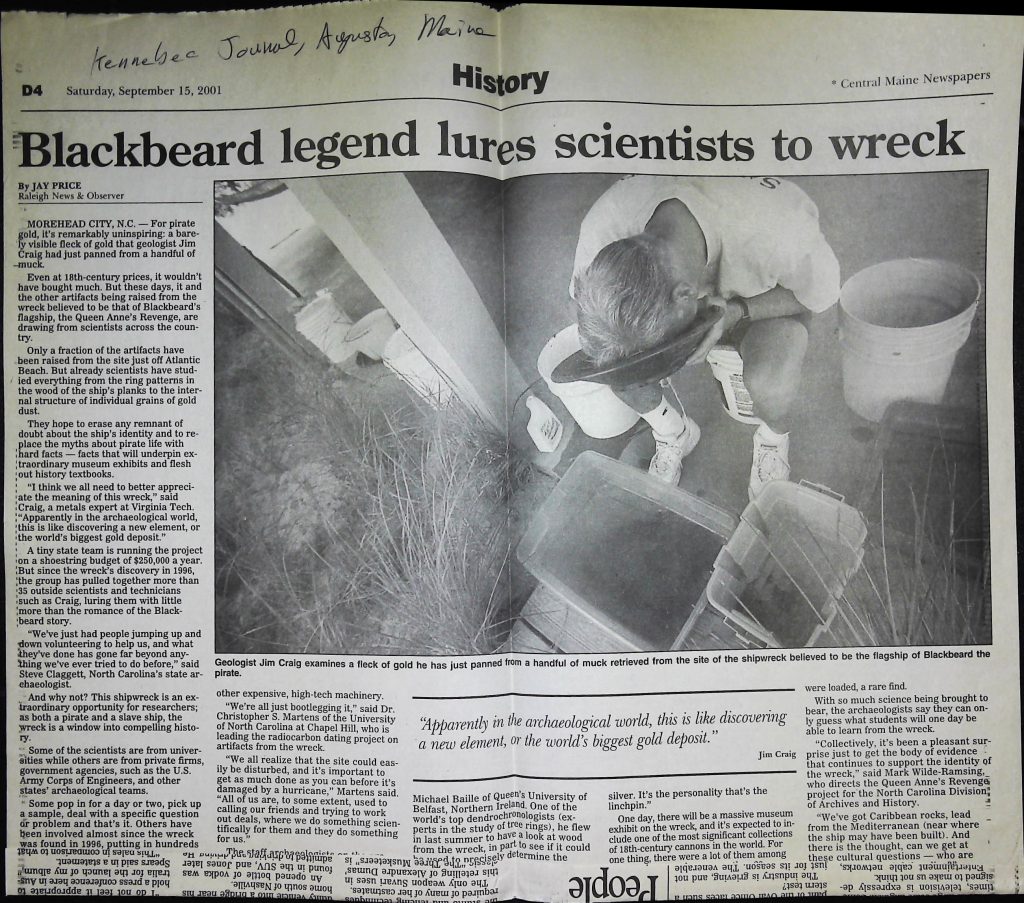
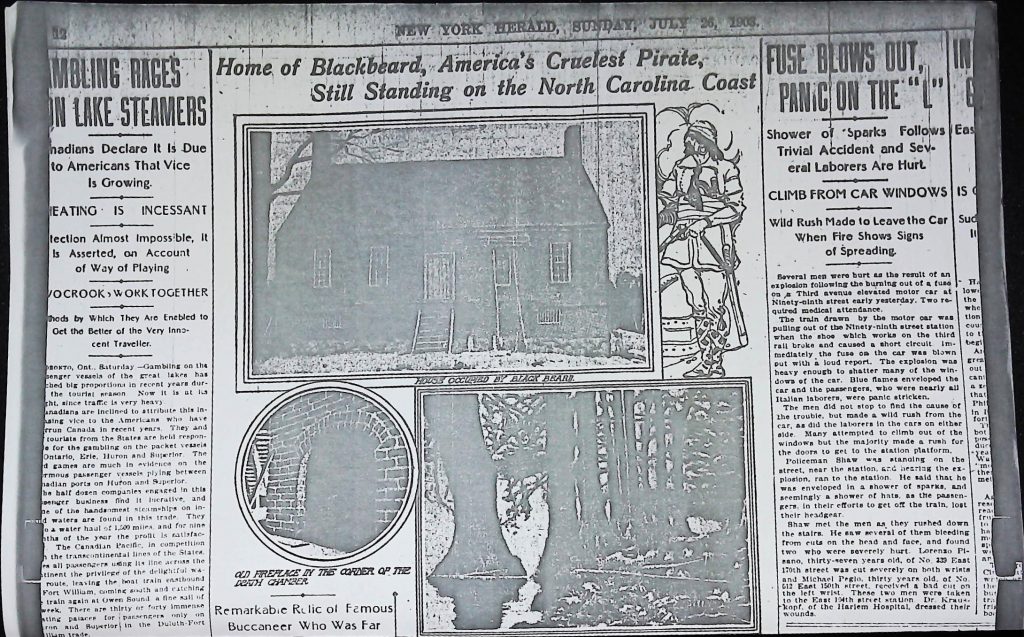
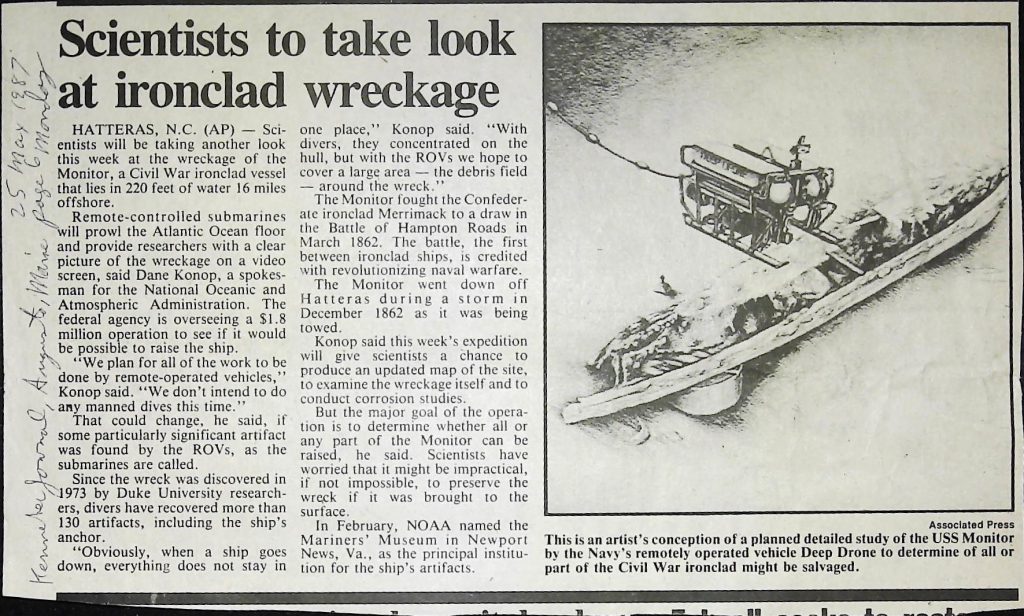
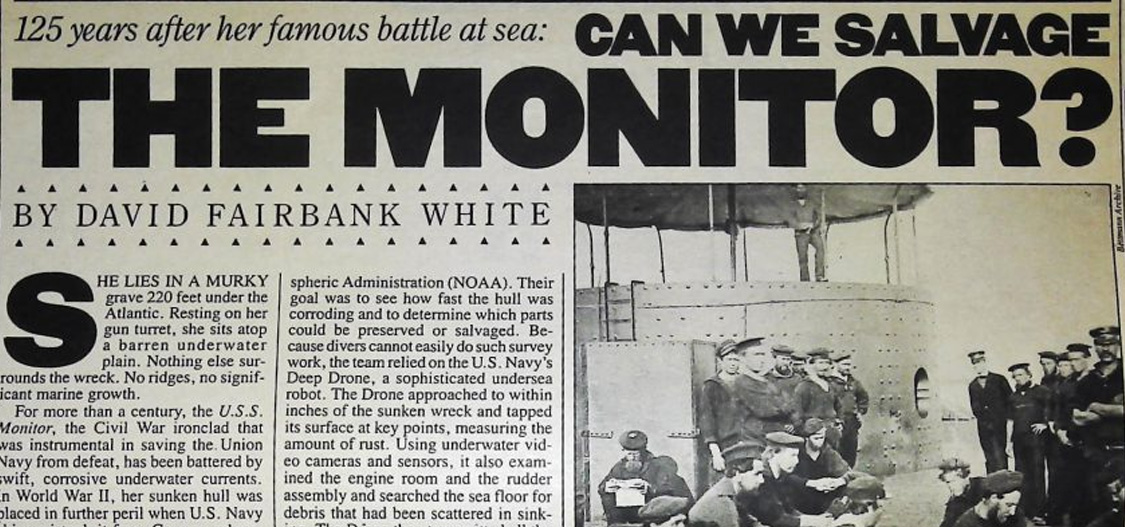
GARY MANGIACOPA ARCHIVE ============================================================ Title: B5F13I3 Slug: b5f13i3 Categories: Lost Treasure Source: https://garymangiacopraarchive.com/b5f13i3 Pages: 14 scanned, 14 extracted OCR: Google Vision API (document_text_detection) Processed: 2026-06-06 ============================================================ Built in only four months under the pressure of war, the Monitor was a tech- nological marvel. More than 170 feet long but rising only 18 inches out of the water, her deck was topped with a cy- lindrical gun turret (hence her nickname, "cheesebox on a raft"). Among her in- novations were armor plating, the world's first revolving gun turret, engines be- low the waterline and one of the first propellers. The Monitor also was the first vessel with forced-air ventilation in her cabin spaces, the first with a flush toilet, and the first with an anchor that could be controlled below deck. Her career was brief but brilliant: At Hampton Roads, Va., on March 9, 1862, this lone and unsupported warship bat- tled to a draw with the Confederate's steam-powered ironclad. the Virginia (the rebuilt Merrimack). It saved the day for the Union fleet, which was block- ading ports in the South. The Battle of Hampton Roads ended the era of wooden fighting ships, and the Monitor became the prototype for the armored, turreted warships that followed. Most recently, the Monitor's cause has been taken up by the National Foun- dation for Maritime Conservation, a new- ly formed private foundation headed by F. Ross Holland, former director of res- toration and preservation for the Statue of Liberty. "One of our principal goals is to raise money for the U.S.S. Moni- tor Project," says Holland. "We also want to develop a national policy about what to do with underwater archaeolog- ical sites. Right now, policies favor the salvagers, often at the expense of the ships." "We have lost the opportunity to learn a lot about our history and our ancestors through the mishandling of other ship- wrecks," says Edward Miller. "We don't just want to pick up debris, like they did with the Titanic. We want to do a con- trolled excavation where we study the debris field archaeologically and docu- ment everything. "And if we are not able to recover the Monitor in our times, we should at least slow its deterioration to insure that tion for future generations. op- "The Monitor is a symbol of Yankee ingenuity and courage in the face of enemy might and a part of our national pride." As a Navy midshipman, Miller was part of the team that first identified the wreck in 1973. "We derive national pride from who we are, where we came from and where we are going," he con- tinued. "That same pride is reflected in the landing on the moon and in the Challenger space shuttle. The goal is to preserve as much of that American pride as is possible. P For more information about the U.S.S. Monitor Project, contact the Marine and Estuarine Management Division. NOAA, Dept. P. 1825 Connecticut Ave.. N.W., Washington, D.C. 20235. PARADE MAGAZINE DEC. 20, 1987 PAGE 11 [PAGE BREAK] Divers find cannon believed to have been on Blackbeard's ship BEAUFORT, N.C. (AP) - Underwater archae- pound or 8-pound ball, Southerly said. Divers ologists have found another cannon from the wreckage of what they believe was the flagship of the notorious pirate Blackbeard. Historical records indicate Blackbeard had 40 guns on the French frigate he captured in 1717 and renamed Queen Anne's Revenge. Since 1996, when the wreckage of the ship was discovered in Beaufort Inlet, divers have found 22 at the site. "We're pretty positive that we have cannon No. 23," said project archaeologist Chris Southerly. uncovered the cannon while excavating an area of the shipwreck's northwest side where they had not previously dug. Divers also found a concretion with chain and part of the mast rigging, and a 9- to 10-inch- diameter cast-iron kettle. A concretion is a min- eral buildup usually found in rock. The dig, which began Monday, was a second priority for the divers, whose main goal was to survey the shipwreck site for storm damage. They found several scoured areas, likely the It is a large cannon that probably shot a 6- result of recent hurricanes, Southerly said. 9 October 2004 Saturday pose B5cal 5-6 New Haven fagister, Conn [PAGE BREAK] 125 years after her famous battle at sea: CAN WE SALVAGE THE MONITOR? BY DAVID FAIRBANK WHITE S HE LIES IN A MURKY grave 220 feet under the Atlantic. Resting on her gun turret, she sits atop a barren underwater plain. Nothing else sur- rounds the wreck. No ridges, no signif- icant marine growth. For more than a century, the U.S.S. Monitor, the Civil War ironclad that was instrumental in saving the. Union Navy from defeat, has been battered by swift, corrosive underwater currents. In World War II, her sunken hull was placed in further peril when U.S. Navy ships mistook it for a German subma- rine and dropped depth charges on her. And only now-125 years after she sank in a gale in the early morning hours of Dec. 31, 1862-has the U.S. government begun a bold and com- plex project to try to save the wreck and, if possible, raise it to the surface for res- toration and preservation in a museum. Last March, the Mon- itor was designated the country's first un- dersea National His- toric Landmark, which gives her the same sta- tus as the Statue of Lib- erty and Mount Vernon. The question that the scien- tists and government officials involved in the salvage project- and all of us-now face is: What kind of effort should we as a nation under- take to save the Monitor? spheric Administration (NOAA). Their goal was to see how fast the hull was corroding and to determine which parts could be preserved or salvaged. Be- cause divers cannot easily do such survey work, the team relied on the U.S. Navy's Deep Drone, a sophisticated undersea robot. The Drone approached to within inches of the sunken wreck and tapped its surface at key points, measuring the amount of rust. Using underwater vid- eo cameras and sensors, it also exam- ined the engine room and the rudder assembly and searched the sea floor for debris that had been scattered in sink- ing. The Drone then transmitted all the data to the U.S. Navy support ship Apache. In addition, it took more than U.S. Navy Marine archaeologists rediscovered She is a symbol of the Monitor 16 miles south-southeast of Cape Hatteras, N.C., in 1973. Subse- quent diving expeditions reported dam- age to the hull and recovered more than lanterns, a bottle of pickle relish, an iron davit used to launch a small boat, 100 artifacts, including one of the ship's pieces of a mahogany cabinet from the captain's cabin and the Monitor's 1300- pound anchor. But vital information on how drastically the ship had corroded was unavailable. Last June, a team of engineers, ar- chaeologists, scientists and telemetry experts spent two weeks collecting data for the National Oceanic and Atmo- the same national pride reflected Crew of U.S.S Monitor sits before her rounded gun turret in 1862. Left: Within the year, a winter gale sank the warship (foreground). 2000 photographs, | no longer intact, and any lifting scheme which scientists are as- sembling into a photo- mosaic of the hull. The most ambitious sal- vage plan would be to re- cover the entire warship and place it in a museum. The chief obstacle to that option, say experts, is cost: The price tag of bringing up the Monitor including recovery, restora- tion and eventual display-would be about $40 million. (Some of the ship's fittings are at the Mariners' Museum in Newport News, Va.; however, no site is now available to show the entire vessel, if it should be raised.) Once a decision is reached, the experts add, the actual archaeology, recovery and conservation in the "Challenger" in the "Challenger" could take 10 to 15 years. space shuttle, says one expert "It would be totally impractical to salvage the ship as a whole," declares Capt. Charles A. Bartholomew, super- visor of salvage and diving for the U.S. Navy. "I don't think it is cost effective, unless you are willing to spend mega- bucks.' "Part of the problem is that the hull is can damage the ship," says Edward M. Miller, manager of the NOAA's U.S.S. Monitor Project. A branch of the De- partment of Commerce, the NOAA has final responsibility for the Monitor. Archive "The data that we compiled last sum- mer will give us hard answers," adds Miller, who expects a complete analy- sis of the Deep Drone's findings early next year. "But we are not only look- ing at recovery of the entire ship. We can devise a way to retard corrosion. Or we can try to preserve the ship right there on the sea floor. The larger ques- tion is: How do we preserve what is there until we do have the resources and technology to selectively recover it? If we are not able to raise the Monitor as a single unit, we should at least pre- serve parts of her as best as we can, because they have lasting value for fu- ture generations. "This is not strictly a government project. We are trying to procure pri- vate sponsorship. And it would be great if we could get schoolchildren involved in our efforts." PAGE 10 DECEMBER 20, 1987 PARADE MAGAZINE [PAGE BREAK] 32A THE NEW HAVEN REGISTER, SUNDAY, JUNE 19, 1977 Civil War Monitor May Be Recovered RALEIGH, N.C. (UPI) - The man who directed a research expedition to the site of the Monitor says scientists no long- er doubt the Civil War Ironclad can be recovered from the ocean floor. "We all think recovery is feasible be- cause of our experience with marine technology, said Dr. Robert Sheridan, chairman of the University of Delaware's marine biology program. Sheridan and other scientists were elated by the findings of the four-day ex- pedition in early April to test the environ- ment around the Ironclad, which lies where it sank in the Atlantic Ocean in 1862. The Monitor is upside down in 220 feet of water 16 miles south-southeast of Cape Hatteras. "It was tremendously successful be- yond our wildest dreams," said John New- ton, executive director of the Monitor Re- search and Recovery Foundation in Beaufort, N.C. "We've made tremendous strides, but there's still a lot to be done.- The Monitor, designed by Swedish inventor John Ericsson, contained 40 inventions, that could have been patented, had there been time. Among the inven- tions were a movable turret, flush toilets, a hidden anchor and a force-air ventila- tion system. The "cheese box on a raft," as the Minotor was called sank in a storm New Year's Eve, 1862, nine months after its inconclusive battle with the Merrimac. Among the things scientists aboard the research vessel Cape Henlopen found was that ocean currents on the sea floor around the wreckage are gently enough for divers to explore the area. There were suspicions that the usual- ly violent weatherc conditions in the "Graveyard of the Atlantic," where powerful winds and heavy seas are a com- mon occurrence, would hamper the project. "We were very happy to have that finding," said Sheridan in a telephone interview from his office in Delaware. "We needed to have that rpoof before going on." But Sheridan, who was part of the research team that discovered the zmoni- tor in 1973, said it may be longer than first anticipated before divers are sent to probe the forerunner of the modern bat- tleship. The diving is being posponed to make more firm decisions abut what they should do," he said. Scientists are hoping for another voy- age in July or August to conduct more experiments, but no date has been set. Another important finding from the first expedition backed up earlier beliefs that the ocean floor near the wreckage is cohesive enough to hold together if scien- Monitor Crew's Descendants Sought RALEIGH, N.C. (UPI) Old family papers and bric-a-brac in attics may help in the recovery of the Civil War ironclad Monitor, if they can only be found. "We are searching for descendants of Monitor crewmen so we can find out more about the construction of the ship," said John Newton, of Beaufort, N.C., execu- tive director of the Monitor Research and Recovery Foundation. "We're looking for letters or anything that would help us understand how the interior of the ship looked, where machin- ery was, events that may have occurred on board. ?'" "What we'd like to know is something like, 'where was the Rivington pump?' he said. "This will be important in giving divers some idea of where everything was located. They need to recognize what they're looking at." Newton said he is interested in hearing from descendants of both the 60 Monitor and 300 Merrimac crewmen, since the two ships were so closely linked in history. He estimated there could be about 10,- 000 descendants, but so far has only heard from 12 and knows only of about two dozen. He said those he has heard from provided invaluable information. Mrs. Robert F. Lent of Hancock, N.H., whose great uncle was an assistant engi- neer on the Monitor, provided a piece of metal apparently salvaged from the ship. "I had a piece of the Monitor knocked off from the fight with the Merrimac," said Mrs. Lent. "When I discovered they were looking for Moitor descendants, I wrote and asked if they'd like the piece to see if it matched the ship they had found." Louise Bushnell of New York City gave Newton "a whole lot of stuff" left by her grandfather, Cornelius Bushnell, who fi- nanced the ship and intervened with President Lincoln to see that the Moni- tor's unique design was accepted. Thomas F. Rowland, of Kennebunk- port, Me., is the grandson of the man who built the Monitor and owned the New York shipyard where it was constructed. He has given a copy of the original model to Newton, and still has a set of the origi- nal tracings drawn by his grandfather's draftsman. Descendants of the Monitor or Merri- mac, or anyone with information pertain- ing to the ships, may contact Newton at the Monitor Research and Recovery Foundation, P.O. Box 1862, Beaufort, N.C. 28516. tists decide to recover the Monitor by dig- ging under the surface and lifting the ship and sediment together. "Now we know that to dig into the sediment to pull something out of the sedi- ment would require so many tons of force," Sheridan said. "It looks like forces needed to penetrate the sediments are not unreasonable and are within the limits of technology. A third finding from the April re- search trip indicated that both the bow and the stern, which face into the ocean floor, are supported from below. Sheridan said this was important because there would be stress on the wreckage during recovery. Among the suggested recovery meth- ods are freezing the waters and ocean floor around the ship and lifting the entire package for transferral to shallower wa- ters, where further exploration can be done with less difficulty. Another method calls for the Glomar Explorer to dig under the sea floor below the wreckage and, again, lift the entire mass for removal to shallower waters. Sheridan, who is also president of the Monitor Research and Recovery Founda- tion, said that the data from the April voyage indicates either of those two meth- ods would be the best. A third suggestion, which would in- volve dismantling the wreckage and removing it piece-by-piece, is turning out to be the least feasible of the three, he said. "Any dismantling would be difficult in its present location." Sheridan said scientists hope to recover the Monitor before 1980, especial- ly if the Glomar is used. He said the exp- lorer is scheduled to be used for unrelated deep sea drilling expeditions during the 1890s. Sheridan, a self-described Civil War buff, said he hopes the effort to save the Monitor can be undertaken because "it's clear to us that the wreck is a resource that should not be wasted. [PAGE BREAK] Project launched to save Civil War vessel Monitor pcs Asbury Park Press! The Associated Press ANNAPOLIS, Md. A historical preservation group and a federal agen- cy announced yesterday that they have launched a project aimed at raising the wreck of the USS Monitor, a Civil War ironclad vessel. The National Trust for Historic Preservation, a private, non-profit or- ganization, and the National Oceanic and Atmospheric Administration, which is responsible for the ship, are collaborating on the project. The Monitor, famous for its duel with the Confederate ironclad Virginia formerly the Union's Merrimac sank during a storm on Dec. 31, 1862, less than a year after it was launched, in 200 feet of water 16 miles off Cape Hatteras, N.C. The "first battle of the ironclads" came to symbolize the end of wooden gunboats and the beginning of the era of the modern fighting ship. The shipwreck was discovered in 1973. Two years later the U.S. secre- tary of commerce designated the Mon- itor and its surrounding waters the first national marine sanctuary. The National Trust will provide the federal agency with a way to raise private funds for the project, as well as technical expertise, said Nancy Foster, chief of the administration's sanctary programs. Ms. Foster said it could be four or five years before a major structure from the Monitor could be recovered, or the ship raised, if such work is found to be feasible. "We will not raise the ship unless we know we can conserve it, display it and, of course, pay for it," Ms. Foster said at a Naval Academy ceremony marking the 10th anniversary of the sanctuary designation. She said she could give no estimate for the cost of the project. More than 100 artifacts have been recovered from the ship, including a lantern that went on public display yesterday for the first time. The lantern was the last thing spotted by crew members aboard the Rhode Island, which had been towing the slower- moving Monitor, before the ship sank and 16 men lost their lives. Because of the Monitor's precar- ious position and exposure to corrosive currents, efforts must be undertaken soon if it is to be saved, said Phillip Lundeberg, retired curator of the Smithsonian Institution's division of naval history. "Simply stated, time is running out on the Monitor," Lundeberg told an audience that included descendents of the ship's builders and officers. The ship is resting upside down on its turret, which gave the Monitor its "cheesebox on a raft" name, Ms. Fos- ter said. Because it is sitting on a sandy bottom and is not embedded in mud, the ship has been subject to a high degree of corrosion, she said. The 173-foot Monitor, which was armed with two 11-inch, muzzle-load- ing cannon protected by eight inches of armor, also is believed to have been damaged by depth charges dropped during World War II by American ships that may have mistaken it for an enemy submarine, Ms. Foster said. [PAGE BREAK] Friday March 8 Milford Conn , 1974 MILFORD CITIZEN t la S 112 YEARS AGO-This photo from North Carolina Archives and History Department shows a sailor standing on the deck 20 of the U.S.S. Monitor, reported found 15 miles Southeast of a Cape Hatteras. (UPI) 1862 Monitor Discovered Off Hatteras DURHAM, N.C. (UPI) - Duke University scientists say the remains of the famous Civil War ironclad USS Monitor are too fragile to raise from the Atlantic using current salvage techniques. John G. Newton, marine superintendent for oceanography at the school's marine laboratory in Beaufort, N.C., said Thursday the ship has been found lying upside down in 220 feet of water about 15 miles southeast of the Cape Hatteras light house. Newton said the wreck was "very fragile" and would be difficult to raise. Rivets holding its iron plates have deteriorated in places and much of the hull is marine en- crusted The wreckage of the 112-foot craft, said Newton, is past the safe range for skin diving and lies in a depression at the edge of the Gulfstream where two knot currents make diving, even for suited divers, "extremely dangerous. The Monitor, often called the "cheesebox on a raft," is considered the forerunner of modern warships. Its deck was almost flush with the water and it carried a single, revolving turret. [PAGE BREAK] The vessel, which fought the Confederate ironclad Merrimac to a draw in Hampton Roads, Va., on March 9, 1862, swamped and sank in a gale Dec. 31, 1862, while under tow to Charleston, S.C., where it was to participate in a federal blockade. Identification of the craft was made following five months of examination of underwater television pictures, photo- graphs, and historic records. Advanced electronic equipment also was used in the search. "The first evidence we had was that the wreck was unique -it didn't resemble any vessel," Newton said. The turret, he added, apparently fell off the ship as it sank and the hull is resting on an angle of the turret. Currents moving past the Monitor have created a 600-foot long depression on the shellstrewn ocean floor. The ship, found by the school's research vessel "East- ward," was located by following the path of the Monitor's tow ship, the Rhode Island, as recorded in its log. Positive identification was aided by an 1861 handwritten description, thought to be a copy of the original contract specified by the ship's designer and builder, John Erricsson. (UPF GA. S.C. Norfolk -35- Pamlico Sound Atlantic Ocoan APPROX. AREA OF SINKING -30- CAPE HATTERAS ROUTE OF 'MONITOR' UNDER TOW -35- 'MONITOR' FOUND HERE FLA SUNKEN TREASURE-Duke Univ. scientists say the remains of the famous Civil War Ironclad USS Monitor are too fragile to raise from the Atlantic using current salvage techniques. An official at the school's Marine Laboratory said the ship has been found lying upside down in 220 feet of water about 15 miles southeast of the Cape Hatteras Light House. (UPI) MILFORD CITIZEN 0. FURNISHED ROOMS FOR RENT DOUBLE OR SINGLE [AD] asonable rates. 878-1262. mosphere, free parking, oms, seperate entrance, nice [AD] ter 6 call 878-0408. [AD] ear busline. Call 877-0704; rivileges, near Milford Center, ROOM FOR RENT-kitchen [AD] ytime. 878-0532 trance. Men preferred Call tchen privileges. Private NICE FURNISHED Room. SOUNDVIEW HOTEL-1,2 ents, by day or week. Please d 3 room furnished apart- [AD] 11 874-9671 MASONRY.. 2077 Evenings. and Concrete work. Call 877- Fireplace, Brick, Block, Stone [AD] Lowell Cantor, 878-2633. guaranteed. Fair prices. Call trician. Free estimates. Work mediately by licensed elec- im- serviced Job Small ELECTRICAL SERVICE [AD] 877-1786. weekends Call Leo after 5 p.m. TVs. Evenings, holidays and for color and black and white Professional licensed repairs TV SERVICE Work guaranteed in shingles, Alum. siding. All Gutters & Leaders. Asphalt Tar & gravel roofs, Repairs, A Bad Leak, A Bad Roof? writing. [PAGE BREAK] page 22 Monday 15 June 1987. Monitor wreck rapidly corroding By MALCOLM W. BROWNE N.Y. Times News Service NEW YORK - Scientists probing the sunken wreck of the Civil War gunboat Monitor have concluded ing so rapidly that a decision will that the historic ironclad is corrod- have to be made soon on what to do with the wreck. For the past two weeks one of the built has been photographing, prob- most advanced deep-sea robots ever ing, testing and measuring the coral-encrusted hulk of the Monitor. The wreck lies in 220 feet of water 16.7 statute miles southeast of Cape Hatteras, N.C. The $1.8-million expedition is a joint undertaking of the National Oceanic and Atmospheric Adminis- Smithsonian Institution, the tration, the United States Navy, the National Parks Department and other organizations. The Navy's contribution includes the loan of its ocean-going tug, the Apache, which has been moored in the storm-tossed Atlantic Ocean directly over the Monitor. "At issue," said Edward M. Miller, one of the oceanic agency expedition, "is whether any given officials who are directing the part of the Monitor should be raised, alone." For example, the turret, preserved in place, or simply left is supporting the port quarter of the partly buried under the ocean floor, hull, which is upside down. Miller said the hull resting on the turret is supported by a rapidly corroding armor belt, a band of armor plate along the sides of the ship. "Before long," he said in a shipboard interview, "the armor will rust through and the wreck will break in two. But if we were to displace the hull from the turret to relieve the stress, the exposure of the turret to ocean turbulence would increase, and this might hasten the destruction of the turret, which is particularly valuable from an archeological viewpoint. 29 Whatever decision is ultimately taken on the basis of the current investigation, Miller said, the situa- tion must be carefully but rapidly weighed, and adequate financing must be assured in advance. "If we were to raise some key parts of the Monitor, we would have to be certain that money would be avail- able to preserve them and also to display them properly, not just bury them in some Federal warehouse,' he said. "The Monitor epitomizes America's technological, political and cultural heritage, and it is priceless." The Monitor, launched Jan. 30, 1862, at the Greenpoint section of Brooklyn, was the star participant in the most famous naval engagement of the Civil War - the Battle of Hampton Roads, near Norfolk, Va. [PAGE BREAK] Merrimack will stay buried PORTSMOUTH, Va. (UPI) Five years ago, Clive Cussler became fascinated by the mysteries of ships that ended up in Davy Jones' locker because of war or disaster. "Shipwrecks are incredible mys- teries," he said. "I think murder pales next to a shipwreck as a mys- tery. It's a part of history."' But one mystery will elude Cus- sler. For six months, he and a crew had been searching the dark, muddy Elizabeth River in Portsmouth for remains of the Civil War ironclad ship Merrimack. Cussler, the author of the 1976 bestseller "Raise the Titanic!," and his crew were unable to bring up very much of the ship because most of it is buried under tons of mud. So they are leaving the ship to rest. "There were about 18 to 20 of us who tried awfully hard to find some- thing," Cussler said. "But there was very little left. I'd give my left arm for the Merrimack.' The Merrimack, called the Virgin- ia by the Confederates, was one of the first ironclads used in battle and the one fray noted in history books was the March 1862 clash with its Union foe, the Monitor. It was the first battle between ironclad ships, and neither was able to pierce the other's hull after four hours of fighting. The Monitor eventually withdrew, and the Merrimack returned to the Portsmouth shipyard. When Confederate troops were forced to leave the shipyard on May 10, 1862, the Merrimack's crew ran it aground, set it afire and blew it up. "We have records that the debris from that explosion rained down on the shore and water for miles around," Cussler said. "In the late 1870s, there was an attempt to raise the ship, but it broke in two and dropped back into the water.' Since the 1930s, the banks around Craney Island have been dredged, burying the Merrimack's remains under more mud. [PAGE BREAK] always makes excuses for him, but that doesn't help the rest of our lungs. 21 We have to wait for Dad before we eat, and Mom never cooks any- thing he doesn't like. She won't let me cook, as she says I don't know how, but if I say "Teach me," she says she's too busy. If we don't pick up, or do things right away, Dad yells or twists our arms. - Mixed Up and Mad in Minnie It's so frustrating to see someone you care doing something you know is unhealthy, but your father has to want to quit himself. If you nag, it may provoke him to smoke more. Someday when your mother is in a good mood, talk over your frustra- tions about cooking. Ask if you could make a side dish, or a dessert for special occasions. She can choose the day. If she can't help you, try one of the good kid's cookbooks. I am most concerned about your father's yelling and arm twisting. It is good you are in that group. Talk to your leader about this problem. She may be able to suggest further help. Organizations such as the Family Service Association can give family 198 ASA Beth brother always talk dirty. I ask them to stop, but they don't seem to care. I told my boyfriend, if he liked me, he wouldn't do it. He sends me candy and stuff but doesn't stop this talk. Frustrated You need to think, and decide whether you want to put up with this kind of talk, or break up. There are other boys who would respect your wishes more. As for your brother, you can only ignore him. Leave the room when he starts up. Dear Beth: I'm 18. My boyfriend and I really love each other, but he is bugging me to go to bed with him. I'm scared. What should I tell him? How should I act? - Virgin Being scared is a valid reason. Tell him you aren't ready for this giant step. It takes courage to follow your inner voice, but if you act sure of your decision, and if he TRULY [PAGE BREAK] Kennebec Jounal, Augusta, Maine D4 Saturday, September 15, 2001 History * Central Maine Newspapers Blackbeard legend lures scientists to wreck By JAY PRICE Raleigh News & Observer MOREHEAD CITY, N.C. For pirate gold, it's remarkably uninspiring: a bare- ly visible fleck of gold that geologist Jim Craig had just panned from a handful of -muck. Even at 18th-century prices, it wouldn't have bought much. But these days, it and the other artifacts being raised from the wreck believed to be that of Blackbeard's flagship, the Queen Anne's Revenge, are drawing from scientists across the coun- try. Only a fraction of the artifacts have been raised from the site just off Atlantic Beach. But already scientists have stud- ied everything from the ring patterns in the wood of the ship's planks to the inter- nal structure of individual grains of gold dust. They hope to erase any remnant of doubt about the ship's identity and to re- place the myths about pirate life with hard facts-facts that will underpin ex- 'traordinary museum exhibits and flesh out history textbooks. "I think we all need to better appreci- ate the meaning of this wreck," said Craig, a metals expert at Virginia Tech. "Apparently in the archaeological world, this is like discovering a new element, or the world's biggest gold deposit." A tiny state team is running the project on a shoestring budget of $250,000 a year. But since the wreck's discovery in 1996, 'the group has pulled together more than 35 outside scientists and technicians such as Craig, luring them with little more than the romance of the Black- beard story. "We've just had people jumping up and down volunteering to help us, and what they've done has gone far beyond any- thing we've ever tried to do before," said Steve Claggett, North Carolina's state ar- chaeologist. And why not? This shipwreck is an ex- traordinary opportunity for researchers; as both a pirate and a slave ship, the wreck is a window into compelling histo- ry. Some of the scientists are from univer- sities while others are from private firms, government agencies, such as the U.S. Army Corps of Engineers, and other states' archaeological teams. x Some pop in for a day or two, pick up a sample, deal with a specific question or problem and that's it. Others have been involved almost since the wreck was found in 1996, putting in hundreds e of the a b c d unque Au jo be a - a b c d de la o op I.. S Geologist Jim Craig examines a fleck of gold he has just panned from a handful of muck retrieved from the site of the shipwreck believed to be the flagship of Blackbeard the pirate. other expensive, high-tech machinery. "We're all just bootlegging it," said Dr. Christopher S. Martens of the University of North Carolina at Chapel Hill, who is leading the radiocarbon dating project on artifacts from the wreck. "We all realize that the site could eas- ily be disturbed, and it's important to get as much done as you can before it's damaged by a hurricane," Martens said. "All of us are, to some extent, used to calling our friends and trying to work out deals, where we do something scien- tifically for them and they do something for us. "Apparently in the archaeological world, this is like discovering a new element, or the world's biggest gold deposit." Michael Baille of Queen's University of Belfast, Northern Ireland. One of the world's top dendrochronologists (ex- perts in the study of tree rings), he flew in last summer to have a look at wood from the wreck, in part to see if it could The staff a diely determine the aieta a was a punoj se to a pod uv and to So far as s to be de as a to je p were loaded, a rare find. With so much science being brought to bear, the archaeologists say they can on- ly guess what students will one day be able to learn from the wreck. "Collectively, it's been a pleasant sur- Jim Craig prise just to get the body of evidence that continues to support the identity of the wreck," said Mark Wilde-Ramsing, who directs the Queen Anne's Revenge project for the North Carolina Division of Archives and History. silver. It's the personality that's the linchpin.' 22 "We've got Caribbean rocks, lead from the Mediterranean (near where the ship may have been built). And there is the thought, can we get at these cultural questions - who are se One day, there will be a massive museum exhibit on the wreck, and it's expected to in- clude one of the most significant collections of 18th-century cannons in the world. For one thing, there were a lot of them among as a te pe e dans sa o RA a 10 ed - da [PAGE BREAK] IMBLING RACES IN LAKE STEAMERS hadians Declare It Is Due to Americans That Vice Is Growing. EATING IS INCESSANT tection Almost Impossible, it Is Asserted, on Account of Way of Playing VOCROOK, WORK TOGETHER hods by Which They Are Enabled to Oct the Better of the Very Inno- cent Traveller. PRONTO, Ont., Baturday -Gambling on the senger vessels of the great lakes has ched blg proportions in recent years dur- the tourist season Now it is at its tht. since traffic is very heavy anadians are Inclined to attribute this in- sing vice to the Americans who have rrun Canada in recent years. They and tourists from the States are held respon- o for the gambling on the packet vesseis Ontario, Erle, Huron and Superior. The d gamen are much In evidence on the rmous passenger vessels plying between adlan ports on Huron and Superlor. he half dozen companies engaged in this senger business find it lucrative, and ne of the handsomest steamships on in- id waters are found in this trade. They o a water haul of 1,500 miles, and for nine ths of the year the profit is satisfac- The Canadian Pacific, in competition h the transcontinental lines of the States, es all passengers using Its line across the tinent the privilege of the delightful wa- route, leaving the boat train enstbound Fort William, coming south and catching train again at Owen Sound a fine sall of NEW YORK HERALD, BUNDAY, JULY 26, 1903. en Home of Blackbeard, America's Cruelest Pirate, Still Standing on the North Carolina Coast OLD FIREPLACE DY THE CORDER OF THE DEATH CHAMBER week. There are thirty or forty immense Remarkable Relic of Famous ating palaces for passengers only on and Buperior in ron Illam trade. the Duluth-Fort Buccaneer Who Was Far HOUSE OCCUPIED BY BLACK BEARD FUSE BLOWS OUT, PANIC ON THE "L" Shower of Sparks Follows Eas Trivial Accident and Sev. eral Laborers Are Hurt CLIMB FROM CAR WINDOWS IS Wild Rush Made to Leave the Car Suc When Fire Shows Signs of Spreading. Beveral men were hurt as the result of an exploalon following the burning out of a fuso on a Third avenue elevated motor car at Ninety-ninth street early yesterday. Two re- quired medical attendance. The train drawn by the motor car was pulling out of the Ninety-ninth street station when the shoe which works on the third rail broke and caused a short circuit Im- mediately the fuse on the car was blown put with a loud report. The explosion was heavy enough to shatter many of the win- dows of the car. Blue flames enveloped the car and the passengers, who were nearly all Italian laborera, were panic stricken. - H The men did not stop to find the cause of the trouble, but made a wild rush from the car, as did the laborers in the cars on either Many attempted to climb out of the alde. windows but the majority made a rush for the doors to get to the station platform. Policeman Shaw was standing on the street, near the station, and hearing the ex- plosion, ran to the station. He said that he was enveloped in a shower of sparks, and seemingly a shower of hats, as the passen- gers. In their efforts to get off the train, lost their headgear. two low the who tlon Cou to t begi Ar Shaw met the men as they rushed down the stairs. He saw several of them bleeding from cuts on the head and face, and found who were severely hurt. Lorenzo Pi- Bano, thirty-seven years old, of No. 239 East 170th street was cut severely on both wrists and Michael Peglo, thirty years old, of No. 612 East 150th street, received a bad cut on the left wrist. These two men were taken to the East 14th street station Dr. Kraus- kopf, of the Harlem Hospital, dressed their wounds. out cant that Phil in I fort Th bot dur •year Wa me the me! A res read fru ha m WI C Wr the but tra fri bo [PAGE BREAK] "Big Pota" Raked In While there is not the glamour around the ke vessels and their cargo games that sur inded the old lower Mississippl boats. ney is plentiful among the lake card play- and some big "pots are raked In by the rtunate gambiers. While the rule is to clude professional gamesters, It is difficult distingulan the protessional from the aver- player who drops in to while away the no in a little game of draw. 'oker is aimust the invariable rule. With wild crowd of tourists that come down m the Canadian Northwest through the rt William gateway and swing Ick and th between the big cities of the States, sing both ways over this delightful irse, it is not unusual to see games in ich a man requires all his facilties to win. From the West has come the custom of ying with two decks, using the joker as Ifth ace and to fill flushes and straights. is farlilties cheating to an alarming e It also makes the game faster, and fellows who want action on their money the greatest possible excitement out of Kame. While the dealer is putting out hands the in to his right is shuming the deck that Just been used This naker 'cold deck- easy and gives the expert who can run hla han in every opportunity to practise art with the least possible chances of de- tlon. hen, too, the danger of a "gn play or a If thrust, that contributed to make the 1 Mississippi play exciting does not obtain An armed man in Canada Is the ex- Te. ption and the use of weapons would cer- inly mean a term in prison, whether the tim was caught cheating or not. Gam- rn any this Immunity from summary pun- ment encourages crooked card playing. Cheats Work in Pairs. The cheats usually work in pair, and if re are but six in the game which la the le. It becomes mere child's play for ex- 118 to clean out the gamesters who are not se. If there are six in the game the two eaters do not resort to the run up of hands, ch. for instance, as shutting up three of kind so that they will fall to a certain yrr, and the cheat will, at the same time Inrer as or small flush They use the I count down. It is simple and has been rked by cheats wherever the great Ameri- 1 game has been play The cheaters sit opposite each other. That ve two plays between them. The cards cut to the left where two decks are used. t brings each cheater into position where cuts the derk his partner has shumed huming the cheats see to it with their xterity that a ret of three of a kind is left the deck Immed nte'y un ter the st thirty rds to come off. This Is pec all eARY ere lx are playing and the six hands are all around The pet (for all are Jackpots) pened, and invertava. Even whe several draw cards It In A tter of fiple calculation to leave the k. after being humed, with a set of e of and under the top thirty Then en the ran to the right of the cheat ks up the deck, after being shuffled, and in passed to the cheat on the left to cut. make a false cut. and the innocent der hands the cardenit nccording to the y they have been counted down When Crooked Play Comes In. The crooked play comes when the pot is nod Tbe cheat to the left of the dealer own when he draws cards a set of three a kind must come to him. The rule is to. en possible, count down three face cards. erefore, if the cheat has a pair of any d he immediately raises the wing he must come out with n full. If he not a pair he holds up two face cards, or none. In the hope that he may come out h four of a kind. But these games are tty fast, and three of a kind always in hole, as the term is. makes a clean-up the crooks Tinion Man wh Worse Than Morgan. ment. FRATES & WERE THE BLACK BEARD LANDING ONCE PRST DEATH CHAMBER IN ATTIC at removed, the bodies of murdered cap- W ELIZADETH CITY, N. C., Saturday. ITHIN two miles of this town still stands the former home of the greatest pirate that ever infested the American court, a man who in the early part of the eighteenth century. made himself master of the high seas and forced the world to acknowledge his raval supremacy as no other man has ever done. This was Edward Teach, otherwise Black- beard. This whole locality was for more than n hundred years a rendezvous for pirates of the world, and the wife of Governor Pinck- ney walke the plank off Dare county, N.C. When Edward Teach lett Bristol, England, ca his Пrst cruiso he was a mere sailor., Morgan, the famous buccaneer and privateer," had already introduced piracy as a "gen- tleman's vocation, and unul King Charles 11. gave him command of Jamalea as Gover- HOT he had created widespread consterna- tlon. The next king was not so friendly and Morgan led to have returned to his loot. and lieutenant Teach was by this time his boon companion After the death of Morgan Teach returned to England, wire he squandered his gains With the support of one Korngold, an old mariner of Morgan's fleet. Teach was en- able to fit out vessel and go into piracy for himself. With an excellent training in cruelty under Morgan, Teach began a career which is without a parallel It was left for him to adopt Mongolian methods, murdering women and children with relentless cruelty Teach's first action on leiving the English const was to follow the Gulf Stream straight to Carolina, where he made for the sounds On the upper bank of the Pasquotank he planted a colony, accessible from the Sound. In the Pirate's Home. The house which the pirate built is now occupied by a well to do farmer. It is two stories high, with a deep basement, walled In by rocks, which have given way to time, exposing the basement to view from the out- sile. All the material was originally brought from England, and though the floors and roofs have been repaired the outside walls of English glazed brick show scarcely a crack The doors and inner walls are carved an panelle The attic, above the second story, was, ac- cording to tradition, the death chamber, or execution room Here on the Hoor dull aplashes and spattered drops of blood are discernible There is in the great replace in the attic a hidden opening which leads to the bane- SECURE TIMBER LAND IN MEXICO opener American Capitalists Invest in Southern Re- public. Into this opening. the bricks being tives were thrown into the moat below. which swept them out into the river and Bound beyond. A secret door led from the first floor to the basement, which seems to have been the chlef Jall, as it has barred windows. There are marks all over the wood work. Here Tench seems to have lived undis- turbed. In the County Court of Pasquotank county, N. C. there are recorded certain deeds grant titles, to one Teach. With the Inlets along the banks, which protect and create the sounds, well guarded SAY SHE CAN TURN FLESH INTO STONE and with the inadequate method of nival Georgia Physician Asserts That attack in vogue in the days of 8panish su- premacy, It was easy for the pirate chieftain to establish himself securely and defy the authorities He Teach obtained the title of Blackbeard goon after he became an independent pirate minde for himself a horse hair beard, which rep 17h and unnatural growth He Has Discovered Method This USES Ahap of spreading terror among those who fell into his hands. beard was tied in red ribbon bows, and had the desired effect. Fell in Fierce Combat. Blackbeard's end was tragic. While the pirate was In winter quarters and most or his cutthroats had scattered over the Span- h main, Governor Spotteswaode, of Vir- ginia, sent Lleutenant Maynard of the British navy with about thirty pleked man. to Reek Blackbeard. The latter, is said to have had seventeen men with him Maynard went to the pirate s home in a small vessel. Beeing the armed craft approach. Black- beard, with his usual daring went out after It. After an exchange of brands! lea and a battle of short duration the English vessel suddenly presented a scene of affright. The men became frantle and rushed below deck. giving the ship up to the pirate. Blackbeard was caught in a ruse and boldly grappled with his opponent's boat. Mounting the "gun'als' the pirate cew dashed recklessly on the captured English Vessel At command the hatchways were thrown back and a swarm of expert swords- men dashed to meet the buccaneers. A terrible battle followed Ickheard led his men with his usual intrepility. At the last, when victory seened within the grasp of Blackheard, a word entered his Tady and he fell wounded, so that his men lost heart and were nearly all 14 The head of Teach was severed from the body, and with this trophy mounted on the bowsprit the English lleutenant returned to Virginia Searchers for Blackbeard's treasure have dug all along the Carolina shores, but all in vain. Every occupant of his house has hd the craze, but not a trace of his ill gotten wealth has ever been found. HOW SALESMEN CAN MAKE WOMEN BUY Ribbon Sellers Should Be Psy- chologists, and Not Think of Anger, Says Expert. of Preservation. CHEMICAL AGENCIES He Maintains That Treated Ac- cording to His Formula Bodies Will Last Forever. ATI ANTA, Ga.. Saturday.-A process of pre- Ferving human bodies known to the Egypt Jana, lost, and sought for in vain by chernista for more than two thousand years, has been iscovered. It is alleged. by Dr. Arnold Rosett, of Atlanta. Unlike the method practised by the priests who laid the Iharaohs in their sarcophagi. the process of Dr. Rosett is not one of mum- mification. but turns human flesh into stone. Dr. Rosett ays he worked for two years and a half before he finally succeeded in sur- pristag nature at her secret.. It was about cght months ago, while he was taking a post-graduate course at Johns Hopkins Uni- Acry in Baltimore, that his efforts were crowned with success. This success cime as a surprise to himself. Dr Rosett was first attracted to the study of preserving dead bodies while he was a student at the University of Maryland. He determined. If the expenditure of time and labor would avall, that he would find the secret. Almost at the outset he discarded all thought of seeking to discover again the methods of embalming used by the ERуp- tlans. He was after something that would preserve all the outlines of the body In an unsarunken condition. The Egyptian mum- mies crumble. In the briefest possible phrase, he "forces" the low natural method of turning flesh int> Mone. The body upon which he is to work 1 put into an airtight vessel of glass or enameled ware, and the chemicals which are used are introduced. Organie Matter Displaced. It is kept in a temperature of about 20 degrees Reaumur. Gradually the molecules of resh are displaced and for every part- cle is substituted a like bulk of inorganle matter. If the process were done all at once. SPECIAL NOTICES An Exceptional Busi Representative and intelliger business capacity and financial re a few important Cities, the ngene est commercial Proposition eve Block Light. The Bloc Is a new system for lighting Stores, Fact of a Lamp generating elght parts of air t be used with any kind of gas and attach of 1,000 candle power. SUPERIOR to the Electric A over a greater area than the sam city. COSTS LESS THAN ONE-FOUR AND ONE-FIFTH THE PR The House Light, which is now rendy known method of lighting for the home. THE BLOCK LIGHT is now in us Mercantile houses In New York and othe astic Indorsement will be furnished you c That it has been an instantaneous R questionably proved by the testimony of o of the Country and in many large Cities accessible to Inquirers. It can be sold in Exclusive Territory W Right Pa financially responsible for their contra sldered only from Men whose record as confidence. Every application must be financial responsibility. It is important once. Block Lig 17 PARK PLACE, ANDERSON! X-LIGHT. [PAGE BREAK] 1887 25 max Joy page Scientists to take look at ironclad wreckage HATTERAS, N.C. (AP) Sci- entists will be taking another look this week at the wreckage of the Monitor, a Civil War ironclad vessel that lies in 220 feet of water 16 miles offshore. Remote-controlled submarines will prowl the Atlantic Ocean floor and provide researchers with a clear picture of the wreckage on a video screen, said Dane Konop, a spokes- man for the National Oceanic and Atmospheric Administration. The federal agency is overseeing a $1.8 million operation to see if it would be possible to raise the ship. "We plan for all of the work to be done by remote-operated vehicles, Konop said. "We don't intend to do any manned dives this time." That could change, he said, if some particularly significant artifact was found by the ROVS, as the submarines are called. Since the wreck was discovered in 1973 by Duke University research- ers, divers have recovered more than 130 artifacts, including the ship's anchor. "Obviously, when a ship goes down, everything does not stay in one place,' Konop said. "With divers, they concentrated on the hull, but with the ROVS we hope to cover a large area - the debris field around the wreck. The Monitor fought the Confeder- ate ironclad Merrimack to a draw in the Battle of Hampton Roads in March 1862. The battle, the first between ironclad ships, is credited with revolutionizing naval warfare. The Monitor went down off Hatteras during a storm in December 1862 as it towed. was being Konop said this week's expedition will give scientists a chance to produce an updated map of the site, to examine the wreckage itself and to conduct corrosion studies. But the major goal of the opera- tion is to determine whether all or any part of the Monitor can be raised, he said. Scientists have worried that it might be impractical, if not impossible, to preserve the wreck if it was brought to the surface. In February, NOAA named the Mariners' Museum in Newport News, Va., as the principal institu- tion for the ship's artifacts. Associated Press This is an artist's conception of a planned detailed study of the USS Monitor by the Navy's remotely operated vehicle Deep Drone to determine of all or part of the Civil War ironclad might be salvaged.