Box 5
Folder 14. Treasure – Ohio
Item 1. Newspaper Clippings
Transcribed Text (OCR)
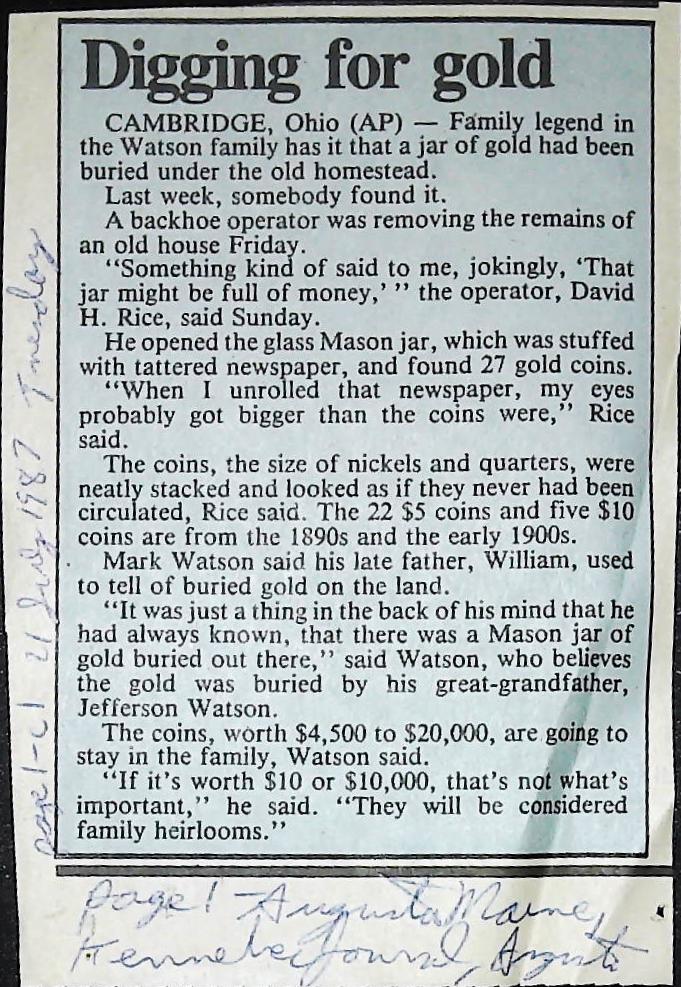
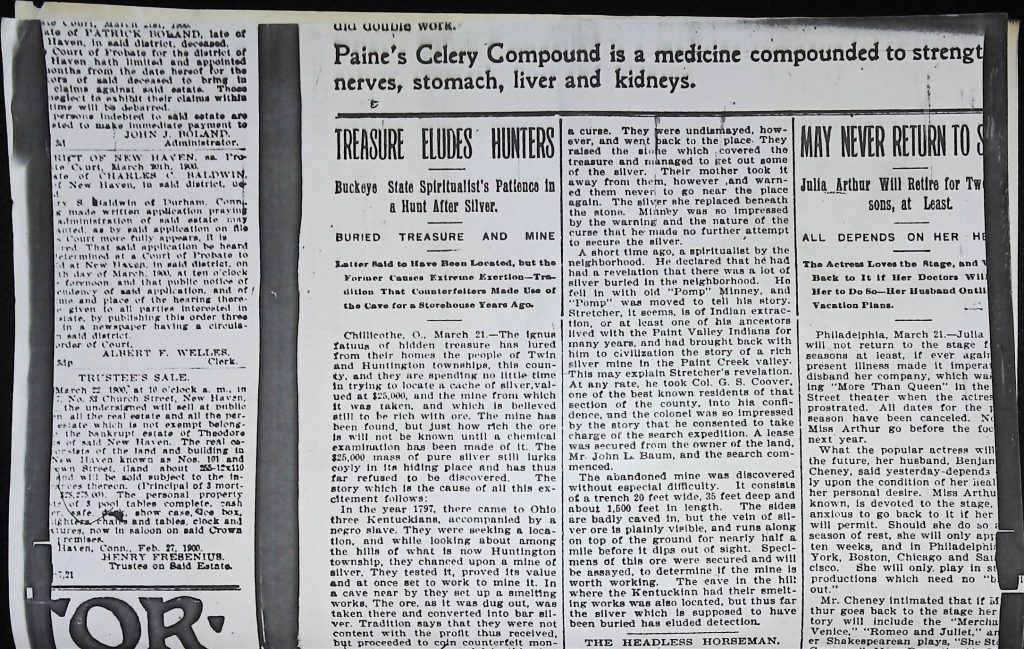
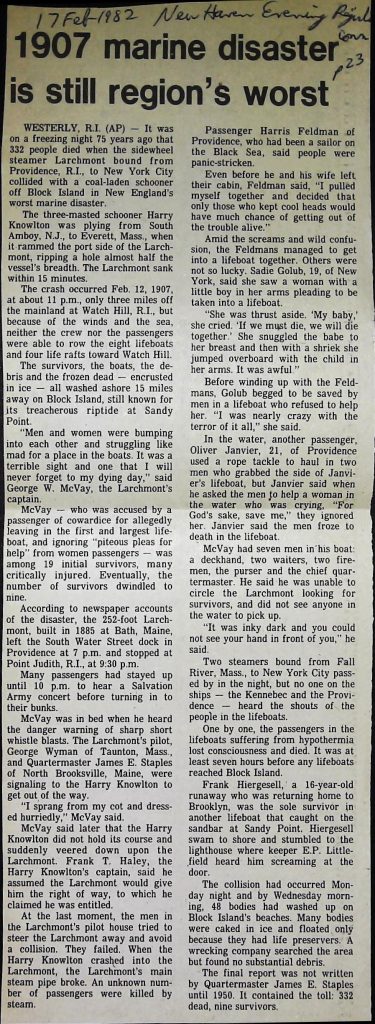
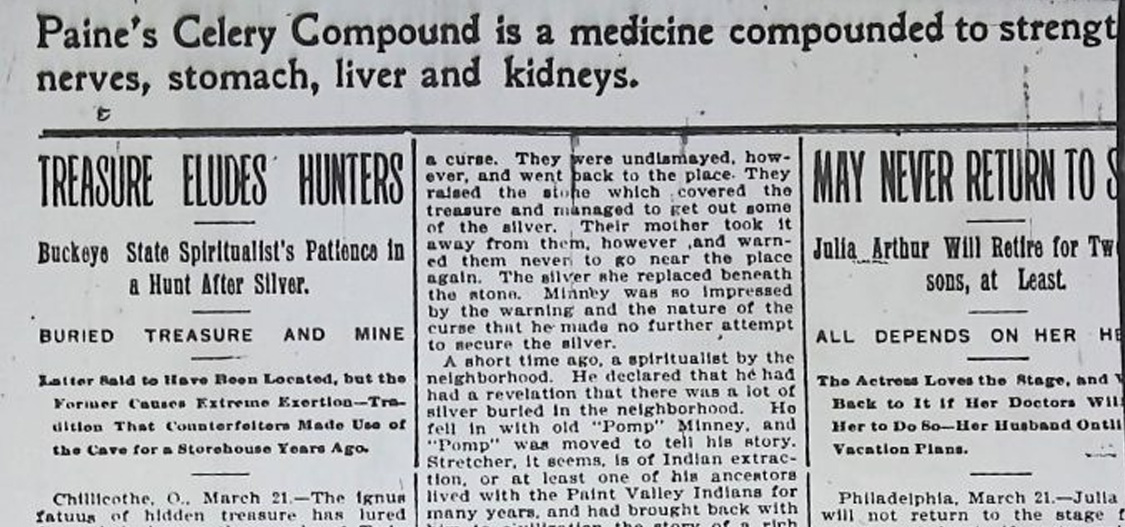
GARY MANGIACOPA ARCHIVE ============================================================ Title: B5F14I1 Slug: b5f14i1 Categories: Lost Treasure Source: https://garymangiacopraarchive.com/b5f14i1 Pages: 5 scanned, 5 extracted OCR: Google Vision API (document_text_detection) Processed: 2026-06-06 ============================================================ 21 y 1987 Tenday Digging for gold CAMBRIDGE, Ohio (AP) Family legend in the Watson family has it that a jar of gold had been buried under the old homestead. Last week, somebody found it. A backhoe operator was removing the remains of an old house Friday. "Something kind of said to me, jokingly, 'That jar might be full of money," " the operator, David H. Rice, said Sunday. He opened the glass Mason jar, which was stuffed with tattered newspaper, and found 27 gold coins. "When I unrolled that newspaper, my eyes probably got bigger than the coins were,' Rice said. The coins, the size of nickels and quarters, were neatly stacked and looked as if they never had been circulated, Rice said. The 22 $5 coins and five $10 coins are from the 1890s and the early 1900s. Mark Watson said his late father, William, used to tell of buried gold on the land. "It was just a thing in the back of his mind that he had always known, that there was a Mason jar of gold buried out there," said Watson, who believes the gold was buried by his great-grandfather, Jefferson Watson. The coins, worth $4,500 to $20,000, are going to stay in the family, Watson said. "If it's worth $10 or $10,000, that's not what's important," he said. "They will be considered family heirlooms." page! Augusta Maine becfoural Argent He [PAGE BREAK] New Have Every Registo Mail? [PAGE BREAK] 27-11d 0061/ [PAGE BREAK] te court, Matei ist, ate of PATRICK BOLAND, late of Haven. In sald district, deceased. Court of Probate for the district of Haven hath limited and appointed onths from the date hereof for the ora of sald deceased to bring in claims against said estate Those neglect to exhibit their claims within time will ta debarred. persons Indebted to sald estate are sted to make immediate payment to JOHN J. BOLAND. Administrator. RICT OF NEW HAVEN, aa. Pre to Court, March 30th, 180 ate of CHARLES C HALDWIN, New Haven, in sald district. J ry Staldwin of Durham. Conn. * made written application praying administration of said estate may anted, as by said application on Ale s Court more fully appears. It is red That said application be heard etermined at a Court of Probate to at New Haven. In said district, on th day of March, 19, at ten o'clock ⚫ forenoon and that publle notice of endency of said application, and of me and place of the hearing there- e given to all parties Interested in state, by publishing this order three In a newspaper having a circula- n said district. order of Court. Sip ALBERT F. WELLES. Clerk. TRUSTEE'S SALE. March 1900, at 10 o'clock a. m., in 7. No. & Church Street, New Haven, the undersigned will sell at publie n all the real estate and all the per- estate which is not exempt belong- the bankrupt estate of Theodore s of sald New Haven. The real co- ersists of the land and building in New Haven known as Nos. 101 and wn Street. (land about 255-12x110 And will be sold subject to the in- aces thereen. (Principal of 3 mort- 2001. The personal property fe of 3 pool tables complete, cash erate., show case, ce box, Ightera chahs and tables, clock and xtures, now in saloon on sald Crown remises Haven, Conn.. Feb. 27, 1900. HENRY FRESENIUS. Trustee on Bald Estate. 7,21 OR and double work. Paine's Celery Compound is a medicine compounded to strengt nerves, stomach, liver and kidneys. TREASURE ELUDES HUNTERS a curse. They were undismayed, how- ever, and went back to the place. They raised the stone which covered the treasure and managed to get out some of the silver. Their mother took it Buckeye State Spiritualist's Patience in away from them, however,and warn- a Hunt After Silver. BURIED TREASURE AND MINE Latter Bald to Have Boon Located, but the Former Causes Extreme Exertion-Tra- dition That Counterfoltors Made Use of the Cave for a Storehouse Years Ago. Chillicothe, O., March 21.-The ignus fatuus of hidden treasure has lured from their homes the people of Twin and Huntington townships, this coun- ty, and they are spending no little time in trying to locate a cache of silver, val- ued at $25,000, and the mine from which it was taken, and which is believed still to be rich with ore. The mine has been found, but just how rich the ore is will not be known until a chemical examination has been made of it. The [AD] $25,000 mass of pure silver still lurks coyly in its hiding place and has thus far refused to be discovered. The story which is the cause of all this ex- citement follows: In the year 1797, there came to Ohio. three Kentuckians, accompanied by a negro slave. They were seeking a loca- tion, and while looking about among the hills of what is now Huntington township, they chanced upon a mine of silver. They tested it, proved its value and at once set to work to mine it. In a cave near by they set up a smelting works. The ore, as it was dug out, was taken there and converted into bar sil- ver. Tradition says that they were not content with the profit thus received, but proceeded to coin counterfelt mon- MAY NEVER RETURN TO ed them never to go near the place Julia Arthur Will Retire for Tw again. The silver she replaced beneath the stone. Minney was so impressed by the warning and the nature of the curse that he made no further attempt to secure the silver. A short time ago, a spiritualist by the neighborhood. He declared that he had had a revelation that there was a lot of silver burled in the neighborhood. Ho fell in with old "Pomp" Minney, and "Pomp" was moved to tell his story. Stretcher, it seems, is of Indian extrac- tion, or at least one of his ancestors lived with the Paint Valley Indians for many years, and had brought back with him to civilization the story of a rich silver mine in the Paint Creek valley. This may explain Stretcher's revelation. At any rate, he took Col. G. S. Coover, one of the best known residents of that Bection of the county, into his confi- dence, and the colonel was so impressed by the story that he consented to take charge of the search expedition. A lease was secured from the owner of the land, Mr. John L. Baum, and the search com- menced. The abandoned mine was discovered without especial difficulty. It consists of a trench 20 feet wide, 35 feet deep and about 1,500 feet in length. The sides are badly caved in, but the vein of sil- ver ore is plainly visible, and runs along on top of the ground for nearly half a mile before it dips out of sight. Speci- mens of this ore were secured and will be assayed, to determine if the mine is worth working. The cave in the hil where the Kentuckian had their smelt- ing works was also located, but thus far the silver which is supposed to have been buried has eluded detection. THE HEADLESS HORSEMAN. sons, at Least ALL DEPENDS ON HER HE The Actress Loves the Stage, and Back to It if Her Doctors Wil Her to Do So-Her Husband Ontli Vacation Plans. Philadelphia, March 21.-Julia will not return to the stage f seasons at least, if ever agal present illness made it imperat disband her company, which was ing "More Than Queen" in the Street theater when the actres prostrated. All dates for the season have been canceled. N Miss Arthur go before the foo next year. What the popular actress will the future, her husband, Benjan Cheney, said yesterday-dependз ly upon the condition of her heal her personal desire. Miss Arthu known, is devoted to the stage. anxious to go back to it if her will permit. Should she do so a season of rest, she will only apr ten weeks, and in Philadelphia York, Boston, Chicago and Sar cisco. She will only. play in st productions which need no "bl out." Mr. Cheney intimated that if f thur goes back to the stage her tory will include the "Mercha Venice," "Romeo and Juliet," an er Shakespearean plays, "She St [PAGE BREAK] 17 Feb-1982 New Haven Evening Regul 1907 marine disaster is still region's worst WESTERLY, R.I. (AP) - It was on a freezing night 75 years ago that 332 people died when the sidewheel steamer Larchmont bound from Providence, R.I., to New York City collided with a coal-laden schooner off Block Island in New England's worst marine disaster. The three-masted schooner Harry Knowlton was plying from South Amboy, N.J., to Everett, Mass., when it rammed the port side of the Larch- mont, ripping a hole almost half the vessel's breadth. The Larchmont sank within 15 minutes. The crash occurred Feb. 12, 1907, at about 11 p.m., only three miles off the mainland at Watch Hill, R.I., but because of the winds and the sea, neither the crew nor the passengers were able to row the eight lifeboats and four life rafts toward Watch Hill. The survivors, the boats, the de- bris and the frozen dead encrusted in ice - all washed ashore 15 miles away on Block Island, still known for its treacherous riptide at Sandy Point. "Men and women were bumping into each other and struggling like mad for a place in the boats. It was a terrible sight and one that I will never forget to my dying day," said George W. McVay, the Larchmont's captain. McVay who was accused by a passenger of cowardice for allegedly leaving in the first and largest life- boat, and ignoring "piteous pleas for help" from women passengers - was among 19 initial survivors, many critically injured. Eventually, the number of survivors dwindled to nine. According to newspaper accounts of the disaster, the 252-foot Larch- mont, built in 1885 at Bath, Maine, left the South Water Street dock in Providence at 7 p.m. and stopped at Point Judith, R.I., at 9:30 p.m. Many passengers had stayed up until 10 p.m. to hear a Salvation Army concert before turning in to their bunks. McVay was in bed when he heard the danger warning of sharp short whistle blasts. The Larchmont's pilot, George Wyman of Taunton, Mass., and Quartermaster James E. Staples of North Brooksville, Maine, were signaling to the Harry Knowlton to get out of the way. "I sprang from my cot and dress- ed hurriedly," McVay said. McVay said later that the Harry Knowlton did not hold its course and suddenly veered down upon the Larchmont. Frank T. Haley, the Harry Knowlton's captain, said he assumed the Larchmont would give him the right of way, to which he claimed he was entitled. At the last moment, the men in the Larchmont's pilot house tried to steer the Larchmont away and avoid a collision. They failed. When the Harry Knowlton crashed into the Larchmont, the Larchmont's main steam pipe broke. An unknown num- ber of passengers were killed by steam. Conn p23 Passenger Harris Feldman of Providence, who had been a sailor on the Black Sea, said people were panic-stricken. Even before he and his wife left their cabin, Feldman said, "I pulled myself together and decided that only those who kept cool heads would have much chance of getting out of the trouble alive." Amid the screams and wild confu- sion, the Feldmans managed to get into a lifeboat together. Others were not so lucky. Sadie Golub, 19, of New York, said she saw a woman with a little boy in her arms pleading to be taken into a lifeboat. "She was thrust aside. 'My baby,' she cried. 'If we must die, we will die together.' She snuggled the babe to her breast and then with a shriek she jumped overboard with the child in her arms. It was awful." Before winding up with the Feld- mans, Golub begged to be saved by men in a lifeboat who refused to help her. "I was nearly crazy with the terror of it all," she said. In the water, another passenger, Oliver Janvier, 21, of Providence used a rope tackle to haul in two men who grabbed the side of Janvi- er's lifeboat, but Janvier said when he asked the men to help a woman in the water who was crying, "For God's sake, save me," they ignored her. Janvier said the men froze to death in the lifeboat. McVay had seven men in his boat: a deckhand, two waiters, two fire- men, the purser and the chief quar- termaster. He said he was unable to circle the Larchmont looking for survivors, and did not see anyone in the water to pick up. "It was inky dark and you could not see your hand in front of you," he said. Two steamers bound from Fall River, Mass., to New York City pass- ed by in the night, but no one on the ships the Kennebec and the Provi- heard the shouts of the people in the lifeboats. dence One by one, the passengers in the lifeboats suffering from hypothermia lost consciousness and died. It was at least seven hours before any lifeboats reached Block Island. Frank Hiergesell, a 16-year-old runaway who was returning home to Brooklyn, was the sole survivor in another lifeboat that caught on the sandbar at Sandy Point. Hiergesell swam to shore and stumbled to the lighthouse where keeper E.P. Little- field heard him screaming at the door. The collision had occurred Mon- day night and by Wednesday morn- ing, 48 bodies had washed up on Block Island's beaches. Many bodies were caked in ice and floated only because they had life preservers. A wrecking company searched the area but found no substantial debris. The final report was not written by Quartermaster James E. Staples until 1950. It contained the toll: 332 dead, nine survivors.