Box 2
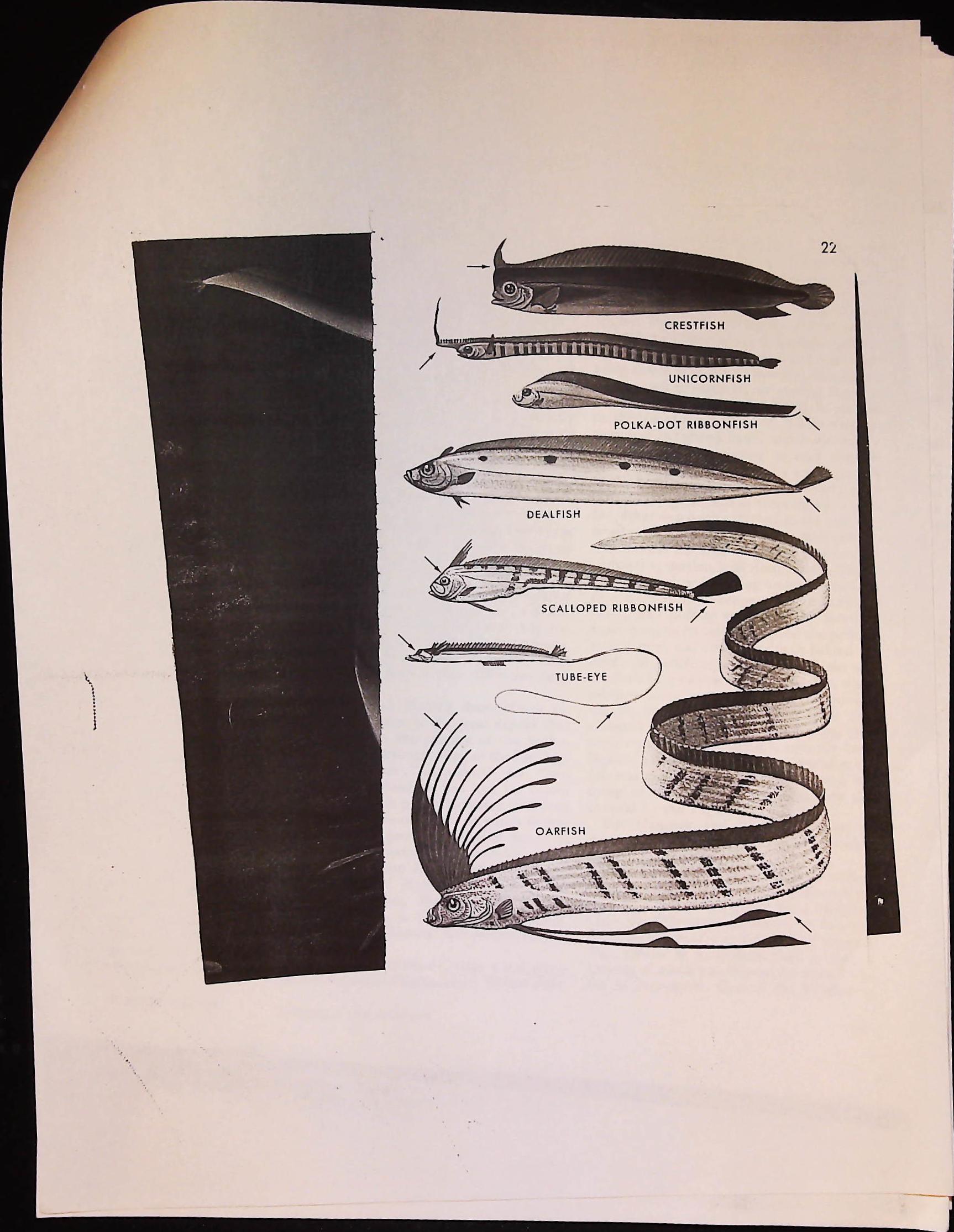
Folder 88. Oarfish
Item 4. Nature’s Sea Serpents



Transcribed Text (OCR)
GARY MANGIACOPA ARCHIVE
============================================================
Title:      B2F88I4
Slug:       b2f88i4
Categories: Cryptozoology
Source:     https://garymangiacopraarchive.com/b2f88i4
Pages:      18 scanned, 18 extracted
OCR:        Google Vision API (document_text_detection)
Processed:  2026-06-06
============================================================

mals it is almost unknown, our
eum containing more specimens of
ats than all the museums of the world
this beetle. It may not be rare in na-
ut when we consider that there have
any collectors in the northern part of
Nature's Sea Serpent
An authentic history of the amazing "King of the Herrings"
America who would have pounced and of his encounters with Homo sapiens
ich a prize, it seems likely that it is
relatives
are or has very retiring habits. How-
among the long-horn
n other parts of America are fairly
S
er South American beetle, Dynastes
, attains a length of seven inches,
; the horns on the thorax, and since
k-bodied animal, it is actually quite
is species and its allies, together
African Megasoma goliathus, be-
the same family as the so-called
beetle, a serious pest in the region
the large species are not known to
veen New York and Washington.
1S.
s and bees cannot boast any gi-
nbers. The largest fly is found in
rica and belongs to a family hav-
il wing venation. Mydas coeru-
ains a length of less than two
is apparently the largest repre-
either of these two large and im-
ers of insects, many of which are
ion of flowers.
t in the control of insect pests and
nate, indeed, that there are not a
large insects and more especially
e not serious pests. It is easy to
t would happen to the world if
s the potato beetle, the grain
others were even half as large as
teus and were si possessed of
destructive bits. On the
eir large size would make them
ible to the attacks of their
hat it is probable that nature
at all disturbed and things
e as they now are.
ng can be said in favor of large
s, and that is, if they were
eople would be attracted to
and thousands upon thou-
as yet unknown to science
ce have been described. But
ologist would be denied the
nto his microscope and dis-
uties of structure and detail
ne of our microscopic species.
NATURAL HISTORY
By William KING GREGORY
Curator, Living and Extinct Fishes, American Museum
OCH NESS has its colossally successful
couver its "Old Reliable,"
"Monster" (with affidavits) and Van-
with eye-
witnesses of rigid respectability. The human
species (self-called Homo sapiens) being for
the most part strongly mythophilous (as
Barnum and many others have discovered),
the market for bigger and better sea serpents
is practically unlimited, but in a strictly
scientific and presumably truthful Museum
not so much can be done toward satisfying
this demand. However, a Curator of Fishes
may be excused perhaps for succumbing oc-
casionally to the showman's urge and point-
ing with pride to one of Nature's own sea
serpents, the King of the Herrings (Regalecus
glesne Ascanius), which is known to attain
the respectable length of twenty-one feet.
I am referring to this fish as Nature's sea
serpent to distinguish him from Kipling's sea
serpent, which was a damaged whale-shark,
and from the Coast-of-Normandy sea ser-
pent, which was a mutilated basking-shark,
and from the Mauretania sea serpent, which
seems to have been a pure Chimaera bom-
bitans in vacuo.
Unlike Doctor Beebe's Bathysphaera in-
tacta, that monster of the great depths that
tried to disturb the privacy of the bathy-
sphere, the unfortunate King of the Herrings
has been neither "untouched" nor "un-
touchable." Indeed he has had his crown
messed up and his person lacerated with boat
hooks on the rare occasions on which he has
fallen into the profane, ravaging hands of
Homo sapiens. Listen to this excellent "Ac-
count of a Ribbon Fish (Gymnetrus) taken
off the coast of Northumberland" as re-
ported by Albany Hancock and Dennis
Embleton, M.D., in The Annals and Maga-
zine of Natural History, Second Series, No.
19, July, 1849:
"On the 26th of March, 1849, a fine speci-
men of a species of Gymnetrus or Ribbon Fish,
NATURE'S SEA SERPENT
was captured by Bartholomew Taylor and
his two sons, the crew of a fishing coble be-
longing to Cullercoats. It was found at about
six miles from shore, and in from twenty to
thirty fathoms water. The men having
started from their fishing ground to return
spot
homewards, observed at a little distance what
appeared to be broken water; the old man
being struck with such a novelty, directed his
lads to pull towards it; on nearing the
they perceived a large fish lying on its side
on the top of the water. The fish as they ap-
proached it righted itself, and came with a
gentle lateral undulating motion towards
them, showing its crest and a small portion
of the head occasionally above water; when
it came alongside, one of them struck it with
his picket - a hook attached to the end of a
small stick, and used in landing their fish; on
this it made off with a vigorous and vertical
undulating motion, and disappeared, Taylor
says, as quick as lightning under the surface.
In a short time it reappeared at a little dis-
tance, and pulling up to it they found it
again lying on its side; they plied the picket a
second time, and struck it a little behind the
head; the picket again tore through the ten-
der flesh by a violent effort of the fish, which
escaped once more, but with diminished
vigour; on the boat coming a third time
alongside, the two young men putting their
arms round the fish, lifted it into the boat.
Signs of life remained for some time after the
fish was captured, but no doubt it was in a
dying or very sickly state when first dis-
covered by the Taylors.'
But Hancock and Embleton report an
more dramatic encounter between
Regalecus and Homo.
even
"We have lately been favoured with a
letter from Mr. George Tate of Alnwick re-
specting a fish of this genus, from which we
make the following extract:-'A fish was
exhibited in January or February of the year
1845, similar in its general form to that, a
drawing of which you showed me when I was
last in Newcastle. One of the Preventive
431

[PAGE BREAK]

"Natural History "Magazine,
Vol. 35, May 1935, pg. 431-437

[PAGE BREAK]

rela
noth
er Sou
atta
; the h
ck-bod
is spe
Afric
the sa
beetle,
veen 1
the la
1S.
s and
nbers.
rica a
il win
ains a
is apl
eithe
ers of
t in th
ion of
nate,
large i
e not
t wou
s the
others
iteus :
desi
eir la
ible
hat it
at :
e as t
ng ca
s, an
eople
and
as J
ce ha
ologi
'nto
lutie
ne of
Service men observed this fish lying in a
shallow pool in the sands about a mile south
of Alnmouth, where it had been left by the
receding tide. Its great length and unusual
appearance at once raised the man's curiosity
and excited his fears. On approaching it, the
creature bent itself round so as to appear like
the rim of a coach-wheel, and the man, sup-
posing it was about to dart upon him, drew
his sword and struck it on the head. The fish
struggled much, but the man striking it re-
peatedly at length succeeded in cutting off its
head.'"
Thus the poor sea-king lost his crown
and his head.
Naturally it is not until after all damage
possible has been done that the local natural-
ist, if there be one, hears about the strange
fish and hurries to the scene to study the
sad remains.
"It was exhibited the same day in Tyne-
mouth, North and South Shields,' write
Messrs. Hancock and Embleton, speaking of
the specimen captured by the fisherman in
1849, "and brought to Newcastle next morn-
ing. In the afternoon we first saw it; we found
it much injured by the strokes of the hook
and by rough handling during its removals
and the examinations it had undergone. The
fins were a good deal torn but the fish evi-
dently quite fresh." And then these very
competent naturalists got busy and made
measurements, careful dissections and a host
of precise and illuminating observations,
which they later combined with a fine review
of the scattered literature of the subject.
A half-century later at Newport Beach on
the shores of southern California a giant oar-
432
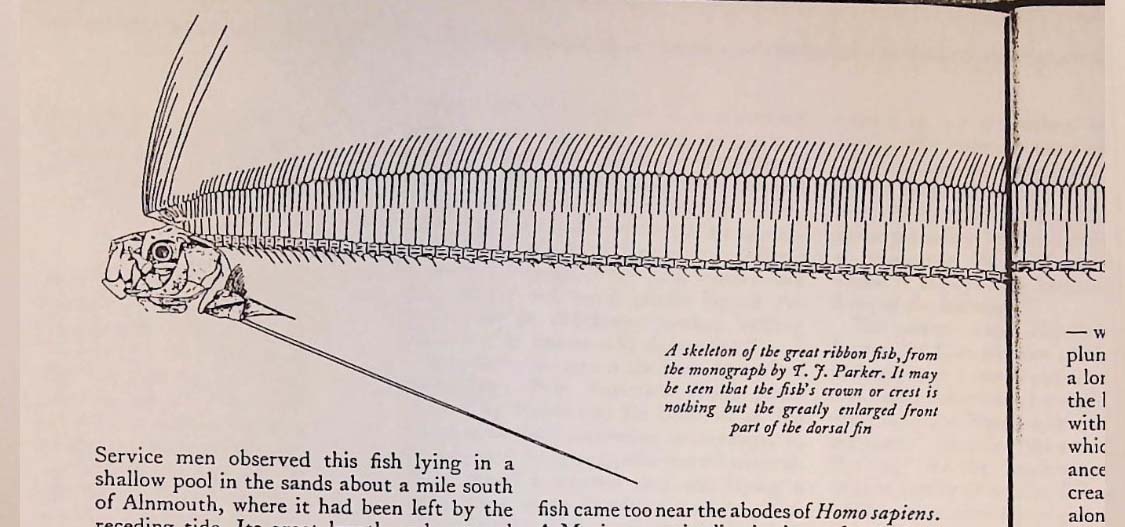
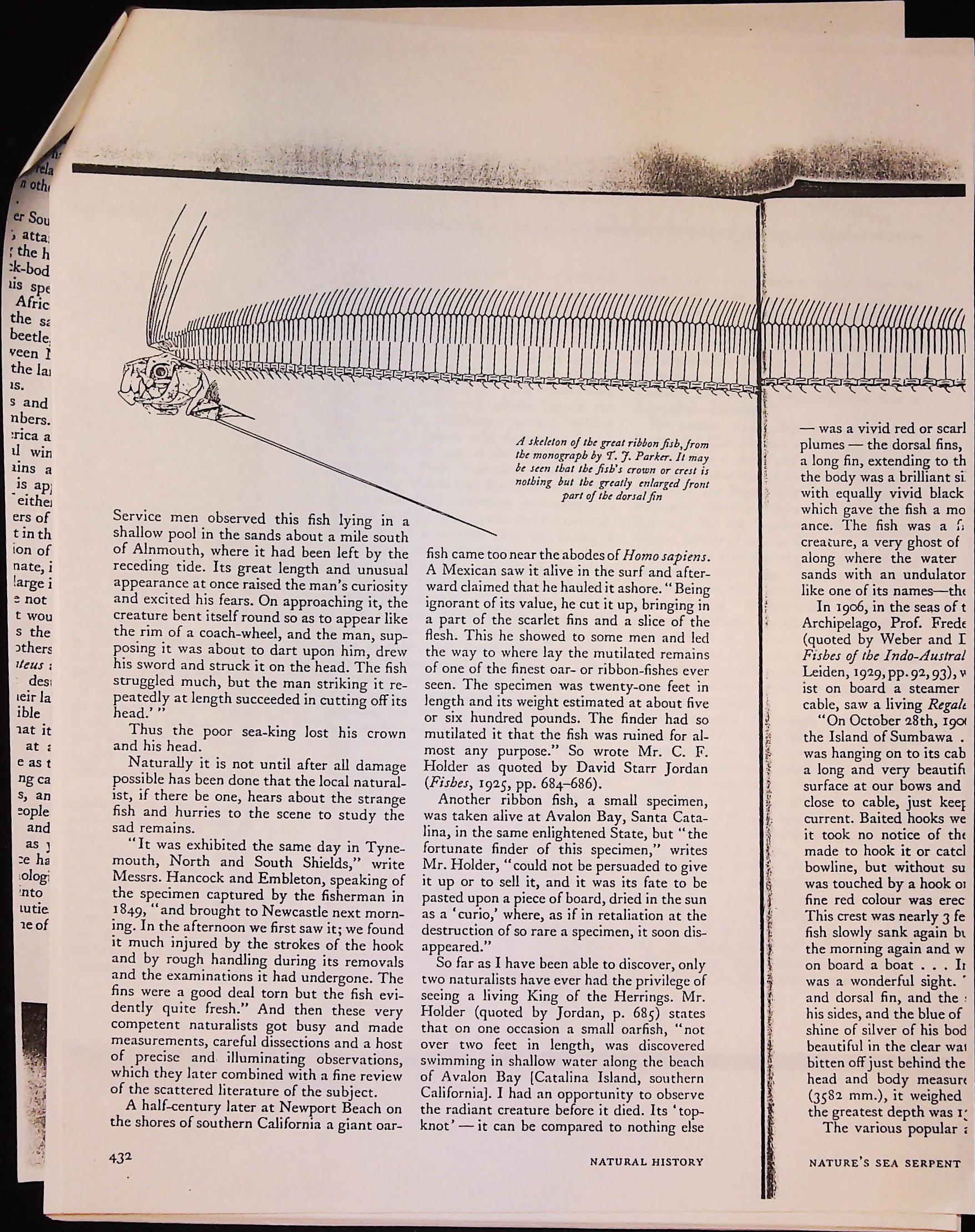
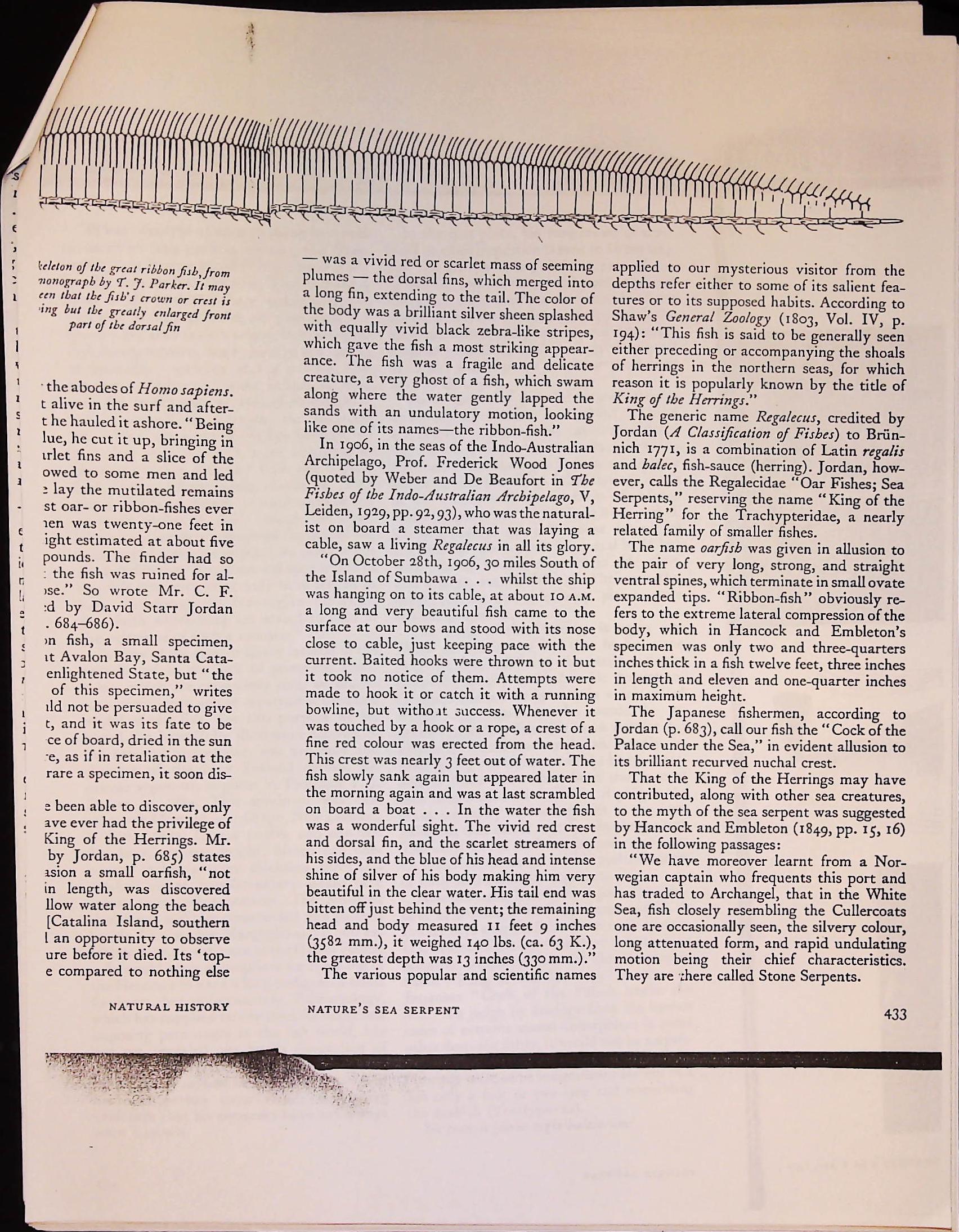
A skeleton of the great ribbon fish, from
the monograph by T. J. Parker. It may
be seen that the fish's crown or crest is
nothing but the greatly enlarged front
part of the dorsal fin
fish came too near the abodes of Homo sapiens.
A Mexican saw it alive in the surf and after-
ward claimed that he hauled it ashore. "Being
ignorant of its value, he cut it up, bringing in
a part of the scarlet fins and a slice of the
flesh. This he showed to some men and led
the way to where lay the mutilated remains
of one of the finest oar- or ribbon-fishes ever
seen. The specimen was twenty-one feet in
length and its weight estimated at about five
or six hundred pounds. The finder had so
mutilated it that the fish was ruined for al-
most any purpose." So wrote Mr. C. F.
Holder as quoted by David Starr Jordan
(Fishes, 1925, pp. 684-686).
Another ribbon fish, a small specimen,
was taken alive at Avalon Bay, Santa Cata-
lina, in the same enlightened State, but "the
fortunate finder of this specimen," writes
Mr. Holder, "could not be persuaded to give
it up or to sell it, and it was its fate to be
pasted upon a piece of board, dried in the
as a 'curio,' where, as if in retaliation at the
destruction of so rare a specimen, it soon dis-
appeared."
sun
"not
So far as I have been able to discover, only
two naturalists have ever had the privilege of
seeing a living King of the Herrings. Mr.
Holder (quoted by Jordan, p. 685) states
that on one occasion a small oarfish,
over two feet in length, was discovered
swimming in shallow water along the beach
of Avalon Bay [Catalina Island, southern
California]. I had an opportunity to observe
the radiant creature before it died. Its 'top-
knot' it can be compared to nothing else
NATURAL HISTORY
- was a vivid red or scarl
plumes-
- the dorsal fins,
a long fin, extending to th
the body was a brilliant si
with equally vivid black
which
the fish a mo
gave
ance. The fish was a f
creature, a very ghost of
along where the water
sands with an undulator
like one of its names-the
In 1906, in the seas of t
Archipelago, Prof. Frede
(quoted by Weber and I
Fishes of the Indo-Austral
Leiden, 1929, pp. 92, 93), v
ist on board a steamer
cable, saw a living Regale
a
"On October 28th, 190
the Island of Sumbawa
was hanging on to its cab
long and very beautifi
surface at our bows and
close to cable, just keep
current. Baited hooks we
it took no notice of the
made to hook it or catcl
bowline, but without su
was touched by a hook or
fine red colour was erec
This crest was nearly 3 fe
fish slowly sank again bu
the morning again and w
on board a boat
was a wonderful sight.
and dorsal fin, and the :
his sides, and the blue of
shine of silver of his bod
beautiful in the clear wat
bitten off just behind the
head and body measure
(3582 mm.), it weighed
the greatest depth was I
The various popular :
II
NATURE'S SEA SERPENT

[PAGE BREAK]

keleton of the great ribbon fish, from
L
S
E
t
t
J
monograph by T. J. Parker. It may
een that the fish's crown or crest is
ing but the greatly enlarged front
part of the dorsal fin
the abodes of Homo sapiens.
t alive in the surf and after-
the hauled it ashore. "Being
lue, he cut it up, bringing in
irlet fins and a slice of the
owed to some men and led
e lay the mutilated remains
st oar- or ribbon-fishes ever
en was twenty-one feet in
ight estimated at about five
pounds. The finder had so
: the fish was ruined for al-
se." So wrote Mr. C. F.
:d by David Starr Jordan
.684-686).
on fish, a small specimen,
it Avalon Bay, Santa Cata-
enlightened State, but "the
of this specimen," writes
ild not be persuaded to give
t, and it was its fate to be
ce of board, dried in the sun
re, as if in retaliation at the
rare a specimen, it soon dis-
e been able to discover, only
ave ever had the privilege of
King of the Herrings. Mr.
by Jordan, p. 685) states
asion a small oarfish, "not
in length, was discovered
llow water along the beach
[Catalina Island, southern
I an opportunity to observe
ure before it died. Its 'top-
e compared to nothing else
NATURAL HISTORY
a
plumes
was a vivid red or scarlet mass of seeming
the dorsal fins, which merged into
long fin, extending to the tail. The color of
the body was a brilliant silver sheen splashed
which
with equally vivid black zebra-like stripes,
gave the fish a most striking appear-
ance. The fish was a fragile and delicate
creature, a very ghost of a fish, which swam
along where the water gently lapped the
sands with an undulatory motion, looking
like one of its names-the ribbon-fish.'
In 1906, in the seas of the Indo-Australian
Archipelago, Prof. Frederick Wood Jones
(quoted by Weber and De Beaufort in The
Fishes of the Indo-Australian Archipelago, V,
Leiden, 1929, pp. 92, 93), who was the natural-
ist on board a steamer that was laying a
cable, saw a living Regalecus in all its glory.
"On October 28th, 1906, 30 miles South of
the Island of Sumbawa whilst the ship
was hanging on to its cable, at about IO A.M.
a long and very beautiful fish came to the
surface at our bows and stood with its nose
close to cable, just keeping pace with the
current. Baited hooks were thrown to it but
it took no notice of them. Attempts were
made to hook it or catch it with a running
bowline, but without success. Whenever it
was touched by a hook or a rope, a crest of a
fine red colour was erected from the head.
This crest was nearly 3 feet out of water. The
fish slowly sank again but appeared later in
the morning again and was at last scrambled
on board a boat In the water the fish
was a wonderful sight. The vivid red crest
and dorsal fin, and the scarlet streamers of
his sides, and the blue of his head and intense
shine of silver of his body making him very
beautiful in the clear water. His tail end was
bitten off just behind the vent; the remaining
head and body measured 11 feet 9 inches
(3582 mm.), it weighed 140 lbs. (ca. 63 K.),
the greatest depth was 13 inches (330 mm.)."
The various popular and scientific names
NATURE'S SEA SERPENT
applied to our mysterious visitor from the
depths refer either to some of its salient fea-
tures or to its supposed habits. According to
Shaw's General Zoology (1803, Vol. IV, p.
194): "This fish is said to be generally seen
either preceding or accompanying the shoals
of herrings in the northern seas, for which
reason it is popularly known by the title of
King of the Herrings."
The generic name Regalecus, credited by
Jordan (A Classification of Fishes) to Brün-
nich 1771, is a combination of Latin regalis
and balec, fish-sauce (herring). Jordan, how-
ever, calls the Regalecidae "Oar Fishes; Sea
Serpents," reserving the name "King of the
Herring" for the Trachypteridae, a nearly
related family of smaller fishes.
The name oarfish was given in allusion to
the pair of very long, strong, and straight
ventral spines, which terminate in small ovate
expanded tips. "Ribbon-fish" obviously re-
fers to the extreme lateral compression of the
body, which in Hancock and Embleton's
specimen was only two and three-quarters
inches thick in a fish twelve feet, three inches
in length and eleven and one-quarter inches
in maximum height.
The Japanese fishermen, according to
Jordan (p. 683), call our fish the "Cock of the
Palace under the Sea," in evident allusion to
its brilliant recurved nuchal crest.
That the King of the Herrings may have
contributed, along with other sea creatures,
to the myth of the sea serpent was suggested
by Hancock and Embleton (1849, pp. 15, 16)
in the following passages:
"We have moreover learnt from a Nor-
wegian captain who frequents this port and
has traded to Archangel, that in the White
Sea, fish closely resembling the Cullercoats
one are occasionally seen, the silvery colour,
long attenuated form, and rapid undulating
motion being their chief characteristics.
They are there called Stone Serpents.
433

[PAGE BREAK]

"It has occurred at once to many here and
to ourselves also on first viewing this Gym-
netrus, that it may possibly have been taken
for the famous Sea Serpent. The Archangel
name of the fish seen there, strengthens the
idea that it may at times have deceived the
eye of some credulous mariner, from its rapid
undulating motion, linear form, and from its
occasionally appearing at the surface, and
leaving a lengthened wake behind it, thus
creating an exaggerated idea of its extent.
"On consulting however the accounts
which have appeared of the Sea Serpent, we
find that they relate in most instances to
creatures widely different from the Ribbon
Fish, such as whales, seals, sharks, etc., seen
under disadvantageous circumstances or im-
perfectly observed. Still, though the Gym-
netrus may not have originated the idea of the
existence of a marine serpent, we think it not
improbable that the occasional appearance of
this fish may very materially have tended to
keep up among the Norwegian fishermen
that faith which they are stated to hold in
the existence of such a monster.'
In view of the extraordinary interest of the
oarfish and in the lack of preserved speci-
mens, which are excessively rare, we under-
took some years ago to construct a life-sized
model of the fish. For this purpose we se-
lected the beautifully illustrated account of
the external appearance, soft anatomy and
skeleton of the New Zealand oarfish, Re-
galecus argenteus, as given by Professor T. J.
Parker in 1884. This specimen was cast
ashore at Moeraki near Otago, New Zealand,
in June, 1883. It was twelve and one-half
feet long, greatest height, fifteen and one-
quarter inches, greatest thickness, three and
one-half inches. Supplementary details were
taken from other sources. The life-sized
model was skilfully constructed and painted
by Mr. Christopher Marguglio and is now ex-
hibited in the inner room of the Hall of Fishes.
It would seem appropriate for the King of
the Herrings to have a long pedigree of noble
forebears, but unfortunately, Paleontology,
which has supplied family trees for many less
imposing personages in the fish world, has
not yet revealed our hero's direct line of
ancestry. Nevertheless, the proud king (not
unlike Homo sapiens in this respect) bears in
his own person some rather convincing
evidences that his ancestors have not always
worn a crown.
In the first place, his very crown or crest
itself on close inspection is seen to be nothing
but the greatly enlarged front part of the
dorsal fin, and the fact that he can raise and
lower this crest confirms the evidence of the
skeleton that the slender rays supporting the
crest are operated by erector and depressor
muscles essentially like those in the dorsal
fin of any yellow perch caught on a bent pin
by a small boy.
Those long and graceful "oars"
on the
under side of the body just behind the head
are assuredly nothing but much specialized
ventral fins; and the fact that they are
fastened to the lower part of the collar-bone
indicates that the King of the Herrings is one
of the innumerable descendants of the an-
cestral "spiny-fin" of the Cretaceous period.
These ancestral spiny-fins were not unlike
the humble yellow perch in general build but
with shorter bodies, rounded in side view,
and a large, normal fish tail. Their mouths,
supported by movable bony plates, were
already protrusile.
The King of the Herrings is again like
Homo sapiens in the fact that he has some
poor relations still living who would no doubt
cheerfully testify to his humble derivation.
Of these the lowest in rank is a fish called
Velifer bypselopterus, who would be an
ordinary-looking fish if it were not for his
enormous dorsal and anal fins. Simply by
multiplying the segments of the body, short-
bodied fishes have often been transformed
into long-bodied ones, and in Regalecus the
great similarity of one segment to the next
indicates that this is exactly what happened.
The early larval deal fish indeed represents
an intermediate stage in this multiplication
of bony and muscular segments.
Hancock and Embleton report the pres-
ence of ovaries in their specimen and T. J.
Parker says that his fish was an adult female.
It is evident therefore that there is little or no
scientific support either for the Norwegian
name "King of the Herrings" or for the
Japanese "Cock of the Palace under the
Sea." To judge by analogy from the known
cases of extreme sexual dimorphism in some
other deep-sea fishes, it would not be surpris-
ing if the mate of the fearsome Queen of the
Herrings were some insignificant shrimp of a
fish only a foot or two long and resembling
the dealfish (Trachypterus).
Sic transit gloria regis balecorum!
434
NATURAL HISTORY
NATURE'S SEA SERPENT

[PAGE BREAK]

As very crown or crest
on is seen to be nothing
arged front part of the
fact that he can raise and
onfirms the evidence of the
slender rays supporting the
d by erector and depressor
lly like those in the dorsal
perch caught on a bent pin
nd graceful "oars' on the
body just behind the head
thing but much specialized
d the fact that they are
ower part of the collar-bone
e King of the Herrings is one
ble descendants of the an-
1" of the Cretaceous period.
spiny-fins were not unlike
w perch in general build but
dies, rounded in side view,
mal fish tail. Their mouths,
novable bony plates, were
e.
the Herrings is again like
the fact that he has some
ll living who would no doubt
y to his humble derivation.
vest in rank is a fish called
terus, who would be an
fish if it were not for his
I and anal fins. Simply by
segments of the body, short-
ive often been transformed
ones, and in Regalecus the
of one segment to the next
is is exactly what happened.
deal fish indeed represents
stage in this multiplication
scular segments.
Embleton report the pres-
in their specimen and T. J.
his fish was an adult female.
efore that there is little or no
t either for the Norwegian
the Herrings' or for the
of the Palace under the
by analogy from the known
>>
sexual dimorphism in some
shes, it would not be surpris-
of the fearsome Queen of the
me insignificant shrimp of a
or two long and resembling
chypterus).
ia regis balecorum!
Oar and Dealfishes-
Enigmas of the Sea
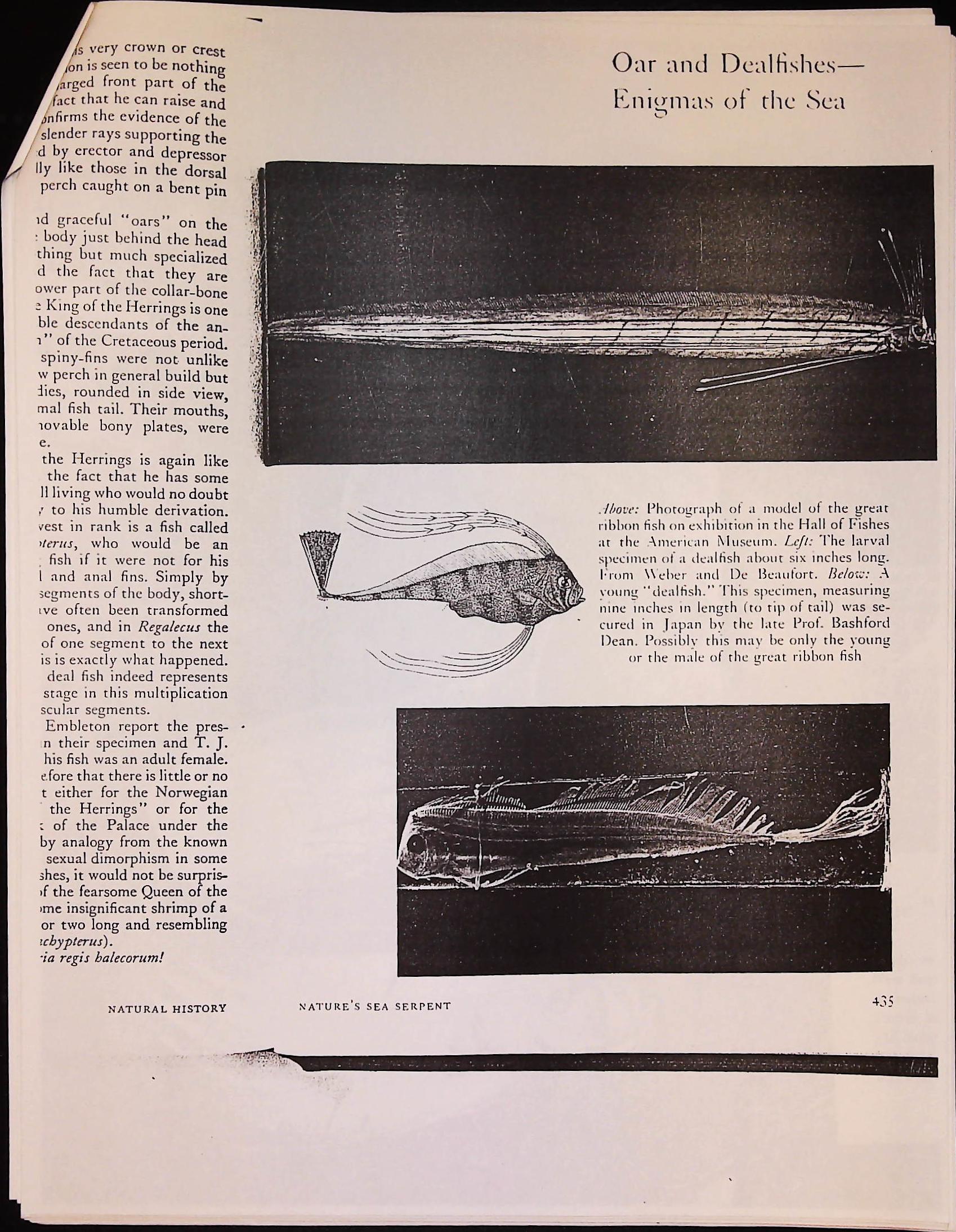
Above: Photograph of a model of the great
ribbon fish on exhibition in the Hall of Fishes
at the American Museum. Left: The larval
specimen of a dealfish about six inches long.
From Weber and De Beaufort. Below: A
young "dealfish." This specimen, measuring
nine inches in length (to tip of tail) was se-
cured in Japan by the late Prof. Bashford
Dean. Possibly this may be only the young
or the male of the great ribbon fish
NATURAL HISTORY
NATURE'S SEA SERPENT
435

[PAGE BREAK]

The
Based on
New Zeal:
described
Parker. It
3½ inche
ribbon fi:
was cast

[PAGE BREAK]

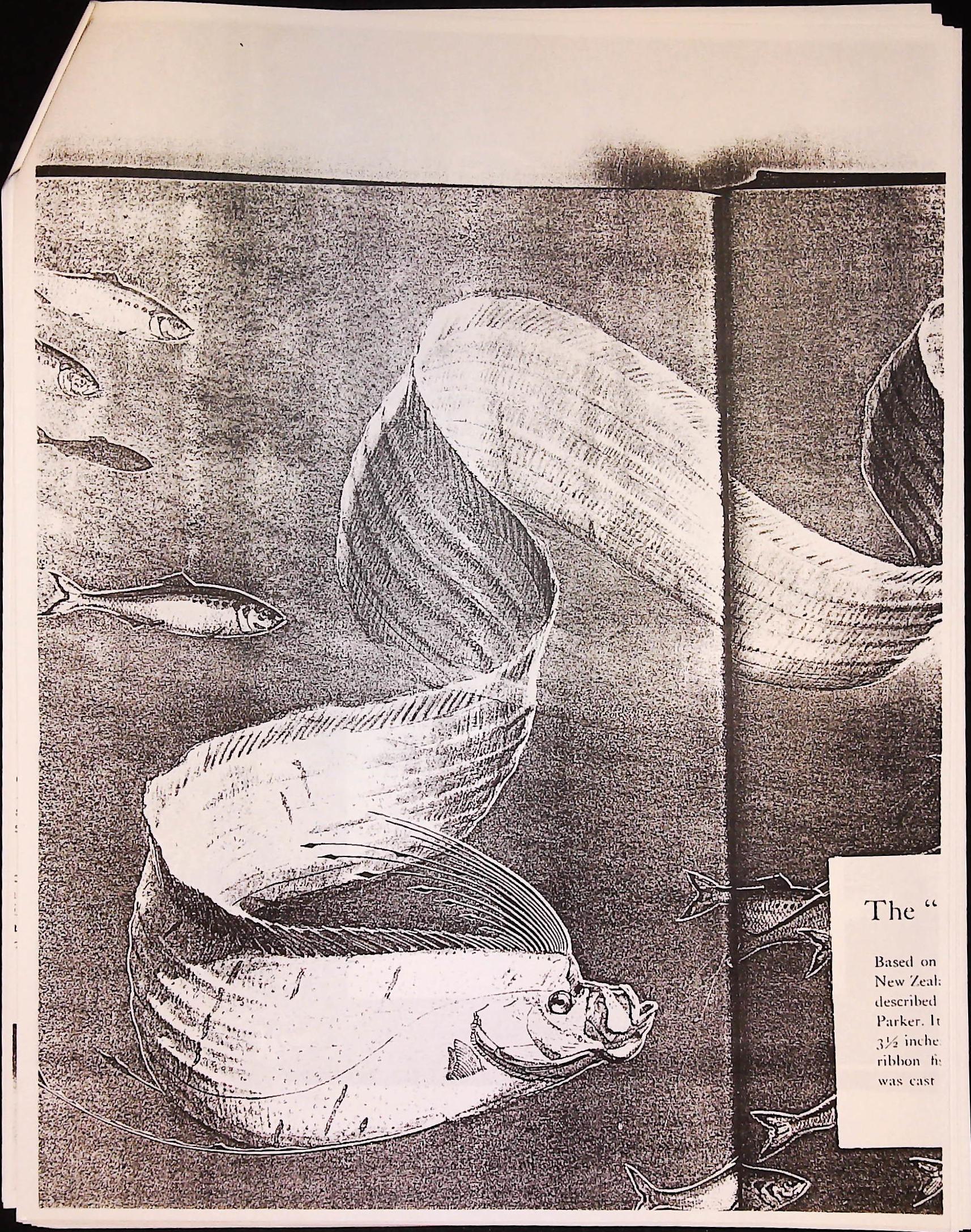
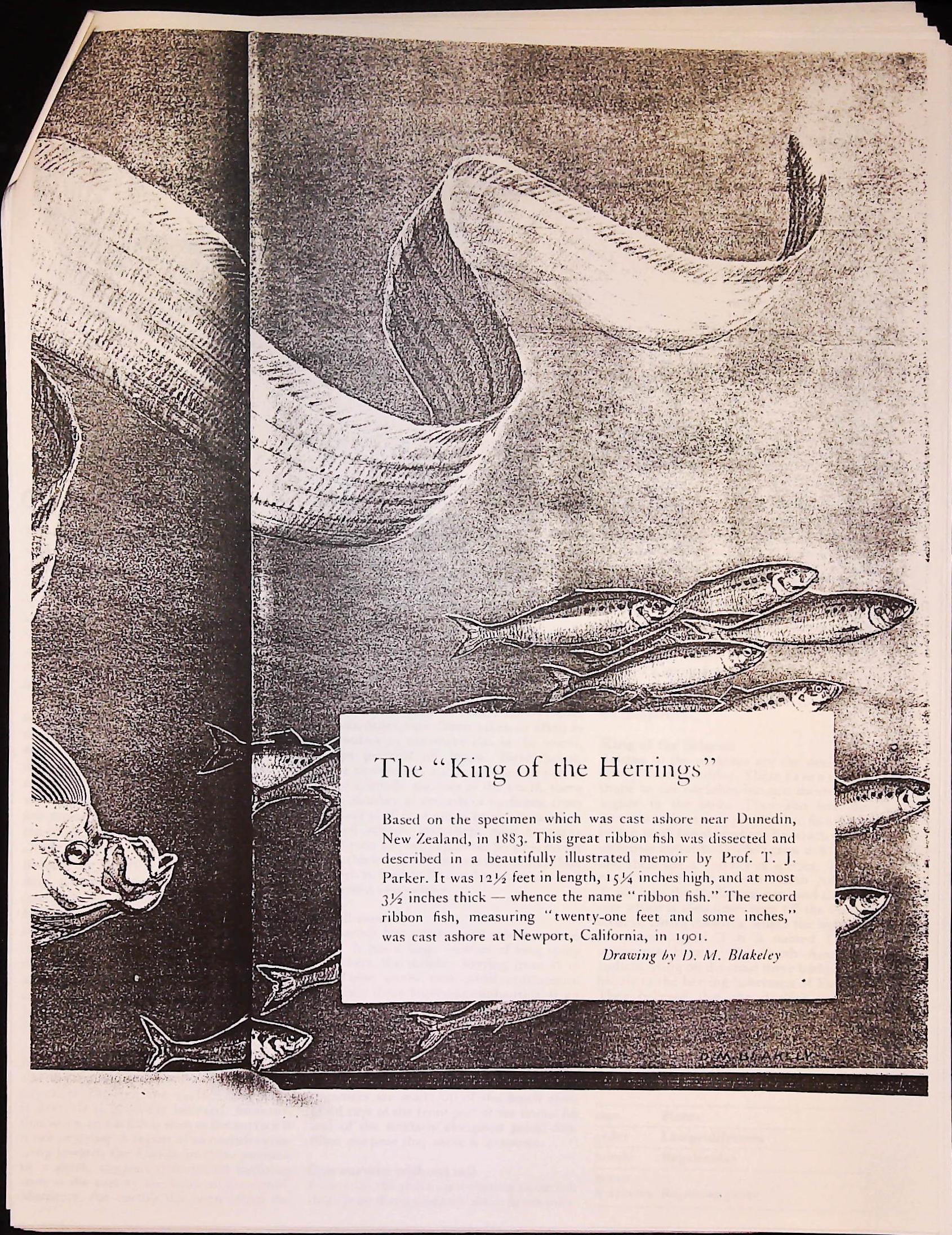
The "King of the Herrings"
Based on the specimen which was cast ashore near Dunedin,
New Zealand, in 1883. This great ribbon fish was dissected and
described in a beautifully illustrated memoir by Prof. T. J.
Parker. It was 12½ feet in length, 154 inches high, and at most
3½ inches thick whence the name "ribbon fish." The record
ribbon fish, measuring "twenty-one feet and some inches,"
was cast ashore at Newport, California, in 1901.
Drawing by D. M. Blakeley
R

[PAGE BREAK]

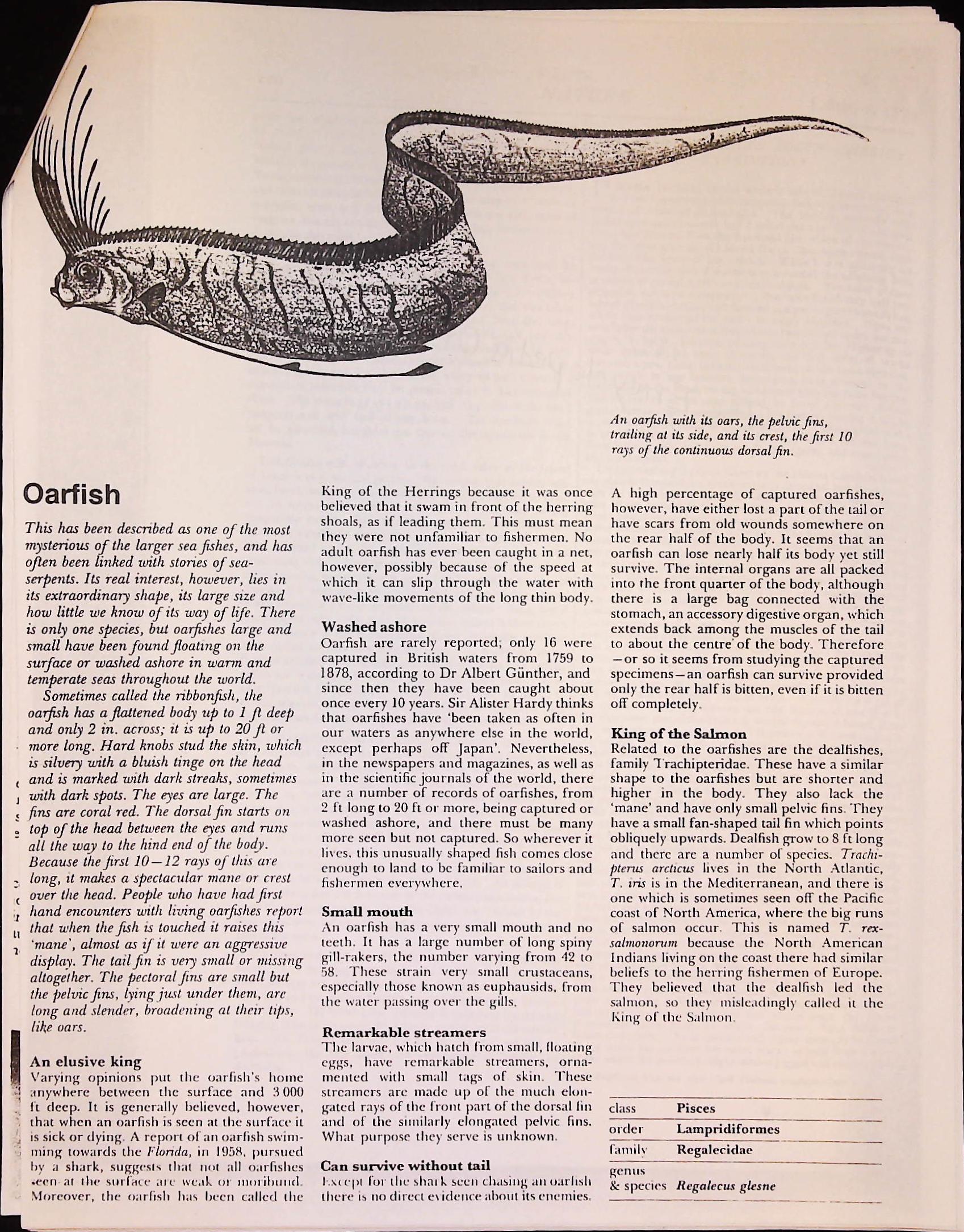
Oarfish
This has been described as one of the most
mysterious of the larger sea fishes, and has
often been linked with stories of sea-
serpents. Its real interest, however, lies in
its extraordinary shape, its large size and
how little we know of its way of life. There
is only one species, but oarfishes large and
small have been found floating on the
surface or washed ashore in warm and
temperate seas throughout the world.
Sometimes called the ribbonfish, the
oarfish has a flattened body up to 1 ft deep
and only 2 in. across; it is up to 20 ft or
more long. Hard knobs stud the skin, which
is silvery with a bluish tinge on the head
and is marked with dark streaks, sometimes
with dark spots. The eyes are large. The
fins are coral red. The dorsal fin starts on
• top of the head between the eyes and runs
all the way to the hind end of the body.
Because the first 10-12 rays of this are
long, it makes a spectacular mane or crest
over the head. People who have had first
J
S
'I
27
hand encounters with living oarfishes report
that when the fish is touched it raises this
'mane', almost as if it were an aggressive
display. The tail fin is very small or missing
altogether. The pectoral fins are small but
the pelvic fins, lying just under them, are
long and slender, broadening at their tips,
like oars.
An elusive king
Varying opinions put the oarfish's home
anywhere between the surface and 3.000
ft deep. It is generally believed, however,
that when an oarfish is seen at the surface it
is sick or dying. A report of an oarfish swim-
ming towards the Florida, in 1958, pursued
by a shark, suggests that not all oarfishes
seen at the surface are weak or moribund.
Moreover, the oarfish has been called the
King of the Herrings because it was once
believed that it swam in front of the herring
shoals, as if leading them. This must mean
they were not unfamiliar to fishermen. No
adult oarfish has ever been caught in a net,
however, possibly because of the speed at
which it can slip through the water with
wave-like movements of the long thin body.
Washed ashore
Oarfish are rarely reported, only 16 were
captured in British waters from 1759 to
1878, according to Dr Albert Günther, and
since then they have been caught about
once every 10 years. Sir Alister Hardy thinks
that oarfishes have 'been taken as often in
our waters as anywhere else in the world,
except perhaps off Japan'. Nevertheless,
in the newspapers and magazines, as well as
in the scientific journals of the world, there
are a number of records of oarfishes, from
2 ft long to 20 ft or more, being captured or
washed ashore, and there must be many
more seen but not captured. So wherever it
lives, this unusually shaped fish comes close
enough to land to be familiar to sailors and
fishermen everywhere.
Small mouth
An oarfish has a very small mouth and no
teeth. It has a large number of long spiny
gill-rakers, the number varying from 42 to
58. These strain very small crustaceans,
especially those known as euphausids, from
the water passing over the gills.
Remarkable streamers
The larvae, which hatch from small, floating
eggs, have remarkable streamers, orna-
mented with small tags of skin. These
streamers are made up of the much elon-
gated rays of the front part of the dorsal fin
and of the similarly elongated pelvic fins.
What purpose they serve is unknown.
Can survive without tail
Except for the shark seen chasing an oarfish
there is no direct evidence about its enemies.
An oarfish with its oars, the pelvic fins,
trailing at its side, and its crest, the first 10
rays of the continuous dorsal fin.
A high percentage of captured oarfishes,
however, have either lost a part of the tail or
have scars from old wounds somewhere on
the rear half of the body. It seems that an
oarfish can lose nearly half its body yet still
survive. The internal organs are all packed
into the front quarter of the body, although
there is a large bag connected with the
stomach, an accessory digestive organ, which
extends back among the muscles of the tail
to about the centre of the body. Therefore
-or so it seems from studying the captured
specimens an oarfish can survive provided
only the rear half is bitten, even if it is bitten
off completely.
King of the Salmon
Related to the oarfishes are the dealfishes,
family Trachipteridae. These have a similar
shape to the oarfishes but are shorter and
higher in the body. They also lack the
'mane' and have only small pelvic fins. They
have a small fan-shaped tail fin which points
obliquely upwards. Dealfish grow to 8 ft long
and there are a number of species. Trachi-
pterus arcticus lives in the North Atlantic,
T. iris is in the Mediterranean, and there is
one which is sometimes seen off the Pacific
coast of North America, where the big runs
of salmon occur. This is named T. rex-
salmonorum because the North American
Indians living on the coast there had similar
beliefs to the herring fishermen of Europe.
They believed that the dealfish led the
salmon, so they misleadingly called it the
King of the Salmon.
class
order
Pisces
Lampridiformes
family
Regalecidae
genus
& species Regalecus glesne

[PAGE BREAK]

270
NATURE
poses that, when the missing constituent is discovered, it should
be called "Tammite." Mr. Tamm's analysis of the new
mineral gives-Metallic Tungsten SS 05, Metallic Iron 5 60,
Metallic Manganese o'15, Undetermined Substance 6:20. Mr.
Tamm ventures upon various conjectures as to this last substance,
and thinks it just possible that, after all, he may have made an
doubts on this point.
tungsten than appears in the analysis. He has, however, strong
analytical error, and that there may be 62 per cent. more of
interesting -The South African Museum, Cape Town, re-
REGARDING "sea-serpents," the following note may be
cently received a specimen of the Ribbon fih (Gymnsterus)
fifteen feet long without the tail. It appears that this fish is
known to distant inland fishermen as being forty feet long,
the "sea serpent" of late years so minutely described by navi-
and from its slender shape and snake-like movement is probably
gators. From its head there is erected a plume of flexible rose-
coloured spines, and from head to tail along its back there is a
conspicuous mane-like fin. Its general colour is l.k: burnished
silver. The eye is large and silvery, and the profile of the head
comports well with that of the horse. The specimen could
not be preserved, but there are two smaller specimens in the
Museum.
THE Garden calls attention to the great value of the Island
of Jamaica as a tropical garden. Its oranges, pine-apples, ban-
anas, limes, lime-juice, cocoa-nuts, and other such products, could
not be surpassed in quality, and might be cultivated to any
imaginable extent. Besides all this, the soil and climate are
eminently suitable to the growth of precious drugs and plants.
Bark is raised easily, the cinchona plantation being in a most
satisfactory state. Then there are hemp and China grass of ex-
cellent quality, nor would any arrowroot be superior to that of
Jamaica if it were but more carefully prepared for market. Here,
it will be said, is a noble prospect for the colony. True, bat it
is a prospect only. Not until the very last returns is there shown
any "tendency to the development of new industries requiring
little capital and no extraordinary skill." It is the old story,
"minor articles are neglected, though they are the very articles
which are wanted, and which the colonists could send. How-
ever, Jamaica is fortunate in having a Governor in Sir J. P.
Grant, who can discern the true capabilities of the island, and
the true place for its industry in the markets of the world.
A CORRESPONDENT of the Madras Mail, quoted by the Times
of India, says that on the night of June 15 last the plain to the
east, north, and north-east of Nandidroog was covered with
"many thousands" of lights, which have been observed occ1-
sionally in former years. The correspondent compares the
appearance to that of a large city brilliantly illuminated, and in
one direction the scene, through a binocalar glass, "looked like
a view of part of the starry heavens, eich flame being like a
Star."
As many of the lights were from tea to fifteen miles dis-
tant from the reporter's point of view, he conjectures that each
flame must have been five to six feet in length. An attempt is
being made to find out the cause of the curiou; phenomenon, the
ignition of some inflammable gas escaping in jets from the sur-
most likely hypothesis being that the lights are "caused by the
face of the earth."
We learn from the Field of July 20, that Mr. Pamaby has
succeeded in bringing sixty black bass fry home from America,
and that they are safely deposited in the tanks at Troutdale,
Keswick, and are feeding heartily, so that they may now be con-
sidered safe. IIe found great difficulty in collecting the fry and
bringing them safely across the Atlantic on account of the intense
heat. Mr. Francis considers this the second greatest feat in
pisciculture, the firt being the conveyance of salmon to
Australia.
[Aug. 1, 1872
PROFESSOR AGASSIZ'S SOUTH AMERICA
EXPEDITION*
III.
IN Mayne Harbour, on the western side of Owen's Islands, I
had an opportunity of investigating two very interesting ne
genera of naked eyed Acalephs. The locality naturally sug-
gested appropriate names, an 1 I called one after Captain Mayn
Crossoteca Mayne, fom the festooned disposition of the ovaries,
the cross-like figure of the ovaries.
and the other after my ol 1 friend Owen, Staurotoca Owenii, from
While I was collecting oa
board, Pourtales and Steindachner ascended the adjoining hills
in search of glacial marks and land animals. The result of their
excursion was most satisfactory. Pourtales found very well pre-
served glacial scratches and furrows upon wide greenstone dykes,
which here intersected the rocks in every direction. Upon one
such ledge the marks were divided into two distinct series, one run-
ning S. W. by W., the other crossing these S.S. W. Higher up on
other dykes of the same character, the first series of marks
occurred again, being perfectly rectilinear, in the same direction,
and though in one instance interrupted, were renewed on the
other side of the break on the same level with the same bearing.
Still higher up on the same hillside he found also very distinct
glacial furrows upon granite ridges, the furrows bearing S.W, by
S., and finer lines again on greenstone dykes. The highest marks.
in the locality were some 500 or 600 feet above the sea level,
and earthworms.
Steindachner collected frogs and their tadpoles, and some insects
On approaching the Guia Narrows, the hills on Chatham Island
are plainly furrowed in a north-westerly direction, and large boul
ders are seen all along upon the ridge of the range, while Esper-
auza Island appears in the south like a large rounded dome be
tween two channels running N. and S. In wide channels we saw
miny whales and also small icebergs. The hills to the height of
about 2,000 feet were everywhere distinctly moutonnées. San-
marez Island, opposite the mouth of Eyre Sound, and the island-
to the west of it, were particularly instructive.
We followed the
western channel, which is also the narrowest, and it soon became
plain that wherever opposite shores with high walls approached
near one another the glacial scratches and furrows, alike distinct,
glacier meets an obstacle.
assumed an ascending direction, as is the case whenever a moving.
That the south side was here also.
everywhere the strike side, was equally apparent from the facts
that all these marks were either wanting or less distinct on the
north side of the islands. Had any abrading agent advanced
from the North, all appearances must have been reversed in these
narrow channels; or they must have crossed them at right angles
had the action come from East or West. Floating ice is out of
the question where the furrows are not horizontal, and here in
the narrowest part of the channel, west of Saumarez Island, there
is a track where the scratches and furrows are distinctly, ascend-
ing on the west side of the channel, and horizontally on the
eastern side opposite, showing that the pressure of the ice-sheet
must have been from S. E. to N.W.
Looking south, after passing Saumarez Island, the scenery
appears totally different, from the fact that this is the lee side of.
the glacier action; and yet the channels have about the same
width an bear the same relations to one another. In the nar-
rowest channels the polished surfaces, with their scratches and far-
rows, are as well preserved and as distinct as in those of the Helle
land.
Platten at the Handeck in the valley of the Hassli in Switzer-
About Iceberg Sound all the mountains are beautifully
rounded and moutonnées. That local glaciers, however, existed,
and extended much beyond their present range, may be plainly
seen in many of the inlets crossing the main channels in an east-
westerly and west-easterly direction. It is true that general and
local glacial plienomena are so interwoven throughout this region
that it is at times difficult to appreciate their true connection;
but there are also many localities where the difference is quite,
obvious. The most interesting of the places here have been
well photographed by Dr. White, and may serve at some futare
time a illustrations of the fact described in this report.
In some places the various kinds of glacial marks were as
plain as in the valleys of Switzerland, and I am surprised
that travellers who have visited this region since the glacial
phenomena have been sɔ much discussed, have failed to
notice them here. As in Switzerland, there seems to be i level
above which the ice-sheet has never risen; at least there is a line
above which the mountain ridges remain jigged and abrupt, while
Reprinted from the New York Tribune, concluded from p. 31

[PAGE BREAK]

"Nature" Magazine, Aug. 1, 1872, pg. 270

[PAGE BREAK]

111053 UL
the party to ho heard, and in this way strongly to
Zicommon that representative electoral orgi A GREAT OFFER!! Will during
tion which tho Tories and the weak-hearted Liberals
Bro now ondoavoring to cry down, avalling them-
golves of the unhappy operation of a local rulo at
of the general plan."
Bradford, which forms (as far as I know) no portion
Tho Pall Mall Gazette gets quito rod in the
face over tho reloase of Condon, the Fonian, on tho
intercession of Inister Welsh. It is moro angry
with the intercossion and attention givon to it than
At the release. It speaks of Mr. Wolsh's letter as "of-
fensive, "extremely prosumptuous," &c., and con-
and.com.
domns Lord Sallsbury for yielding to it as estab.
lishing the principle that any justly-sentenced
criminal who can protond a political motivo for his
crimo, and can succeed in enlisting the intercession
of a suflloiontly pertinacious Government in his
favor, may count upon a remission of Bontonco for
which his loss fortunately placed follow-convicts
may petition in vain."
In replying to an address on the occasion of
the Feast of St. Joachim in Rome, Popo Loo XIII.
referred to Protestant worship and schools in that
pity in terms that would do credit to the sixteenth
century. Ho doplored that in Romo, the centro of |
Christianity, pormission had beon given to horetical
Bocts to orect places of worship, to open schools, and
to disseminato among the people injurious publica-
tions, and that the Sovereign Pontiff was not per-
mitted, as ho dosirod to do, to oppose a remedy to tho
Linpiety which had invadod tho city. It was tho
duty of tho citizens, however, to rondor futilo tho
efforts of tho impious people by making it an invlo-
lable law to keep thomsolros and thoir childron from
any contact with heresy.
The little town of Penarth, Glamorganshire,
Wales, lately witnessed a brilliant colobration of
the coming of ago of Lord Windsor, who owns large
estates in that vicinity. His lordship unitos in his
person the lines of Olive and Windsor, and is one of
the richest poors of the realm. Ho is a great
grandson of the famous Lord Clive, who was only
un Irish peor, but whose son, Edward, was raised
to the British peorage, successively, as Baron Clivo
of Walcot, Barou Powls of Powis Castle, Baron
Herbort of Cherbury, Viscount Clive of Ludlow,
and Earl of Powis. A son of this second Lord Ollvo
married the Baroness Windsor, of a familly whoso
nobility datos back 350 yours, and the presont Lord
Windsor is the eldest offspring of this marrlage.
Inrd
dispose of 100 NEW PIANOS & ORGANS of
first-class makers at lower prices for cash or
Installments than ever before offered. WATERS'
PIANOS & ORGANS are the BEST MADE,
warranted for 6 years. Illustrated CataloguCA
MIniled. PIANOS, 7 Octave 3125, 7 1-3 oc-
tave $135. ORGANS, 7 Stops S60, S Stops
[AD] $63, 12 Stops 950 cash, in perfect order, not
used a year. Sheet music at half price. HOR-
ACE WATERS & SONS, Man't'rs. and Dealers.
40 Enst 11th-st.. N. Y.
UPRIGHT AND SQUARE PIANOS AND
ORGANS, now and second-linnd, of the best makers.
to rent and for sale. Prices low, terms reasonablo WM.
A. POND & CO., No. 25 Union-squaro, between 15th
and 16th sts.
DANCING.
DE GARMIO'S
CLASSES IN DANCING,
NU. 578 5TH-AV.,
Corner 47th-st., opposite Windsor Hotel.
WATCHES, JEWELRY, &C.
MONEY--DIAMONDS,
WATCHES, JEW-
ELRY, silver-ware, &c., bought and sold buck at a
smalt advance. GEO. C. ALLEN, No. 1,100 Broadway,
near 29th st..
1,267 BROADWAY, OVER HERALD
jewelry, &c., bought and sold. Branch, No. 1,207 Broad-
way.
LINDO BROS.
NBranch Ladies late ofico; diamonds, watches,
BANKRUPT NOTICES.
THIS IS TO GIVE NOTICE THAT ON THE
28th day of August, A. D. 1878. a warrant in bunk-
ruptcy was issued against the estate of BARTHOLOMEW
CROWE, of New-York, in the County of New-York, and
and
19t
H
try.
H
nt A
L
Indy
Call
L
met
Aigl
to A
N.
and
ent
post
N
232
N.
will
CFS
a ba
st..
State of New-York, who has been adjudged a bankrupt N.
on his own petition; that the payment of any debts and
delivery of any property belonging to such bankrupt to
him or for a use, and tho transfer of any property by
him are forbidden by law; that a meeting of tho creditors
of said bankrupt, to provo their debts and choose ono
or more Assignees of his estate, will be held at a Court of
Bankruptcy, to be holden at No. 152 Broadway, in the
City of New-York, before Mr. Henry Wilder Allen, Je
ister, on the 10th day of October. A. D. 1878. at 2
o'clock P. M.
LOUIS F. PAYN,
U. S. Marshal, as Messenger, Southern District of Now-
York.
or a
Bor
Ni
ly m
403
N
two
till
IN THE MATTE to Get BAXTER, N
A young sea-serpent has been captured at
Van Dioman's Land. The following is the descrip-
tlon: "The, fish is 14, foot long, 15 inches deop
from tho neck. to the 'bolly, taporing 2 inches to
the tail, and 8 inches in diameter at the thickest
place. Thero aro no scales, but tho skin is liko pol-,
Ashed silvor, with 18 dark lines and rows of spots
running from tho head to tho tall oach side. There
is a mane on the neck 20 inches long, and continues USouthern District of New-York-In Bankruptcy.
from tlro head to the tail; small head, no tooth, pro-
trusive mouth, capablo of being oxtended four inches,
liko a sucker; oyes flat, about the sizo of a half-
crown, and liko silver, with black pupils. Thoro arol
two foolers under the chin, 32 inchos long. Tho
fish was alive when captured.",
The London Times states that the Claimant,
whose health has been suffering from his close con-
finoment at the Portsoa Convict Prison and his un-
ceasing application to his sowing-machino, is now
employed upon light labor at the extension works in
connection with Portsmouth Dock-yard. At first ho
was mado useful in brick-making, but the extaremo
publicity of the work attracted more visitors than,
Wore convenient, and he has baan since told off to a
emp
Othe
N
'an
Allen, Register in Bankruptcy. Southern District of
New-York, 89.: At the City of Now-York, tho 5th day of
September, A. D. 1878. To whom it inny concern: Tho
undersigned hereby gives uotlco of his appointment as
Assigneo of Geo. L. Baxter, of New-York, in the
County of New-York, and Stato of Now-York. within
sail district, who has Leon adjudged a bankrupt upon
his own petition by the District Court of salt diet.
JOSEPH T. FARRINGTON,
s20-1aw3w*
Assignee.
TNITED STATES DISTRICT COURT.-
Southern District of New-York, se.-At the City of New-
York, the 6th day of August, 1878.-The undersigned
hereby gives notice of his appointment ns Assigneo of
JOIN TAYLOR, of the City of Now-York, in the Coun
ty and State of New-York, within said district, who has
been adjudged a bankrupt upon the petition of his credit. S
ors by the District Court of said district.
JOHN H. PLATT, Assigneo,
40 Wall-street, Now-York.
TN BANKRUPTCY.-DISTRICT OF NEW JER-
IN NOWAK, on the 18th day of September,
A. D. 1878.-Tho undersigned hereby gives notice of his
appointment as Assigneo of WILLIAM L. VAN ALS-
(TYNE, of Newark, in the County of Essex, and State of
New Jersey, within sald district, who bas been alged
bankrunt upon his own petition by the District Court
of said district. E. N. MILLER, Assignee, &e..
[AD] $20-1Aw8wr
782 Broad at.
dres
exp
char
AY..
dres
wait
322
60m

[PAGE BREAK]

New York Times, Sept. 27, 1878, pg. 6

[PAGE BREAK]

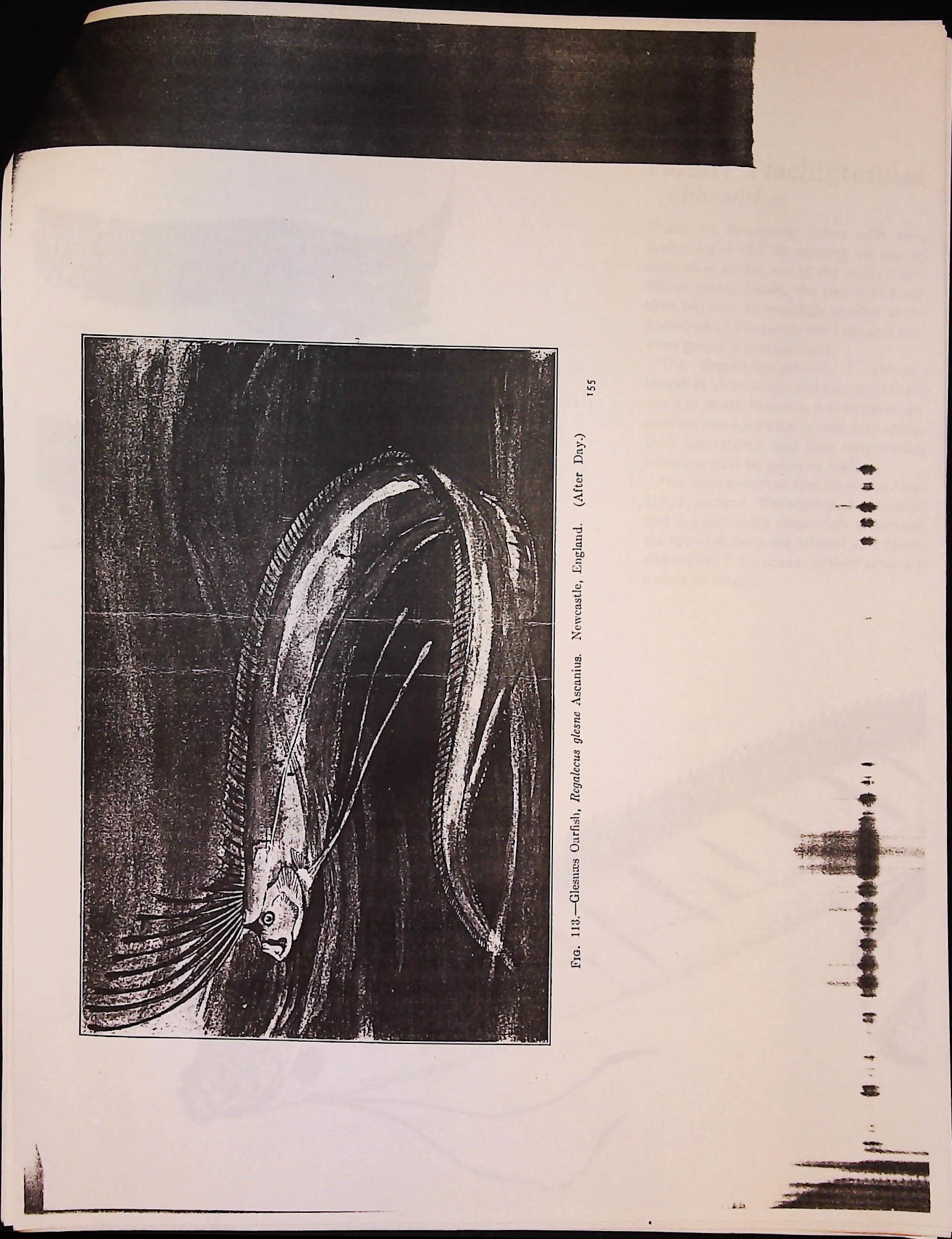
FIG. 113. Glesnæs Oarfish, Regalecus glesne Ascanius. Newcastle, England. (After Day.)
155
*****

[PAGE BREAK]

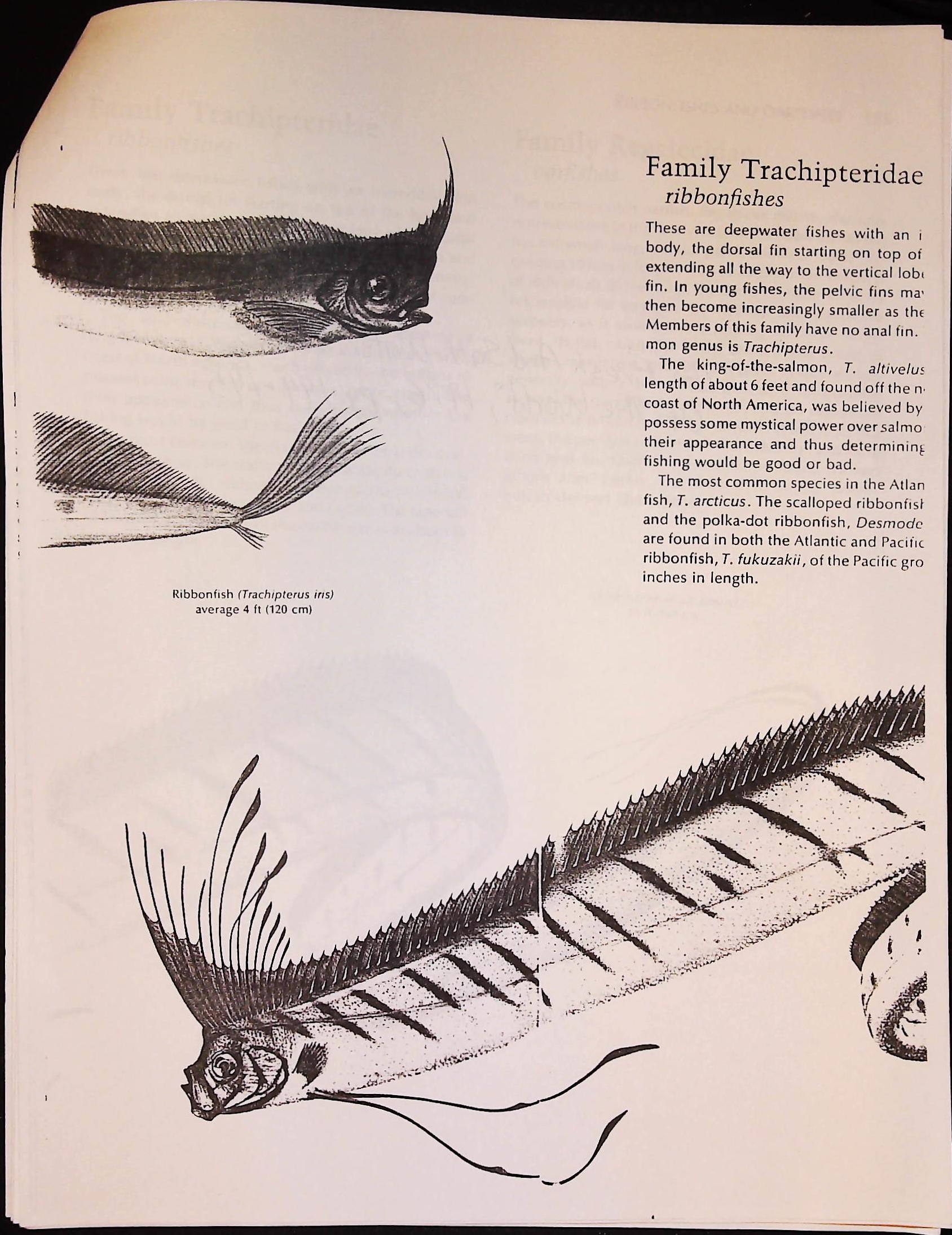
Ribbonfish (Trachipterus iris)
average 4 ft (120 cm)
Family Trachipteridae
ribbonfishes
These are deepwater fishes with an i
body, the dorsal fin starting on top of
extending all the way to the vertical lob
fin. In young fishes, the pelvic fins ma
then become increasingly smaller as the
Members of this family have no anal fin.
mon genus is Trachipterus.
The king-of-the-salmon, T. altivelus
length of about 6 feet and found off the n
coast of North America, was believed by
possess some mystical power over salmo
their appearance and thus determining
fishing would be good or bad.
The most common species in the Atlan
fish, T. arcticus. The scalloped ribbonfish
and the polka-dot ribbonfish, Desmode
are found in both the Atlantic and Pacific
ribbonfish, T. fukuzakii, of the Pacific gro
inches in length.

[PAGE BREAK]

"The Fresh And Salt-Water Fishes
Of The World", 1976, pg. 194-195

[PAGE BREAK]

H
S
01
e₁
S
iti
y
C
17.
LS
-e
Family Trachipteridae
ribbonfishes
These are deepwater fishes with an incredibly thin
body, the dorsal fin starting on top of the head and
extending all the way to the vertical lobe of the caudal
fin. In young fishes, the pelvic fins may be large and
then become increasingly smaller as the fish matures.
Members of this family have no anal fin. The most com-
mon genus is Trachipterus.
The king-of-the-salmon, T. altivelus, reaching a
length of about 6 feet and found off the northern Pacific
coast of North America, was believed by the Indians to
possess some mystical power over salmons, controlling
their appearance and thus determining whether the
fishing would be good or bad.
The most common species in the Atlantic is the deal-
fish, T. arcticus. The scalloped ribbonfish, Zu cristatus,
and the polka-dot ribbonfish, Desmodema polysticta,
are found in both the Atlantic and Pacific. The tapertail
ribbonfish, T. fukuzakii, of the Pacific grows to about 56
inches in length.
RIBBONFISHES AND OARFISHES · 195
Family Regalecidae
oarfishes
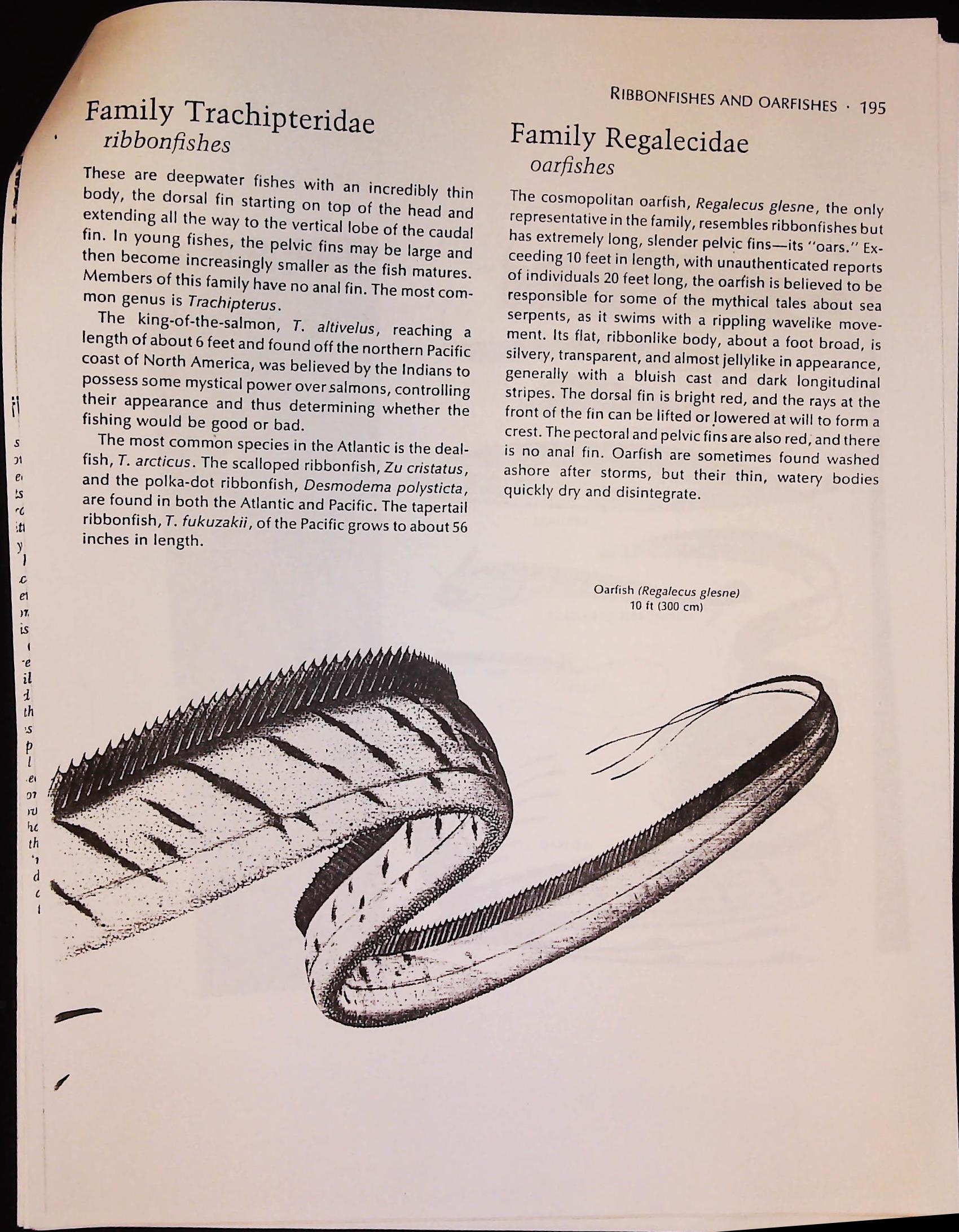
The cosmopolitan oarfish, Regalecus glesne, the only
representative in the family, resembles ribbonfishes but
has extremely long, slender pelvic fins-its "oars." Ex-
ceeding 10 feet in length, with unauthenticated reports
of individuals 20 feet long, the oarfish is believed to be
responsible for some of the mythical tales about sea
serpents, as it swims with a rippling wavelike move-
ment. Its flat, ribbonlike body, about a foot broad, is
silvery, transparent, and almost jellylike in appearance,
generally with a bluish cast and dark longitudinal
stripes. The dorsal fin is bright red, and the rays at the
front of the fin can be lifted or lowered at will to form a
crest. The pectoral and pelvic fins are also red, and there
is no anal fin. Oarfish are sometimes found washed
ashore after storms, but their thin, watery bodies
quickly dry and disintegrate.
'S
P
hc
'1
Oarfish (Regalecus glesne)
10 ft (300 cm)

[PAGE BREAK]

DEALFISH
CRESTFISH
UNICORNFISH
POLKA DOT RIBBONFISH
SCALLOPED RIBBONFISH
TUBE-EYE
OARFISH
22