Misplaced Animals

B2F34I2

Box 2

Folder 34. Alligators – Misplaced Animals

Item 2. Journal of American Folklore

Transcribed Text (OCR)

GARY MANGIACOPA ARCHIVE
============================================================
Title:      B2F34I2
Slug:       b2f34i2
Categories: Misplaced Animals
Source:     https://garymangiacopraarchive.com/b2f34i2
Pages:      3 scanned, 3 extracted
OCR:        Google Vision API (document_text_detection)
Processed:  2026-06-06
============================================================

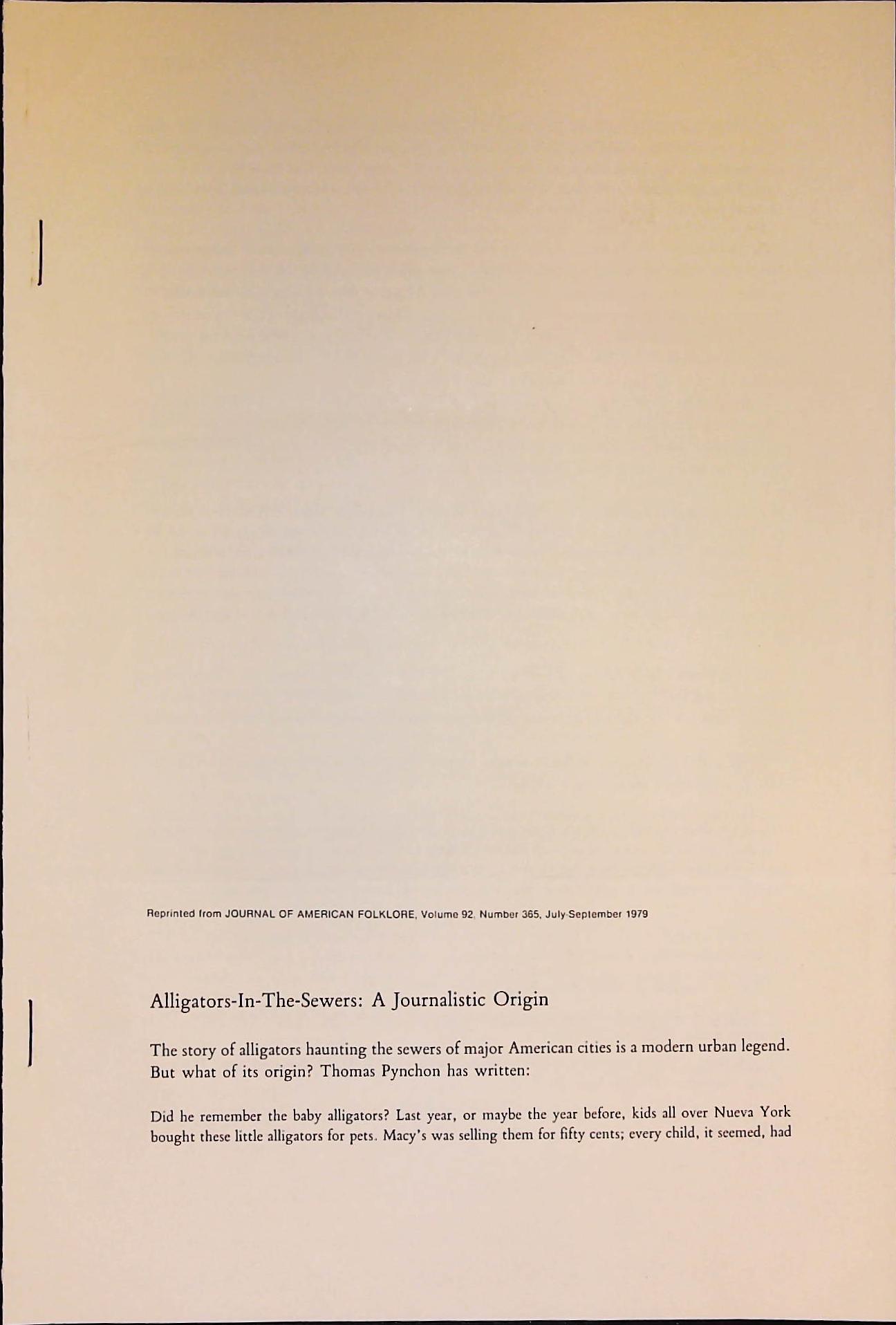
Reprinted from JOURNAL OF AMERICAN FOLKLORE, Volume 92, Number 365, July-September 1979
Alligators-In-The-Sewers: A Journalistic Origin
story
The of alligators haunting the sewers of major American cities is a modern urban legend.
But what of its origin? Thomas Pynchon has written:
Did he remember the baby alligators? Last year, or maybe the year before, kids all over Nueva York
bought these little alligators for pets. Macy's was selling them for fifty cents; every child, it seemed, had

[PAGE BREAK]

336
NOTES
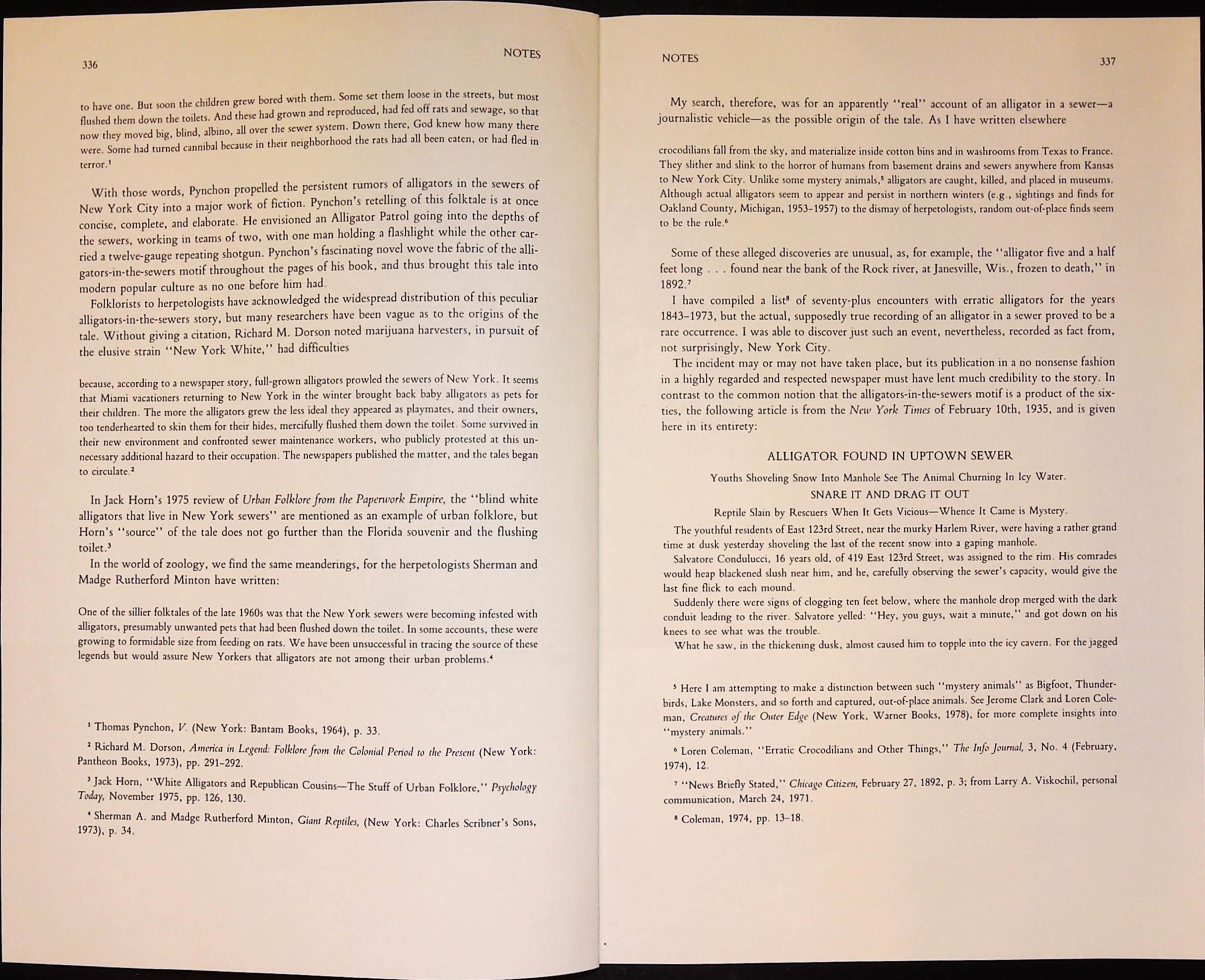
to have one. But soon the children grew bored with them. Some set them loose in the streets, but most
flushed them down the toilets. And these had grown and reproduced, had fed off rats and sewage, so that
now they moved big, blind, albino, all over the sewer system. Down there, God knew how many there
were. Some had turned cannibal because in their neighborhood the rats had all been eaten, or had fled in
terror.'
With those words, Pynchon propelled the persistent rumors of alligators in the sewers of
New York City into a major work of fiction. Pynchon's retelling of this folktale is at once
concise, complete, and elaborate. He envisioned an Alligator Patrol going into the depths of
the sewers, working in teams of two, with one man holding a flashlight while the other car-
ried a twelve-gauge repeating shotgun. Pynchon's fascinating novel wove the fabric of the alli-
gators-in-the-sewers motif throughout the pages of his book, and thus brought this tale into
modern popular culture as no one before him had.
many
Folklorists to herpetologists have acknowledged the widespread distribution of this peculiar
researchers have been vague as to the origins of the
alligators-in-the-sewers story, but
tale. Without giving a citation, Richard M. Dorson noted marijuana harvesters, in pursuit of
the elusive strain "New York White," had difficulties
because, according to a newspaper story, full-grown alligators prowled the sewers of New York. It seems
that Miami vacationers returning to New York in the winter brought back baby alligators as pets for
their children. The more the alligators grew the less ideal they appeared as playmates, and their owners,
too tenderhearted to skin them for their hides, mercifully flushed them down the toilet. Some survived in
their new environment and confronted sewer maintenance workers, who publicly protested at this un-
additional hazard to their occupation. The newspapers published the matter, and the tales began
to circulate, 2
necessary
In Jack Horn's 1975 review of Urban Folklore from the Paperwork Empire, the "blind white
alligators that live in New York sewers" are mentioned as an example of urban folklore, but
Horn's "source" of the tale does not go further than the Florida souvenir and the flushing
toilet.³
In the world of zoology, we find the same meanderings, for the herpetologists Sherman and
Madge Rutherford Minton have written:
One of the sillier folktales of the late 1960s was that the New York sewers were becoming infested with
alligators, presumably unwanted pets that had been flushed down the toilet. In some accounts, these were
growing to formidable size from feeding on rats. We have been unsuccessful in tracing the source of these
legends but would assure New Yorkers that alligators are not among their urban problems.*
1 Thomas Pynchon, V. (New York: Bantam Books, 1964), p. 33.
2 Richard M. Dorson, America in Legend: Folklore from the Colonial Period to the Present (New York:
Pantheon Books, 1973), pp. 291-292.
'Jack Horn, "White Alligators and Republican Cousins-The Stuff of Urban Folklore," Psychology
Today, November 1975, pp. 126, 130.
* Sherman A. and Madge Rutherford Minton, Giant Reptiles, (New York: Charles Scribner's Sons,
1973), p. 34.
NOTES
337
My search, therefore, was for an apparently "real" account of an alligator in a sewer-a
journalistic vehicle-as the possible origin of the tale. As I have written elsewhere
crocodilians fall from the sky, and materialize inside cotton bins and in washrooms from Texas to France.
They slither and slink to the horror of humans from basement drains and sewers anywhere from Kansas
to New York City. Unlike some mystery animals, alligators are caught, killed, and placed in museums,
Although actual alligators seem to appear and persist in northern winters (e.g, sightings and finds for
[AD] Oakland County, Michigan, 1953-1957) to the dismay of herpetologists, random out-of-place finds seem
to be the rule."
Some of these alleged discoveries are unusual, as, for example, the "alligator five and a half
feet long
found near the bank of the Rock river, at Janesville, Wis., frozen to death," in
1892.7
I have compiled a list of seventy-plus encounters with erratic alligators for the years
[AD] 1843-1973, but the actual, supposedly true recording of an alligator in a sewer proved to be a
rare occurrence. I was able to discover just such an event, nevertheless, recorded as fact from,
not surprisingly, New York City.
The incident may or may not have taken place, but its publication in a no nonsense fashion
in a highly regarded and respected newspaper must have lent much credibility to the s story. In
contrast to the common notion that the alligators-in-the-sewers motif is a product of the six-
ties, the following article is from the New York Times of February 10th, 1935, and is given
here in its entirety:
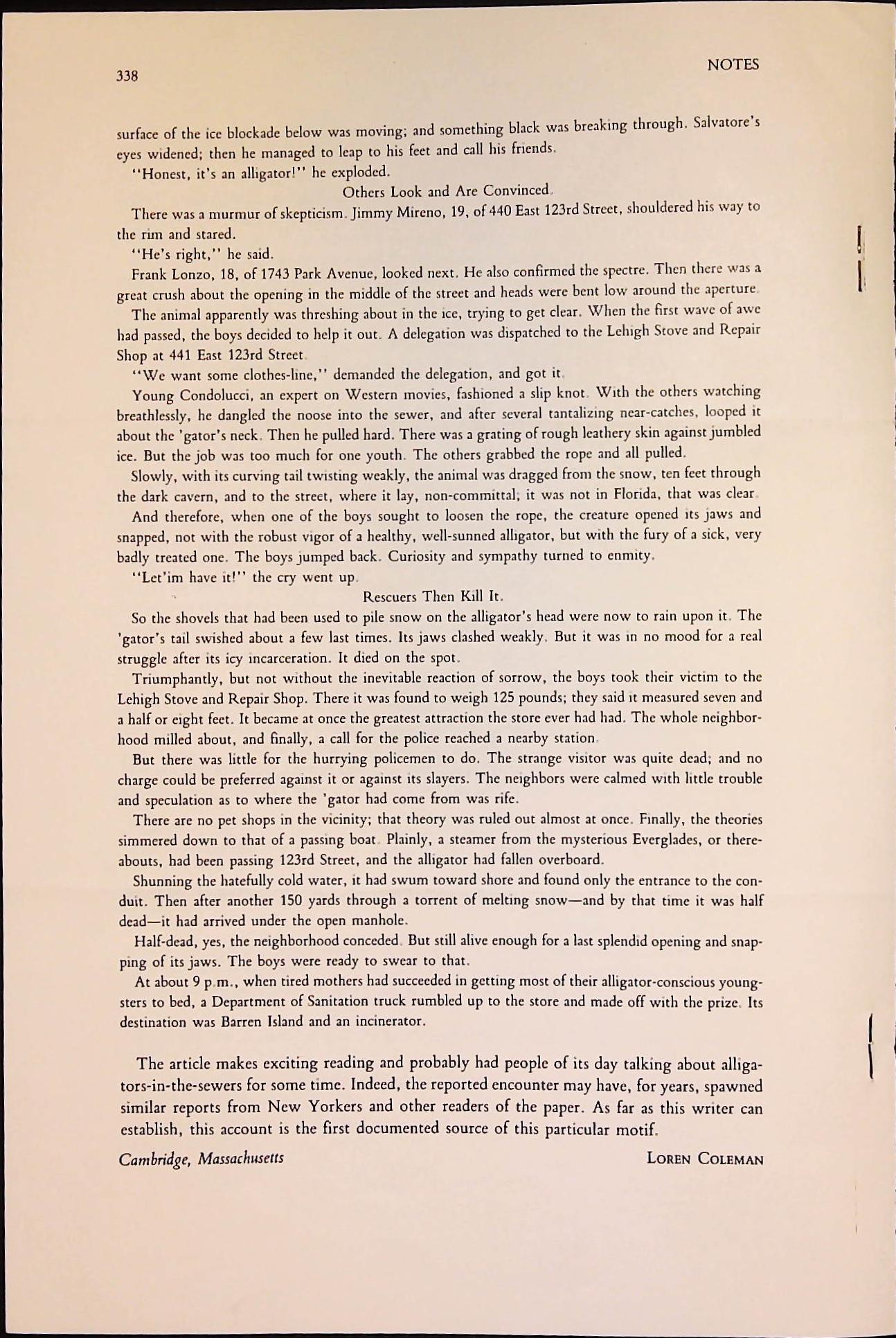
ALLIGATOR FOUND IN UPTOWN SEWER
Youths Shoveling Snow Into Manhole See The Animal Churning In Icy Water.
SNARE IT AND DRAG IT OUT
Reptile Slain by Rescuers When It Gets Vicious-Whence It Came is Mystery.
The youthful residents of East 123rd Street, near the murky Harlem River, were having a rather grand
time at dusk yesterday shoveling the last of the recent snow into a gaping manhole.
Salvatore Condulucci, 16 years old, of 419 East 123rd Street, was assigned to the rim. His comrades
would heap blackened slush near him, and he, carefully observing the sewer's capacity, would give the
last fine flick to each mound.
Suddenly there were signs of clogging ten feet below, where the manhole drop merged with the dark
conduit leading to the river. Salvatore yelled: "Hey, you guys, wait a minute,
and got down on his
knees to see what was the trouble.
What he saw, in the thickening dusk, almost caused him to topple into the icy cavern. For the jagged
5 Here I am attempting to make a distinction between such "mystery animals" as Bigfoot, Thunder-
birds, Lake Monsters, and so forth and captured, out-of-place animals. See Jerome Clark and Loren Cole-
man, Creatures of the Outer Edge (New York, Warner Books, 1978), for more complete insights into
"mystery animals."
Loren Coleman, "Erratic Crocodilians and Other Things," The Info Journal, 3, No. 4 (February,
1974), 12.
7 "News Briefly Stated," Chicago Citizen, February 27, 1892, p. 3; from Larry A. Viskochil, personal
communication, March 24, 1971.
* Coleman, 1974, pp. 13-18.

[PAGE BREAK]

338
NOTES
surface of the ice blockade below was moving; and something black was breaking through. Salvatore's
eyes widened; then he managed to leap to his feet and call his friends.
"Honest, it's an alligator!" he exploded.
Others Look and Are Convinced.
There was a murmur of skepticism. Jimmy Mireno, 19, of 440 East 123rd Street, shouldered his way to
the rim and stared.
"He's right," he said.
Frank Lonzo, 18, of 1743 Park Avenue, looked next. He also confirmed the spectre. Then there was a
great crush about the opening in the middle of the street and heads were bent low around the aperture.
The animal apparently was threshing about in the ice, trying to get clear. When the first wave of awe
had passed, the boys decided to help it out. A delegation was dispatched to the Lehigh Stove and Repair
Shop at 441 East 123rd Street.
"We want some clothes-line," demanded the delegation, and got it
Young Condolucci, an expert on Western movies, fashioned a slip knot. With the others watching
breathlessly, he dangled the noose into the sewer, and after several tantalizing near-catches, looped it
about the 'gator's neck. Then he pulled hard. There was a grating of rough leathery skin against jumbled
ice. But the job was too much for one youth. The others grabbed the rope and all pulled.
Slowly, with its curving tail twisting weakly, the animal was dragged from the snow, ten feet through
the dark cavern, and to the street, where it lay, non-committal; it was not in Florida, that was clear.
And therefore, when one of the boys sought to loosen the rope, the creature opened its jaws and
snapped, not with the robust vigor of a healthy, well-sunned alligator, but with the fury of a sick, very
badly treated one. The boys jumped back. Curiosity and sympathy turned to enmity.
"Let'im have it!" the cry went up.
Rescuers Then Kill It.
So the shovels that had been used to pile snow on the alligator's head were now to rain upon it. The
'gator's tail swished about a few last times. Its jaws clashed weakly. But it was in no mood for a real
struggle after its icy incarceration. It died on the spot.
Triumphantly, but not without the inevitable reaction of sorrow, the boys took their victim to the
Lehigh Stove and Repair Shop. There it was found to weigh 125 pounds; they said it measured seven and
a half or eight feet. It became at once the greatest attraction the store ever had had. The whole neighbor-
hood milled about, and finally, a call for the police reached a nearby station.
But there was little for the hurrying policemen to do. The strange visitor was quite dead; and no
charge could be preferred against it or against its slayers. The neighbors were calmed with little trouble
and speculation as to where the 'gator had come from was rife.
There are no pet shops in the vicinity; that theory was ruled out almost at once. Finally, the theories
simmered down to that of a passing boat. Plainly, a steamer from the mysterious Everglades, or there-
abouts, had been passing 123rd Street, and the alligator had fallen overboard.
Shunning the hatefully cold water, it had swum toward shore and found only the entrance to the con-
duit. Then after another 150 yards through a torrent of melting snow-and by that time it was half
dead-it had arrived under the open manhole.
Half-dead, yes, the neighborhood conceded. But still alive enough for a last splendid opening and snap-
ping of its jaws. The boys were ready to swear to that.
At about 9 p.m., when tired mothers had succeeded in getting most of their alligator-conscious young-
sters to bed, a Department of Sanitation truck rumbled up to the store and made off with the prize. Its
destination was Barren Island and an incinerator.
The article makes exciting reading and probably had people of its day talking about alliga-
tors-in-the-sewers for some time. Indeed, the reported encounter may have, for years, spawned
similar reports from New Yorkers and other readers of the paper. As far as this writer can
establish, this account is the first documented source of this particular motif.
Cambridge, Massachusetts
LOREN COLEMAN

Leave a Reply

Your email address will not be published. Required fields are marked *