Box 2
Folder 72. Coelacanth
Item 14. Shirley Bell

Transcribed Text (OCR)
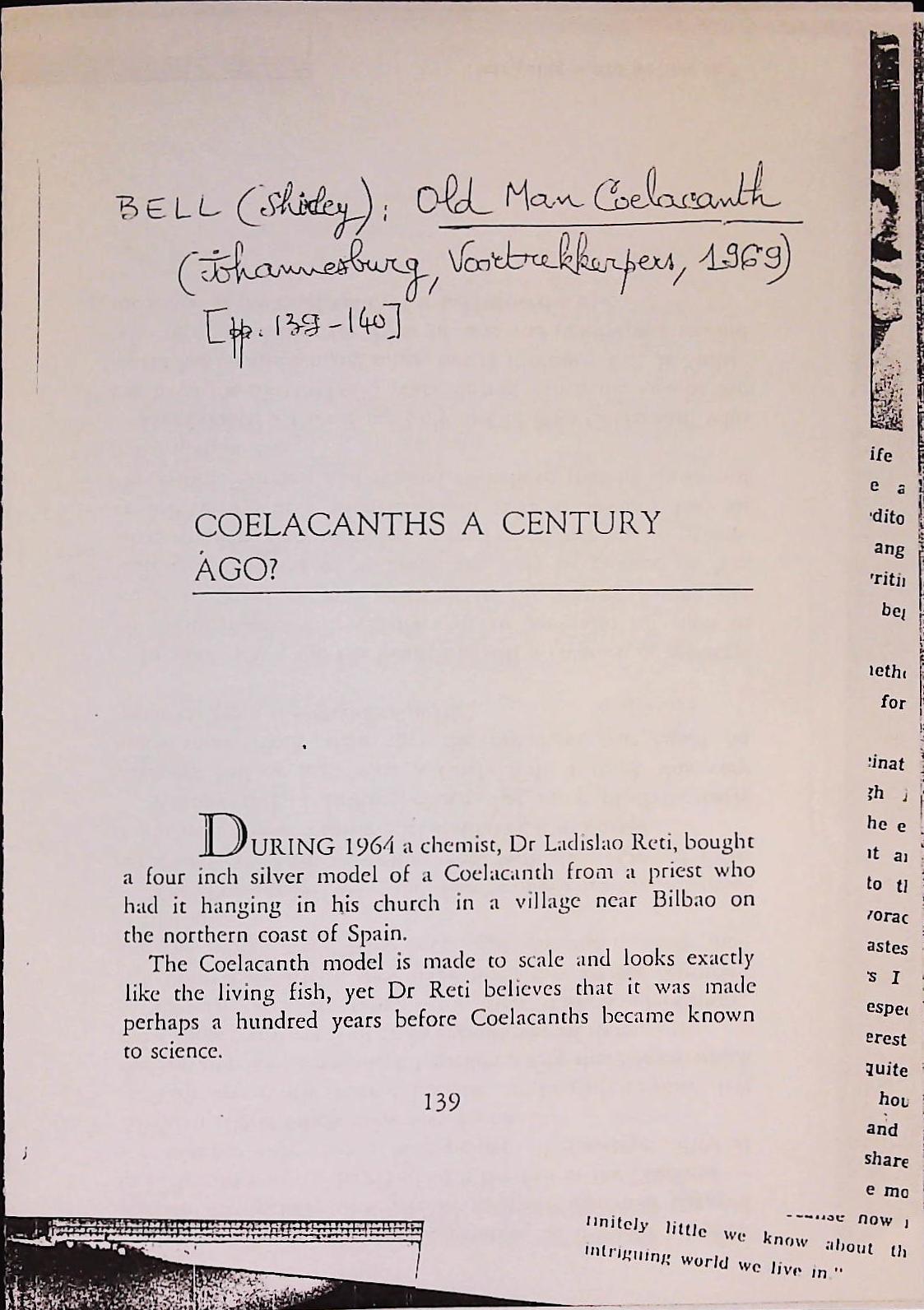
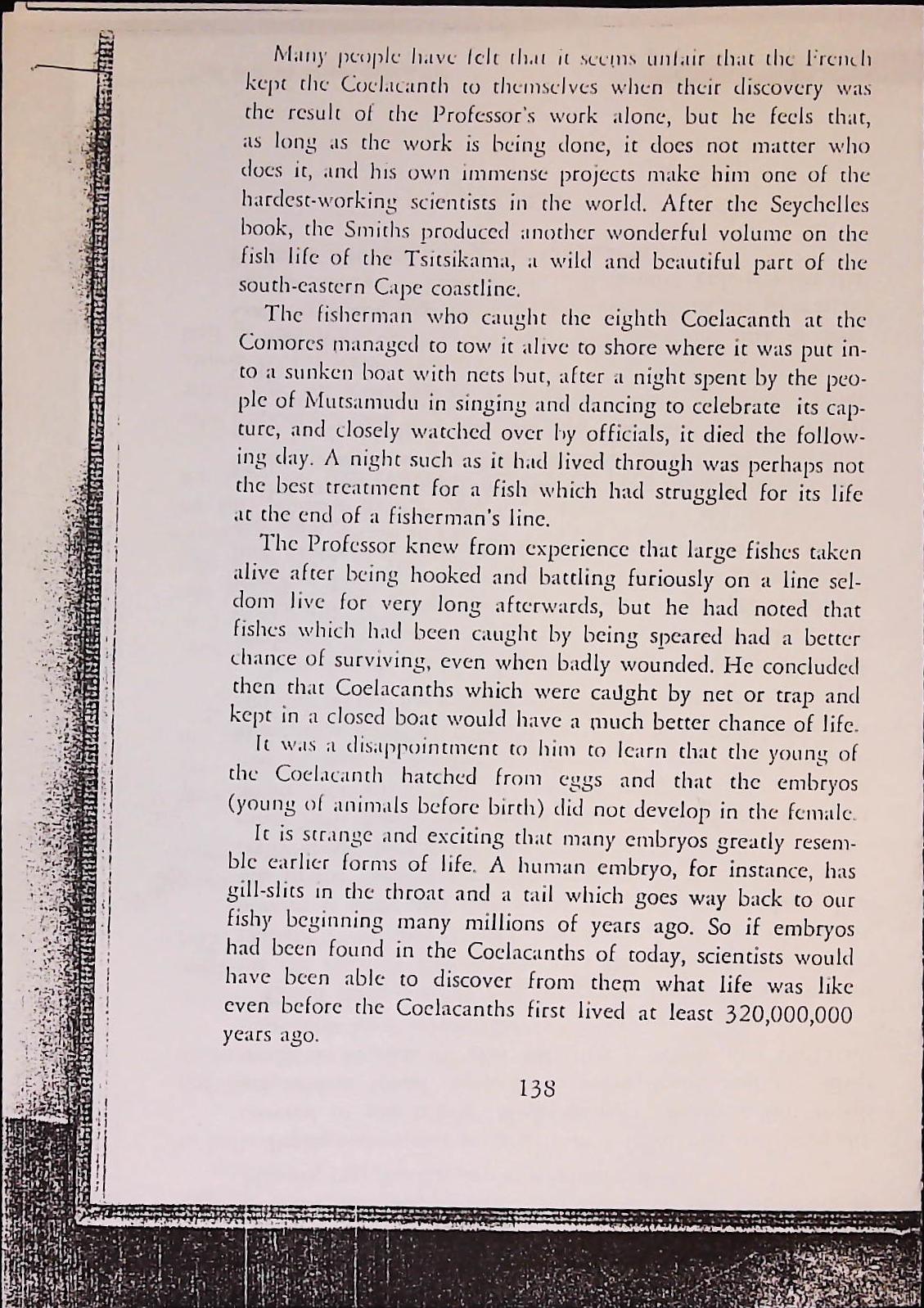
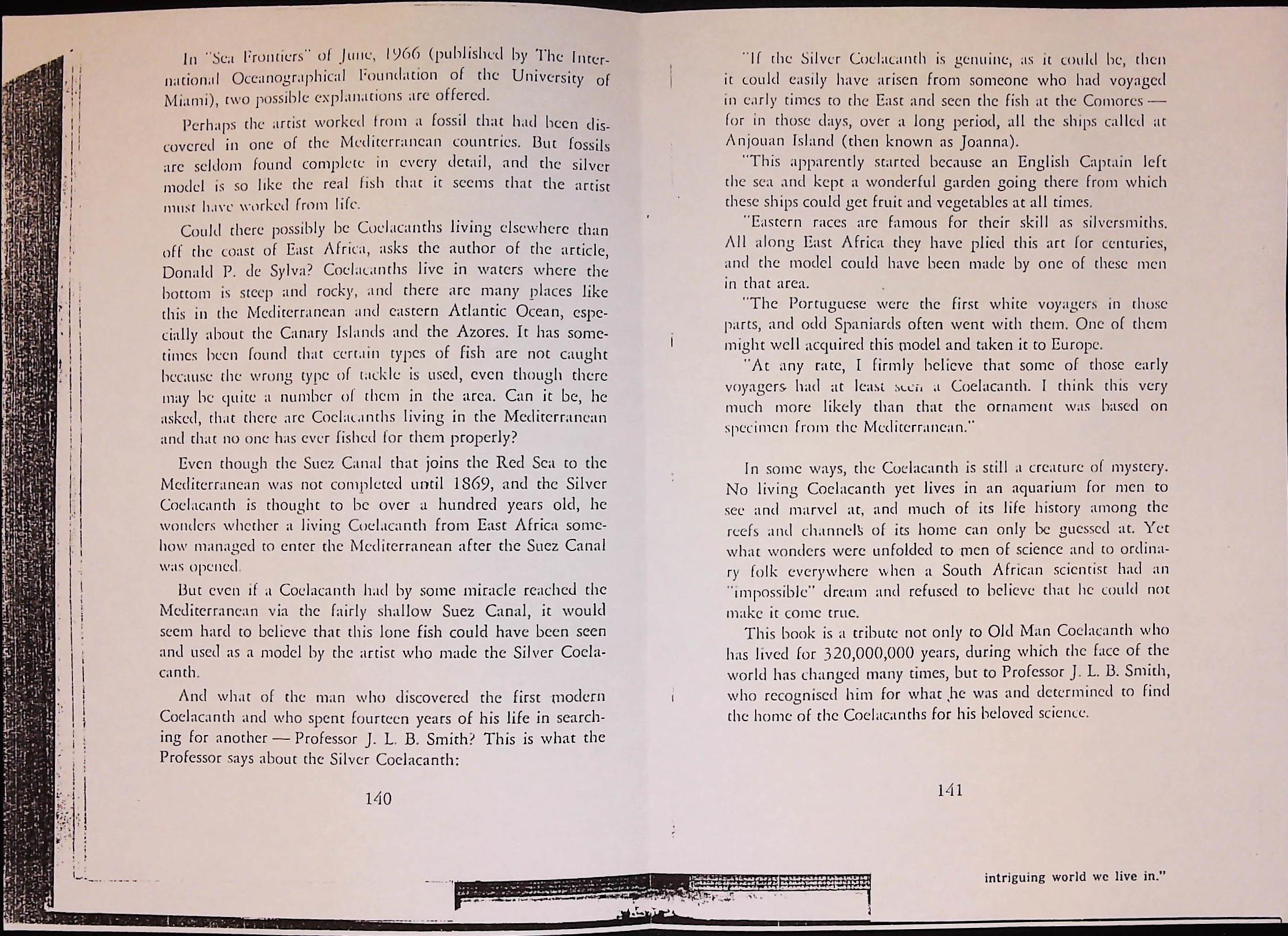
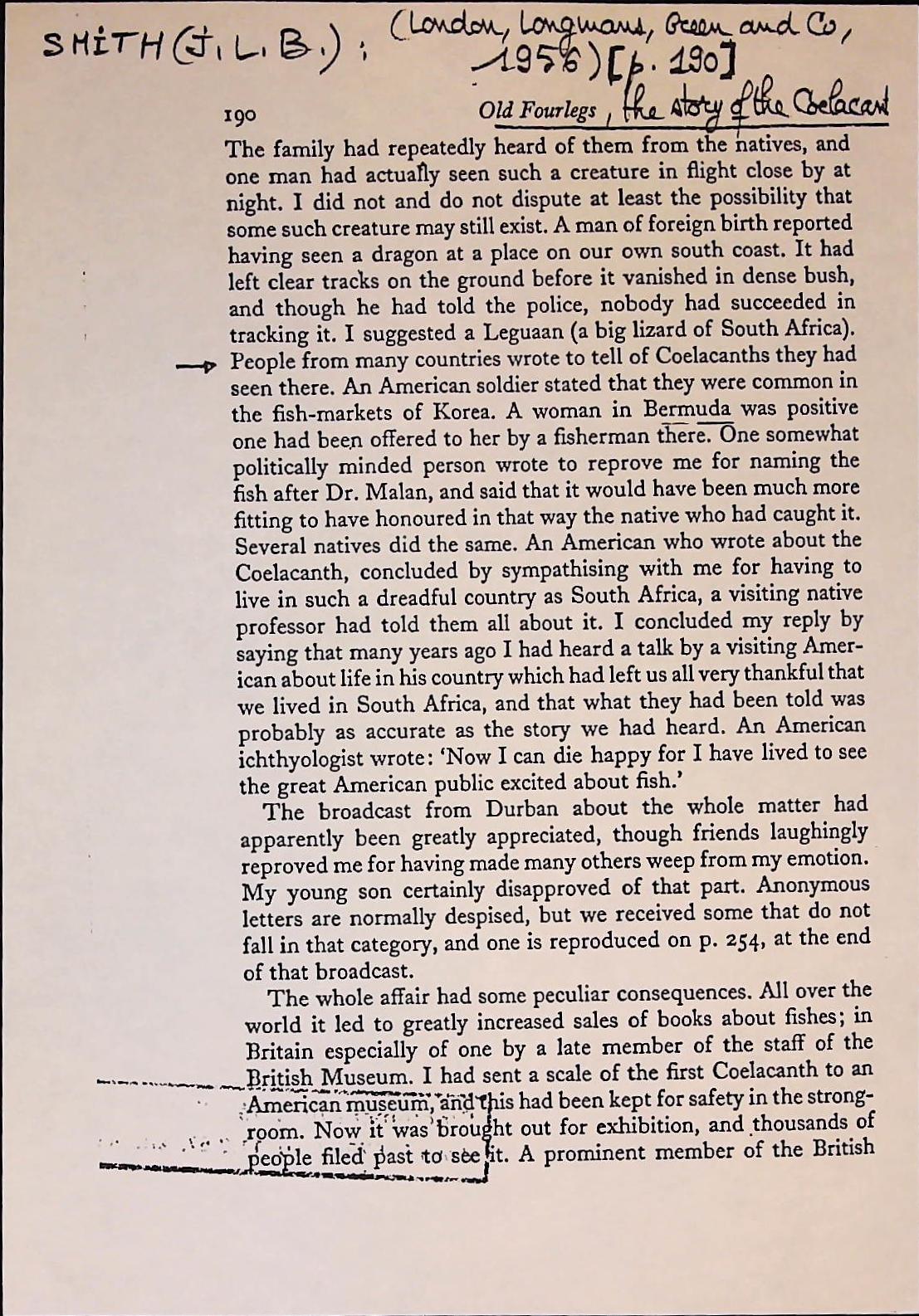
GARY MANGIACOPA ARCHIVE ============================================================ Title: B2F72I14 Slug: b2f72i14 Categories: Cryptozoology Source: https://garymangiacopraarchive.com/b2f72i14 Pages: 4 scanned, 4 extracted OCR: Google Vision API (document_text_detection) Processed: 2026-06-06 ============================================================ j BELL (Shidey); Old Man Coelacanth (itshannesburg, Venttrekkerpers, 1969) [12.139-140] COELACANTHS A CENTURY AGO? ife e a 'dito ang 'riti bel neth for :inat ghj DURING 1964 a chemist, Dr Ladislao Reti, bought a four inch silver model of a Coelacanth from a priest who had it hanging in his church in a village near Bilbao on the northern coast of Spain. The Coelacanth model made to scale and looks exactly like the living fish, yet Dr Reti believes that it was made perhaps a hundred years before Coelacanths became known to science. 139 he e it ai to tl vorac astes 'S I espe erest quite hou and share e mo - now unitely little we know about th intriguing world we live in." [PAGE BREAK] Many people have felt that it seems unfair that the French kept the Coelacanth to themselves when their discovery was the result of the Professor's work alone, but he feels that, as long as the work is being done, it does not matter who does it, and his own immense projects make him one of the hardest-working scientists in the world. After the Seychelles book, the Smiths produced another wonderful volume on the fish life of the Tsitsikama, a wild and beautiful part of the south-eastern Cape coastline. The fisherman who caught the eighth Coelacanth at the Comores managed to tow it alive to shore where it was put in- to a sunken boat with nets but, after a night spent by the peo- ple of Mutsamudu in singing and dancing to celebrate its cap- ture, and closely watched over by officials, it died the follow- ing day. A night such as it had lived through was perhaps not the best treatment for a fish which had struggled for its life at the end of a fisherman's line. The Professor knew from experience that large fishes taken alive after being hooked and battling furiously on a line sel- dom live for very long afterwards, but he had noted that fishes which had been caught by being speared had a better chance of surviving, even when badly wounded. He concluded then that Coelacanths which were caught by net or trap and kept in a closed boat would have a much better chance of life. It was a disappointment to him to learn that the young of the Coelacanth hatched from eggs and that the embryos (young of animals before birth) did not develop in the female. It is strange and exciting that many embryos greatly resem- ble earlier forms of life. A human embryo, for instance, has gill-slits in the throat and a tail which goes way back to our fishy beginning many millions of years ago. So if embryos had been found in the Coelacanths of today, scientists would have been able to discover from them what life was like even before the Coelacanths first lived at least 320,000,000 years ago. 138 [PAGE BREAK] In "Sea Frontiers" of June, 1966 (published by The Inter- national Oceanographical Foundation of the University of Miami), two possible explanations are offered. Perhaps the artist worked from a fossil that had been dis- covered in one of the Mediterranean countries. But fossils are seldom found complete in every detail, and the silver model is so like the real fish that it seems that the artist must have worked from life. Could there possibly be Coelacanths living elsewhere than off the coast of East Africa, asks the author of the article, Donald P. de Sylva? Coelacanths live in waters where the bottom is steep and rocky, and there are many places like this in the Mediterranean and eastern Atlantic Ocean, espe- cially about the Canary Islands and the Azores. It has some- times been found that certain types of fish are not caught because the wrong type of tackle is used, even though there may be quite a number of them in the area. Can it be, he asked, that there are Coelacanths living in the Mediterranean and that no one has ever fished for them properly? Even though the Suez Canal that joins the Red Sea to the Mediterranean was not completed until 1869, and the Silver Coelacanth is thought to be over a hundred years old, he wonders whether a living Coelacanth from East Africa some- how managed to enter the Mediterranean after the Suez Canal was opened. But even if a Coelacanth had by some miracle reached the Mediterranean via the fairly shallow Suez Canal, it would seem hard to believe that this lone fish could have been seen and used as a model by the artist who made the Silver Coela- canth. And what of the man who discovered the first modern Coelacanth and who spent fourteen years of his life in search- ing for another Professor J. L. B. Smith? This is what the Professor says about the Silver Coelacanth: "If the Silver Coelacanth is genuine, as it could be, then it could easily have arisen from someone who had voyaged in early times to the East and seen the fish at the Comores for in those days, over a long period, all the ships called at Anjouan Island (then known as Joanna). "This apparently started because an English Captain left the sea and kept a wonderful garden going there from which these ships could get fruit and vegetables at all times. "Eastern races are famous for their skill as silversmiths. All along East Africa they have plied this art for centuries, and the model could have been made by one of these men in that area. "The Portuguese were the first white voyagers in those parts, and odd Spaniards often went with them. One of them might well acquired this model and taken it to Europe. "At any rate, I firmly believe that some of those early voyagers had at least seen a Coelacanth. I think this very much more likely than that the ornament was based on specimen from the Mediterranean." In some ways, the Coelacanth is still a creature of mystery. No living Coelacanth yet lives in an aquarium for men to see and marvel at, and much of its life history among the reefs and channels of its home can only be guessed at. Yet what wonders were unfolded to men of science and to ordina- ry folk everywhere when a South African scientist had an "impossible" dream and refused to believe that he could not make it come true. This book is a tribute not only to Old Man Coelacanth who has lived for 320,000,000 years, during which the face of the world has changed many times, but to Professor J. L. B. Smith, who recognised him for what he was and determined to find the home of the Coelacanths for his beloved science. 140 141 intriguing world we live in." [PAGE BREAK] SMITH (J.L.B.) 190 (London, Longmans, Green and Co, 1956) [190] Old Fourlegs, the story of the Coelacant The family had repeatedly heard of them from the natives, and one man had actually seen such a creature in flight close by at night. I did not and do not dispute at least the possibility that some such creature may still exist. A man of foreign birth reported having seen a dragon at a place on our own south coast. It had left clear tracks on the ground before it vanished in dense bush, and though he had told the police, nobody had succeeded in tracking it. I suggested a Leguaan (a big lizard of South Africa). People from many countries wrote to tell of Coelacanths they had seen there. An American soldier stated that they were common in the fish-markets of Korea. A woman in Bermuda was positive one had been offered to her by a fisherman there. One somewhat politically minded person wrote to reprove me for naming the fish after Dr. Malan, and said that it would have been much more fitting to have honoured in that way the native who had caught it. Several natives did the same. An American who wrote about the Coelacanth, concluded by sympathising with me for having to live in such a dreadful country as South Africa, a visiting native professor had told them all about it. I concluded my reply by saying that many years ago I had heard a talk by a visiting Amer- ican about life in his country which had left us all very thankful that we lived in South Africa, and that what they had been told was probably as accurate as the story we had heard. An American ichthyologist wrote: 'Now I can die happy for I have lived to see the great American public excited about fish.' The broadcast from Durban about the whole matter had apparently been greatly appreciated, though friends laughingly reproved me for having made many others weep from my emotion. My young son certainly disapproved of that part. Anonymous letters are normally despised, but we received some that do not fall in that category, and one is reproduced on p. 254, at the end of that broadcast. The whole affair had some peculiar consequences. All over the world it led to greatly increased sales of books about fishes; in Britain especially of one by a late member of the staff of the British Museum. I had sent a scale of the first Coelacanth to an American museum, and this had been kept for safety in the strong- room. Now it was brought out for exhibition, and thousands of people filed past to see it. A prominent member of the British