Box 3
Folder 18. Elsewhen
Item 14. Issue 14

Transcribed Text (OCR)
GARY MANGIACOPA ARCHIVE
============================================================
Title: B3F18I14
Slug: b3f18i14
Categories: Cryptozoology, Ghost Stories, UFOs, Wildmen
Source: https://garymangiacopraarchive.com/b3f18i14
Pages: 11 scanned, 11 extracted
OCR: Google Vision API (document_text_detection)
Processed: 2026-06-06
============================================================
ELSEWHEN
The Journal of the Strange & Unusual Phenomena Research Association
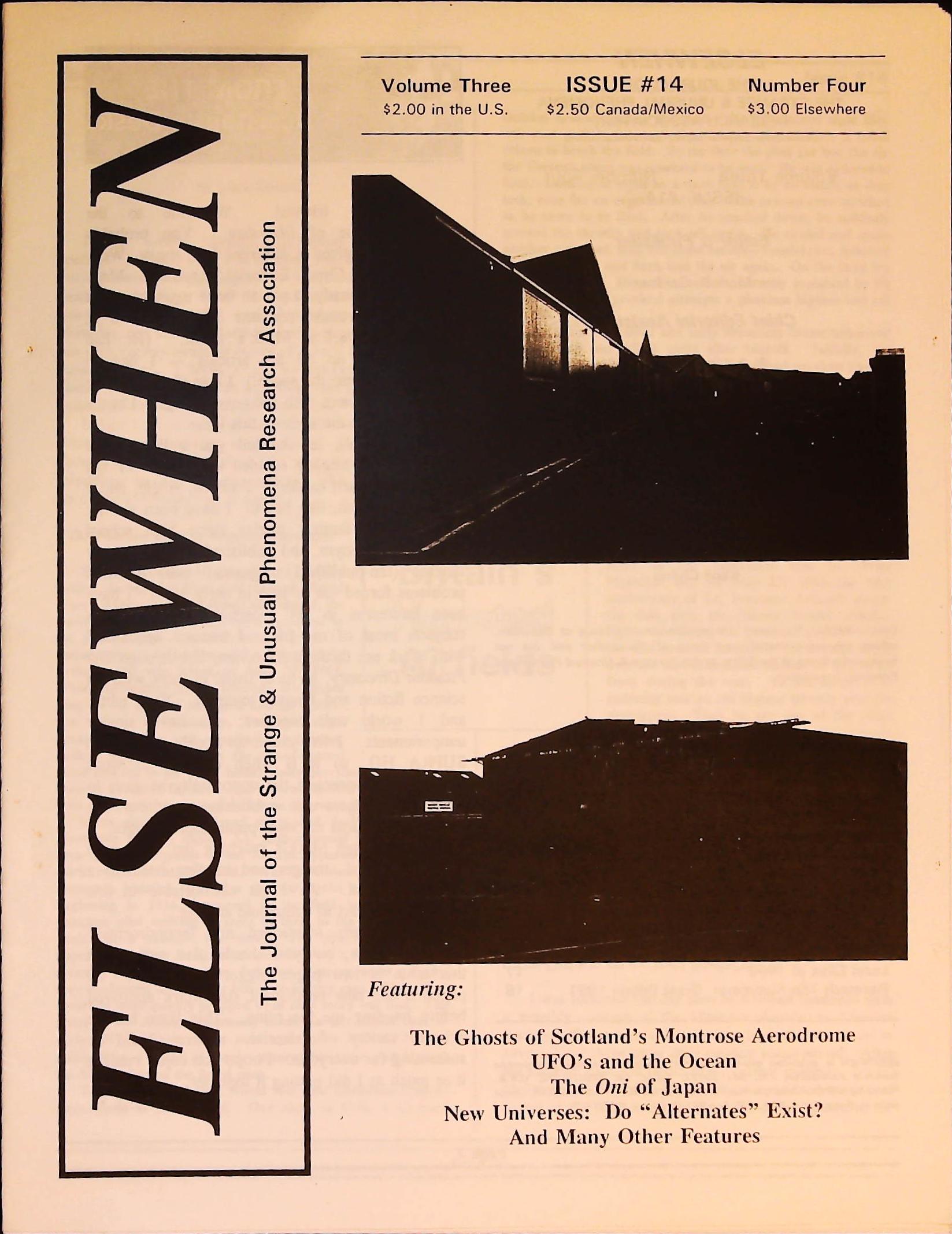
Featuring:
==
Volume Three
[AD] $2.00 in the U.S.
ISSUE #14
[AD] $2.50 Canada/Mexico
Number Four
[AD] $3.00 Elsewhere
The Ghosts of Scotland's Montrose Aerodrome
UFO's and the Ocean
The Oni of Japan
New Universes: Do "Alternates" Exist?
And Many Other Features
[PAGE BREAK]
ELSEWHEN
THE JOURNAL OF
THE STRANGE & UNUSUAL PHENOMENA
RESEARCH ASSOCIATION
(Formerly The Temporal Anomaly Research Association)
Volume Three
Number Four
ISSUE #14
Editor & Publisher
Mark R. Gardner
Chief Editorial Assistant
S. Ashley Kristensen
Contributors to This Issue
Hugh Trotti
Kimberly Wajer
Bufo Calvin
Courtney Phillips
Thomas A. Luce
Malána Jackson
Gary Mangiacopra
Kenji Chōno
DISCLAIMER: The views and opinions in this issue of Elsewhen,
unless otherwise stated, are those of the author and are not
necessarily those of the Editor or the Strange & Unusual Phenomena
Research Association.
IN THIS ISSUE:
The Ghosts of Scotland's Montrose Aerodrome
The "Mystery Hill" Mystery
Hairy Blobs Explained?
UFOs and the Ocean
Monster Menagerie: The Oni of Japan
10
New Universes: Do "Alternates" Exist?
11
Off the Bookshelf
12
Fortean Research On A Budget - Tip #6
13
From a Psi-ologist's Notebook: Definitions
14
The Myth of the Great Lakes Triangle
Translucent Time Travellers/Doubtful Islands
15
16
Local Clips of 1992
17
Research Trip Summary: Great Britain 1991
18
ELSEWHEN is published quarterly by the Strange & Unusual Phenomena
[AD] Research Association, P.O. Box 20173, Keizer, OR 97307-0173, U.S.A.
01992 by SUPRA. Price per copy is $2.00 In the U.S. POSTMASTER: Send
address changes to SUPRA, P.O. Box 20173, Kelzer, OR 97307.
FROM THE
Assistant's Desk
Elsewhen
Greetings, friends!
fourteenth issue of Elsewhen.
Welcome to the
You probably
immediately noticed a different face above. Well,
it's me, the Chief Editorial Assistant! Mark
decided I was ready to put an issue together. In a
couple of marathon sessions I formatted it at
SUPRA HQ, a.k.a. Mark's home. (He had
already typed up all the articles
I had to
squeeze them into the space!) I was also given the
okay to experiment with the cover design. Let me
know what you think about this issue.
First of all, let me tell you a little about
myself. (I've already scolded the Editor for not
doing this himself earlier!) I am 26, single, and a
native Oregonian, like Mark. I have been writing
romance and fantasy stories since high school
under a pseudonym, and published a small fantasy
fanzine (fan-published magazine) until personal
problems forced me to stop in early 1990. I have
been interested in the supernatural and fortean
subjects most of my life. I became acquainted
with Mark not through Elsewhen, but through The
Fandom Directory, as he is listed in there with his
science fiction and fantasy interests. Your editor
and I work well together; we have similar
temperaments. I live about an hour's drive from
SUPRA HQ, so it is often difficult to work
together. I appreciate the opportunity he gave to
keep my fingers in publishing, without the
monthly pressures my own publication brought. I
will never forget Mark's reaching out with open
arms to a total stranger and treating her like a
As I get comfortable in this
long-lost friend.
position, I'll start to contribute articles.
I've already mentioned my "experimental"
format changes, but you should also notice that
this issue is two pages bigger than usual.
pages is the new permanent size Mark approved
before handing me the reins. This issue has an
There should be
eclectic variety of material.
something for everyone. I hope you enjoy reading
it as much as I did putting it together.
20
S.A.K.
The Ghosts of
Scotland's Montrose Aerodrome
by Mark Gardner
In my article "Strange Happenings in Northeast
Scotland" in Issue #11, I introduced you to some of the
stories of strange happenings at the Montrose Aerodrome in
Scotland. Although I had lived in that area for nearly a
year and a half (1982-83), most of my close friends lived in
Montrose, and had been back for two months a year later, I
was only vaguely aware of stories of strange happenings that
I began to dig for information after the
occurred there.
mother of my friend Linda mentioned that Linda's brother
walked the dog at the "haunted" aerodrome.
Before I go on with this article, I want to reprint the
section of my previous article that is pertinent to this
This will refresh the memories of long-time
discussion.
[AD] subscribers as will as bringing those who
are newer to Elsewhen up to speed:
The Phantom Pilots of Montrose Aerodrome
Issue #14
Heinkel bomber buzzed the field. An experienced night flier
was sent aloft to intercept the German plane before it could
return to bomb the field. By the time the pilot got into the air
the German plane was nowhere to be seen. He was ordered to
land. Landing at night on a dark field is by no means an easy
task, even for an experienced pilot. The ground crew watched
as he came in to land. After he touched down, he suddenly
gunned the throttle and took off again. He circled and made
another approach with the same results-Touchdown, followed
by full throttles and back into the air again. On the third try
he safely landed. His actions were apparently explained by his
claim that on his previous attempts a phantom biplane had cut
him off!
In 1942 a very strict and surly lieutenant (name unknown)
crashed and was killed right after takeoff. Initially, the
mechani: who serviced the plane and had had previous trouble
with the pilot was accused of rigging the plane in revenge. The
charges were dropped due to lack of evidence. In a startling
parallel to the death and haunting of Lt. Arthur, this pilot
began to appear quite often. It got to be such a nuisance, that
all new flight cadets were eventually briefed on the "ghost"
upon arrival. The sightings gradually faded away, but from
time to time this phantom pilot was seen
entering the building that had formerly housed
the base morgue. It is unclear if he is still
appearing today.
Britain's
Haunted
Airfields
The aerodrome at Montrose was a bustling
facility during the First and Second World
Wars. Although it now stands abandoned, the
stories of ghostly sightings have continued to
the present day. The first official ghost on
record appears to be that of Lt. Desmond L.
Arthur, who was killed on May 27, 1913.
While descending for a landing, the upper
wing of the biplane collapsed and all control
was lost. Unfortunately, in those days,
parachutes were not standard equipment.
Arthur was thrown from the out-of-control
plane and fell to his death before many horrified eyewitnesses.
Rumors persisted for some time afterwards that the plane had
been deliberately tampered with by a disgruntled mechanic.
Many planes crashed and pilots died during these early
pioneering days of flight. Lt. Arthur would probably have
been quickly forgotten if not for the apparent fact that his
The aerodrome at Montrose
spirit remained at the field.
became a training field after the war broke out in Europe.
Beginning in 1916, personnel at the field began seeing a
phantom pilot walking in front of them to the mess, only to
vanish as it reached the door. The phantom pilot also
appeared in other locations around the No. 2 Mess. On one
occasion two men on sentry duty fled in terror when a figure
they challenged faded away before their very eyes. Charges of
desertion were quickly dropped when their story was told. The
ghost of Lt. Arthur supposedly made his last appearance in
early 1917 and was never seen again after a final, belated
ruling from a board of inquiry cleared his name and blamed
his death solely on the failed wing.
Then came the Second World War and Hurricane fighters
were based at the airfield. One night in 1940, a German
As if all of this wasn't strange enough,
listen to the experience that Sir Peter
Masefield had on May 27, 1963-the 50th
anniversary of Lt. Desmond Arthur's death:
On that day, the famous British aviation
figure was flying his personal airplane along
the east coast of Scotland. He decided to fly
over the now-abandoned airfield he had flown
from during the war. To his surprise he
suddenly saw an old biplane directly over the
aerodrome. Then he saw one of the wings
buckle and the plane spin into the ground.
The shocked Sir Masefield made a landing on
a nearby golf course and ran to the old airfield. Nothing! He
was bewildered to discover that there was absolutely no trace
of the accident he had just seen. So it seems that the restless
spirit of Lt. Arthur might still occasionally reenact his last
moments.
Today the abandoned airfield is used as a campground,
people take their dogs for walks there, and several old hangars
are used by local businesses. One can't help wonder if every
once in awhile someone sees a figure walking in front of them,
wearing flight gear. I intend to do a lot of research into this
subject and take pictures when in Scotland next time. I am
considering writing a long feature article or maybe even a book
on the ghosts of the Montrose aerodrome.
I was fortunate that my time in Scotland coincided with
a monthly meeting of the Montrose Aerodrome Museum
Society. The members were quite surprised and pleased to
have a Yank show up at their meeting unannounced! After
the meeting I sat and talked to the current chairman, Ian G.
McIntosh, about each of the above-mentioned stories of
events at the old aerodrome site. He soon demolished the
Page 2
Page 3
[PAGE BREAK]
Elsewhen
majority of these stories as exaggerations, myths or stories
made up by some writer with a deadline to meet.
How I wish that I had had a tape recorder along, since
Mr. McIntosh proceeded to tell me some of the real stories
of strange happenings tied to Montrose. These were from
first-hand personal accounts the society had collected over
the years from the actual witnesses. As I was a stranger to
them, I was not given access to the witness files they have.
I hope this will change in the future. I was given
permission to spend the night at their museum when it is up
The museum is to be
and running in the near future.
housed in the old headquarters building which is currently
boarded up. I got a big surprise when an article about the
meeting appeared in a local newspaper, prominently
mentioning me, although they spelled my surname in the
Scottish way (see below).
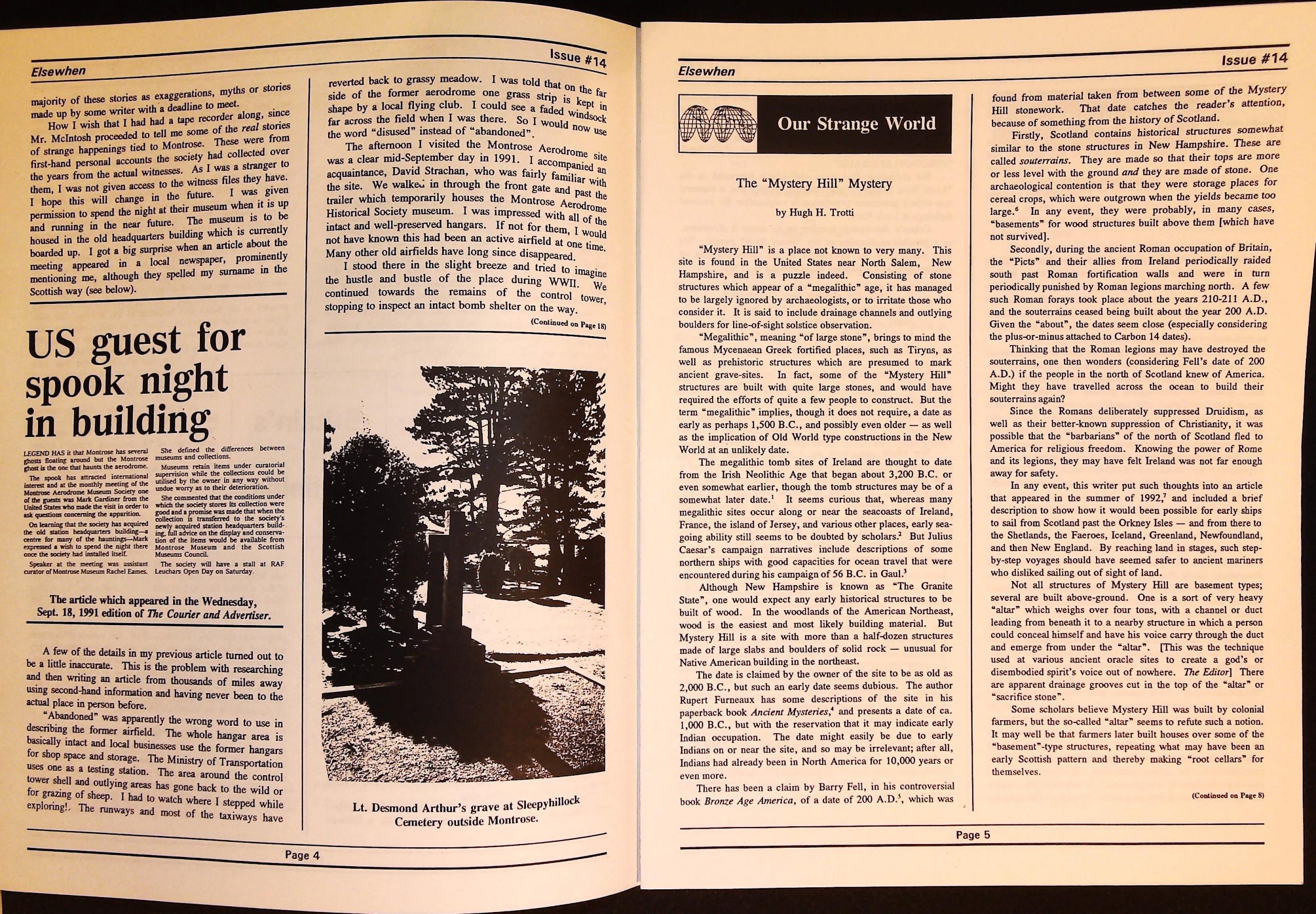
US guest for
spook night
in building
LEGEND HAS it that Montrose has several
ghosts floating around but the Montrose
ghost is the one that haunts the aerodrome.
The spook has attracted international
interest and at the monthly meeting of the
Montrose Aerodrome Museum Society one
of the guests was Mark Gardiner from the
United States who made the visit in order to
ask questions concerning the apparition.
On learning that the society has acquired
the old station headquarters building-a
centre for many of the hauntings-Mark
expressed a wish to spend the night there
once the society had installed itself.
Speaker at the meeting was assistant
curator of Montrose Museum Rachel Eames.
She defined the differences between
museums and collections.
Museums retain items under curatorial
supervision while the collections could be
utilised by the owner in any way without
undue worry as to their deterioration.
She commented that the conditions under
which the society stores its collection were
good and a promise was made that when the
collection is transferred to the society's
newly acquired station headquarters build-
ing, full advice on the display and conserva-
tion of the items would be available from
Montrose Museum and the Scottish
Museums Council.
The society will have a stall at RAF
Leuchars Open Day on Saturday.
The article which appeared in the Wednesday,
Sept. 18, 1991 edition of The Courier and Advertiser.
A few of the details in my previous article turned out to
be a little inaccurate. This is the problem with researching
and then writing an article from thousands of miles away
using second-hand information and having never been to the
actual place in person before.
"Abandoned" was apparently the wrong word to use in
describing the former airfield. The whole hangar area is
basically intact and local businesses use the former hangars
for shop space and storage. The Ministry of Transportation
uses one as a testing station. The area around the control
tower shell and outlying areas has gone back to the wild or
for grazing of sheep. I had to watch where I stepped while
exploring!, The runways and most of the taxiways have
Page 4
Issue #14
reverted back to grassy meadow. I was told that on the far
side of the former aerodrome one grass strip is kept in
shape by a local flying club. I could see a faded windsock
far across the field when I was there. So I would now use
the word "disused" instead of "abandoned".
The afternoon I visited the Montrose Aerodrome site
was a clear mid-September day in 1991. I accompanied an
acquaintance, David Strachan, who was fairly familiar with
the site. We walked in through the front gate and past the
trailer which temporarily houses the Montrose Aerodrome
Historical Society museum. I was impressed with all of the
intact and well-preserved hangars. If not for them, I would
not have known this had been an active airfield at one time.
Many other old airfields have long since disappeared.
I stood there in the slight breeze and tried to imagine
the hustle and bustle of the place during WWII.
We
continued towards the remains of the control tower,
stopping to inspect an intact bomb shelter on the way.
(Continued on Page 18)
Lt. Desmond Arthur's grave at Sleepyhillock
Cemetery outside Montrose.
Elsewhen
Our Strange World
The "Mystery Hill" Mystery
by Hugh H. Trotti
"Mystery Hill" is a place not known to very many. This
site is found in the United States near North Salem, New
Hampshire, and is puzzle indeed. Consisting of stone
structures which appear of a "megalithic" age, it has managed
to be largely ignored by archaeologists, or to irritate those who
consider it. It is said to include drainage channels and outlying
boulders for line-of-sight solstice observation.
"Megalithic", meaning "of large stone", brings to mind the
famous Mycenaean Greek fortified places, such as Tiryns, as
well as prehistoric structures which are presumed to mark
ancient grave-sites. In fact, some of the "Mystery Hill"
structures are built with quite large stones, and would have
required the efforts of quite a few people to construct. But the
term "megalithic" implies, though it does not require, a date as
early as perhaps 1,500 B.C., and possibly even older - as well
as the implication of Old World type constructions in the New
World at an unlikely date.
The megalithic tomb sites of Ireland are thought to date
from the Irish Neolithic Age that began about 3,200 B.C. or
even somewhat earlier, though the tomb structures may be of a
somewhat later date.' It seems curious that, whereas many
megalithic sites occur along or near the seacoasts of Ireland,
France, the island of Jersey, and various other places, early sea-
going ability still seems to be doubted by scholars. But Julius
Caesar's campaign narratives include descriptions of some
northern ships with good capacities for ocean travel that were
encountered during his campaign of 56 B.C. in Gaul.³
Although New Hampshire is known as "The Granite
State", one would expect any early historical structures to be
built of wood. In the woodlands of the American Northeast,
wood is the easiest and most likely building material. But
Mystery Hill is a site with more than a half-dozen structures
made of large slabs and boulders of solid rock - unusual for
Native American building in the northeast.
The date is claimed by the owner of the site to be as old as
2,000 B.C., but such an early date seems dubious. The author
Rupert Furneaux has some descriptions of the site in his
paperback book Ancient Mysteries, and presents a date of ca.
1,000 B.C., but with the reservation that it may indicate early
Indian occupation. The date might easily be due to early
Indians on or near the site, and so may be irrelevant; after all,
Indians had already been in North America for 10,000 years or
even more.
There has been a claim by Barry Fell, in his controversial
book Bronze Age America, of a date of 200 A.D.', which was
Page 5
Issue #14
found from material taken from between some of the Mystery
Hill stonework.
That date catches the reader's attention,
because of something from the history of Scotland.
Firstly, Scotland contains historical structures somewhat
similar to the stone structures in New Hampshire. These are
called souterrains. They are made so that their tops are more
or less level with the ground and they are made of stone. One
archaeological contention is that they were storage places for
cereal crops, which were outgrown when the yields became too
large.❝
In any event, they were probably, in many cases,
"basements" for wood structures built above them [which have
not survived].
Secondly, during the ancient Roman occupation of Britain,
the "Picts" and their allies from Ireland periodically raided
south past Roman fortification walls and were in turn
periodically punished by Roman legions marching north. A few
such Roman forays took place about the years 210-211 A.D.,
and the souterrains ceased being built about the year 200 A.D.
Given the "about", the dates seem close (especially considering
the plus-or-minus attached to Carbon 14 dates).
Thinking that the Roman legions may have destroyed the
souterrains, one then wonders (considering Fell's date of 200
A.D.) if the people in the north of Scotland knew of America.
Might they have travelled across the ocean to build their
souterrains again?
Since the Romans deliberately suppressed Druidism, as
well as their better-known suppression of Christianity, it was
possible that the "barbarians" of the north of Scotland fled to
America for religious freedom. Knowing the power of Rome
and its legions, they may have felt Ireland was not far enough
away for safety.
In any event, this writer put such thoughts into an article
that appeared in the summer of 1992, and included a brief
description to show how it would been possible for early ships
to sail from Scotland past the Orkney Isles and from there to
the Shetlands, the Faeroes, Iceland, Greenland, Newfoundland,
and then New England. By reaching land in stages, such step-
by-step voyages should have seemed safer to ancient mariners
who disliked sailing out of sight of land.
Not all structures of Mystery Hill are basement types;
several are built above-ground. One is a sort of very heavy
"altar" which weighs over four tons, with a channel or duct
leading from beneath it to a nearby structure in which a person
could conceal himself and have his voice carry through the duct
and emerge from under the "altar". [This was the technique
used at various ancient oracle sites to create a god's or
disembodied spirit's voice out of nowhere. The Editor] There
are apparent drainage grooves cut in the top of the "altar" or
"sacrifice stone".
Some scholars believe Mystery Hill was built by colonial
farmers, but the so-called "altar" seems to refute such a notion.
It may well be that farmers later built houses over some of the
"basement"-type structures, repeating what may have been an
early Scottish pattern and thereby making "root cellars" for
themselves.
(Continued on Page 8)
[PAGE BREAK]
Elsewhen
THE CRYPTOZOO
HAIRY BLOBS EXPLAINED?
by Hugh H. Trotti
A knowledge of "hairy blobs" is more or less restricted
to those interested in the various studies taking place in the
new area called "Cryptozoology". Since that area includes
many different levels of quality and scientific effort, and is
not confined to such subjects as a possible "Bigfoot" or
"Loch Ness Monster", many different items of interest may
be followed. One such is the "hairy blob".
The
Cryptozoology as a field is comprised of both serious
scientists, some connected with prestigious institutions, and
amateurs, laymen, and adventurers of various sorts.
main group, the International Society of Cryptozoology,
issues both newsletters and yearly peer-reviewed journals,
and is coordinated by J.R. Greenwell, who filmed an
interesting Chinese expedition searching for a possible
"Wildman", which was broadcast by public TV stations.
One of the oddities presented in a newsletter of the
organization was an account of "blobs" washed up on coasts
in the Atlantic and Pacific Oceans blobs covered with
stringy material resembling hair, and comprised of a tough,
cartilaginous material. Was this a "new" life-form not
heretofore discovered, whose living members lurked in the
depths of the seas?
The blobs have also been written up in various books
that deal with unexplained things and events. Some
descriptions imply that the blobs are somehow alive, and
that if one holds a cigarette lighter against them, the tissue
"moves away" from the heat. All in all, a most peculiar
report, indeed.
Perhaps the answer to the puzzle of "What could that
be?" can be found in one of the works of author Daniel
Cohen. In The Encyclopedia of Monsters (New York:
Dorset Press, 1989, pp. 174-176), Cohen presents an
interpretation of a curiosity that he calls
"Pseudoplesiosaur". It seems that badly decomposed
carcasses of some odd creature are sometimes washed up on
coasts and found by people who note the resemblance to the
extinct marine reptile of long ago.
The body of the basking shark, sometimes being
washed up on coasts, was presented by Cohen because of its
resemblance to the extinct plesiosaur. The decomposition
results in the loss of the gill structure with the jaws early
on, and the dorsal fin goes quickly as well. The bottom
Page 6
Issue #14
lobe of the tail carries no skeletal structure, and so rots and
falls away soon. The portion of the carcass remaining after
these losses so resembles a possible "plesiosaur" (the side
fins resembling "flippers"), that when it washes ashore it is
often so identified. Cohen titles this section of his work
"PSEUDOPLESIOSAUR".
We remember that some individuals interested in the
"Loch Ness Monster" phenomenon believe that a remnant
non-extinct plesiosaur population is responsible for claimed
sightings at Loch Ness.
Cohen's description inspires us to apply it elsewhere,
as a possible explanation of the "Hairy Blob" puzzle. We
note particularly his description of the decomposition of
muscle fibers in the basking shark carcass (p. 176):
when the shark's skin decomposes,
the underlying muscle fibers begin to
break up into whiskerlike fibers which
tend to give the carcass the appearance
of being covered with fur..."
Is it possible that this description applies to the "blob"
problem as well as to the "pseudoplesiosaur"? If so, the
blob itself will represent the final stages of decay of some
more "regular" denizen of the oceans, and the peculiar
"hairy" or string-like structures surrounding it may
represent the simple decomposition of muscle fibers.
We might also note as a final comment on this
phenomenon that Marco Polo described the hairy body of a
huge fish found on the bed of a river whose water had been
diverted away. He stated that some who ate of it died.
Could this be explained by the same decay processes cited
by Cohen, that result in "hair-like" appearances? (For the
Marco Polo account, cf. Polo, Marco, The Travels, New
York: Penguin Books, paperback, 1982, p. 228).
THE WILD PLACES
-a new Journal of the paranormal
UFOs, crop circles, ghosts, Spiritualism, visions,
allens, guides, exorcism and much more.
ISSUE 4 OUT NOW
Our biggest and best issue yet - 40 packed pages including:
Jenny Randalls on her understanding of her contacts with alien intelligences, Lushio
Price on Spuntualist history, the Prison Earth Theory of existence explored by Matin
Kottmayer, End Times Bulletin, Talking to Strangers, Urban Shamen Phul Hine on
consamporary occultism, Chris Harvey with Do We Have A Spirit, Peter Hough
Looking For The Aliens,and the biggest review and listing of specialist journals
Currently published anywhere in the world!
Sample issue £1.65. 4-issue subscripition, £6 from: -
[AD] $15
Kevin McClure, 42 Victoria Road, Mount Charles, CASH
St. Austell, Cornwall PL25 4QD.
[AD] $4
CASH
FAST FACTS OUR MAIL IN 1992
From January 1st to December 1st we received
927 pieces of mail at SUPRA HQ addressed to
TARA, SUPRA or Elsewhen!
Elsewhen
??
Theories & Ideas
UFOs and the Ocean
by
Thomas A. Luce
Scientists and many people have been obsessed with
trying to find extraterrestrial intelligence on some planet
somewhere in the universe. Therefore, these people reason
that UFOs (unidentified flying objects) just have to be
coming from some advanced civilization on some planet in
the vast universe. That is a mistake!
UFOs do not come from some planet somewhere out
there in the universe. They come from our very own Planet
Earth, that is, from the ocean! There is an intelligent
species of beings dwelling in the ocean depths.
A great invincible hero was portrayed as being the son
of a deep-sea intelligent species of beings. In Homer's Iliad
Thetis is the subterranean "mother" of the hero Achilles.
Thetis dwelled at the bottom of the ocean in a great cave,
and "rose like a cloud from the bed of the sea.'"
44% of all deep-sea life have evolved their own
bioluminous, colored organs. These species of deep-sea life
with the bioluminous, colored organs are able to blink them.
This blinking attribute is the way that these species of
deep-sea life signal each other or communicate with each
other. It is their way of talking. Now there in an
intelligent species of deep-sea life (UFOs) that have also
evolved their own bioluminous, colored blinking organs.
Blinking lights of various colors have been reported in many
UFO sightings.
Several species of deep-sea life have a swim bladder
that fills with gas as they swim upward toward the surface
of the ocean. At this new level, deep-sea fish are
practically weightless and can dart about at great speeds and
swim very gracefully. There is an intelligent deep-sea
species of life that also fills itself with gas as it swims
upward toward the surface of the ocean. As this intelligent
deep-sea species of life with the bioluminous, colored
blinking organs leaves the ocean and enters the atmosphere
it would be practically weightless! This explains why UFOs
seem to have instant acceleration, great speeds, and great
maneuverability! This intelligent deep-sea species of life
with the shining attributes (UFOs) is a part of Earth's
natural evolution. This intelligent deep-sea species of life
evolved naturally in the oceans of the Planet Earth just as
Page 7
Issue #14
the intelligent human being did on land. Thus nature has
intelligent beings both in the ocean and on the land.
Would an intelligent, shining deep-sea species of life
evolve in the depths of the oceans on some other planet in
the universe just as intelligence would evolve on land? I
would say so.
Just what is this intelligence?
produce intelligence?
Why should nature
It is the moral duty of those who write books,
especially books of a scientific nature, to inform their
readers of the facts.
Thor Heyerdahl wrote: "We saw the shine of
phosphorescent eyes drifting on the surface on dark nights,
and on one single occasion we saw the sea boil and bubble
while something like a big wheel came up and rotated in the
air, while some of our dolphins tried to escape by hurling
themselves desperately through space." (Kon-Tiki, Page
153, Rand McNally, 1976).
This sighting of a "big wheel" that came up out of the
ocean was made in 1947 as Thor Heyerdahl and five other
men sailed on a balsa wood raft from Lima, Peru, across
the Pacific to the Polynesian Islands.
Evidently the rotating "big wheel" terrified the
dolphins that had been following the Kon-Tiki balsa wood
raft. It has been reported that UFOs terrify animals. How
fast did the "big wheel" rotate? What color was it? Was it
luminous? Was there any sound? Was a picture taken?
How long did the "big wheel" rotate in the air above the
ocean? Was it observed descending back into the ocean?
There have been many reports of UFOs being wheel-shaped
and rotating!
Here is another one by Thor Heyerdahl:
"That night we were given a fright of a quite
unexpected kind. Norman roused me in a low voice for the
change of watch on June 30 at 0.30 hours and I sat up in
my sleeping bag and began to pull on my socks, as the air
was raw and cold on the bridge. Then he called again, and
this time there was terror in his voice.
"Come quick, quick! Look there!'
"I dived out of the opening in the wicker wall with
Santiago close to my heels and we hoisted ourselves over
the cabin roof where Norman was pointing.
"It was like the Day of Judgement. Over the horizon
to starboard, in the northwest, rose a pale, round disc,
which never completely left the water, but grew and grew,
like a phantom aluminum-colored moon rising half-hidden
by the rim of the sea, like a compact nebula, brighter than
the milky way and symmetrically circular, it grew in size, a
stem-mushroom, and seemed to be rushing straight toward
us as it spread farther and farther across the sky. My first
thought was a reflection against a veil of humanity from an
enormous searchlight over the horizon, my next was an
atomic cloud caused by human error, or a phenomenon of
the northern lights, but the feeling that a scintillating shower
[PAGE BREAK]
Elsewhen
of foreign bodies was descending on us from the cosmos
persisted, until the disc of light was covering about thirty
degrees of the sky, then it suddenly stopped growing,
dissolved almost imperceptibly and disappeared. We were
(The Ra Expeditions, Pages
left without an explanation."
328-329, Doubleday, 1971).
This
The powerful "Day of Judgement" light was made by
our bioluminous, deep-sea dwelling neighbors!
sighting was made as Thor Heyerdahl sailed with five other
men on a papyrus reed boat from Safi, Africa, across the
Atlantic ocean to Barbados in the Lesser Antilles in 1969.
Here is the description of another sighting from the
same book, same page:
"We had seen orange lights on the horizon to the
northwest, one was a bright flash with no sign of a ship, the
other was drop-shaped and we saw it just as it sailed
diagonally down and vanished in the sea."
n
What about the drop-shaped and orange lights that
apparently vanish into the ocean? Many UFO reports
describe them as being drop-shaped and orange in color.
The Thing
"There have been several instances when several pieces
of sonar equipment on different ships in a task force heard
the sound of a great body propelling itself with some
powerful mechanism at high speed through the black waters
and crushing pressures five miles down. The speed of the
things seem to have been as high as those of the most
advanced nuclear submarines. The 'thing' could hardly be
an animal at these depths or could it?" (Mysteries
Beneath the Sea by William R. Corliss, Page 151, Thomas
Y. Crowell Company, New York, 1970).
"Deep, deep down, five miles deep into the realm of
hydrospace, there exists a form of life of which we had not
the slightest conception, and which may have possessed
physical strength and driving energy that lay beyond the
understanding, or even imagination of man." (Hydrospace
by Martin Caidin, Page 26, E.P. Dutton and Company,
New York, 1964).
Here is a modern-day technological discovery of some
powerful, unknown submarine entity! Here is almost the
one piece of hard physical evidence that those in a position
to render judgement would need. This "experience" caused
the Navy much apprehension. How is it that no one in the
Task Force had the slightest conception of what they were
hearing?
These were sounds that were picked up on the sonar
and hydrophones of different ships in a Task Force of the
U.S. Navy in 1963. The U.S. Navy was conducting
exercises to train personnel in the detection and tracking of
underwater craft, so it was said. These maneuvers were
Issue #14
conducted off the coast of Puerto Rico during Project
Mohole as exploratory drilling was conducted from the
bottom of the ocean floor in the Puerto Rican Trench, which
has a depth of 30,176 feet. It was the aim of Project
Mohole, which was funded by the National Science
Foundation, to drill the world's deepest hole from the
bottom of the ocean floor, but was never completed.
Several other incidents of "things" heard deep under the
ocean have been reported by other countries' navies and
have been properly documented. Orderly patterns of
deliberate signals have been picked up originating from deep
under the ocean, indicating intelligence.
We should now know what UFOs are and where they
are coming from... The human being is not the Master
Creature of the Planet Earth after all!
The UFO mystery is solved!
(Continued from Page 5)
The state authorities and others have removed slabs of
stone through the years for bridge building and other uses,
leaving the site a mere skeleton of what it may once have
been. At least one of the structures may have been a place
of refuge in the event of danger, being entered only by
crawling down into it on one's stomach. In such a place,
even women and children could repel unwanted entrance by
using clubs. A few structures are more above-ground, and
are claimed to be "temples" by Barry Fell. Whatever they
are, the mere fact that they exist is an enigma.
Several things more should be considered: Firstly,
Barry Fell makes claims (and presents photographs) of stone
structures all over New England, not just in New
Hampshire. From other sources we have heard strong
claims of the massive prehistoric mining of copper around
the Great Lakes.
Some places (thinking especially of the Mystery Hill
site) seem to be hidden away to make finding them from the
Atlantic coast difficult. For instance, if one followed a
river course inland from the Atlantic Ocean to reach
Mystery Hill, one would have to pass the first tributary and
continue on, then turn to follow northwards a second
tributary for some miles, and then walk westward for
several miles or so overland to reach the site.
We have the claims of Irish sailings to (perhaps) the
New World, like that of the monk St. Brendan (also known
as "Brendan the Bold") in a boat made of a wooden frame
with leather stretched over it. This type of voyage was
actually duplicated in the late 1960's by Tim Severin.
There are claims that there are stone alignments to
indicate ancient solstice dates at Mystery Hill. If so, does
this prevent an Irish occupation since the early medieval
Irish apparently did not celebrate solstices (but the Saxons
did)? The dating of the Mystery Hill site would seem
Elsewhen
important in this connection, but firm dating (which
separates out Indian presence if they were not the builders)
has yet to be done in a convincing manner.
streams.
Finally, since farmers often move stones to clear fields
or to use in building fences or other structures, it may be
that grave markers or some early people or other have been
removed, making it impossible to find tell-tale remains. But
we have not heard of any attempts at dredging lakes or
Late Bronze Age and later Iron Age peoples of
Britain often threw weapons into water as sacrifices rather
than burying them with the dead, as in earlier times.' There
is a large pond or lake indicated on modern maps quite near
the site of Mystery Hill. It would be interesting to
determine if the lake-bed or nearby stream-beds contain
ancient weapons, as a possible indicator to what people
were at Mystery Hill in very early times. A more detailed
and sure dating is required.
Certainly, Barry Fell's claims seem exaggerated and
his theories somewhat unlikely. Nevertheless, it seems that
he has called attention to something real at least so far as
"Mystery Hill" is concerned - for it is difficult to simply
dismiss his photographs. The photographs indicate that
something has been ignored in New England. Did Native
Americans build in stone early on? 10 We recall that they
were the mysterious "mound builders" whose earthen works
puzzled 18th and 19th Century Americans. Or should we
think of the early "red earth/red ocher" arctic area peoples
as "pre-Vikings"? Their stone tools resemble Scandinavian
types; though, perhaps neolithic, they probably did not mine
copper, but simply fished and hunted seal and walrus. It
would be interesting to know some answers to the "stone
builders" puzzle.
1.
2.
3.
NOTES
Woodman, P.C., "Filling in the Spaces in Irish
295-314
the British
Prehistory",
of
PP.
archaeological journal Antiquity, esp. p. 302.
Haywood, John, Dark Age Naval Power, New
York: Routledge, 1991. A conservative view of
sea-going capabilities.
Caesar, Julius, Gallic War and Other Writings,
New York: Random House (Modern Library),
1957, Book III, pp. 64-65; translated by Moses
Hadas. Was Caesar praising enemy capabilities to
make his victory seem more impressive, or have
scholars sometimes ignored his account? The ships
described, though of shallow draft, had very high
sides and were constructed of strong oak wood so
that ramming them was not effective; they carried
leather sails and had strong internal braces secured
with iron. Since the Romans won the battle and
captured these ships, one would suppose the
descriptions to be accurate.
4.
5.
6.
7.
8.
9.
10.
Issue #14
Furneaux, Rupert, Ancient Mysteries, New York:
Ballantine Books, 1987 paperback, pp. 187-192. A
good overview of "Mystery Hill".
Fell, Barry, Bronze Age America, Boston: Little,
Brown & Co., 1982, p. 53 (citing a Carbon 14 date
from charcoal from "foundation layer", although he
believes in much earlier dates, e.g. pp. 52-53,
which seem dubious). In this and his other book,
America B.C., Fell also pictures dolmens
various stone monuments constructed of very large
boulders supported by smaller ones - a megalithic
Old World type of structure; these are shown in
photographs, not claimed in words only.
Laing, Lloyd, and Jennifer Laing, Celtic Britain
and Ireland: The Myth of the Dark Ages, New
York: St. Martins Press, 1990, p. 131. Also see
pp. 127, 128, 148, 152.
Trotti, Hugh H., "America's Stonehenge", FATE
Magazine, June 1992, pp. 51-61. ("Stone" is the
name of the owner of the site that others call
"Mystery Hill".)
Hutton, Ronald, The Pagan Religions of the Ancient
British Isles: Their Nature and Legacy,
Cambridge: Blackwell, 1991. The early medieval
Irish did not celebrate solstices or equinoxes (p.
177), though the early Saxons did (pp. 272, 337).
We might note that some ancient Irish probably had
a different view, judging by the Newgrange tomb;
and, of course, Christianity came early to Ireland.
Hutton, Ronald, op. cit., pp. 184-191.
areas.
Any "megalithic" link to New England creates
problems because of current views of the lack of
early Old World contacts and the supposed lack of
competent early ships, although megalithic sites in
the Old World are often found on or near Europe's
coastal
If Native Americans built
"megalithic" type structures (or if early Icelandic
settlers did so), such difficulties would disappear.
One is left to wonder at the "wild wheat" described
in the Viking saga descriptions of "Vinland", as
well as the eagerness of the natives to trade their
furs without apparent treaty or preparation
remembering that the Phoenicians planted crops and
traded throughout the Mediterranean in their day.
Could the Celts have done so, too? Vinland's
inhabitants were said to live in caves and in holes
Could those "holes" lead into
in the ground.
souterrains?
Or could those "holes" or "caves"
have been descriptions of Eskimo igloos, which, of
course, Europeans had never seen before?
Page 8
Page 9
[PAGE BREAK]
Elsewhen
MONSTER MENAGERIE
[Editor's Note: This is the third installment of a four-
part series on the monsters of Japan.]
The Oni of Japan
by Kenji Chōno
INTRODUCTION/HISTORICAL REVIEW
The general image of this creature is a hairy, muscular
giant with horns and fangs. It has an iron bat as a weapon.
Although it is supposed to be an evil, spiritual being, a clear
definition is almost impossible.
Historically, the Oni was not necessarily an evil
existence for our ancestors. It was a symbol of
extraordinary space, the world beyond our societies or the
incomprehensible outside world. In other words, it was a
symbol of the negative world. Sometimes it could even be
a spiritual god.
the
Though, at first, the Oni was an invisible being, as
Buddhism became popular in Japan, it was idolized under
the influence of Buddhist art from the continent
Buddhist temple uses tiles with the face of the Oni, perhaps
because the sacred yet barbarous characteristics of the Oni
was considered to play a proper part in expelling evil and
[AD] protecting Buddha. During the Heian Era (794-1192), when
Buddhism penetrated into various social levels, the image of
the Oni people had agreed with that of the Buddhists, and
the figure of the Oni as a sacred spirit was driven away. A
typical image of such an Oni is the Oni in Jigoku ("Hell"),
who, under the command of Enma-daiou ("The King of
Hell"), tortures the souls of the people, who, when alive,
committed crimes. These Onis' characteristics - merciless
- were established at this stage and used to
and savage
enlighten people in teaching the conception of Buddhism.
The Oni was recognized as the existence to be
conquered - such as seen in the Momotarou Legend, in
which a hero, with the aid of a dog, monkey and pheasant,
fought and conquered Onis who lived on Onigashima ("The
Island of the Oni"); or in the Issunboushi Legend, in which
a tiny boy, 3 cm high, whom an Oni swallowed, attacks that
Oni from inside with a sword made from a needle. Finally,
the Oni did surrender and gave him a magical hammer, with
which the boy could be as large as ordinary people.
VARIETIES
I. Normal-Sized Oni
Issue #14
2.5 to 2.8 meters tall; hairy, muscular body;
reddish (or bluish) grey in color, so that it is called
Aka-Oni ("Red Oni") or Ao-Oni ("Blue Oni");
disheveled hair; two horns; slanted eyes; a mouth
"torn" up to its ears; sharp fangs and nails. It is
always naked except for the pants made of a tiger's
hide. It uses an iron bat as a weapon.
II. Kooni ("Small Oni")
30 to 50 cm tall; a small version of the Oni. It
lives in the hollow of a tree or in a cave. It
possesses strong spiritual power like the other large
Onis do.
III. Yamauba ("Old Woman of the Mountain")
The mouth is "torn" up to her ears and she had
sharp eyes. She lives in a solitary house on a
mountain. Whenever a traveler visited, she first
served him kindly, then later killed him while he
was asleep and devoured him. Strictly, this is not
an Oni.
IV. Ushioni ("Ox Oni")
In some western Japanese areas, legends remain
about a half-man, half-ox monster. Usually, its
face is human, while its body is that of an ox (or
sometimes vice versa).
OTHER CHARACTERISTICS
Those who lived in a group chose steep, rocky
mountains as their bases. They attacked the nearby villages
indiscriminately, robbed them of their wealth, and devoured
people.
Those who lived alone hid under bridges or at the gate,
which were the important traffic routes, in order to easily
attack people.
The Oni can take any form it likes. Usually the Oni
transforms itself into a young, attractive boy or girl to catch
people totally off guard, before attacking and killing them.
Sometimes the Oni takes the form of an old woman to eat a
baby or child.
When the Oni devours human flesh, it tears the victims'
bodies into pieces. Why the Oni favors human flesh is
explained in one way as follows: Originally, the Oni was a
being of the underground spirit world, but since human
beings began to excavate the ancient mount, the Oni came
up through the tunnels in it. However, due to the
environmental differences, the Oni has to devour fresh
human flesh once a week, otherwise their bodies will rot.
Elsewhen
The male Oni likes girl's flesh, while the female favors
young men's. But for both, the infant and child are their
favorite food.
Although the reason is unknown, the Oni is said to
dislike peaches. The legend of Momotarou perhaps came
from this belief. Even now, in some local areas, it is the
custom to plant a peach tree in the yard as a way of
avoiding evil.
The Onis also hate beans. Thus, on February 3rd, the
day of Setsubun, we throw beans, calling: "Oni wa soto,
fuku wa uchi" ("Oni out, fortune in").
Parched rice is also effective. The ancient travelers
carried parched rice to throw at Onis whenever being
attacked during their travels.
IDENTITIES/POSSIBLE EXPLANATIONS OF THE ONI
PHENOMENON
1.
The soul of the dead; a ghost
2. Beings of the underground country of dead people's
souls, Yomi no Kuni.
3. Some anthropoids
4.
5.
In ancient times, various
A former race of Japan
races existed in Japan, but one which came from
the Korean Peninsula, the Tenson race, gained
great authority and conquered the indigenous
Kunitsukami race. Some of these ran away into the
mountains and resisted the central government.
They were later called Oni.
Stranded foreigners - Since Japan is surrounded
by the sea, from time to time some shipwrecked
foreigners somehow reached Japan. Because the
Japanese at that time were unfamiliar with those
from the West, they feared and called those
foreigners Oni.
- Because of some kind of skin
6. Horned people
trouble or birth defect?
Theories & Ideas
New Universes:
Do "Alternates" Exist?
by Hugh Trotti
Issue #14
more
Scientists (and fiction writers) have often wondered
about the possible "branching off" of universes at key times
in Earth's history. What would have happened if Napoleon
had won the Battle of Waterloo? And, even
interesting: Do a world or worlds exist in which he did win
that struggle? The "what ifs" of history have engaged the
imagination of many writers; even Winston Churchill played
with the idea of what things would be like had the South
won the American Civil War. Is there a world somewhere
in which that outcome did, in fact, occur?
Mark Gardner, editor of Elsewhen, asked a good
question in this regard in Issue #12 on Page 14. If such
"branching off" could take place, where would the energy
(not to mention the mass) required to produce it come from?
The concept seems dubious if regarded in this light, much
like magical incantations that might somehow multiply food
or wealth; the creation of something from nothing.
There is something else to consider: What seems of
great, overriding, and earth-shaking importance to us may
be of no importance whatsoever to the physical cosmos that
surrounds us. From time to time we suspect such may be
the case, and then we may reach for religious consolation to
assure us of our own importance. But it remains true that,
to the elk in the forest and the earthworm in the ground,
and to the trees, grasses, rocks and soil of Earth, it made no
difference at all whether Napoleon won or lost.
However, there does seem one possible way that
"multiple universes" may come into being. Some galaxies
seem to possess the structure called a "black hole" near
their centers; those structures of inordinately dense matter
and tremendous gravitational pull, from which even light
Scientists have proposed a "super-dense"
cannot escape.
state of affairs before the beginning of our own universe;
this does seem markedly similar to what is believed about
the matter that is packed into black holes (as was pointed
out some time ago in a "Letter to the Editor" in the weekly
science magazine Science News).
At some point, such super-dense matter may possibly
explode into a new and larger state of matter when some
sort of critical amount is reached, and such new state of
matter may be in effect a "new universe". Such a scenario
is, of course, difficult to prove. It does, however, have the
virtue of an explanation for the origin of both the energy
and the mass (or "physical stuff") for the formation of
hypothetical new universes.
Such "universes" would not be "alternates" for any
event in our little history that so interests us.
But they
would be new places beginning with a "clean slate", as you
might say. This concept avoids the old questions of "Who
made the world?" and "Who made the universe?" (The use
of the word "who" brings the whole thing nearer to our
level.) Nevertheless, we do have the answer for possible
beginnings: both the energy and mass of "new universes"
some out of black holes. Unfortunately, human history
would be irrelevant in such a process.
Page 10
Page 11
[PAGE BREAK]
Elsewhen
Off the Bookshelf
I have just completed reading (sequentially) UFO Crash
at Roswell by Randle and Schmitt, and Out There by
Howard Blum. They both failed to convince me, although
I thought you might be interested in
for different reasons.
my comments.
The Randle and Schmitt book managed to take a
potentially sensationalistic subject and make it completely
"sensationless." How one manages to make an alleged
UFO crash, body recovery, and government coverup
uninteresting, is, well, a testament to a chosen position of
objectiveness. So objective, in fact, that not only is the
reporter not involved in the story, the reader isn't either. I
enjoyed reading the book-it was well-written within what it
was trying to convey, and I commend the authors for their
obvious efforts, both in research and restraint. It was dry,
though-dry as a government report. What didn't convince
me, however, was that the book operated largely on what I
call the PWIK Principle-Prove What Is Known. They did
produce hundreds of witnesses, but most of the witnesses
could have reported the same observations in a book
intending to prove the cover story. Let me put it this way:
suppose your girlfriend says she has to stay overnight on a
business trip. Someone tells you she is having an affair.
That person produces ten witnesses. Pretty convincing,
huh? However, examined dispassionately, 9 of the
witnesses actually only confirm that she stayed at the motel
in question at the time in question, and maybe that a man
checked in shortly after her and left slightly before. The
tenth witness says that he saw that man go into her room.
Actually, all you have is one witness, even if several of the
other witnesses also believe she is having an affair!
Now, the other factor here is that the story seems to
hinge on the fact that the Government treated this "crashed
balloon" incident differently than they treated others. This
is a tactic often used by advocates of positions: they say,
"Why would anybody act this way?", knowing that the
reader, in the state of mind and with the facts on hand that
the reader has, wouldn't do so. There are two elements
here: Whether someone would ever do what has been
suggested, and whether they would do it in the
circumstances.
I think the first question is difficult to answer. Think
of some of the extreme things people have done, and often
without apparent motivation. For instance, in high school
some friends and I spent quite a bit of time and effort trying
to saw a (downed) telephone pole in half with a nylon rope.
Page 12
Issue #14
We made quite good progress, and probably could have
eventually succeeded. Now, someone who chose to prove
that the pole was cut by aliens (it was being essentially
burned through by the friction) could say, "Why would
anyone waste the time [and here might be an estimate of the
hours] and the effort ['they could have made something they
could have sold with that effort']?" The fact is, we would
have, even though we couldn't have told you why.
The other part is what I call the Super-Logical Viewer
syndrome. Remember, at the time the reader is getting the
facts, he is not living them or particularly emotionally
involved. The reader is reading. Decisions are therefore
made far more logically than they would if the reader was
the percipient. For instance, how many people watching
slasher movies have commented that they would never leave
the other people in that situation? "What an idiot!" they
shout at the screen. Still, haven't we all done that? Heard
a noise and gone to check on it without proper precautions?
Maybe lit a cigarette (I don't personally smoke) near a
flammable liquid? The late Isaac Asimov had a theory:
"People are dumb." I will not accept questionable
motivation as proof.
Blum, on the other hand, is too novelistic, just as he
says he was afraid it would seem. The book is too often
descriptive, subjectively descriptive. Often, the subjective
description seems conjectural, since the author wasn't even
there. Also, the book commits the cardinal sin: no index,
not even a bibliography. Unacceptable in a work of
non-fiction, and I'd often like to see them in fiction!
Finally, although it is nice to have a UFO book written by
someone not passionately involved, there seemed to be some
gaps in facts. The Philadelphia Experiment was a novel? A
"shrewdly provocative story about a voyage to a futuristic
world"?
Anyway, I'm perfectly willing to accept that the
government may have a crashed saucer in "Hangar 18"
(even though that would make me drastically revise the
book I'm working on), but these two books didn't prove it
to me. What do y'all think?
The next issue of
Elsewhen
is due out around
March 7, 1993
Be sure not to miss it!
Bufo Calvin
Elsewhen
O
RESEARCH TIPS
FORTEAN RESEARCH ON A BUDGET:
Tip #6 - Subscribing to Which Magazines?
by Gary S. Mangiacopra
In these economic times, one has a limited amount of
money that one can divert to subscribing to non-fortean
magazines that would be of immense help to your
investigation into fortean phenomena. But which of the
literally several thousand magazines published in the United
States monthly could you narrow down into, let's say, half a
dozen or so, that I have found of invaluable help? They are
- TREASURE MAGAZINES!
How can these specialized magazines, devoted to the
finding of lost treasure, have a direct bearing towards
fortean research you may ask? I shall explain: Whenever
you get a bunch of fortean researchers together, one of the
major topics of discussion is the problem of finding data
about a region one is interested in. What is the terrain like;
how rugged is it; how are the weather conditions during the
year; is it private or public land; are there any dangerous
elements; what equipment should one take with you when
you enter such regions; are there any local historical
societies that may be of help; are there any local residents;
has anything unusual happened in the past; etc.
These questions are time-consuming in regards to
preliminary inquiries that may cost time and money trying
to get background information before doing any in-the-field
investigations. They will produce a strain on your limited
resources. But I have found that treasure magazines offer
many answers to your regions of interest by people who
have been there, and reported their successes and difficulties
they encountered. As compared to other backpacking or
travel magazines which usually avoid reporting to their
readers of problems their writers have encountered, treasure
magazine writers are very blunt about any problems they
encounter; problems that they stress others should avoid, if
possible, or stupid mistakes or errors of judgement they did
without realizing it. These will help future treasure hunters
in their investigations
examples are:
Be careful when investigating abandoned
farmhouse sites for covered wells that one could fall into;
do not enter abandoned mines due to poisonous air,
possibility of collapse or if no one knows you are there; the
risk of poisonous snakes; etc. The list can go on and on.
or even save their lives! Some
These treasure magazines office tips to the treasure
hunters on how to conduct research to discover hidden local
treasures, such as where to acquire maps past and present of
Page 13
Issue #14
the region, which historical societies or local libraries are
useful for background information, the legalities of
investigation for treasure, new in-the-field equipment that is
being used, etc. These are suggestions that one can easily
adapt to fortean research and have helped me many times in
my investigations of unexplained phenomena.
It must be remembered that treasure hunters are the
most pragmatic researchers one can encounter. They are
investing their limited time and money, and they expect to
be rewarded for their efforts. They are the first to discredit
any treasure lead that does not hold up upon investigation.
Their degree of reliability is one of the highest that I have
found for such a regularly published monthly magazine. I
stand fully behind it when I say that one should subscribe to
them if you have a limited amount of money tha. you can
devote to subscribing to magazines that can help you in your
fortean research. The ones currently being published and
one can find at the newsstand are as follows: Treasure,
Treasure Found, Treasure Fact, Lost Treasure, and Western
and Eastern Treasure. If you cannot find them at your
newsstand, write to me care of S.U.P.R.A. and I will send
you their address(es).
There is also one more major reason as to why you
should subscribe to these magazines. They are also a good
source for fortean reports! In the past few years they
occasionally carried reports of Bigfoot, literally haunted
treasures, ancient Roman coins being found in the U.S.,
archaeological puzzles, and some other strange phenomena
that these treasure hunters have encountered. It should be
remembered that there are more treasure hunters out in the
field as compared to the number of fortean researchers who
are doing fieldwork.
TOTAL ECLIPSE!
ILLUSTRATED JOURNAL OF THE
OCCULT, BIZARRE AND UNUSUAL!
"The Wizards
Speak Only
During The
Total Eclipse"
1 YEAR - 6 ISSUES - $12.00
Sample Issue Only $2,00
[AD] PO Box 1055
Suisun City, CA 94585
[PAGE BREAK]
Elsewhen
Psychic Scenarios
FROM A PSI-OLOGIST'S NOTEBOOK:
Definitions
by James Baker
CONGRUENCY/CONGRUENT
In parapsychology, terms applied to those phantoms,
apparitions, or appearances that are in harmony or accord
with their surroundings. That is, the surroundings of the
percipient, as, for example, in those cases where a phantom
may stand at the end of the bed and the lower-most part of
the phantom is not visible because of the obstructing bed.
A phantom which enters a doorway, ascends or descends
stairs, and is of normal and natural size would exhibit
congruency. However, such adaptations, according to
G.M.N. Tyrell (Apparitions), may be worked out through
the joint action of sender and receiver (or percipient), a
subconscious and automatic process on the part of both
parties. Congruency may be met with in crystallomancy or
crystal-vision when the size of the projected imagery is
determined by the size and perimeter of the crystal ball.
INCONGRUENCY/INCONGRUENT
In parapsychology, terms applied to those phantoms,
apparitions, or appearances that are not in harmony or
accord with their surroundings. That is, the surroundings,
background, or visual field of the percipient, as, for
example, when a telepathic or clairvoyant image may appear
in "midair" or otherwise be superimposed on a real,
objective background but not in harmony with it. The
incongruency of phantasmic appearances suggests that they
are subjective and are not self-conscious, autonomous
entities.
CATAPLASIA/CATAMORPHISM
These terms can be applied to phantasmal appearances,
whatever their origin may be, when there is a diminution or
fading out, especially of their lower parts, as, for example,
the lower limbs. Cataplasia seems to be characteristic of a
certain class of phantom, if one may judge from the
literature.
Issue #14
The term cataplasia may be applied also to the
attenuation of phantasmal figures in other respects, as when
a phantom will appear translucent, transparent, and when
finally approaching absolute invisibility. Cataplasia or
catamorphism - the terms may be used interchangeably.
may be static or progressive, if not inconstant.
Such a
feature in many cases suggests the possible telepathic origin
of phantasms, whether from the living or the supposititious
dead. Cataplasia has allegedly occurred in mediumistic
seances. Conscious, autonomous entities, according to the
In
claimants, have occurred in physical mediumship.
general, the behavior of alleged spirit materializations has
indicated the presence and activity of autonomous, self-
conscious entities. As opposed to telepathic apparitions, it
would seem that projected "astral bodies" (pneumae) of
living persons may be featured by cataplasia.
NEWS
Now the News...
This is the third of a series of interesting newsclippings in
Elsewhen. I have decided to retain this feature on a semi-regular
basis. It will appear when I receive worthy articles.
RUMORS OF MONSTER TURTLE IN LAKE
FRIGHTENS ILLINOIS TOWN
(JUNE 16) COMTEX ISLAND LAKE, IL - Some call it
Moby Turtle. Others say it's the Loch Ness Turtle, Nessie Turtle for
short. Daily, the monster turtle legend grows.
The aquatic reptile throwing scares into Island Lake villagers is
said, in certain circles, to have a shell that measures 6 feet across.
There's even a rumor that somebody's dog is missing.
Two weeks ago, word first spread through Island Lake - a
normally quiet town of 5,000, northwest of Chicago that a huge
snapping turtle chased a dog that was out for a swim in the village's
namesake lake. The rumor swiftly changed: Soon the turtle had bitten
the dog, and before long it had eaten it, according to Mayor Charles
Amrich. He dispatched the village water czar, an avid angler, to catch
the culprit.
By last week's end, Island Lake Water Superintendent Neal
DeYoung had snagged five large turtles, three weighing between 30
and 45 pounds, the mayor said. But the big one, believed to weigh
about 60 pounds, remained at large.
The captured turtles have been shelled over to state conservation
officials, who took them to another location, the mayor said.
"Personally, I haven't seen it, but people who have, hold their
arms in a large circle to describe it," said DeYoung, who uses chicken
liver as bait on a 170-pound test line tied to several steel leaders with
treble hooks.
They are determined to catch the mud-colored snapper out of fear
that it may harm some village child enjoying a summer vacation swim
in the lake.
(Contributed by Bufo Calvin)
Elsewhen
The Wajer Reports
The Myth of the Great Lakes Triangle
I recently came upon a book, entitled The Great Lakes
Triangle, by one Jay Gourley, published in 1977. Having
lived in the Great Lakes region most of my life, and having
never heard of such a thing, I was fascinated. In this book
he catalogs ship after ship and plane after plane which have
disappeared, been wrecked, sank, etc., in the lakes. Each
case has some element of mystery involved: Bodies never
found, bodies found but no wreckage, complete
disappearance... He proposes that the area of the Great
Lakes has some great force at work causing these disasters.
Well, no offense, Mr. Gourley, but I say rubbish.
Even allowing for the fact that advanced deep-water search
techniques we use now were not possible then, I don't
believe there was ever grounds for such a radical theory.
I give him credit for a good try, though. According to
data analysis he has done, he claims the Great Lakes
account for even more mysterious disappearances than the
Bermuda Triangle. He attempts to show connections
between all kinds of phenomena and presents several
theories on what he feels might be happening. While his
research into the histories of the specific cases is excellent, I
feel there is no "terrifying revelation" to be had here.
Two
After several chapters of carefully documented
"disappearances" of various types, he puts forth several
theories. These range from the more mundane ideas of
magnetic disturbances caused by large iron ore deposits
(which have been verified) to things quite radical.
theories involved the fact that true north and magnetic north
(which are not the same) are roughly aligned in compass
heading along a line which passes through the Great Lakes
and extends to the southern portion of the Bermuda
Triangle. This line either causes some distortion in the
space-time continuum or, in another case, serves as some
sort of runway for UFO's. Or both (?)
arise completely without
He claims that storms
explanation, lights are spotted over the Lakes, etc., and that
all this leads to a mystery as great as the Bermuda Triangle.
One question I would like to ask Mr. Gourley is, has
he ever actually lived near the Great Lakes?
Issue #14
Yes, many ships and planes have disappeared. Yes,
storms arise without warning. Yes, there have been UFO's
spotted over the lakes. What do they have to do with each
other? Here is the perspective of a long time resident, with
some facts Mr. Gourley may not have had access to.
To start off, I do not deny there are dangers in the
Lakes. What I deny is that these dangers are linked in some
great epic mystery of the universe. The disproportionately
large number of incidents in the lakes are perfectly
explainable and to be expected.
Firstly, the Great Lakes were formed during the last
Ice Age, the product of glaciers. The lakes and area
surrounding, as Mr. Gourley states, are rich in iron-ore.
This does cause areas of magnetic disturbance which can
interfere with navigational and radio equipment. He claims
many ships and planes disappeared without a distress call.
Well, if a storm arises and magnetic disturbance is already
present, what are the chances of such a call being heard? I
suspect that calls were issued in some cases, but never
received. Also, as he states, the lakes aren't that big. A
plane could cross Lake Erie longwise in a matter of
minutes. Might not a plane undergoing instrument
interference just "wait it out" thinking they will fly past it
any minute, and meanwhile go off course, not realizing it
until it's too late?
Also, having been carved out over millennia, the lakes
are exceptionally deep, and some sections of the lake
bottoms are only becoming accessible with modern
technology. The extensive searches done in the past were
actually very limited in scope. As an example I put forth
the fairly recent discovery of the famous ship Edmund
Fitzgerald. It was found on the bottom of a deep section of
Lake Superior, and investigation has confirmed it was sunk
by a storm on the lake.
Also, Mr. Gourley states that the area of the lakes is
"sparsely populated". Since when have cities like Chicago,
Detroit, Cleveland, Toledo, and Milwaukee added up to
"sparse population"? And add to this the fact that these
cities have always been very active in industrial and
shipping ventures, capitalizing on the native iron and
forests, as well as being distribution centers for all kinds of
agricultural and manufactured goods. These cities put out a
great deal of traffic on and over the lakes. The more traffic
in a given area, the more likely accidents become.
A third major factor is that of weather conditions. He
states that storms arise suddenly out of clear skies. This is
true. But it is because the area of the Great Lakes is where
warm air, rising from the Gulf of Mexico, most often meets
Page 14
Page 15
[PAGE BREAK]
Elsewhen
the jet stream, which brings arctic air from Siberia and
Alaska. When cold fronts meet warm fronts, the result is
storms. Other less dramatic results are fog and wind. This
is so constant that even on days when things appear to be
clear and calm, there are often craft advisories, warning
private boaters to stay off the water. The conditions are
worst in late autumn and early spring. Even the ocean-
going freighters usually end routes on the lakes by the end
of October, and do not resume until the end of April.
Many of the reports listed are of those who ventured out
during this fall to winter period when not only rain, but
snow and ice become dangers.
To address his reports of UFO's on the lakes, well,
UFO's have been reported everywhere. There is no
necessary connection to ship disappearances. The Great
Lakes area is hardly a UFO hotspot.
As possible support for the space-time continuum
disturbance theory, Mr. Gourley points out stories going
back to the Native Americans in the region of large
creatures in the lakes. Well, this may be true, as I myself
presented such a report not too long ago ("The Saga
Continues", Elsewhen, Volume Two, Number Three). Who
knows what lurks in the depths?
A few of the ships which disappeared in the lakes may
have truly fallen victim to some space-time disturbance or
something, but it is my feeling that most of the numerous
reports he presents may be solved in the next few years, as
we continue to explore the bottoms of the lakes. Until now,
I think, it has just been true that, in the words of Gordon
Lightfoot: "Superior, they say, never gives up its dead
when the skies of November turn gloomy."
Kimberly Wajer
[I bought the above-mentioned book when it came out
during the height of Bermuda Triangle interest at the
end of the 1970's and still have it. I agree with
Kimberly that with the passage of time most of Mr.
Gourley's theories no longer hold water. At the time,
though, it was popular enough to have been featured in
an episode of In Search Of..., which I managed to
videotape not long ago during its rebroadcast on the
Arts & Entertainment Network.
The Editor]
EXPLAINED!
by Bufo Calvin
Issue #14
THE MYSTERY: Although ghosts appear so normal that it
is only by context that their spectral nature is revealed,
some apparitions are see-through.
PAST SOLUTIONS: "There ain't no such thing" and
hallucinations can be as transparent as they want; the
"ghosts" are in the process of forming; the apparition is
actually an astral traveller and as such has no body; there is
insufficient psychic energy present for a full manifestation;
the "spirit" being is simply a replay of something that has
happened before and the "recording" has faded.
THE FREE FLOATING THEORY OF TIME TRAVEL
SOLUTION: My theory, inspired by an article by Mark
Gardner, states that time travel occurs spontaneously. This
translucence bothered me a bit at first-I didn't want to
invoke "astral time travel". My brother, the physicist,
suggested a solution. The theory already stated that what
travelled was selected by its electromagnetic signature. If
the person being seen was not travelling, but only the light
from them was, one could see through it.
Even more
interestingly, only certain colors might be selected, creating
the "pale" ghostly figures sometimes seen. It would be
expected that interaction would be unlikely with this type of
phantom.
DOUBTFUL ISLANDS
THE MYSTERY: Some islands appear to have an
intermittent existence; sometimes they are there, sometimes
they are not.
PAST SOLUTIONS: The islands were mischarted to begin
with; later seekers misnavigated; the islands are volcanic,
and "pop up and down"; the travellers entered another
dimension; the islands are fairy lands; what were thought to
be islands were really seaweed, whales, or "floating
islands".
Of
THE FREE FLOATING THEORY OF TIME TRAVEL
SOLUTION: My theory also allows for geographic
displacement, although that is less likely to occur.
course, it would be ridiculous to propose that entire islands
uproot and plop down again in another year. Instead, what
happens is that the boat time travels to a period in which the
island existed! The passengers are simply unaware of the
unusual nature of their voyage. The theory also requires
that they return to their original time, again without
noticing.
Elsewhen
LOCAL CLIPS
Welcome to a new annual feature in Elsewhen's December issue
- clippings of interest from our local papers, collected during the
course of the year. This time all are from the Statesman Journal
of Salem, Oregon. I hope the readers enjoy them!
Ashley K.
August 14, 1992 ►
November 16, 1992
Bigfoot trap comes up empty
The Associated Press
APPLEGATE-It looks like a
big empty box, a 10-foot-square
structure reinforced with metal
bolts and anchored with tele-
phone poles along the Collins
Mountain Trail in the Rogue
River National Forest.
And in 18 years, it hasn't
trapped even one Bigfoot.
"For a long time, only a few
local people knew about the Big-
foot trap," Su Rolle, the ranger
for the Applegate District, said.
"But more and more people are
stopping to ask where it is."
As a result, the U.S. Forest
Service plans to place an inter-
pretive sign at the site.
"People often ask us about the
trap and if we've seen any Big-
foot tracks," Rolle said. "There is
a tremendous amount of local in-
terest in stories of Bigfoot."
The trap was built in 1974 by
the Eugene-based North Ameri-
can Wildlife Research, which no
longer exists.
The research group was drawn
to the area after local miner
Perry Lovell found 18-inch
human-like tracks in his garden
near the Applegate River. The
creature reportedly had a 6-foot
stride.
The group was intent on prov-
ing the existence of Bigfoot, or
Sasquatch, and received a spe-
cial-use permit from the Forest
Service to build the trap.
The group used 2-by-12 lum-
ber, reinforced with metal bolts
and plates. The door is a heavy
metal grate encased in a steel
frame.
Ross Knotts, 80, a retired
Methodist minister, delights in
leading hikers to the fortified
Bigfoot trap.
A sign now marks the Collins
Mountain Trail trailhead. If you
follow the trail about three-
quarters of a mile, then take the
left fork of the trail, you'll spot
the trap about 200 feet beyond
an old miner's cabin.
"These people were very seri-
ous about trying to catch it,"
Rolle said. "It took quite a bit of
energy and effort to build that
trap. It was no joke."
The trap is the only one of its
kind, said anthropologist Grover
Krantz, of Washington State
University. Krantz has studied
Bigfoot for decades.
"There have been lots of re-
ports from the general area," he
said. "In fact, half of all the
Sasquatch reports are concen-
trated in the Northwest."
Krantz, who has been teaching
anthropology since 1966, is con-
vinced that the creature does
exist. His book, Big Foot Prints,
was published two weeks ago.
"The book is an analysis of sci-
entific evidence of the existence
of the Sasquatch," he said. It in-
cludes footprints, anecdotes and
a one-minute film shot of an ape-
like creature taken near Bluff
Creek in Northern California in
1987. That site is about 50 miles
south of the trap.
"Do we have definitive proof?
No," Krantz said. "But there
have been lots of footprints
found, and a lot of sightings."
But none trapped.
Issue #14
Scientist says odds
are 50-50 on bigfoot
PULLMAN, Wash.
Grover Krantz, a Washing-
ton State University an-
thropologist, gives last
week's reported bigfoot
sighting near Lapwai,
Idaho, a 50-50 chance of
being authentic.
Krantz, who has spent
more than two decades
studying the legendary,
ape-like creature said to
roam the forests of the Pa-
cific Northwest, said such a
hoax would have involved
an incredible amount of
work.
At the scene about 90
miles southeast of Spokane,
Wash., Krantz said he
found tracks in a plowed
field. The footprints were
about size 12 or 13 and rel-
atively undefined in the
loose soil, but the stride
was fairly long, he said.
Witnesses said they saw
one hairy creature, de-
scending a hillside and
later hiding in bushes near
the Nez Perce National
Historical Park's visitor
center near Spalding.
- From wire reports
Salem anglers find ocean phenomenon
By Henry Miller
The Statesman Journal
A couple of Salem salmon anglers got
themselves in hot water off the Oregon
coast
Rich Chung said he and Lee Hibler
were fishing July 28 with Thom Kaffun
about a mile outside of the jetty at Tilla-
mook, when Chung noticed that the
boat's electronic thermometer was read-
ing 72 to 74 degrees.
That's about 10 degrees hotter than
Oregon coastal ocean water ever gets.
"I thought something was wrong with
my boat thermometer," Kaffun, presi-
Oregon fishing report: Page 4D
put your hand in it."
Bill Quinn, professor of oceanography
at OSU, was equally surprised.
"Boy, that's awful high, isn't it?" he
said. "According to the charts, the high-
est temperature at that latitude is 17
degrees (Celsius, 62.6 Fahrenheit).
"The ocean in general along the coast,
where it gets a little upwelling, gets to
55 or 57 degrees.
Bot Quinn and Jane Huyer, profes-
sor of physical oceanography at OSU,
only thing I can imagine is that some of
the Columbia River outflow was closer
to shore than usual.
"Maybe one spot was more unusually
warm than normal. That would be con-
sistent with Columbia River outflow.
Water from the Columbia reaches the
ocean with a salinity content of about 10
parts per thousand, compared with an
ocean salinity of 35 parts per thousand,
she said.
The hot spot the anglers drifted into
probably was caused by some unmixed,
warmer Columbia River water forming
a bubble of fresh water, called a lens,
up, Huyer said.
dent of the Salem Chapter of the As- agreed that the warm water patch prob- floating on top of the ocean and heating
sociation of Northwest Steelheaders, ably was caused by some Columbia
River outflow floating on top of the
said. "I thought something was screwy.
Chung said: "I've never, never, never
seen it like that. It was warm. You could
ocean.
Huyer said: "It's conceivable, and the
Kaffun said he didn't know how big
the warm patch of water was, but both
he and Chung said they couldn't find
signs of life.
"It was a desert; there was nothing
there," Kaffun said.
Chung said, "There wasn't any fish.
There weren't even any seals."
Kaffun said it was just another inci-
dent in a year of screwy weather and
water off the coast.
"The water I ran into Sunday was 63
degrees. They were catching sharks, lots
of sharks, right off the mouth of Tilla-
mook Bay," he said. "You think you had
a chinook on, and it was a sand shark.
"I've been fishing this for umteen
years, and I can't figure this out. About
mid-July, everything just went
bonkers."
▲ August 13, 1992
TRANSLUCENT TIME TRAVELLERS
[We welcome comments on any articles!
The Editor]
Page 16
Page 17
[PAGE BREAK]
Elsewhen
(Continued from Page 4)
After climbing over a rickety fence, we walked along
the crumbling remains of a taxiway that had seen better
days. A path ran from the taxiway to the side of the control
tower.
I
The condition of the tower is pathetic nowadays.
The downstairs portion is a mess of rubbish and sheep
droppings; the upstairs portion is completely gone.
climbed the outside stairway (missing its handrail) to the
bare concrete slab that had been the floor of the upper
story. Years of weather have removed most signs of the
previous architecture. I looked out from this vantage point
across the meadow and tried to picture Hurricanes taking off
to defend Scotland and Northeast England against the
Luftwaffe fifty years before.
The control tower ruins are a center of some reported
hauntings. Strangely enough, none of my photos of the
control tower turned out, although every other one I took
that day did! I intended to revisit the site again for a much
longer period of time but never managed to. Considering
the condition of most of this former military airfield, it does
not take much imagination to picture it being haunted by
restless spirits on dark, moonless nights.
Now to some of the stories I heard from members of
the Montrose Aerodrome Museum Society... (Please bear
with me, I do have a good memory, but these were told to
me over a year ago.)
First of all, the story of a "pilot" vanishing in front of
people en route to the mess hall was explained away by a
man who worked at the aerodrome during the war. He says
he worked at the mess and sometimes took a shortcut
between buildings. If someone had been walking behind
him and glanced away briefly, that person would have
turned back to find the fellow in front of him had suddenly
disappeared. This had been explained to "witnesses" back
then but some of them must have been more willing to
believe the ghostly explanation. No supernatural cause
here. Also, the 50th anniversary sighting by Sir Masefield
was apparently based on a story he told to pull the legs of
friends, but was taken seriously by someone.
Now as to actual stories: During the war a sentry on
duty one night saw the "ghost" of a well-known local man
who had recently been killed in action with the RAF in
North Africa. On another occasion, a WAAF operating a
tea cart for the airmen was shocked to see a pilot she knew
had been killed in action walking towards her. She
screamed and fainted. When she regained her senses, he
was nowhere to be seen. On several occasions, during and
right after the war, locals reported seeing a silent, phantom
fighter flying in the direction of the Basin (a tidal estuary a
couple of miles from the aerodrome). Legend has it that a
German plane went down there during the war and was
never recovered from the thick mud. On many occasions
up to the present day people have witnessed shadowy
figures in and around the ruined control tower, remaining
hangars (see cover photos), and open areas. If I learn of
any updates, I will let you know about them.
Issue #14
Research Trip 1
GREAT BRITAIN 1991: A SUMMARY
Due to space considerations and giving priority to other
people's articles, I have postponed this twice before.
Thanks for your patience!
My combination of long-overdue vacation and research
trip to Great Britain in September 1991 was a great success,
although I saw less than half of what I had originally
planned I ran out of money! I was surprised at how well
the weather cooperated during my trip quite unusual for
September in England or Scotland!
My time in London was spent visiting the Museum of
the Moving Image, dedicated to motion pictures and
television; the Tower of London, perhaps haunted by a
dozen or more ghosts; the Royal Air Force Museum at
Hendon, supposedly haunted by a pilot; revisiting the
Imperial War Museum, which had changed a lot since 1982;
and seeing a performance of Andrew Lloyd Webber's great
musical, Starlight Express, which took my breath away.
From London I took a pre-paid tour to see ancient Bath,
the Salisbury Cathedral and Stonehenge. The skies were
gray at first but brightened up later. I enjoyed seeing the
famous Roman baths which had been excavated years ago.
Warm water from hot springs still comes out of Roman
plumbing! Visiting Stonehenge was a life-long dream
fulfilled. There is no way to adequately explain the feeling
of rounding a curve and suddenly seeing the famous
structure there in front of your eyes! I felt like I was
completing a pilgrimage. I didn't want to leave and was the
last person back on the bus. The visit to the cathedral was
cancelled due to Prince Charles' scheduled speech there to
appeal for support of restoration. Instead, we visited the
famous Avebury Stones, erected centuries ago by ancient
Britons. That was an unexpected bonus I was thrilled
about! I took tons of photos during the day.
Page 18
Then on to York... Years ago I was told by someone
that a trip to England was a waste if I didn't see historic
York. He was right! I enjoyed myself so much I stayed an
extra day. I visited the Jorvik Viking Museum and spent
the whole day exploring until my feet were sore.
The
second night I went on a Ghost Walk where a guide told
about the city's ghosts! Absolutely fascinating!
The rest of my time was spent in the Montrose area of
Scotland where I was stationed years ago in the Navy. See
the Montrose Ghost article for some details. Alas, my time
quickly passed. I had to cancel my visit to Liverpool, the
home of the Beatles, because I was down to £50 by then.
I gathered enough material to write from for years. I
am now considering another trip in 1994. That may be a
guided tour conducted by me to visit various sites.
The Following Are Some of the Exciting
Subjects That Appear in Elsewhen:
✓ Time Travel & Temporal Anomalies
✓ Lake Monsters & Sea Serpents
✓ Bigfoot & The Abominable Snowman
✓ Ghosts, Poltergeists & Hauntings
✓ Vampirism & Lycanthropy
✓ UFO's & USO's
✓ Lost Civilizations & Technology
✔Mystery Spots & Vortices
✓ The Bermuda/Devil's Triangle
✓ Out-Of-Place Artifacts (Oöparts)
✓ Impossible Fossils
✓ ESP & Other Psychic Abilities
✓ Unusual Skyfalls
The New Age Movement
✓ Hoaxes, Scandals & Conspiracies
✓ Spontaneous Human Combustion
✔ Pyramids & Megalithic Sites
✔ Fairies, Elves, Mermaids & Others
✓ Strange Aerial & Ocean Phenomena
✓ Mysterious Appearances & Disappearances
✓ Witchcraft & Other Pagan Practices
✓ Near-Death Experiences
✓ Meteorological Anomalies & Ghost Lights
✓ Plus Much, Much More...
ELSEWHEN ORDER FORM
Complete form and send payment in U.S. funds to:
S.U.P.R.A.
[AD] P.O. Box 20173, Keizer, OR 97307 U.S.A.
☐ 1 Year - $8 U.S./$10 Can & Mex/$11 Int'l
2 Years
[AD] $15 U.S./$18 Can & Mex/$20 Int'l
☐ Issues 1-8 - $1.50/$1.75/$2.50 each
Issues 9-11 - $1.75/$2.00/$2.50 each
[AD] $2.00/$2.50/$3.00 each
□ Issues 12 on
All prices include postage & handling charges.
(Please Print Clearly)
Name
Address
State
City
Country
Zip
Page 19
We also recommend you check out & support:
FATE
170 Future Way
Marion, OH 43305
Strange Magazine
[AD] P.O. Box 2246
Rockville, MD 20852
The International Fortean Organization
[AD] P.O. Box 367
[AD] Arlington, VA 22210-0367
International Society of Cryptozoology
[AD] P.O. Box 43070
Tucson, AZ 85733
Fortean Times
20 Paul Street
Frome, Somerset BA11 1DX
GREAT BRITAIN
U.F.O. Newsclipping Service
Route 1, Box 220
Plumerville, AR 72127
Intuitive Explorations
Box 561
[AD] Quincy, IL 62306-0561
Total Eclipse
[AD] P.O. Box 1055
Suisun City, CA 94585
Penn. Assn. for the Study of the Unexplained
6 Oakhill Ave.
Greensburg, PA 15601
Fortean Research Center
[AD] P.O. Box 94627
Lincoln, NE 68509
Fenómenos Anómalos
C/. Belén, 15-1° Dcha.
28004 Madrid, SPAIN
B.C.S. Cryptozoology Club
[AD] #308 8790 Cartier Street
Vancouver, B.C. V6P 4V2
CANADA
Ghost Research Society
[AD] P.O. Box 205
[AD] Oaklawn, IL 60454-0205
Far Out
9171 Wilshire Blvd., Suite 300
Beverly Hills, CA 90210
UFO Encounters
[AD] P.O. Box 1142
Norcross, GA 30091
[PAGE BREAK]
Coming in the Next Issue of Elsewhen:
The Mystery of the Men In Black
The Ghosts of RAF Hendon
"666" and "Medusa's Lair"
Fortean Research On A Budget - Tip #7
Imaginary Time, i(t)
The Tengu of Japan
Plus Much, Much More...
ELSEWHEN is published four times a year in March, June,
September and December. The subscription rate in the U.S. is
[AD] $8.00 for 4 issues. Back issues 1-8 are available for $1.50 each
and issues 9-11 are $1.75 each. From Issue 12 on the U.S. price
of Elsewhen is $2.00/copy. See inside for other rates.
SUBMISSIONS are always welcomed. We are interested in all
"fortean" subjects. We want short articles, illustrations, letters,
and book reviews. Longer articles or a continuing series will be
considered. All articles should be typed or clearly printed, and
accompanied by return postage if the original is to be returned.
SUBMISSION DEADLINE: Each issue of Elsewhen is prepared
months in advance. Submissions should therefore be received at
least six months before the issue requested. For example, if you
want something to be in Issue 17, it should be in the Editor's
hands before Issue 15 is sent out.
SUBMISSION MEDIA: Elsewhen is prepared using WordPerfect
5.10.
Submissions on 3½" or 54" floppy disks are greatly
appreciated and save a lot of time. Typed articles and
illustrations should be on white paper. All submitted material is
subject to editing for spelling, grammar and style, and may be
shortened to fit available space. You can also submit to us on
GEnie via M.GARDNER2.
Remember, Elsewhen can only grow and improve with the
participation of all contributors and subscribers. Your thoughts,
ideas, suggestions, and comments are solicited and welcomed.
S.U.P.R.A. values each and every member!
Beasts and Battles, by
Hugh H. Trotti, New York:
Rivercross Publishing,
1989, hardcover, 175 pages,
[AD] $18.95 plus $2.00 postage
and handling
BIZARRE beliefs in history considered seriously:
Between literal acceptance of puzzling phenomena
and the dismissal of such as hoax or delusion, there
may be a third approach --analysis of such as
midunderstood real things. How might Medusa,
Fire-Breathing Dragon and Atlantis have been
real? What could be involved in Time Travel? The
new book Beasts and Battles contains analysis of
such, as well as of some historical battles,
approaching data with new interpretations.
Order from H. H. Trotti, 230 Wilton Dr., Decatur,
GA 30030; allow three weeks for delivery; no
C.O.D's include check with order.