Cryptozoology

B3F1I5

Box 3

Folder 1. Internet Cryptozoology Reports

Item 5. Patagonian Lake Monster


Transcribed Text (OCR)

GARY MANGIACOPA ARCHIVE
============================================================
Title:      B3F1I5
Slug:       b3f1i5
Categories: Cryptozoology
Source:     https://garymangiacopraarchive.com/b3f1i5
Pages:      4 scanned, 4 extracted
OCR:        Google Vision API (document_text_detection)
Processed:  2026-06-06
============================================================

NESSIE
1 of 4
STRANGEhome NESSIE home
NESSIE and other Lake Monsters
http://www.cais.net/strangemag/nahuelito.html
NAHUELITO, PATAGONIAN LAKE
MONSTER
by Mark Chorvinsky
Many tourists around the popular Argentinian resort of Bariloche have sighted a lake
monster that has been dubbed "Nahuelito." In the manner of Nessie, Nahuelito is named
after the body of water that is her domain, Nahuel Huapi Lake, which covers 318 sq.
miles at the foot of the Patagonian mountains.
Nahuelito has occasionally been visible for several minutes on the surface of the lake
and has been sighted by scores of tourists and locals. Descriptions have varied from that
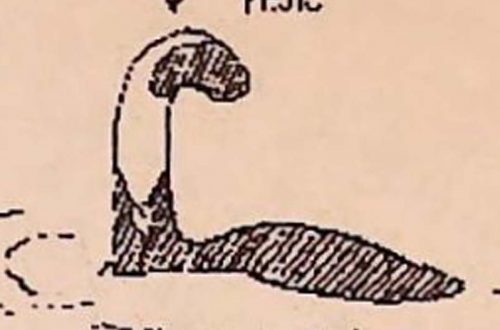
of a giant water snake with humps and fish-like fins to a swan with a snake's head, the
overturned hull of a boat, and the stump of a tree. Estimates of the creature's length range
from 15 to 150 feet. Nahuelito is said to surface only in the summer, when the wind is
still. Witnesses say that a sudden swell of water and a shooting spray precede the
surfacing of the creature.
There are many resorts in the mountains of southern Argentina. Bariloche resort hosts
100,000 tourists in summer season and as many in winter. The largest group of
Nahuelito sightings was at the beginning of March, coinciding with the tourist season.
The population of the resort areas have taken to Nahuelito in expected ways. The
possibilities for exploitation have not escaped the local's notice: Nahuelito T-shirts and
posters are common sights around the resorts.
Nahuelito has become an Argentinian media star, as the summer vacation in Patagonia
coincides with the slow news "silly season." The first films of the creature, showing little
more than lines and ripples on the water, have been shown many times on news shows.
They are said to provide little information as to Naheulito'a appearance. Patagonia, with
its mountainous and desolate regions, has been home to many tales of monstrous
animals, and the notion of a Patagonian lake monster is not a new one. Patagonian
10/22/96 7:54 AM

[PAGE BREAK]

NESSIE
2 of 4
http://www.cais.net/strangemag/nahuelito.html
Indians told of a huge creature lake-dwelling creature without head, legs or tail. The
Patagonian plesiosaur has been in the public consciousness since the early 1920s.
Peter Costello, in his book In Search of Lake Monsters (Granada Publishing Limited, St.
Albans, Herts, 1975) points out that eleven years before Nessie came to the world's
attention, the search for a Patagonian plesiosaur made international news. In 1922 Dr.
Clementi Onelli (Director of the Buenos Aires Zoo) received a report of huge tracks and
crushed bushes and undergrowth leading to an unnamed lake shore. And, according to
the account, in the middle of the lake was a monster.
The well-regarded informant, an American gold prospector named Martin Sheffield, saw
"an animal with a huge neck like a swan, and the movements made me suppose the beast
to have a body like that of a crocodile." The swan-like neck mentioned here is an
element of a number of contemporary Naheulito sightings as well. In Arthur Conan
Doyle's The Lost World, which was serialized in The Strand in 1912, one of the
characters describes a lake monster he once sighted, as a "creature like a huge swan, with
clumsy body and a high flexible neck." The inevitable circular question of whether life is
imitating art or art imitating life (or some permutation thereof) comes to the forefront in
cases such as this. Costello felt that The Lost World "inevitably colored popular ideas"
and set the stage for the 1922 Patagonian plesiosaur debut.
Onelli had been receiving sporadic reports of an unknown creature since 1897 and with
the information he now had as a result of the Sheffield sighting, he was determined to
mount an expedition to find the monster. The expedition, which was led by Jos Cihagi,
superintendent of the zoo, was unsuccessful, causing Leonard Matters in the July 1922
issue of Scientific American to conclude that the plesiosaur, "if it ever existed, appears to
have fled to parts unknown."
One interesting aspect of the ill-fated expedition was the conservationist attitude some
Argentinians had toward the monster, foreshadowing the efforts of Joseph W. Zarzynski
and Jacques Boisvert with Champ and Memphre respectively, both of which are now
protected by law. In 1922, Dr. Albarrin, President of the Society for the Protection of
Animals, petitioned the Minister of the Interior to refuse permits to the expedition on the
grounds that the creature in question came under laws forbidding the hunting of rare
animals. The expedition was carrying dynamite (to mine the lake) and elephant rifles.
While the expedition permits were not refused, there was some question as to whether
permits had been granted or not. There were crossed signals--the expedition, now far into
the Patagonian lake region, stopped until the permit question was settled and this
confusion and the press criticism surrounding it seriously damaged the image of the
expedition.
Nahuelito sightings pre-dated both The Lost World and the 1922 Patagonian plesiosaur
search. The George Garrett lake monster sighting is perhaps the best known historical
Nahuelito sighting, the earlier sightings taking place in other lakes and rivers of
Patagonia. Around 1910 Garrett was managing a company on Lake Nahuel Huapi when
the brief incident supposedly occurred.
10/22/96 7:54 AM

[PAGE BREAK]

NESSIE
3 of 4
http://www.cais.net/strangemag/nahuelito.html
Garrett provided the following description to the Toronto Globe at the height of the 1922
Patagonian plesiosaur controversy: "...we were beating windward up an inlet called 'Pass
Coytrue,' which bounded the peninsula. This inlet was about five miles in length, a mile
or so in width, and of an unfathomable depth. Just as we were near the rocky shore of the
peninsula, before tacking, I happened to look astern towards the centre of the inlet, and,
to my great surprise, I saw about a quarter of a mile to leeward, an object which
appeared to be 15 or 20 feet in diameter, and perhaps six feet above the water. "After a
few minutes, the monster disappeared. "On mentioning my experience to my neighbours,
Garrett continued, "they said the Indians often spoke of immense water animals they had
seen from time to time." The news story recounting the Garrett sighting ran in the Globe
on April 6, 1922. Thus, the story was told in retrospect, some 12 years after the event.
The plesiosaur theory is the main one being bandied about in the press and it is such a
creature whose smiling countenance gazes out from the tourist posters. While the living
dinosaur explanation is the most prevalent one, there are several other less popular
theories making their rounds in Argentina. Of interest to those who have been following
the "mystery submarine" phenomenon is the local belief that an unknown sub is
prowling the lake's depths. For those readers unfamiliar with this phenomenon and its
folkloric implications with regards to aquatic monsters, one of the essential notions
expressed by its proponents is that the mystery submarine is a modern manifestation of
the aquatic monster, a cultural variant on the water monster. (See Michel Meurger with
Claude Gagnon, Lake Monster Traditions, Fortean Tomes, London, 1989; also Fortean
Times #49).
Patagonia is no stranger to mystery subs--in February, 1960, the Argentine navy chased
an "unidentified undersea object" for 18 days, never finding the strange intruder. The
now-chic monster-mystery sub connection was not lost on the press at the time.
Newsweek opened its February 22, 1960 feature on the mystery sub entitled "The Wily
Whatzit?" thusly: "Was it a whale? Or an amphibious flying saucer? Or the Loch Ness
monster gone astray?"
An article by William R. Rudy in the New York Post of February 17, 1960 was headlined
"The Monster Rally Down Argentine Way," and describes the route that Nessie would
have taken to get to Patagonia: "From Loch Ness in Northern Scotland the route lies
down the Ness River, seven miles NNE into Moray Firth and the North Sea. Wind and
weather conditions probably would dictate a serpent's next move--over the Orkney's into
the North Atlantic, or the shorter route through treacherous Pentland Firth. Once in the
North Atlantic it is virtually a straight run some 8,000 miles SSW to the cold waters of
Golfo Nuevo on the lower Argentine coast." The article's illustration visually expresses
the theme as it depicts a caricatured "sea serpent" monster on the surface of the water in
proximity to a battleship dropping depth charges.
Also making the rounds is a third theory augmenting the growing body of strange lore
surrounding nuclear power. Some Argentinians are wondering if Nahuelito could be the
result of nuclear experimentation by German scientists during the Peron regime in the
1950s.
Those intrigued with almost any aspect of lake monster study will find something of
10/22/96 7:54 AM

[PAGE BREAK]

NESSIE
4 of 4
http://www.cais.net/strangemag/nahuelito.html
interest in the case of Nahuelito. The Lake Nahuel Huapi monster and her Patagonian
relations may have been the first possibly-real creatures linked in the public
consciousness with the plesiosaur, an image that is as popular or more popular today in
the public imagination than it was in 1922.
Whether fact, fiction, or some surreal combination of the two, one thing is
certain--Nahuelito is here to stay and we will be hearing much more about her in the
future.
STRANGEhome NESSIE home NEXT
©Mark Chorvinsky, 1995
10/22/96 7:54 AM

Leave a Reply

Your email address will not be published. Required fields are marked *