Cryptozoology - Wildmen

B3F24I4

Box 3

Folder 24. Criptozoologie (Italy)

Item 4. Internet Articles


Transcribed Text (OCR)

GARY MANGIACOPA ARCHIVE
============================================================
Title:      B3F24I4
Slug:       b3f24i4
Categories: Cryptozoology, Wildmen
Source:     https://garymangiacopraarchive.com/b3f24i4
Pages:      38 scanned, 38 extracted
OCR:        Google Vision API (document_text_detection)
Processed:  2026-06-06
============================================================

From: CURSI To: Isabella
Date: 26/03/99 Time: 2.37.36
Page 1 of 5
Ist Part:
L'ASSOCIATION BELGE D'ETUDE ET DE PROTECTION DES
ANIMAUX RARES - A.S.B.L
PRESENTATION
A. What is ABEPAR?
The "Association Belge d'Etude et de Protection des Animaux Rares"
ASBL or ABEPAR created at the beginning of 1993, is the first
European French-speaking Association entirely devoted to
cryptozoology.
The target of ABEPAR was to be an association specialised in this
field, with the initial aim of setting up expeditions and finding the
necessary funds.
However, we had to be make ourselves known both in the
cryptozoological field and to the general public.
Thus, in April-May 1994, through the impetus of Doctor B.
Heuvelmanns, the father of this discipline, the monthly review
"Cryptozoologie, le premier mensuel en français sur le sujet" was
published, addressed not only to the scientists but also to the general
public...
B. ACHIEVEMENTS SINCE ITS CREATION
First of all, we tried to obtain support from the scientists interested in
this kind of study. We soon found out that we had filled a vacuum and
were thus able to enjoy their collaboration, especially that of Dr.
Bernard Heuvelmanns, a Belgian zoologist who for over half a

[PAGE BREAK]

To: Isabella
Date: 26/03/99 Time: 2.37.36
Page 2 of 5
century has been fighting for acquainting the official scientific
institutions with this special branch of zoology. Today he is
considered the leading light of this discipline. He was the one to coin
the expression "cryptozoology" (etymologically: the study of hidden
animals). Thanks to him, throughout the world, many scientists have
officially or privately been studying these issues.
The Press was then made aware of our existence, especially following
our project of setting up a first expedition to the Central African
Republic. In Belgium, La Dernière Heure dedicated the whole of page
3 to us in its edition dated 15/6/93. Le Vif - L'Express three full pages
(15/7/93), not to mention Le Soir of January 15-16th 1994. Others
offered us a column or a short article, such as Van, on 08/09/93 or
Science & Nature in October 93, and recently again Le Soir
(27/07/95).
About 20 press articles concerning the association and its activities
have been written until now (see enclosure for examples). These were
completed by several radio interviews and an announcement on
colloque '98, during the weekly Belgian television magazine "Le
jardin extraordinaire" dated 07/2/98.
C. ACHIEVEMENTS OF ABEPAR SINCE ITS CREATION
Cryptozoology
In April 1994, we created the first French-speaking monthly magazine
on cryptozoology. Since its creation, it has continuously been
evolving towards greater professionality in its presentation, with the

[PAGE BREAK]

To: Isabella
Date: 26/03/99 Time: 2.37.38
Page 3 of 5
purpose of being diffused in bookshops in Belgium, first, then in
France, before covering Switzerland and Quebec.
Still for promotion purposes, the Association concentrated on
developing further fields of activity.
School Activities
Since 1994, several conferences were held in the schools of Belgium.
These conferences were very successful with the children.
Public Conferences
Despite our having already held a series of conferences in 1993.
namely at the Free University of Brussels, 1995 was to be the year in
which such activity was fully developed within our association.
A cryptozoological circle open to all and meeting on a monthly basis
was born from this initiative.
Scientific Expeditions
Coming back to the objective underlying the creation of the
association, a first expedition was organised in December 1993-
January 1994. Its purpose was to bring home first hand testimonies on
a mysterious amphibious feline which the people in the Republic of
Central Africa refer to as the "Water Panther". The undertaking was a
success, even going beyond its target in a certain sense: the discovery
of a skin at the home of a local made it possible to extend the
distribution area of another feline which even the locals hardly knew,
the African golden cat Felis.

[PAGE BREAK]

SI To: Isabella
Date: 26/03/99 Time: 2.37.36
Page 4 of 5
In August 1998, we were invited to take part in a scientific expedition
in Norway on and around lake Seljordsvatnet, in the Province of
Telemark. The objective was the search supported by important
technological means for an animal similar to the Loch Ness monster.
A 20-minute film representing a large animated aquatic object incited
us to organise another expedition this summer.
Theme Journeys
In association with tourist bodies and agencies, ABEPAR has setup a
project of theme journeys aimed at bringing small groups of people
interested in cryptozoology on the field.
During these journeys, we propose observation excursions, evidence
collecting, conferences on the issue, meetings with specialists.
During the summer of 1999, we will for the fourth consecutive time
propose an expedition to the Loch Ness.
Participation in Cultural Events
In 1994, A.B.E.P.A.R. took part in several cultural events in Belgium.
We also participated in the Belgium preview of the film Loch Ness, on
July 7th 1996.
Creation of Two Cryptozoology Symposiums
The first European symposium on cryptozoology was organised in
Brussels in February 1997. The title was: Dragons, Monsters &
Demons: Zoological Legends and Realities.

[PAGE BREAK]

To: Isabella
Date. 26/03/99 Time: 2.37.36
Page 5 of 5
The second European symposium took place in February 1998 on the
theme: Mermaids, Water Snakes and Sea Monsters.
Today, the third European symposium you are attending has been
organised in Rome thanks to our friends and colleagues from the
Italian Natural Parks.
Creation of an Internet Site
Thanks to the sponsoring of the conceiver of Internet sites Zigzag, the
association has had its own site since a few months.
D. CONCLUSION
Today, through our actions, our association is well established in the
cryptozoological circles and promotion with the public is also being
pursued actively. thanks namely our symposiums of which the present
one is the outcome.

[PAGE BREAK]

From: CURSI To: Isabella
Date: 26/03/99 Time 2.45.16
Page 1 of 14
IS THE YETI THE BROWN BEAR?
Presentation of the book by Reinhold Messner
"Yeti - Legende und Wirklichkeit"
and debate
By François de SARRE, sociologist
The recent publication of the book written by the Italian
mountaineer Reinhold Messner - "Yeti - Legende und Wirklichkeit"
["The Yeti Legend and Reality"] published by S. Fischer in
Frankfurt, gave rise to many reactions, especially in the German-
speaking countries where its appearance had been cleverly organised.
The books is attractive; the middle contains splendid
panoramas of Tibet and the neighbouring countries, portraits, scenes
of daily-life in the Himalayas.
Yet no Yeti is to be found, at least not the one you would
expect: the Yeti presented by Messner is nothing but the brown bear.
Ursus Arctos!
The sensational photos "promised" for years are those of a
modest-size brown bear encountered in the Kashmir region. The book
also contains quite a suggestive picture taken in a Tibetan monastery
of a stuffed bear.
However, let us go back to the facts from the very beginning.
In 1986, teleprinters throughout the world spread information about a
meeting between Reinhold Messner and the Yeti, somewhere in
eastern Tibet:
"It was much bigger than me, strong and hairy, with long
brownish-black hairs which covered its eyes. It was standing on two

[PAGE BREAK]

m: CURSI To: Isabella
Date: 26/03/99 Time: 2.45.16
Page 2 of 14
legs and as soon as I set my eyes on it, I realised it fitted all the
descriptions made by the Sherpas and Tibetans."
The Italian mountaineer, Reinhold Messner, was the first to
climb the world's 14 over 8000 m peaks. In 1978, he climbed the
Everest without oxygen supply. Owing to his perfect knowledge of the
Himalayas, Messner decided to pursue his search for the identity of
the Yeti. From 1986 to 1998, after about 30 expeditions and 20'000 km
in the Himalayas and the Karakorum, the South Tyrolean thought he
had definitively solved the Yeti enigma. That is at least what he says in
his book. "I was successful because I have been to the Himalayas
more often than the others", says Messner, in substance.
For Messner, the situation is clear: a wild animal in the Tibetan
mountains, namely a large-size bear, turns into a "monster" and
fabulous creature back down in the valleys. All the way to Nepal
where the Sherpas conveyed the myth.
When Shipton's famous footprint went round the world in
1951, the Western press wasted no time in picking up the story, thus
strengthening the myth of the Yeti. Did a giant primate, a survivor of
prehistory, perhaps an intermediate link between the
in the Himalayas?
ape and
man, live
The "Yeti hunt" began, and more intensively so after Edmund
Hillary and Tensing Norgay's conquest of the Everest in 1953 which
had further increased the interest of the public for the Himalayan
range and its mysterious inhabitant. Expeditions were undertaken by
the Daily Mail (1954) and Tom Slick (1957, 1958, 1959), followed by
the World Book (1960).

[PAGE BREAK]

om: CURSI To: Isabella
Date: 26/03/99 Time: 2.45.16
Page 3 of 14
For most experts, among whom Bernard Heuvelmanns, the
most plausible candidate to the zoological identity of the Yeti was an
anthropomorphic ape, still unknown to science, which lived in the
mountain forests of Nepal.
The size of a teenager, it is reddish-brown, with a conical, egg-
shaped head. A larger dark or black creature - 2.50m - supposedly
lived on the northern slopes of the Himalayas. Some put forward that
the "small" yetis were young individuals belonging to the same
species as the "big" ones, a hypothesis which seemed to have been
corroborated when Messner, in 1997, announced that he had taken a
photo of a black female yeti and her offspring with reddish-brown fur.
[The document, supposing it exists, has not yet been published].
Currently, cryptozoologists agree in considering two distinct forms:
one (Gigantopithecus?) can be seen from Tibet to Malaysia; the other
(Sivapithecus?) is essentially Nepalese.
However, let's come back to Messner's book, and to his first
encounter with the Yeti, in July 1986. Some details help in identifying
his position: Eastern Tibet, in the mountain valley of Mekong.
However, Messner himself stresses that the names of the places he
mentions are false "to prevent people from hunting down the animal".
In any case, he supposedly saw "something big, dark, walking
upright, emerging from the rhododendrons about thirty steps away
from where he was standing...
The story has already changed somewhat since 1986, when
Messner said: "I saw it at a distance of ten meters. It was a mixture
between a man and an ape. It immediately moved away".

[PAGE BREAK]

om: CURSI To: Isabella
Date: 26/03/99 Time: 2.45.16
Page 4 of 14
In the 1998 book, the creature caught sight of at dusk was
soon to turn into a bear... Here are some passages:
"I held my breath while I watched the dark and silent mass run
through the bushes. What could that be trotting along alone in the
woods enjoying the dusk? When the being returned to the clearing, I
saw a figure of impressive size, planted firmly on its feet. It remained
silent for a time before turning round and merging into the dark.
What was it? I remained motionless, looking around, listening
carefully, aware of the different scents rising from the earth. While I
cautiously approached the place from where the creature had
appeared, I noticed a hollow in the damp ground. A footprint was
outlined in the black mud. The footprint of a giant human foot! I took
a photo. My feet did not sink into the mud as deeply. I inferred that the
creature was much heavier than me.
While I observed the footprint, I remembered the famous one
photographed in the snow by Eric Shipton in 1951. It was considered
the strongest evidence as to the existence of the yeti.
Was it an animal of that kind? For me, the Yeti had until then
only been an age-old legend, and nothing more! It belonged to the
Himalayan commonplaces, together with the frozen peaks, the snow
blizzards and the freezing winter nights. The Sherpas had often told
me about the yeti, the women it abducted, the yaks it eviscerated and
of course the gigantic footprints it left in the snow.
That very evening, I saw the footprints another four times. The
animal had climbed the slope and must have been slightly further up. I
then heard a whistle similar to that of a chamois giving alarm. On my

[PAGE BREAK]

rom: CURSI To: Isabella
Date: 26/03/99 Time 2.45.16
Page 5 of 14
right, I saw a two-legged creature running, disappearing and
reappearing from behind the trees. For a moment, it stood motionless
in the moonlight, its head turned in my direction. It whistled. In a
flicker, I caught sight of the beast's face: the eyes and teeth, though
not the shape or colour, stood out against the black silhouette. The
creature was facing threateningly. It was hairy and stood on two short
legs; its strong arms almost hang down to its knees. I considered it
was over two meters tall. Its body seemed much more sturdily built
than that of a man of the same size: 1 was as astonished as I was
afraid at seeing the beast move through the bushes which such ease".
Messner reported that the animal ran on its four legs towards
the top of the slope. The Italian mountaineer told some Nomads he
was staying with about his misadventure: "Chemo!" they answered...
Normally, they live further down in the woods, while at the height of
summer, they follow the yak herds - their prey - and cross the snowy
hills to move from one valley to the next.
When Messner inquired whether a chemo was a bear, they
answered: "No, he is not a bear. He is both a bear and a man. He
carries his children on its back. He eats what we eat. He lives where
we live. He blinks like a human being when he is blinded by the sun.
Though he looks like a bear or a very big ape".
This is the very passage of the book where Reinhold Messner
peremptorily affirms: "For me, the mystery of the Yeti had at last been
solved!".
The Tibetan legends on the yeti were born in those and other
valleys, while the myth had taken root further down, in the villages,

[PAGE BREAK]

rom: CURSI To: Isabella
Date: 26/03/99 Time: 2.45.16
Page 6 of 14
where the most grotesque tales were told. The chemo bear, which gave
rise to the whole story, was completely forgotten...
Disproportionate footprints, feeding habits, dens, everything
confirms that it is indeed the brown bear (Ursus arctos) which reigns
at night over the frozen expanses where man believes he is the master
during the day.
From now on. the whole book revolves around the theme of
the bear-yeti. Reinhold Messner does indeed touch on the hypothesis
of a late Gigantopithecus (without even once mentioning the name of
Bernard Heuvelmanns!) and on several elements from the dossier on
the wild men of Eurasia whose zoological status he does not mention.
The mountaineer from South-Tyrol wonders whether a large
ape can live and feed - at such an altitude. He admits that the tracks
discovered in the snow could belong to animals moving occasionally
from one forested valley to another.
The yeti is of course incorrectly considered a mountain animal.
Its habitat is in the mountain forests, namely in Nepal, between 2'800
and 4'500 meters: those areas are covered by very dense vegetation
and, moreover, practically impenetrable to man due to the uneven
ground and deep ravines. It is plausible to imagine that a large
anthropoid could still live in a natural environment so hostile to
observation, without ever having been photographed or r filmed.
Set in his belief of a "bear-yeti", Reinhold Messner repeats
throughout the book that the chemo (or chemong) is a big brown bear,
well known to the inhabitants of the Himalayas. Its embellished
legend reached Nepal; the Westerners, attracted by the sensational

[PAGE BREAK]

From: CURSI To: Isabella
Date: 26/03/99 Time: 2.45.16
Page 7 of 14
side of the story - the discovery of the intermediate link between the
ape and man and/or possible survival of the fossil form of large ape
contributed towards sustaining the myth. Bhutan issued a stamp
bearing effigy of the yeti, while the latter has become an object of
marketing in Kathmandu: yetis can be seen on T-shirts and other
articles for sale. The Nepalese government, spurred by the Sherpas -
who looked forward to awakening the curiosity of western trekkers
was soon to discover the virtues of the yeti in terms of tourist
attraction...
Therefore, according to Messner, the yeti is a kind of a cross
between a real animal (Ursus arctos) and a fantasy, a pure product of
human imagination: the monster, abductor of women, demon of the
night, whose attitude is not ruled by any moral "code of conduct",
free to do even the most shameful things.
This explains a certain anthropomorphic trend, a neologism
which means that the creature gradually takes on an anthropomorphic
appearance, namely, in this case, that of a big ape, due to the almost
human feelings it is given..
This would explain the cultural objects, such as masks, scalps
or remains attributed to the ape-yeti, used in Tibetan or Sherpa
religious ceremonies.
In Bhutan, Messner even found and photographed - what
appeared to be the remains of a young anthropoid presented by the
monks as a "red" yeti. He thought it was a setup and was much more
interested, in Mai 1997, by a stuffed bear he discovered hanging under
the porch of a Tibetan monastery in Kham. The animal, placed in an

[PAGE BREAK]

rom: CURSI To: Isabella
Date: 26/03/99 Time: 2.45.16
Page 8 of 14
intimidating position, is nowhere near a giant of its species, yet for
Messner it is a convincing proof that the brown bear, called chemo, is
the yeti.
After having lost a film which contained many of the footprints
in the snow, and a lot of misfortune in the photo-hunt of the chemo in
eastern Tibet, Reinhold Messner was more successful in Kashmir, in
August of the same year.
Locally known as "chemo", the bear-yeti came to the
appointment with the camera. These are the photos which are
presented in the book, thus putting an end to around 12 years of
investigations and research work on the field.
Is the yeti the brown bear? In fact, the hypothesis is not new.
As to the issue of the footprints attributed to the "man of the snow", of
course one could think they belong to bears which often stand on their
back legs but do not cover long distances in the erect position. Like
the British zoologist John Napier, Messner suggests that the snow
bear, in this case the Ursus arctos isabellinus, usually places its back
legs right into the footprints of its front legs. The footprints of the
back paws of a bear do in any case look quite similar to those of a
man; however, as recalled by Bernard Heuvelmanns, the fifth toe is
the biggest. The claws do no necessarily leave traces. Shipton's
famous footprint - perhaps somewhat "improved" by the author's ice
axe could belong to a bear. The trail crossed in 1955 by Father
Bordet, a geologist accompanying the French expedition to Makalu,
was followed for over one kilometre and appeared to better fit the
profile of a biped anthropoid. The footprint was about 20cm long,

[PAGE BREAK]

From: CURSI To: Isabella
Date: 26/03/99 Time: 2.45.16
Page 9 of 14
with steps at a distance of about 50cm from each other. The footprints
bore a certain similarity with a human foot, 4 toes were visible, the
first turned inwards was the biggest; the footprints were perfectly in
line, jutting out to the left or the right at each stride, which would
imply that the trail had indeed been left by a creature walking on its
back legs only.
To support the hypothesis of the bear-yeti, Reinhold Messner
tells us about the story of a German ethnologist, Ernst Schäffer, who
towards the end of the 30s travelled throughout Tibet under the
commission of Adolf Hitler. The nazis in fact believed that the Nordic
race had a special origin and searched the Himalayas for their pan-
germanic ancestor who was resistant and insensitive to cold
temperatures. Of course Ernst Schäffer had been interested in the Yeti,
nevertheless he reached the conclusion that it was the Tibetan bear:
"When the latter stands on its back legs, it looks like a human being; it
can be distinguished from the other bears by thicker fur, longer hairs
and a larger skull in proportion with the body".
Apparently Eric Shipton contacted Ernst Schäffer, asking him
not to publish his work in English for fear of losing the credits
allocated for future expeditions in the Himalayas...
All this is told in Messner's book. Of course, the bear might
have inspired some of the Himalayan legends, yet it seems unlikely to
have been at the foundation for all the evidence on the yeti. A recent
example (September 1998) was given by the American mountaineer,
Craig Calonica, who saw two black-furred creatures walking upright

[PAGE BREAK]

rom: CURSI To: Isabella
Date: 26/03/99 Time: 2.45.16
Page 10 of 14
with a stoop, at an altitude of about 6000m, on the Chinese side of the
Everest: "Their arms were very long and their hands very big"
We are nowhere near knowing everything about the bears of
central Asia whose systematisation appears to be quite confused.
Perhaps some are real giants, like the brown bears on the Kodiak
island, in Alaska.
The "chemo" described by Messner at the beginning of his
book, the one he first met in 1986, is in any case rather uncommon for
a bear:
whistles, runs upright with ease, is not really huge (2m). Its
apparently exclusively nocturnal habits puzzle zoologists; the South-
Tyrolean mountaineer fails to immediately identify the moonlit
silhouette as a bear which is a priori easy to recognise - round years
on the top of the head, a face characterised by a long muzzle.
Nevertheless, in the following pages, Messner makes the
reader consider the mysterious creature as a being bear and nothing
else. He notices that the Tibetan Nomads he talks to tend to humanise
it he carries his "children" on his back ascribing it human
behavioural features. No one is astonished that it kills yaks by
throwing large stones at them. Or that it abducts young women to
bring them to its den.
The chemo yeti equation seems to prevail, though it is hasty:
it would be more correct to say that it is just one of the many sides of
the yeti phenomenon.
The brown bear is part of the mystification process
the
"chemo" of the Tibetan mountaineers - sustaining the myth around the
yeti by its different manifestations. Thus, in Nepal, the relatively large

[PAGE BREAK]

From: CURSI To: Isabella
Date: 26/03/99 Time: 2.45.16
Page 13 of 14
Thus, according to these sources, the Ladakh skeleton had apparently
been purchased in June 1997; a week later, Messner photographed a
mother yeti and her child, and then filmed a sleeping yeti. In his book,
at around the same date, the South-Tyrolean relates the episode of the
stuffed bear at the Kham monastery, in Eastern Tibet. It wasn't before
August that he travelled to Kashmir where he only photographed
brown bears against the background of a Himalayan mountain valley.
The very ones which have a central place in its book.
That is where the adventure ended. The tracking of the yeti
ends on a rather bucolic note. After reading the book, the exploration
and sociocultural aspect will be retained. The Italian mountaineer, a
great connoisseur of the Himalayas, has carefully established
friendship ties with the Sherpas and Tibetans whose customs he
illustrates in his book. Often alone, he has travelled throughout the
huge areas where the legend situates the fabulous yeti. Undeniably,
Reinhold Messner's field book represents an essential piece of work to
be included in the large dossier on the Great Stranger of the
Himalayan range.
Is this the beginning of a sort of "yetimania"? The primate
specialist, Volker Sommer, in his book "Die Grossen Menschenaffen"
(BLV, Munich, 1998), writes about the thesis of the orang-utan
surviving in the mountain valleys of Nepal. Langen Müller Herbig has
announced the coming publication of a book by the mountaineer
Bruno Baumann, one of Messner's "rivals" both in the mountains and
in conference halls because Baumann favours the theory of the big
nocturnal primate unknown to science.

[PAGE BREAK]

From: CURSI To: Isabella
Date: 25/03/99 Time: 2.45.16
Page 14 of 14
In any case, Reinhold Messner relentlessly repeats: "In 10 or
20 years, everyone will agree with me in saying that the yeti is the
brown bear". In the meantime, he has entrusted all his data and
archives to the American primatologist, George Schaller for study
purposes.
At the beginning of his book, Reinhold Messner meets the yeti
at the end, it is no longer the yeti.
The mystery still hovers over the Himalayan immensities while
scientific truth is long to come.
The Italian mountaineer has had the great merit of putting in a
token appearance on the field, and of acquainting us with the yeti story
from an unusual viewpoint... We regret the absence of a bibliographic
index. All useful information appears to have been gleaned from the
Internet.
"Yeti - Legende und Wirklichkeit"
whose publication in
is in any case an
English has been announced by Macmillan
excellent book containing very beautiful illustrations and I can only
recommend it to all keen cryptozoologists.

[PAGE BREAK]

CENTRO PARCHI
00
B
PARKS CENTRE
OVIALE TITO LIVIO, 12-00136 ROMA (Italy) (06) 35403331 (06) 35403253 TELEX 624550 NAT PAR 1
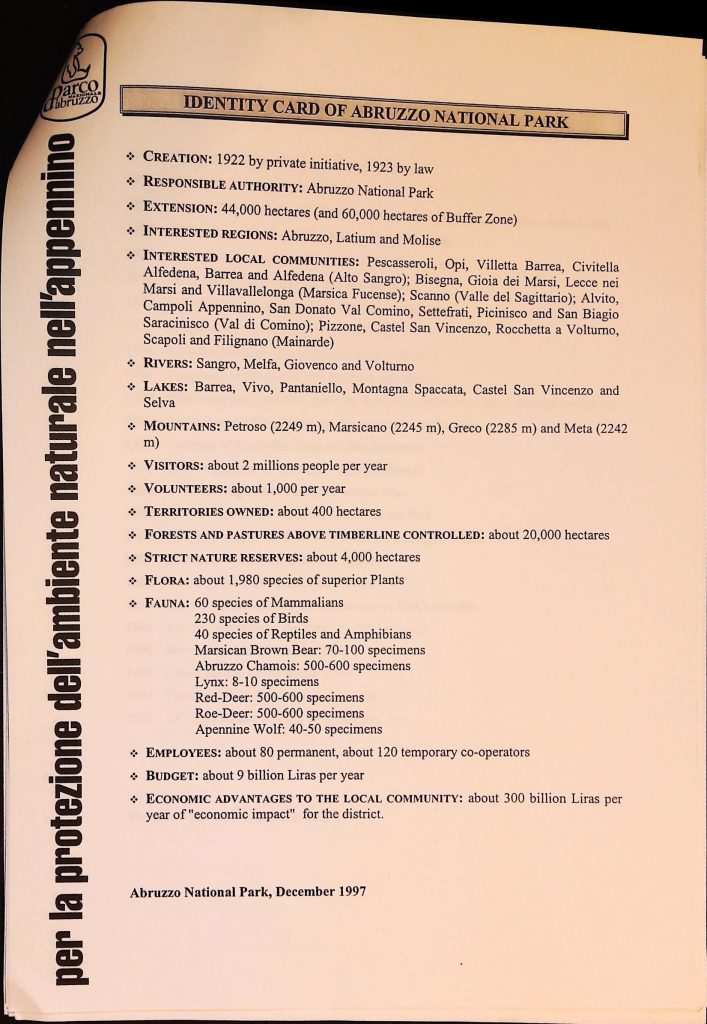
ABRUZZO NATIONAL PARK
THE CONSERVATION EFFECT OF AN ECO-DEVELOPMENT SUCCESS-CASE
1. PRESENTATION
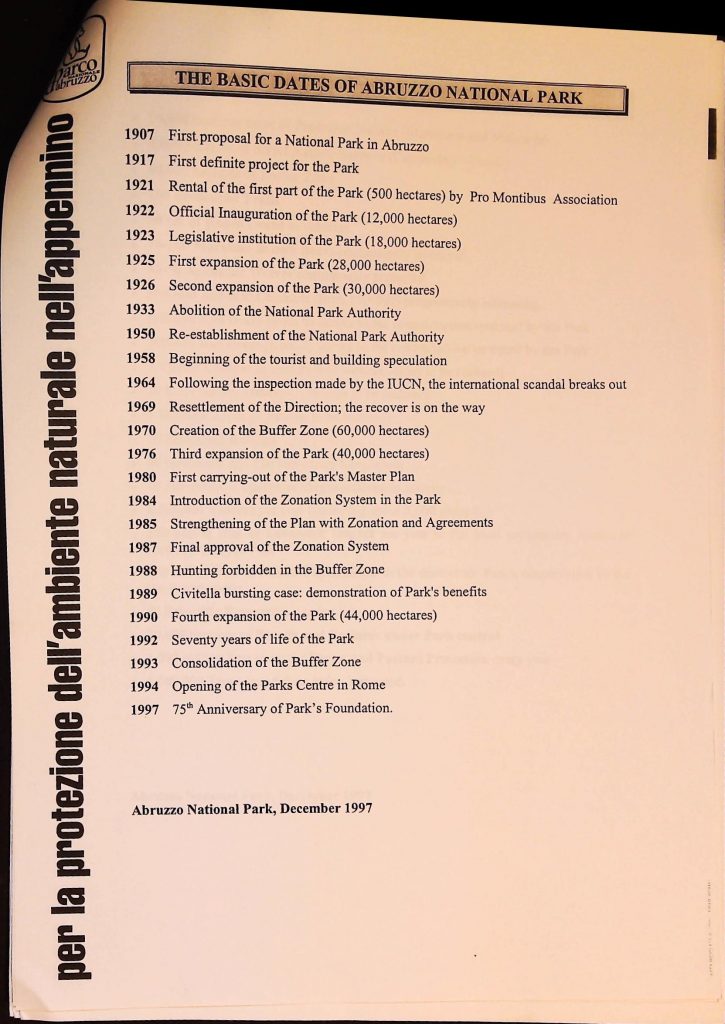
The Abruzzo National Park, created in 1922 and therefore the oldest in Italy, is
internationally considered as pilot-organisation in nature conservation: an example that most
of the modern Parks, not only in our Country, are trying to imitate. During the last quarter of
the Century the history of our Park has been marked by continuous and innovating efforts
devoted to meet the urgent needs of nature protection adn those of development. The Abruzzo
National Park was the first one to show - not only theoretically but in practice - that the
protection of the environment has positive effects and economic advantages such as income
and employment. Moreover, it has promoted controlled cultural visits in the Park, has
"invented" a special agreement system with local Communities in order to overcome the
controversies in the urbanistic field, has created the Zonation System in the territory in order
to reconciliate protection and development: in other words, has managed with success a
policy of "eco-development", based mainly on the modern "eco-tourism".
The real projects carried out for the first time in a large and modern Italian National Park
range from the first Visitor Centre among Italian National Parks, created in 1969 in
Pescasseroli, to the first scientific group working in a European Park, the Apennine Centre
for Ecological Research, created in 1972; from the first Wildlife Area for the Apennine
Wolf at Civitella Alfedena, created in 1971, to the first Strict Nature Reserve, the
Camosciara, created in 1972.
The Abruzzo National Park has achieved impressive results for the protection of the most
endangered species, creating the Italy Wolf Group for the protection of the Apennine Wolf
in 1974, the Italy Chamois Group for the safeguard of the Abruzzo Chamois in 1978, the
Italy Bear Group for the protection of the Abruzzo Brown Bear in 1983, whilst in 1993 the
Italy Lynx Group has been created to substain the "return" of this wonderful feline in our
Country. Furthermore, from 1977, the Park hosts the Italian Committee for National Parks
and Equivalent Reserves, engaged in the creation and support of a vast "system" of protected
areas, including both land and sea, in Italy. Then the Park has launched in 1993 the
Biodiversity Project for the acknowledgement and the richness tutelage and variety of flora
and fauna around us. Finally, the Park created in 1994 the Park Centre in Rome, in order to
PARCHI
COMITATO
NAZIONALI
ITALIA
ERISERVE
ANALOGHE
Creato nel 1994 come Operazione speciale di sinergia ambientale tra due delle più autorevoli e antiche istituzioni
Italiane di Conservazione - il Parco Nazionale d'Abruzzo, un'Organizzazione Pubblica sorta nel 1922, e il Comitato
Parchi Nazionali e Riserve Analoghe, un'Organizzazione non Governativa nata nel 1977 - il Centro Parchi
costituisce oggi il principale punto di riferimento sull'autentica realtà della Conservazione della Natura in Italia.
Created in 1994 as a joint-venture by two of the most authoritative and ancient Italian Conservation Institutions
- the Abruzzo National Park, a Public Agency established in 1922, and the Italian Committee of National Parks
and Nature Reserves, a Non-Governmental Organization born in 1977- the Parks Centre is the main reference
point about the true situation of Nature Conservation in Italy.
Darco
NAZIONALE

[PAGE BREAK]

CENTRO PARCHI
PARKS CENTRE
VIALE TITO LIVIO, 12-00136 ROMA (Italy) (06) 35403331 (06) 35403253 OTELEX 624550 NAT PARI
promote a better knowledge and awareness in the field of Nature Conservation through
Protected Areas.
Those who wish to acquire a deeper information about of the Park have just to contact one
of its Visitor Centres including a Wildlife Area, such as: Civitella Alfedena for the Apennine
Wolf and the Lynx, Opi and Bisegna for the Abruzzo Chamois and Villavallelonga for the
Red Deer, without forgetting the renewed Pescasseroli Visitor Centre, adjacent to the well-
known Wildlife Park and to the new Apennine Garden. Visitors can also address themselves
to the various local Information offices of the Park, open all year round and placed in the
main villages. A rich series of publications provides full information and orientation.
2. THE ECO-DEVELOPMENT OF ABRUZZO NATIONAL PARK
We would like to examine more closely the history of Abruzzo National Park, in Italy,
which was considered lost 25 years ago, but is now recovering, thanks to an agressive and
innovative policy which consists, first of all, in reversing almost all previous statements,
methods and styles. Among them, the old and primitive dilemma assuming that in such
marginal areas there is no place enough for man and wildlife - as the villagers in Abruzzo
used to say: "before thinking to the bear, care of men!" - an idea now perhaps on the verge of
extinction, since the success of the Park, not only in preserving wildlife and scenary, but also
in granting economical benefits to the local population, clearly demonstrates that local wealth
cannot be associated with bear destruction, but badly needs its preservation! In the case of
Abruzzo, we may very well say that contraints acted as a stimulus to explore new, more
imaginative and vigorous policies!
The central question has been how to protect bears and wolves, while at the same time
enabling people to experience a new model of sustainable development, based on a
reasonable exploitation of local resources, in order to secure long-term conservation of the
basic heritage.
The main aims of the National Park - Conservation, Education, Scientific Research - are of
course to be emphasized, but also new relevant effects of a new situation and policy have to
be considered: Eco-development, and especially Eco-tourism, a fast-growing industry
producing at the same time significat benefits and potential risks for environment. We prefer
nevertheless to speak of "cultural visit", a very soft kind of tourism, wich occurs as well in
historical, archeological and artistic sites as in natural areas.
NAZIONALI
COMITATO PARCHI
ITALIA
ERISERVE
ANALOGHE
Creato nel 1994 come Operazione speciale di sinergia ambientale tra due delle più autorevoli e antiche istituzioni
Italiane di Conservazione - il Parco Nazionale d'Abruzzo, un'Organizzazione Pubblica sorta nel 1922, e il Comitato
Parchi Nazionali e Riserve Analoghe, un'Organizzazione non Governativa nata nel 1977 - il Centro Parchi
costituisce oggi il principale punto di riferimento sull'autentica realtà della Conservazione della Natura in Italia.
Created in 1994 as a joint-venture by two of the most authoritative and ancient Italian Conservation Institutions
-the Abruzzo National Park, a Public Agency established in 1922, and the Italian Committee of National Parks
and Nature Reserves, a Non-Governmental Organization born in 1977- the Parks Centre is the main reference
point about the true situation of Nature Conservation in Italy.
Darco
NAZIONALE

[PAGE BREAK]

CENTRO PARCHI
BWB
PARKS CENTRE
□ VIALE TITO LIVIO, 12-00136 ROMA (Italy) (06) 35403331 (06) 35403253 TELEX 624550 NAT PAR 1
This may be possible through a very complex and sophisticated policy: clear legislation,
vigorous Park Authority and modern planning, based essentially on zonation criteria: Zone
A= Strict Nature Reserve (don't leave anything but images and pictures), Zone B= General
Nature Reserve (conciliation with traditional activities and populations), Zone C= Soft
Protection (sustainable ecological production), Zone D= Development (we insist,
Development: instead of simply controlling what happens, this means to orientate the process
in a sustainable way, taking the leadership of the future of such strategic areas): for instance
encouraging restauration of ancient villages instead than allowing the realisation of new
expensive villas and condominiums and so on. By this policy, profits do not flow to the
plains, but stay now in the hands of local inhabitants.
In this context, special management criteria and structures example given,
Visitor/Information Centres, Wildlife Areas and others - proved to be invaluable tools to
minimize the visitors' impact as well as to maximize their environmental perception. For
instance, with a small investment one old stable became a Wolf Museum, covering not only
biology but also tales, history and traditions; and an adjacent field turned into an Apennine
Wolf Wildlife Area - we could say a "Wolf Embassy" - with a pack of captive wolves bred in
seminatural conditions, playing an essential role in destroying the legend of the "bad wolf".
3. PARK'S BENEFITS FOR LOCAL PEOPLE
The classic example of this new policy is Civitella Alfedena, a small village with 300
inhabitants in the heart of the Park, which was virtually on the way to be abandonned 25 years
ago, and has found now, with a growing economy and with the return of emigration, a new
strength and hope for the future, becoming a centre of activities and services for the Park.
And in december 1989 it shocked Italy coming at the first place, in the classific of deposits.
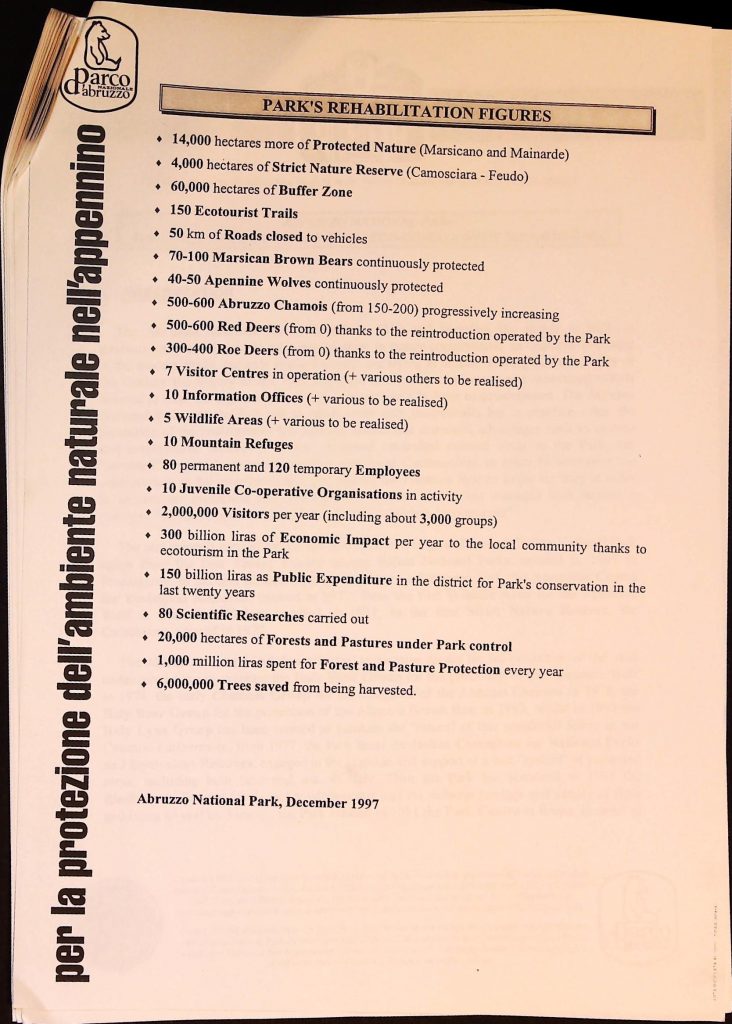
Some simple figures may show the situation: 5 billion liras of Park budget actually develop a
local economic impact of about 300 billion liras, created in the Park itself 200 jobs (80
permanent and 120 temporary) and about 1.000 more jobs in indirectly related activities.
Small enterprises flourished in number: at least 1.600, mostly familiar. No big business for
one, but spreading benefits for many.
PARCHI
OMITATO
So, trends changed and new interests grew for the whole area of Abruzzo: involving in
conservation activities young volunteers, especially as guides to control "limited number
access", respecting ancient religious tradictions, developing typical forms of skills and
handcrafts, and marketing selected local products with a special quality mark, managed by the
Park Authority.
NAZIONALI
ITALIA
RISERVE
ANALOG
LOGHE
Creato nel 1994 come Operazione speciale di sinergia ambientale tra due delle più autorevoli e antiche istituzioni
Italiane di Conservazione - il Parco Nazionale d'Abruzzo, un'Organizzazione Pubblica sorta nel 1922, e il Comitato
Parchi Nazionali e Riserve Analoghe, un'Organizzazione non Governativa nata nel 1977 - il Centro Parchi
costituisce oggi il principale punto di riferimento sull'autentica realtà della Conservazione della Natura in Italia.
Created in 1994 as a joint-venture by two of the most authoritative and ancient Italian Conservation Institutions
-the Abruzzo National Park, a Public Agency established in 1922, and the Italian Committee of National Parks
and Nature Reserves, a Non-Governmental Organization born in 1977 - the Parks Centre is the main reference
point about the true situation of Nature Conservation in Italy.
Parco
NAZIONALE
abruzzo

[PAGE BREAK]

CENTRO PARCHI
PARKS CENTRE
VIALE TITO LIVIO, 12-00136 ROMA (Italy) (06) 35403331 (06) 35403253 TELEX 624550 NAT PARI
The evidence of the Park role in the ransom of this area was so clear, that a local Bank
asked - and obtained on the basis of special agreements - to use the emblem of the Park with
the well known bear logo even on its cheques: thus associating the idea of conservation not
with failure and stagnation, but with wealth and success.
4. GOALS ACHIEVED ALSO IN WILDLIFE MANAGEMENT
In about a quarter of a century, the Apennine heritage of fauna - and especially of the most
typical big fauna of the Central Apennines - has passed from minimal levels to a much more
positive and promising situation, with unexpected developments - both in terms of quality and
quantity - which aroused the increasing interest of external and abroad observers.
This is largely due, in all probability, to the original conservation strategy operated by the
Abruzzo National Park, along innovative and anti-conventional criteria, starting from the
moment of its re-organisation (1969), with the constant and whole-hearted support of the
main environmental associations, particularly the World Wide Fund, Italy.
The essential trait of this strategy lies in its interdisciplinary and intersectorial approach
which, although based on knowledge of the environmental, ecological and biological material
world, is not limited only to that but goes far beyond it, embracing every aspect of the
connected spiritual, cultural and social reality. In other words, it takes account of a basic eco-
sociological perspective, which aims to discover the deepest roots of social behaviour
(positive, indifferent and negative attitudes) concerning modern environmental problems, and
thus orientates the conservation action according to a principle which is not only right and
correct, but also suitable for concretely achieving the goals laid down.
The "revolutionary" character of such a strategy may be efficiently illustrated by
considering the initiatives concerning protected animals, for example, especially the big
species of mammals typical of Apennine fauna: in particular not only the Marsican Brown
Bear (Ursus arctos marsicanus) and the Abruzzo Chamois (Rupicapra ornata), the two
species for the saving of which the Abruzzo National Park was created in 1922, but also the
Apennine Wolf (Canis lupus italicus) and the European Lynx (Lynx lynx), in addition to less
rare but rather significant species, such as the Red Deer (Cervus elaphus hippelaphus) and the
Roe Deer (Capreolus capreolus).
To review the evolution of this special fauna in the Abruzzo National Park and in the
Central Apennines can be instructive and surprising at the same time, especially from the year
NAZIONALI
ITALIA
E
ER
RISERVE
ANALOGHE
Creato nel 1994 come Operazione speciale di sinergia ambientale tra due delle più autorevoli e antiche istituzioni
Italiane di Conservazione - il Parco Nazionale d'Abruzzo, un'Organizzazione Pubblica sorta nel 1922, e il Comitato
Parchi Nazionali e Riserve Analoghe, un'Organizzazione non Governativa nata nel 1977 - il Centro Parchi
costituisce oggi il principale punto di riferimento sull'autentica realtà della Conservazione della Natura in Italia.
Created in 1994 as a joint-venture by two of the most authoritative and ancient Italian Conservation Institutions
- the Abruzzo National Park, a Public Agency established in 1922, and the Italian Committee of National Parks
and Nature Reserves, a Non-Governmental Organization born in 1977 - the Parks Centre is the main reference
point about the true situation of Nature Conservation in Italy.
Darco
Cabruzzo
NAZIONALE
COMITATO
PARCHI

[PAGE BREAK]

PARCHI
COMITATO
CENTRO PARCHI
G
O
00
PARKS CENTRE
VIALE TITO LIVIO, 12-00136 ROMA (Italy) (06) 35403331 (06) 35403253 TELEX 624550 NAT PARI
1969 onwards, the year in which the difficult task of reorganising the Park was undertaken
and brought to completion over the course of over 25 years of intense work and stimulating
campaigns.
At that time there were an estimated 60-80 Bears at the most. There was little hope of
saving them, due to the apparently irreversible situation of accelerating degradation of the
territory. Little or no attention was paid to the peculiarities of this isolated population,
regarded as a mere relict, a southern nucleus of the normal European Brown Bear.
The Chamois, on the other hand, was regarded as a simple population, or geographical
subspecies of the Alpine Chamois, surviving by chance, with 150-200 inter-related and
vulnerable creatures, on the most inaccessible peaks of the Park and greatly threatened with
extinction, mainly in connection with the epidemics likely to be caused by the invasive
presence of domestic animals in the surrounding areas.
It was estimated that no more than 7-13 specimens of the Wolf, considered a "harmful"
and "pest" animal to be eliminated as soon as possible, survived in the Park, reduced to lone
scavengers searching for rubbish on the tips. Also in this case, no importance was attributed
to the classification of Apennine populations, long isolated both geographically and
reproductively from other nuclei of wolves surviving in Europe.
Even more negative seemed the situation of the Lynx, long thought to be extinct in Italy
and totally non-existant in the Apennines. Many authoritative experts were indeed convinced
that the hypothetical presence of such a feline in historical times was to be wholly excluded,
and that all extant quotations on the subject actually refer to the Wild Cat.
Finally, the Red Deer and the Roe Deer were supposed to be completely absent from the
wild not only in the Central Apennines, but throughout most of the Italian peninsula. The
scarce autochthonous surviving populations (Red Deer in the Bosco della Mesola, Roe Deer
in Castel Porziano, the Gargano and the Monti di Orsomarso) appeared too limited, fragile
and differentiated to suggest their reintroduction into the Park. Moreover, the idea of such a
reintroduction was strongly opposed by locals, hunters and even academics.
Hence, the situation was the following: at the moment of the start of the Park's recovery, 3
of the 6 most significant species of mammals were extinct, or considered so; while the other 3
were greatly endangered or even on the verge of extinction. Such surviving species numbered
also very limited populations, consisting in the progeny of the few dozens specimens
surviving when the Park was created (about 30 Bears and less than 30 Chamois estimated
NAZIONALI
ITALIA
E RISER
ANALOGHE
Creato nel 1994 come Operazione speciale di sinergia ambientale tra due delle più autorevoli e antiche istituzioni
Italiane di Conservazione - il Parco Nazionale d'Abruzzo, un'Organizzazione Pubblica sorta nel 1922, e il Comitato
Parchi Nazionali e Riserve Analoghe, un'Organizzazione non Governativa nata nel 1977 - il Centro Parchi
costituisce oggi il principale punto di riferimento sull'autentica realtà della Conservazione della Natura in Italia.
Created in 1994 as a joint-venture by two of the most authoritative and ancient Italian Conservation Institutions
-the Abruzzo National Park, a Public Agency established in 1922, and the Italian Committee of National Parks
and Nature Reserves, a Non-Governmental Organization born in 1977- the Parks Centre is the main reference
point about the true situation of Nature Conservation in Italy.
arco
NAZIONALE

[PAGE BREAK]

PARCHI
COMITATO
CENTRO PARCHI
LE
00
PARKS CENTRE
VIALE TITO LIVIO, 12-00136 ROMA (Italy) (06) 35403331 (06) 35403253 TELEX 624550 NAT PAR I
between 1920 and 1930): i.e., absolutely insufficient populations, according to modern
conservation biology principles, in order to ensure the future of such valuable species.
The situation of the big fauna of the Abruzzo National Park and of other surrounding
Protected Areas Parks sounds to be quite different and greatly improved today. The destiny of
the Marsican Brown Bear appears brighter and the future of the Abruzzo Chamois is
definitely promising. The rescue and diffusion of the Apennine Wolf has gone beyond every
expectation, while the Lynx has registered a very important reappearance, largely unexpected
to many, but officially confirmed by the Park's authorities in January 1994. The reintroduction
of the Red Deer and Roe Deer became one of the most brilliant successes boasted by
conservation in the Apennines and, after initial prejudices and criticism, is now largely
imitated elsewhere. The revival of the ecosystem favours the increase or the return of other
vulnerable animals, valuable indicators of environment quality. Among these it is worth
mentioning the Otter (Lutra lutra), apparently absent for many years, but recently observed
anew in the Park; the Porcupine (Hystrix cristata), which silently tends to occupy the hot and
dry slopes at lower altitudes; the Golden Eagle (Aquila chrysaetos) of which there is an
optimum density of pairs over the territory; the Goshawk (Accipiter gentilis) whose
significant numbers indicate the presence of an ideal habitat: mature, natural, intact forest.
Still more striking is the incidence of some stenoecious species, strictly linked to the big,
ancient and decaying trees, and to semi-dessicated and decomposing trunks, such as the very
rare White-backed Woodpecker (Dendrocopos leucotos lilfordi), present with around 250-300
pairs in the Park and bordering areas.
The live nature of the Park shall thus tend increasingly to reconstitute and consolidate
itself in the future with ever richer, more diversified and stabler eco-systems, asking only to
be observed discreetly and intelligently helped in critical phases. The hard-won investment in
this quarter of a century shall in future decades bear not only cultural, ecological and
scientific fruits, but also civil, social and economic benefits to the local population and the
national and international communities which are interested in the future of this extraordinary
Apennine fauna, which deserves consideration both as Italian and European heritage.
5.-PRESERVING A RICH BIODIVERSITY
In fact, the Park offers an enviable sample of "biodiversity", i.e. of a wealth and variety of
fauna and flora. Thanks to the Biodiversity Project launched in 1994, it is now possible to
provide some initial, non-definitive, information on this, through the preliminary check-lists
concerning both the Park's territory and that of its Buffer Zone.
NAZIONALI
ITALIA
E
RISERVE
ANALOGHE
Creato nel 1994 come Operazione speciale di sinergia ambientale tra due delle più autorevoli e antiche istituzioni
Italiane di Conservazione - il Parco Nazionale d'Abruzzo, un'Organizzazione Pubblica sorta nel 1922, e il Comitato
Parchi Nazionali e Riserve Analoghe, un'Organizzazione non Governativa nata nel 1977 - il Centro Parchi
costituisce oggi il principale punto di riferimento sull'autentica realtà della Conservazione della Natura in Italia.
Created in 1994 as a joint-venture by two of the most authoritative and ancient Italian Conservation Institutions
-the Abruzzo National Park, a Public Agency established in 1922, and the Italian Committee of National Parks
and Nature Reserves, a Non-Governmental Organization born in 1977- the Parks Centre is the main reference
point about the true situation of Nature Conservation in Italy.
Darco
NAZIONALE

[PAGE BREAK]

CENTRO PARCHI
B
PARKS CENTRE
OVIALE TITO LIVIO, 12-00136 ROMA (Italy) (06) 35403331 (06) 35403253 TELEX 624550 NAT PARI
The data on the flora would already appear to be highly significant, including a good 1900
species of superior Plants: so far a figure which will certainly increase upon further research,
but already equivalent to almost a third of the entire Italian flora (in an area barely
corresponding to a three-hundredth of the national territory!). Moreover, 323 species of Fungi,
in the vast group of inferior Plants, have been recorded.
As far as the fauna is concerned, 336 species of Vertebrates have been recorded,
subdivided as follows: 62 Mammals, 230 Birds, 16 Reptiles, 12 Amphibians and 16 Fishes. In
the immense kingdom of the Invertebrates, it should be pointed out that the project,
considering the vastness of the field of study, is just at its beginning; it is nevertheless already
possible to list 2,826 species of Insects, among which the most representative orders appear to
be distributed as follows: 1,534 Coleopterans, 447 Hemipterans, 306 Lepidopterans, 36
Plecopterans, 33 Odonatans and 12 Ephemeropterans.
In total 5,385 Plants and Animal species have thus been detected. However, the most
complex and demanding part of this meticulous and ambitious work has yet to be developed.
Large territories have still to be thoroughly explored, while some groups of plants and
animals richer in species and difficult to classify are still under study.
6.
TOWARD AN INTEGRATED SYSTEM OF PROTECTED AREAS AROUND
ABRUZZO NATIONAL PARK
Thanks to the drive from the environmentalist movement, stimulated by the example of the
Abruzzo National Park, the foundations are being laid for the establishment in the Central
Apennines of an extensive system of National Parks and Protected Areas to ensure
conservation of the principal mountain and forest ecosystems, working through the important
symbolic force and key-point action of the so-called "lead species" or "animal leaders" which
can express the highest values, thus ensuring implicit protection of all the other living
components and of every other physical, geological, ecological and landscape component of
these extraordinary environments.
Even a quick, superficial examination of this system, easily linked by a set of fauna-exchange
corridors, shows that it substantially coincides with some of the strong points of Apennine
Nature, specifically:
1.- The primary and secondary area of the Marsican Brown Bear
2.- The primary and secondary area of the Apennine Wolf
3.- The actual and potential area of the Abruzzo Chamois
NAZIONALI
PARCHI NA
COMITATO
ITALIA
E RISERV
ANALOGHE
Creato nel 1994 come Operazione speciale di sinergia ambientale tra due delle più autorevoli e antiche istituzioni
Italiane di Conservazione - il Parco Nazionale d'Abruzzo, un'Organizzazione Pubblica sorta nel 1922, e il Comitato
Parchi Nazionali e Riserve Analoghe, un'Organizzazione non Governativa nata nel 1977 - il Centro Parchl
costituisce oggi il principale punto di riferimento sull'autentica realtà della Conservazione della Natura in Italia.
Created in 1994 as a joint-venture by two of the most authoritative and ancient Italian Conservation Institutions
-the Abruzzo National Park, a Public Agency established in 1922, and the Italian Committee of National Parks
and Nature Reserves, a Non-Governmental Organization born in 1977- the Parks Centre is the main reference
point about the true situation of Nature Conservation in Italy.
Parco
11 NAZIONALE
abruzzo

[PAGE BREAK]

CENTRO PARCHI
F
PARKS CENTRE
VIALE TITO LIVIO, 12-00136 ROMA (Italy) (06) 35403331
(06) 35403253 TELEX 624550 NAT PARI
4.- The more or less recent historical area, and the area of reported new sightings of the
European Lynx.
On the wave of Abruzzo National Park success and around this "fulcrum", a "system" of
National Parks and other Protected Areas, is therefore coming into reality, the ARVE system,
that means Abruzzo Green Region of Europe, the South European Park, with a total area of
over 600,000 hectares. It will protect the most important nature assets of the Central
Apennines as one of the most important "Green Areas" for the European Union of the Third
Millennium.
National and Regional Parks
1 Abruzzo National Park - Buffer Area
2. Gran Sasso - Laga National Park
3. Majella National Park
4. Monti Sibillini National Park
5. Sirente Velino Regional Park
Proposed new Parks
6. Monti Ernici-Simbruini Inter-Regional Park
7. Matese Inter-Regional Park
Nature Reserves, Refuges, Oases
In the "ARVE system" there are about 40 Reserves of varius types, some of which are to be
incorporated in the new Parks. Proposals are also being studied on various other land and
marine Reserves, to be created in future.
7. A NEW POLICY FOR ITALIAN PARKS
The success of this experience was instrumental in allowing Italian Conservation
Organisations, first of all WWF and the National Parks Committee, to develop broader
strategies and campaigns: from "The challenge of 10%", launced in 1980 to protect, before
the end of the Century, at last one tenth on the Country to "The Year of the Parks",
presented in 1990 in order to establish a comprehensive Parks System on land and in the sea,
with the idea of making Italy - once called "Il Bel Paese", The Beautiful Country - "A Land
of Green Parks", surrounded by the Mediterranean, "A Sea of Blue Parks".
PARCHI
NAZIONALI
COMITATO
ITALIA
E RISERVE
ANALOGHE
Creato nel 1994 come Operazione speciale di sinergia ambientale tra due delle più autorevoli e antiche istituzioni
Italiane di Conservazione - il Parco Nazionale d'Abruzzo, un'Organizzazione Pubblica sorta nel 1922, e il Comitato
Parchi Nazionali e Riserve Analoghe, un'Organizzazione non Governativa nata nel 1977 - il Centro Parchi
costituisce oggi il principale punto di riferimento sull'autentica realtà della Conservazione della Natura in Italia.
Created in 1994 as a joint-venture by two of the most authoritative and ancient Italian Conservation Institutions
-the Abruzzo National Park, a Public Agency established in 1922, and the Italian Committee of National Parks
and Nature Reserves, a Non-Governmental Organization born in 1977- the Parks Centre is the main reference
point about the true situation of Nature Conservation in Italy.
Parco
NAZIONALE

[PAGE BREAK]

CENTRO PARCHI
00
PARKS CENTRE
VIALE TITO LIVIO, 12-00136 ROMA (Italy) (06) 35403331 (06) 35403253 TELEX 624550 NAT PAR I
Currently Italy has created, or is starting, more than 10 new National Parks, as well as
many Regional Parks and a long series of Nature Reserves and other Protected Areas. The
key-point is to-day an efficient management, in order to transform some "Paper-Parks" in
realities: but the final goal of "The challenge of 10%" seems now possible, and perhaps a bit
closer.
PARCHI
COM
OMITATO
NAZIONALI
ITALIA
RISERVE
ANALOGHE
Creato nel 1994 come Operazione speciale di sinergia ambientale tra due delle più autorevoli e antiche istituzioni
Italiane di Conservazione - il Parco Nazionale d'Abruzzo, un'Organizzazione Pubblica sorta nel 1922, e il Comitato
Parchi Nazionali e Riserve Analoghe, un'Organizzazione non Governativa nata nel 1977 - il Centro Parchi
costituisce oggi il principale punto di riferimento sull'autentica realtà della Conservazione della Natura in Italia.
Created in 1994 as a joint-venture by two of the most authoritative and ancient Italian Conservation Institutions
- the Abruzzo National Park, a Public Agency established in 1922, and the Italian Committee of National Parks
and Nature Reserves, a Non-Governmental Organization born in 1977- the Parks Centre is the main reference
point about the true situation of Nature Conservation in Italy.
Darco
NAZIONALE

[PAGE BREAK]

CENTRO PARCHI
00
B
PARKS CENTRE
VIALE TITO LIVIO, 12-00136 ROMA (Italy) (06) 35403331 (06) 35403253 TELEX 624550 NAT PARI
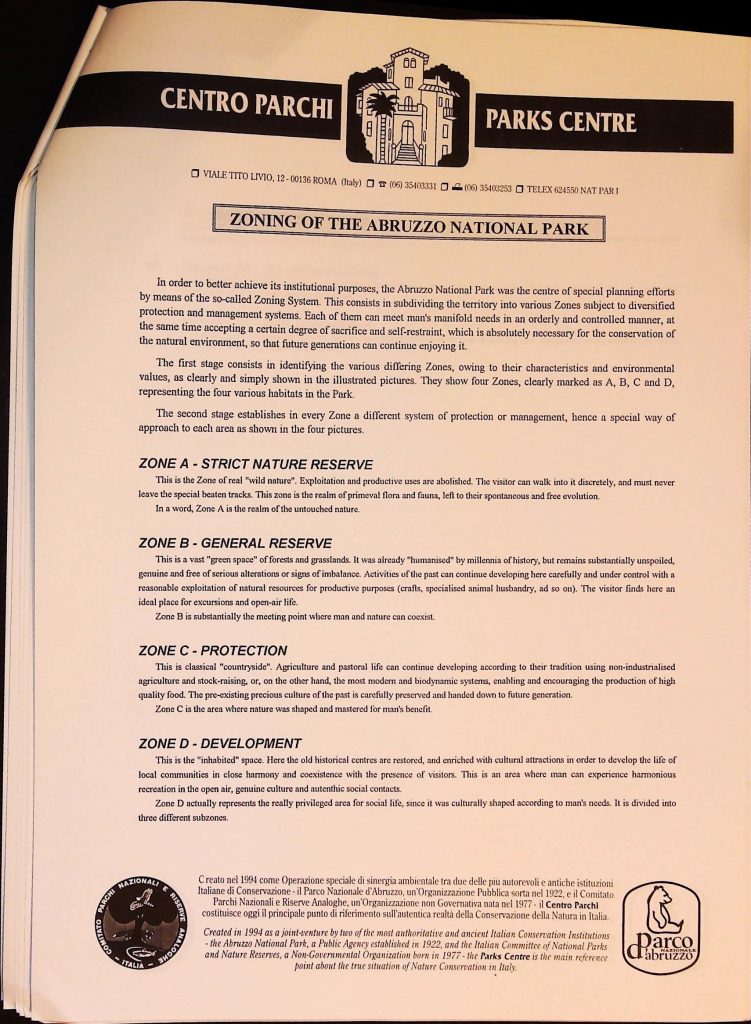
ZONING OF THE ABRUZZO NATIONAL PARK
In order to better achieve its institutional purposes, the Abruzzo National Park was the centre of special planning efforts
by means of the so-called Zoning System. This consists in subdividing the territory into various Zones subject to diversified
protection and management systems. Each of them can meet man's manifold needs in an orderly and controlled manner, at
the same time accepting a certain degree of sacrifice and self-restraint, which is absolutely necessary for the conservation of
the natural environment, so that future generations can continue enjoying it.
The first stage consists in identifying the various differing Zones, owing to their characteristics and environmental
values, as clearly and simply shown in the illustrated pictures. They show four Zones, clearly marked as A, B, C and D,
representing the four various habitats in the Park.
The second stage establishes in every Zone a different system of protection or management, hence a special way of
approach to each area as shown in the four pictures.
ZONE A
STRICT NATURE RESERVE
This is the Zone of real "wild nature". Exploitation and productive uses are abolished. The visitor can walk into it discretely, and must never
leave the special beaten tracks. This zone is the realm of primeval flora and fauna, left to their spontaneous and free evolution.
In a word, Zone A is the realm of the untouched nature.
ZONE B-GENERAL RESERVE
This is a vast "green space" of forests and grasslands. It was already "humanised" by millennia of history, but remains substantially unspoiled,
genuine and free of serious alterations or signs of imbalance. Activities of the past can continue developing here carefully and under control with a
reasonable exploitation of natural resources for productive purposes (crafts, specialised animal husbandry, ad so on). The visitor finds here an
ideal place for excursions and open-air life.
Zone B is substantially the meeting point where man and nature can coexist.
ZONE C - PROTECTION
This is classical "countryside". Agriculture and pastoral life can continue developing according to their tradition using non-industrialised
agriculture and stock-raising, or, on the other hand, the most modern and biodynamic systems, enabling and encouraging the production of high
quality food. The pre-existing precious culture of the past is carefully preserved and handed down to future generation.
Zone C is the area where nature was shaped and mastered for man's benefit.
ZONE D-DEVELOPMENT
This is the "inhabited" space. Here the old historical centres are restored, and enriched with cultural attractions in order to develop the life of
local communities in close harmony and coexistence with the presence of visitors. This is an area where man can experience harmonious
recreation in the open air, genuine culture and autenthic social contacts.
Zone D actually represents the really privileged area for social life, since it was culturally shaped according to man's needs. It is divided into
three different subzones.
PARCHI
NAZIONALI
COMITATO
ITALIA
E RISERVE
ANALOGHE
Creato nel 1994 come Operazione speciale di sinergia ambientale tra due delle più autorevoli e antiche istituzioni
Italiane di Conservazione - il Parco Nazionale d'Abruzzo, un'Organizzazione Pubblica sorta nel 1922, e il Comitato
Parchi Nazionali e Riserve Analoghe, un'Organizzazione non Governativa nata nel 1977 - il Centro Parchi
costituisce oggi il principale punto di riferimento sull'autentica realtà della Conservazione della Natura in Italia.
Created in 1994 as a joint-venture by two of the most authoritative and ancient Italian Conservation Institutions
-the Abruzzo National Park, a Public Agency established in 1922, and the Italian Committee of National Parks
and Nature Reserves, a Non-Governmental Organization born in 1977- the Parks Centre is the main reference
point about the true situation of Nature Conservation in Italy.
Parco
NAZIONALE

[PAGE BREAK]

CENTRO PARCHI
B
PARKS CENTRE
I.
VIALE TITO LIVIO, 12-00136 ROMA (Italy) (06) 35403331 (06) 35403253 TELEX 624550 NAT PARI
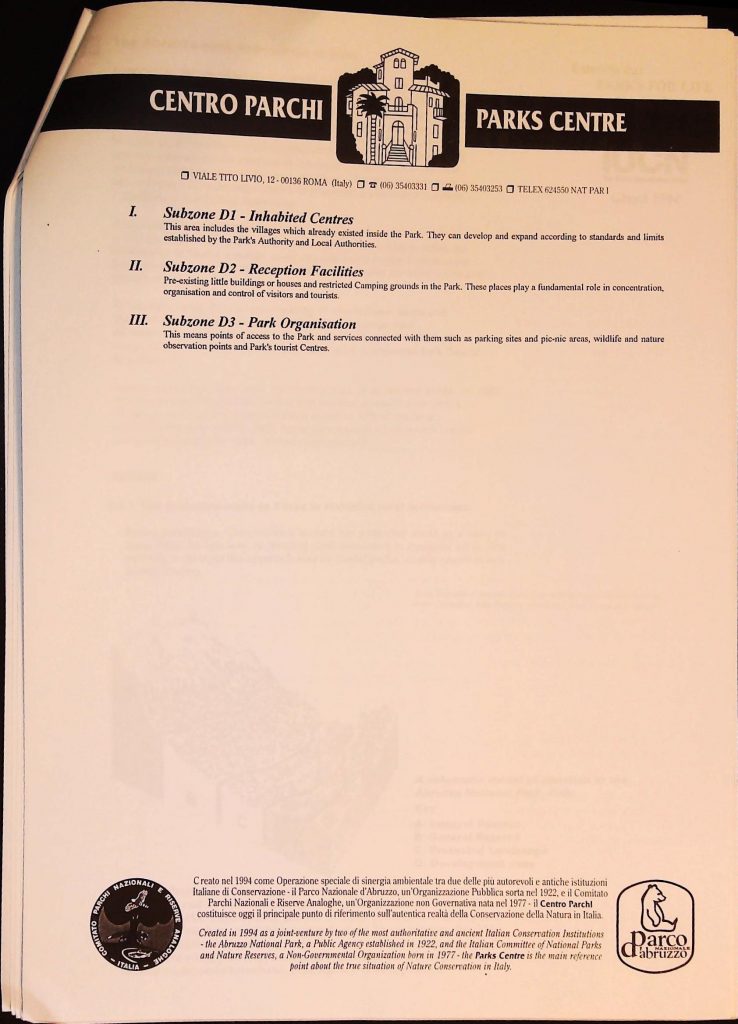
Subzone D1 - Inhabited Centres
This area includes the villages which already existed inside the Park. They can develop and expand according to standards and limits
established by the Park's Authority and Local Authorities.
II.
Subzone D2 - Reception Facilities
III.
Pre-existing little buildings or houses and restricted Camping grounds in the Park. These places play a fundamental role in concentration,
organisation and control of visitors and tourists.
Subzone D3 - Park Organisation
This means points of access to the Park and services connected with them such as parking sites and pic-nic areas, wildlife and nature
observation points and Park's tourist Centres.
PARCHI
NAZIONALI
COMITATO
ITALIA
Creato nel 1994 come Operazione speciale di sinergia ambientale tra due delle più autorevoli e antiche istituzioni
Italiane di Conservazione - il Parco Nazionale d'Abruzzo, un'Organizzazione Pubblica sorta nel 1922, e il Comitato
Parchi Nazionali e Riserve Analoghe, un'Organizzazione non Governativa nata nel 1977 - il Centro Parchl
costituisce oggi il principale punto di riferimento sull'autentica realtà della Conservazione della Natura in Italia.
Created in 1994 as a joint-venture by two of the most authoritative and ancient Italian Conservation Institutions
- the Abruzzo National Park, a Public Agency established in 1922, and the Italian Committee of National Parks
and Nature Reserves, a Non-Governmental Organization born in 1977- the Parks Centre is the main reference
point about the true situation of Nature Conservation in Italy.
Parco
NAZIONALE
RISERVE
ANALOGHE

[PAGE BREAK]

22
The Abruzzo park experience in Italy
A model for the use of national parks to revitalize local economies as
well as conserve nature is the Abruzzo National Park. The hallmarks of
its approach are an autonomous park agency, acting on a clear Management
Plan, implementing strong zonation and attempting to reconcile
conservation with ecodevelopment. Despite many problems, the park has
brought great benefits to local people, while effectively conserving the
species, habitats and landscapes of the region. Indeed, there are now
ambitious plans to expand Abruzzo, creating a 'South European Park' by
establishing a surrounding network of protected areas over a massive
600,000 ha in the Central Apennines.
Abruzzo shows the value of an approach in which the national park
combines conservation with cultural and local revival. It also shows the
importance of having a model, so all can see that it works. This success
has demonstrated to policy-makers that national parks are worthwhile and
important.
At a national level, Italy is now planning 25 new national parks and
about 70 new marine parks and reserves. To encourage their
establishment, in 1990 the National Parks Committee and WWF-Italy
launched their campaign 'A Land of Green Parks' surrounded by a 'Sea of
Blue Parks'.
Twenty years ago, less than 1% of Italy was in protected areas. In 1980
conservationists issued their central and regional governments with a
challenge: increase the protected areas estate to 10% of the land
surface by the year 2000. In 1991 Parliament passed a framework law on
protected areas and by 1994, 7% had been reached.
Estratto da:
PARKS FOR LIFE
Action for Protected
Areas in Europe
IUCN
The World Conservation Union
Gland 1994
ACTION
5.2.1 Use protected areas as a way to revitalize rural economies.
Recommendation. Governments should see protected areas as a way, in
many areas the best way, of reviving rural economies in marginal areas The
best way to develop this approach may by model parks, ideally one or more
in each country.
Parco Nazionale d'Abruzzo Reproduced with kind permission of National
Parks Committee, Italy Diagram created by F Tassi, drawn by S Maugeri
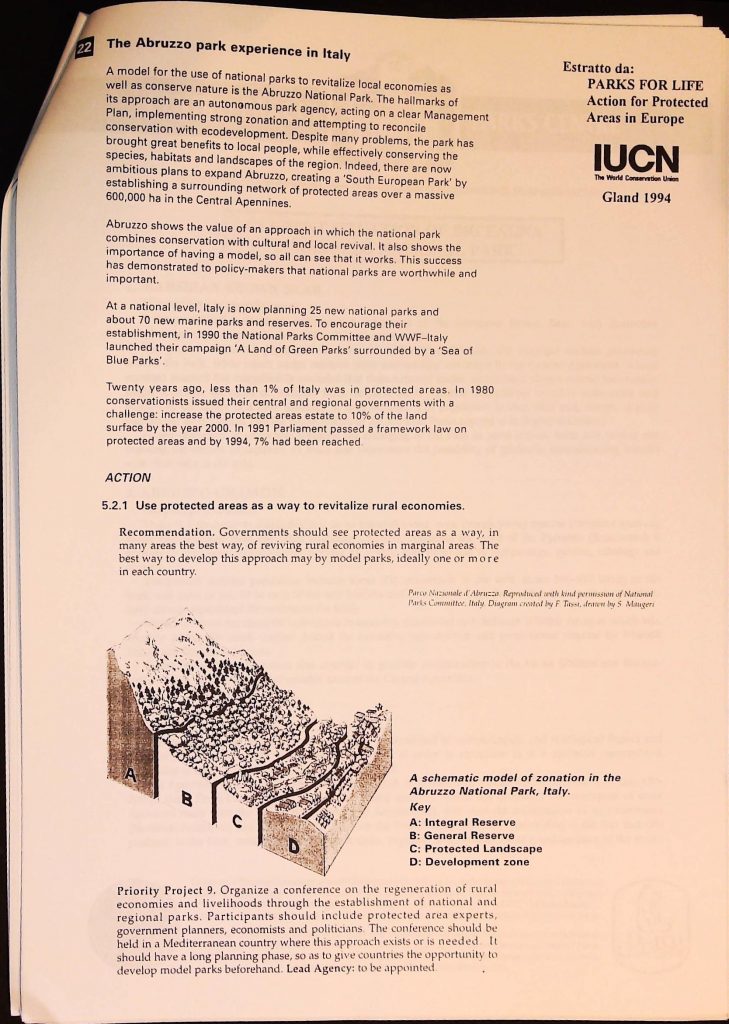
A schematic model of zonation in the
Abruzzo National Park, Italy.
Key
A: Integral Reserve
B: General Reserve
C: Protected Landscape
D: Development zone
Priority Project 9. Organize a conference on the regeneration of rural
economies and livelihoods through the establishment of national and
regional parks. Participants should include protected area experts,
government planners, economists and politicians. The conference should be
held in a Mediterranean country where this approach exists or is needed. It
should have a long planning phase, so as to give countries the opportunity to
develop model parks beforehand. Lead Agency: to be appointed

[PAGE BREAK]

CENTRO PARCHI
T
00
PARKS CENTRE
VIALE TITO LIVIO, 12-00136 ROMA (Italy) (06) 35403331 (06) 35403253 TELEX 624550 NAT PAR1
CURRENT SITUATION OF BIG FAUNA
IN ABRUZZO NATIONAL PARK
1. MARSICAN BROWN BEAR
(Ursus arctos marsicanus)
It is considered a strongly differentiated subspecies of the European Brown Bear, with distinctive
morphological, genetic, ethological and ecological peculiarities.
The present remaining population is estimated at 70-100 individuals, the essential nucleus gravitating
around the Park, while minor nuclei colonise other surrounding territories in the Central Apennines. Recent
accurate research has categorically excluded that these external nuclei, which have always existed historically,
might constitute the result of "escapes" from the park, while repeated observations would in some cases lend
support to the thesis of a slow tendency to improvement. The population is thus vital and, maybe, slightly
increasing: its expansion into the whole system of the Abruzzo Parks appears to be highly desirable.
Future objectives of protection comprise the enlarging of the Park in some critical areas and raising and
breeding the species in captivity, to study and experiment the possibility of gradually reconditioning females
with their cubs to the wild.
2. ABRUZZO CHAMOIS
(Rupicapra ornata)
There is a tendency to reappraise this as an autochthonous, even though young species (incipient species),
neatly differentiated from any other European Chamois, including the izard of the Pyrenees (from which it
appears to have been reproductively isolated for a very long time) due to morphology, genetic, ethology and
ecology.
The present residual population includes about 600 individuals in the wild, about 500-550 living in the
Park, and more or less 30 in each of the new Maiella and Gran Sasso-Laga Parks (they are small nuclei which
have already reproduced themselves in the wild).
Moreover, there are about 60 individuals in captivity, distributed in 5 different Wildlife Areas to which was
recently added the small nucleus hosted for scientific, reproductive and promotional reasons by Munich
Zoological Garden in Bavaria.
Future conservation objectives also consider its possible reintroduction in the Monti Sibillini and Sirente-
Velino Parks, as well as in other suitable areas of the Central Apennines.
3. APENNINE WOLF
(Canis lupus italicus)
The individuality of the Apennine population, characterised by morphological and ethological factors and
reproductively isolated must be attentively evaluated in order to recognize in it a southern geographical
subspecies of lesser dimensions than the European Wolf.
The Apennine Wolf's present population in the Park is estimated at around 40-50, with more or less 450-
500 in Italy. There has thus been a quick and strong recovery, which has facilitated the reconquest of some
Apennine areas (like the Appennino Dauno and Aspromonte), and even the colonisation of new territories
(Northern Apennines and Maritime Alps, also on the French side). Still more interesting is the fact that this
predator, in the Park, started to hunt in a pack again, regularly and successfully as a consequence of the return
NAZIONALI
PARCHI NA
COMITATO
ITALIA
E
RISERVE
ANALOGHE
Creato nel 1994 come Operazione speciale di sinergia ambientale tra due delle più autorevoli e antiche istituzioni
Italiane di Conservazione - il Parco Nazionale d'Abruzzo, un'Organizzazione Pubblica sorta nel 1922, e il Comitato
Parchi Nazionali e Riserve Analoghe, un'Organizzazione non Governativa nata nel 1977 - il Centro Parchi
costituisce oggi il principale punto di riferimento sull'autentica realtà della Conservazione della Natura in Italia.
Created in 1994 as a joint-venture by two of the most authoritative and ancient Italian Conservation Institutions
-the Abruzzo National Park, a Public Agency established in 1922, and the Italian Committee of National Parks
and Nature Reserves, a Non-Governmental Organization born in 1977 - the Parks Centre is the main reference
point about the true situation of Nature Conservation in Italy.
arco
abruzzo
NAZIONALE

[PAGE BREAK]

CENTRO PARCHI
00
PARKS CENTRE
VIALE TITO LIVIO, 12-00136 ROMA (Italy) (06) 35403331 (06) 35403253 TELEX 624550 NAT PARI
of hoofed mammals, its favourite prey. A little known but quite important role is played by the wolf especially
in colder, snowy winters: that of controlling the Wild Boar population (Sus scrofa), which is often not pure and
has been introduced to the Apennines for hunting purposes. It is interesting to observe that Wolf damages to
domestic animals are virtually non-existant in balanced rural areas where wild game is in plenty. This damage
are found excessively elsewhere, in presence of consistent nuclei and packs of wild, abandonned and feral dogs.
Given that 80% of damages claimed by shepherds and breeders are actually caused by such dogs, it may be
assumed with certainty that it is the wolf which, in protected areas, eliminates them or drives them away thus
contributing significantly to reduce harm to domestic animals.
Future protection goals consider the extension on a wider scale of the Park's conservation strategies as
essential, with a series of initiatives: protection (the setting up of new protected areas); promotion (the creation
of new Wildlife Areas for the Apennine Wolf) and compensation (swift and full payment of compensations for
any damage to domestic animals).
4. LYNX
(Lynx lynx)
In Italy, the presence of the Lynx in the western and eastern Alps as well as in the Apennines (mostly
central) has by now been widely demonstrated and cannot be seriously disputed. However, while some experts
tend to consider it as a result of the re-introduction carried on successfully beyond the Alps (France,
Switzerland, former Yugoslavia) - a fact which would not anyway explain its presence in the Apennines - it is
likely that vestigial nuclei of this feline, which has a remarkably secretive behaviour, were able to survive in
mountain areas, which were particularly remote and segregated, both in the western and eastern Alps and the
Apennines. An important study published in 1981 by the National Research Council completely ignored this
species, excluding it from Italian fauna. Instead, it is on the other hand plausible that the Lynx was present at
the time in this country, albeit in a quite small number.
There are multiple, much certain and coherent proof of the present existence of the Lynx in the Park, with
an estimated 2-3 pairs, while significant evidence emerges from other central and partly southern Apennine
areas. Although one cannot obviously exclude the hypothesis of clandestine immission or liberation by
unknown persons, the objective situation - perfectly wild, elusive specimens, used to the territory and linked to
particular zones, often the same ones where their presence had been historically observed for various decades
inclines us towards the most reasonable and plausible explanation: that is to say the actual survival of small
original vestigial nuclei, greatly favoured today by the improved environment protection and the increasing
availability of prey. The creation Wildlife Areas for the Lynx in the Park (there are three at present) has
certainly played a role as a powerful "catalyst", while the renewal and intensification of observation and
research conducted by the Italian Lynx Group confirms the accuracy of the data already acquired on the subject.
Future safeguard targets strive to consolidate the strategy adopted by the Park up to now, obviously
excluding any hypothesis of re-introduction from outside due to the extreme importance of this population,
presumably autochthonous, the morphological, genetic, ethological and ecological characteristics of which
deserve to be seriously studied in depth.
5. RED DEER
(Cervus elaphus hippelaphus)
The re-introduction of Red Deer into the Park was initiated in the year 1971 and was concluded in 1975:
about 70 specimens of alpine origin were brought in (from the National Parks of Triglav in Slovenia, Engadin
NAZIONALI
ARCHI NAZ
COMITATO
ITALIA
E
RISERVE
ANALOGHE
Creato nel 1994 come Operazione speciale di sinergia ambientale tra due delle più autorevoli e antiche istituzioni
Italiane di Conservazione - il Parco Nazionale d'Abruzzo, un'Organizzazione Pubblica sorta nel 1922, e il Comitato
Parchi Nazionali e Riserve Analoghe, un'Organizzazione non Governativa nata nel 1977 - il Centro Parchi
costituisce oggi il principale punto di riferimento sull'autentica realtà della Conservazione della Natura in Italia.
Created in 1994 as a joint-venture by two of the most authoritative and ancient Italian Conservation Institutions
- the Abruzzo National Park, a Public Agency established in 1922, and the Italian Committee of National Parks
and Nature Reserves, a Non-Governmental Organization born in 1977 - the Parks Centre is the main reference
point about the true situation of Nature Conservation in Italy
Par
arco
abruzzo
NAZIONALE

[PAGE BREAK]

CENTRO PARCHI
L
00
PARKS CENTRE
VIALE TITO LIVIO, 12-00136 ROMA (Italy) (06) 35403331 (06) 35403253 TELEX 624550 NAT PAR 1
to which to resort.
in Switzerland and the Bavarian Forest in Germany), due to the lack of Apennine authochthonous populations
The insertion in the ecosystem was harmonious, without the imbalances and damages to the forest cover
suggested by some, and expansion into the adjacent territories appeared constant, a fact most probably due to
the presence of predators. The present population in the Park seems to be around 500-600 deer, and now seems
to be fully established in the area.
Future protection targets concern merely the consolidation of the policy applied by the Park
6. ROE DEER
(Capreolus capreolus)
up to now.
The re-introduction of the Roe Deer was started in the year 1970 and concluded in 1976: about 60
specimens of alpine origin were freed altogether. Other solutions were impractical due to the fact, on the one
hand, that the above mentioned scarce and localized authochthonous Apennine nuclei were too limited,
differentiated and vulnerable to be used, on the other hand the more abundant northern population, like the one
in Tuscany, did not provide any guarantee of purity and of native origin.
This choice gave place to rather lively discussions, as a possible genetic divergence of Apennine populations
with respect to the Alpine ones could not be excluded a priori (though it was neither known nor demonstrated).
Anyway, the Park authorities made the clear decision to give priority, with respect to possible differences at
infraspecific or most probably infrasubspecific level, to the need to restore the completeness of the ecosystem,
ecological balance and the endogenous capacity of the environment for self-sustainment.
Although the increase of the Roe Deer has been slower and a bit more delayed compared to the deer, and its
diffusion has grown in a less obviously noticeable way, the present population in the Park is nonetheless
estimated at 300-400. Most probably, it is notably underestimated as an accurate survey has not yet been carried
on.
Also in this case, future protection targets concern merely the consolidation of the policy adopted by the
Park up until now.
PARCHI
NAZIONALI
COMITATO
ITALIA
E
RISERVE
ANALOGHE
Creato nel 1994 come Operazione speciale di sinergia ambientale tra due delle più autorevoli e antiche istituzioni
Italiane di Conservazione - il Parco Nazionale d'Abruzzo, un'Organizzazione Pubblica sorta nel 1922, e il Comitato
Parchi Nazionali e Riserve Analoghe, un'Organizzazione non Governativa nata nel 1977 - il Centro Parchi
costituisce oggi il principale punto di riferimento sull'autentica realtà della Conservazione della Natura in Italia.
Created in 1994 as a joint-venture by two of the most authoritative and ancient Italian Conservation Institutions
- the Abruzzo National Park, a Public Agency established in 1922, and the Italian Committee of National Parks
and Nature Reserves, a Non-Governmental Organization born in 1977 - the Parks Centre is the main reference
point about the true situation of Nature Conservation in Italy.
Parco
abruzzo
NAZIONALE

[PAGE BREAK]

Darco
NAZIONALE
Cabruzzo
per la protezione dell'ambiente naturale nell'appennino
WHY THIS PARK IS REALLY SPECIAL
- not
The Abruzzo National Park, inaugurated in 1922 by private initiative thanks to its
Autonomous Agency established in 1921, and therefore the oldest National Park in
Italy, is internationally considered as pilot-organisation in nature conservation: an
example that most of the modern Parks, not only in our Country, are trying to imitate.
During the last quarter of the Century the history of our Park has been marked by
continuous and innovating efforts devoted to meet the urgent needs of nature protection
and those of development. The Abruzzo National Park was the first one to show
only theoretically but in practice - that the protection of the environment has positive
effects and economic advantages such as income and employment. Moreover, it has
promoted controlled cultural visits in the Park, has "invented" a special agreement
system with local Communities in order to overcome the controversies in the urbanistic
field, has created the Zoning System in the territory in order to reconciliate protection
and development: in other words, has managed with success a policy of "eco-
development", mainly based on the modern "eco-tourism".
The real projects carried out for the first time in a large and modern National Park
range from the first Visitor Centre among Italian National Parks, created in 1969 in
Pescasseroli, to the first scientific group working in a European Park, the Apennine
Centre for Ecological Research, created in 1972; from the first "Wildlife Area" for
the Apennine Wolf at Civitella Alfedena, created in 1971, to the first Strict Nature
Reserve, the Camosciara, created in 1972.
The Abruzzo National Park has achieved impressive results for the protection of the
most endangered species, creating the Italy Wolf Group for the protection of the
Apennine Wolf in 1974, the Italy Chamois Group for the safeguard of the Abruzzo
Chamois in 1978, the Italy Bear Group for the protection of the Abruzzo Brown Bear
in 1983 whilst in 1993 the Italy Lynx Group has been created to sustain the "return" of
this wonderful feline in our Country. Furthermore, from 1977, the Park gives hospitality
and support to the Italian Committee for National Parks and Equivalent Reserves,
engaged in the creation and support of a vast "system" of protected areas, including both
land and sea, in our Country. Then the Park has launched in 1993 the Biodiversity
Project for the global consideration of its rich wildlife. Finally, the Park created in 1994
the Parks Centre in Rome, in order to promote a better knowledge and awareness in the
field of Nature Conservation through Protected Areas.
Those who wish to acquire a deeper knowledge of the Park have just to contact one
of its Visitor Centres including a Wildlife Area, such as: Civitella Alfedena for the
Apennine Wolf and the Lynx, Opi and Castenuovo a Volturno for the Abruzzo
Chamois, Villavallelonga for the Red Deer, Bisegna for the Roe Deer and San
Sebastiano for the Insects, without forgetting the re-newed Pescasseroli Visitor Centre,
adjacent to the well-known Wildlife Park and to the new Apennine Garden. Visitors can
also address themselves to the various local Information Offices of the Park, open all
year round and placed in the main villages. A rich series of publications provides full
information and orientation.
Abruzzo National Park, December 1997

[PAGE BREAK]

Darco
NASIONALE
Tabruzzo
per la protezione dell'ambiente naturale nell'appennino
IDENTITY CARD OF ABRUZZO NATIONAL PARK
✰ CREATION: 1922 by private initiative, 1923 by law
❖ RESPONSIBLE AUTHORITY: Abruzzo National Park
✰ EXTENSION: 44,000 hectares (and 60,000 hectares of Buffer Zone)
✰ INTERESTED REGIONS: Abruzzo, Latium and Molise
✰ INTERESTED LOCAL COMMUNITIES: Pescasseroli, Opi, Villetta Barrea, Civitella
Alfedena, Barrea and Alfedena (Alto Sangro); Bisegna, Gioia dei Marsi, Lecce nei
Marsi and Villavallelonga (Marsica Fucense); Scanno (Valle del Sagittario); Alvito,
Campoli Appennino, San Donato Val Comino, Settefrati, Picinisco and San Biagio
Saracinisco (Val di Comino); Pizzone, Castel San Vincenzo, Rocchetta a Volturno,
Scapoli and Filignano (Mainarde)
RIVERS: Sangro, Melfa, Giovenco and Volturno
LAKES: Barrea, Vivo, Pantaniello, Montagna Spaccata, Castel San Vincenzo and
Selva
MOUNTAINS: Petroso (2249 m), Marsicano (2245 m), Greco (2285 m) and Meta (2242
m
✰ VISITORS: about 2 millions people per year
✰ VOLUNTEERS: about 1,000 per year
TERRITORIES OWNED: about 400 hectares
FORESTS AND PASTURES ABOVE TIMBERLINE CONTROLLED: about 20,000 hectares
✰ STRICT NATURE RESERVES: about 4,000 hectares
FLORA: about 1,980 species of superior Plants
FAUNA: 60 species of Mammalians
230 species of Birds
40 species of Reptiles and Amphibians
Marsican Brown Bear: 70-100 specimens
Abruzzo Chamois: 500-600 specimens
Lynx: 8-10 specimens
Red-Deer: 500-600 specimens
Roe-Deer: 500-600 specimens
Apennine Wolf: 40-50 specimens
EMPLOYEES: about 80 permanent, about 120 temporary co-operators
✰ BUDGET: about 9 billion Liras per year
ECONOMIC ADVANTAGES TO THE LOCAL COMMUNITY: about 300 billion Liras per
year of "economic impact" for the district.
Abruzzo National Park, December 1997

[PAGE BREAK]

arco
RARIONALE
abruzzo
per la protezione dell'ambiente naturale nell'appennino
THE BASIC DATES OF ABRUZZO NATIONAL PARK
1907 First proposal for a National Park in Abruzzo
1917 First definite project for the Park
1921 Rental of the first part of the Park (500 hectares) by Pro Montibus Association
1922 Official Inauguration of the Park (12,000 hectares)
1923 Legislative institution of the Park (18,000 hectares)
1925 First expansion of the Park (28,000 hectares)
1926 Second expansion of the Park (30,000 hectares)
1933 Abolition of the National Park Authority
1950 Re-establishment of the National Park Authority
1958 Beginning of the tourist and building speculation
1964 Following the inspection made by the IUCN, the international scandal breaks out
1969 Resettlement of the Direction; the recover is on the way
1970 Creation of the Buffer Zone (60,000 hectares)
1976 Third expansion of the Park (40,000 hectares)
1980 First carrying-out of the Park's Master Plan
1984 Introduction of the Zonation System in the Park
1985 Strengthening of the Plan with Zonation and Agreements
1987 Final approval of the Zonation System
1988 Hunting forbidden in the Buffer Zone
1989 Civitella bursting case: demonstration of Park's benefits
1990 Fourth expansion of the Park (44,000 hectares)
1992 Seventy years of life of the Park
1993
Consolidation of the Buffer Zone
1994 Opening of the Parks Centre in Rome
1997 75th Anniversary of Park's Foundation.
Abruzzo National Park, December 1997
I

[PAGE BREAK]

Pa
Darco
NAZIONALE
abruzzo
PARK'S REHABILITATION FIGURES
14,000 hectares more of Protected Nature (Marsicano and Mainarde)
◆ 4,000 hectares of Strict Nature Reserve (Camosciara - Feudo)
✦ 60,000 hectares of Buffer Zone
◆ 150 Ecotourist Trails
♦ 50 km of Roads closed to vehicles
◆ 70-100 Marsican Brown Bears continuously protected
♦ 40-50 Apennine Wolves continuously protected
♦ 500-600 Abruzzo Chamois (from 150-200) progressively increasing
◆ 500-600 Red Deers (from 0) thanks to the reintroduction operated by the Park
♦ 300-400 Roe Deers (from 0) thanks to the reintroduction operated by the Park
⚫ 7 Visitor Centres in operation (+ various others to be realised)
♦ 10 Information Offices (+ various to be realised)
♦ 5 Wildlife Areas (+ various to be realised)
◆ 10 Mountain Refuges
♦ 80 permanent and 120 temporary Employees
◆ 10 Juvenile Co-operative Organisations in activity
◆ 2,000,000 Visitors per year (including about 3,000 groups)
ecotourism in the Park
◆ 300 billion liras of Economic Impact per year to the local community thanks to
♦ 150 billion liras as Public Expenditure in the district for Park's conservation in the
last twenty years
80 Scientific Researches carried out
• 20,000 hectares of Forests and Pastures under Park control
◆ 1,000 million liras spent for Forest and Pasture Protection every year
♦ 6,000,000 Trees saved from being harvested.
per la protezione dell'ambiente naturale nell'appennino
Abruzzo National Park, December 1997

[PAGE BREAK]

TEN RULES FOR "THE PERFECT VISITOR"
OF A NATIONAL PARK
Love for nature must not be destructive. Imagine what could happen if
everybody picked a flower, wrote their name on a secular tree trunk, or threw
paper on the ground. Love for nature must become a real positive value.
A conscientious, well informed and sensitive visitor is the most reliable
guarantee for the safe-keeping of a National Park.
National Parks belong to everyone: help us to preserve them for future
visitors too.
1.
Become well informed about the National Park before and during your visit:
examine its problems closely and discuss them with other interested parties.
Go to the Visitor's Information Centres or to other meeting points in the
National Park.
2. When you are in the National Park, try to behave in the best possible
"ecological" way: consume very little and do not disturb. Remember that
noises, vandalisms and littering are the visiting cards of ill-bred people.
3. Use your motor-vehicles only to reach the National Park and travel through
its main roads; do not enter the heart of nature by car. No racing, no four
wheel driving, no gymkhanas and no rides in cars of motorcycles through the
fields and woods; no rides on motorboats. Motor-vehicles should be used as
little as possible and should never be driven off the roads.
4. Take a few naturalistic itineraries on foot (when possible by horse or mule).
Enjoy the distance from modern society and from technology. Try to better
understand the environment and identify yourself with nature.
5. Do not pick up flowers, do not break branches or carve into tree trunks. Do
not light fires (only in suitable areas). You could cause a serious fire and
significantly contribute to the impoverishment of the natural environment.
6. Do not bring dogs along (not even on the leash), guitars or radios. Do bring a
binocular, a camera and a map to experience and feel in the best way the
world surrounding yourself.
7. If you have the good fortune to see any wild animals, have the good sense to
behave with respect and discretion. Do not squawk or pursue them, but enjoy
in blank silence those precious instants of direct contact with nature, which is
becoming more rare in this world and which you will never forget.
8. Park rangers are very busy in their jobs. There is little personnel and much
work to be done, therefore, not everything can always be perfect. Try not to

[PAGE BREAK]

intensify problems with useless discussions and, when you can, show
understanding and give help: they will always be appreciated.
9. Report immediately the staff or to the management of the National Park any
problems which you may have noticed so that they can act quickly to find a
solution.
10. If you enjoyed your experience with the National Park, become a supporter of
the nature. There are many ways for nature lovers - to limit or remedy the
damages created by most people who still destroy or ignore nature.
"Leave nothing but your footprints. Do not take away anything but your
photos, memories and sensations".
(National Park Service)
Created in 1994 as a joint-venture by two of the most authoritative and
ancient Italian Conservation Institutions the Abruzzo National Park, a Public
Agency established in 1922, and the Italian Committee for National Parks and
Nature Reserves, a Non-Governmental Organisation born in 1977 the Parks
Centre is the main reference point about the true situation of Nature Conservation
in Italy.

Leave a Reply

Your email address will not be published. Required fields are marked *