Cryptozoology

B3F28I1

Box 3

Folder 28. Cryptozoology Newsletter

Item 1. Vol. 1 No. 1


Transcribed Text (OCR)

GARY MANGIACOPA ARCHIVE
============================================================
Title:      B3F28I1
Slug:       b3f28i1
Categories: Cryptozoology
Source:     https://garymangiacopraarchive.com/b3f28i1
Pages:      5 scanned, 5 extracted
OCR:        Google Vision API (document_text_detection)
Processed:  2026-06-06
============================================================

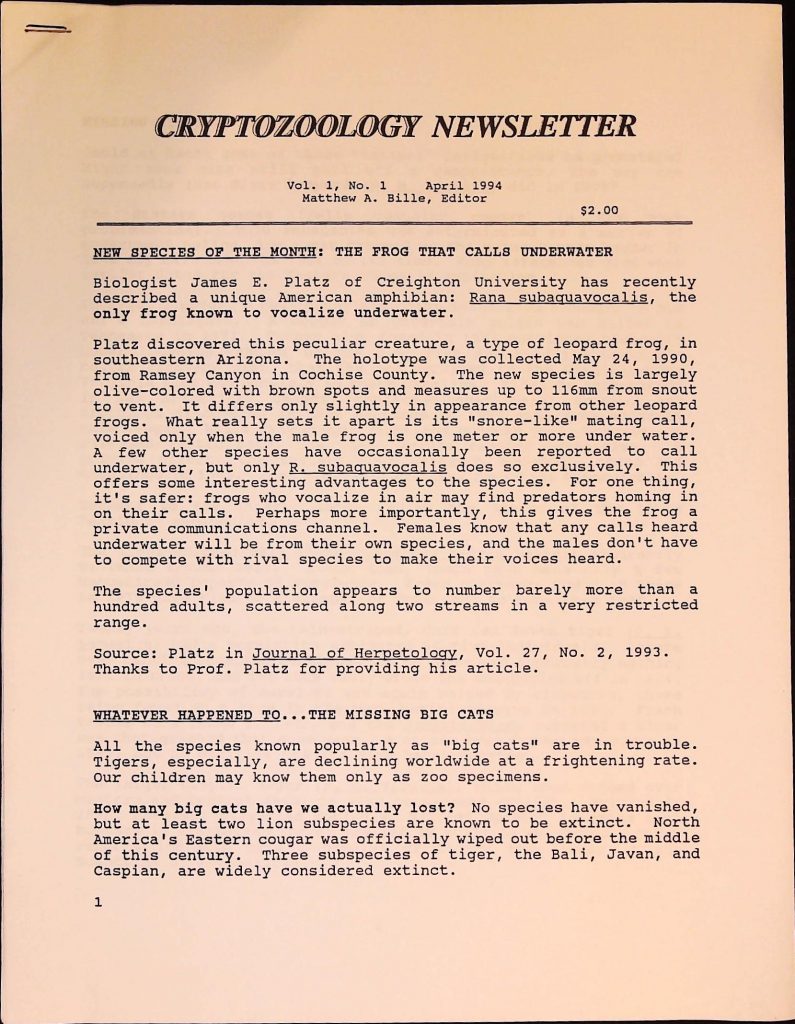
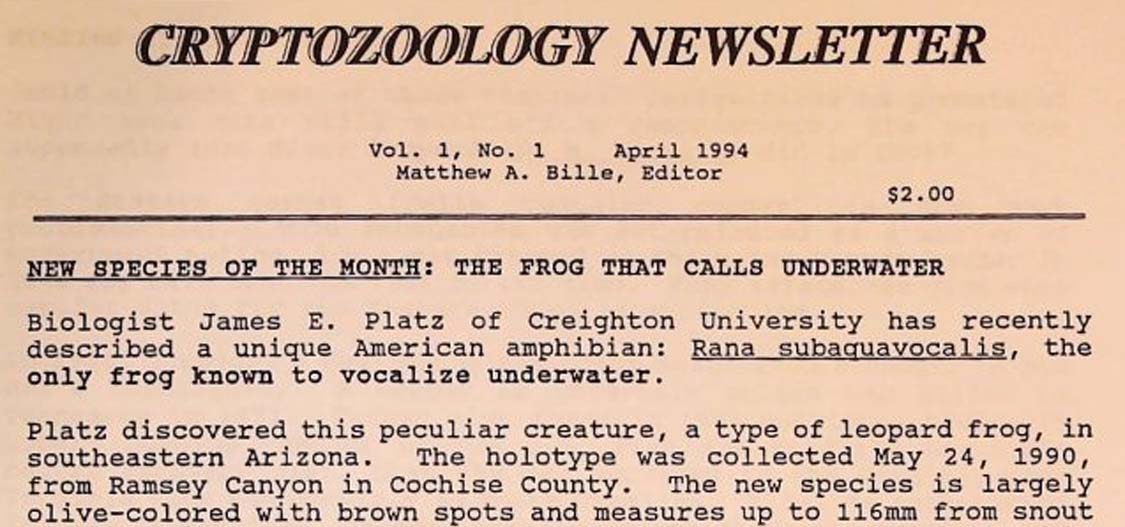
CRYPTOZOOLOGY NEWSLETTER
Vol. 1, No. 1 April 1994
Matthew A. Bille, Editor
[AD] $2.00
NEW SPECIES OF THE MONTH: THE FROG THAT CALLS UNDERWATER
Biologist James E. Platz of Creighton University has recently
described a unique American amphibian: Rana subaquavocalis, the
only frog known to vocalize underwater.
Platz discovered this peculiar creature, a type of leopard frog, in
southeastern Arizona. The holotype was collected May 24, 1990,
from Ramsey Canyon in Cochise County. The new species is largely
olive-colored with brown spots and measures up to 116mm from snout
to vent. It differs only slightly in appearance from other leopard
frogs. What really sets it apart is its "snore-like" mating call,
voiced only when the male frog is one meter or more under water.
A few other species have occasionally been reported to call
underwater, but only R. subaquavocalis does so exclusively. This
offers some interesting advantages to the species. For one thing,
it's safer: frogs who vocalize in air may find predators homing in
on their calls. Perhaps more importantly, this gives the frog a
private communications channel. Females know that any calls heard
underwater will be from their own species, and the males don't have
to compete with rival species to make their voices heard.
The species' population appears to number barely more than a
hundred adults, scattered along two streams in a very restricted
range.
Source: Platz in Journal of Herpetology, Vol. 27, No. 2, 1993.
Thanks to Prof. Platz for providing his article.
WHATEVER HAPPENED TO...THE MISSING BIG CATS
All the species known popularly as "big cats" are in trouble.
Tigers, especially, are declining worldwide at a frightening rate.
Our children may know them only as zoo specimens.
How many big cats have we actually lost? No species have vanished,
but at least two lion subspecies are known to be extinct. North
America's Eastern cougar was officially wiped out before the middle
of this century. Three subspecies of tiger, the Bali, Javan, and
Caspian, are widely considered extinct.

[PAGE BREAK]

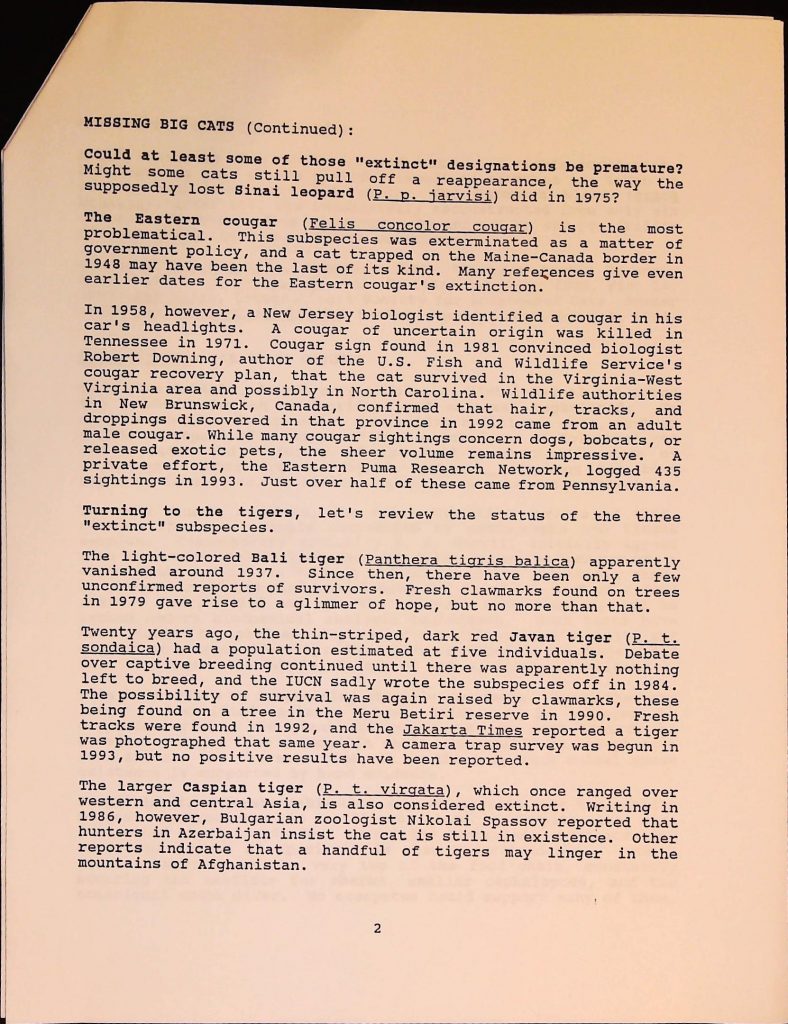
MISSING BIG CATS (Continued):
Could at least some of those "extinct" designations be premature?
Might some cats still pull off a reappearance, the way the
supposedly lost Sinai leopard (P. p. jarvisi) did in 1975?
The Eastern cougar (Felis concolor cougar) is the most
problematical. This subspecies was exterminated as a matter of
government policy, and a cat trapped on the Maine-Canada border in
1948 may have been the last of its kind. Many references give even
earlier dates for the Eastern cougar's extinction.
In 1958, however, a New Jersey biologist identified a cougar in his
car's headlights. A cougar of uncertain origin was killed in
Tennessee in 1971. Cougar sign found in 1981 convinced biologist
Robert Downing, author of the U.S. Fish and Wildlife Service's
cougar recovery plan, that the cat survived in the Virginia-West
Virginia area and possibly in North Carolina. Wildlife authorities
in New Brunswick, Canada, confirmed that hair, tracks, and
droppings discovered in that province in 1992 came from an adult
male cougar. While many cougar sightings concern dogs, bobcats, or
released exotic pets, the sheer volume remains impressive. A
private effort, the Eastern Puma Research Network, logged 435
sightings in 1993. Just over half of these came from Pennsylvania.
Turning to the tigers, let's review the status of the three
"extinct" subspecies.
The light-colored Bali tiger (Panthera tigris balica) apparently
vanished around 1937. Since then, there have been only a few
unconfirmed reports of survivors. Fresh clawmarks found on trees
in 1979 gave rise to a glimmer of hope, but no more than that.
Twenty years ago, the thin-striped, dark red Javan tiger (P. t.
sondaica) had a population estimated at five individuals. Debate
over captive breeding continued until there was apparently nothing
left to breed, and the IUCN sadly wrote the subspecies off in 1984.
The possibility of survival was again raised by clawmarks, these
being found on a tree in the Meru Betiri reserve in 1990. Fresh
tracks were found in 1992, and the Jakarta Times reported a tiger
was photographed that same year. A camera trap survey was begun in
1993, but no positive results have been reported.
The larger Caspian tiger (P. t. virgata), which once ranged over
western and central Asia, is also considered extinct. Writing in
1986, however, Bulgarian zoologist Nikolai Spassov reported that
hunters in Azerbaijan insist the cat is still in existence. Other
reports indicate that a handful of tigers may linger in the
mountains of Afghanistan.

[PAGE BREAK]

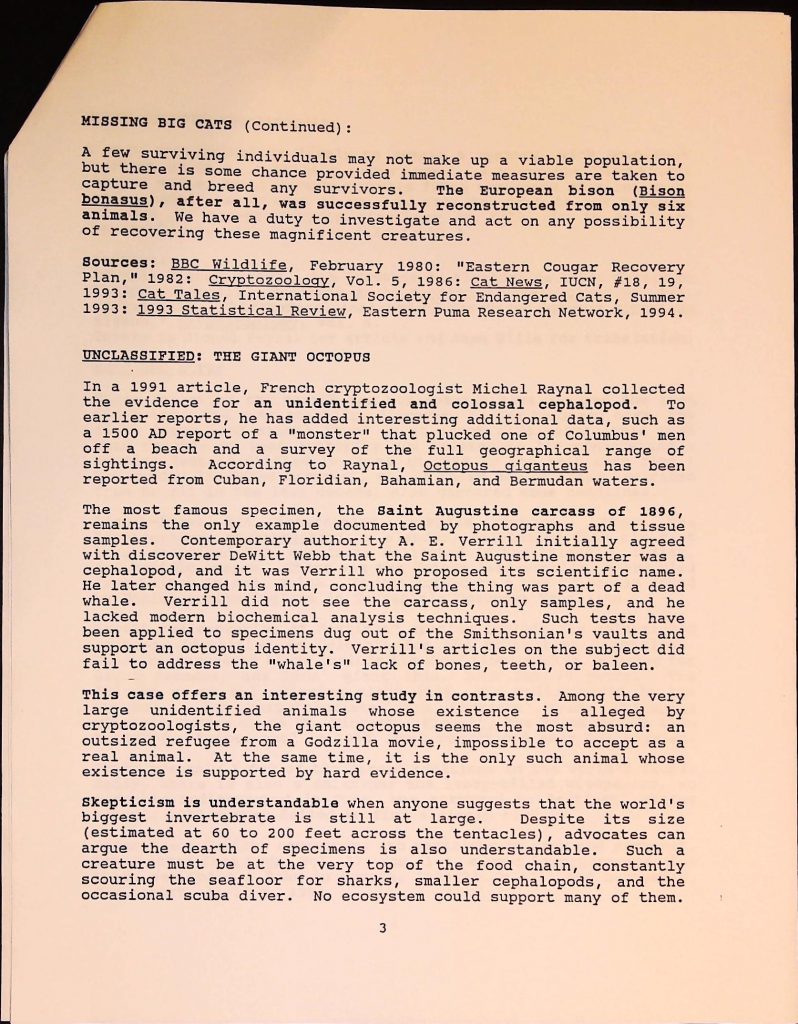
MISSING BIG CATS (Continued):
A few surviving individuals may not make up a viable population,
but there is some chance provided immediate measures are taken to
capture and breed any survivors. The European bison (Bison
bonasus) '
after all, was successfully reconstructed from only six
animals. We have a duty to investigate and act on any possibility
of recovering these magnificent creatures.
Sources: BBC Wildlife, February 1980: "Eastern Cougar Recovery
Plan," 1982: Cryptozoology, Vol. 5, 1986: Cat News, IUCN, #2318, 19,
1993: Cat Tales, International Society for Endangered Cats, Summer
1993: 1993 Statistical Review, Eastern Puma Research Network, 1994.
UNCLASSIFIED: THE GIANT OCTOPUS
In a 1991 article, French cryptozoologist Michel Raynal collected
the evidence for an unidentified and colossal cephalopod. To
earlier reports, he has added interesting additional data, such as
a 1500 AD report of a "monster" that plucked one of Columbus' men
off a beach and a survey of the full geographical range of
sightings. According to Raynal, Octopus giganteus has been
reported from Cuban, Floridian, Bahamian, and Bermudan waters.
The most famous specimen, the Saint Augustine carcass of 1896,
remains the only example documented by photographs and tissue
samples. Contemporary authority A. E. Verrill initially agreed
with discoverer DeWitt Webb that the Saint Augustine monster was a
cephalopod, and it was Verrill who proposed its scientific name.
He later changed his mind, concluding the thing was part of a dead
whale. Verrill did not see the carcass, only samples, and he
lacked modern biochemical analysis techniques. Such tests have
been applied to specimens dug out of the Smithsonian's vaults and
support an octopus identity. Verrill's articles on the subject did
fail to address the "whale's" lack of bones, teeth, or baleen.
This case offers an interesting study in contrasts. Among the very
large unidentified animals whose existence is alleged by
cryptozoologists, the giant octopus seems the most absurd: an
outsized refugee from a Godzilla movie, impossible to accept as a
real animal. At the same time, it is the only such animal whose
existence is supported by hard evidence.
Skepticism is understandable when anyone suggests that the world's
biggest invertebrate is still at large. Despite its size
(estimated at 60 to 200 feet across the tentacles) advocates can
argue the dearth of specimens is also understandable. Such a
creature must be at the very top of the food chain, constantly
scouring the seafloor for sharks, smaller cephalopods, and the
occasional scuba diver. No ecosystem could support many of them.

[PAGE BREAK]

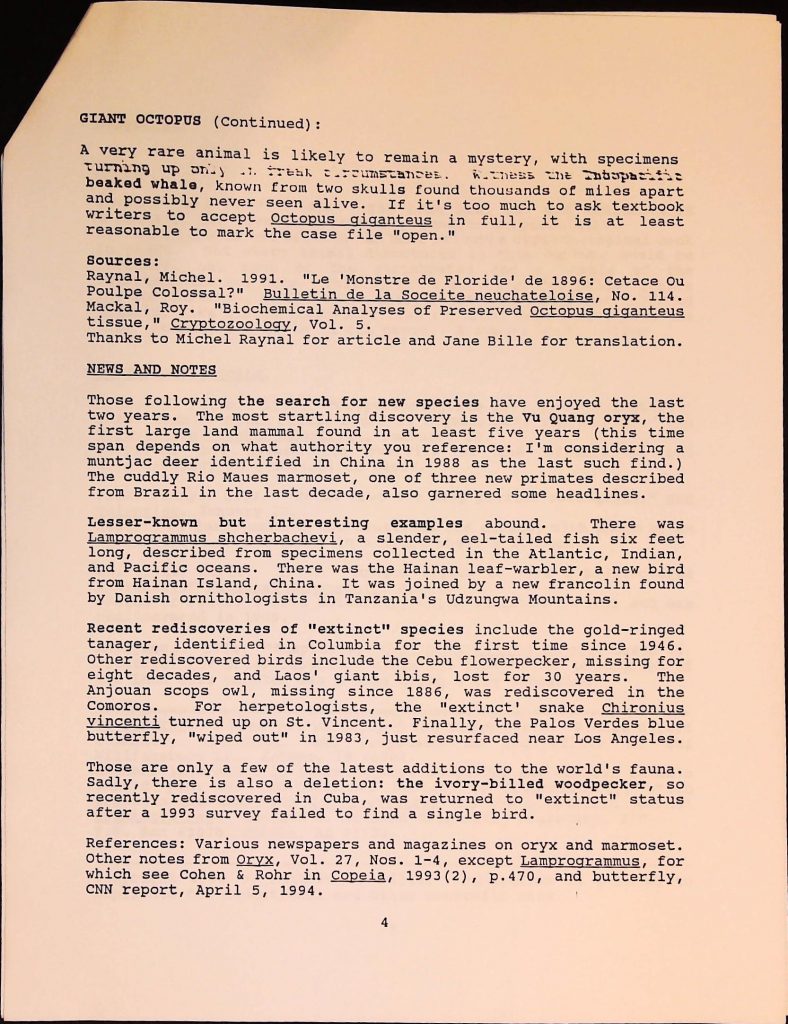
GIANT OCTOPUS (Continued):
A very rare animal is likely to remain a mystery, with specimens
Turning up only .1. Freak CUMEtances. Witness the Inbopacific
beaked whale, known from two skulls found thousands of miles apart
and possibly never seen alive. If it's too much to ask textbook
writers to accept Octopus giganteus in full, it is at least
reasonable to mark the case file "open."
Sources:
Raynal, Michel. 1991. "Le 'Monstre de Floride' de 1896: Cetace Ou
Poulpe Colossal?" Bulletin de la Soceite neuchateloise, No. 114.
Mackal, Roy. "Biochemical Analyses of Preserved Octopus giganteus
tissue," Cryptozoology, Vol. 5.
Thanks to Michel Raynal for article and Jane Bille for translation.
NEWS AND NOTES
Those following the search for new species have enjoyed the last
two years. The most startling discovery is the Vu Quang oryx, the
first large land mammal found in at least five years (this time
span depends on what authority you reference: I'm considering a
muntjac deer identified in China in 1988 as the last such find.)
The cuddly Rio Maues marmoset, one of three new primates described
from Brazil in the last decade, also garnered some headlines.
There was
Lesser-known but interesting examples abound.
Lamprogrammus shcherbachevi, a slender, eel-tailed fish six feet
long, described from specimens collected in the Atlantic, Indian,
and Pacific oceans. There was the Hainan leaf-warbler, a new bird
from Hainan Island, China. It was joined by a new francolin found
by Danish ornithologists in Tanzania's Udzungwa Mountains.
Comoros.
Recent rediscoveries of "extinct" species include the gold-ringed
tanager, identified in Columbia for the first time since 1946.
Other rediscovered birds include the Cebu flowerpecker, missing for
eight decades, and Laos' giant ibis, lost for 30 years. The
Anjouan scops owl, missing since 1886, was rediscovered in the
For herpetologists, the "extinct' snake Chironius
vincenti turned up on St. Vincent. Finally, the Palos Verdes blue
butterfly, "wiped out" in 1983, just resurfaced near Los Angeles.
Those are only a few of the latest additions to the world's fauna.
Sadly, there is also a deletion: the ivory-billed woodpecker, so
recently rediscovered in Cuba, was returned to "extinct" status
after a 1993 survey failed to find a single bird.
References: Various newspapers and magazines on oryx and marmoset.
Other notes from Oryx, Vol. 27, Nos. 1-4, except Lamprogrammus, for
which see Cohen & Rohr in Copeia, 1993 (2), p.470, and butterfly,
CNN report, April 5, 1994.

[PAGE BREAK]

RESOURCES:
BOOKS
Shuker, Karl P. N. 1993. The Lost Ark: New and Rediscovered
Animals of the Twentieth Century. London: HarperCollins.
Zoologist Shuker has written the most valuable crytozoological book
in years.
included,
Not every animal discovered in this century could be
but most of the vertebrates and a sample of the
invertebrates are here. This is not a survey of "cryptids" (there
is, for instance, no Loch Ness entry) but some still-unclassified
animals, like a huge freshwater fish reported from China, made the
cut. Sources are given in all cases. A superb contribution.
RECENT PERIODICALS.
Monaghan, Peter. 1993. "Cryptozoologists Defy Other Scientists'
Skepticism to Stalk Beasts Found in Legend, Art, and History," The
Chronicle of Higher Education, February 10.
Skeptical but sympathetic overview of the
cryptozoology on a scientific basis.
efforts to put
Park, Penny. 1993. "Beast from the deep puzzles zoologists," New
Scientist, January 23.
Reports of large unknown sea creatures off Canada, with photo of an
unidentified animal found in a sperm whale's stomach.
Weintraub, Boris. 1994. "Oregon Fights to Save a Rediscovered
Butterfly," National Geographic, April.
Status of Fender's blue butterfly, which vanished in 1931 and was
rediscovered in 1989.
Anonymous. 1994. "Snapshots," U.S. News & World Report, March 28.
Frustratingly brief report of claim the 1934 Wilson photograph of
the Loch Ness monster was a hoax using a toy submarine.
IN CLOSING: I hope you've enjoyed the first issue. Please direct
comments, brickbats, and responses to the editor at 802
Williamsburg Dr., Kokomo, IN 46902.
Readers interested in learning more about new and unknown animals
should join the International Society of Cryptozoology, which
produces the quarterly ISC Newsletter and the scientific journal
Cryptozoology. Contact J. Richard Greenwell, Secretary, ISC,
[AD] P.O. Box 43070, Tucson, AZ 85733.
Copyright 1994 by Matthew A. Bille. Permission is granted to
duplicate for educational and other nonprofit uses.

Leave a Reply

Your email address will not be published. Required fields are marked *