Cryptozoology

B4F29I1

Box 4

Folder 29. Narwhals Cryptids

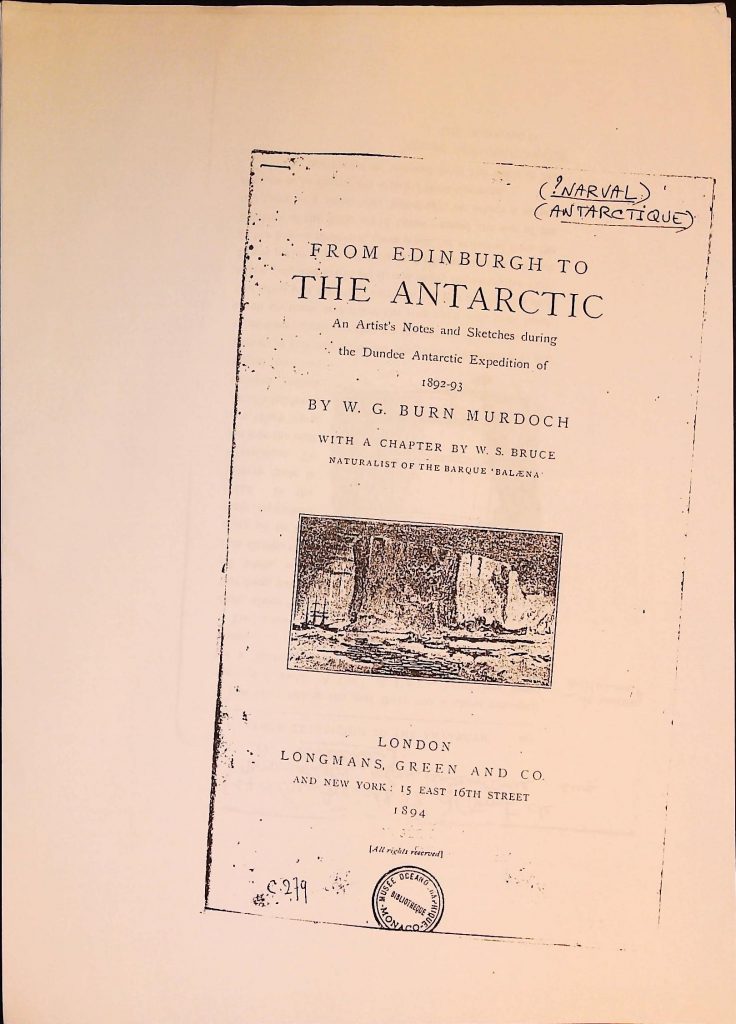
Item 1. From Edinburgh to the Antarctic


Transcribed Text (OCR)

GARY MANGIACOPA ARCHIVE
============================================================
Title:      B4F29I1
Slug:       b4f29i1
Categories: Cryptozoology
Source:     https://garymangiacopraarchive.com/b4f29i1
Pages:      4 scanned, 4 extracted
OCR:        Google Vision API (document_text_detection)
Processed:  2026-06-06
============================================================

(?NARVAL)
(ANTARCTIQUE)
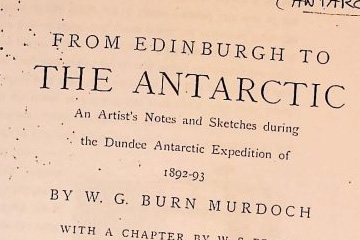
FROM EDINBURGH TO
THE ANTARCTIC
An Artist's Notes and Sketches during
the Dundee Antarctic Expedition of
1892-93
BY W. G. BURN MURDOCH
WITH A CHAPTER BY W. S. BRUCE
NATURALIST OF THE BARQUE BALENA'
LONDON
LONGMANS, GREEN AND CO.
AND NEW YORK: 15 EAST 16TH STREET
1894
279
[All rights reserved]
USEE
OCEANO
BIBLIOTHEQUE
NOW.)
APHIQUE

[PAGE BREAK]

344
[17 décembre 1892, détart de
Bransfield, ocean antarctique
le Balaena,
FROM EDINBURGH TO THE ANTARCTIC
209
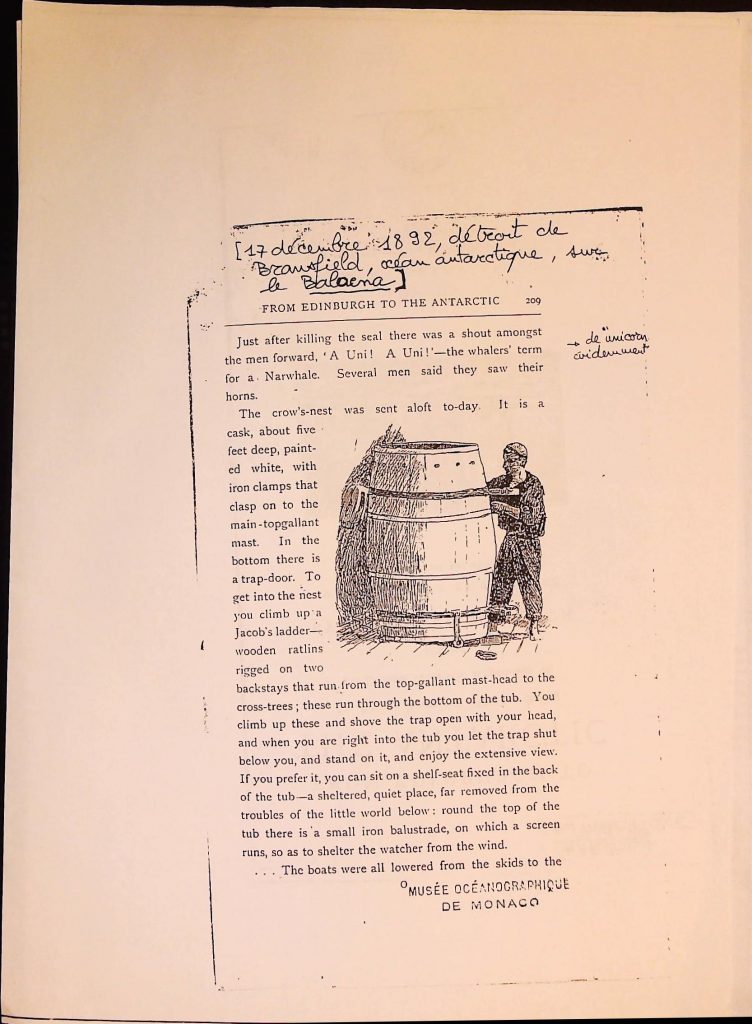
Just after killing the seal there was a shout amongst
the men forward, 'A Uni! A Uni!'-the whalers' term
for a Narwhale.
horns.
The crow's-nest
cask, about five
feet deep, paint-
ed white, with
iron clamps that
clasp on to the
main-topgallant
mast. In the
bottom there is
a trap-door. To
get into the nest
you climb up a
Jacob's ladder-
wooden ratlins
rigged on two
Several men said they saw their
was sent aloft to-day. It is a
backstays that run from the top-gallant mast-head to the
cross-trees; these run through the bottom of the tub. You
climb up these and shove the trap open with your head,
and when you are right into the tub you let the trap shut
and stand on it, and enjoy the extensive view.
below you,
you prefer it, you can sit on a shelf-seat fixed in the back
of the tub-a sheltered, quiet place, far removed from the
troubles of the little world below: round the top of the
tub there is a small iron balustrade, on which a screen
runs, so as to shelter the watcher from the wind.
If
The boats were all lowered from the skids to the
MUSÉE OCEANOGRAPHIQUE
DE MONACO
sur
→ de unicorn.
t
cvidemment

[PAGE BREAK]

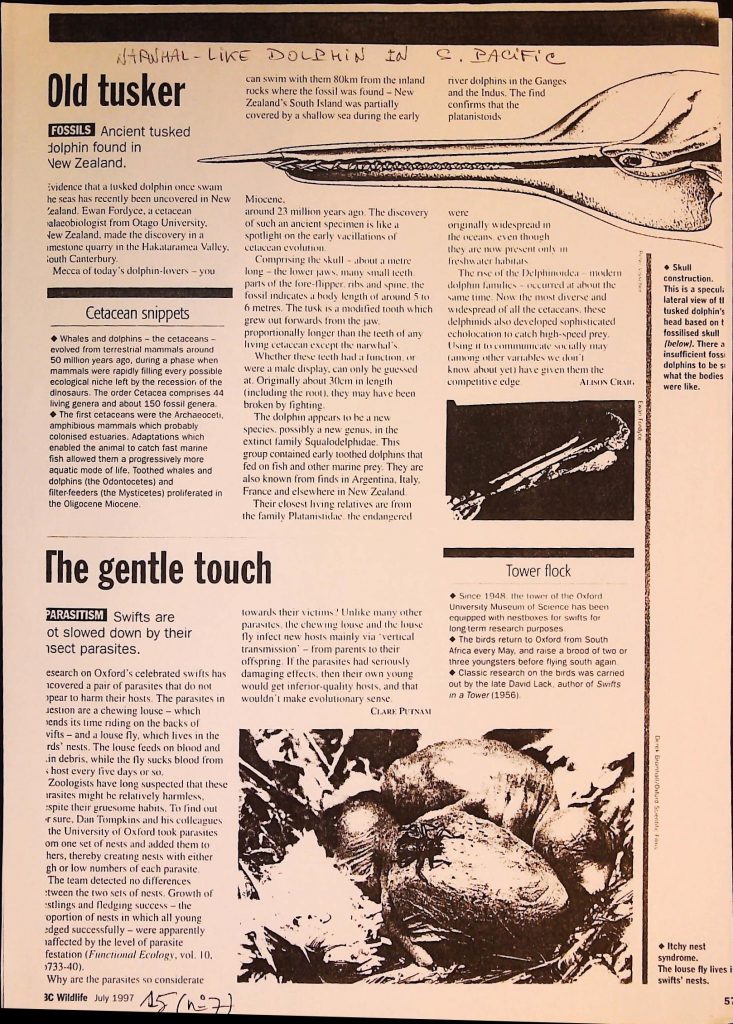
NARWHAL-LIKE DOLPHIN IN
Old tusker
FOSSILS Ancient tusked
dolphin found in
New Zealand.
Evidence that a tusked dolphin once swam
he seas has recently been uncovered in New
'ealand. Ewan Fordyce, a cetacean
alaeobiologist from Otago University.
New Zealand. made the discovery in a
imestone quarry in the Hakataramea Valley.
South Canterbury.
Mecca of today's dolphin-lovers - you
Cetacean snippets
Whales and dolphins the cetaceans -
evolved from terrestrial mammals around
50 million years ago, during a phase when
mammals were rapidly filling every possible
ecological niche left by the recession of the
dinosaurs. The order Cetacea comprises 44
living genera and about 150 fossil genera.
The first cetaceans were the Archaeoceti,
amphibious mammals which probably
colonised estuaries. Adaptations which
enabled the animal to catch fast marine
fish allowed them a progressively more
aquatic mode of life. Toothed whales and
dolphins (the Odontocetes) and
filter-feeders (the Mysticetes) proliferated in
the Oligocene Miocene.
can swim with them 80km from the inland
rocks where the fossil was found - New
Zealand's South Island was partially
covered by a shallow sea during the early
Miocene,
around 23 million years ago. The discovery
of such an ancient specimen is like a
spotlight on the early vacillations of
cetacean evolution.
Comprising the skull - about a metre
long- the lower jaws, many small teeth.
parts of the fore-flipper. ribs and spine. the
fossil indicates a body length of around 5 to
6 metres. The tusk is a modified tooth which
grew out forwards from the jaw.
proportionally longer than the teeth of any
living cetacean except the narwhal's
Whether these teeth had a function, or
were a male display, can only be guessed
at. Originally about 30cm in length
(including the root), they may have been
broken by fighting.
The dolphin appears to be a new
species. possibly a new genus, in the
extinct family Squalodelphidae. This
group contained early toothed dolphins that
fed on fish and other marine prey. They are
also known from finds in Argentina, Italy,
France and elsewhere in New Zealand.
Their closest living relatives are from
the family Platanistidae. the endangered
S. PACIFIC
river dolphins in the Ganges
and the Indus. The find
confirms that the
platanistoids
were
originally widespread in
the oceans even though
they are now present only in
freshwater habitats
The rise of the Delphinoidea modern
dolphin families occurred at about the
same time. Now the most diverse and
widespread of all the cetaceans, these
delphinids also developed sophisticated
echolocation to catch high-speed prey.
Using it to communicate socially may
(among other variables we don't
know about yet) have given them the
competitive edge
ALISON CRAIG
Pate Visscher
Ewan Fordyce
◆ Skull
construction.
This is a specul.
lateral view of tl
tusked dolphin's
head based on t
fossilised skull
(below). There a
insufficient fossi
dolphins to be si
what the bodies
were like.
The gentle touch
PARASITISM Swifts are
ot slowed down by their
sect parasites.
esearch on Oxford's celebrated swifts has
covered a pair of parasites that do not
pear to harm their hosts. The parasites in
Jestion are a chewing louse - which
ends its time riding on the backs of
vifts and a louse fly, which lives in the
rds' nests. The louse feeds on blood and
.in debris, while the fly sucks blood from
s host every five days or so.
Zoologists have long suspected that these
irasites might be relatively harmless,
:spite their gruesome habits. To find out
r sure, Dan Tompkins and his colleagues
the University of Oxford took parasites
om one set of nests and added them to
hers, thereby creating nests with either
gh or low numbers of each parasite.
The team detected no differences
tween the two sets of nests. Growth of
:stlings and fledging success - the
oportion of nests in which all
young
edged successfully - were apparently
affected by the level of parasite
festation (Functional Ecology, vol. 10.
733-40).
Why are the parasites so considerate
3C Wildlife July 1997
15/1977
towards their victims! Unlike many other
parasites, the chewing louse and the louse
fly infect new hosts mainly via 'vertical
transmission - from parents to their
offspring. If the parasites had seriously
damaging effects, then their own young
would get inferior-quality hosts, and that
wouldn't make evolutionary sense.
CLARE PUTNAM
Tower flock
Since 1948. the tower of the Oxford
University Museum of Science has been
equipped with nestboxes for swifts for
long term research purposes
The birds return to Oxford from South
Africa every May, and raise a brood of two or
three youngsters before flying south again
◆ Classic research on the birds was carried
out by the late David Lack, author of Swifts
in a Tower (1956).
Derek Bromhall/Oxford Scientific Films
◆ Itchy nest
syndrome.
The louse fly lives i
swifts' nests.
57

[PAGE BREAK]

SCHOUTEN, Guillaume (=Willem Cornelisz)
SOUTHERN NARWHAL-LIKE
ANIMAL
1619 Journal ou description du merveilleux voyage de Guillaume chouten, Hollandois
natif de Hoorn, fait ès années 1615, 1616 & 1617. Amsterdam, chez Harman Ianson : 9-
10.
(Atlantique nord, octobre 1615, à bord de l'Eendracht).
"Le 5 d'october [sic] nous nous trouvasmes à la hauteur de 4 degrez 17 minutes,
sur le midy y avoit un grand bruit au devat du navire, tellement que le maistre du
navire, estant en arrière en la galerie, pensa que quelqu'un des matelots tomboit de la
proue du navire en la mer, & redargant [sic] du costé du navire, vid que la mer
n'estoit que du sang, comme s'il y eut esté espandu beaucoup de sang, sans qu'il
sceut que cestoit ; mais trouvasmes puis après qu'un grand monstre marin avoit
heurté contre le navire avec sa corne d'une violente force car lors qu'estions arrivez
en la rivière de Porto Desire, & que nostre navire fut sur le rivage pour estre nettoyé
& calfaté, nous trouvasmes en la proue du navire environ 7 pieds [2,10 m] sous l'eau
une corne de façon & grosseur comme le bout d'une dent d'Eléphant, de longueur
environ d'un pied [30 cm], estant rompu avec grande violence & force, ayant percé le
navire tout outre, & pénétré par trois planches bien fortes & épaisses, tellement que
(sans nostre sceu) eussions esté en grand danger de perdre ensemble & le navire & la
vie."
on October 5 [161]
we were by Lideg. 17mm [N. lat.
17mm [N. lat., Allantic
Ocean]), at 12 o'clock there was a great noise at the top of the
that the master thought that one of the sailors fall into
the sea, and looking aside, saw that the sea was covered
boat, so
with blood
But we
found
that
a
great
sea in custer
found about
had checked the boat with its hoe with violent strength
because while at Porto Desire river […] we
7 feet under the water a
about s foot long
tooth
hoen like the tip of an elephant

Leave a Reply

Your email address will not be published. Required fields are marked *