Cryptozoology

B4F35I2

Box 4

Folder 35. Snakes General

Item 2. Magazine Articles


Transcribed Text (OCR)

GARY MANGIACOPA ARCHIVE
============================================================
Title:      B4F35I2
Slug:       b4f35i2
Categories: Cryptozoology
Source:     https://garymangiacopraarchive.com/b4f35i2
Pages:      24 scanned, 24 extracted
OCR:        Google Vision API (document_text_detection)
Processed:  2026-06-06
============================================================

SEA SNAKES AND SEA SERPENTS
that the water, brought in motion by the animal, dashed against
it, but immediately it disappeared again under water. The head
resembled that of a scal, its skin was also as woolly, but the body
was as thick and as long as a yacht of fifty tons, and the tail,
which seemed to be about thirty-five feet long, tapered towards
the end which was as pointed as a boat-hook."
The second account mentioned is in the form of an affidavit by
L. Von Ferry and it is of particular interest because of the de-
tails it contains. It is probably as representative as any of the tales
concerning the great sea monsters.
"In the latter end of August, in the year 1746, as I was on a
voyage, on my return from Trundheim, on a very calm and hot
day, having a mind to put in at Molde, it happened that when
we had arrived with my yacht within a mile of the aforesaid
Molde, being at a place called Jule-Naess, as I was reading in a
book, I heard a kind of murmuring voice from amongst the men
at the oars, who were eight in number, and observed that the
man at the helm kept off from the land. Upon this I inquired
what was the matter, and was informed that there was a sea-
serpent before us. I then ordered the man at the helm to keep
the land again, and to come up with this creature of which I had
heard so many stories. Though the fellows were under some
apprehension, they were obliged to obey my orders. In the mean-
time the sea-snake passed by us, and we were obliged to tack
the vessel about in order to get nearer to it. As the snake swam
faster than we could row, I took my gun which was loaded with
small shot, and fired at it; on this he immediately plunged under
water. We rowed to the place where it sank down (which in
the calm might be easily observed) and lay upon our oars, think-
ing it would come up again to the surface; however it did not.
Where the snake plunged down, the water appeared thick and
red; perhaps the small shot might have wounded it, the distance
being very little. The head of this sea-serpent, which it held
more than two feet above the surface of the water, resembled that
[197]
SNAKES AND THEIR WAYS
of a horse. It was of a greyish color, and the mouth was quite
black, and very large. It had black eyes, and a long white mane,
which hung down from the neck to the surface of the water.
Besides the head and neck, we saw seven or eight folds, or coils,
of this snake, which were very thick, and as far as we could guess
there was a fathom's distance between each fold. I related this
affair in a certain company, where there was a person of dis-
tinction present, who desired that I would communicate to him
an authentic detail of all that happened; and for this reason two
of sailors who were present at the same time and place where
I saw this monster, namely, Niels Petersen Kopper, and Niels
Nielsen Anglewigen, will appear in court, to declare on oath the
truth of every particular herein set forth; and I desire the favour
of an attested copy of the said descriptions."
my
Of course sea serpents supposedly exist in all the waters of the
world, and Australia has a goodly number of them. Not a year
passes but that one or more are reported from the Island con-
tinent. It is not often that observers of these strange creatures
have the opportunity of approaching them, even though they
may possess the desire to do so. But in June, 1930, four men who
had been fishing off the Bellambi Reef, on the south east of
New South Wales, saw a creature that they described as a sca
serpent. It broke water several times and gave the impression
of great length. Although amazed and fearful of what might
happen to them, they rowed nearer to it and were successful in
obtaining a good view of the beast. From their description of its
head, which they said resembled the beak of a pelican, Mr. David
G. Stead, the outstanding authority on the fishes of Australian
waters, concluded that the animal was probably a pike whale, one
of the common species occurring along the south shores of Aus-
tralia. It grows to more than thirty feet, the length given by the
fishermen for their "sea serpent."
A few days after the appearance of this creature a second "sea
serpent" appeared only a few miles away and was viewed by a
[198]

[PAGE BREAK]

SEA SNAKES AND SEA SERPENTS
at hand, either that the princes will die or will be banished, or
that a war will soon break out."
If we examine in detail other stories of sea serpents we will
usually find that they agree in at least some respects with the
creature described by Olaus Magnus. This serpent had scales,
as the author could not imagine one devoid of them. In the ac-
counts related by the Norse fishermen the skin was usually de-
scribed as smooth, so that we are able to observe what we may
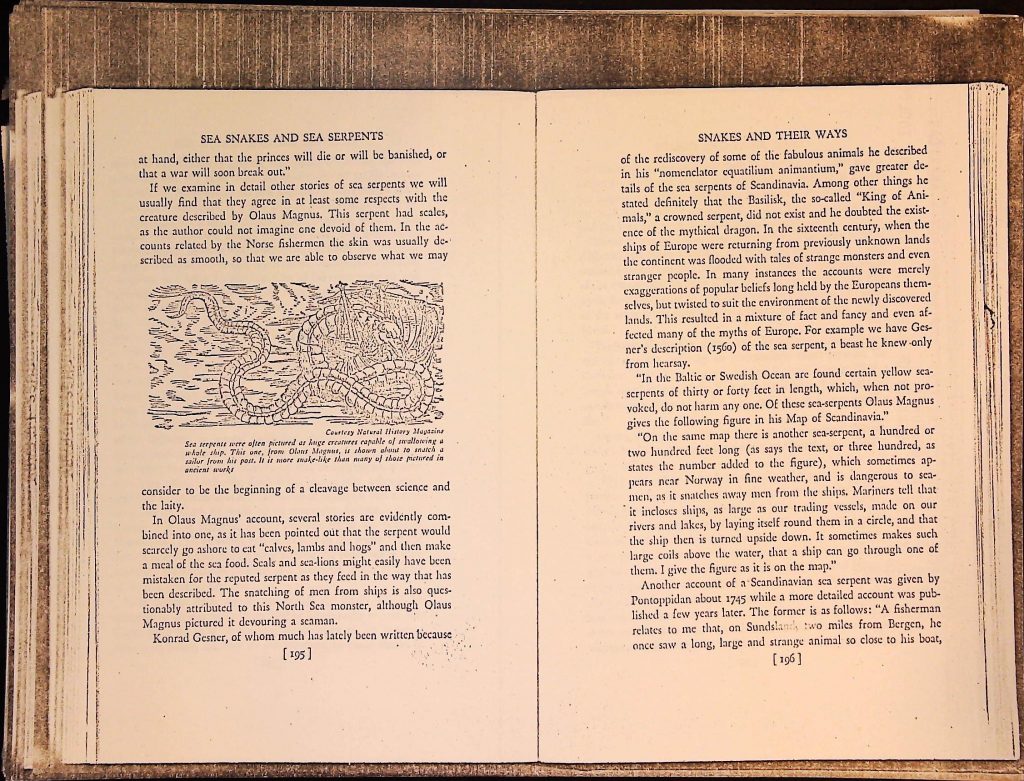
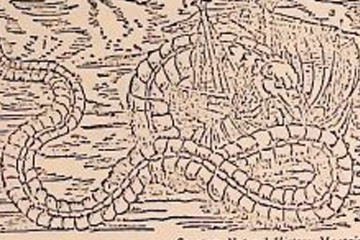
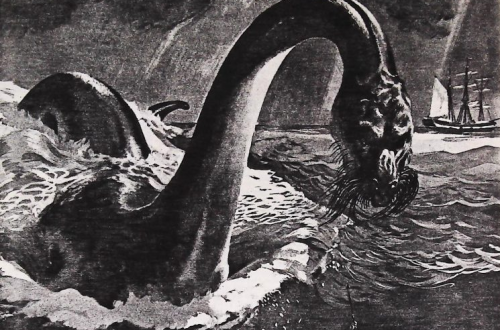
Courtesy Natural History Magazine
Sea serpents were often pictured as huge creatures capable of swallowing a
whole ship. This one, from Olaus Magnus, is shown about to snatch a
sailor from his post. It is more snake-like than many of thote pictured in
ancient works
consider to be the beginning of a cleavage between science and
the laity.
In Olaus Magnus' account, several stories are evidently com-
bined into one, as it has been pointed out that the serpent would
scarcely go ashore to eat "calves, lambs and hogs" and then make
a meal of the sea food. Seals and sea-lions might easily have been
mistaken for the reputed serpent as they feed in the way that has
been described. The snatching of men from ships is also ques-
tionably attributed to this North Sea monster, although Qlaus
Magnus pictured it devouring a seaman.
Konrad Gesner, of whom much has lately been written because
[195]
SNAKES AND THEIR WAYS
of the rediscovery of some of tlie fabulous animals he described
in his "nomenclator equatilium animantium," gave greater de-
tails of the sea serpents of Scandinavia. Among other things he
stated definitely that the Basilisk, the so-called "King of Ani-
mals," a crowned serpent, did not exist and he doubted the exist-
ence of the mythical dragon. In the sixteenth century, when the
ships of Europe were returning from previously unknown lands
the continent was flooded with tales of strange monsters and even
stranger people. In many instances the accounts were merely
exaggerations of popular beliefs long held by the Europeans them-
selves, but twisted to suit the environment of the newly discovered
lands. This resulted in a mixture of fact and fancy and even af-
fected many of the myths of Europe. For example we have Ges-
ner's description (1560) of the sea serpent, a beast he knew-only
from hearsay.
"In the Baltic or Swedish Occan are found certain yellow sea-
serpents of thirty or forty feet in length, which, when not pro-
voked, do not harm any one. Of these sca-serpents Olaus Magnus
gives the following figure in his Map of Scandinavia."
"On the same map there is another sea-serpent, a hundred or
two hundred feet long (as says the text, or three hundred, as
states the number added to the figure), which sometimes ap-
pears near Norway in fine weather, and is dangerous to sea-
men, as it snatches away men from the ships. Mariners tell that
it incloses ships, as large as our trading vessels, made on our
rivers and lakes, by laying itself round them in a circle, and that
the ship then is turned upside down. It sometimes makes such
large coils above the water, that a ship can go through one of
them. I give the figure as it is on the map."
Another account of a Scandinavian sea serpent was given by
Pontoppidan about 1745 while a more detailed account was pub-
lished a few years later. The former is as follows: "A fisherman
relates to me that, on Sundsland, two miles from Bergen, he
once saw a long, large and strange animal so close to his boat,
[196]

[PAGE BREAK]

SEA SNAKES AND SEA SERPENTS
one that had Broadway gasping and gaping something less than
a century ago. We refer to the skeleton exhibited by Dr. Albert
C. Koch, on Broadway in the year 1845 under the scientific name
Hydrarchus sillimanni. It was a complete skeleton as far as ap-
pearances go, but it had its defects. These, however, were not dis-
covered until after the animal had been noted and described in
many scientific journals and newspapers. Dr. Koch was evidently
a good showman and despite the criticism that quickly appeared,
continued to display the skeleton. One of the most emphatic and
convincing of the articles exposing Koch appeared in the "Illus-
trated London News" of November, 1848, three years after the.
first exhibition of the skeleton. It is an enlightening document
written by G. A. Mantell, a ranking geologist of the times.
"Sir, Will you allow me to correct a statement that appeared
in the last Number of your interesting publication? The fossil
mentioned at the conclusion of the admirable notice of the so-
called Sea-Serpent, as having been exhibited in America under the
name of Hydrarchus Sillimanni, was constructed by the exhibi-
tor Koch, from bones collected in various parts of Alabama, and
which belonged to several individual skeletons of an extinct
marine cetacean, termed Basilosaurus by the American naturalists,
and better known in this country by that of Zeuglodon, a term
signifying yoked teeth. Mr. Koch is the person who, a few years
ago, had a fine collection of fossil bones of elephants and masto-
dons, out of which he made up an enormous skeleton, and ex-
hibited it in the Egyptian Hall, Piccadilly, under the name of
Missourium. This collection was purchased by the trustees of the
British Muscum, and from it were selected the bones which now
constitute the matchless skeleton of a Mastodon in our National
Gallery of Organic Remains.
"Not content with the interest which the fossils which he
collected in various parts of the United States really possess, Mr.
Koch, with the view of exciting the curiosity of the ignorant
multitude, strung together all the vertebrae he could obtain of
[193]
SNAKES AND THEIR WAYS
the Basilosaurus, and arranged them in a serpentine form; manu-
factured a skull and claws, and exhibited the monster as a fossil
Sea-Serpent, under the name above mentioned-Hydrarchus. But
the trick was immediately exposed by the American naturalists,
and the true nature of the fossil bones pointed out.
"Bones of the Basilosaurus have been found in many parts of
Alabama and South Carolina, in green sand belonging to a very
ancient (Eocene) tertiary formation. Hundreds of vertebrae, bones
of the extremities, portions of the cranium, and of the jaws with
teeth, have from time to time been collected. Remains of species
of the same genus have also been found near Bordeaux and in
Malta.
"Professor Owen has shown that the original animal was a
marine cetacean, holding an intermediate place between the
Cachelots and the herbivorous species. It must have attained a
length equal to that of the largest living whales; for a series of
vertebrae was observed in situ, that extended in a line sixty-five
fect."
Among the better known of the early sea serpents is that de-
scribed by Olaus Magnus, Archbishop of Upsala, who wrote in
*555 as follows:
"They who, either to trade or to fish, sail along the shores of
Norway, relate with concurring evidence a truly admirable story,
namely that a very large serpent of a length of upwards of 200
fect, and 20 feet in diameter lives in rocks and holes near the
shore of Bergen; it comes out of its caverns only on summer
nights and in fine weather to devour calves, lambs and hogs, or
into the sea to eat cuttles, lobsters and all kinds of sea-crabs.
It has a row of hairs of two feet in length, hanging from the neck,
sharp scales of a dark colour, and brilliant flaming eyes. It attacks
boats and snatches away the men, by raising itself high out of the
water, and devours them: and commonly this does not happen
without a terrible event in the Kingdom, without a change being
[194]
gocs

[PAGE BREAK]

SEA SNAKES AND SEA SERPENTS
Mr. Edward Newman, the Editor of the Zoologist, adds:
"It is impossible for any story to read more like a hoax than
this, but I had ready means of procuring, through a friend at
Lloyd's, the information that there is such a ship as the 'British
Banner,' that she is commanded by Mr. William Taylor, a re-
spectable and trustworthy gentleman, and that she did arrive at
Liverpool on Sunday, March 18 last past, and is now in the Albert
Dock. Armed with this information I wrote to Captain Taylor,
who has replied in the most courteous manner; he confirms the
above statement, adding that he sent it to the 'Daily Post' him-
self, and adding also that the young one reported to have been
caught was presented to the Museum at Melbourne, where it was
thoroughly inspected and pronounced to be a veritable sca-ser-
pent."
If the Editor of the Zoologist took Captain Taylor's "Sea Ser-
pent" seriously, Mr. George Guyon, of the Isle of Wight, did not,
for he submitted the following poem which was duly published:
"I've a story to tell-I don't say that it's true-
But just as I heard it I tell it to you.
"A ship there was sailing upon the blue sea
With her canvas all set, when the captain, said he
"I feel that the vessel is all of a tremble,
A sort of sea earthquake it seems to resemble;
"Send forward the mate to see what is the matter.'
When lo! what he saw would have made your teeth chatter,
"An enormous big snake rising out of the sca,
Some three hundred feet long it might possibly be,
"And in bulk it might equal a 'wide crinoline'
(At least seven yards round that description must mean).
"With jaws eight feet long, and with eyes fiercely glaring,
A horn and a mane; he looked horribly daring,
[191]
SNAKES AND THEIR WAYS
"While the bowsprit he shook in his terrible mouth.
'Twas in Latitude east and in Longitude south,
"This is somewhat obscure, but I think on the whole
It occurred th' other side of the Antarctic pole,
"The ship inaking six knots-leaving foam in her wake,
Yet she stopped at the touch of this wonderful snake;
"And the Jibboom and bowsprit were snapped like a straw;
But his strength was outdone by his marvellous maw;
"For he swallowed the stay-sail and also the jib,
Like a boy gulping oysters-they went down too glib.
"With his stay to his stomach he turned him about,
with his tail such a vigorous flout,
And
gave
"That some timbers to atoms were crushed by the blow,
And what more might have happened we none of us know,
"When an object appeared for the which he set sail,
And both object and story were much like a whale."
The incident is closed by the following terse announcement by
the Editor of the same journal.
"Captain Taylor's Sea-Serpent.-A friend, who has the oppor-
tunity of communicating with Melbourne on the subject of the
young sea-serpent which Captain Taylor says (Zoöl. 6985) he
presented to the Museum at Melbourne, has ascertained through
Mr. Coates, of that town, that Captain Taylor is so far correct,
that he did at the time specified present a specimen of Pelamys
bicolor to the Museum in question, and Professor M'Coy ex-
hibited the same to Mr. Coates. Of course there is no rational
ground for concluding that this small sea snake is the young of
any such gigantic creature as Captain Taylor has described.-
Edward Newman."
We cannot dismiss the sea serpent hoaxes without referring to
[192]

[PAGE BREAK]

SEA SNAKES AND SEA SERPENTS
ually swells to a diameter of two fect in the centre, giving about
six feet girth; it then tapers off towards the tail, and ends in a
fin, which can expand in fan-shape three feet across, or close in
a sheath. Double rows of fins are alternately placed along the
belly. The head is most singular. The eyes are large, staring and
terrific, with a transparent membrane attached to the lids, pro-
tecting the cyc without impeding the vision. No gills appear.
The mouth is like that of the fish called a sucker; it can stretch
so as to swallow a body a foot and a half in diameter: there are
no teeth; a bony substance, extending in two parallel lines, covers
the upper and lower part of the head. The sides and back are
dusky brown; the belly is dirty white. Although sinuous like
a snake, there are hard knot-like substances along the back. The
harpoon is still in him. He lies in the water, confined with ropes,
which keep his body in a curve, so that he cannot get away. He
can use his head and tail, with which he stirs the water all around.
When he rears his head (which he generally keeps under water)
he presents a fearful aspect. In expanding his mouth he ex-
hibits a blood-red cavity, horrible to look at, and the air rushes
forth with a heavy short puff."
So authentic did this announcement appear that it was repro-
duced in the "Zoologist" (London) in the same year and the
story might have continued to be credited by the scientific world
but for a communication from Washington. In his letter to the
"Zoologist" Mr. Spencer F. Baird, of the Smithsonian Institution
wrote:
"You have probably since learned that the account is an un-
mitigated hoax, manufactured by a newspaper-editor while on
a summer vacation, for the purpose of furnishing material for
his editorial correspondence." It was just five years later, 1860, that
the "Zoologist" published another sea serpent story that was
equally fabulous, and again science came to the rescue. The tale
is an interesting one and bears repeating here.
"The following extract from the log of the 'British Banner,'
[189]
SNAKES AND THEIR WAYS
which arrived at Liverpool on Sunday, March 18 last, appeared
in the Liverpool Daily Post of March. On the twenty-fifth
of April, in lat. 12° 7' East and longitude 93° 52' South, felt a
strong sensation as if the ship were trembling. Sent second mate
to see what was up; the latter called out to me to go up the fore
rigging and look over the bows. I did so, and saw an enormous
serpent shaking the bowsprit with his mouth. There was about
thirty feet of the serpent out of the water, and I could see in the'
water abaft of our stern; must have been at least three hundred
fect long; was about the circumference of a very wide crinoline
petticoat, with black back, shaggy manc, horn on his forehead,"
and large glaring eyes, placed rather near the nose, and jaws
about eight feet long; he did not observe me, and continued to
shake the bowsprit and to throw the sea alongside into a foam,
until the former came clear away of the ship. The serpent was
powerful enough, although the ship was carrying all sail, and
going at about six knots at the time he attacked us, to stop her
way completely. When the bowsprit with the jibboom sails and
rigging went by the board, the monster swallowed the foretop-
mast staysail and flying jib, with the greatest apparent ease; he
also snapped the thickest of the rigging asunder like thread. He
sheered off a little after this, and returned apparently to scratch
himself against the side of the ship, making a most extraordinary
noise, resembling that on board a steamer when the boilers are
blowing off. A whale breached within a mile of the ship at this
time, and the serpent darted off after it like a flash of lightning,
striking the vessel with his tail, and staving in all the starboard
quarter galley. Saw no more of it, but caught a young one in the
afternoon, and brought it on to Melbourne.-William Taylor,
Master, 'British Banner.'
"(The British Banner arrived here on Sunday, and is now in
the Albert Dock. Captain Taylor declares that the above state-
ment is perfectly correct.-Editor Daily Post.)".
[190]

[PAGE BREAK]

SEA SNAKES AND SEA SERPENTS
head was raised high above the water and when he shook his
head water sprayed from his mane. They recovered from their
shock and paddled frantically in an effort to escape. The chase
continued for more than half a mile before the serpent, with a
snort of disgust, dived below the surface and disappeared. What-
ever the truth of this story, the two Indians actually arrived in
Orillia in a very shaky condition and with very pale faces, and
they refused to return to Rama by canoe that night.
We might have considered the condition of the men excellent
evidence that they had undergone some terrifying experience if
we had not had further acquaintance with some of their tribes-
men during the war. In view of our later knowledge, we have
long been convinced that their exhaustion was due to the fact
that they had paddled strenuously over most of the distance from
Rama in order to reach Orillia while the stores were still open.
As we later learned these Indians have the power of assuming
a deceptive appearance of extreme fatigue or illness whenever they
may gain anything by doing so.
The Couchiching sea serpent is undoubtedly a figment of the
imagination. Probably it originated from Indian mythology, al-
though we have not heard stories of the Great Serpent (as related
in tales of Gluskap) told by any of the Rama residents.
One of the most famous sea serpent stories originated in the
fertile mind of a New York newspaper man. This is one instance
in which cyc witnesses actually saw the monster and their state-
ments were entirely true, because the serpent did appear and it
remained in clear view for some time. It was a really fine practi-
cal joke. The sea serpent was constructed by the newspaper man
in his summer home. A wire was run from the shore to a sub-
merged anchorage, and the sea serpent was fastened to the end
in the water under cover of darkness. By tightening the wire the
"monster" was drawn beneath the surface. At an appropriate time
it was permitted to come to the surface before witnesses, and a
furor of excitement and publicity followed. Newspaper reporters
[187]
SNAKES AND THEIR WAYS
rushed to the scene and the telegraph flashed the news around
the world. The head and neck of the "serpent" appeared above
the surface of the water, swaying slightly from the action of the
waves. From all descriptions it must have been a very baleful
looking creature. The secret of the "scrpent's" origin was finally
released, but this created no such sensation as its original appear-
ance. Many sea serpent hoaxes have been quickly exposed. On
August 13, 1855, the "Buffalo Daily Republic" announced the
capture of the great American water-snake in Silver Lake, near
Perry Village, New York.
"On Sunday, the 12th, the snake came to the surface displaying
a length of thirty feet. On Monday morning all were on the alert.
At nine o'clock he appeared between the whaleman's boat and
the shore: he lay quiescent on the surface, and the whaleman's
boat moved slowly towards him, Mr. Smith, of Covington, point-
ing his patent harpoon. On reaching within ten feet of the snake,
the iron whistled in the air, and he darted off towards the upper
part of the lake, almost dragging the boat under water by his
movement. Line was given him, and in half an hour his strength
seemed much exhausted. The whaleman then went ashore and
gradually hauled the line in. When within fifty feet of the shore,
the snake showed renewed life, and with one dart nearly carried
off the whale line, but he was dragged slowly ashore amid ex-
citement unexampled in the district. Four or five ladies fainted
on seeing the snake, who although ashore, lashed his body into
tremendous folds, and then straightened himself out in agony
with a noise that made the earth tremble. The harpoon had
penetrated a thick muscular part, eight feet from his head. He
is fifty-nine feet eight inches in length, and has a most disgust-
ing look. A slime a quarter of an inch thick covers his body, and
if removed is instantly replaced by exudation. The body is varia-
ble in size. The head is the size of a full grown calf. Within
eight feet from the head the neck gradually swells to the thick-
ness of a foot in diameter; it then tapers down, and again grad-
[188]

[PAGE BREAK]

SEA SNAKES AND SEA SERPENTS
been practically unknown. Today Loch Ness is as well known,
by name at least, as Piccadilly, the Strand or Broadway, and the
notoriety that was attached to the discovery of the strange mon-
ster has resulted in a great influx of tourists and much business
for the canny Scottish folk who inhabit its shores.
There have been two explanations of the identity of the Loch
Ness monster. One is that it was nothing more or less than a seal,
the other that it might have been a killer whale. There is no abso-
lute proof of its identity, but the conclusion that it was a seal,
reached by Mr. Hinton, keeper of mammals at the British Mu-
scum of Natural History, may be accepted without reservation.
The assertion of Dr. Roy Chapman Andrews, of the American
Museum of Natural History, that the photograph submitted to
him resembled in appearance the dorsal fin of a killer whale offers
another possibility.
Unfortunately the scientific explanation of sea serpents is not
nearly so exciting as the news of their discovery. In comparison
to the serpent itself, the animal responsible for the news flash is
usually a very mundane creature and the scientist who exposes
it is of much less importance than the person who first saw it.
We do not wish to give the impression that scientists are always
trying to take the joy and thrills out of the lives of those who
make phenomenal discoveries. The opposite is really true. No
scientist living could find greater pleasure than in the discovery
of a sea serpent. He would be eminently more satisfied by the
receipt of a sca serpent than of any other animal, and he would
consider it a great honor to be able to announce that he had at
last found a real onc.
Sea serpents date as far back as our history goes and many of
the fables concerning them probably were handed down from
prehistoric times. They owe their origin to some incident that
could not be properly explained by our ancestors and, as a result,
they took on supernatural significance and became associated with
the gods of mythology. Despite the old storics some of the re-
[185]
SNAKES AND THEIR WAYS
cently discovered sea serpents are more interesting. There is
"Old Faithful," that sportive inhabitant of the Pacific, that pays
an annual visit to the waters separating Vancouver, British Colum-
bia, from Vancouver Island. Old Faithful got his name because
of the regularity with which he has appeared. Just how long he
has been putting in an appearance we do not know, but it has
been a great many years; if memory serves us rightly, since
shortly after the beginning of the present century.
British Columbia had another sea serpent which was once
quite active but which has not been seen for some years. This
serpent first attracted attention when the apple growing industry
was at its zenith in the Okanagan Valley. The "snake" appeared
in Okanagan one summer and drew a great deal of attention to
that region. It was a most obliging animal because it appeared
several times that t and was seen by a large number of people.
For several years following it was reported almost annually.
Speculation linked it up with Vancouver's Old Faithful but the
connection was never proved.
year
The Lake Couchiching sea serpent must be more than thirty
years old if he is still living, for he first came to our notice more
than thirty years ago and he was a very sizable creature at that
time. The residents of the town of Orillia have long been anxious
to capture him, and we know of at least one expedition that set
out with this purpose in mind. However, he has not put in an
appearance since the beginning of the World War. Shortly be-
fore that time it was reported that he frightened two Indian
residents of the reservation at Rama almost to death. According
to the story related by these braves, they started out from Rama
in the late afternoon to paddle the three miles to Orillia. They
had covered more than half the distance and had passed Grape
Island when they heard a furious commotion in the water bc-
hind them. Looking back such a horrible sight met their eyes
that they were terrified into immobility. Glaring at them with
burning, baleful eyes was the huge sea serpent. His horse-like
[186]

[PAGE BREAK]

SEA SNAKES AND SEA SERPENTS
they are seldom seen, but when the sea becomes rough and
choppy they are usually much in evidence, the sea appearing to
be alive with them.
From an examination of the stomach contents it has been
found that certain species show a preference for members of the
catfish family. Anandale, who has spent the greater part of his
life in India, and whose studies of the sea snakes have been very
extensive, states that the spines of these fish are worked out
through the body wall of the snake during the process of diges-
tion. It is difficult to understand how the snake could survive
the puncturing of the stomach and body wall, but apparently
it is able to do so.
Various forms of animal and plant life frequently attach them-
selves to sea snakes. They are often found literally covered with
sea weed and barnacles. These organisms are not parasitic, since
they do not injure the snake in any way unless their presence
impedes its progress through the water. When present in number
they do, of course, more or less conceal the ground color of
their host, but it is not likely that they make the snake more
conspicuous. The presence of seaweed on the snakes should aid
concealment. The snakes are not always on the move but wrap
themselves about any convenient objects such as seaweed, anchor
chains, etc. It is while they are resting that the young of the
barnacles settle upon them, as they do upon any hard object with
which they come in contact.
. Man cannot be considered inimical to sea snakes but they are
not without their enemies. Sea eagles snatch them from the surf
and fly with them to a convenient perch where they tear them
apart, warding off by means of beating wings any attempts of
the snake at self-defence. It is also likely that they are eaten by
other large sea birds and fish.
The sea snakes belonging to the group known scientifically
as the Laticandinae differ considerably from other marine snakes.
They resemble land snakes in having broad ventral shields.
[183]
SNAKES AND THEIR WAYS
Through use of these they are able to travel on land and are far
from helpless when brought up in fish nets. They have been
seen leaving the sea and crawling up on the rocks in native vil-
lages where fish are being dried in the sun. When disturbed they
drop to the ground and quickly make their way to the water.
The snakes of this group are egg-layers, going up on land to
find a suitable place in which to deposit the eggs. Both the egg-
laying habit and the presence of the ventral shields are primitive
conditions, and both may be considered as a hindrance to a
strictly marine existence. They indicate clearly that this group
represents a transitional stage between the terrestrial elapines and
the strictly pelagic forms.
The breeding season is probably spread over the entire year,
but too little is known for us to be at all definite on this point.
Wall has observed that certain species double their length in a
single year and others become fully mature in this space of time.
These, however, are not as prolific as some of the others, giving
birth to as few as two or three young at a time. The young de-
velop within the female, the mature embryos being enclosed in
membranous sacs, as in other ovoviviparous snakes.
Although there is no evidence that "Sea Serpents" actually
exist, these fabulous creatures must receive considerable attention
book dealing with the habits of snakes. Some of these
in
any
reputed reptiles obviously could not have been snakes because
they were described as having smooth, slimy skins. Despite this
we shall consider them along with the rest of the mythical crea-
tures that have so excited the minds of scientists with doubt and
of laymen with wonder and awe. The duty of the scientist is to
determine the identity of all sea serpents, and in these days, with
rapid transportation and telephotos, any mystery that might
surround the identity of the serpent of the moment is quickly
cleared up. As an example of this we have only to consider the
Loch Ness monster that a few years ago focussed the attention
of the whole world on a tiny area, the existence of which had
[184]

[PAGE BREAK]

SEA SNAKES AND SEA SERPENTS
or struggle in a most futile manner. This helplessness is not en-
part by the
tirely due to the shape of the body but is accounted for in great.
type of scalation. The large ventral scutes that provide
the means of locomotion in land snakes are absent in all but onc
group of sea snakes, being replaced by scales. The scales, which
do not overlap, are usually small and are provided with keels
that
may be produced into spines and tubercles.
Some of the species are enormously enlarged on the posterior
part of the body where the girth may be four or five times that
of the small anterior part and head. An arrangement of this sort
naturally enables the stomach to hold large prey. Such species
are known to exist chiefly on cels.
The sea snakes have two general types of color pattern. The
commonest is a greenish-gray ground color crossed by black or
second
dark brown bands that generally entirely encircle the body. The
has
type
a dorsal coloration of black or dark brown that
changes abruptly to yellow or yellowish-white below, the tail
being pale with dark markings above. Both types of coloration
are protective. The camouflaging of ships during the world war
was based upon the same principle that nature has employed
for millions of years-the breaking up of solid colors in order
to conceal the outline of an object when viewed from a distance.
This same principle is further illustrated by the markings of the
strongly banded water snakes and many other animals, and it is
surprising how efficient it proves as a method of concealment.
The dark dorsal and pale ventral coloration is extremely 'com-
mon in the animal kingdom and is also scen in birds. The diffi-
culty of locating shore birds while they are still is well known
to all bird lovers, the color combination breaking up the ventral
shadow and literally cutting the bird in half from a visual point
of view, so that the shape is deceptive. A uniformly colored snake
or bird is much more easily seen than a bicolored one, a fact
that can be quickly proven during almost any stroll through the
country.
[181]
SNAKES AND THEIR WAYS
Sea snakes are equipped with fangs on the front of the upper
jaw, as cobras arc. There has been little experimentation with
their poison but it is known to be many times more toxic than
the cobra's and to have a neurotoxic reaction that is particularly
effective on cold-blooded animals. This is to be expected, inas-
much as cels and other fish comprise their dict.
Sea snakes do not have a bad reputation as regards their rela-
tionship to man. They are principally dangerous to bathers dur-
ing or after a storm. During the monsoons they are washed
ashore in large numbers, the mangrove swamps sometimes
swarming with them following a particularly heavy storm. It is
then that they constitute the greatest danger. In their frantic at-
tempts to prevent themselves from being washed ashore as they
are buffeted about in the surf, they grasp anything that comes
their way, sinking their teeth in and hanging on desperately.
If they should get hold of a human being the result would prob-
ably be fatal. So far as we know there have been no scientific
observations made of the effect of sea-snake venom on humans
but there are records of deaths. We have an unconfirmed report
of the death of a German investigator off the coast of Panama
many years ago but have been unable to secure details. No other
death in American waters has come to our notice.
In regions where sea snakes are numerous the native fishermen
hold them in great contempt, picking them up and tossing them
back into the sea without any thought of danger. Almost every cast
of nets results in the capture of numbers of sea snakes, which are
quickly disposed of in the way described. In view of the large
numbers encountered by the fishermen in sorting their catch it
seems remarkable that so few bites result. Wall, watching some
fishermen who were using lines, noticed with considerable amuse-
ment that Enhydrina schistosa, one of the common sea snakes in
those waters, took the bait more frequently than fish.
Travelers in the tropical waters of the orient may sometimes see
these snakes in almost countless numbers. During calm weather
[182]

[PAGE BREAK]

I'
CHAPTER XIV
SEA SNAKES AND SEA SERPENTS
T MAY seem odd that any snakes should have taken up a
strictly marine existence, especially if we consider the fact
that their distant ancestors came originally from the sea in
order to seek a less crowded domain and fresh supplies of food.
But, like other groups of animals, certain of them, again in
search of food, have returned to the environment in which prim-
itive life began, because there they could find food in abundance.
In order to understand this seeming paradox it is necessary to
remember that the reptilian ancestors which crawled from the
water were very different from snakes and that the world was
still uninhabited by present day mammals, birds and reptiles, all
of which are descended from the same ancestral stock. Almost
all mammals can swim naturally, but they must be looked upon
as mere novices when compared to snakes. Because of their build
and flexible spinal column snakes are admirably adapted for
swimming. It is not at all strange, then, that many kinds are
found in the ocean and never come to dry land.
Sea snakes themselves are derived directly from the cobras
and their allies (Elapidae), but they have undergone so much
modification that they are placed in the family Hydrophiidae
(meaning water snake). As is to be expected because of their
relationship to the cobras, all are poisonous. Some of them are
beautifully colored and resemble certain cels so closely that they
have actually been confused by some scientific workers.
At the present time the sea snakes are limited to tropical waters
extending from America to Asia and Africa, but there is a pos-
[179]
SNAKES AND THEIR WAYS
sibility that they may eventually find their way into the Atlantic
ocean. Up until the time of the opening of the Panama Canal the
range of these snakes was definitely limited by the cold waters to
the north and south and the barriers provided by the great land
masses, so that there was no possibility of their rounding the tips
of the continents in the south or gaining entrance through the
Mediterranean. However, man may have provided the necessary
access to the Atlantic by the building of the Panama Canal. It
is scarcely necessary to go into details regarding the means by
which the snakes could find their way into the Atlantic. Perhaps
they never shall. There are two barriers to their becoming estab-
lished east of the American Continent. To do so they must pass
through the canal in sufficiently large numbers to breed without
interruption. Furthermore, the large body of fresh water consti-
tuting Gatun Lake, through which they would have to pass be-
fore reaching the salt water of the Atlantic, may be a barrier. We
cannot be certain that this is an actual barrier because sea snakes
have been found a hundred miles up tidal streams where the
amount of salt in the water must be extremely small. Gatun Lake,
of course, is entirely fresh water.
All of the fifty or more sea snakes are powerful swimmers,
their tails being vertically flattened and providing perfect paddles
for propulsion through the water. It is not known just how long
they can remain submerged, but reliable investigations indicate
a period of at least eight hours. Since they breathe free air, as do
all other snakes, the nostrils are modified so that they may be
closed, thus preventing the entrance of water into the lungs when
the snake dives beneath the surface. Since the lung is large and
provided with a storage space for air, and respiration is slow, the
snakes are able to remain submerged for long periods of time
without discomfort.
On land most of these snakes are helpless. Their body is usually
gently arched so that the dorsal length is greater than the ventral.
As a result, when brought to land they lie helplessly on their sides
[180]

[PAGE BREAK]

SEA SNAKES AND SEA SERPENTS
number of people, all of whom were able to give clear accounts
of it. The animal, they said, was about eighty feet long. It seemed
to be traveling very leisurely with an undulating motion toward
Bellambi Reef, its huge shining back head rising in the air and
disappearing, giving the impression that it was feeding. From
time to time the head shot upward at the end of a long, serpent-
like neck.
Once more we take the identification of this creature from the
records of Mr. Stead. He says that the descriptions were suffi-
ciently clear to identify the animal as a great calamary, cuttle-
fish or giant sea squid, called "Polypus" in many of the old
accounts. These animals are huge molluscs and are distantly re-
lated to the octopus, differing in that they have an extra pair of
tentacles (ten instead of eight), the sucking discs of which are
located on large, broadened pads at the end of the extra pair of
enormously long arms. The natural habitat of these great cal-
amaries is the ocean depths where they are believed to exist in
enormous numbers. Occasionally one comes to the surface and
is apparently unable to return to its normal haunts because its
body becomes inflated by gases when the pressure of the ocean
depths is released.
The great calamaries are the prey and the enemy of the mighty
sperm whale, since they form the only food of these huge
cetaceans. But, as is often the case with predacious animals, the
sperm whale is not always able to overcome its intended victim
and is sometimes killed by a calamary. Before explaining how
this is accomplished let us first consider the Noumea sea serpent.
The Noumea, New Caledonia, sea serpent came into promi-
nence only a few years ago. It was first sighted on September 22
by two native women who were crossing a bay about eight miles
from Noumea, their attention being attracted to it by a terrific
detonation. Turning around they saw the weird creature about
eighty yards off. It whistled for some seconds and blew to a great
[199]
SNAKES AND THEIR WAYS
height a jet of smoke and then a torrent of water. It made a
heavy swell and splashed on the sea with a tremendous noise.
When it lifted its head and tail out of the water they were able
to observe that the back of its head was clothed with long hair.
Later they sighted it going in the direction of Noumca harbor.
On September 30 it was again observed, this time about two
miles from Noumea harbor. In this description it is said to have
thrown its body out of the water "like a mast."
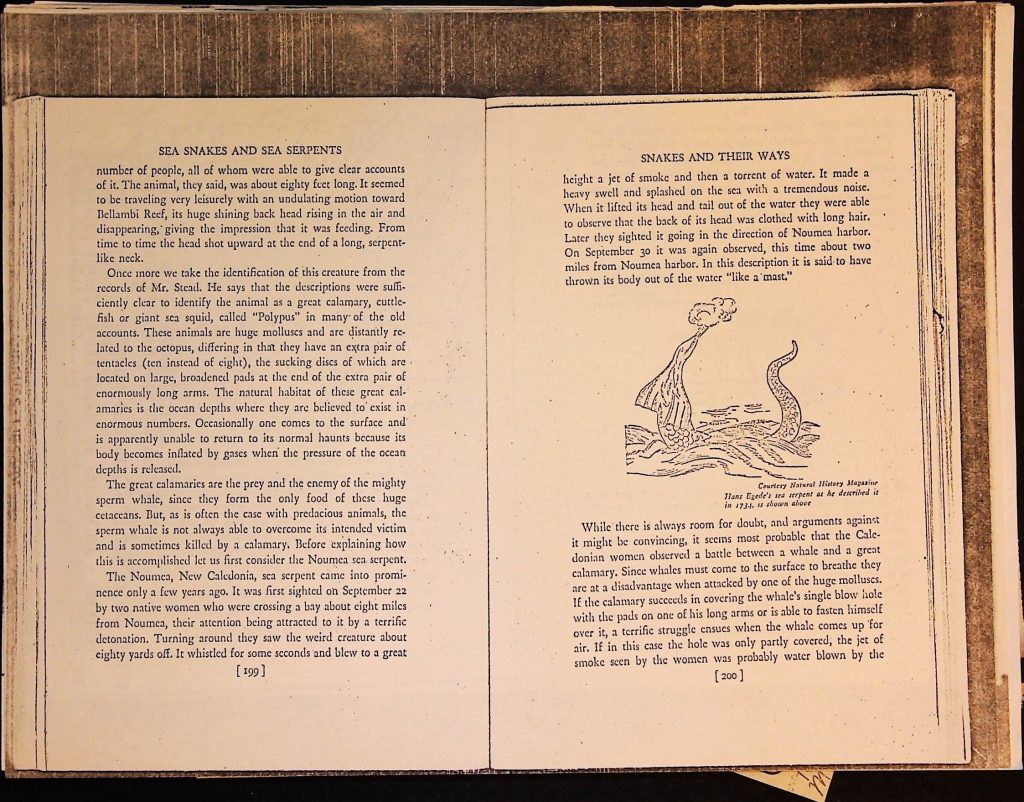
Courtesy Natural History Magazine
Hans Egede's sea serpent as he described is
in 1734, is shown above
While there is always room for doubt, and arguments against
it might be convincing, it seems most probable that the Cale-
donian women observed a battle between a whale and a great
calamary. Since whales must come to the surface to breathe they
are at a disadvantage when attacked by one of the huge molluscs.
If the calamary succeeds in covering the whale's single blow hole
with the pads on one of his long arms or is able to fasten himself
over it, a terrific struggle ensues when the whale comes up for
air. If in this case the hole was only partly covered, the jet of
smoke seen by the women was probably water blown by the
[200]

[PAGE BREAK]

God heart genera
SEA SNAKES AND SEA SERPENTS
whale and colored black by an inky substance secreted by the
calamary. The breaching of the whale with the attendant impact
of its heavy body on the surface of the water would account for
the terrific noise they heard, while the "hair" on the serpent's
neck may have been the calamary's tentacles. The second sea
serpent near Noumea might have been a great calamary, possibly
the same one that had attacked the whale.
It is casy to understand how these giant molluscs are mistaken
for sea serpents. They grow to great length-a hundred feet or
Courtesy Natural History Magazine
It is easy to see the similarity between this
drawing of a giant squid and Egede's sea
serpent. There is no doubt that these mal.
luses have often been mistaken for the Jub-
ulons monsters of the deep
more, if we include the long arms. The sucker discs on the ends
of the arms vary in shape in the different species. They may be
triangular, oval, or more or less round. The suckers are located
on the tough stalks and are sometimes armed with retractile.
claws. The prey is grasped by the long arms and dragged toward
the mouth until all the tenacles are able to come into play. When
they swim the calamaries move backwards through the water
with great speed. If they happen to be at the surface, the tail,
[201]
SNAKES AND THEIR WAYS
which also varics in shape in the different kinds, bobs in and
out of the water, while the long arms move with an undulating
motion.
Some scientists explain all the "great sea serpents" by the single
word "calamary." This is not sufficient explanation, but it is un-
doubtedly true that a great many of the hundreds of reputed sea
serpents were actually calamaries. But there are many other ex-
planations. Whales, dolphins, sharks, floating sea weed, scals
and numerous other denizens of the deep have all been mistaken
for the "great sea serpent." We might add that lines of sea birds
are also thought to have given rise to sea serpent stories.
Snakes and their Ways
1937) Harper & Brothers Nil
printed in U.S. second edition
Charles
by C. Howard Curran - Dept of
American Museum
and.
Entomology
of Natural History
Hauffeld curator of reptile
Staten & dard Zoological society
[202]

[PAGE BREAK]

Oft 6 1 min
cord was a
Malaysia in
following
killed one
convicts at
umbar. Hn
piy. and
oils of the
lks of the
and on
eight feet
Malaya
ngth and
Cerved in
portal for
in Malay
d for re-
Pin for a
3.camp on
ay Arch
was given
explorer
tha
a place
schooner
op on the
mjungle.
of a huge
few days
very***
ddra.co
could
as ab.
25 Ju
its ..:
surv. n
ed. 1:
li and os
was.
been...
few t
the uppe
1,[cr
4 be
relat: A
ptual
no lo:
whi
557
ggest fossil snakes Gigantophis and
udtsoia did not exceed 10-11m 33-36ft. Un-
fortunately many people often forget that all animals
hust live within the laws of physics and chemistry,
and the height of absurdity was reached in February
1980 when an Indonesian newspaper carried the
following item:
'A giant python was crushed by a bulldozer at a
forest project in N Bengkulu, SW Sumatra. The
snake contained four human corpses, two of which
.ppeared to have been recently devoured as they
were still in their shorts and trousers. Ine operator
of the bulldozer battled for over an hour with the
two mammoth snakes, each reported to be about
25 metres (82.5 ft) long, before one snake killed
been
ind the other escaped. Larger snak
reported.'
The largely aquatic anaconda (Eumectes murinus) of
the swamps, lakes and slow-moving rivers of tropical
South America and Trinidad has also been credited
with the title of 'longest snake in the world' but
although it is the heaviest of the giant serpents - a
17 ft 5-2m anaconda will scale as much as a 24 ft 7.3m
1. reticulated python - great bulk can often be mislead-
ing when it comes to estimating length.
To prove this point A Hyatt Verrill (1937) once
asked the other members of an animal-collecting
expedition he was leading in Guyana to estimate the
length of an anaconda they had spotted curled up on
a rock. The estimates varied from 20 ft 6.1m to 60 ft
18.3m, but when the snake was shot and straightened
out it was found to measure exactly 19 ft 6 in 5-9m.
although it was exceptionally bulky and scaled 360 lb
163kg.
Also complicating the issue is the fact that the
anaconda has probably been the subject of more
exaggerated claims regarding its size than any other
living animal. The early Spanish settlers called it
'matatora' (buil-killer) and spoke of individuals
measuring 60-80 ft 18-24m. but even larger snakes
have been reported.
In January 1948, for instance, a 'sucuriju gigante
(giant boa) in asuring 40 131 in length and
weighing an estimated 5 tonnes was allegedly
captured alive atter a band of Indians found it sleeping
off a heavy meal on the banks of the Amazon. The
snake was later towed to Manaos, W Brazil by river
tug where it was the object of some curiosity until its
life was snuffed out by a burst of machine-gun fire
(Dinsdale, 1965). Later the same year another one
measuring 35. 115ft was reportedly killed at Fort
Abunda in th Guapore District, SW Brazil after it
had crawled into the old fortifications (Heuvelmans,
1958), and in 1954 a length of 36 m 118ft was quoted
for another serpentine colossus shot by a Brazilian
army patrol at Amapa on the French Guiana border
(Gregor, 1962). Needless to say nothing was pre-
WOOD (Gerald L.);
Reptiles 107
served of any of these outsized individuals, and two
published photographs were valueless because no
yardicks were given.
Fortunately some of the carly explorers and
natulis who visited South America were much
mor citical in their accounts of this giant snake.
Capt, Stedman (1796), for example, who travelled
extensively in the Guianas between 1772 and 1777,
said the largest anaconda killed by him measured
22 ft in 6-8m. Sir Robert Schomburgk (1847-48),
the German explorer, collected one in British Guiana
which ped exactly 18 ft 5-49m, and Alfred Wallace
(185), who explored large parts of Amazonia, wrote
that he never saw an anaconda over 20 ft 6.1m,
although he was told by his native bearers that they
were sometimes 60-80 ft 18-24 m.
Nicholas Guppy (1963) collected an anaconda in
the Yampari River, Guyana which measured 17 ft
3 in 5-26m and had a maximum girth of 28 in 71 cm (it
had just constricted an 8 ft 2-4 m alligator), and on
another occasion he shot a much larger example on
the banks of the Kassikaityù River in the extreme
sout of that country. Unfortunately this one fell
into very deep water and could not be recovered, but
Guppy and the rest of his party all agreed that the
snake must have been at 27 ft 8.2 m long.
Many extreme measurements have been based on
the lengths of skins, but these records are unreliable.
It is virtually impossible to remove the skin of a
snake without stretching it by at least 10 per cent,
and in the case of the anaconda and other heavy
snakes the skin can be deliberately stretched without
much distortion to the markings by 30 per
causing
cent or more.
T
The American Consul at Iquitos, Peru told
Leo Clark, the American explorer, that many of
the conda skins brought to the city by traders
cacl year measured 40 ft 12.2m, and Thomas
Barou claims he saw a 45 ft 13.7m skin (Perry,
1970)
In the 1920s Raymond L Ditmars, Curator of
Reptiles at New York Zoological Park personally
offe$1000 to anyone who could supply him with
naconda skm measuring over 40 ft 12-2m, but
the eley was never claimed.
Ce of the longest anacondas ever captured was a
treneriously bulky individual shot by W L Schurz
(19) Brazil which measured 27 ft 9 in 8-46m in
leng nd had a maximum girth of 44 in 1-12 m. Its
wei-1
din
Cla
was not recorded, but a snake of these
sons would probably scale about 450 lb 204 kg.
collected another one near Iquitos which taped
26f8-15m, and an anaconda measuring 26 ft 3 in
8-00m was killed in Pernambuco State, E Brazil in
(1948. A 26 ft 7.9m female shot in Nariva Swamp,
Trinidad contained a 5ft 1.5m alligator in her
stomach (Oliver. 1963), while the 10 m 32 ft 10 in skin
Guinness Book of Animal Facts and Feats
Enfield
Guinness. Superlatives,
Ltd
3rd ed., 1982) [p. 107]

[PAGE BREAK]

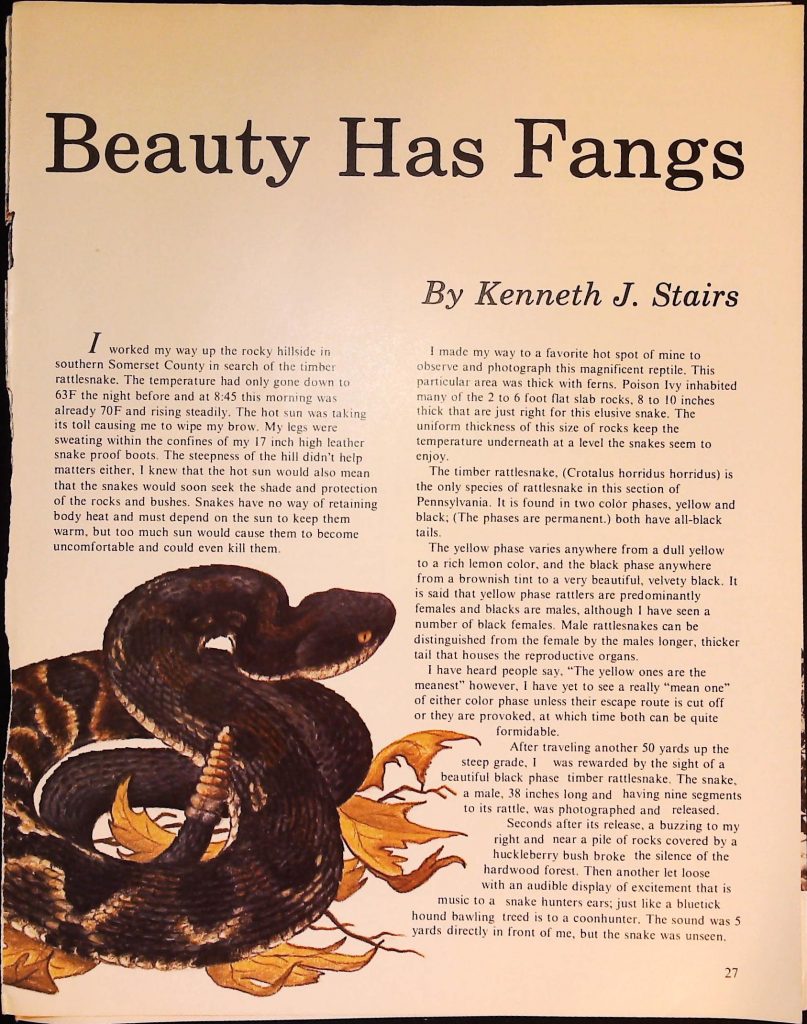
Beauty Has Fangs
By Kenneth J. Stairs
I
worked my way up the rocky hillside in
southern Somerset County in search of the timber
rattlesnake. The temperature had only gone down to
63F the night before and at 8:45 this morning was
already 70F and rising steadily. The hot sun was taking
its toll causing me to wipe my brow. My legs were
sweating within the confines of my 17 inch high leather
snake proof boots. The steepness of the hill didn't help
matters either, I knew that the hot sun would also mean
that the snakes would soon seek the shade and protection
of the rocks and bushes. Snakes have no way of retaining
body heat and must depend on the sun to keep them
warm, but too much sun would cause them to become
uncomfortable and could even kill them.
I made my way to a favorite hot spot of mine to
observe and photograph this magnificent reptile. This
particular area was thick with ferns. Poison Ivy inhabited
many of the 2 to 6 foot flat slab rocks, 8 to 10 inches
thick that are just right for this elusive snake. The
uniform thickness of this size of rocks keep the
temperature underneath at a level the snakes seem to
enjoy.
The timber rattlesnake, (Crotalus horridus horridus) is
the only species of rattlesnake in this section of
Pennsylvania. It is found in two color phases, yellow and
black; (The phases are permanent.) both have all-black
tails.
The yellow phase varies anywhere from a dull yellow
to a rich lemon color, and the black phase anywhere
from a brownish tint to a very beautiful, velvety black. It
is said that yellow phase rattlers are predominantly
females and blacks are males, although I have seen a
number of black females. Male rattlesnakes can be
distinguished from the female by the males longer, thicker
tail that houses the reproductive organs.
I have heard people say, "The yellow ones are the
meanest" however, I have yet to see a really "mean one"
of either color phase unless their escape route is cut off
or they are provoked, at which time both can be quite
formidable.
After traveling another 50 yards up the
steep grade, I was rewarded by the sight of a
beautiful black phase timber rattlesnake. The snake,
a male, 38 inches long and having nine segments
to its rattle, was photographed and released.
Seconds after its release, a buzzing to my
right and near a pile of rocks covered by a
huckleberry bush broke the silence of the
hardwood forest. Then another let loose
with an audible display of excitement that is
music to a snake hunters ears; just like a bluetick
hound bawling treed is to a coonhunter. The sound was 5
yards directly in front of me, but the snake was unseen.
27

[PAGE BREAK]

Both snakes were sending warnings but the probability
of capturing both was slim. One would seek a quick
getaway when I moved in on his or her den mate. I chose
the second rattler because there were no bushes, just a
rotting oak log. I carefully peered over the log, and there,
coiled in a classic striking pose, was an adult yellow
phase rattler.
The snake was a fine specimen. Its skin, bright yellow,
was apparently created by a recent shedding.
I stretched my snake hook over the mossy old log and
gently picked up the now angry viper. The snake was
thoroughly enraged so I decided not to measure it. After
photographing, it was released near the basking area.
Needless to say, the other snake was nowhere to be
found. Basking areas are where snakes can get easy
access to the warming rays of the sun, usually near the
tops of mountains with a southern or southeastern
exposure. Since I was not far from my truck and medical
attention I didn't mint hunting this area alone, but I
never hunt a remote area without a companion.
I have never heard of a timber rattlesnake's fangs
penetrating a good pair of leather hiking boots however,
I like a little higher protection, affordable snake-proof
boots, when in the woods looking for snakes. There are
plastic and canvas leggins on the market that afford good
protection in snake country. I have used the plastic type
in the past but, have found the snake proof boots more
to my liking.
Rattlesnakes start their journey back to the den from
their summer retreats anywhere from mid-August to early
September, depending on the weather. These snakes will
sometimes travel over a mile from the den, although it
has been my experience to notice many rattlers at dens
all summer long.
Rattlesnakes are active in Pennsylvania from mid-April
to mid-October, again depending on the weather.
Mating usually takes place in the spring of the year,
although recent observations indicate that mating may
take place throughout the entire summer. Blacksnakes do
not mate with rattlesnakes as some people contend.
Although rattlesnakes, copperheads, garter snakes,
milksnakes and blacksnakes may share the same winter
quarters, that is as far as it goes.
The next place to investigate was the rock ledge on top
of the hill there I always found something to
up
photograph.
Much to my disappointment the ledge revealed nothing
more than several chipmunks running across the rocks as
though they had something very important to do.
A check of the time showed 12:30 and time to start
back down the hillside. Just as I was about to enter the
laurel thicket, I saw it, about 3 inches of the rattlers'
dark colored tail stuck out from under the lichen covered
flat rock. A quick grab and a tongful of leaves told a
disappointing story. Judging from the small tail of the
snake, I guessed it to be a young snake probably born
the previous year.
There are probably as many theories on the proper
method of treating snakebite as there are different brands
28
of fishing rods. I feel the American Red Cross is
probably the most accepted method. In any case, when a
snakebite is encountered remain calm and seek medical
attention immediately.
I ended my day on that mountain and left with
pleasant memories and some good photographs. Many
times I have gone out all day and haven't seen a trace of
a buzztail, so this day I felt quite fortunate.
This denizen of the rocky hillside is slowly being
nudged out of its environment due to the ever increasing
urbanization of man, therefore it is imperative that we as
sportsmen and conservationists keep a close check on this
beautiful creature.
The female rattler gives live birth to four to 15 young,
10 to 12 inches in length, usually in September.
Totally capable of caring for themselves, these small
creatures blend very well into their new surroundings.
Their venom is not of the same volume as adults, but
what they lack in quantity they make up for in
determination. They are usually quite bold and will strike
wildly when threatened.
About seven to 10 days after arriving into their new
unsure world, they shed. This shedding rids them of the
button shaped appendage at the end of their tail called
the pre-button, and gives them their first real ornament.
This button cannot be heard until the snake sheds again,
giving it a segment and a button that can be heard at
short distances.
Timber rattlers shed two to five times a year and a
segment is added each time. An adult rattler with a
button is rare because the rocks that these reptiles inhabit
usually break them off. The most segments I have seen
on a rattlesnake in its natural surrounding has been 14.
The amount of segments are not a determining factor
of age however, short tapered segments indicate a young
snake, long tapered segments the older snake, and wide
segments of uniform width the old snake.
The timber rattlesnake is an inoffensive serpent that
would rather run than fight. If you see a rattler in the
wilds, observe at a distance and appreciate the beauty of
nature you have just witnessed.
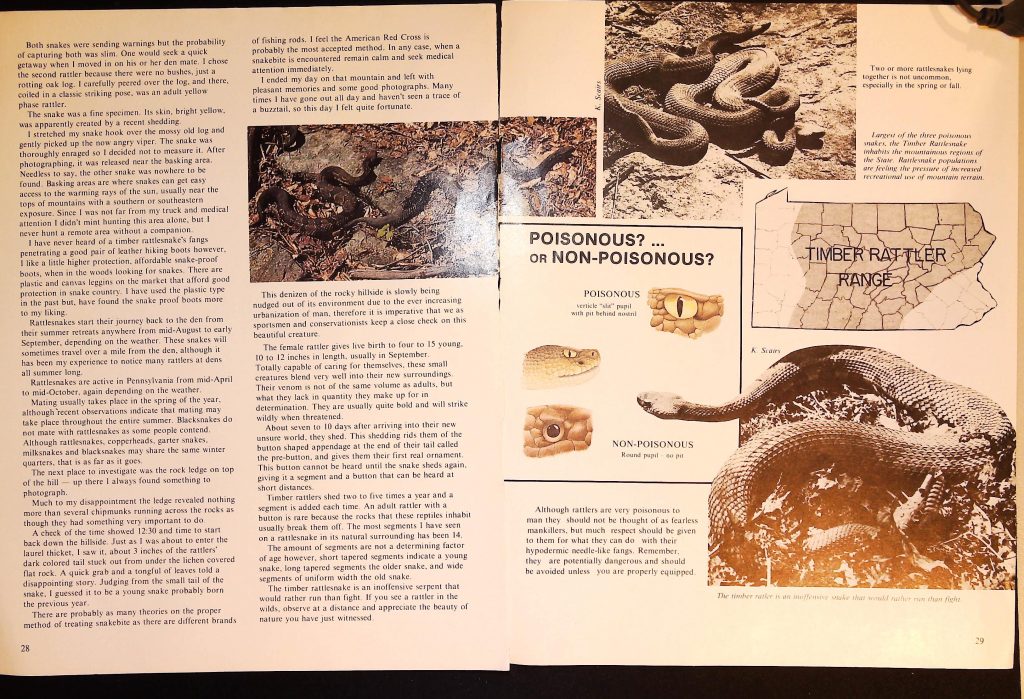
K. Scairs
POISONOUS?
OR NON-POISONOUS?
POISONOUS
verticle "slit" pupil
with pit behind nostril
NON-POISONOUS
Round pupil no pit
Although rattlers are very poisonous to
man they should not be thought of as fearless
mankillers, but much respect should be given
to them for what they can do with their
hypodermic needle-like fangs. Remember,
they are potentially dangerous and should
be avoided unless you are properly equipped.
K. Scairs
Two or more rattlesnakes lying
together is not uncommon.
especially in the spring or fall.
Largest of the three poisonous
snakes, the Timber Rattlesnake
inhabits the mountainous regions of
the State. Rattlesnake populations
are feeling the pressure of increased
recreational use of mountain terrain.
TIMBER RATTLER
RANGE
The timber ratler is an inoffensive snake that would rather run than fight.
29

[PAGE BREAK]

EVOLUTION WATCH
How the Snake Lost Its Legs
Snakes, researchers once thought, descended from humble burrowing lizards. New evidence suggests
a marine pedigree, and a family tree that includes 45-foot reptiles.
A
LL VERTEBRATES THAT LIVE
on land-from humans to alli-
gators to birds-are collectively
known as tetrapods, meaning
"four feet." The name sticks even though
the legs to which two of these feet are at-
tached have become arms in humans
and wings in birds. In snakes, the change
was even more radical; they lost all four
of their limbs. One of the few remain-
ing signs of their limbed heritage is the
presence of vestigial hips imprisoned in
the rib
cage.
rachis problematicus (meaning "prob-
lematic thick-ribbed animal"), was dis-
covered in the late 1970s by quarry work-
ers 12 miles north of Jerusalem. After a
preliminary study, Hebrew University
herpetologist George Haas suggested
that while the fossil looked serpentine,
there was no evidence that it was closely
related to kes bere matters rested
until 19, hiel Lee of the
Univers or racy in Australia and
Michael well of the Field Museum
in Chicago came to Jerusalem to study
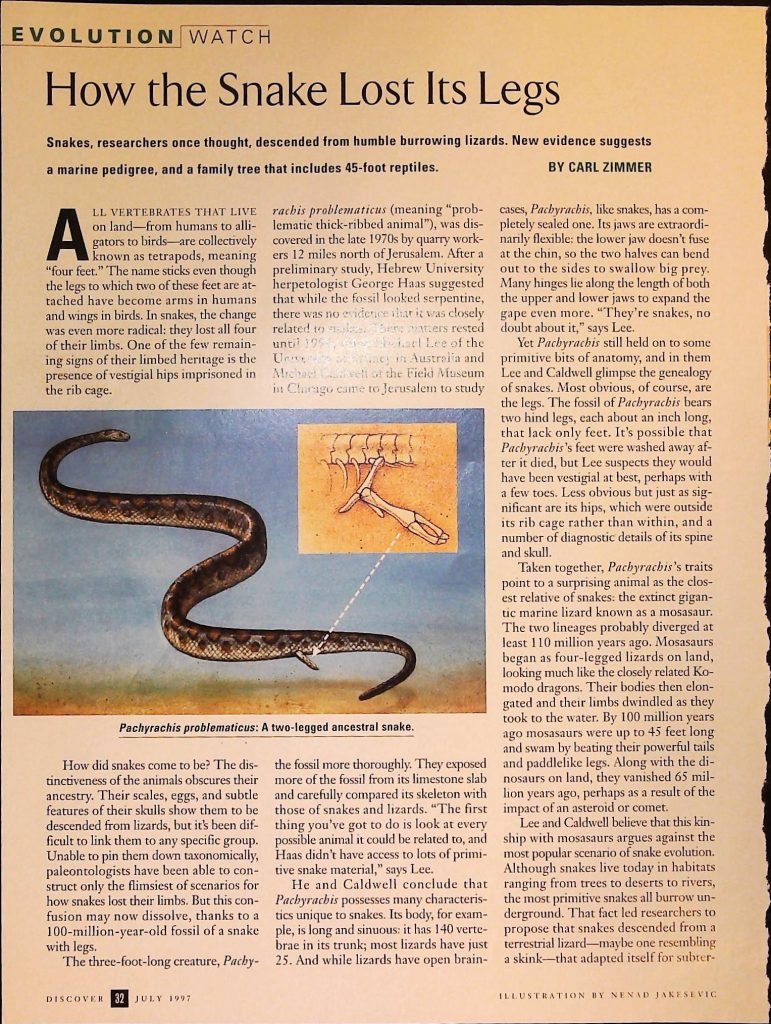
Pachyrachis problematicus: A two-legged ancestral snake.
How did snakes come to be? The dis-
tinctiveness of the animals obscures their
ancestry. Their scales, eggs, and subtle
features of their skulls show them to be
descended from lizards, but it's been dif-
ficult to link them to any specific group.
Unable to pin them down taxonomically,
paleontologists have been able to con-
struct only the flimsiest of scenarios for
how snakes lost their limbs. But this con-
fusion may now dissolve, thanks to a
100-million-year-old fossil of a snake
with legs.
the fossil more thoroughly. They exposed
more of the fossil from its limestone slab
and carefully compared its skeleton with
those of snakes and lizards. "The first
thing you've got to do is look at every
possible animal it could be related to, and
Haas didn't have access to lots of primi-
tive snake material," says Lee.
He and Caldwell conclude that
Pachyrachis possesses many characteris-
tics unique to snakes. Its body, for exam-
ple, is long and sinuous: it has 140 verte-
brae in its trunk; most lizards have just
brain-
open
The three-foot-long creature, Pachy- 25. And while lizards have
DISCOVER 32 JULY 1997
BY CARL ZIMMER
cases, Pachyrachis, like snakes, has a com-
pletely sealed one. Its jaws are extraordi-
narily flexible: the lower jaw doesn't fuse
at the chin, so the two halves can bend
out to the sides to swallow big prey.
Many hinges lie along the length of both
the upper and lower jaws to expand the
gape even more. "They're snakes, no
doubt about it," says Lee.
Yet Pachyrachis still held on to some
primitive bits of anatomy, and in them
Lee and Caldwell glimpse the genealogy
of snakes. Most obvious, of course, are
the legs. The fossil of Pachyrachis bears
two hind legs, each about an inch long,
that lack only feet. It's possible that
Pachyrachis's feet were washed away af-
ter it died, but Lee suspects they would
have been vestigial at best, perhaps with
a few toes. Less obvious but just as sig-
nificant are its hips, which were outside
its rib cage rather than within, and a
number of diagnostic details of its spine
and skull.
Taken together, Pachyrachis's traits
point to a surprising animal as the clos-
est relative of snakes: the extinct gigan-
tic marine lizard known as a mosasaur.
The two lineages probably diverged at
least 110 million years ago. Mosasaurs
began as four-legged lizards on land,
looking much like the closely related Ko-
modo dragons. Their bodies then elon-
gated and their limbs dwindled as they
took to the water. By 100 million years
ago mosasaurs were up to 45 feet long
and swam by beating their powerful tails
and paddlelike legs. Along with the di-
nosaurs on land, they vanished 65 mil-
lion
years ago, perhaps as a result of the
impact of an asteroid or comet.
Lee and Caldwell believe that this kin-
ship with mosasaurs argues against the
most popular scenario of snake evolution.
Although snakes live today in habitats
ranging from trees to deserts to rivers,
the most primitive snakes all burrow un-
derground. That fact led researchers to
propose that snakes descended from a
terrestrial lizard-maybe one resembling
a skink-that adapted itself for subter-
ILLUSTRATION BY NENAD JAKESEVIC

[PAGE BREAK]

ON
- ODD
INTEREST,
22
Notes.
SEX.
color, grows greatly
Aval ruffles or plaiting for
ings.
populer shades for parosols.
red, bright blue and old
A MONSTER SNAKE.
possible, kill the much-feared serpent.
Owing to the funlaif they were obliged
The Carious Slaht Witnessed by a Miner to move cautiously, but they were a [Wash
Hunt in a Colliery.
Since Friday last
writes under a late date as follows:
A Minersville Pennsylvania corres
pondent of the Philadelphia Times,
A new
politics, is s
city. It will
will have for
resolute lot and pushed on sturdily,
through shallow lakes of inky water.
excitement over a monster shake that John Mulhearn clutched his
over heaps of fallen slate, rock and
(arth, until they were a mile from the
Then the damp became so
and began retracing their steps, explor editor, Hon. W. V
Mine Hill Gap have beto shake that in the breasts as they went suddenly published the C
local editor is W. Ch
entrance.
e Greenaway figures appear on mining patches in the living in the bad that they were unable to go further our enemies; hone
ders for trimming aprons
resses.
and
place of the white and tinted mulls
Batiste and nun's veilings take the
ed last summer.
ough,
reflect upon
ach right unfashionable.
of
neighborhood of
old Mayflower Colliery, a few miles from into an old chamber, whispered in tones (Washington
lives in the abandoned working of the comrade by the arm, and pointing up Spicy articles may be locked
this place. On
drove
up
They looked and saw glaring out of!
that while passing Carey's patch, north eyeballs that moved backward and for-
Mr. W. v. Turner, of Raleigh. N. C
BER, a paper in the interest
its way down the mountain side, fol. finding it to
Striped hosiery retains its popularity Rev. Alfred R evening the that chilled his hearers: "There it is."
Little girls wear their hair flowing at of the "Gap," he saw a snake between ward as the serpent swayed its neck. of agonism,
on on, in spite of the efforts to render it to the Mansion House and that cimmerian cavern a pair of blazing has commenced the publication of the
Agence of the the back or aranged in long, loose curis thirty and forty feet long and as thick They must have passed within fifty feet "honey for friends and stings for ene
as the body of an ordinary man winding of the reptile when they came in, and, mies." The BEк LeRibs to practice
do not hesitate
been apt scholars.
but banged in front.
An imported English riding hat is a
al which has
Actors in ante-bellum felt hat furned up in three corners and lowed by a wriggling stream of- small return, completely Pectedly on their with its stings just as the fangs of the
4, and there are living
evel best to solve the
the strenuous efforts put
nat direction. When I was
Ath to have from four to six wives,
de majority of whom were colored
women. I know a white Negro in this
city whose father was his master, and
to treat silk and other fabrics, and it is
substance.
Courtship and Marriage in Germany.
reptiles.
posite side of the ravine, and within
had an excellent view of them. The
way.
seen.
As they did
[Arkansas Man
The following new exchanges are
tend to them our journalistic hand, and
them which can be brought to light for
decorated with feathers and a rosette.
Paraffine dissolved in naptha is used leisurely, and stopped every few minutes
to his instructors. True, this is an iso. which gives them enough for comfort tell his remarkable story.
The monster moved very they backed quickly out of the gang-
There their courage revived, and
that Negro, or nondescript, is a disgrace their income from the Government, /ed witness drove here with all speed to down into the gangway.
said that the most delicate hues of ground and utter a peculiar whirring of buckshot from half a dozen shotguns
to raise its head several feet above the they re entered and discharged a volley
serpent ap to the mouth of the tunnel,
The hunters followed the trail of the
where they held a caucus, and decided
armed party, headed by Captain Daniel exits from the old workings, and im -
Dorr, went to Carey's patch in search of prison the great snake alive. A charge
unnerved them, and Item became hushed and still is desit
paper has yielded up the glost.
it being understood bore that that
Carey's patch, and in the mad found the work was finished before dark yesterday,
along it was a common thing material thus prepared will not be sound. As Mr. Rossiter was on the op into the breast in which the python was been added to our list this week: The
When the echoes died away they Radical, of Hope, Arkansas; BEE,
e highly moral white men of the injured by ice cream or any foreign three hundred yards of the snakes, he heard the monster winding his way Washington, D. C.; Expositor, of Bal-
snakes disappeared in the black mouth of among the debris in the breast, hissing eigh, N. C; Headlight and Arkansas
As most gentlemen in Germany derive the Mayflower tunnel, and the astonish-showers of dirt and bits of slate rattling ansaw Traveler, of this city. We ex-
venomously as he went, and sending Methodist, of Morilton, Ark, and Ark.
His hearers not care to continue the chase they welcome them in the field, especially
GUARD lated case, yet there are handreds of but not for extravagance, their wives were inclined to be skeptical at first, returned to the entrance, and, as a last the Radical and BEE, as the beat the
but his manner was so earnest that an resort, they resolved to close all the same political sword that the Mansi
All their doubts vanished mouth, and the same power was used
The victims of their adulterous and if she happens to have a great talent when they crcs-ed the ravine below successfully on tne cave-in holes. This Washington, D. C. This ber is a
C, ou bly be held accountable for what has and she devotes all her time and energy trail of the huge reptile. The trail was and the people feel comparatively safe; industrious, obtain its share of cial
to the cultivation of that talent, until a trifle over thirteen inches wide, and but it will be years before they forget
to resent the civilization of other days- she appears as one of the great players the impress in the mud an inch deep. the excitement this wonderful serpent working bees can scarcely survive and
SE 19, 1881.
airy wers a licentions and lewd set in
the mere asking. The Southern chiv-
are obliged to be very careful in their
brought up in strict economy
expenditure, and their daughters are
the New York their day, and they are not much better Therefore, after German young lady evidence corroborative of Mr. Rossiter's of dynamite did the work for the tunnel
in this enlightened period.
onal Colored
saw an ad
d its aaj contemptible practices can not reasona-
To happened; they are here, and they rep-
e the guiding and restraining influence
of Anglo Saxon rule-the vice, immor.
has left school her real work begins.
for music, everything else is given up,
of Germany.
medicerity, she is not encouraged in
throwing away her time in musical
If it seems likely she will remain in
statement.
caused.
The Cheerful Goat.
e of our wonen under that peculiar practice, but she then qualifies herself Shenandoah for "RattlesLake Tom," ar
to return to Minersville and on to The town goat has the run of the
on was neither spared nor re-
lity and lewdness of the Christian (?)
of the Southern Confederacy. The
of the sunny South had to
for being a help to her mother by learn-
by killing snakes for their oil.
old man who has for years earned a liv-
does.
[Virginia Star!
We have before us the first number
of the BRE, a new journal started in
first-rate one and it will no doubt, if
honey, etc, in a profession wher
[Journal of Progra
where drones utterly and queries
Be a busy bee and gather i
every opening flower of opportunity
It is with pleasure we place apa or
exchange list, the Ben a weekly paper
Messrs. Turner and Hamio, and elded
The passions peculiar to the ing cookery, dressmaking, ironing, pick- ing night nothing was talked of but goat is composed mainly of horns, hair published in Washingtes, C
and the fruits of that un-
ous union were in many
d of on the auction
death by the hands
them existence.
ling and preserving vegetables for the
winter.
in the history partner for life.
care for beauty in a wife if not accom-
panied by more enduring qualities, and
they are very cautious in choosing a
As a rule, German gentlemen do not
ain to curse
eir
relations
When not en-
the bark off the neighbors' fruit trees,
beer keg, in front of the corner grocery,
respected and feared by all who are
empty sardine boxes. The town goat is
he may be found standing on an empty
gaged in butting the breath out of some
member of his own family, or peeling
gleefully chewing wrapping paper and
printed.
is a seven column foliosper, wo
BEE and its able managers
was at one time one of the sc
colored men of the State W
by William V. Turner, forment of
Alabama. He is an able werd
[Chronicle, Evan
We welcome to our exchange site
men, her domestic
Before ingratiating himself with the
parents, sisters, brother and servants.
the big snake. On Friday morning and digestive organs.
, which is no trifle, for not heard a quarter of a mile.
wood wife, he engages himself to her fifty yards away, and from that struc
town. He is not domestic in his habits.
ung lady then begins to make sists that its hissing could have been
utes after the big snake made its ap-
above the mouth of the Mayflower tun-
strange ball was composed of thirty or
near by. He says it is about thirty five
God and father's consent to visit at his house scales, each of which is as large as the
ed and that he may observe the young lady in balm of a man's hand. Its head is acquainted with his eccentricities of
themselves. They got apart, however,
with remarkable celerity and quickly
nate, who young lady, the gentleman first asks her covered with black, red and green
lies ranged themselves in a twenty-foot eir-
If her conduct toward them is irre-liams first saw the snake he, for safety, washing, break several windows, and
proachable and he thinks she will make clambered up Sugarman's old breaker, pursue thirty-seven dogs in the adjoin-
He is seldom ever seen asleep. The
bel and coil itself on a little plateau
David William Williams, a miner, saw
the serpent come ont of a "cave-in"
ho furniture, household pearance a perfect ball of rattlesnakes splinters broken off him at every curve
came rolling out of the tunnel. The and angle of his anatomy, yet withal he
feet long, nearly two feet thick and
is cheerful and frolicsome. His jaunty
[Nows, Wason,
tht of a bride is three to five feet in length, and so pearance, that causes some people to
"yes are large and fiery. When Wal. He can be relied on to eat a week's lished at Washington, DC
and twined and locked togeth. surmise that he isn't all that he should
er were they that it appeared as though be, but they julge him too hastily, as
toward her adorned with a yellow crest, and its character. He is a very reliable animal. BEE. a well-edited weekly oral a
they would never be able to separate people of strong prejudices are prone
ture looked down on the monster. Its half the time. Policemen shoot at journalism. It is elited in
A few min- of hot water on him. As a result of and neatly printed.
bim, boys try to discourage him with City, by Mr. William V.
forty rattlers, each measuring from tail gives him a debonair and rakish aplished in
ele, in the center of which, with head last week to an old party named
The BEE is a newspaper abi
these assaults, he usually bas chips and unbounded success
stones, and housekeepers empty kettles erly of this State. It is
ing yard all in one day, and not work made its appearance the
changing rings, for in Germany head was held erect, and Williams in-
have wedding rings.
to provide her own ward-
crockery, pots and
verything necessary
ment.
of Pickford's
Ossips as
wn Paper.
twisted
it. The perfect silence which
a moment or two after the circle
coiled the "king stake," as people here
erect, glaring eyes and rising crest, was
to do.
lives on an oatmeal diet and
who owns a goat. Old man M
Whirter, who lives in Wiscons
of his money. On Mond
in which every tail thing last week, Mr. McWhirt
suggested by an incident that happen
These remarks about the goat are
med was broken by a
used
taken off his oak
morocco pocket b
ment bonds to
Why Mr. Mo
the yard feeding th
ed to don'le its former
d and that portion of
right swayed to and
effect on the king snakb. 1rs
much enlarged, the yel
with the rattling in the se
thing was that
tling at the
then left
in his pock
and
he hac
The EE,
and William
tend
venture
and
YO
will be
paper di
rule we mu
picnic.
Invitations
The promenade a
on Friday was a fail
The strawberry
heen in progress
Church closed Frid
The
Prof. Philip Pat
lectured last Taced
ball was crowded w
Sparta enic i
isit we
Park was an event
ment.
Acess
A plenic was give
N1, for the bese
Lodge. No. 1374, a
sold at a redne
Seventh stre
If Cong
hdren's clo hin
The largest stock
kin

[PAGE BREAK]

side time.
then took his de
y sintom of the
ng in the street, ran
Fellow, etcbanging
day, the
of the wart
supplemented by a grant the
the
Everyta nx, was the answer.
now tuit in October, we hold
echanic Baldiz ere, which will be
Fecing
000ssion will be the are ver
Bat will give yo
The session will . held in
Zn M. Church three days, aud
colored order in this
amme a few days."
The
an Uab,
cons marry
as while the
had the power,
en wrested from
Le: the
It is too soon to
of superonity over the
of other sections of this country
Font of morality, virtue an I chastity"
let the South rejoice in the fact
broken more hearts, rained more virtu-
tabas produced more illegitimates,
the land with illigimate
and husbandless wives is any
Now, shat up Mr. Secesh
ani demoralize the Negro than any
other people on the face of the earth.
web and done more to disgrace
JOB BUSKER
Republican ex-cutive
Dallas county, Alabama, and speaks for
committee of
Hon. Wm. J. Stevens, chairman of the
The following communication is from
SELMA, June 12, 18-2.
ters
kioris
Own Paper
garter of
after the big s
fauce a perfect ba
* rolling out of 10
forty
bre
themselves.
call it
et were they that it app as
they would never be ato
twisted and twined and torsed t
The perfect
They get part, however,
with remarkable exterity and quickly
of the ladice ranged themselves in a twenty food cir
was formed was brokes by
le, in the center of which, with hid
Padelphia seems erect, garing eves and rising crest, was
coiled the king stake" people bre
lasted a moment or two after the circle
phia Times adds
wards of that e ty.
ily Dab is distict physician in
The Philatel
One of them, Dr.
ot, bus ist been appointed
entrusted with the healing
The list of those who have gradas-
e ted from the college and have earned
emmandable pstions is a credita
sofient recognition for their skill to
the Norristown at patal. Dr.
Harrisburg, whore Dr. Margaret Cleves,
another assistant. Dr. Agnes JohnsCD,
physien in the female department of
of Zacaville, Ohio, is the assistant
physics to the Athens, Oats, insane
Dr. Aloe Bennett is the chief
Ana Kizler is the assistant physician
at the tate apital for the men at
a graduate of the lows adical college
is the chief, and Dr. Jane Garver is
311
the resident by an
Web
same instant,
chorus, in which every tail was used
eyes became much enlarged, the yel
low crest swelled to don'le ita tormer
its body that was upright swayed to and
fro in perfect time with the rattling
The most remarkable thing was that
every shake stopped rattling at the
wonderful effect on the king sah
sze while its bead and that portion of
Three of the largest rattlers the left
the circle, and approached the king.
rattling as they west. Reaching his
lussing loudly, moved down the hall
body their tails became silent, and he,
rattlers followed in his track, but male
the platforms below the breaker. The
NO ROSA
king soak stationed himself on the
Reaching the platforms, the
fallen to decay. The all ke
- wk. Mr
bacal
i porket inscal of p
Ditoreo cat-book
ment is to the am
Way Mr. Mer carr
he bad attended to the wants of
tha gatment ising in the mad
toof of the enteken ep
and turnedt et hus cat, be
gost had pulled of the fence, as
within the range of McWhirter's visio
asd a rock that the eit man pro
stool balasong himself on the
seating what
bis direction he was in the
835
Tenant of a red mene poket-book
A e afil and debarack, t
sonth side, which is open aid of the misfortune aased on M War
ter and he realiz! that bis two thos
the starry of four do
asdelars in boals were dawaY IN
at beweest to his feelings 10
yell take the wad of a
the resident after all the snakes except the big one.
went under the platforms and bailings
began under the building. This was
A minute or two
a tertie rattling
institution; another t
in this city, which is
1. d another is the
girls in New York city; eight are assist
assistant rendent phytolan of the same, from the north side
physician of the bosse of mercy for
college itself, and in the New England ing before him.
the basere sull's hospital,
ant physicians in the woman's hospital
had disappeared
attached to the raised his head and glared at the open-
An infant later ont
evidently a signal, as the king sake
and with disc in every feature and
free time! hay fork in his band h
11 did not tarry,
bospital for women at 1 chidren at Bos-darted a rat, to be picked up and so to wait for him.
ton.
and are members of the consulting
hospitals and charitable isitations,
to Sprin field, Mass.
industrial school at Lancaster; some
girls, one has been the city physician
boards, one is physician to the state
are visiting physicians to schools for
In addition to these, several are
consulting and sistag physicians to
and another is
bolted alive and kicking by the waiting
Half a dozen rats, drive
monster.
corn.
devoured the rallers
up by the serpeat tauch the
way that a chicken picks up
from their nests by the rattlesnakes;
When thirty odd rats Lad
came darting out, and were snatched
appearance, and, after repeating the
male
7 The BEE-Mr. Editor: I read with healthier to the city of Charlotte, circle performance referred to above.
Irwing year illustration from
reat pleasure your article on the South,
Michigan.
the
fourth Alabama district I can certify
to the rathfulness of every
the
of the
word
A Desperado's Deallt.
Silk
covered
When the
to
legzed abito -
with a celerity and
MA
The Bet, a neatly printel
and edited by Willam V
came to our the this week
and is a strong aircest for the t
of the Negrs.
voyage ou the pour alasti.
Burse the sick
Self-Care While Narsing the Sk
To those who are led nig
portance, not caly
street maard,
to their patent, that tr
severe illness, it is of the armet its
should be preserved and thir
critical stat
of
majority
ready referred to
Having participated in all the Spanky, in the Indian Territory.
can elect, will elect if permitted, and to
people of the Capital for a recitation of loaded
than the Hon. Jerre Haraison,
next Congress from this dirtrict is no sad
peats very conspicuous in the
Who the Republicans stomach.
Lode of carrying elections in the face threw him down and threatened to kill
yon him. Taylor rx walked away,
weil painted with the Bourbon attempted to take the weapon, bat Silk hour
cted to Congress from this district him again in the breast. Suk stargeted
reaches you. A for the next ten years, provided the and seemed blinded, as he red at a
district remain as it is now, constituted Cuoctaw Indian, who was scaled on
two hundred fost long.
Lat procell
they wzgled od in single he does
Moses Silk has been killed at Fort Welshman in the cld breaker
the valley, making a procession fulls
from his astonishment
canvases that occurred in the district was drunk and was dring a revolver this strange sight, be hastened
-to pai a
since its formation. I ought to be, if not, indiscriminately, when Sen Taylor Minersville and became the lion of the
I do not know whether it will be shot through the hat. He leveled bis when the trap fell
but returned pasty and shot Sun in
buoyancy that was miracolons in a four-
art there will not be, a Democrat back, and, as the later turned,
large area of
the fan Iscape between himself and bis
The goat went streaking down
the street, the irrascible old min, cat-
of the counties of Dallas, Lowndes,, a stump, eating a lunch, and taking no breaker on Friday night, so that they
les and hat, in full cry in his wake.
As the pageant came tearing alo.g, the
got bleating a derisive defiance and
interesting reading or not to the good shotgun at Silk and lied both barrels, the five linndred pounds of stone came
the ambient gloaming and calling on
his hay fork in an alderman's
sleeping men in the breaker; but a
pedestrians crawled up on the
not even the redoubtable Rattle
was willing to go eat
bought any day at
into the darkness, and see whether the
men, who thought be was a crazy man,
for they couldnt understand why any
the populace to "heal off that $2,000
a doze
fe hack drivers drove into alley, rod of couvale
6 Me Whiter waving the lay fork in
the procession passel. MeWarter talionsly prolonge
Callse
fer over two taby bieges, entangled submit the following p
ear, and to and them in preser
rattling down, and rolled into the front gardens, and out through back
ailed in a stable. A batcher was
much absting breath or noticea
was several times tripped up by police health while attending the
big stake was crushed or not. The then pried him open with
career, until at last the goat was cor
part in the affray. The Indian was could come out and finish the sake importanate petitions to the passers-by
About midnight to "stop the pirate! "catch the incen-
interest in an ordinary go that could the skin, take care als
If the malady of the patie
7. an 1, under instructions from Mr
Any market ale
McWhirter, cat the goat's throat and
of canons people occupied the old stay his footsteps, bat after each delay which the lava take
increased its speed, and renewed his dows or draft of
side of the bed or sick per
great reptile. The haster and a crow! McWhirter stopped not, neither def he opposite to or ass frust
diary thief! etc., etc. Over shraberry
check below. This nose aroused the yard gates they kept on their mid
B Watkins, of this
they will
charter, from the
which
scarred e
ing for a T-
overwhelming
There has not been, and I
or, James Perry, Hale and Wilcox.
the line
the following:
EL D. W GLASSIE.
AN IN PRINCIPLE
with
Silk now
bind shot, into his
want to make friends before I die."
Taylor, y have killed me, but I
A he spoke he szed the sheriff,
walked up to Taylor and
The Shenandoah
snake hunter
reached Carey's Patch on Friday after.
noon, and at once set a deadfdi, baited
with a chicken, in front of the en
trance to the cavernous haunt of the
snake Tom
could take so
and attempted to kill him as he held tear that it had escaped, and would Inside him was found an assort
him in his arms. Hedrew one of the
sheriff's pistols from his belt, and shot
make
A
meal of the first man that
showed himself kept them all in the
that their
from you.
or take their best
nights in
chiged to 8 p
To keep one's o
of prolonged care
morning, cr
early in the mor
larly infect
fresh oder ga
ment of clothes pins, manilla paper,
hay, underclothing, a child's she, and to chang
tatement of the foosened is hold, waked backward a
friends came to his aid and lodged two the trap down, but not even a scale of was no trace of the U.
the officer once, when two of Taylor's breaker until daylight, when they found a piece of a broken mirror, but there morning
of our last issue
etrated apon
ename
a justice of
we inad.
balls in the side of hi assailant. Silk the big snake.
S. bonds
He directed the
McWhirter tried to swear but emotion of t
killed me this time, se, fell on the
round, and died without a struggle. making a score of entrances to the tan
working have caved in at varicus points.
The Mayflower colliery has been choked his utterance.
few steps, and exclaing. You have abandoned for years, and its miles of butcher to give the remains to the poor.
pocket book and the bonds in
and went home in a hack, to find b
He had been shut six times. and was rel. While the hunters were examin. pocket of his coat where he had
literally riddled with ead. silk was
one of the most acted lesperadoes in
one of the party looked up and was
ing the fallen trap on Saturday morning
terror to the people of Hot Spanky down the mountain a' racing spo
the Tan nation, and had long been a horrified to see the big snake coming
ttle vill ge on the lae of the new When discovered the snake was t
rai He is credid with having hundred yards away, and rer Vew.
five men and with paving been without waiting to get a nearer view.
y to naaberless card ry,
lives. The snake, how
them.
Texas Siftinge
"How is the soil in K
who went to Kan
reply. "I know a N
with Iv $15 p
one of a group as the t
Richest in the wor
of the feminine breast professional snake hunter and eleven prove
to Fost remants that "pro- ever, stoppel before the mouth of the worth $20,000
will at calm the through one of the sink-holes, The was a che
masculine of tears." But tonnel was reached and disappeared he raise pr
wbonnet.
ill solen the hard
pel him to hand
volunteers, all miners, armed them will
started to explore the old mine, and, if t
selves and on Saturday afternoon $13
A

[PAGE BREAK]

Washington BEE
page?, col 51882

[PAGE BREAK]

FREE VOLUME 14 NUMBER 5 JUNE 29, THRU JULY 15, 2001
THE
NEXT ISSUE JULY 16, 2001
FREE
BEAR
FACTSMANE
[AD] P.O. Box 718, Norway, Maine 04268 Tel. (207) 583-2851 or 1-800-870-0097 (in Maine); FAX (207) 583-4637
Serving the Cities and Towns of Northern York, Cumberland, Oxford, Androscoggin, Franklin, Southern Kennebec
Counties, The Maine Tourist Bureau and selected outlets in Maine, New Hampshire, Massachusetts, Canada and
http://www.bearfactsme.com & EMail editor@bearfactsme.com
UNCLE EPH:
SNAKE IN THE GRASS
By 'Digger' Williams
Well boys and girls I guess summer is finally
officially here as well actually. It was a hot sticky one the
other day. I had a nice place to spend the day. It was cool
damp and very comfortable. 1 cleaned out my well of
the accumulated silt. Towards dark I slithered out of the
well to be hit by the blast furnace of an evening. You
know I just lay there in bed and I can honestly say I never
felt hotter.
ice from the snow that had been blown in during the past
winter. I generally carried a small bottle of anti-freeze
(drinking kind) to ward off the chills. Now it had been
close to noon when I went in and I guess I had been in a
good two hours slipping and sliding in the silt in the cave,
knowing I was the first white man to set foot in that cave
for hundreds of years. As I got down, probably a good half
mile into the ground I noticed that it was starting to get
warmer. If you didn't already know the deeper you go into
the earth the warmer it gets cause the center of the earth is
(R)
INC.
Agiant Snake in
NH? Or a
Socia
literory/
I Commentary
"Am checking on it. W
home", and I heard that and was close to wetting these
draws. Ducking my head and entering the small cavern I
noticed those same tracks all over the sand floor. The walls
of this cavern were very warm and even gave off the rosy
glow. There curled up around a large bolder, that was red
and very warm was the biggest snake I have ever seen. 1
can tell you what it wasn't. It wasn't like anything I had
ever seen while sober or intoxicated. Let me describe him
to you: I would guess a total length of over 40 to 50 feet.
Big around as a good sized maple tree. A big head the size
Vallanan Danda lit.

[PAGE BREAK]

damp and very comfortable. I cleaned out my well of
the accumulated silt. Towards dark I slithered out of the
well to be hit by the blast furnace of an evening. You
know I just lay there in bed and I can honestly say I never
felt hotter.
Enough of the small talk, let's get down and dirty.
I heard that somewhere and I kind -a liked it. Over in
Stowe, NH there is a whole bunch of caves. In my younger
days, a couple of years ago, I used to like to go exploring.
Those caves were just great to take a torch and crawl in
on a hot summer day like last week. Yes, I know I never
went alone and always told others where we were going.
I ain't stupid, you know.
While hunting for blackberries, one hot summer day, I
noticed a cool breeze drifting down from the hillside above.
This is a sure sign of a cave. This one was one that I
had never heard of before and the excitement was just ah
booming in me. I went back to the old truck and grabbed
a torch and was soon at the place where the cool air was
coming from. Parting the bushes that covered the opening I
had to crawl on the old fat belly just to get past the mouth.
You know it was shaped like a open mouth too. Not wanting
to get turned around in that dark hole in the ground I had
thought to bring with me a good sized roll of string. As I
went in I played out the string. That was a sure bet that I
could get out of that cave when I wanted.
The sights to be had in those caves are beyond
belief and this one was no difference. It was cold as the
dickens in there and there was even a couple of patches of
Table of Contents
Lewiston/Auburn
2,4
Current Events
Western Maine
Oxford Hills Art Festival
5, 6, 7
4th of July
9-12
Harrison Old Home Days-
13
Lake Region.
14-17
Classified Ads.
Misc.
19
20
knowing I was the first white man to set foot in that cave
for hundreds of years. As I got down, probably a good half
mile into the ground I noticed that it was starting to get
warmer. If you didn't already know the deeper you go into
the earth the warmer it gets cause the center of the earth is
molten rock and is hot as hell. Some preachers believe that
is where hell really is. I ain't never been there and when I
do the big swan dive at the end of this life I am in hopes
that I will go up not down, don't you know.
I had a great thirst and had been sipping on the contents of
my little bottle just to drive the chills away and hopefully
to keep the spirit man away cause I weren't ready to go
right then. The strangest thing happened just as I rounded
a corner. I heard what sounded like music but it had to be
the wind. Wind a mile or so in the ground? Not likely. The
light of the torch started to reveal the drawings on the cave
walls. Beautiful pictures drawn in charcoal and red and
yellow ocra. I had seen these before in other caves and the
Indians and the Red Paint People that inhabited this area
thousands of years before we were put here drew them. It
was still getting warmer and deeper we went.
I have to digress here and say that I had gone berry picking
with a granddaughter and she was quite a trooper. Twelve
years old and not afraid of anything. Now, I was afraid of
what was ahead but she wasn't. The deeper we went the
warmer it got and I noticed that ahead there was a large
room or opening. It was the most beautiful sight all those
stalagmites and stalactites and boulders all over the place.
The ground under our feet had turned from slimy muck
to clean white sand. You know the king you like to walk
barefoot through and let it come up between your toes.
We sat down to rest a bit on one of the rocks. It was actually
warm to the touch. As I looked around with the torch I
noticed a strange writhe marking on the flat ground that
reminded me of a snake trail but this was not like that. It
was a large trail and no snake I knew of here in Maine or
New Hampshire left a trail like that, it was huge.
There were several openings at the end of the cavern and
I was just about out of string. One of these appeared to be
giving off a warm rosy glow and was inviting exploration.
I figured I could get out of this so we picked ourselves
up and headed to the opening. My Granddaughter was the
first in as my bones were not as spry and I was a little
apprehensive, if you know what mean. From deep in
that opening there came a deep voice and I surely knew it
wasn't the Granddaughter's voice. "Welcome to my humble
and very warm was the biggest snake I have over seen.
can tell you what it wasn't. It wasn't like anything I had
ever seen while sober or intoxicated. Let me describe him
to you: I would guess a total length of over 40 to 50 feet.
Big around as a good sized maple tree. A big head the size
of a Volkswagen. Beady eyes like two red headlights and
teeth like those long icicles that form on the roof each
winter. The forked tongue darted out every few seconds
tasting the air or was it us. Granddaughter was curious but
all I wanted to do was get the hell out of there.
Now I have never been a fan of snakes. In fact a few years
ago I had a well full of snakes and you know I dug another
well rather than clean them out. I hate snakes and this
big one was developing a big hate in me. It was with this
invitation and the big toothy grin that made me want to
leave quick. Some of you may remember the big blob
in the first Star Wars. That is a close similarity to what
was in that cavern.
I grabbed the Granddaughter and hustled the both of us out
of that cave as fast as the feet would allow us to move. I
said the hell with the dam string but the trip out was a lot
faster then the trip in. At one of the many twists and turns I
looked over my shoulder and that big snake was hot on our
track. I wouldn't have thought that big lump could move
as fast as he did. Granddaughter and I made it our slipping
and sliding in the muck at the entrance I dove for the hole
and pushed her through first. We were covered with gray
slimy clay and as I headed down hill to the truck I looked
again and the snake thing was nowhere in sight. Now I
ask you was it really there or was it something in the little
bottle that I drank?
I went back the next day with a dozen sticks of 30%
dynamite and quickly placed it in the crevice at the opening,
set fire to the fuse and as I was headed back to the truck
there was one big explosion and the cave opening was no
more. You know I haven't been caving since that delightful
excursion. I don't care if I never see another snake as long
as I live. You just have to love it. The Granddaughter went
to school out west and has been a cave explorer as a hobby
for years. I sure hope she doesn't run into any snake in the
grass. I will withhold judgment of any of her boyfriends.
If they look like a snake, talk like a snake and want to play
games in the
I told her to remember the snake in the
grass,
cavern and run like hell.
See you next issue.

[PAGE BREAK]

NEWSPAPER: THE BEAR FACTS (P.O. BOX 718, NORWAY, MAINE)
SERVING AREAS OF NORTHERN YORK, CUMBERLAND, OXFORD, ANDROSCOGGIN, FRANKLIN, SOUTHERN KENNEBEC,
COUNTIES, THE MAINE TOURIST BUREAU AND SELECTED OUTLETS IN MAINE, NEW HAMPSHIRE,
MASSACHUSETTS, CANADA.
VOLUME 14, NUMBER 5 - 29 JUNE THRU 15 JULY 2001 -
NEXT ISSUE 16 JULY 2001 - FREE
UNCLE EPH: SNAKE IN THE GRASS - by 'DIGGER' WILLIAMS

[PAGE BREAK]

The eyewitness story of a primitive struggle between a mother elephant and a giant python that was t
ing to swallow her baby
Jungle Dance of Death
By JOHN CARLOV
incent Lojingau, a lumber contractor in
British Borneo, started out on a quiet little
stroll one morning a few weeks ago. Sev-
cral hours later he was staring at the
world's most fantastic wrestling match-a
battle to the death between an elephant and a 30-foot
python. The prize they were fighting for was a baby
elephant which the python had seized and was at-
tempting to swallow
The scene was a clearing in the dense jungle of
northern Borneo, wildest of the East Indies islands.
Lojingau, a Portuguese, had set out from his camp
near Lungtoi with two Malays and a dog. After wan-
dering several miles through the tangled tropical
undergrowth, the men heard the trumpeting of an
elephant. The dog then led them to the clearing.
where Lojingau was amazed to see the baby elephant
struggling in the coils of the python.
The elephant had been flung on its side, bellowing
with pain and fright, the long length of the killer
snake enfolding it several times. As the python in-
creased the pressure of its death crush, its cruel,
clastic jaws gripped the baby elephant's trunk and
slowly but steadily began to swallow.
Lojingau wanted to shoot the reptile but the
Malays urged him to keep out of the clearing. There
might be another python near by, they told him, and
in any event one or both of the baby elephant's parents
was bound to come pounding onto the scene soon.
The lumberman and the two Malays then climbed
Irees on the edge of the clearing and settled them-
selves to watch the next stage of the battle. According
to the eyewitness account they later gave to this
writer, they had not long to wait.
Within a few minutes, with a roar of rage, the
baby elephant's mother came charging into the clear-
ing. She grabbed the python's tail and tried to
wrench the reptile clear of the calf. The big elephant's
first efforts were too frantic, however, and she failed
to get a good grip on the snake's slippery skin.
Her frenzied struggles sent dust and dirt flying
and thrashed leaves and branches from nearby bushes.
Finally the elephant wrapped her trunk around the
python, gave a tremendous heave and sent the calf
rolling out of the snake's coils like a great yo-yo.
Enraged, the python backlashed and whipped its
tail about the big elephant's trunk, its jaws still
grimly holding the calf.
Thus linked to her child, the mother elephant stood
for a moment, undecided what to do next.
Apparently figuring that drastic measures were
the only way out, she gave another tremendous heave.
this time sideways, sending snake and calf whirling.
At the right moment, the elephant jerked back,
cracking the snake like a whip and breaking its grip
on the baby elephant. The python's sharp fangs raked
long. red gashes down the calfs trunk, but the little
elephant was flung free, rolling over and over in
the dusty arena.
Triumphant and trumpeting. the big elephant
wheeled and lashed the snake against a tree. Only
slightly stunned, the python viciously writhed down-
ward and coiled itself around the elephant's right
front leg. its tail anchored to a tree.
Thus foiled in her attempts to lash the snake to
death, the clephant tried to tear it in half by rearing
her head and trunk and kicking about with her front
legs, sometimes stumbling and going to her knees.
Lojingau, perched in his tree, estimated that this
crazy dance of death went on for at least half an
hour, the clephant trying to tear or shake the snake
loose and the python grimly holding to the big beast's
trunk and leg.
At last, apparently tiring of the deadlock, the
elephant stood still, breathing heavily. The python
at once slipped free and streaked across the ground
toward the baby elephant. With unbelievable agility
the mother was after the snake and caught it before
it could again coil about the calf.
this time the big elephant made no mistake. Viciously
she slammed the python against a tree trunk
-not once but a dozen times, literally flailing the
life out of the reptile. Then, when there was no longer
any motion in the snake, the elephant put it down
and deliberately pounded the python into the ground
with her pile-driver legs. After a while there was
nothing left of the snake except a mass of flesh and
skin. The titanic battle, which had lasted more than
an hour, was over.
As Lojingau watched, the mother clephant, all ten-
derness now, nursed her baby to his feet. Weak and
tottering, still whimpering with fright, the calf lurched
slowly off into the jungle, supported by its mother.
Could the python have swallowed the baby elephant?
Professor Michael Tweedie, director of Raffles
Muscum in Singapore and top authority on the snakes
of southeast Asia, thinks not. Although the python is
the second largest snake in the world-It is exceeded
in size only by the anaconda of South America-the
stretch of its jaws is limited.
To Professor Tweedie's knowledge, the largest
known object ever swallowed by a python was
Malayan stag, which is about the size of a Jersey cow.
And in this case the python swallowed more than it
could stomach the stag's horns pierced the snake's
body and killed it. Howover, pythons have been known
to swallow goats, horns and all, without any ill effects.
There are two kinds of python the so-called
reticulated python and the dwarf or Blood Python.
The reticulated type is the giant that grows to over
30 feet in length and is capable of crushing a water
buffalo to death in its coils.
It is a fearsome but fascinating creature to look at
the middle section is as round as a log, tapering
away on each end to a thin head and tail, and the
yellowish or brown skin is intricately patterned with
mosaic-like designs.
The Blood Python is shorter, averaging seven feet
in length, and is rather attractive in a repulsive sort
of way
It is brick-red, spotted on the back, with
black sides and a distinctive black mark on the head.
It feeds chiefly on rats and is highly regarded as a
rat-catcher and pet.
More than one tourist has stepped off a ship at
Singapore and gone into a mild fit of hysterics at
the sight of an Indian watcan calmly strolling
by with a Blood Python undulating along at his heels.
These snakes are widely used to keep waterfront
warehouses free of rats.
According to Professor Tweedie, the python's repu-
tation as a man-killer has been greatly exaggerated.
Although this strangler snake is the scourge of the
jungle and domestic animals, it will attack a man
only if trapped or angered. There is only one known
case of a python actually swallowing a human being
and that was a 14-year-old boy in Indonesia.
There have, however, been many other cases when
pythons have attacked and tried to swallow human
brings. In Ceylon a 16-year-old boy accidentally
kicked a 25-foot python, which quickly coiled about
his legs. The boy seized the snake just below the
head, for half an hour, and prevented it from exerting
its bone-crushing pressure. Two passing laborers
heard the boy's cries and rescued him.
Although the bite of the python is non-polsonous,
it often leaves fatal septic wounds. Several British
soldiers died from such bites during the carly days
of the war against Communist guerrillas in the Ma-
layan jungles.
Since then all troops operating in the jungles have
been taught, first, how to avoid snakes and, second,
how to treat the wounds if they are bitten. Third,
the boys are given a course in how to wrestle a python.
According to Captain John Headlam, who conducts
This course, any man of reasonable strength can out-
grapple even a 30-foot python. The trick, he says, is
to grab the jungle strangler just below the head.
squeeze hard and keep the tail away from trees.
"Once a python gets its tail anchored to a tree,"
the captain warns, "it can crush the life out of a
horse, let alone a man."
Python skins bring a big price in Singapore and
many Malays make a profitable business out of trap-
ping the snakes. The usual, and casiest, method is to
catch a wild boar and stake it out near a known
python lair. When one of the reptiles appears and
swallows the bait, it goes into a coma and is casy
to kill or handle.
More daring trappers use a noose attached to a
long bamboo pole. The noose is slipped over the
python's head and pulled tight. What happens then
is a sporting toss-up. Sometimes the trapper battles
the snake to a standstill. Just as often, the serpent
breaks loose and sends the trapper running for his life.
Some snake hunters use a rifle or shotgun, but
shooting a python is not as simple as it might seem.
You can pump a dozen bullets or a bushel of buckshot
into an angry python and still have it come at you.
The only sure way to stop it is to blast the head right
off-and a python's head is a tiny, tricky target to
hit, especially if you're shooting in a hurry.
Although the British seaport colony of Singapore is
mainly composed of a big, bustling, up-to-date city,
there are still some swampy areas on the island and
the serpent-sheltering jungles of Johore are not far
away. Consequently snake stories in Singapore are
like fish stories in Florida-everybody has a few and
some of them are even true. This writer can vouch
for the following ones:
Freddio Pope, a Singapore garage owner, was prac-
ticing golf shots in his garden one day when he heard
his dog howling. Hurrying around the house, he saw
the pup in the coils of a python. The snake had its
head drawn back, ready to strike at the dog's eyes
and blind it. Still carrying a golf club, Freddie
promptly whacked the python's head for a birdie.
The Church of England Bishop of Singapore, the
Right Reverend H. Baines, was preaching one Sun-
day morning when a python ambled down the aisle
and looked around for a front seat. The Bishop
broke off his sermon and signaled the organist to give
out with some soft music. An usher then banged the
unwelcome guest over the head with the collection
box. More indignant than hurt, the snake made for
the door, spitting spitefully at the congregation. No-
body hung around to hear the rest of the sermon.
16 THE AMERICAN WEEKLY March 4, 1956
ILLUSTRATED BY BOB KUNN

[PAGE BREAK]

NEWSPAPER: THE WASHINGTON POST
LOCATION: WASHINGTON, D.C.
DATE: 4 MARCH 1956
SUNDAY SUPPLEMENT MAGAZINE: THE AMERICAN WEEKLY
PAGE 16-17

Leave a Reply

Your email address will not be published. Required fields are marked *