Cryptozoology

B4F44I1

Box 4

Folder 44. Manatee Chessie

Item 1. Newspaper Clippings


Transcribed Text (OCR)

GARY MANGIACOPA ARCHIVE
============================================================
Title:      B4F44I1
Slug:       b4f44i1
Categories: Cryptozoology
Source:     https://garymangiacopraarchive.com/b4f44i1
Pages:      48 scanned, 48 extracted
OCR:        Google Vision API (document_text_detection)
Processed:  2026-06-06
============================================================

Kennebec Journal.
Mitchell
Continued from 15
explore the possibility of neuro-
poisoning. But again, all test came
up negative.
Presently the baffled re-
24 April 1996
Tracke
cal 1-4
ntinued from 15
usta, Maine
d
25 ba
Cfied Sox had just dropped towards It was at Cocape from a TO
searchers are looking into a possi-
ble correlation between the die-off
and the unprecedented opening of
almost every dam and dike spill-
way on the Kissimmee/
Okeechobee River drainage system
earlier this spring. Unheralded
amounts of winter rainfall filled the
Lake Okeechobee watershed to
perilously unused gates.
Research scientists theorize that
B
Ro
Amy Taranko
this unparalleled release of millions
of gallons of river bottom water con-
taining tons of sediment into the
Caloosahatchee River (a designated
manatee sanctuary) may have ex-
posed the cetaceans to some un-
known contaminators.
Marine pathologists are presently
conducting extensive tests on tissue
samples for pesticides, rare viruses,
toxic chemicals, etc. But sadly it
well may be that we will never know
what caused the Caloosahatchee
kill-off.
Nate Mitchell is a freelance out-
doors columnist. He lives in
Augusta
ST.CROIX rad

[PAGE BREAK]

INSIDE
NHL: The Rangers win again in Montreal to tie their series with the Canadiens
Sports editor: Jerry Lauzon
[AD] 623-3811, Ext. 436
Sports
Page 17
KENNEBEC JOURNAL.
Wednesday, April 24, 1996 15
The Maine
Naturalist
Nate Mitchell
Manatee
mortality
baffling
By the time March rolls around
this old guide is usually suffering
from an advanced case of cabin
fever and severe light deprivation,
particularly after a typical Maine
winter as this one has been.
Since spring is notoriously slow
in developing into summer here in
Maine, I have found a trek to the
tropical climes of Southwest Flori-
da a decidedly pleasant way to re-
cover from these Maine winter mal-
adies.
My travel itinerary, while nor-
mally flexible, includes several days
on Sanibel Island, shelling capital
of the world, which is also the home
of the J. Ding Darling Wildlife
Sanctuary. My wife Linda is an avid
collector of exotic sea shells and a
stay on the island gives her a gold-
en opportunity to wander its miles
of sandy beaches which are literally
covered with a colorful profusion of
new and sometimes rare shells af-
ter each tide.
At the same time Linda is enjoy-
ing one of her favorite avocations, I
find high adventure exploring 6,000
acres of bayous, tidal waters, and
mangrove swamps photographing
the myriads of tropical birds that
congregate on the refuge.
A few days before our departure
I learned of the mysterious deaths
of a number of Florida manatees in
the waterways of the Sanibel-Fort
Myers region.
Since the Florida manatee is one
of the most seriously endangered
marine mammals in the world with
the species only 2,700 individuals
away from extinction, I made a
mental note to check with authori-
ties on the baffling die-off during
my visit to the island.
Shortly after we arrived on Sani-
t
I
J
Q
T

[PAGE BREAK]

A8
CONNECTICUT POST Monday, December 25, 1995
FOREIGN & DOMESTIC AUTO REPAIR
BRAKEMASTERS! Florida's manatee deaths
Lowest Prices Under the Sun!
point toward extinction
KNIGHT-RIDDER
MIAMI This has been one of
the worst years ever for manatees
in Florida.
So far in 1995, 198 manatees
have been found dead. Only one
year was worse 1990, when a
killing freeze helped push the num-
ber of manatee deaths to 206. This
year's death toll alarms experts,
who fear the endangered sea cow is
sliding toward extinction.
"The continuing climb in mana-
tee mortality figures is astound-
ing,' said Greg Bossart, the
veterinarian at Miami Seaquarium.
"All the powerful laws on the
books that are supposed to protect
this animal are not having any ef-
fect. We are exterminating our state
marine mammal."
The number of manatee deaths
documented by state officials ex-
ceeds last year's total of 193. Those
numbers represent the loss of more
than 10 percent of the manatee's
total estimated population
1,800.
of
Manatees reproduce slowly. A
female will give birth to one calf
every four years, then keep its
young with it for two years.
Also alarming is the increasing
number of dead baby manatees.
There were 46 last year; this year
there have been more than 50. And
the percentage of young manatees
being identified in scientific sur-
veys is falling, from 12 percent of
the total population a few years
ago to just 7 percent last
year.
"The loss of young represents a
double whammy for the species,"
Bossart said. "We are losing the fu-
ture breeding stock."
The numbers represent a record
in a year without freezing tempera-
tures in South Florida. In 1990, 49
of 206 manatees died in a late De-
cember freeze.
"If you take the 49 that died in
the freeze, the 1990 total is in line
with the unmistakable, long-term
trend: All the numbers are heading
up," said Patti Thompson, the biol-
ogist for the Save the Manatee
Club in Maitland.
The state has been gathering
statistics on manatee mortality
since 1974, when only seven were
reported dead. A total of 2,610
recorded manatee deaths have been
recorded.
About a third of all manatee
deaths this year and since 1974
were caused by people who
slammed them with motorboats,
crushed them in floodgates or en-
tangled them in fishing gear.
That the number of human-re-
lated manatee deaths is staying up
is frustrating to experts since the
state and counties have passed new
laws and regulations to protect the
animals.
Most laws are focused on slow-
ing down boaters.
Asian oysters to be tested
in Chesapeake Bay waters
KNIGHT-RIDDER
was a phone call from the Environmental Defense
NEWPORT NEWS, Va.
Fund, which is "in vigorous opposition to any non-
-The Virginia Marine native oysters" being placed in Virginia waters. Bill
Resources Commission has approved a series of Goldsborough of the Chesapeake Bay Foundation
scientific experiments
in which Asian oysters will wants to review the project in detail but said VIMS
Researchers at the Virginia Institute of Marine
be tested in the Chesapeake Bay and its tributaries. scientists made a compelling case.
Science will determine whether any of four Asian
oyster strains would thrive in the bay and whether
they are resistant to diseases that have all but
wiped out native oysters.
The experiments are a recognition that efforts to
restore native oysters to the bay are, in the words of
oyster scientist Roger Mann, "not getting us any-
where." The state's oyster harvest from both public
and private grounds has dropped from more than 4
million bushels in 1959 to fewer than 50,000
bushels this year.
Much of that decline is blamed on diseases.
Scientists have looked for strains of native oysters
with some resistance to the diseases but have con-
cluded they will not be able to repopulate the bay
with natives.
The experiments with Asian oysters have the
backing of Virginia's oyster industry, which has be-
gun to give up hope the native animals will recover.
"Hopefully the tests will go through and let us
know whether we have any hope for the future,"
said oyster grower Chip Petre.
The only objection to the experiments Tuesday
In the past, environmentalists have questioned
whether non-native oysters would spread new dis-
eases or reproduce uncontrollably, further damag-
ing native species. In part because of those fears,
Mann said, he had some apprehension about
proposing the experiments and emphasized the
safeguards VIMS would take to prevent the acci-
dental introduction of a non-native species to the
bay.
But Mann and his colleagues from VIMS found
themselves explaining why they could not get the
Asian oysters into the bay sooner. The researchers
do not plan to begin any testing in the bay until
1997, and experiments with fertile Asian oysters
would not begin until 1999.
Secretary of Natural Resources Becky Norton
Dunlop suggested the scientists move up their in-
water tests so that the results would be available in
1996.
That is neither possible nor advisable, said
Robert Byrne, director of research at VIMS. The
project consists of several carefully crafted experi-
ments, and "one cannot simply pick and choose
what elements one wants to do when," Byrne said.

[PAGE BREAK]

Ce victims U
Manatee's amazing odyssey ends in zoo
HUTCHINSON ISLAND, Fla. (AP) - A manatee
was captured while napping on the shore of a cool-
ing pond at a nuclear power plant, and taken to a
local zoo.
The sea cow, nicknamed Pamela, was spotted
Saturday. She apparently was sucked from the
ocean through one of three pipes that pulls water
into the pond at the plant.
The 7-foot healthy manatee was hoisted onto a
stretcher Tuesday by looping a rope around its tail,
and then trucked to Tampa's Lowry Park Zoo.
111
NY POST/5/91

[PAGE BREAK]

C4
THE NEW YORK TIMES THE ENVIRONMENT TUESDAY, AUGUST 25, 1992
Hearing of Manatees
May Prove to Be Key
To Protecting Species
Florida's recovery
Scientists say that at least 1,800
West Indian manatees roam the
coasts and coastal rivers of Florida
and southern Georgia, but, given the
plan is slowly getting difficulty of spotting the animals un-
under way.
By CATHERINE DOLD
TAMPA, Fla.
IT the flash of a hand signal in
the water, Stormy, a 1,200-
pound, 7-year-old manatee,
swam to place his head in
the wire hoop suspended in his tank.
Seconds later, a light came on at the
end of the tank, signaling that it was
time to swim out of the hoop and
bump his lips against a paddle sus-
pended to the right of the light. When
he responded correctly, his trainer
blew a whistle that told him to collect
his reward, a monkey biscuit.
The behavior Stormy was learning
will soon be used to develop a mana-
tee hearing test. Stormy will swim to
insert his head in the hoop, and a tone
will be sounded in the water. When
the light comes on, Stormy will indi-
cate if he heard the tone by swim-
ming to the left paddle if he did and to
the right if he did not.
Six months ago, Dr. Edmund Ger-
stein of Florida Atlantic University
began Stormy's training here at Low-
ry Park Zoo in Tampa. When Dr.
Gerstein advances to the hearing test,
he will be studying Stormy and an-
other manatee, Dundee, to try to find
out why nearly every manatee spot-
ted in Florida's waters seems to have
collided with a boat. Could it be that
manatees cannot hear approaching
boats so they are unable to swim out
of harm's way?
sea
The research is part of an effort to
protect manatees, seal-like marine
mammals sometimes called
cows, that grow up to 13 feet long and
weigh up to 3,500 pounds. Although
they have been on the endangered
species list for nearly two decades,
protection programs have been slow
to develop. Under a recovery plan for
manatees that got under way in 1983,
Federal and state officials are doing
basic research to determine their life
history and habitat requirements,
and are taking steps to protect their
habitats, reduce mortality and edu-
cate the public.
But no one can say for sure wheth-
catch-up right now," said Patrick
er the plan will work. "We're playing
Rose, the administrator of the Office
of Protected Species in the Florida
Department of Natural Resources.
der murky water, no one is certain
how many there are, or whether the
population is increasing or decreas-
ing.
In 1991, at least 174 manatees died
in Florida. Fifty-three of those died of
injuries caused by boats, according to
the Department of Natural Re-
sources, which determines the cause
of death in each case. The boat-relat-
ed deaths set a new record, but just
barely. The death toll has been climb-
ing for several years, and scientists
are not sure about how long the popu-
lation can withstand such a high mor-
tality rate.
"Right now it's anybody's guess
whether the number dying exceeds
the number being born," Mr. Rose
said. "Regardless of where the popu-
lation is today, the animal's ability to
recover gets more difficult every day.
"Some see the manatee as a warm,
cuddly issue," he said. But he added,
"They are the barometer of how well
we are able to protect coastal ecosys-
tems. As the manatees fare, so do
systems.'
The research on the manatees'
Patton, a senior biologist at Mote
Marine Laboratory, a nonprofit re-
hearing was originated by Geoffrey
search organization in Sarasota. He is
collaborating with Dr. Gerstein.
hit at least 12 times, judging from his
"One manatee in Florida has been
scars," Mr. Patton said. "Why don't
they learn to avoid boats?"
Mr. Patton and Dr. Gerstein say
the solution may be to learn to warn
the animals of oncoming danger.
Once they determine the manatees'
hearing range, they will try to find out
how well manatees hear in the pres-
ence of background noise and wheth-
er they can tell the direction of the
tone.
Looking for a Solution
"If we could determine their hear-
ing ability, it may be possible to modi-
fy the sounds that boats make so the
animals can locate them and get out
of the way," Mr. Patton said. "It
could boil down to some simple plas-
tic device on the hull that would vi-
brate at the right frequency and cue
the animal."
A few feet away from Stormy's
tank, two wild manatees were recov-
ering from their injuries under the
watchful eye of zoo volunteers. One
had a collapsed lung that had proba-
bly been pierced by a rib broken in a
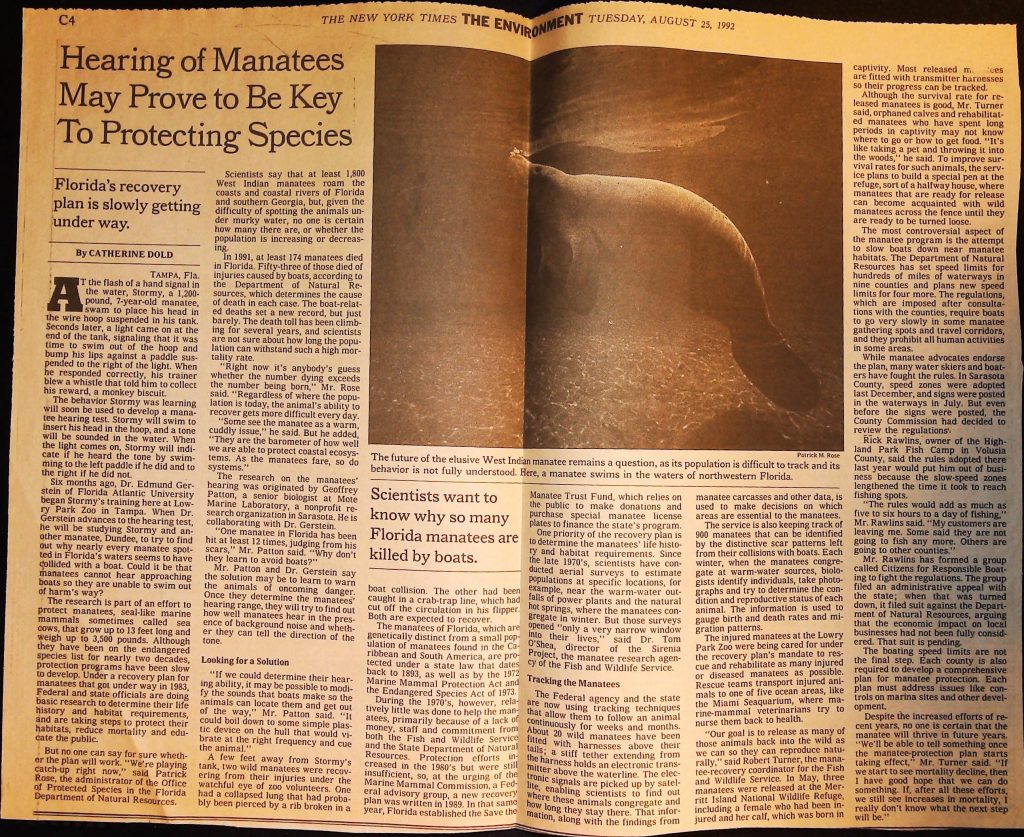
Patrick M. Rose
The future of the elusive West Indian manatee remains a question, as its population is difficult to track and its
behavior is not fully understood. Here, a manatee swims in the waters of northwestern Florida.
Scientists want to
know why so many
Florida manatees are
killed by boats.
boat collision. The other had been
caught in a crab-trap line, which had
cut off the circulation in his flipper.
Both are expected to recover.
Manatee Trust Fund, which relies on
the public to make donations and
purchase special manatee license
plates to finance the state's program.
One priority of the recovery plan is
to determine the manatees' life histo-
ry and habitat requirements. Since
the late 1970's, scientists have con-
ducted aerial surveys to estimate
populations at specific locations, for
example, near the warm-water out-
falls of power plants and the natural
hot springs, where the manatees con-
gregate in winter. But those surveys
opened "only a very narrow window
into their lives," said Dr. Tom
O'Shea, director of the Sirenia
Project, the manatee research agen-
cy of the Fish and Wildlife Service.
Tracking the Manatees
The manatees of Florida, which are
genetically distinct from a small pop-
ulation of manatees found in the Ca-
ribbean and South America, are pro-
tected under a state law that dates
back to 1893, as well as by the 1972
Marine Mammal Protection Act and
the Endangered Species Act of 1973. The Federal agency and the state
During the 1970's, however, rela- are now using tracking techniques
tively little was done to help the man that allow them to follow an animal
atees, primarily because of a lack of continuously for weeks and months.
money, staff and commitment from About 20 wild manatees have been
both the Fish and Wildlife Service fitted with harnesses above their
and the State Department of Natural tails; a stiff tether extending from
Resources. Protection efforts in the harness holds an electronic trans-
creased in the 1980's but were still mitter above the waterline. The elec-
insufficient, so, at the urging of the tronic signals are picked up by satel-
Marine Mammal Commission, a Fed- lite, enabling scientists to find out
eral advisory group, a new recovery where these animals congregate and
plan was written in 1989. In that same how long they stay there. That infor-
year, Florida established the Save the mation, along with the findings from
manatee carcasses and other data, is
used to make decisions on which
areas are essential to the manatees.
The service is also keeping track of
900 manatees that can be identified
by the distinctive scar patterns left
from their collisions with boats. Each
winter, when the manatees congre-
gate at warm-water sources, biolo-
gists identify individuals, take photo-
graphs and try to determine the con-
dition and reproductive status of each
animal. The information is used to
gauge birth and death rates and mi-
gration patterns.
captivity. Most released m ees
are fitted with transmitter harnesses
so their progress can be tracked.
Although the survival rate for re-
leased manatees is good, Mr. Turner
said, orphaned calves and rehabilitat-
ed manatees who have spent long
periods in captivity may not know
where to go or how to get food. "It's
like taking a pet and throwing it into
the woods," he said. To improve sur-
vival rates for such animals, the serv-
ice plans to build a special pen at the
refuge, sort of a halfway house, where
manatees that are ready for release
can become acquainted with wild
manatees across the fence until they
are ready to be turned loose.
The injured manatees at the Lowry
Park Zoo were being cared for under
the recovery plan's mandate to res-
cue and rehabilitate as many injured
or diseased manatees as possible.
Rescue teams transport injured ani-
mals to one of five ocean areas, like
the Miami Seaquarium, where ma-
rine-mammal veterinarians try to
nurse them back to health.
The most controversial aspect of
the manatee program is the attempt
to slow boats down near manatee
habitats. The Department of Natural
Resources has set speed limits for
hundreds of miles of waterways in
nine counties and plans new speed
limits for four more. The regulations,
which are imposed after consulta-
tions with the counties, require boats
to go very slowly in some manatee
gathering spots and travel corridors,
and they prohibit all human activities
in some areas.
While manatee advocates endorse
the plan, many water skiers and boat-
ers have fought the rules. In Sarasota
County, speed zones were adopted
last December, and signs were posted
in the waterways in July. But even
before the signs were posted, the
County Commission had decided to
review the regulations'.
"Our goal is to release as many of
those animals back into the wild as
we can so they can reproduce natu-
rally," said Robert Turner, the mana-
tee-recovery coordinator for the Fish
and Wildlife Service. In May, three
manatees were released at the Mer-
ritt Island National Wildlife Refuge,
including a female who had been in-
jured and her calf, which was born in
Rick Rawlins, owner of the High-
land Park Fish Camp in Volusia
County, said the rules adopted there
last year would put him out of busi-
ness because the slow-speed zones
lengthened the time it took to reach
fishing spots.
"The rules would add as much as
five to six hours to a day of fishing,'
Mr. Rawlins said. "My customers are
leaving me. Some said they are not
going to fish any more. Others are
going to other counties."
Mr. Rawlins has formed a group
called Citizens for Responsible Boat-
ing to fight the regulations. The group
filed an administrative appeal with
the state; when that was turned
down, it filed suit against the Depart-
ment of Natural Resources, arguing
that the economic impact on local
businesses had not been fully consid-
ered. That suit is pending.
The boating speed limits are not
the final step. Each county is also
required to develop a comprehensive
plan for manatee protection. Each
plan must address issues like con-
trols on marina sites and other devel-
opment.
Despite the increased efforts of re-
cent years, no one is certain that the
manatee will thrive in future years.
"We'll be able to tell something once
the manatee-protection plan starts
taking effect," Mr. Turner said. "If
we start to see mortality decline, then
I have good hope that we can do
something. If, after all these efforts,
we still see increases in mortality, I
really don't know what the next step
will be."

[PAGE BREAK]

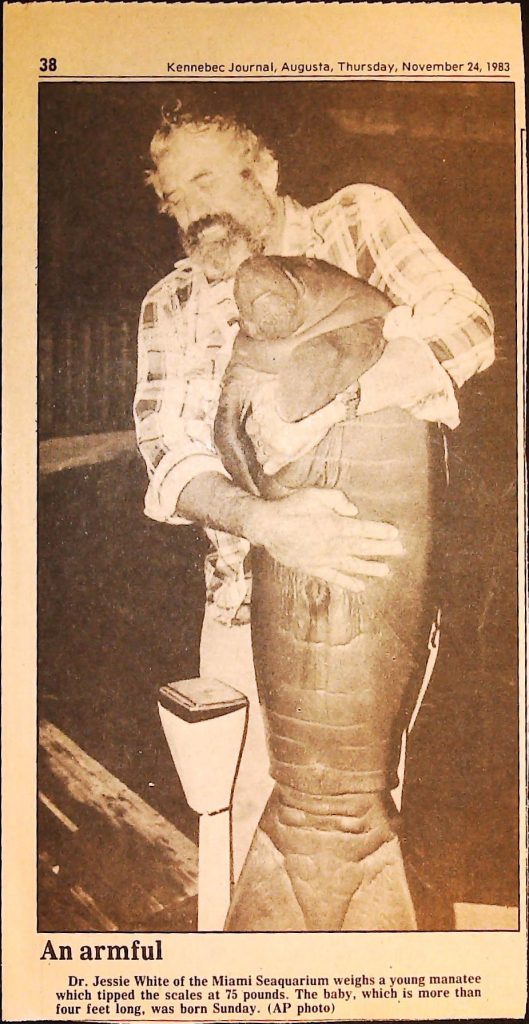
38
Kennebec Journal, Augusta, Thursday, November 24, 1983
An armful
Dr. Jessie White of the Miami Seaquarium weighs a young manatee
which tipped the scales at 75 pounds. The baby, which is more than
four feet long, was born Sunday. (AP photo)

[PAGE BREAK]

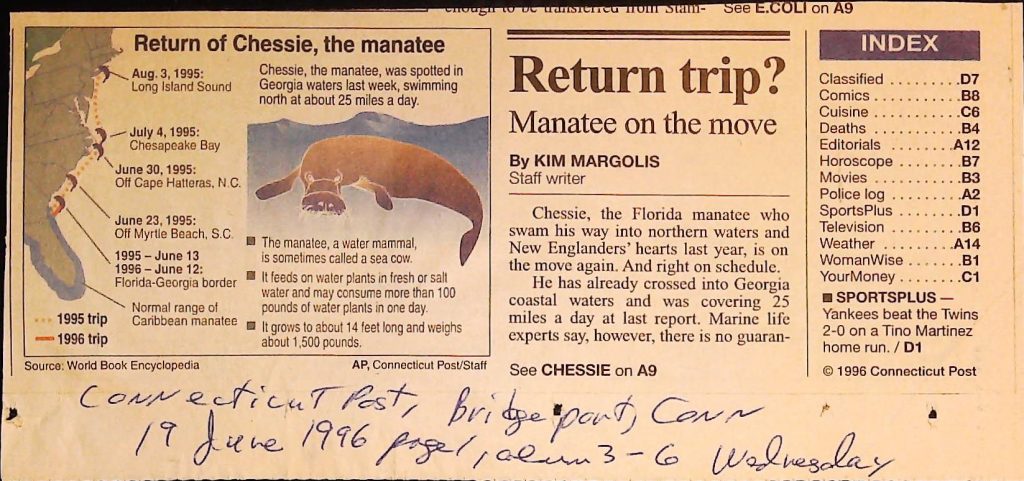
1995 trip
1996 trip
Return of Chessie, the manatee
Aug. 3, 1995:
Long Island Sound
July 4, 1995:
Chesapeake Bay
June 30, 1995:
Off Cape Hatteras, N.C.
June 23, 1995:
Off Myrtle Beach, S.C.
1995 June 13
1996
June 12:
Florida-Georgia border
Normal range of
Caribbean manatee
Source: World Book Encyclopedia
Chough to be transTCHICO Tom Stam- See E.COLI on A9
Chessie, the manatee, was spotted in
Georgia waters last week, swimming
north at about 25 miles a day.
The manatee, a water mammal,
is sometimes called a sea cow.
It feeds on water plants in fresh or salt
water and may consume more than 100
pounds of water plants in one day.
grows
s to about 14 feet long and weighs
about 1,500 pounds.
Return trip?
Manatee on the move
By KIM MARGOLIS
Staff writer
Chessie, the Florida manatee who
swam his way into northern waters and
New Englanders' hearts last year, is on
the move again. And right on schedule.
He has already crossed into Georgia
coastal waters and was covering 25
miles a day at last report. Marine life
experts say, however, there is no guaran-
AP, Connecticut Post/Staff
See CHESSIE on A9
INDEX
Classified
.D7
Comics
.B8
Cuisine
.C6
Deaths
.B4
Editorials
A12
Horoscope
.B7
Movies
.B3
Police log
.A2
SportsPlus
.D1
Television
.B6
.A14
WomanWise
.B1
YourMoney
.C1
Weather
SPORTSPLUS
Yankees beat the Twins
2-0 on a Tino Martinez
home run. / D1
© 1996 Connecticut Post
Connecticut Post, Bridgeport, CONN.
19 June 1996 pagel, alum 3-6 Wednesday

[PAGE BREAK]

Allentown, PA-
11/23/45 Gary, I'm sure you're
3/6/11
seen this, but here's
a copy anyways justin
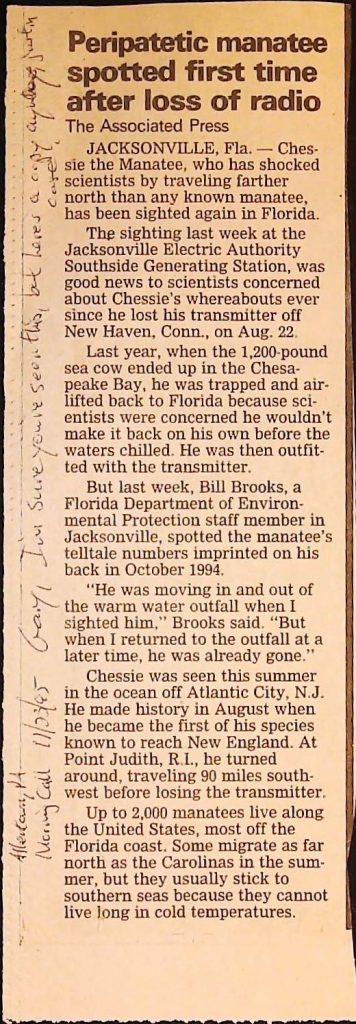
Peripatetic manatee
spotted first time
after loss of radio
The Associated Press
JACKSONVILLE, Fla. - Ches-
sie the Manatee, who has shocked
scientists by traveling farther
north than any known manatee,
has been sighted again in Florida.
The sighting last week at the
Jacksonville Electric Authority
Southside Generating Station, was
good news to scientists concerned
about Chessie's whereabouts ever
since he lost his transmitter off
New Haven, Conn., on Aug. 22.
Last year, when the 1,200-pound
sea cow ended up in the Chesa-
peake Bay, he was trapped and air-
lifted back to Florida because sci-
entists were concerned he wouldn't
make it back on his own before the
waters chilled. He was then outfit-
ted with the transmitter.
But last week, Bill Brooks, a
Florida Department of Environ-
mental Protection staff member in
Jacksonville, spotted the manatee's
telltale numbers imprinted on his
back in October 1994.
"He was moving in and out of
the warm water outfall when I
sighted him," Brooks said. "But
when I returned to the outfall at a
later time, he was already gone.'
Chessie was seen this summer
in the ocean off Atlantic City, N.J.
He made history in August when
he became the first of his species
known to reach New England. At
Point Judith, R.I., he turned
around, traveling 90 miles south-
west before losing the transmitter.
Up to 2,000 manatees live along
the United States, most off the
Florida coast. Some migrate as far
north as the Carolinas in the sum-
mer, but they usually stick to
southern seas because they cannot
live long in cold temperatures.

[PAGE BREAK]

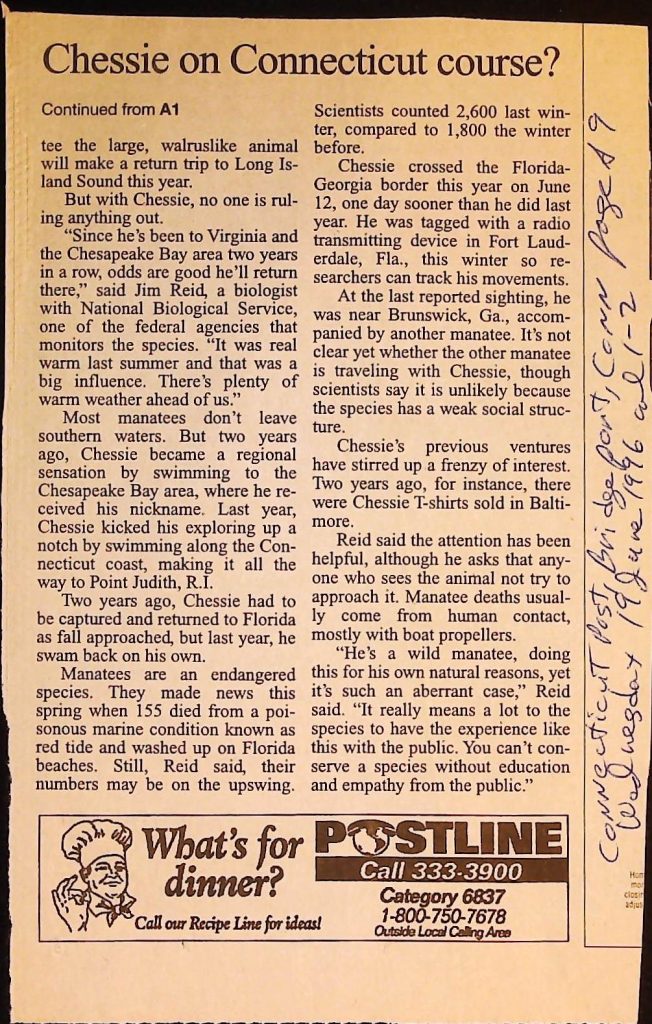
Chessie on Connecticut course?
Continued from A1
tee the large, walruslike animal
will make a return trip to Long Is-
land Sound this year.
But with Chessie, no one is rul-
ing anything out.
"Since he's been to Virginia and
the Chesapeake Bay area two years
in a row, odds are good he'll return
there," said Jim Reid, a biologist
with National Biological Service,
one of the federal agencies that
monitors the species. "It was real
big influence. There's plenty of
warm last summer and that was a
warm weather ahead of us."
Most manatees don't leave
southern waters. But two years
ago, Chessie became a regional
sensation by swimming to the
Chesapeake Bay area, where he re-
ceived his nickname. Last year,
Chessie kicked his exploring up a
notch by swimming along the Con-
necticut coast, making it all the
way to Point Judith, R.I.
Two years ago, Chessie had to
be captured and returned to Florida
as fall approached, but last year, he
swam back on his own.
Manatees are an endangered
species. They made news this
spring when 155 died from a poi-
sonous marine condition known as
red tide and washed up on Florida
beaches. Still, Reid said, their
numbers may be on the upswing.
Scientists counted 2,600 last win-
ter, compared to 1,800 the winter
before.
Chessie crossed the Florida-
Georgia border this year on June
12, one day sooner than he did last
year. He was tagged with a radio
transmitting device in Fort Laud-
erdale, Fla., this winter so re-
searchers can track his movements.
At the last reported sighting, he
was near Brunswick, Ga., accom-
panied by another manatee. It's not
clear yet whether the other manatee
is traveling with Chessie, though
scientists say it is unlikely because
the species has a weak social struc-
ture.
Chessie's previous
ventures
have stirred up a frenzy of interest.
Two years ago, for instance, there
were Chessie T-shirts sold in Balti-
more.
Reid said the attention has been
helpful, although he asks that any-
one who sees the animal not try to
approach it. Manatee deaths usual-
ly come from human contact,
mostly with boat propellers.
"He's a wild manatee, doing
this for his own natural reasons, yet
it's such an aberrant case," Reid
said. "It really means a lot to the
species to have the experience like
this with the public. You can't con-
serve a species without education
and empathy from the public."
What's for POSTLINE
dinner?
Call our Recipe Line for ideas!
[AD] Call 333-3900
Category 6837
[AD] 1-800-750-7678
Outside Local Calling Area
19 June 1996 al 1-2
Connecticut Post Bridgeport, CONN page 19
Hom
mor
closin
adjus

[PAGE BREAK]

[AD] 0-243-9696
Bridgeport, CONN Wednesday
CONNECTICUT POST 22 NOV 1995
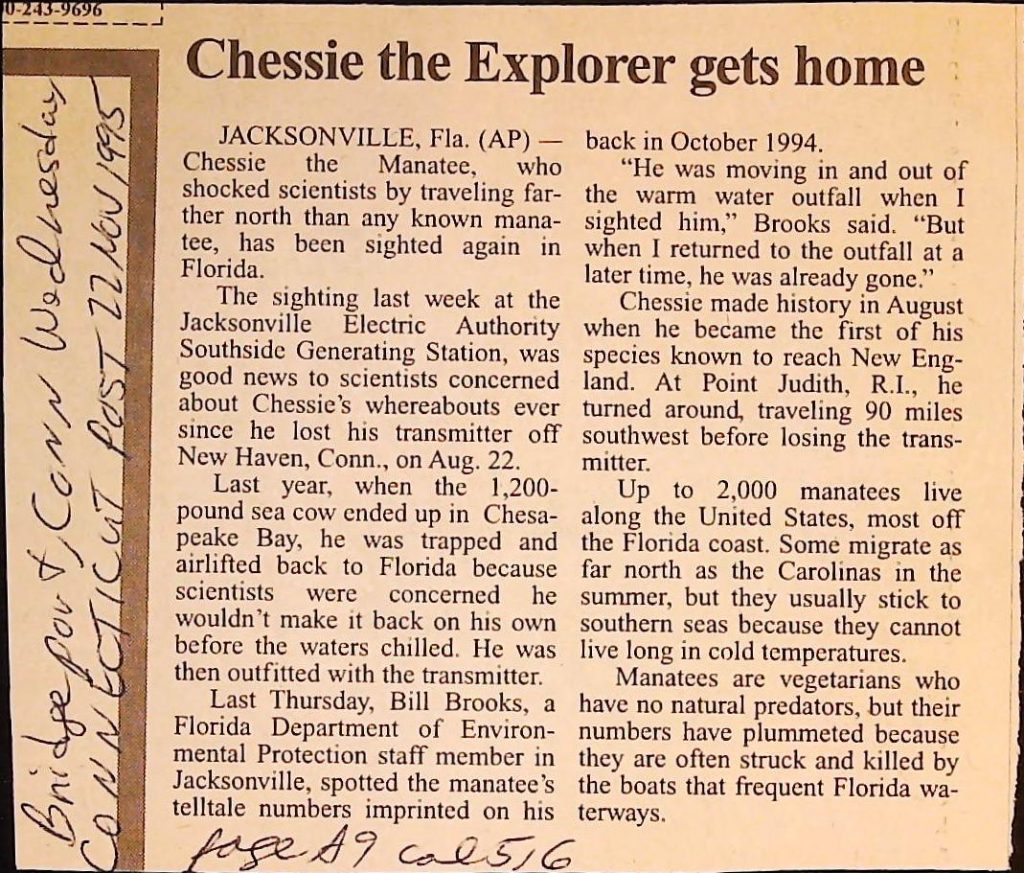
Chessie the Explorer gets home
JACKSONVILLE, Fla. (AP) -
Chessie the Manatee, who
shocked scientists by traveling far-
ther north than any known mana-
tee, has been sighted again in
Florida.
The sighting last week at the
Jacksonville Electric Authority
Southside Generating Station, was
good news to scientists concerned
about Chessie's whereabouts ever
since he lost his transmitter off
New Haven, Conn., on Aug. 22.
Last year, when the 1,200-
pound sea cow ended up in Chesa-
peake Bay, he was trapped and
airlifted back to Florida because
scientists were concerned he
wouldn't make it back on his own
before the waters chilled. He was
then outfitted with the transmitter.
Last Thursday, Bill Brooks, a
Florida Department of Environ-
mental Protection staff member in
Jacksonville, spotted the manatee's
telltale numbers imprinted on his
fage A9 cal516
back in October 1994.
"He was moving in and out of
the warm water outfall when I
sighted him," Brooks said. "But
when I returned to the outfall at a
later time, he was already gone."
Chessie made history in August
when he became the first of his
species known to reach New Eng-
land. At Point Judith, R.I., he
turned around, traveling 90 miles
southwest before losing the trans-
mitter.
Up to 2,000 manatees live
along the United States, most off
the Florida coast. Some migrate as
far north as the Carolinas in the
summer, but they usually stick to
southern seas because they cannot
live long in cold temperatures.
Manatees are vegetarians who
have no natural predators, but their
numbers have plummeted because
they are often struck and killed by
the boats that frequent Florida wa-
terways.

[PAGE BREAK]

eleton
mobile.
wheels of the one horse shay and the old
me and remained where they stopped. There
of the passengers or of the exact time at
Certain detalls of construction of the buggy
It must have been many years ago.
lent such as the loss of a wheel crossing
er indeed. Water-holes were few and far
where repairs could be made were great
an animal often meant that travelers were
et of vast waterless areas, doomed to almost
vation.
ve been advanced as to what probably occur-
ved that a broken wheel caused the tragedy.
worn-out even before its owner attempted to
ve way in the heart of the wastelands. The
ed of exhaustion and thirst and the passengers
desert for days. Perhaps they were rescued
in and carried on to the promised land of
perhaps in some dry canyon or sand-pit their
What Happened Here? The Bones of
Its Tracks in Walker's Pass, California.
or What Happened to Them Will Probably
structed projector in the center
of small lenses, the moving lights o
apparatus is moved by a sm
courses and movements of the h
the moon are shown by
And
ons can be thrown
the spectator enters
rance of the night
the light changes
this eatre and
with an unu
Jess of the w
rium in Lond
Chose of the M
and most accur
are being made
eve entire classe
Heved by the Bri
this model of th
create a wider
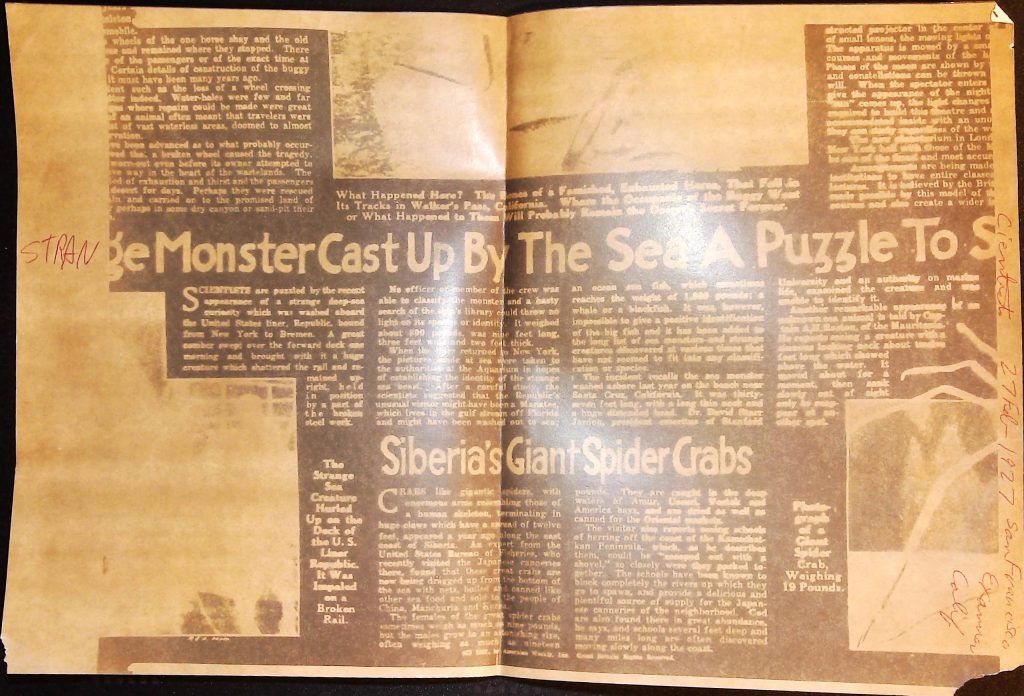
STRAN Be Monster Cast Up By The Sea A Puzzle To S
S
CIENTISTS are puzzled by the recent
appearance of a strange deep-sea
curiosity which was washed aboard
the United States liner, Republic, bound
from New York to Bremen. A great
comber wept over the forward deck ane
morning and brought with it a huge
creature which shattered the rail
ne-
main
right, held
in
by
on
of
th
steel work.
The
Strange
Cre
Broken
Rail.
an
whale or a
No officer remember of the crew was
able to classify the monster and a hasty reaches the weight of
search of the pls library could throw no
light on its specs or identity. It weighed
about 800 pods, was nine feet long.
three feet wand two feet thick.
When these returned to New York,
the picturede at sea were taken to
the authorities at the Aquarium in hopex
of establishing the identity of the strange
sea benet After a careful study o
scientists suggested that the Republic's
unusual visitor might have been a Manatee
which lives in the gulf stream off Florida
and might have been washed out to sen
impossible to give a
of the big fish and
the
list of sea
crea decovered at
have not seemed to fit
cation or species.
The incident recalls the
washed asbare last year on the be
Santa Cruz California.
seven feet long, with a long
a huge distended
Dr.
Jordon, president emeritus of
Siberia's Giant Spider Crabs
C
RABS ke gigantic spiders, with
enormous arms resembling those of
a human skeleton, terminating in
huge claws which have a spread of twelve
feet, appeared a year ago along the east
coast of Siberia. An expert from the
United States Bureau of Fisheries, who
recently visited the Japanse cannenes
there, found that these great crabs are
now being dragged up from the bottom of
the sea with pets, boiled and canned like
other sea food and sold to the people of
China, Manchuria and berea
The females of the at spider crabe
sometimes wzh as ch
nine pounds,
but the males grow to an atoning size,
often weighing as much
nineteen
PORNOS. They are
waters of Amur, Ca
America bays, and am
canned for the Orienta
The visitor se report
of herring off the count of
kan Peninsula, which
them, could be
bar
ith a
10-
wn to
shovel," so closely were
Rether The schools have be
black completely the rivers up which they
go to spawn, and provide a delicious and
plentiful source of supply for the Japan-
ese canneries of the neighborhood. Cod
are also found there in great abundance.
he says, and schools several feet deep and
many miles long are often discovered
moving slowly along the coast,
University and an author on mas
of the
eing a creature
ing neck about
ich showed
Crab,
Weighing
19 Pounds.
and
27 Fl-1927 San Francisco
Calif
Examma

[PAGE BREAK]

CONNECTICUT POST Thursday, August 31, 1995
grave
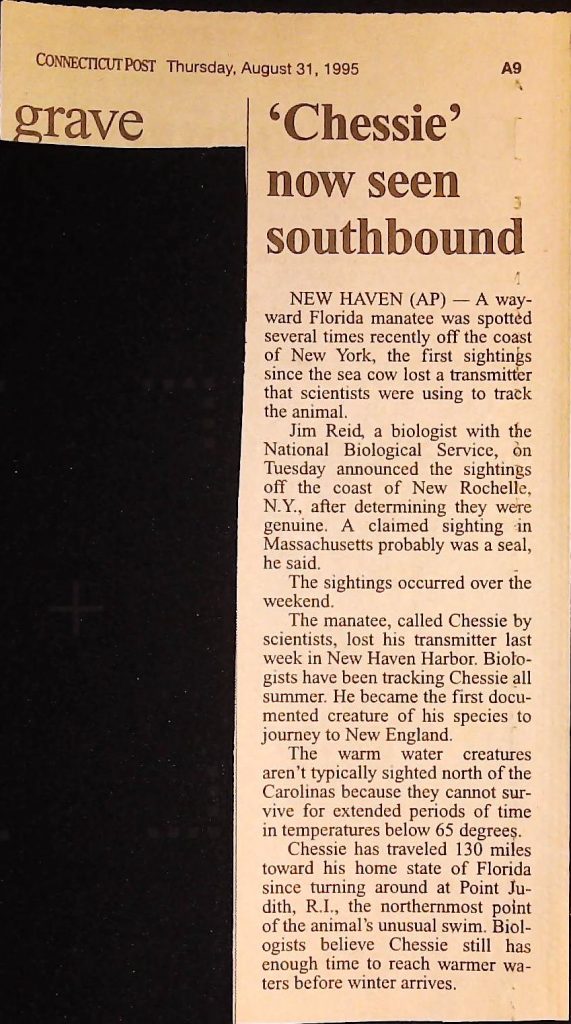
'Chessie'
A9
now seen
southbound
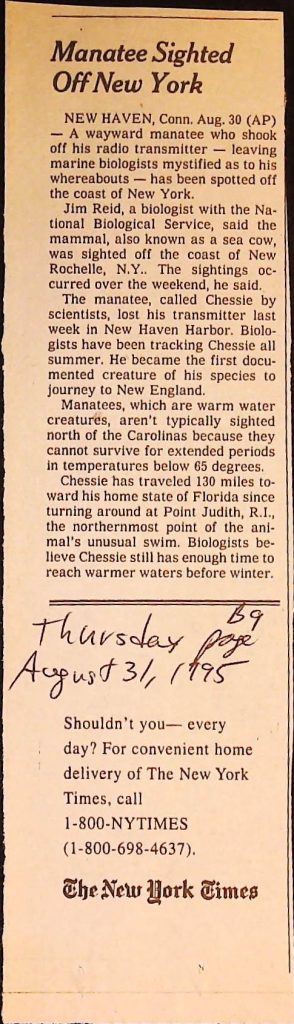
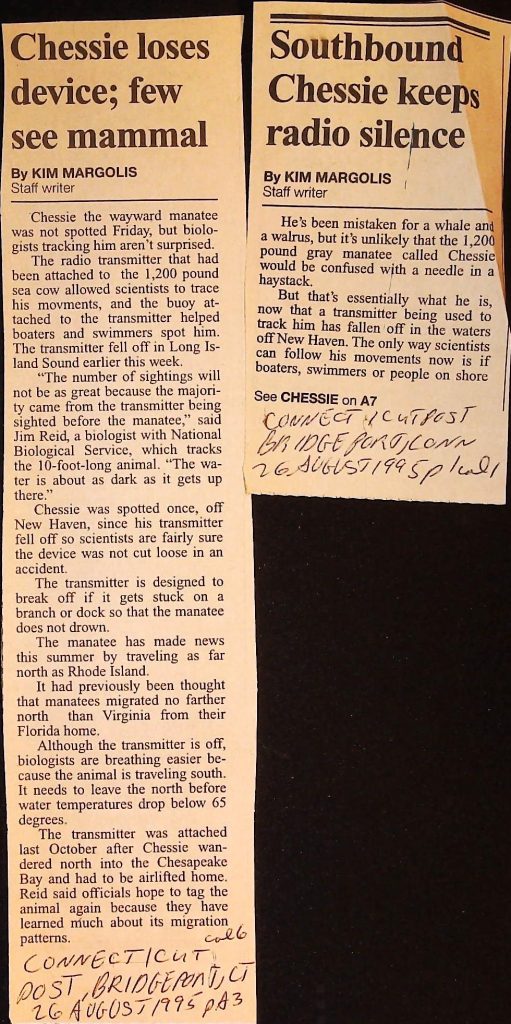
NEW HAVEN (AP) - A way-
ward Florida manatee was spotted
several times recently off the coast
of New York, the first sightings
since the sea cow lost a transmitter
that scientists were using to track
the animal.
Jim Reid, a biologist with the
National Biological Service, on
Tuesday announced the sightings
off the coast of New Rochelle,
N.Y., after determining they were
genuine. A claimed sighting in
Massachusetts probably was a seal,
he said.
The sightings occurred over the
weekend.
The manatee, called Chessie by
scientists, lost his transmitter last
week in New Haven Harbor. Biolo-
gists have been tracking Chessie all
summer. He became the first docu-
mented creature of his species to
journey to New England.
The warm water creatures
aren't typically sighted north of the
Carolinas because they cannot sur-
vive for extended periods of time
in temperatures below 65 degrees.
Chessie has traveled 130 miles
toward his home state of Florida
since turning around at Point Ju-
dith, R.I., the northernmost point
of the animal's unusual swim. Biol-
ogists believe Chessie still has
enough time to reach warmer wa-
ters before winter arrives.

[PAGE BREAK]

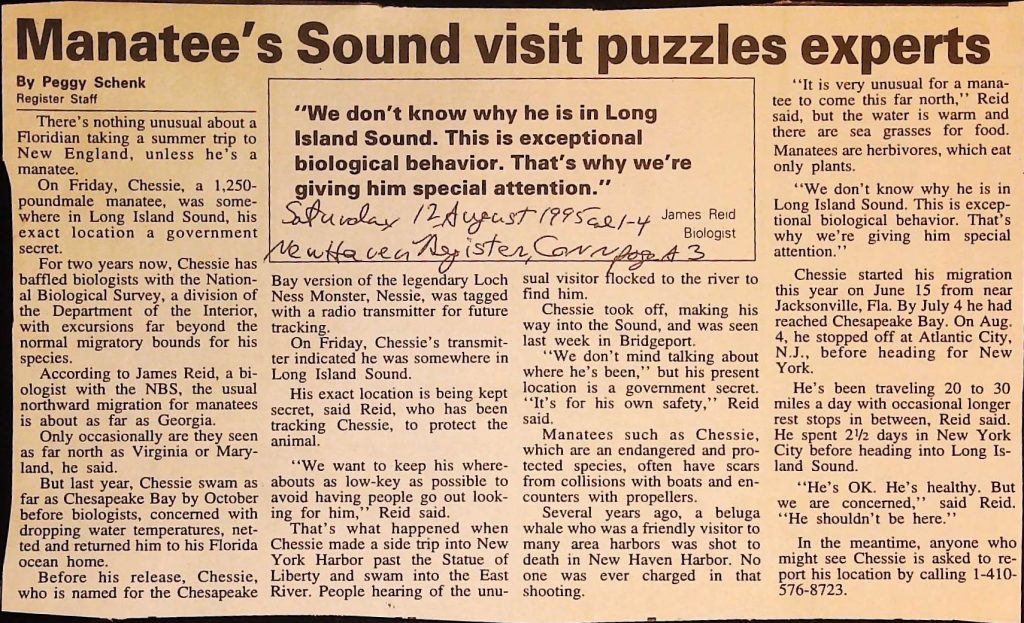
Manatee's Sound visit puzzles experts
By Peggy Schenk
Register Staff
There's nothing unusual about a
Floridian taking a summer trip to
New England, unless he's a
manatee.
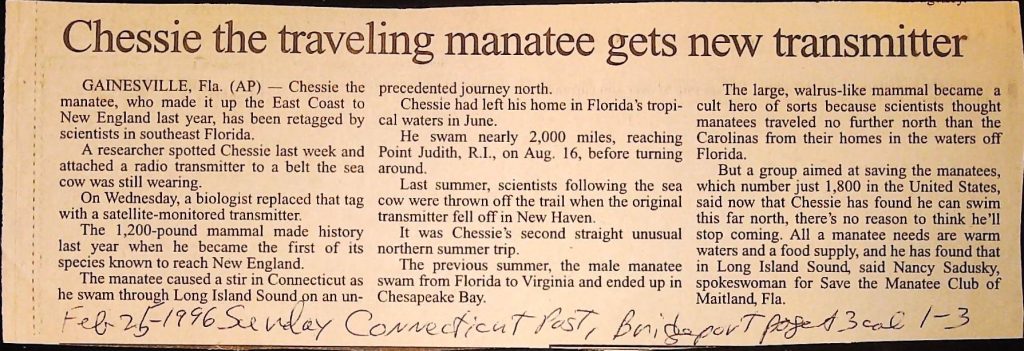
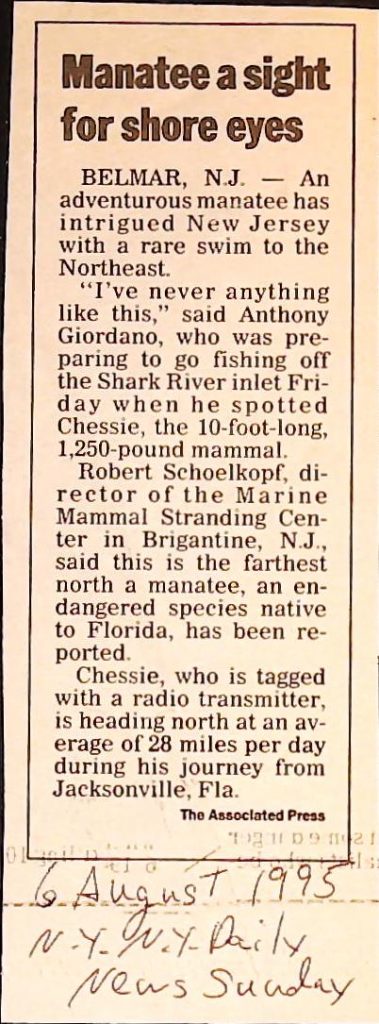
On Friday, Chessie, a 1,250-
poundmale manatee, was some-
"We don't know why he is in Long
Island Sound. This is exceptional
biological behavior. That's why we're
giving him special attention."
where in Long Island Sound, his Saturday 12 August 1995 al 1-4
exact location a government
secret.
For two years now, Chessie has
baffled biologists with the Nation-
al Biological Survey, a division of
the Department of the Interior,
with excursions far beyond the
normal migratory bounds for his
species.
According to James Reid, a bi-
ologist with the NBS, the usual
northward migration for manatees
is about as far as Georgia.
Only occasionally are they seen
as far north as Virginia or Mary-
land, he said.
But last year, Chessie swam as
far as Chesapeake Bay by October
before biologists, concerned with
dropping water temperatures, net-
ted and returned him to his Florida
ocean home.
Before his release, Chessie,
who is named for the Chesapeake
James Reid
Biologist
New Haven Agister, Counge A 3
Bay version of the legendary Loch
Ness Monster, Nessie, was tagged
with a radio transmitter for future
tracking.
On Friday, Chessie's transmit-
ter indicated he was somewhere in
Long Island Sound.
His exact location is being kept
secret, said Reid, who has been
tracking Chessie, to protect the
animal.
"We want to keep his where-
abouts as low-key as possible to
avoid having people go out look-
ing for him," Reid said.
That's what happened when
Chessie made a side trip into New
York Harbor past the Statue of
Liberty and swam into the East
River. People hearing of the unu-
sual visitor flocked to the river to
find him.
Chessie took off, making his
way into the Sound, and was seen
last week in Bridgeport.
"We don't mind talking about
where he's been," but his present
location is a government secret.
"It's for his own safety,"
," Reid
said.
Manatees such as Chessie,
which are an endangered and pro-
tected species, often have scars
from collisions with boats and en-
counters with propellers.
Several years ago, a beluga
whale who was a friendly visitor to
many area harbors was shot to
death in New Haven Harbor. No
one was ever charged in that
shooting.
"It is very unusual for a mana-
tee to come this far north," Reid
said, but the water is warm and
there are sea grasses for food.
Manatees are herbivores, which eat
only plants.
"We don't know why he is in
Long Island Sound. This is excep-
tional biological behavior. That's
why we're giving him special
attention.
Chessie started his migration
this year on June 15 from near
Jacksonville, Fla. By July 4 he had
reached Chesapeake Bay. On Aug.
4, he stopped off at Atlantic City,
N.J., before heading for New
York.
He's been traveling 20 to 30
miles a day with occasional longer
rest stops in between, Reid said.
He spent 22 days in New York
City before heading into Long Is-
land Sound.
"He's OK. He's healthy. But
we are concerned, said Reid.
"He shouldn't be here."
In the meantime, anyone who
might see Chessie is asked to re-
port his location by calling 1-410-
[AD] 576-8723.

[PAGE BREAK]

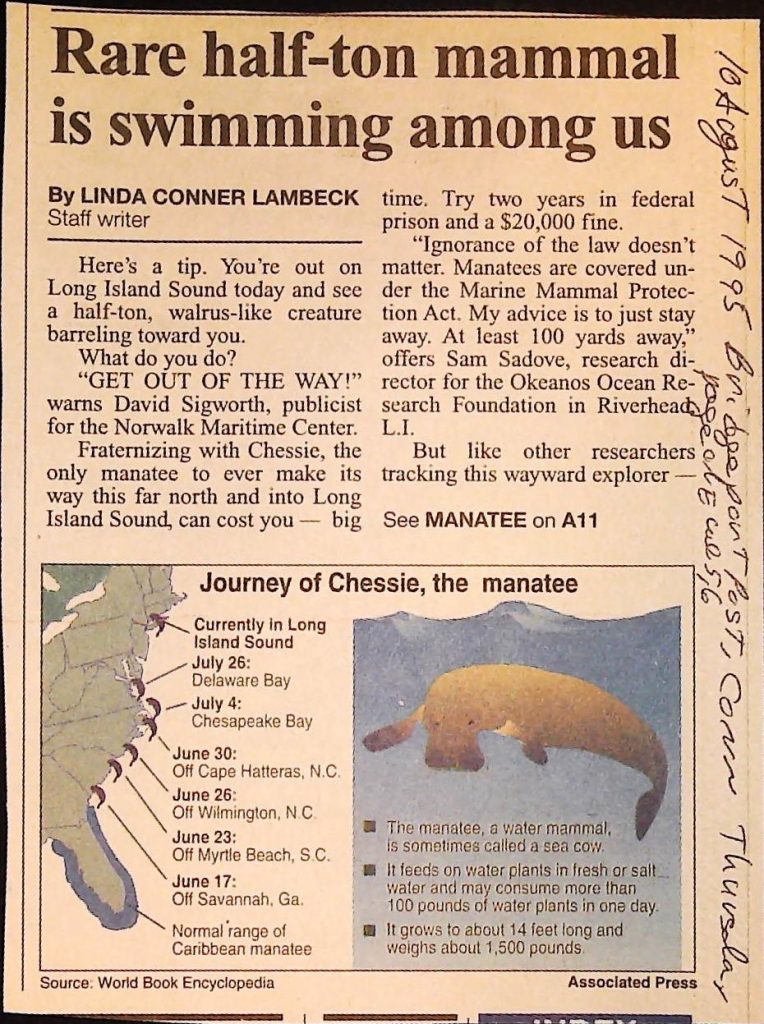
Rare half-ton mammal
is swimming among us
By LINDA CONNER LAMBECK time. Try two years in federal
Staff writer
Here's a tip. You're out on
Long Island Sound today and see
a half-ton, walrus-like creature
barreling toward you.
What do you do?
"GET OUT OF THE WAY!"
warns David Sigworth, publicist
for the Norwalk Maritime Center.
Fraternizing with Chessie, the
only manatee to ever make its
way this far north and into Long
Island Sound, can cost you
prison and a $20,000 fine.
"Ignorance of the law doesn't
matter. Manatees are covered un-
der the Marine Mammal Protec-
tion Act. My advice is to just stay
away. At least 100 yards away,"
offers Sam Sadove, research di-
rector for the Okeanos Ocean Re-
search Foundation in Riverhead
L.I.
But like other researchers
tracking this wayward explorer
big See MANATEE on A11
Journey of Chessie, the manatee
Currently in Long
Island Sound
July 26:
Delaware Bay
-port POST, CONN Thursday
10 August 1995 Bridge we 576
July 4:
Chesapeake Bay
June 30:
Off Cape Hatteras, N.C.
June 26:
Off Wilmington, N.C
June 23:
Off Myrtle Beach, S.C.
June 17:
Off Savannah, Ga.
Normal range of
Caribbean manatee
Source: World Book Encyclopedia
The manatee, a water mammal,
is sometimes called a sea cow.
It feeds on water plants in fresh or salt
water and may consume more than
100 pounds of water plants in one day.
It grows to about 14 feet long and
weighs about 1,500 pounds.
Associated Press

[PAGE BREAK]

SportPos:
NND
10 August 1995 page 413 Thursday
Bridge
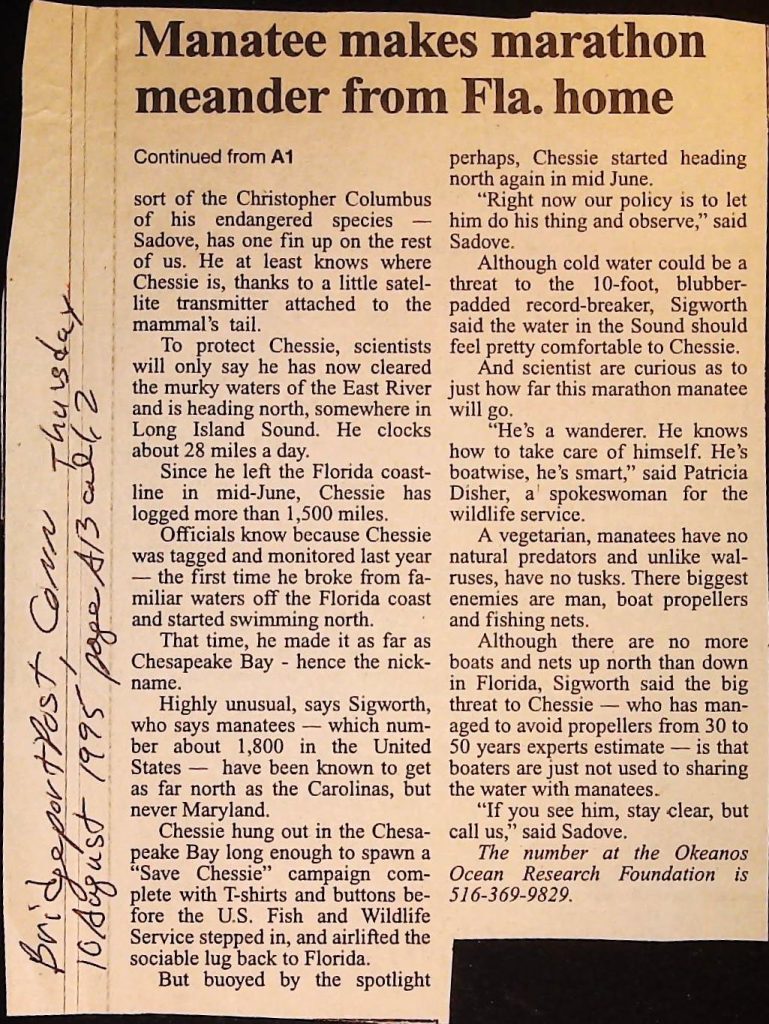
Manatee makes marathon
meander from Fla. home
Continued from A1
sort of the Christopher Columbus
of his endangered species
Sadove, has one fin up on the rest
of us. He at least knows where
Chessie is, thanks to a little satel-
lite transmitter attached to the
mammal's tail.
To protect Chessie, scientists
will only say he has now cleared
the murky waters of the East River
and is heading north, somewhere in
Long Island Sound. He clocks
about 28 miles a day.
Since he left the Florida coast-
line in mid-June, Chessie has
logged more than 1,500 miles.
Officials know because Chessie
was tagged and monitored last year
the first time he broke from fa-
miliar waters off the Florida coast
and started swimming north.
That time, he made it as far as
Chesapeake Bay - hence the nick-
name.
Highly unusual, says Sigworth,
who says manatees which num-
ber about 1,800 in the United
States have been known to get
as far north as the Carolinas, but
never Maryland.
Chessie hung out in the Chesa-
peake Bay long enough to spawn a
"Save Chessie" campaign com-
plete with T-shirts and buttons be-
fore the U.S. Fish and Wildlife
Service stepped in, and airlifted the
sociable lug back to Florida.
But buoyed by the spotlight
perhaps, Chessie started heading
north again in mid June.
"Right now our policy is to let
him do his thing and observe," said
Sadove.
Although cold water could be a
threat to the 10-foot, blubber-
padded record-breaker, Sigworth
said the water in the Sound should
feel pretty comfortable to Chessie.
And scientist are curious as to
just how far this marathon manatee
will go.
"He's a wanderer. He knows
how to take care of himself. He's
boatwise, he's smart," said Patricia
Disher, a spokeswoman for the
wildlife service.
A vegetarian, manatees have no
natural predators and unlike wal-
ruses, have no tusks. There biggest
enemies are man, boat propellers
and fishing nets.
Although there are no more
boats and nets up north than down
in Florida, Sigworth said the big
threat to Chessie who has man-
aged to avoid propellers from 30 to
50 years experts estimate
- is that
boaters are just not used to sharing
the water with manatees.
"If you see him, stay clear, but
call us," said Sadove.
The number at the Okeanos
Ocean Research Foundation is
[AD] 516-369-9829.

[PAGE BREAK]

THE NEW YORK TIMES METRO TUESDAY, AUGUST 8, 1995
REGION
Roving Manatee's Whale of a Trail
Endangered Mammal Travels From Florida to East River
By CHUCK SUDETIC
His name is Chessie and he is an
Olympian of a mammal known as a
manatee. He is male, about 10 feet
long, 1,200 pounds and 30 to 50 years
old. He was spotted here yesterday
swimming up the East River. And
anybody who messes with him could
be fined $20,000.
Chessie has now broken all
records for known manatee travel,
Linda Taylor of the United States
Fish and Wildlife Service said. Last
year, on his first trip north, he made
it as far as the Chesapeake Bay
before scientists, concerned about
his health in cooler waters, had him
airlifted back to Florida in October.
Wildlife Service scientists named
hím Chessie after the bay.
Manatees resemble large walrus-
es without tusks, and the 1,800 in the
United States are an endangered
species. The animals live mostly in
the coastal inlets and rivers of Flor-
ida and migrate north in summer,
generally no farther than the North
Carolina coast, Ms. Taylor said.
This summer, Chessie, who has
been dodging boats all his life, spent
the Fourth of July holiday near the
mouth of the Chesapeake Bay after
leaving his winter home in Florida.
Then, he swam up the New Jersey
coast, covering about 28 miles a day,
said Jim Reid, a biologist who stud-
ies manatees for the Interior De-
partment's National Biological Serv-
ice.
Mr. Reid said Chessie, a vegetari-
an, had no trouble finding food dur-
ing his trek up the coast. But Mr.
Reid said that "there is really noth-
ing for him to eat in the East River in
terms of natural vegetation."
"Pollution and debris in the water
are a concern," he said. "But we
Here fishy, fishy'
is definitely out,
Says the Wildlife
Service.
have to remember that he is an adult
manatee who frequents Fort Lau-
derdale and canals in other urban
areas in Florida, which are, frankly,
not nice places to be."
Ms. Taylor said people should not
try to feed the manatee.
"Chessie is very, very endan-
gered, and protected by both the
Marine Mammal Act and the Endan-
gered Species Act," she said. "The
fine for harassing him could be
[AD] $20,000."
"The only people who should be
around him are researchers," she
added. "People should not feed him
and should not go near him even in
boats."
Chessie's trip this far north may
be the result of the unusually warm
air and ocean temperatures this
summer, Mr. Reid said.
The biologist affixed a satellite
transmitter to Chessie's tail when he
ventured into the Chesapeake Bay
last year and has been tracking him
ever since.
"We've been monitoring his
progress as he's been moving up the
coast, both by satellite and by truck
and boat," Mr. Reid said. "In a lot of
places, the road is close enough and
you can track better by vehicle."
Mr. Reid said he examined Ches-
sie about three weeks ago and at-
tached a new satellite transmitter.
"We can get six locations a day,"
he said.
Manatees have no natural preda-
tors, Mr. Reid said.
"The only real danger to them
comes from man," he said. "Chessie
has been dodging boats his entire
life. He has several scars he's re-
ceived from boat motors. About half
of the manatees killed by boats are
killed by the hull impact."
Ms. Taylor said Chessie has cov-
ered about 1,500 miles since setting
off from his winter home in the Ba-
nana River in Brevard County, Flor-
ida.
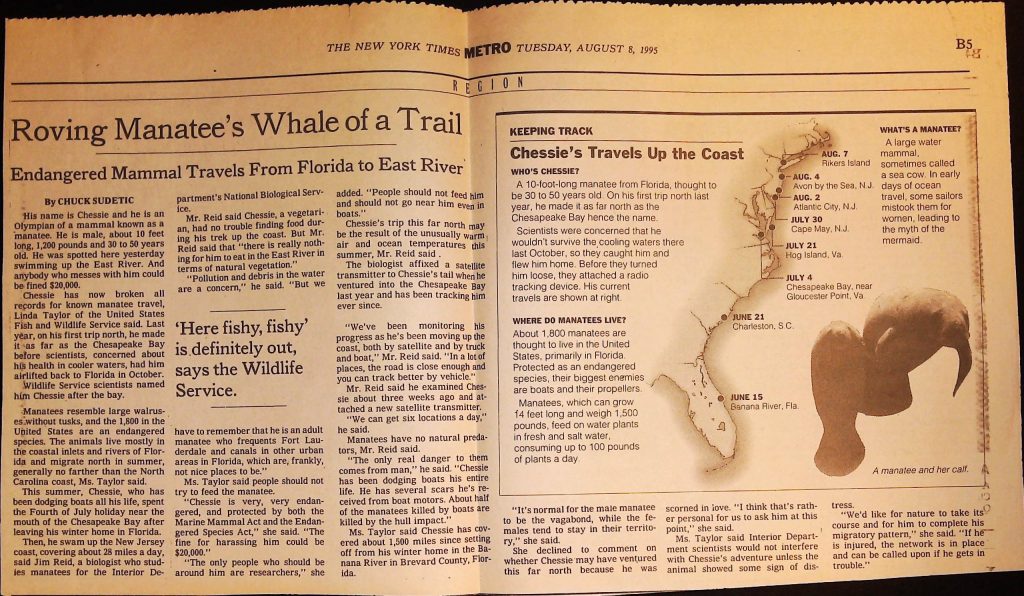
KEEPING TRACK
Chessie's Travels Up the Coast
WHO'S CHESSIE?
A 10-foot-long manatee from Florida, thought to
be 30 to 50 years old. On his first trip north last
year, he made it as far north as the
Chesapeake Bay hence the name.
Scientists were concerned that he
wouldn't survive the cooling waters there
last October, so they caught him and
flew him home. Before they turned
him loose, they attached a radio
tracking device. His current
travels are shown at right.
WHERE DO MANATEES LIVE?
About 1,800 manatees are
thought to live in the United
States, primarily in Florida.
Protected as an endangered
species, their biggest enemies
are boats and their propellers.
Manatees, which can grow
14 feet long and weigh 1,500
pounds, feed on water plants
in fresh and salt water,
consuming up to 100 pounds
of plants a day.
"It's normal for the male manatee
to be the vagabond, while the fe-
males tend to stay in their territo-
ry," she said.
She declined to comment on
whether Chessie may have ventured
this far north because he was
JUNE 21
AUG. 4
AUG. 7
Rikers Island
WHAT'S A MANATEE?
A large water
mammal,
sometimes called
a sea cow. In early
Avon by the Sea, N.J. days of ocean
AUG. 2
Atlantic City, N.J.
JULY 30
Cape May, N.J.
JULY 21
Hog Island, Va.
JULY 4
Chesapeake Bay, near
Gloucester Point, Va
Charleston, SC.
JUNE 15
Banana River, Fla.
scorned in love. "I think that's rath-
er personal for us to ask him at this
point," she said.
Ms. Taylor said Interior Depart-
ment scientists would not interfere
with Chessie's adventure unless the
animal showed some sign of dis-
tress.
B5
travel, some sailors
mistook them for
women, leading to
the myth of the
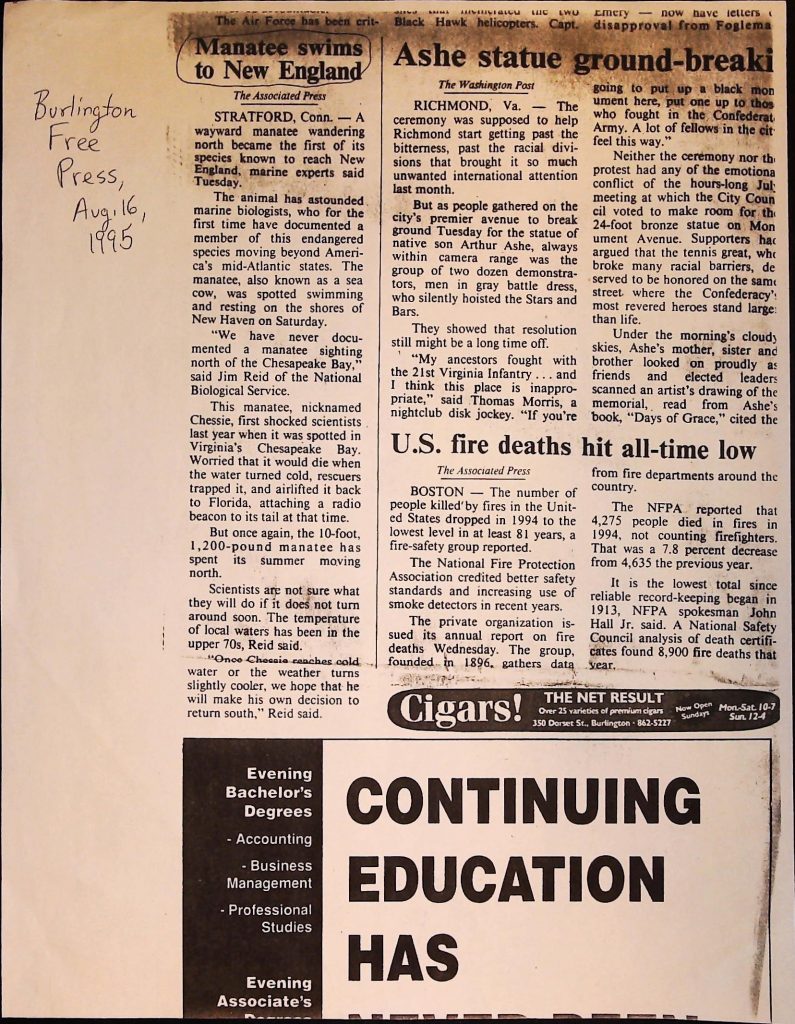
mermaid.
A manatee and her calf.
"We'd like for nature to take its
course and for him to complete his
migratory pattern," she said. "If he
is injured, the network is in place
and can be called upon if he gets in
trouble."

[PAGE BREAK]

18
TUESDAY, AUGUST 8, 1995
AUGUSTA, MAINE
KENNEBEC JOURNAL
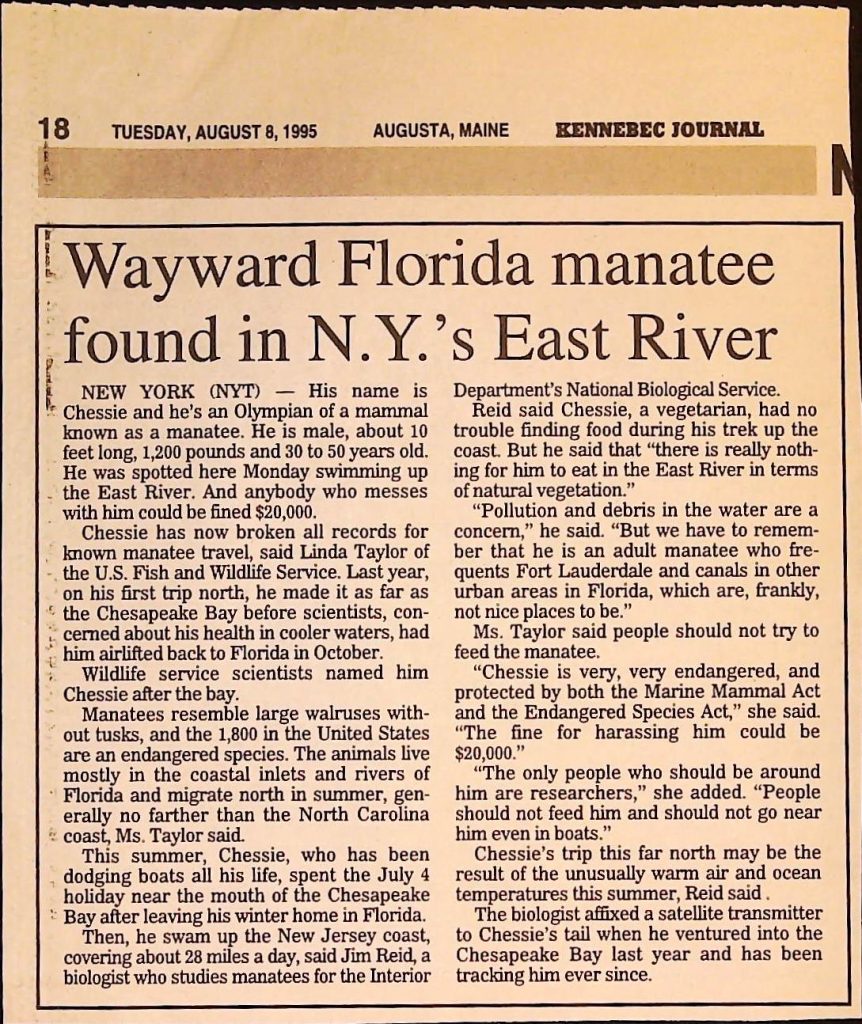
Wayward Florida manatee
found in N.Y.'s East River
NEW YORK (NYT) His name is
Chessie and he's an Olympian of a mammal
known as a manatee. He is male, about 10
feet long, 1,200 pounds and 30 to 50 years old.
He was spotted here Monday swimming up
the East River. And anybody who messes
with him could be fined $20,000.
Chessie has now broken all records for
known manatee travel, said Linda Taylor of
the U.S. Fish and Wildlife Service. Last year,
on his first trip north, he made it as far as
the Chesapeake Bay before scientists, con-
cerned about his health in cooler waters, had
him airlifted back to Florida in October.
Wildlife service scientists named him
Chessie after the bay.
Manatees resemble large walruses with-
out tusks, and the 1,800 in the United States
are an endangered species. The animals live
mostly in the coastal inlets and rivers of
· Florida and migrate north in summer, gen-
erally no farther than the North Carolina
coast, Ms. Taylor said.
This summer, Chessie, who has been
dodging boats all his life, spent the July 4
holiday near the mouth of the Chesapeake
Bay after leaving his winter home in Florida.
Then, he swam up the New Jersey coast,
covering about 28 miles a day, said Jim Reid, a
biologist who studies manatees for the Interior
Department's National Biological Service.
Reid said Chessie, a vegetarian, had no
trouble finding food during his trek up the
coast. But he said that "there is really noth-
ing for him to eat in the East River in terms
of natural vegetation."
"Pollution and debris in the water are a
concern," he said. "But we have to remem-
ber that he is an adult manatee who fre-
quents Fort Lauderdale and canals in other
urban areas in Florida, which are, frankly,
not nice places to be."
Ms. Taylor said people should not try to
feed the manatee.
"Chessie is very, very endangered, and
protected by both the Marine Mammal Act
and the Endangered Species Act," she said.
"The fine for harassing him could be
[AD] $20,000."
"The only people who should be around
him are researchers," she added. "People
should not feed him and should not go near
him even in boats."
Chessie's trip this far north may be the
result of the unusually warm air and ocean
temperatures this summer, Reid said.
The biologist affixed a satellite transmitter
to Chessie's tail when he ventured into the
Chesapeake Bay last year and has been
tracking him ever since.
N

[PAGE BREAK]

LIMAGAN SAGU (KG012 EL K
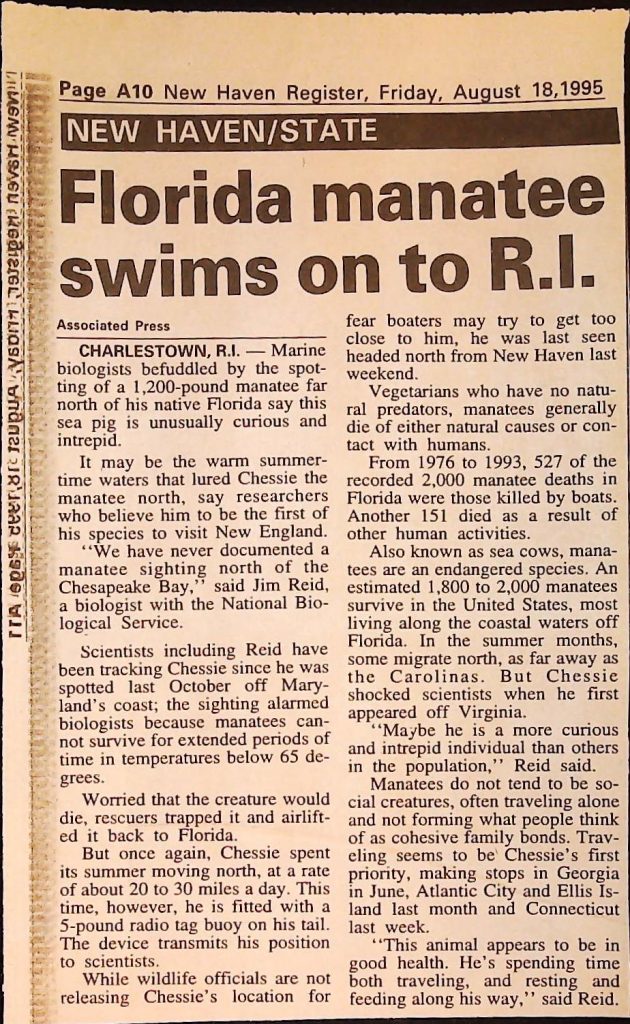
Page A10 New Haven Register, Friday, August 18,1995
NEW HAVEN/STATE
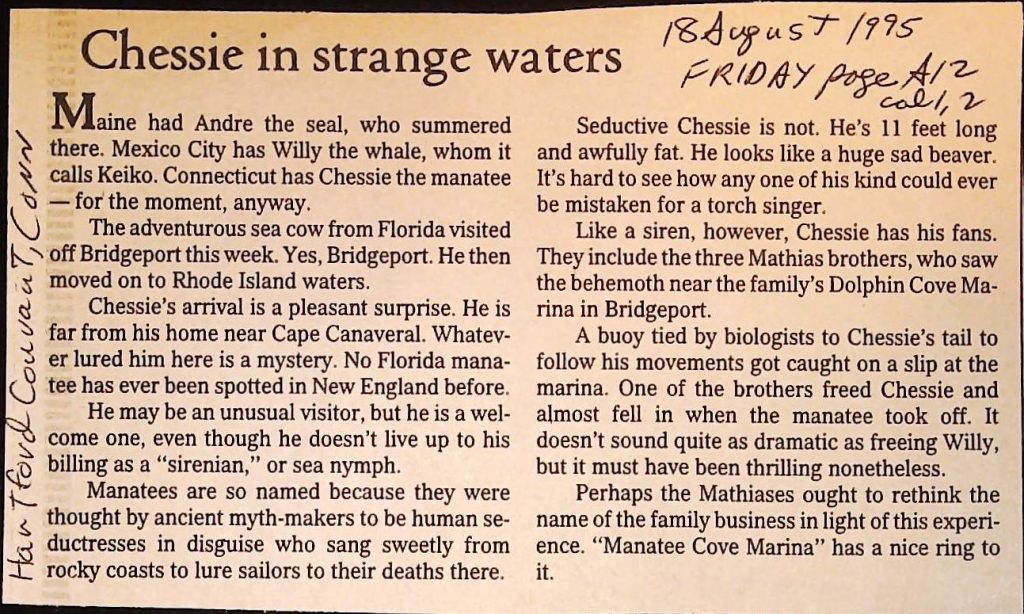
Florida manatee
swims on to R.I.
Associated Press
CHARLESTOWN, R.I.
Marine
biologists befuddled by the spot-
ting of a 1,200-pound manatee far
north of his native Florida say this
sea pig is unusually curious and
intrepid.
It may be the warm summer-
time waters that lured Chessie the
manatee north, say researchers
who believe him to be the first of
his species to visit New England.
"We have never documented a
manatee sighting north of the
Chesapeake Bay," said Jim Reid,
a biologist with the National Bio-
logical Service.
Scientists including Reid have
been tracking Chessie since he was
spotted last October off Mary-
land's coast; the sighting alarmed
biologists because manatees can-
not survive for extended periods of
time in temperatures below 65 de-
grees.
Worried that the creature would
die, rescuers trapped it and airlift-
ed it back to Florida.
But once again, Chessie spent
its summer moving north, at a rate
of about 20 to 30 miles a day. This
time, however, he is fitted with a
5-pound radio tag buoy on his tail.
The device transmits his position
to scientists.
While wildlife officials are not
releasing Chessie's location for
fear boaters may try to get too
close to him, he was last seen
headed north from New Haven last
weekend.
Vegetarians who have no natu-
ral predators, manatees generally
die of either natural causes or con-
tact with humans.
From 1976 to 1993, 527 of the
recorded 2,000 manatee deaths in
Florida were those killed by boats.
Another 151 died as a result of
other human activities.
Also known as sea cows, mana-
tees are an endangered species. An
estimated 1,800 to 2,000 manatees
survive in the United States, most
living along the coastal waters off
Florida. In the summer months,
some migrate north, as far away as
the Carolinas. But Chessie
shocked scientists when he first
appeared off Virginia.
"Maybe he is a more curious
and intrepid individual than others
in the population," Reid said.
Manatees do not tend to be so-
cial creatures, often traveling alone
and not forming what people think
of as cohesive family bonds. Trav-
eling seems to be Chessie's first
priority, making stops in Georgia
in June, Atlantic City and Ellis Is-
land last month and Connecticut
last week.
"This animal appears to be in
good health. He's spending time
both traveling, and resting and
feeding along his way," said Reid.

[PAGE BREAK]

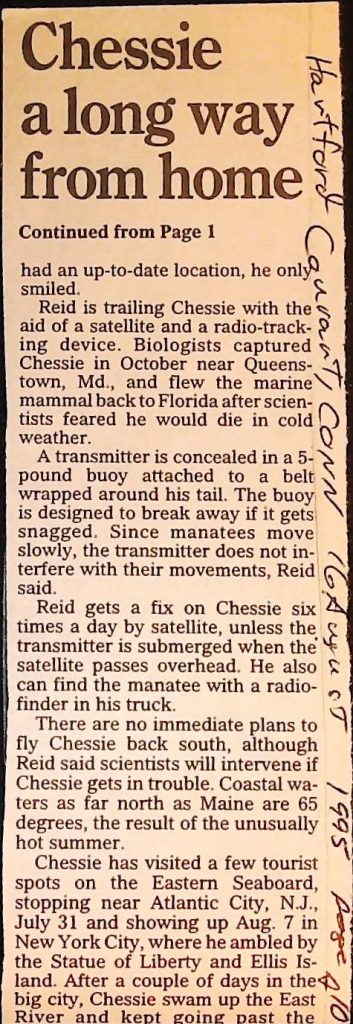
Chessie
a long way
from home
Continued from Page 1
had an up-to-date location, he only
smiled.
Reid is trailing Chessie with the
aid of a satellite and a radio-track-
ing device. Biologists captured
Chessie in October near Queens-
town, Md., and flew the marine
mammal back to Florida after scien-
tists feared he would die in cold
weather.
A transmitter is concealed in a 5-
pound buoy attached to a belt
wrapped around his tail. The buoy
is designed to break away if it gets
snagged. Since manatees move
slowly, the transmitter does not in-
terfere with their movements, Reid
said.
Hartford
Reid gets a fix on Chessie six
times a day by satellite, unless the
transmitter is submerged when the
satellite passes overhead. He also
can find the manatee with a radio-
finder in his truck.
There are no immediate plans to
fly Chessie back south, although
Reid said scientists will intervene if
Chessie gets in trouble. Coastal wa-
ters as far north as Maine are 65
degrees, the result of the unusually
hot summer.
Chessie has visited a few tourist
spots on the Eastern Seaboard,
stopping near Atlantic City, N.J.,
July 31 and showing up Aug. 7 in
New York City, where he ambled by
the Statue of Liberty and Ellis Is-
land. After a couple of days in the
big city, Chessie swam up the East
River and kept going past the
ST
1995

[PAGE BREAK]

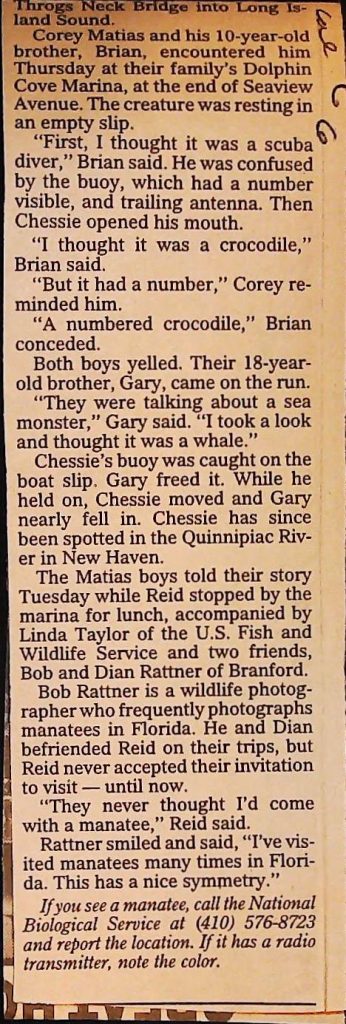
Throgs Neck Bridge into Long Is-
land Sound.
Corey Matias and his 10-year-old
brother, Brian, encountered him
Thursday at their family's Dolphin
Cove Marina, at the end of Seaview
Avenue. The creature was resting in
an empty slip.
"First, I thought it was a scuba
diver," Brian said. He was confused
by the buoy, which had a number
visible, and trailing antenna. Then
Chessie opened his mouth.
"I thought it was a crocodile,"
Brian said.
"But it had a number," Corey re-
minded him.
"A numbered crocodile," Brian
conceded.
Both boys yelled. Their 18-year-
old brother, Gary, came on the run.
"They were talking about a sea
monster," Gary said. "I took a look
and thought it was a whale.'
Chessie's buoy was caught on the
boat slip. Gary freed it. While he
held on, Chessie moved and Gary
nearly fell in. Chessie has since
been spotted in the Quinnipiac Riv-
er in New Haven.
The Matias boys told their story
Tuesday while Reid stopped by the
marina for lunch, accompanied by
Linda Taylor of the U.S. Fish and
Wildlife Service and two friends,
Bob and Dian Rattner of Branford.
Bob Rattner is a wildlife photog-
rapher who frequently photographs
manatees in Florida. He and Dian
befriended Reid on their trips, but
Reid never accepted their invitation
to visit until now.
"They never thought I'd come
with a manatee," Reid said.
Rattner smiled and said, "I've vis-
ited manatees many times in Flori-
da. This has a nice symmetry.'
If you see a manatee, call the National
[AD] Biological Service at (410) 576-8723
and report the location. If it has a radio
transmitter, note the color.
C

[PAGE BREAK]

B
B
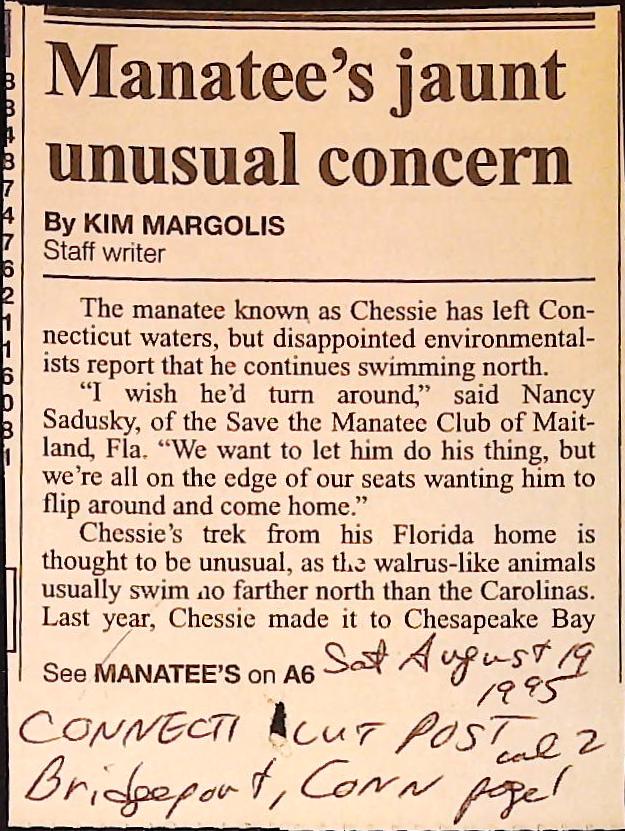
Manatee's jaunt
unusual concern
By KIM MARGOLIS
Staff writer
The manatee known as Chessie has left Con-
necticut waters, but disappointed environmental-
ists report that he continues swimming north.
"I wish he'd turn around," said Nancy
8 Sadusky, of the Save the Manatee Club of Mait-
land, Fla. "We want to let him do his thing, but
we're all on the edge of our seats wanting him to
flip around and come home."
Chessie's trek from his Florida home is
thought to be unusual, as the walrus-like animals
usually swim no farther north than the Carolinas.
Last year, Chessie made it to Chesapeake Bay
1995
19
See MANATEE'S on A6 Sat Augustig
CONNECTICUT POST 2
Bridgeport, CONN page!

[PAGE BREAK]

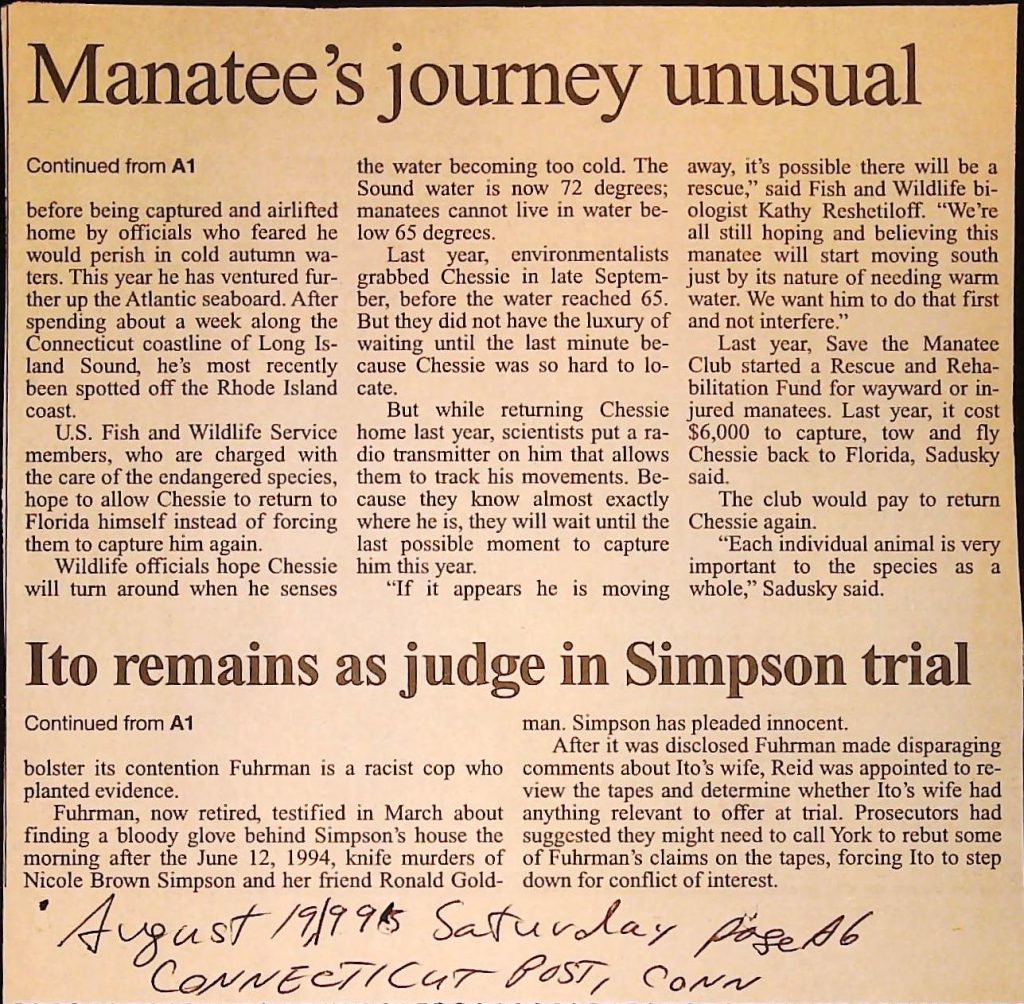
Manatee's journey unusual
Continued from A1
before being captured and airlifted
home by officials who feared he
would perish in cold autumn wa-
ters. This year he has ventured fur-
ther up the Atlantic seaboard. After
spending about a week along the
Connecticut coastline of Long Is-
land Sound, he's most recently
been spotted off the Rhode Island
coast.
U.S. Fish and Wildlife Service
members, who are charged with
the care of the endangered species,
hope to allow Chessie to return to
Florida himself instead of forcing
them to capture him again.
Wildlife officials hope Chessie
will turn around when he senses
the water becoming too cold. The
Sound water is now 72 degrees;
manatees cannot live in water be-
low 65 degrees.
Last year, environmentalists
grabbed Chessie in late Septem-
ber, before the water reached 65.
But they did not have the luxury of
waiting until the last minute be-
cause Chessie was so hard to lo-
cate.
But while returning Chessie
home last year, scientists put a ra-
dio transmitter on him that allows
them to track his movements. Be-
cause they know almost exactly
where he is, they will wait until the
last possible moment to capture
him this year.
"If it appears he is moving
away, it's possible there will be a
rescue," said Fish and Wildlife bi-
ologist Kathy Reshetiloff. "We're
all still hoping and believing this
manatee will start moving south
just by its nature of needing warm
water. We want him to do that first
and not interfere."
Last year, Save the Manatee
Club started a Rescue and Reha-
bilitation Fund for wayward or in-
jured manatees. Last year, it cost
[AD] $6,000 to capture, tow and fly
Chessie back to Florida, Sadusky
said.
The club would pay to return
Chessie again.
"Each individual animal is very
important to the species as a
whole," Sadusky said.
Ito remains as judge in Simpson trial
Continued from A1
bolster its contention Fuhrman is a racist cop who
planted evidence.
Fuhrman, now retired, testified in March about
finding a bloody glove behind Simpson's house the
morning after the June 12, 1994, knife murders of
Nicole Brown Simpson and her friend Ronald Gold-
man. Simpson has pleaded innocent.
After it was disclosed Fuhrman made disparaging
comments about Ito's wife, Reid was appointed to re-
view the tapes and determine whether Ito's wife had
anything relevant to offer at trial. Prosecutors had
suggested they might need to call York to rebut some
of Fuhrman's claims on the tapes, forcing Ito to step
down for conflict of interest.
· August 19/9915 Saturday pose Ab
CONNECTICUT POST, CONN.

[PAGE BREAK]

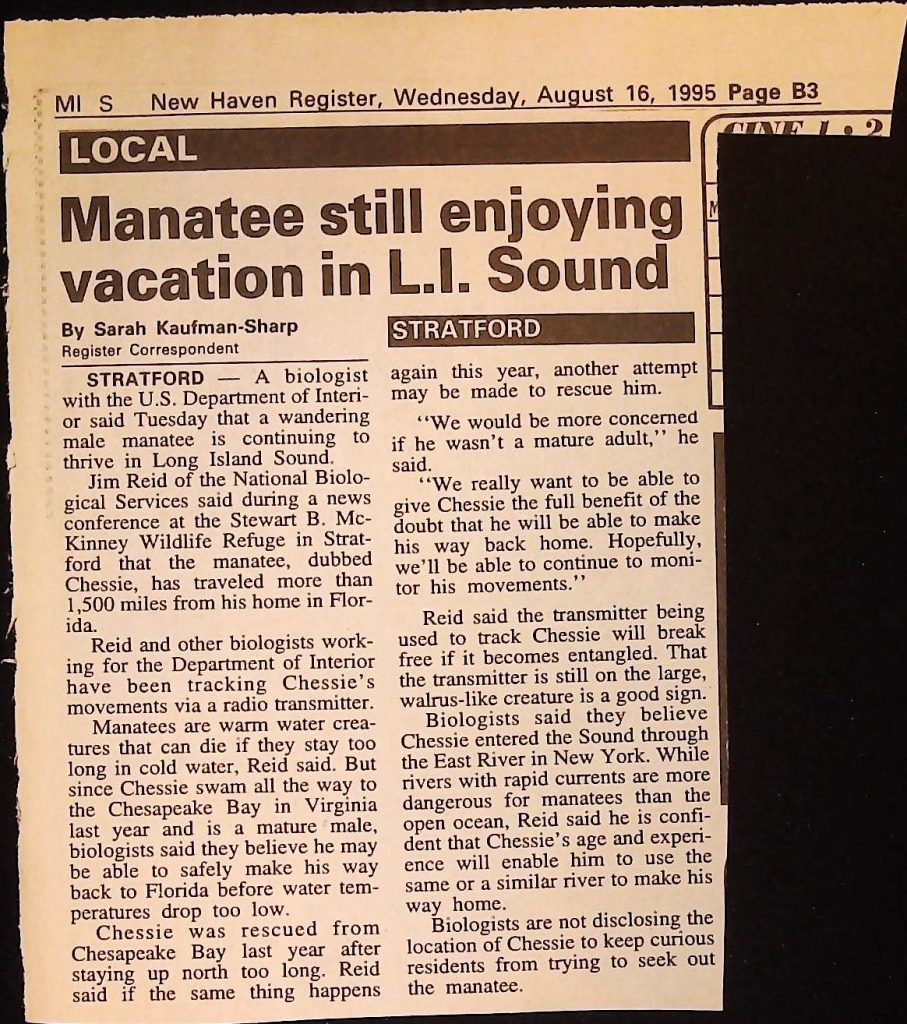
MI S
New Haven Register, Wednesday, August 16, 1995 Page B3
LOCAL
Manatee still enjoying
vacation in L.I. Sound
By Sarah Kaufman-Sharp
Register Correspondent
STRATFORD
A biologist
with the U.S. Department of Interi-
or said Tuesday that a wandering
male manatee is continuing to
thrive in Long Island Sound.
Jim Reid of the National Biolo-
gical Services said during a news
conference at the Stewart B. Mc-
Kinney Wildlife Refuge in Strat-
ford that the manatee, dubbed
Chessie, has traveled more than
1,500 miles from his home in Flor-
ida.
Reid and other biologists work-
ing for the Department of Interior
have been tracking Chessie's
movements via a radio transmitter.
Manatees are warm water crea-
tures that can die if they stay too
long in cold water, Reid said. But
since Chessie swam all the way to
the Chesapeake Bay in Virginia
last year and is a mature male,
biologists said they believe he may
be able to safely make his way
back to Florida before water tem-
peratures drop too low.
Chessie was rescued from
Chesapeake Bay last year after
staying up north too long. Reid
said if the same thing happens
STRATFORD
again this year, another attempt
may be made to rescue him.
"We would be more concerned
if he wasn't a mature adult," he
said.
"We really want to be able to
give Chessie the full benefit of the
doubt that he will be able to make
his way back home. Hopefully,
we'll be able to continue to moni-
tor his movements.
Reid said the transmitter being
used to track Chessie will break
free if it becomes entangled. That
the transmitter is still on the large,
walrus-like creature is a good sign.
Biologists said they believe
Chessie entered the Sound through
the East River in New York. While
rivers with rapid currents are more
dangerous for manatees than the
open ocean, Reid said he is confi-
dent that Chessie's age and experi-
ence will enable him to use the
same or a similar river to make his
way home.
Biologists are not disclosing the
location of Chessie to keep curious
residents from trying to seek out
the manatee.

[PAGE BREAK]

A10
CONNECTICUT POST
Wednesday, August 16, 1995
Hope rises
in rubble
of theater
Developers prowl
Stratford landmark
By ELIZABETH GALVIN
Correspondent
STRATFORD
A musty
stage, sagging floors and torn ceil-
ing tiles almost obscure what was
once a show-stopping landmark.
But Stratford resident Louis
Burke is able to look past defects
in the hulking gray building, aban-
doned six years ago. He only sees
soft footlights and hears thunder-
ous applause.
Burke is among at least three
prospective developers who are
looking for a chance to revive the
state-owned American Festival
Theatre, formerly known as the
American Shakespeare Theatre.
Interested buyers met with rep-
resentatives from the state Depart-
ment of Environmental Protection
Tuesday to tour the 14.4-acre prop-
erty on the Housatonic River.
The state is looking for bidders
to purchase and revive the property
as a performing arts center.
Prospective buyers must contin-
ue operating the property as a the-
ater and produce at least one
Shakespearean production each
year, according to state legislation
enacted last year.
Burke, of Brickhill-Burke Pro-
ductions, said he has been interest-
ed in the property for the past six
years. He would like to build at
least two additional theaters there
to offer a variety of productions to
theater goers.
"It's a magnificent site and the
name of Stratford itself has a cer-
tain mystique," Burke said. "It's
sad to see that it has been neglected
for so long."
The property
overgrown with
weeds and the massive theater it-
self has become dilapidated.
Yellow fiberglass insulation
hangs out of holes in the ceiling of
the lobby. Floor tiles are missing to
expose plywood that sags under the
weight of those who cross it.
"What has happened here over
the course of the years is a shame,"
DEP Commissioner Sidney J. Hol-

[PAGE BREAK]

DLOOK Sald But we hope to feCITLY
it."
The state has tried to lease the
property in the past with no suc-
cess, said Charles Reed, DEP's di
rector of land acquisition and
property management.
Another local group, Stratford
upon-the-Housatonic, was chose
by the state last year to develop th
property. But lease negotiation
were stalled due to complaint
from Burke about the selectio
process.
Robert DelBuono, president o
SUTHI, said his group is still inter
ested in the property. He also a
tended Tuesday's meeting.
This time the DEP is lookin
for a serious bidder. A nonrefund
able deposit of at least $25,000 wi
be required.
An advisory committee is bein
assembled to review proposals
Reed said. The state is more con
Ledyard targeted
for bogus $100 bills
NEWARK, N.J. (AP) - Sev
men passing counterfeit $100 bil
may have fooled change machin
in Atlantic City casinos, but th
couldn't dupe a prostitute for lor
authorities said Tuesday.
After learning from colleagu
that the three hundreds she w
given by one of the men were t
gus, the woman tipped police at t
resort, leading to their arrest ov
the Memorial Day weekend, sa
Robert Pochopin, special agent
charge of the Secret Service offi
in Atlantic City.
Since then, bills from the san
printer have been found in Las V
gas casinos and at Foxwoods R
sort Casino in Ledyard, Conn. N
one has been arrested in conne
tion with those counterfeit bil
Three others believed linked to t
ring have been arrested in Atlan
City casinos, Pochopin said.
On Tuesday, a federal gra
jury in Camden indicted the sev
6V
Quene
9669 'Kepsupм I

[PAGE BREAK]

UST 15, 1995
page 44 cal 4,5 COUNTY ST
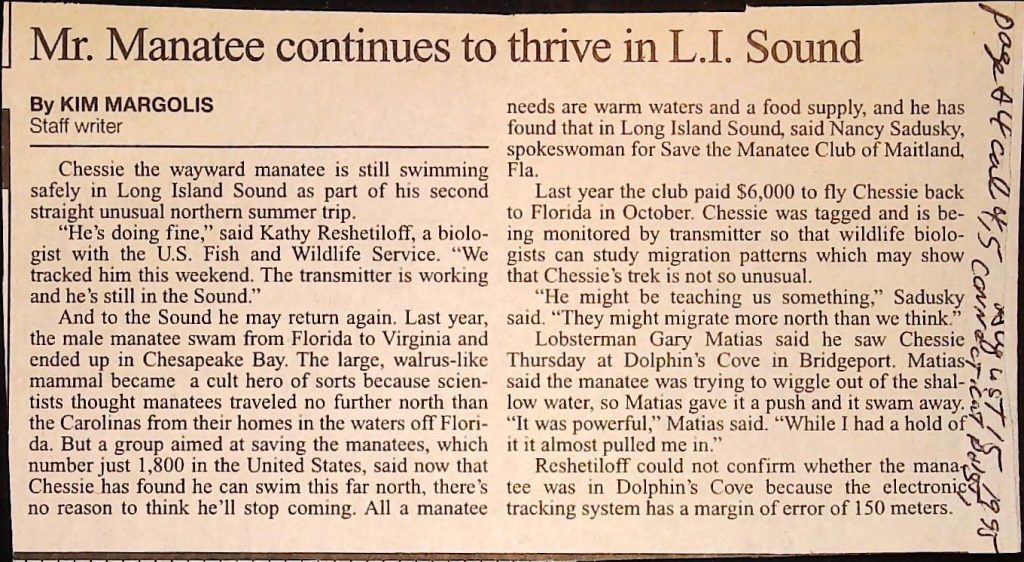
Mr. Manatee continues to thrive in L.I. Sound
By KIM MARGOLIS
Staff writer
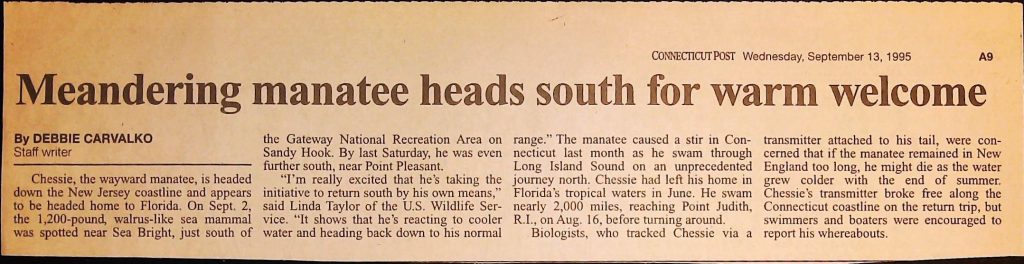
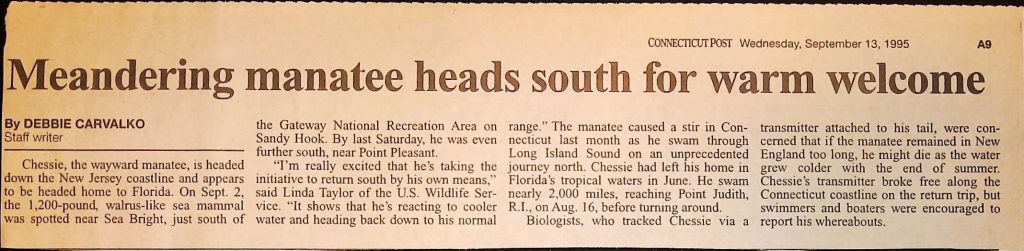
Chessie the wayward manatee is still swimming
safely in Long Island Sound as part of his second
straight unusual northern summer trip.
"He's doing fine," said Kathy Reshetiloff, a biolo-
gist with the U.S. Fish and Wildlife Service. "We
tracked him this weekend. The transmitter is working
and he's still in the Sound."
And to the Sound he may return again. Last year,
the male manatee swam from Florida to Virginia and
ended up in Chesapeake Bay. The large, walrus-like
mammal became a cult hero of sorts because scien-
tists thought manatees traveled no further north than
the Carolinas from their homes in the waters off Flori-
da. But a group aimed at saving the manatees, which
number just 1,800 in the United States, said now that
Chessie has found he can swim this far north, there's
no reason to think he'll stop coming. All a manatee
needs are warm waters and a food supply, and he has
found that in Long Island Sound, said Nancy Sadusky,
spokeswoman for Save the Manatee Club of Maitland,
Fla.
Last year the club paid $6,000 to fly Chessie back
to Florida in October. Chessie was tagged and is be-
ing monitored by transmitter so that wildlife biolo-
gists can study migration patterns which may show
that Chessie's trek is not so unusual.
"He might be teaching us something," Sadusky
said. "They might migrate more north than we think."
Lobsterman Gary Matias said he saw Chessie
Thursday at Dolphin's Cove in Bridgeport. Matias
said the manatee was trying to wiggle out of the shal-;
low water, so Matias gave it a push and it swam away.
"It was powerful," Matias said. "While I had a hold of
it it almost pulled me in.'
Reshetiloff could not confirm whether the mana
tee was in Dolphin's Cove because the electronic
tracking system has a margin of error of 150 meters.

[PAGE BREAK]

A10 THE HARTFORD COURANT: Friday, August 18, 1995
Former supervisor
By MATTHEW DALY
Courant Staff Writer
A former supervisor at the Hart-
ford Juvenile Detention Center
changed, without his superiors'
knowledge, rules restricting ac-
cused teenage offenders' access to
violent and sexual movies, a top
judicial department official said
Thursday.
The former supervisor, whose
name was not released, changed the
rules before the ultraviolent movie
"Natural Born Killers" was shown
to teenagers at the detention center
in June, said the official, Robert F.
Cunningham, deputy director of ju-
venile detention services for the ju-
dicial department.
The R-rated movie was brought to
the Broad Street facility by a staff
member who apparently believed-
incorrectly that he or she was
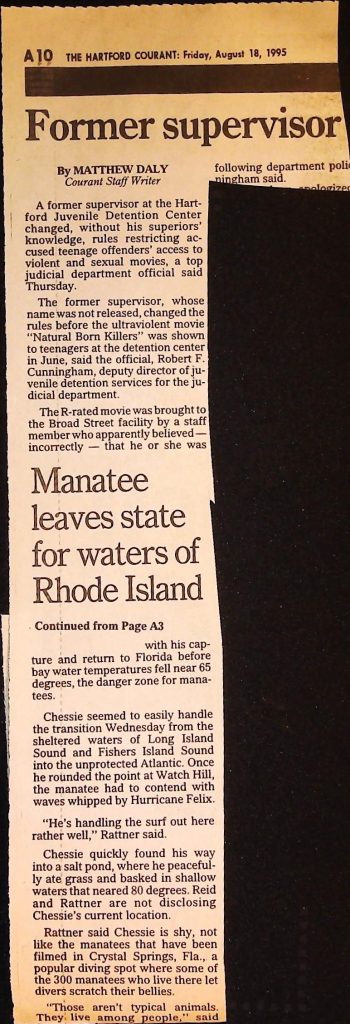
Manatee
leaves state
for waters of
Rhode Island
Continued from Page A3
with his cap-
ture and return to Florida before
bay water temperatures fell near 65
degrees, the danger zone for mana-
tees.
Chessie seemed to easily handle
the transition Wednesday from the
sheltered waters of Long Island
Sound and Fishers Island Sound
into the unprotected Atlantic. Once
he rounded the point at Watch Hill,
the manatee had to contend with
waves whipped by Hurricane Felix.
"He's handling the surf out here
rather well," Rattner said.
Chessie quickly found his way
into a salt pond, where he peaceful-
ly ate grass and basked in shallow
waters that neared 80 degrees. Reid
and Rattner are not disclosing
Chessie's current location.
Rattner said Chessie is shy, not
like the manatees that have been
filmed in Crystal Springs, Fla., a
popular diving spot where some of
the 300 manatees who live there let
divers scratch their bellies.
"Those aren't typical animals.
They live among people," said
following department poli
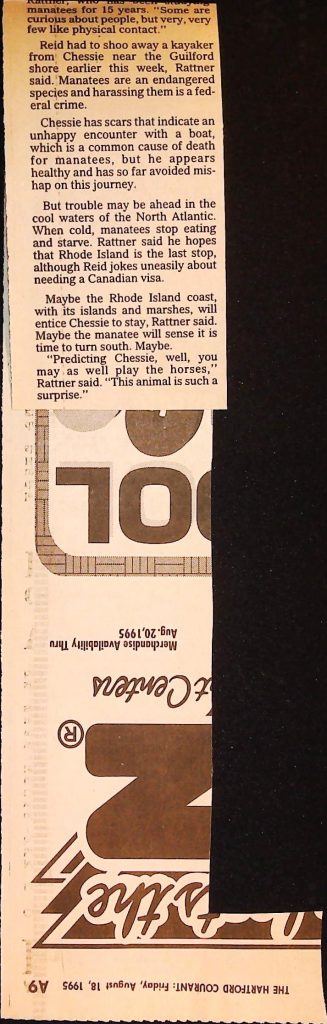
ningham said.
apologized

[PAGE BREAK]

Kauer, who has been studying
manatees for 15 years. "Some are
curious about people, but very, very
few like physical contact.'
Reid had to shoo away a kayaker
from Chessie near the Guilford
shore earlier this week, Rattner
said. Manatees are an endangered
species and harassing them is a fed-
eral crime.
Chessie has scars that indicate an
unhappy encounter with a boat,
which is a common cause of death
for manatees, but he appears
healthy and has so far avoided mis-
hap on this journey.
But trouble may be ahead in the
cool waters of the North Atlantic.
When cold, manatees stop eating
and starve. Rattner said he hopes
that Rhode Island is the last stop,
although Reid jokes uneasily about
needing a Canadian visa.
Maybe the Rhode Island coast,
with its islands and marshes, will
entice Chessie to stay, Rattner said.
Maybe the manatee will sense it is
time to turn south. Maybe.
"Predicting Chessie, well, you
may as well play the horses,'
Rattner said. "This animal is such a
surprise."
10
2!
23
133
M
(a)
M
92048
C
6.22
IN
S661'07.ɓny
6 66 850 P

[PAGE BREAK]

Hantford Couran
Connecticut
18 August 1995 page A12 FRIDAY
Chessie in strange waters
Ma
Laine had Andre the seal, who summered
there. Mexico City has Willy the whale, whom it
calls Keiko. Connecticut has Chessie the manatee
- for the moment, anyway.
The adventurous sea cow from Florida visited
off Bridgeport this week. Yes, Bridgeport. He then
moved on to Rhode Island waters.
Chessie's arrival is a pleasant surprise. He is
far from his home near Cape Canaveral. Whatev-
er lured him here is a mystery. No Florida mana-
tee has ever been spotted in New England before.
He may be an unusual visitor, but he is a wel-
come one, even though he doesn't live up to his
billing as a "sirenian," or sea nymph.
Manatees are so named because they were
thought by ancient myth-makers to be human se-
ductresses in disguise who sang sweetly from
rocky coasts to lure sailors to their deaths there.
Seductive Chessie is not. He's 11 feet long
and awfully fat. He looks like a huge sad beaver.
It's hard to see how any one of his kind could ever
be mistaken for a torch singer.
Like a siren, however, Chessie has his fans.
They include the three Mathias brothers, who saw
the behemoth near the family's Dolphin Cove Ma-
rina in Bridgeport.
A buoy tied by biologists to Chessie's tail to
follow his movements got caught on a slip at the
marina. One of the brothers freed Chessie and
almost fell in when the manatee took off. It
doesn't sound quite as dramatic as freeing Willy,
but it must have been thrilling nonetheless.
Perhaps the Mathiases ought to rethink the
name of the family business in light of this experi-
ence. "Manatee Cove Marina" has a nice ring to
it.

[PAGE BREAK]

A 10 THE HARTFORD COURANT: Friday, August 18, 1995
Former superio
By MATTHEW DALY
Courant Staff Writer
A former supervisor at the Hart-
ford Juvenile Detention Center
changed, without his superiors'
knowledge, rules restricting ac-
cused teenage offenders' access to
violent and sexual movies, a top
judicial department official said
Thursday.
The former supervisor, whose
name was not released, changed the
rules before the ultraviolent movie
"Natural Born Killers" was shown
to teenagers at the detention center
in June, said the official, Robert F.
Cunningham, deputy director of ju-
venile detention services for the ju-
dicial department.
The R-rated movie was brought to
the Broad Street facility by a staff
member who apparently believed-
incorrectly that he or she was
Manatee
leaves state
for waters of
Rhode Island
Continued from Page A3
with his cap-
ture and return to Florida before
bay water temperatures fell near 65
degrees, the danger zone for mana-
tees.
Chessie seemed to easily handle
the transition Wednesday from the
sheltered waters of Long Island
Sound and Fishers Island Sound
into the unprotected Atlantic. Once
he rounded the point at Watch Hill,
the manatee had to contend with
waves whipped by Hurricane Felix.
"He's handling the surf out here
rather well," Rattner said.
Chessie quickly found his way
into a salt pond, where he peaceful-
ly ate grass and basked in shallow
waters that neared 80 degrees. Reid
and Rattner are not disclosing
Chessie's current location.
Rattner said Chessie is shy, not
like the manatees that have been
filmed in Crystal Springs, Fla., a
popular diving spot where some of
the 300 manatees who live there let
divers scratch their bellies.
"Those aren't typical animals.
They live among people," said

[PAGE BREAK]

Katti
manatees for 15 years. "Some are
curious about people, but very, very
few like physical contact.
Reid had to shoo away a kayaker
from Chessie near the Guilford
shore earlier this week, Rattner
said. Manatees are an endangered
species and harassing them is a fed-
eral crime.
Chessie has scars that indicate an
unhappy encounter with a boat,
which is a common cause of death
for manatees, but he appears
healthy and has so far avoided mis-
hap on this journey.
But trouble may be ahead in the
cool waters of the North Atlantic.
When cold, manatees stop eating
and starve. Rattner said he hopes
that Rhode Island is the last stop,
although Reid jokes uneasily about
needing a Canadian visa.
Maybe the Rhode Island coast,
with its islands and marshes, will
entice Chessie to stay, Rattner said.
Maybe the manatee will sense it is
time to turn south. Maybe.
"Predicting Chessie, well, you
may as well play the horses,"
Rattner said. "This animal is such a
surprise.'
10
67 661 8
5661'07-6ny

[PAGE BREAK]

tford Cou
I, CONN FRIDAY
Manatee spurns state
for Rhode Island waters
By MARK PAZNIOKAS
Courant Staff Writer
It seems Chessie, the wayward
Florida manatee, is a typical
Connecticut tourist. The state
was not his vacation destination,
just a nice spot to spend a few
days poking around.
After a week wending his way
east along the state's coast
with side trips into a Bridgeport
marina, New Haven Harbor and
the Connecticut River- Chessie
was spotted Wednesday riding
the storm-tossed waves off
Watch Hill, R.I.
"He was surfing with the surf-
ers," said Bob Rattner, a Bran-
ford nature photographer who is
helping government biologist
Jim Reid monitor Chessie. "They
were real excited."
Their excitement is under-
standable. Chessie is 11 feet
long, weighs about 1,200 pounds
and looks like a walrus without
tusks. He also is towing a small
buoy that contains two tracking
devices.
Alarmed surfers reported see-
ing a "seal dragging a lobster
pot," Rattner said. But he and
Reid quickly confirmed that the
odd sight was Chessie and his
buoy, which resembles the
markers used on lobster traps.
Chessie has no interest in lob-
sters, though. Manatees are her-
bivores, eating only plants. Pick-
ings were slim when he passed
by Manhattan last month in the
East River, but he found plenty of
tasty marsh grass in Connecti-
cut.
Rhode Island is the 11th state
on Chessie's grand tour, an odys-
sey that began in June when the
adult mammal left a sheltered
river near Cape Canaveral, Fla.,
to boldly go where no manatee
has gone before.
The previous record for north-
ward travel by one of the tropical
creatures was set last fall, when
Chessie swam to Chesapeake
Bay. He picked up his nickname
on that journey, which ended
Please see Manatee, Page A10
*Page A3 18 August 1995 call, 2

[PAGE BREAK]

Hartford Courant, CONN FRIDAY
Manatee spurns state
for Rhode Island waters
By MARK PAZNIOKAS
Courant Staff Writer
It seems Chessie, the wayward
Florida manatee, is a typical
Connecticut tourist. The state
was not his vacation destination,
just a nice spot to spend a few
days poking around.
After a week wending his way
east along the state's coast
with side trips into a Bridgeport
marina, New Haven Harbor and
the Connecticut River- Chessie
was spotted Wednesday riding
the storm-tossed waves off
Watch Hill, R.I.
"He was surfing with the surf-
ers," said Bob Rattner, a Bran-
ford nature photographer who is
helping government biologist
Jim Reid monitor Chessie. "They
were real excited."
Their excitement is under-
standable. Chessie is 11 feet
long, weighs about 1,200 pounds
and looks like a walrus without
tusks. He also is towing a small
buoy that contains two tracking
devices.
Alarmed surfers reported see-
ing a "seal dragging a lobster
pot," Rattner said. But he and
Reid quickly confirmed that the
odd sight was Chessie and his
buoy, which resembles the
markers used on lobster traps.
Chessie has no interest in lob-
sters, though. Manatees are her-
bivores, eating only plants. Pick-
ings were slim when he passed
by Manhattan last month in the
East River, but he found plenty of
tasty marsh grass in Connecti-
cut.
Rhode Island is the 11th state
on Chessie's grand tour, an odys-
sey that began in June when the
adult mammal left a sheltered
river near Cape Canaveral, Fla.,
to boldly go where no manatee
has gone before.
The previous record for north-
ward travel by one of the tropical
creatures was set last fall, when
Chessie swam to Chesapeake
Bay. He picked up his nickname
on that journey, which ended
Please see Manatee, Page A10
18 August 1995 page A3call, 2

[PAGE BREAK]

A8
The Advocate, Saturday, August 19, 1995.
The ADVOCATE
Established in 1829 Southern Connecticut Newspapers, Inc.
75 Tresser Blvd., P.O. Box 9307
A Times Mirror
Newspaper
Stamford, Conn.
[AD] 06904-9307
Publisher/Chief Executive Officer: William J. Rowe
Executive Vice President/Editor: Kenneth H. Brief
Managing Editor: Barry Hoffman
Editorial Page Editor: Deirdre S. Channing
Editorials
Chessie, the manatee on the move
O
ur part of the country entices
plenty of visitors at this time of
year. Some seem unlikely to go
out of their way to visit this corner of
New England. None of them, however,
has provoked the surprise that Chessie,
the manatee, did as he swam through
the waters off Greenwich and Stamford
en route from New. York City to New
Haven Harbor and points beyond.
The 1,200-pound aquatic mammal,
dubbed Chessie during a previous foray
into the upper reaches of the Chesa-
peake Bay, is the first of his species to
be a documented visitor to our waters.
Most of the estimated 1,800 to 2,000
manatees that survive in the United
States live in the coastal waters of Flori-
da. The creatures need water 65 degrees
or warmer; prolonged exposure to cold-
er water could be deadly.
Which is why Chessie got a plane ride
back to Florida last year from the
Chesapeake after summer ended. Man-
atees are on the list of endangered
The Issue:
We should welcome
aquatic mammal's foray
into the state's shores.
species, and scientists didn't want an
adventurous critter like Chessie to meet
an untimely demise as autumn set in.
They also wanted to keep track of the
unusual creature that seems to be unnat-
urally interested in places manatees just
don't turn up, so they attached a radio
tag buoy that allows them to monitor
his movements.
That's how they knew he was head-
ing north, past Atlantic City, up the East
River in New York and on into Cos Cob
Harbor and the Mianus River. The man-
atee was spotted in those last two
respective locations by Steve Beau-
mont of Cos Cob and Fred Peters of
Mianus Marine on Aug. 8. That
evening, there were further sightings as
the large animal swam his way up the
shoreline.
The scientists have said Chessie is
still on the move, but they have refused
to give his precise location. No wonder.
Manatees are peaceful vegetarians
without natural enemies in the animal
world. Most fatalities are caused by
contact with humans. As if to under-
score that point, Chessie bears the scars
of an encounter with a motorboat.
Keeping clear of them is the best
course; penalties for killing a manatee
could be as much as $125,000 and a
year in prison.
No one seems to know where Chessie
is heading, or why. The biologists who
rescued him last year are wondering
whether another plane ride may be in his
future this fall. We may never learn why
he passed this way. Chalk it up to just
one more occurrence in nature that is a
mystery. Unlike some visitors who seem
out of place here, however, Chessie is
one we should make welcome.

[PAGE BREAK]

Chessie the traveling manatee gets new transmitter
GAINESVILLE, Fla. (AP) Chessie the
manatee, who made it up the East Coast to
New England last year, has been retagged by
scientists in southeast Florida.
A researcher spotted Chessie last week and
attached a radio transmitter to a belt the sea
cow was still wearing.
On Wednesday, a biologist replaced that tag
with a satellite-monitored transmitter.
The 1,200-pound mammal made history
last year when he became the first of its
species known to reach New England.
The manatee caused a stir in Connecticut as
he swam through Long Island Sound on an un-
precedented journey north.
Chessie had left his home in Florida's tropi-
cal waters in June.
He swam nearly 2,000 miles, reaching
Point Judith, R.I., on Aug. 16, before turning
around.
Last summer, scientists following the sea
cow were thrown off the trail when the original
transmitter fell off in New Haven.
It was Chessie's second straight unusual
northern summer trip.
The previous summer, the male manatee
swam from Florida to Virginia and ended up in
Chesapeake Bay.
The large, walrus-like mammal became a
cult hero of sorts because scientists thought
manatees traveled no further north than the
Carolinas from their homes in the waters off
Florida.
But a group aimed at saving the manatees,
which number just 1,800 in the United States,
said now that Chessie has found he can swim
this far north, there's no reason to think he'll
stop coming. All a manatee needs are warm
waters and a food supply, and he has found that
in Long Island Sound, said Nancy Sadusky,
spokeswoman for Save the Manatee Club of
Maitland, Fla.
T
Feb-25-1996 Sunday Connecticut Post, Bridport page#3 call 1-3

[PAGE BREAK]

CONNECTICUT POST Wednesday, September 13, 1995
A9
Meandering manatee heads south for warm welcome
By DEBBIE CARVALKO
Staff writer
Chessie, the wayward manatee, is headed
down the New Jersey coastline and appears
to be headed home to Florida. On Sept. 2,
the 1,200-pound, walrus-like sea mammal
spotted near Sea Bright, just south of
was
the Gateway National Recreation Area on
Sandy Hook. By last Saturday, he was even
further south, near Point Pleasant.
"I'm really excited that he's taking the
initiative to return south by his own means,"
said Linda Taylor of the U.S. Wildlife Ser-
vice. "It shows that he's reacting to cooler
water and heading back down to his normal
range." The manatee caused a stir in Con-
necticut last month as he swam through
Long Island Sound on an unprecedented
journey north. Chessie had left his home in
Florida's tropical waters in June. He swam
nearly 2,000 miles, reaching Point Judith,
R.I., on Aug. 16, before turning around.
Biologists, who tracked Chessie via a report his whereabouts.
transmitter attached to his tail, were con-
cerned that if the manatee remained in New
England too long, he might die as the water
grew colder with the end of summer.
Chessie's transmitter broke free along the
Connecticut coastline on the return trip, but
swimmers and boaters were encouraged to

[PAGE BREAK]

Manatee Sighted
Off New York
NEW HAVEN, Conn. Aug. 30 (AP)
- A wayward manatee who shook
off his radio transmitter - leaving
marine biologists mystified as to his
whereabouts has been spotted off
the coast of New York.
Jim Reid, a biologist with the Na-
tional Biological Service, said the
mammal, also known as a sea cow,
was sighted off the coast of New
Rochelle, N.Y.. The sightings oc-
curred over the weekend, he said.
The manatee, called Chessie by
scientists, lost his transmitter last
week in New Haven Harbor. Biolo-
gists have been tracking Chessie all
summer. He became the first docu-
mented creature of his species to
journey to New England.
Manatees, which are warm water
creatures, aren't typically sighted
north of the Carolinas because they
cannot survive for extended periods
in temperatures below 65 degrees.
Chessie has traveled 130 miles to-
ward his home state of Florida since
turning around at Point Judith, R.I.,
the northernmost point of the ani-
mal's unusual swim. Biologists be-
lieve Chessie still has enough time to
reach warmer waters before winter.
69
Thursday page
August 31, 1995
Shouldn't you
every
day? For convenient home
delivery of The New York
Times, call
1-800-NYTIMES
[AD] (1-800-698-4637).
The New York Times

[PAGE BREAK]

CONNECTICUT POST Wednesday, September 13, 1995
A9
Meandering manatee heads south for warm welcome
By DEBBIE CARVALKO
Staff writer
Chessie, the wayward manatee, is headed
down the New Jersey coastline and appears
to be headed home to Florida. On Sept. 2,
the 1,200-pound, walrus-like sea mammal
was spotted near Sea Bright, just south of
the Gateway National Recreation Area on
Sandy Hook. By last Saturday, he was even
further south, near Point Pleasant.
"I'm really excited that he's taking the
initiative to return south by his own means,'
said Linda Taylor of the U.S. Wildlife Ser-
vice. "It shows that he's reacting to cooler
water and heading back down to his normal
range." The manatee caused a stir in Con-
necticut last month as he swam through
Long Island Sound on an unprecedented
journey north. Chessie had left his home in
Florida's tropical waters in June. He swam
nearly 2,000 miles, reaching Point Judith,
R.I., on Aug. 16, before turning around.
Biologists, who tracked Chessie via a
transmitter attached to his tail, were con-
cerned that if the manatee remained in New
England too long, he might die as the water
grew colder with the end of summer.
Chessie's transmitter broke free along the
Connecticut coastline on the return trip, but
swimmers and boaters were encouraged to
report his whereabouts.

[PAGE BREAK]

Hartford Couvant, CONN
Chessie in strange waters
Maine had Andre the seal, who summered
there. Mexico City has Willy the whale, whom it
calls Keiko. Connecticut has Chessie the manatee
- for the moment, anyway.
The adventurous sea cow from Florida visited
off Bridgeport this week. Yes, Bridgeport. He then
moved on to Rhode Island waters.
Chessie's arrival is a pleasant surprise. He is
far from his home near Cape Canaveral. Whatev-
er lured him here is a mystery. No Florida mana-
tee has ever been spotted in New England before.
He may be an unusual visitor, but he is a wel-
come one, even though he doesn't live up to his
billing as a "sirenian," or sea nymph.
Manatees are so named because they were
thought by ancient myth-makers to be human se-
ductresses in disguise who sang sweetly from
rocky coasts to lure sailors to their deaths there.
18 August 1995
FRIDAY pose A12
call, 2
Seductive Chessie is not. He's 11 feet long
and awfully fat. He looks like a huge sad beaver.
It's hard to see how any one of his kind could ever
be mistaken for a torch singer.
Like a siren, however, Chessie has his fans.
They include the three Mathias brothers, who saw
the behemoth near the family's Dolphin Cove Ma-
rina in Bridgeport.
A buoy tied by biologists to Chessie's tail to
follow his movements got caught on a slip at the
marina. One of the brothers freed Chessie and
almost fell in when the manatee took off. It
doesn't sound quite as dramatic as freeing Willy,
but it must have been thrilling nonetheless.
Perhaps the Mathiases ought to rethink the
name of the family business in light of this experi-
ence. "Manatee Cove Marina" has a nice ring to
it.

[PAGE BREAK]

Manatee a sight
for shore eyes
An
BELMAR, NJ.
adventurous manatee has
intrigued New Jersey
with a rare swim to the
Northeast.
"I've never anything
like this," said Anthony
Giordano, who was pre-
paring to go fishing off
the Shark River inlet Fri-
day when he spotted
Chessie, the 10-foot-long,
1,250-pound mammal.
Robert Schoelkopf, di-
rector of the Marine
Mammal Stranding Cen-
ter in Brigantine, N.J.,
said this is the farthest
north a manatee, an en-
dangered species native
to Florida, has been re-
ported.
Chessie, who is tagged
with a radio transmitter,
is heading north at an av-
erage of 28 miles per day
during his journey from
Jacksonville, Fla.
The Associated Press
12109 21
6. August 1995
N.Y. W.X-Daily
News Sunday

[PAGE BREAK]

23 July
ter
cean Cruising Is Irrestible to Errant Bay Manatee
By Amy Argetsinger
The Washington Post
ANNAPOLIS, Md.
"Ches-
sie," the adventurous Florida ma-
natee recently spotted on his
I second northward charge up the
Bay, has apparently
swimming nearly as far
north as the Potomac River, the
1,500-pound sea cow turned
around, headed out to the Atlan-
tic Ocean and hung a left.
Wednesday afternoon, he was
sighted near Maryland's Assatea-
gue Island, south of Ocean City.
U.S. Fish and Wildlife Service
officials said it's still too soon to
guess whether Chessie plans to
repeat his summer of '94 shenani-
gans.
Last year, Chessie swam past
Annapolis to the mouth of the
Chester River on the Eastern
Shore, about 700 miles north of
his natural habitat off the central
Florida coast. The manatee re-
ceived his nickname and wide-
spread notice after he was seen
bumping against boats at a mari-
na near the mouth of the Chester.
When he dawdled through Sep-
tember, scientists and wildlife of-
ficials, worried he would get
caught in a cold snap, airlifted
him back to Florida on an all-ex-
Spense-paid flight.
Manatees, endangered plant-
eating mammals, resemble hip-
pos without legs or walruses with-
out tusks. Their closest relatives
in the animal kingdom are el-
ephants. Warm-water creatures,
they rarely stray farther north
AP File Photo
WEST INDIAN MANATEE swims in warm waters of Blue Springs State
Park near Orange City, Fla.
than the Carolinas.
Environmental agencies and
groups went to the trouble of res-
cuing Chessie from the bay last
year because only 1,800 of his
species survive. After spending
[AD] $6,000 on the rescue, Maitland,
Fla.-based Save the Manatee es-
tablished Chessie's Emergency
Rescue Fund not necessarily
earmarked for Chessie, but at this
rate, "who knows?" said spokes-
man Nancy Sadusky.
said.
"We would like not to have to
rescue him again,' she
"We'll just have to see what hap
pens.
Chessie's latest excellent ad
venture started June 15, when he
departed from Jacksonville, Fla.
Three weeks later, he swam past
the Rappahannock River. Then
last week, he reversed course,
swimming around the tip of Vir-
ginia's Eastern Shore on Satur-
day.
Marine biologists from the De-
partment of the Interior caught
up with him Monday near Hog Is-
land, off Virginia's Atlantic coast,
and replaced the batteries in the
satellite-tracking tag attached to
his tail.
Fish and Wildlife Service offi-
cials said it's too soon in the sea-
son to start worrying about
another rescue. In the meantime,
they don't mind watching him ex-
plore, said agency spokesman
Patricia Fisher.
"I don't know what the right bi-
ological term is, but he already
had a girl down in Florida this
year," she said.

[PAGE BREAK]

Bridgeport, Corn Cal 5,6
CONNECTICUT POST Friday, August 25, 1995
Chessie throws 'voice'
Continued from A1
spot him. Right now, though,
they're not quite sure where he is.
On the plus side, Chessie ap-
pears to be headed toward his
Florida home, after an unprece-
dented summer trip up the East
Coast. Researchers had worried
he would go so far north that he
would be unable to get home be-
fore the water got cold.
But last weekend, after reach-
ing Rhode Island, he turned
around and headed south through
Long Island Sound. It appears he
stopped near New Haven and even
swam a ways up the Quinnipiac
River to feed on plants.
On Tuesday, researchers be-
lieve, the buoy carrying the radio
transmitter came loose. But biolo-
gists aren't fretting. Yet.
A7
"He's still in warm waters and
in a comfort zone,' said Kathy
Rashetiloff, a biologist with the
U.S. Fish and Wildlife Service.
Chessie's transmitter was de-
signed to break off if it became
entangled. Otherwise, it could
hold the animal underwater and
drown him, Rashetiloff said.
Chessie, named last year be-
cause of an unusual trek to the
Chesapeake Bay, had to be cap-
tured in the fall and airlifted to
Florida before water temperatures
dipped below 65 degrees. Previ-
ously, it was thought manatees did
not migrate north of the Caroli-
nas.
Even though Chessie is friend-
ly, swimmers and boaters should
not try to approach him. Anyone
seeing Chessie may call Mystic
[AD] Marinelife Aquarium at 536-9631.

[PAGE BREAK]

second cable sys- ity to compete in arte
22 August 1995
Hartford Couvant
Hartford, Connecticut
Connecticut page BW
'cul 34
Chessie's hope: Go
south, young manatee
By MARK PAZNIOKAS
Courant Staff Writer
Chessie the wandering manatee
abruptly did an about-face off the
coast of Rhode Island over the
waters - possibly on a 1,500-mile
weekend and is back in Connecticut
swim home to Florida.
Reid, the government biologist who
"It's the right direction," said Jim
has been tracking Chessie since the
marine mammal left Florida in
June. "But he's still a very long way
from Florida."
Chessie reached Point Judith,
R.I., but then he backtracked 35
miles into Long Island Sound, Reid
said Monday in a telephone inter-
view from his office at the National
Biological Service in Gainesville,
Fla.
Satellite tracking pinpointed the
manatee Saturday off Mystic and in
New London Harbor, Reid said. He
declined to release more recent lo-
cations, hoping to keep the curious
away from the shy, gentle creature.
Chessie had the water to himself
Sunday and today. Connecticut
beaches were closed to swimming
and shellfishing from Waterford to
Rhode Island because of a raw sew-
age spill Saturday night in Mystic.
"I don't see that as being a prob-
lem right now," Reid said of the
sewage. Chessie probably had
passed by Mystic before the sewage
plant malfunctioned, and manatees
are hearty animals, he said.
"We do find these animals often
frequent polluted waters. The Mi-
ami River in Miami sometimes has
quite a few manatees in there in the
wintertime, some times year
round," he said. "It has certainly
less than optimal water quality."
Time and temperature are great-
er problems for Chessie.
Reid declined to speculate if
Chessie can safely make it back to
his native southern waters before
the ocean temperature drops below
65 degrees, the point below which
Reid declined to
speculate if Chessie can
make it back to his native
waters before the ocean
temperature drops below
65 degrees, the point
below which manatees
tend to stop eating.
the walrus-like manatees tend to
stop eating.
Chessie, an adult male who has
wandered 1,000 miles farther north
than any other manatee, conceiv-
ably could take up temporary resi-
dence at one of the spots where he
stopped to feed on marsh grass on
his trip, Reid said.
"So we're still concerned," Reid
said. "He doesn't have a lot of time
to waste."
Manatees have prodigious appe-
tites, eating the equivalent of be-
tween 4 percent and 9 percent of
their body weight every day. Ches-
sie weighs about 1,200 pounds.
Chessie once before feinted south
and then continued his trip north. In
July, the manatee briefly reversed
direction off the eastern shore of
Virginia and Maryland. Then he re-
sumed his northward swim.
Biologists trapped Chessie last
October in Chesapeake Bay, which
accounts for his nickname, after
water temperatures dipped danger-
ously low. The Coast Guard flew
him back to Florida and affixed a
tracking device.
Reid said he expects Chessie to
remain in Long Island Sound for
several days, feeding and resting. If
the manatee is heading home, Reid
has no doubt he can find his way.
"We know these guys have a
good memory," Reid said. "They
know how to navigate."

[PAGE BREAK]

Overband
Hartford Courant 22 August 1995
Hartford, Connecticut pages 7 cal 3,4
Tuesday
Chessie's hope: Goday
south, young manatee
By MARK PAZNIOKAS
Courant Staff Writer
abruptly did an about-face off the
coast of Rhode Island over the
waters - possibly on a 1,500-mile
weekend and is back in Connecticut
swim home to Florida.
Chessie the wandering manatee
"It's the right direction," said Jim
Reid, the government biologist who
has been tracking Chessie since the
marine mammal left Florida in
June. "But he's still a very long way
from Florida."
Chessie reached Point Judith,
R.I., but then he backtracked 35
miles into Long Island Sound, Reid
said Monday in a telephone inter-
view from his office at the National
Biological Service in Gainesville,
Fla.
Satellite tracking pinpointed the
manatee Saturday off Mystic and in
New London Harbor, Reid said. He
declined to release more recent lo-
cations, hoping to keep the curious
away from the shy, gentle creature.
Chessie had the water to himself
Sunday and today. Connecticut
beaches were closed to swimming
and shellfishing from Waterford to
Rhode Island because of a raw sew-
age spill Saturday night in Mystic.
"I don't see that as being a prob-
lem right now," Reid said of the
sewage. Chessie probably had
passed by Mystic before the sewage
plant malfunctioned, and manatees
are hearty animals, he said.
"We do find these animals often
frequent polluted waters. The Mi-
ami River in Miami sometimes has
quite a few manatees in there in the
wintertime, some times year
round," he said. "It has certainly
less than optimal water quality.
Time and temperature are great-
er problems for Chessie.
Reid declined to speculate if
Chessie can safely make it back to
his native southern waters before
the ocean temperature drops below
65 degrees, the point below which
Reid declined to
speculate if Chessie can
make it back to his native
waters before the ocean
temperature drops below
65 degrees, the point
below which manatees
tend to stop eating.
the walrus-like manatees tend to
stop eating.
Chessie, an adult male who has
wandered 1,000 miles farther north
than any other manatee, conceiv-
ably could take up temporary resi-
dence at one of the spots where he
stopped to feed on marsh grass on
his trip, Reid said.
"So we're still concerned," Reid
said. "He doesn't have a lot of time
to waste.
Manatees have prodigious appe-
tites, eating the equivalent of be-
tween 4 percent and 9 percent of
their body weight every day. Ches-
sie weighs about 1,200 pounds.
Chessie once before feinted south
and then continued his trip north. In
July, the manatee briefly reversed
direction off the eastern shore of
Virginia and Maryland. Then he re-
sumed his northward swim.
Biologists trapped Chessie last
October in Chesapeake Bay, which
accounts for his nickname, after
water temperatures dipped danger-
ously low. The Coast Guard flew
him back to Florida and affixed a
tracking device.
Reid said he expects Chessie to
remain in Long Island Sound for
several days, feeding and resting. If
the manatee is heading home, Reid
has no doubt he can find his way.
"We know these guys have a
good memory," Reid said. "They
know how to navigate.

[PAGE BREAK]

Hartford Couvant
Tuesday
67
wal 3,4
Hartford, CoNN August 22, 1995 pose?
Chessie's hope: Go
south, young manatee
By MARK PAZNIOKAS
Courant Staff Writer
Chessie the wandering manatee
abruptly did an about-face off the
coast of Rhode Island over the
weekend and is back in Connecticut
waters - possibly on a 1,500-mile
swim home to Florida.
"It's the right direction," said Jim
Reid, the government biologist who
has been tracking Chessie since the
marine mammal left Florida in
June. "But he's still a very long way
from Florida."
Chessie reached Point Judith,
R.I., but then he backtracked 35
miles into Long Island Sound, Reid
said Monday in a telephone inter-
view from his office at the National
Biological Service in Gainesville,
Fla.
Satellite tracking pinpointed the
manatee Saturday off Mystic and in
New London Harbor, Reid said. He
declined to release more recent lo-
cations, hoping to keep the curious
away from the shy, gentle creature.
Chessie had the water to himself
Sunday and today. Connecticut
beaches were closed to swimming
and shellfishing from Waterford to
Rhode Island because of a raw sew-
age spill Saturday night in Mystic.
"I don't see that as being a prob-
lem right now," Reid said of the
sewage. Chessie probably had
passed by Mystic before the sewage
plant malfunctioned, and manatees
are hearty animals, he said.
"We do find these animals often
frequent polluted waters. The Mi-
ami River in Miami sometimes has
quite a few manatees in there in the
wintertime, some times year
round," he said. "It has certainly
less than optimal water quality."
Time and temperature are great-
er problems for Chessie.
Reid declined to speculate if
Chessie can safely make it back to
his native southern waters before
the ocean temperature drops below
65 degrees, the point below which
Reid declined to
speculate if Chessie can
make it back to his native
waters before the ocean
temperature drops below
65 degrees, the point
below which manatees
tend to stop eating.
the walrus-like manatees tend to
stop eating.
Chessie, an adult male who has
wandered 1,000 miles farther north
than any other manatee, conceiv-
ably could take up temporary resi-
dence at one of the spots where he
stopped to feed on marsh grass on
his trip, Reid said.
"So we're still concerned," Reid
said. "He doesn't have a lot of time
to waste."
Manatees have prodigious appe-
tites, eating the equivalent of be-
tween 4 percent and 9 percent of
their body weight every day. Ches-
sie weighs about 1,200 pounds.
Chessie once before feinted south
and then continued his trip north. In
July, the manatee briefly reversed
direction off the eastern shore of
Virginia and Maryland. Then he re-
sumed his northward swim.
Biologists trapped Chessie last
October in Chesapeake Bay, which
accounts for his nickname, after
water temperatures dipped danger-
ously low. The Coast Guard flew
him back to Florida and affixed a
tracking device.
Reid said he expects Chessie to
remain in Long Island Sound for
several days, feeding and resting. If
the manatee is heading home, Reid
has no doubt he can find his way.
"We know these guys have a
good memory,'
Reid said. "They
know how to navigate.

[PAGE BREAK]

22 August 1995
Hartford Courant
Hartford, Connecticut
page 137
cal
3.4
Chessie's hope: Go
south, young manatee
By MARK PAZNIOKAS
Courant Staff Writer
abruptly did an about-face off the
coast of Rhode Island over the
weekend and is back in Connecticut
waters - possibly on a 1,500-mile
swim home to Florida.
Chessie the wandering manatee
Reid, the government biologist who
has been tracking Chessie since the
marine mammal left Florida in
"It's the right direction," said Jim
June. "But he's still a very long way
from Florida."
Chessie reached Point Judith,
R.I., but then he backtracked 35
miles into Long Island Sound, Reid
said Monday in a telephone inter-
view from his office at the National
Biological Service in Gainesville,
Fla.
Satellite tracking pinpointed the
manatee Saturday off Mystic and in
New London Harbor, Reid said. He
declined to release more recent lo-
cations, hoping to keep the curious
away from the shy, gentle creature.
Chessie had the water to himself
Sunday and today. Connecticut
beaches were closed to swimming
and shellfishing from Waterford to
Rhode Island because of a raw sew-
age spill Saturday night in Mystic.
"I don't see that as being a prob-
lem right now," Reid said of the
sewage. Chessie probably had
passed by Mystic before the sewage
plant malfunctioned, and manatees
are hearty animals, he said.
"We do find these animals often
frequent polluted waters. The Mi-
ami River in Miami sometimes has
quite a few manatees in there in the
wintertime, some times year
round," he said. "It has certainly
less than optimal water quality."
Time and temperature are great-
er problems for Chessie.
Reid declined to speculate if
Chessie can safely make it back to
his native southern waters before
the ocean temperature drops below
65 degrees, the point below which
Reid declined to
speculate if Chessie can
make it back to his native
waters before the ocean
temperature drops below
65 degrees, the point
below which manatees
tend to stop eating.
the walrus-like manatees tend to
stop eating.
Chessie, an adult male who has
wandered 1,000 miles farther north
than any other manatee, conceiv-
ably could take up temporary resi-
dence at one of the spots where he
stopped to feed on marsh grass on
his trip, Reid said.
"So we're still concerned," Reid
said. "He doesn't have a lot of time
to waste."
Manatees have prodigious appe-
tites, eating the equivalent of be-
tween 4 percent and 9 percent of
their body weight every day. Ches-
sie weighs about 1,200 pounds.
Chessie once before feinted south
and then continued his trip north. In
July, the manatee briefly reversed
direction off the eastern shore of
Virginia and Maryland. Then he re-
sumed his northward swim.
Biologists trapped Chessie last
October in Chesapeake Bay, which
accounts for his nickname, after
water temperatures dipped danger-
ously low. The Coast Guard flew
him back to Florida and affixed a
tracking device.
Reid said he expects Chessie to
remain in Long Island Sound for
several days, feeding and resting. If
the manatee is heading home, Reid
has no doubt he can find his way.
"We know these guys have a
good memory," Reid said. "They
know how to navigate.

[PAGE BREAK]

Burlington
Free
Press,
Aug. 16,
1995
The Air Force has been crit-
Manatee swims
to New England
The Associated Press
STRATFORD, Conn. - A
wayward manatee wandering
north became the first of its
species known to reach New
England, marine experts said
Tuesday.
The animal has astounded
marine biologists, who for the
first time have documented a
member of this endangered
species moving beyond Ameri-
ca's mid-Atlantic states. The
manatee, also known as a sea
cow, was spotted swimming
and resting on the shores of
New Haven on Saturday.
"We have never docu-
mented a manatee sighting
north of the Chesapeake Bay,"
said Jim Reid of the National
Biological Service.
This manatee, nicknamed
Chessie, first shocked scientists
last year when it was spotted in
Virginia's Chesapeake Bay.
Worried that it would die when
the water turned cold, rescuers
trapped it, and airlifted it back
to Florida, attaching a radio
beacon to its tail at that time.
But once again, the 10-foot,
1,200-pound manatee has
spent its summer moving
north.
Scientists are not sure what
they will do if it does not turn
around soon. The temperature
of local waters has been in the
upper 70s, Reid said.
"Once Chesaia ranches cold
water or the weather turns
slightly cooler, we hope that he
will make his own decision to
return south," Reid said.
Evening
Bachelor's
Degrees
- Accounting
- Business
Management
- Professional
Studies
Evening
Associate's
2323
434444 AVANCIALCY LIC [WO Emery
now have letters (
Black Hawk helicopters. Capt. disapproval from Foglema
Ashe statue ground-breaki
The Washington Post
RICHMOND, Va. The
ceremony was supposed to help
Richmond start getting past the
bitterness, past the racial divi-
sions that brought it so much
unwanted international attention
last month.
But as people gathered on the
city's premier avenue to break
ground Tuesday for the statue of
within camera range was the
native son Arthur Ashe, always
group of two dozen demonstra-
tors, men in gray battle dress,
who silently hoisted the Stars and
Bars.
They showed that resolution
still might be a long time off.
"My ancestors fought with
the 21st Virginia Infantry... and
I think this place is inappro-
priate," said Thomas Morris, a
nightclub disk jockey. "If you're
going to put up a black mon
ument here, put one up to thos
who fought in the Confederat
Army. A lot of fellows in the cit
feel this way.
Neither the ceremony nor th
protest had any of the emotiona
conflict of the hours-long Jul
meeting at which the City Coun
cil voted to make room for the
24-foot bronze statue on Mon
ument Avenue. Supporters hac
argued that the tennis great, who
broke many racial barriers, de
served to be honored on the sam
street where the Confederacy':
most revered heroes stand large:
than life.
Under the morning's cloudy
skies, Ashe's mother, sister and
brother looked on proudly as
friends and elected leaders
scanned an artist's drawing of the
memorial, read from Ashe's
book, "Days of Grace," cited the
U.S. fire deaths hit all-time low
The Associated Press
BOSTON - The number of
people killed' by fires in the Unit-
ed States dropped in 1994 to the
lowest level in at least 81 years, a
fire-safety group reported.
The National Fire Protection
Association credited better safety
standards and increasing use of
smoke detectors in recent years.
The private organization is-
sued its annual report on fire
deaths Wednesday. The group,
founded in 1896, gathers data
Cigars!
from fire departments around the
country.
The NFPA reported that
4,275 people died in fires in
1994, not counting firefighters.
That was a 7.8 percent decrease
from 4,635 the previous year.
It is the lowest total since
reliable record-keeping began in
1913, NFPA spokesman John
Hall Jr. said. A National Safety
Council analysis of death certifi-
cates found 8,900 fire deaths that
year.
THE NET RESULT
Over 25 varieties of premium cigars
[AD] 350 Dorset St., Burlington 862-5227
Now Open Mon-Sat. 10-7
Sundays
Sun. 124
CONTINUING
EDUCATION
HAS

[PAGE BREAK]

Chessie loses
device; few
see mammal
By KIM MARGOLIS
Staff writer
Chessie the wayward manatee
was not spotted Friday, but biolo-
gists tracking him aren't surprised.
The radio transmitter that had
been attached to the 1,200 pound
sea cow allowed scientists to trace
his movments, and the buoy at-
tached to the transmitter helped
boaters and swimmers spot him.
The transmitter fell off in Long Is-
land Sound earlier this week.
"The number of sightings will
not be as great because the majori-
ty came from the transmitter being
sighted before the manatee," said
Jim Reid, a biologist with National
Biological Service, which tracks
the 10-foot-long animal. "The wa-
ter is about as dark as it gets up
there."
Chessie was spotted once, off
New Haven, since his transmitter
fell off so scientists are fairly sure
the device was not cut loose in an
accident.
The transmitter is designed to
break off if it gets stuck on a
branch or dock so that the manatee
does not drown.
The manatee has made news
this summer by traveling as far
north as Rhode Island.
It had previously been thought
that manatees migrated no farther
north than Virginia from their
Florida home.
Although the transmitter is off,
biologists are breathing easier be-
cause the animal is traveling south.
It needs to leave the north before
water temperatures drop below 65
degrees.
The transmitter was attached
last October after Chessie wan-
dered north into the Chesapeake
Bay and had to be airlifted home.
Reid said officials hope to tag the
animal again because they have
learned much about its migration
patterns.
coll
CONNECTICUT
POST, BRIDGEPORT, CT
26 AUGUST 1995 PA3
Southbound
Chessie keeps
radio silence
By KIM MARGOLIS
Staff writer
He's been mistaken for a whale and
a walrus, but it's unlikely that the 1,200
pound gray manatee called Chessie
would be confused with a needle in a
haystack.
But that's essentially what he is,
now that a transmitter being used to
track him has fallen off in the waters
off New Haven. The only way scientists
can follow his movements now is if
boaters, swimmers or people on shore
See CHESSIE on A7
CONNECTICUTPOST
BRIDGE PORTCONN
26 AUGUST 1995 pleads

Leave a Reply

Your email address will not be published. Required fields are marked *