Box 4
Folder 51. Giant Snakes
Item 1. Internet Articles


Transcribed Text (OCR)
GARY MANGIACOPA ARCHIVE
============================================================
Title:      B4F51I1
Slug:       b4f51i1
Categories: Cryptozoology
Source:     https://garymangiacopraarchive.com/b4f51i1
Pages:      15 scanned, 13 extracted
OCR:        Google Vision API (document_text_detection)
Processed:  2026-06-06
============================================================

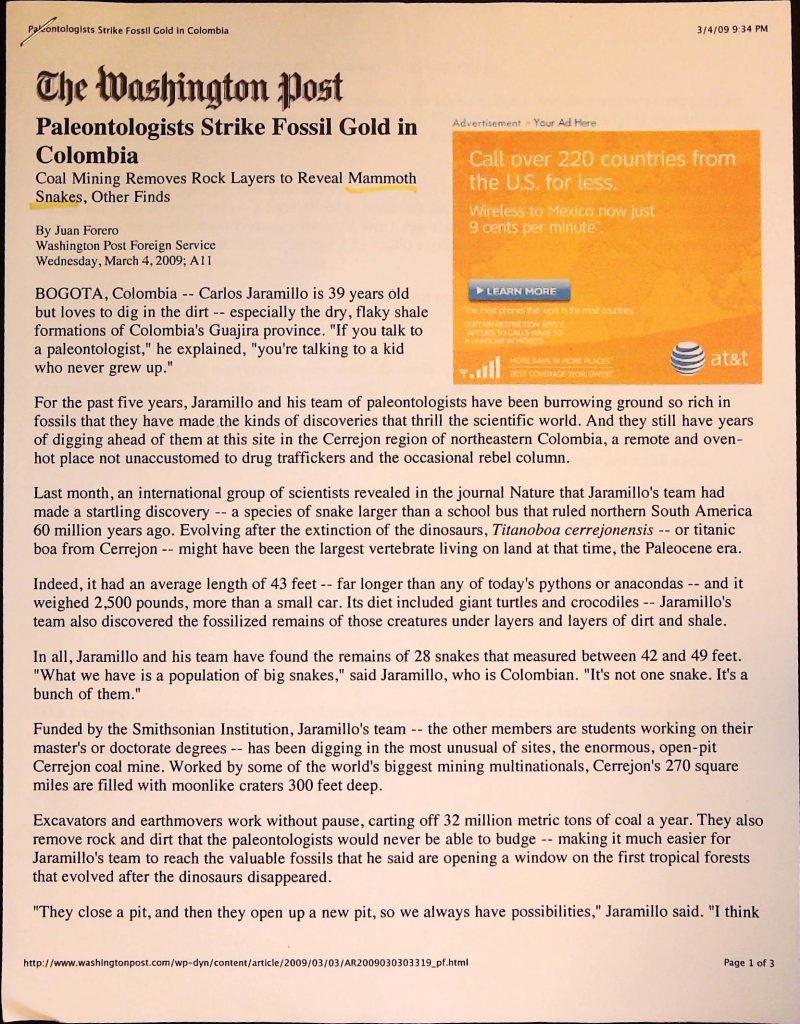
Paleontologists Strike Fossil Gold in Colombia
Paycontologis
The Washington Post
Paleontologists Strike Fossil Gold in
Colombia
Coal Mining Removes Rock Layers to Reveal Mammoth
Snakes, Other Finds
By Juan Forero
Washington Post Foreign Service
Wednesday, March 4, 2009; A11
BOGOTA, Colombia -- Carlos Jaramillo is 39 years old
but loves to dig in the dirt -- especially the dry, flaky shale
formations of Colombia's Guajira province. "If you talk to
a paleontologist," he explained, "you're talking to a kid
who never grew up."
Advertisement Your Ad Here
3/4/09 9:34 PM
Call over 220 countries from
the U.S. for less.
Wireless to Mexico now just
9 cents per minute.
LEARN MORE
The most phones, that work is best countries
CONTAIN RESTRICTION APPLY
ARMESTO CALLS MADE TO
ALANDLINEN HOE
MORE BARS IS MORE PLACES
BEST COVERAGE WORLDWIDE
at&t
For the past five years, Jaramillo and his team of paleontologists have been burrowing ground so rich in
fossils that they have made the kinds of discoveries that thrill the scientific world. And they still have years
of digging ahead of them at this site in the Cerrejon region of northeastern Colombia, a remote and oven-
hot place not unaccustomed to drug traffickers and the occasional rebel column.
--
Last month, an international group of scientists revealed in the journal Nature that Jaramillo's team had
made a startling discovery a species of snake larger than a school bus that ruled northern South America
60 million years ago. Evolving after the extinction of the dinosaurs, Titanoboa cerrejonensis
or titanic
boa from Cerrejon -- might have been the largest vertebrate living on land at that time, the Paleocene era.
--
Indeed, it had an average length of 43 feet -- far longer than any of today's pythons or anacondas -- and it
weighed 2,500 pounds, more than a small car. Its diet included giant turtles and crocodiles -- Jaramillo's
team also discovered the fossilized remains of those creatures under layers and layers of dirt and shale.
In all, Jaramillo and his team have found the remains of 28 snakes that measured between 42 and 49 feet.
"What we have is a population of big snakes," said Jaramillo, who is Colombian. "It's not one snake. It's a
bunch of them."
--
Funded by the Smithsonian Institution, Jaramillo's team the other members are students working on their
master's or doctorate degrees -- has been digging in the most unusual of sites, the enormous, open-pit
Cerrejon coal mine. Worked by some of the world's biggest mining multinationals, Cerrejon's 270 square
miles are filled with moonlike craters 300 feet deep.
Excavators and earthmovers work without pause, carting off 32 million metric tons of coal a year. They also
remove rock and dirt that the paleontologists would never be able to budge -- making it much easier for
Jaramillo's team to reach the valuable fossils that he said are opening a window on the first tropical forests
that evolved after the dinosaurs disappeared.
"They close a pit, and then they open up a new pit, so we always have possibilities," Jaramillo said. "I think
http://www.washingtonpost.com/wp-dyn/content/article/2009/03/03/AR2009030303319_pf.html
Page 1 of 3

[PAGE BREAK]

tologists Strike Fossil Gold In Colombla
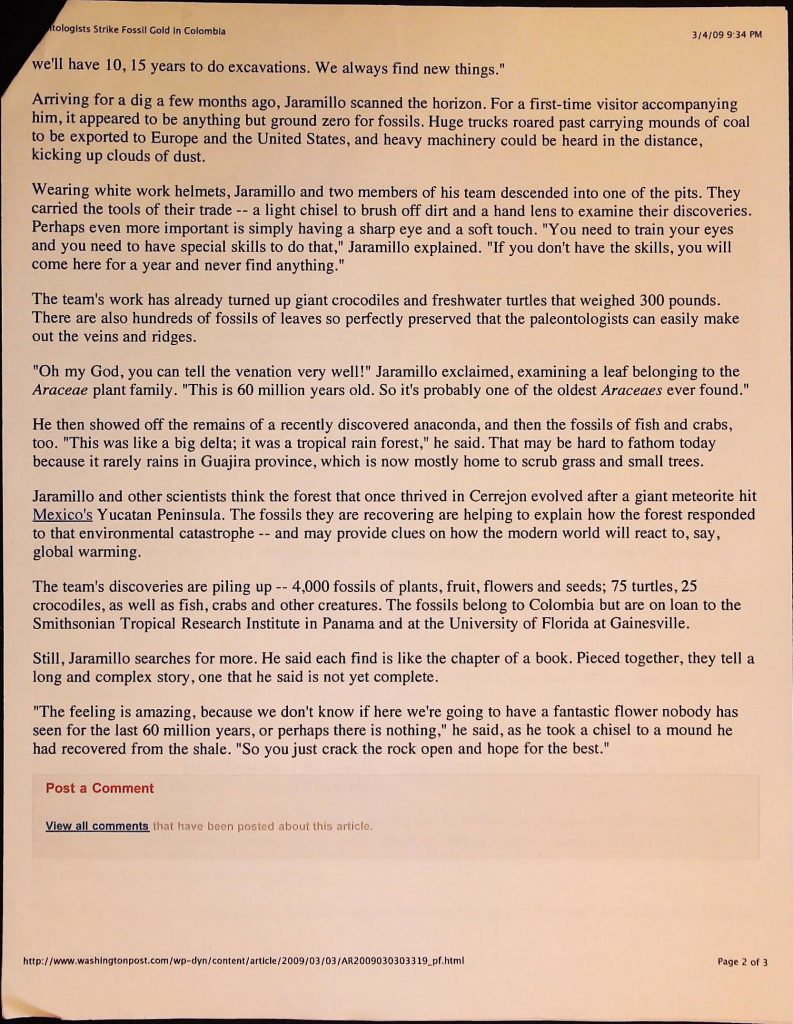
we'll have 10, 15 years to do excavations. We always find new things."
3/4/09 9:34 PM
Arriving for a dig a few months ago, Jaramillo scanned the horizon. For a first-time visitor accompanying
him, it appeared to be anything but ground zero for fossils. Huge trucks roared past carrying mounds of coal
to be exported to Europe and the United States, and heavy machinery could be heard in the distance,
kicking up clouds of dust.
--
Wearing white work helmets, Jaramillo and two members of his team descended into one of the pits. They
carried the tools of their trade a light chisel to brush off dirt and a hand lens to examine their discoveries.
Perhaps even more important is simply having a sharp eye and a soft touch. "You need to train your eyes
and you need to have special skills to do that," Jaramillo explained. "If you don't have the skills, you will
come here for a year and never find anything.
The team's work has already turned up giant crocodiles and freshwater turtles that weighed 300 pounds.
There are also hundreds of fossils of leaves so perfectly preserved that the paleontologists can easily make
out the veins and ridges.
"Oh my God, you can tell the venation very well!" Jaramillo exclaimed, examining a leaf belonging to the
Araceae plant family. "This is 60 million years old. So it's probably one of the oldest Araceaes ever found."
He then showed off the remains of a recently discovered anaconda, and then the fossils of fish and crabs,
too. "This was like a big delta; it was a tropical rain forest," he said. That may be hard to fathom today
because it rarely rains in Guajira province, which is now mostly home to scrub grass and small trees.
Jaramillo and other scientists think the forest that once thrived in Cerrejon evolved after a giant meteorite hit
Mexico's Yucatan Peninsula. The fossils they are recovering are helping to explain how the forest responded
to that environmental catastrophe and may provide clues on how the modern world will react to, say,
global warming.
--
The team's discoveries are piling up -- 4,000 fossils of plants, fruit, flowers and seeds; 75 turtles, 25
crocodiles, as well as fish, crabs and other creatures. The fossils belong to Colombia but are on loan to the
Smithsonian Tropical Research Institute in Panama and at the University of Florida at Gainesville.
Still, Jaramillo searches for more. He said each find is like the chapter of a book. Pieced together, they tell a
long and complex story, one that he said is not yet complete.
"The feeling is amazing, because we don't know if here we're going to have a fantastic flower nobody has
seen for the last 60 million years, or perhaps there is nothing," he said, as he took a chisel to a mound he
had recovered from the shale. "So you just crack the rock open and hope for the best.
Post a Comment
View all comments that have been posted about this article.
http://www.washingtonpost.com/wp-dyn/content/article/2009/03/03/AR2009030303319_pf.html
Page 2 of 3

[PAGE BREAK]

Stay still, will you?
Last week the reptile world was rocked by the news that a 14-metre python had been discovered
in Indonesia. Could a snake really be so long? There was only one way to find out - we sent John
Aglionby along with a tape measure
"Look, you must understand that a python's length is not constant," explains Darmanto, the owner
and handler of Fragrant Flower. Fragrant Flower is the reticulated python found living in a
tourism park in central Java which was last week touted as the longest and heaviest snake ever
captured- 14.85m and 447kg. "Depending on the weather, on how recently he has eaten and
when he last shed his skin, Fragrant can stretch and contract a great deal. A few days ago he
stretched himself out halfway round the cage.'
This hurried explanation by the man whose large buck teeth, sparkling eyes and animated face
lend him more than a passing resemblance to Bugs Bunny is in response to the remarkably
unsmelly Fragrant, as he is commonly known, coming up well short when I step into his cage,
tape measure in hand.
Indeed, "coming up well short" does not do justice to the disparity between the claimed length
and the length I measured. If Fragrant ever extends to 14.85m long he will be the most mind-
boggling animal on earth because I measured him at somewhere between 6.5 and 7m.
The imprecise estimate is due to my reluctance to grab hold of his tail and stretch out the
beautiful body that is a patchwork of brown, dark yellow and black scales even though Fragrant
seems docile enough when his face is hugged, kissed and petted by the unfazed Darmanto.
The snake's unfriendly yellow eyes and the hissing forked tongue that darts in and out of his
deceptively small-looking jaws, not to mention my desire to see my wife and four-month-old
daughter again and the distance to the nearest competent hospital, mean my courage only extends
so far.
Weighing the python is impossible. Judging by a tentative feel of his body while his attention is
distracted by children poking their fingers through his cage, I would put it at perhaps 100kg but
no more.
"The reason he is not that large now is because he has not eaten for about six weeks and has just
shed his skin so his body is quite firm at the moment," explains Darmanto, pushing his index
finger hard into the body. "When he's at his full length he's much softer and I can push my finger
in much further. And his body is much fatter too, perhaps up to 50cm in diameter."
I poke the body: it seems pretty squidgey and closer to 20 cm across. But locked inside a cage
with what is undoubtedly a mammoth and extremely dangerous snake, even if it is not a record-
breaker, is neither the time nor the place, I reckon, to tell his protective owner I think he is
talking baloney.
So I play along and measure the halfway-round-the-cage stretch instead. This comes to 13.1m.
"Are you sure you saw both ends at once and that perhaps he hadn't just moved in a few

[PAGE BREAK]

seconds?" I ask.
Mr Darmanto, who says he can get so close to Fragrant's head because he has inherited "inner
strength" from his great-great-grandfather, Nasi Ibrahim, is adamant. "Oh, yes. I was cleaning the
floor at the other end so I could see him all," he said. "Fragrant then slipped off the rail and into
the pool.'
M
Fragrant's age is the next subject I broach. "Probably around 150," is Darmanto's reply.
"Although to be honest I don't know this for certain because it was calculated by an expert from
Madiun [a small town in east Java] and I just have to take his word for it.'
Fragrant Flower's enclosure is the antithesis of what I had expected this alleged world-record
obliterator's home to be. Even though he is kept in a crumbling, under-funded government-owned
tourism park 2,300ft up a mountain in central Java, I had imagined a setting worthy of his status.
Perhaps a smartly uniformed gateman or two holding doors to a newly built, or at least freshly
painted, compound. Certainly voluble staff distributing brochures detailing every aspect of the
snake's slither to stardom. But initially I can't even see the pen, even when I followed the signs
pointing to the home of "Asia's longest snake".
Sandwiched between a creaky roller-coaster and a public swimming pool in the 16-acre park in
Curug Sewu, a village 40 miles south of the city of Semarang surrounded by stunning rice
terracing and clove tree plantations, Fragrant lives in a rusting 9.5m by 4.5m cage behind
unpainted corrugated iron.
Curious gawpers have to pay a scruffy employee 2,500 rupiah (17p) to enter the muddy
enclosure, which is also home to a few mangy-looking monkeys chained to bamboo poles and
two slothful mongrels that would most appropriately be named Fragrant's Breakfast and
Fragrant's Lunch, as three or four canines a month are Fragrant's diet.
Onlookers are ostensibly kept back from the cage by a rickety bamboo fence. But many, wanting
a closer inspection, put their faces up to the wire mesh.
Darmanto's hitherto detailed descriptions suddenly became vague when he is asked to recount
when and by whom Fragrant's record-breaking length and weight were measured.
"It was a guy called Mr Alek from a laboratory at Gadjah Mada University," he says, referring to
one of Indonesia's most prestigious centres of learning. "He did it some months ago.
Unfortunately I don't have any photos with me.'
"1
So why have Fragrant's record-breaking statistics been kept secret until last week - 19 months
after Darmanto says he caught the python in Sumatra, by hypnotising him into a deep sleep.
"Don't ask me," he says. "I'm just the owner. That's for the government to decide."
Agus Rifai, the head of the local government tourism office, who has come with me to meet
Fragrant, says his department only acquired the snake a couple of weeks ago from elsewhere in
Java. "We're still checking the verification," he says.

[PAGE BREAK]

Once beyond the range of Fragrant Flower's mighty coils and Darmanto's inner power, I decide to
find out exactly how much of a wild python chase I have been on. "Essentially, a python's body
size is as unflexible as ours is," explains Richard Shine, professor of evolutionary biology at
Sydney University and a world python expert. "[Darmanto's story] is exceedingly consistent.
These giant pythons always shrink whenever a tape measure turns up."
Shine says that when he conducted the allegedly first and only detailed field study of reticulated
pythons, he examined 2,000 snakes in two locations in Sumatra; the females were much bigger
than the males but none measured even seven metres long. "The longest male was only four and a
half metres, plus 10% for the tail," he says. "He's undoubtedly got a monster snake there but it's
almost certainly a female, not a male. It's impossible to tell from the photos."
Shine says that despite having seen the insides of numerous specimens during his research, he
has never encountered any reticulated python that eats dogs. "We found monkeys, pigs and even
porcupines but no dogs," he says. Most of the pythons were empty though, corroborating
Darmanto's claim that Fragrant has not eaten for weeks. None of the pythons Shine has
encountered weighed more than 100kg; he described the allegation that Fragrant weighs up to
447kg as "delightful".
Dave Barker, from Texas, who says his claim to have the world's largest python collection of
2,000 snakes has never been contested, is also doubtful about Fragrant's age. "There's no real way
to age snakes but by the number of scars and from the proportion of the size of the head to the
body [on photographs of Fragrant on the internet], I would guess it's a young big snake, perhaps
five to eight years old." He says the longevity record is probably about 50 years for a python kept
in a zoo in St Louis, Missouri.
Apart from the obvious explanation that the Fragrant Flower record is completely untrue and
made up to boost visitor numbers to the park, which Agus says have risen 60% in the two weeks
since the python's arrival, Barker has two theories to account for the evolution of the record
claim. They both centre on an allegation by Darmanto that Fragrant is in fact the spiritual ruler of
the Kubu, a remote Sumatran tribe that shuns the outside world, and it took a year of negotiations
with the elders before he could take it away.
"If this is a spiritual ruler snake then perhaps it really can stretch and change size," Barker says.
"The other is that the true giant snake remains in the jungle with the admiring tribe and it took
them the year of negotiations to find another retic[ulated python] large enough to give to the
government.

[PAGE BREAK]

False World's Largest Snake
In late December 2003, major and reputable news companies including The Associated Press
(AP) of the United States reported on an alleged record-breaking giant snake WITHOUT any
fact-checks of the source information. The completely erroneous information was also broadcast
repeatedly as fact on a major entertainment animal program on cable television shows including
Animal Planet - as recently as March of 2009 in the United States. In short, many so called
world-class reputable major news outlets and animal-specialized major network television
programs did NOT do what they were supposed to do - examine the validity of the source -
before releasing the news. Incidentally, this type of UNPROFESSIONALISM OF NEWS
REPORTERS has been seen more and more in main-stream news companies in the United
States. Sending a single reporter to the location would clarify this alleged discovery of the
century BUT none of the American news outlets saw fit to do so.
Here is the actual report of the alleged world's largest giant
snake captured in Indonesia.
JAKARTA, Indonesia - Indonesian villagers claim to have captured a python that is almost 49
feet long and weighs nearly 990 pounds, a local official said. If confirmed, it would be the largest
snake ever kept in captivity. (Actual quote from The Associated Press)
More news of the alleged world's largest giant snake captured in
Indonesia.
It happened in Jakarta, Indonesia. Local government official Rachmat said the reticulated python
measured 48 feet 8 inches and weighed in at 983 pounds. The Indonesian newspaper Republika
said the snake, which was caught last year but only recently put on public display, eats three or
four dogs a month. It is currently on display in Kendal, in central Java in Indonesia.
Unlike the unprofessional and lazy American news companies, the one in the Britain actually did
the right thing. Upon hearing of this major breaking news story, the British newspaper The
Guardian sent a reporter out to actually measure the legendary snake. In other words, he
undertook a real scientific method and physically measured the animal as any REAL journalist
should have done for a story of this stature. He reported that the snake (Fragrant Flower) was
only between 21 and 23 feet (6.5 to 7 meters) in length according to his measurement. He also
reported the estimated weight of the monster was about 220 pounds (100 kg). The Guardian also
shed the light on the matter by actually asking a professional scientist on the subject matter as
any REAL news companies should have done. The Guardian quoted Richard Shine, a python
expert from Sydney University regarding other claims officially published about the monster
snake by the source in Indonesia; these giant pythons always shrink whenever a tape measure
turns up.
For more information on this matter (updated April 16, 2007), see following website.
http://www.snopes.com/critters/wild/bigsnake.asp

[PAGE BREAK]

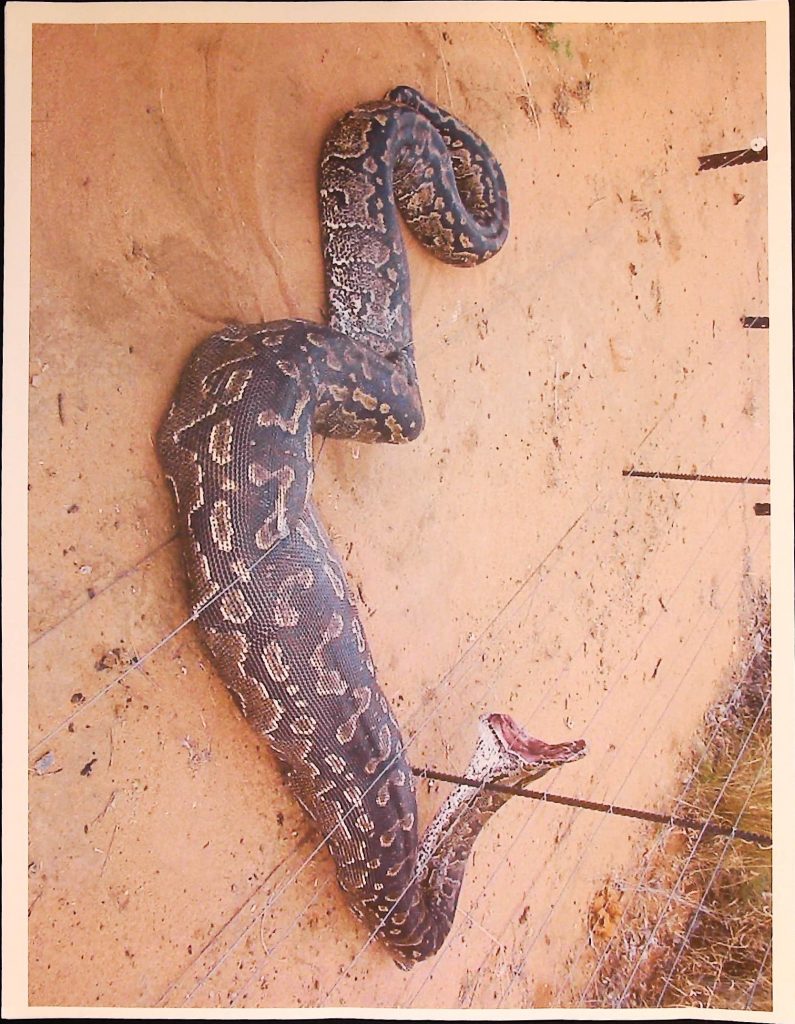
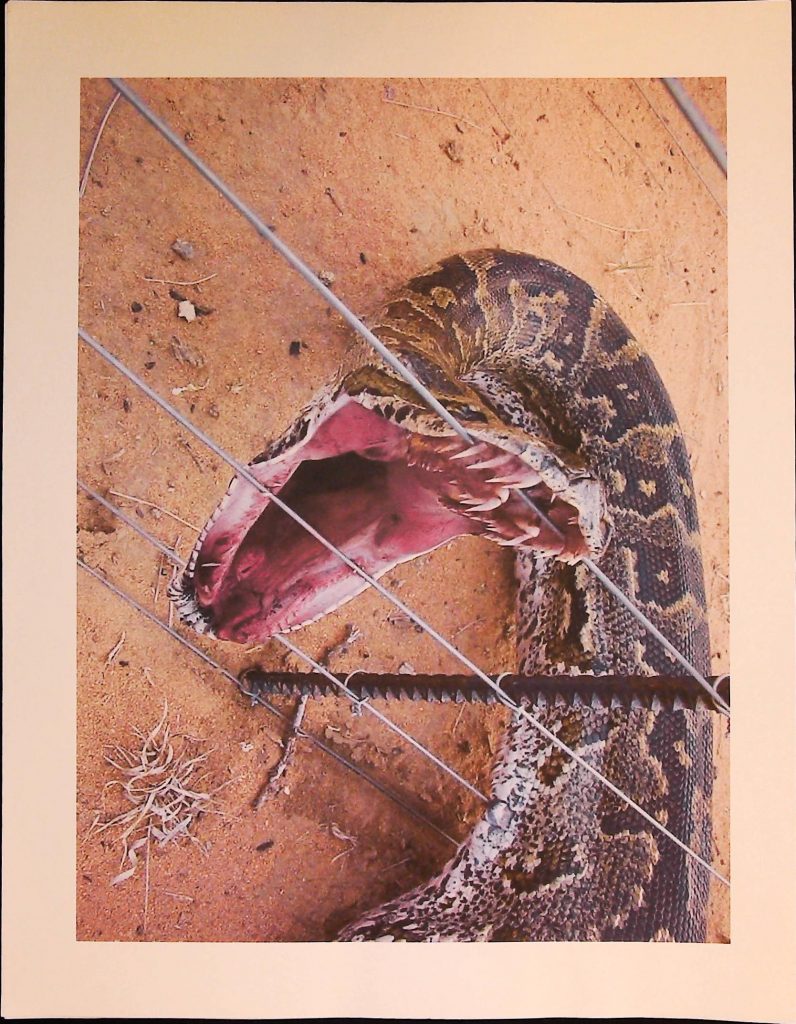
Takeshi Yamada stated the following. The giant python on display at Giant Snake Show of the
Four C Productions was nearly 20 foot, so, the alleged World's largest snake in Indonesia, which
is only 10% larger than it, is nothing significant at all. There is a big difference between 49 foot
and 22 foot! This story of the discovery of the biggest snake in the century was nothing but a
well-fabricated and orchestrated publicity stunt for this tiny Asian nation hoping to gain a
moment of international attention and small fame. The people and the government of Indonesia
sold the snake story like talkers of Giant Snake sideshows at midways of fair grounds in the turn
of the century in the United States. In short, the Indonesian government ran the Giant Snake
Sideshow! And almost every news companies in America and around the world bought it like
little kids without any critical thinking!
Note: Four C Productions: Four C Productions in Florida is the largest nation-wide traveling
sideshow company, which produces 60 to 70 shows annually in the United States. Yamada
produced numerous commissioned artworks such as sideshow banners, sideshow showfronts,
sideshow gaffs, and sideshow props for the company for years. For more information see
Making of the Giant Snake Show: Sideshow Showfront Created by Takeshi Yamada by this
author as told by Takeshi Yamada.

[PAGE BREAK]

FALSE WORLD'S LARGEST SNAKE
THIS IS PAGE: 2

[PAGE BREAK]

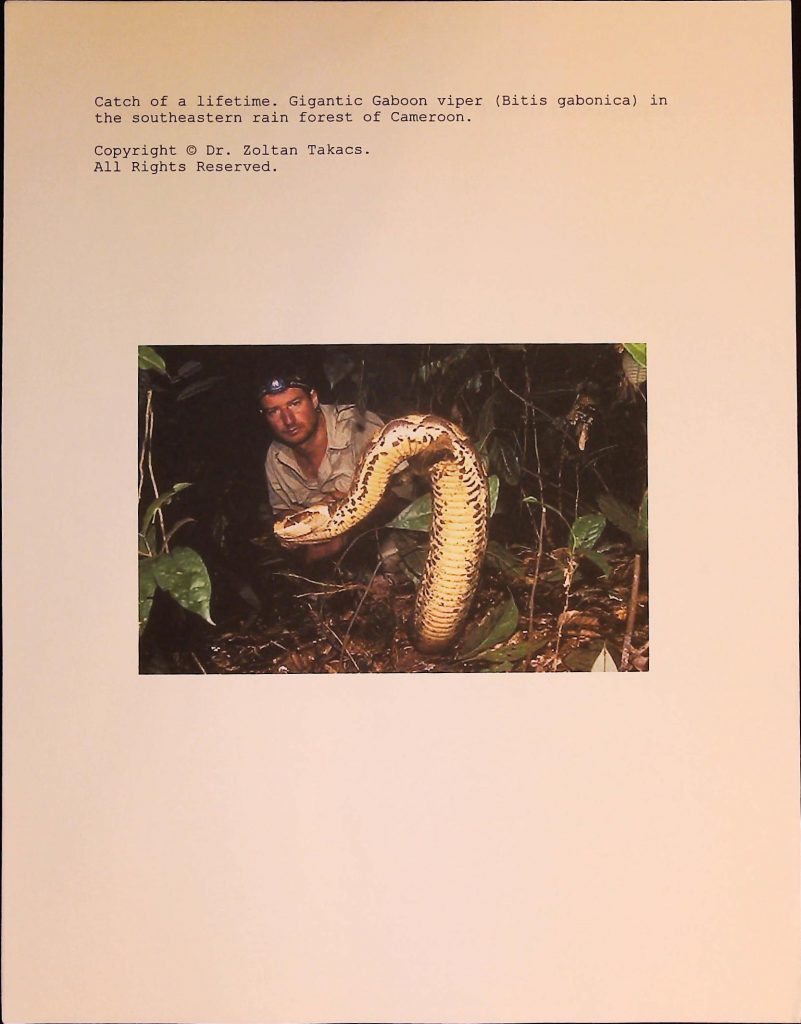
Catch of a lifetime. Gigantic Gaboon viper (Bitis gabonica) in
the southeastern rain forest of Cameroon.
Copyright © Dr. Zoltan Takacs.
All Rights Reserved.

[PAGE BREAK]

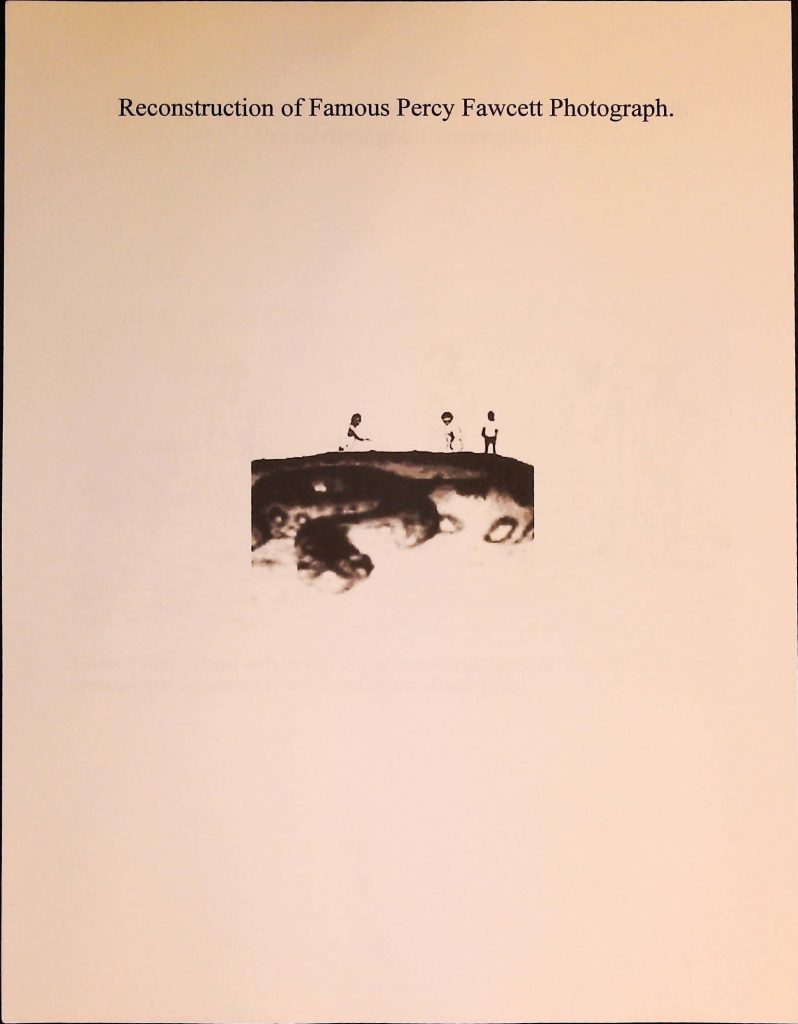
Reconstruction of Famous Percy Fawcett Photograph.

[PAGE BREAK]

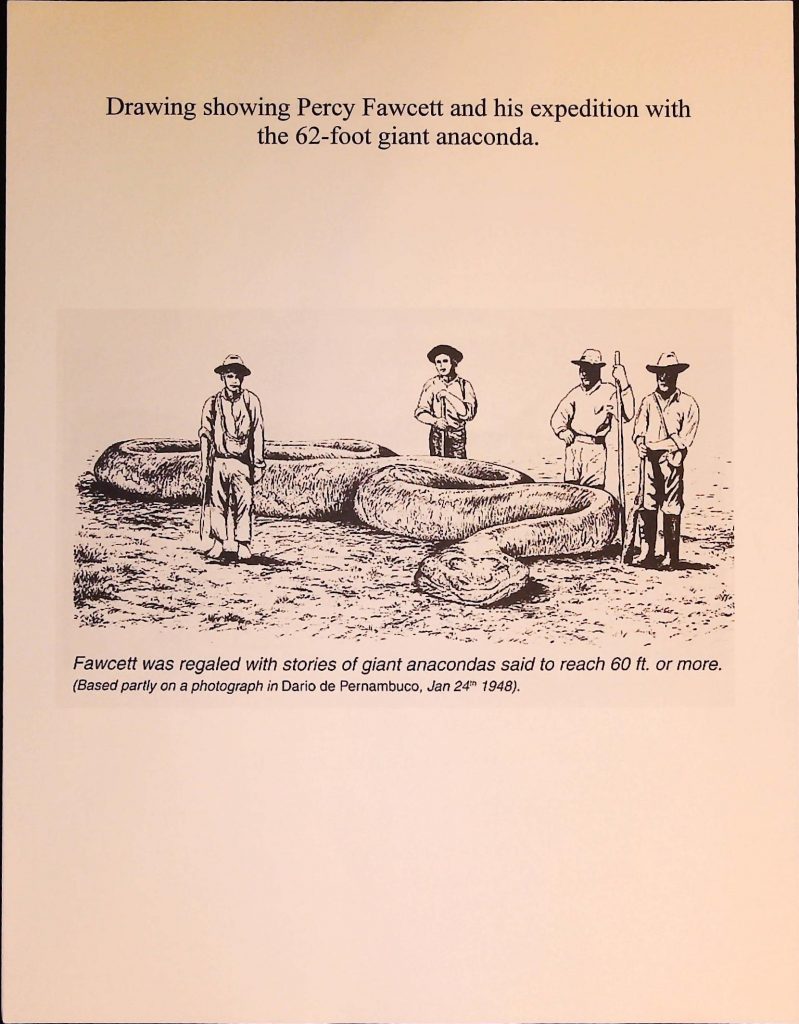
Drawing showing Percy Fawcett and his expedition with
the 62-foot giant anaconda.
Fawcett was regaled with stories of giant anacondas said to reach 60 ft. or more.
(Based partly on a photograph in Dario de Pernambuco, Jan 24 1948).

[PAGE BREAK]

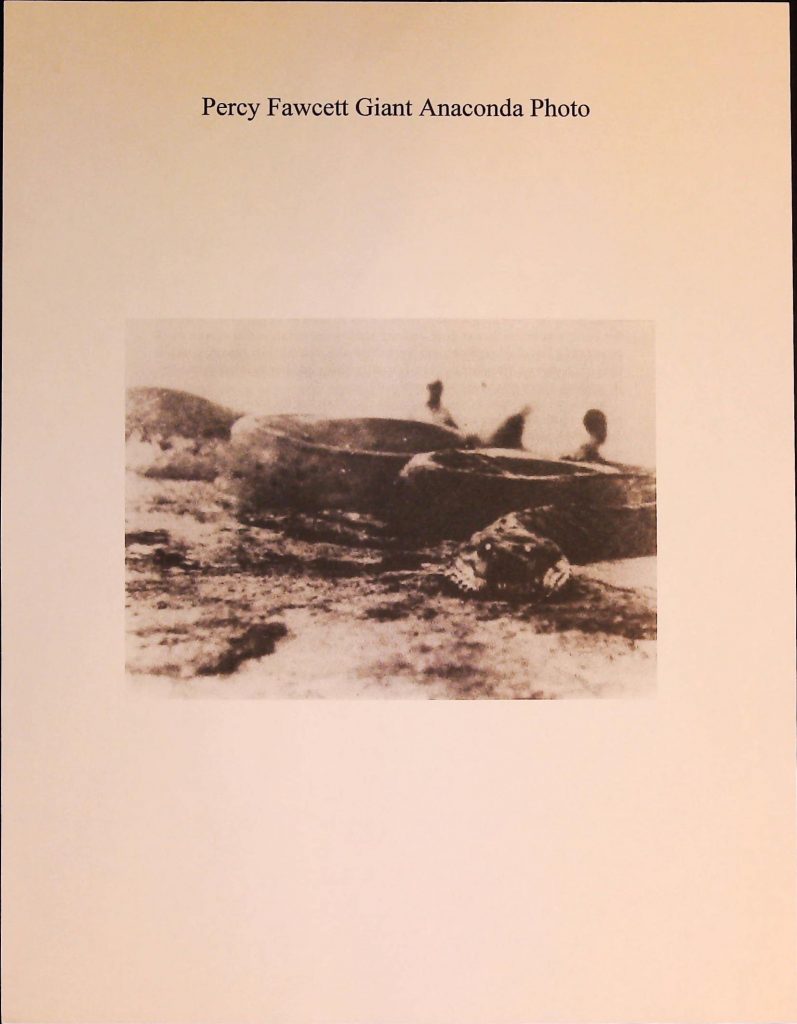
Percy Fawcett Giant Anaconda Photo published in either
a book or a magazine.

[PAGE BREAK]

Percy Fawcett Giant Anaconda Photo