Lost Treasure

B5F18I1

Box 5

Folder 18. Treasure – South Carolina

Item 1. Newspaper Clippings


Transcribed Text (OCR)

GARY MANGIACOPA ARCHIVE
============================================================
Title:      B5F18I1
Slug:       b5f18i1
Categories: Lost Treasure
Source:     https://garymangiacopraarchive.com/b5f18i1
Pages:      8 scanned, 8 extracted
OCR:        Google Vision API (document_text_detection)
Processed:  2026-06-06
============================================================

EXTRA 22
Books
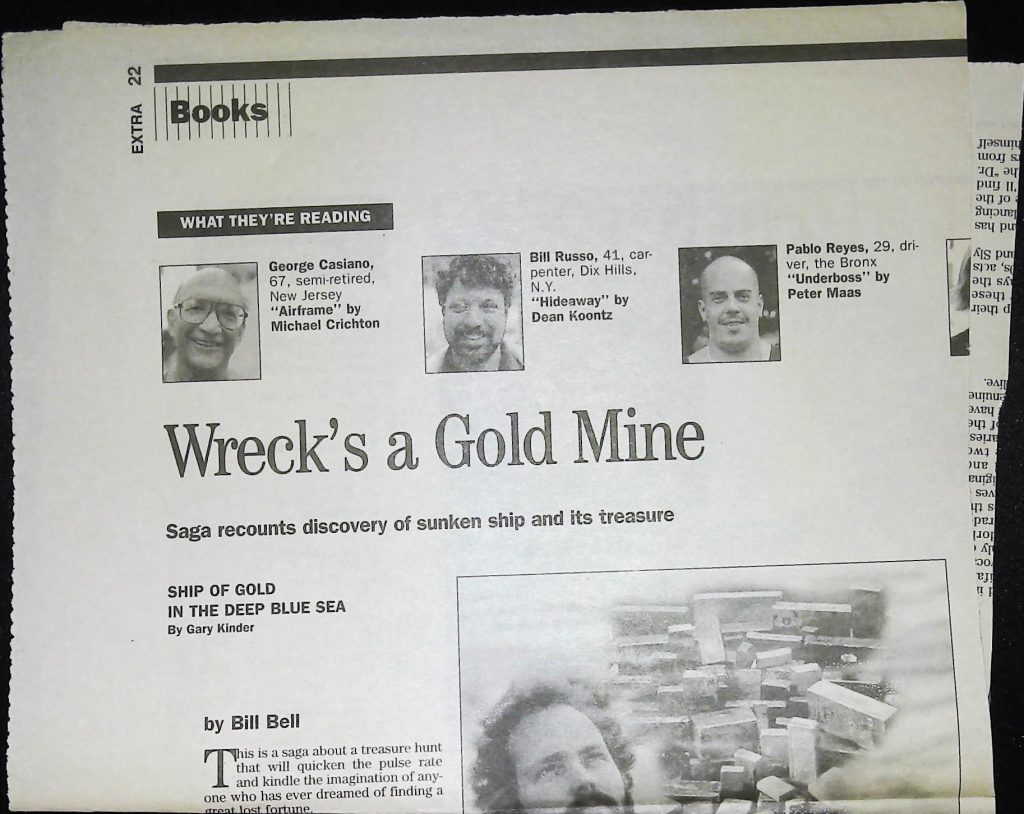
WHAT THEY'RE READING
George Casiano,
67, semi-retired,
New Jersey
"Airframe" by
Michael Crichton
Bill Russo, 41, car-
penter, Dix Hills,
N.Y.
"Hideaway" by
Dean Koontz
шo s
pulj II.
Bu
sey pu
Pablo Reyes, 29, dri-
ver, the Bronx
"Underboss" by
AIS pu
spe's
at
Peter Maas
bu
Wreck's a Gold Mine
Saga recounts discovery of sunken ship and its treasure
M
Que
47 S
ред
Po
AT
50.
SHIP OF GOLD
IN THE DEEP BLUE SEA
By Gary Kinder
by Bill Bell
I
This is a saga about a treasure hunt
that will quicken the pulse rate
one who has ever dreamed of finding a
great lost fortune.
ej!

[PAGE BREAK]

Sunday, July 5, 1998
DAILY NEWS
It also is a gripping drainn a
disaster at sea- the sinking in 1857 of
& gold-laden sidewheel steamer off the
Carolina coast, which claimed about
- and about the rewards of
425 lives
intellectual and scientific curiosity.
There are plenty of heroes in this
sweeping, surging story, which Kinder
says took 10 years to write and is based
on interviews, official records and
painstaking research that shows on
every riveting page.
one
Actually, there are two stories here,
stitched seamlessly together
telling of the last tragic voyage of the
Central America, the other of the
search for its grave. Into this fabric,
a cast that is
Kinder also has woven
every bit as vivid as the doomed assem-
bly aboard the Titanic.
The story begins with the discovery
of gold in 1848 near Sutter's Mill, in
California, which sent tens of thou-
sands of adventurers, visionaries and
get-rich-quickers racing to seek their
fortunes.
Many of the gold bugs stayed, but
thousands eventually returned East,
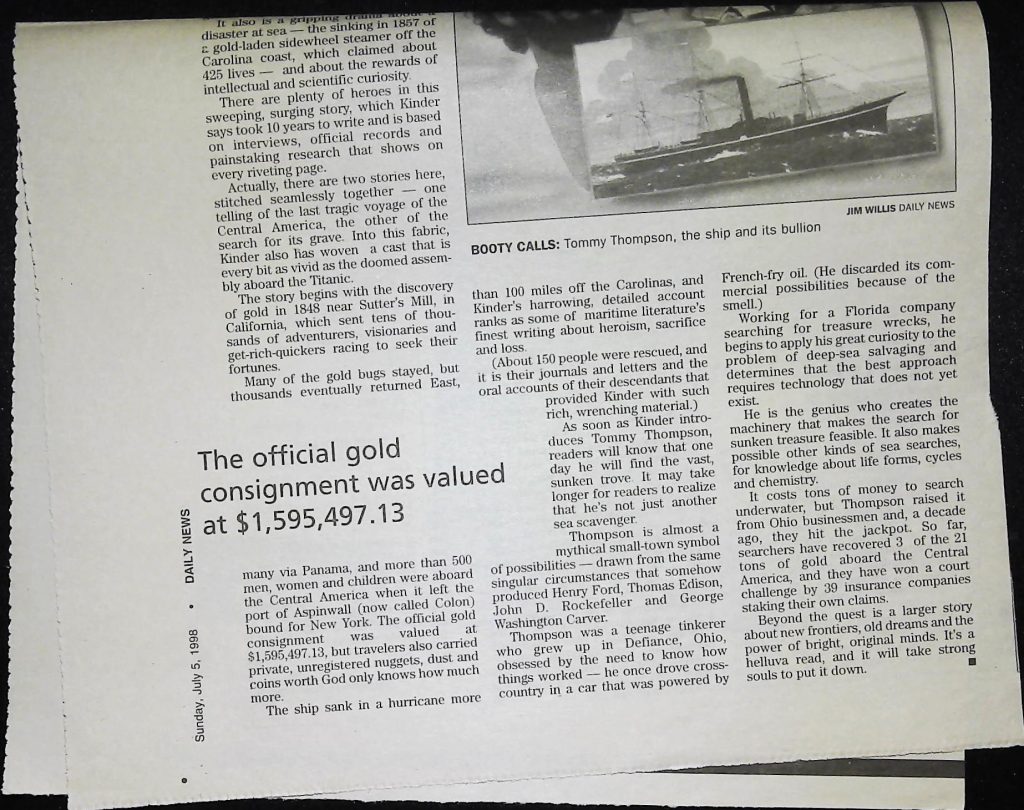
BOOTY CALLS: Tommy Thompson, the ship and its bullion
than 100 miles off the Carolinas, and
Kinder's harrowing, detailed account
ranks as some of maritime literature's
finest writing about heroism, sacrifice
and loss.
(About 150 people were rescued, and
it is their journals and letters and the
oral accounts of their descendants that
provided Kinder with such
rich, wrenching material.)
The official gold
consignment was valued
at $1,595,497.13
many via Panama, and more than 500
men, women and children were aboard
the Central America when it left the
port of Aspinwall (now called Colon)
bound for New York. The official gold
valued at
consignment was
[AD] $1,595,497.13, but travelers also carried
private, unregistered nuggets, dust and
coins worth God only knows how much
more.
The ship sank in a hurricane more
As soon as Kinder intro-
duces Tommy Thompson,
readers will know that one
day he will find the vast,
sunken trove. It may take
longer for readers to realize
that he's not just another
sea scavenger.
Thompson is almost a
mythical small-town symbol
of possibilities - drawn from the same
singular circumstances that somehow
produced Henry Ford, Thomas Edison,
John D. Rockefeller and George
Washington Carver.
Thompson was a teenage tinkerer
who grew up in Defiance, Ohio,
obsessed by the need to know how
things worked -- he once drove cross-
country in a car that was powered by
JIM WILLIS DAILY NEWS
French-fry oil. (He discarded its com-
mercial possibilities because of the
smell.)
Working for a Florida company
searching for treasure wrecks, he
begins to apply his great curiosity to the
problem of deep-sea salvaging and
determines that the best approach
requires technology that does not yet
exist.
He is the genius who creates the
machinery that makes the search for
sunken treasure feasible. It also makes
possible other kinds of sea searches,
for knowledge about life forms, cycles
and chemistry.
It costs tons of money to search
underwater, but Thompson raised it
from Ohio businessmen and, a decade
ago, they hit the jackpot. So far,
searchers have recovered 3 of the 21
tons of gold aboard the Central
America, and they have won a court
challenge by 39 insurance companies
staking their own claims.
Beyond the quest is a larger story
about new frontiers, old dreams and the
power of bright, original minds. It's a
helluva read, and it will take strong
souls to put it down.

[PAGE BREAK]

The Sunday Post Bridgeport, Connecticut, June 19, 1988
A 19
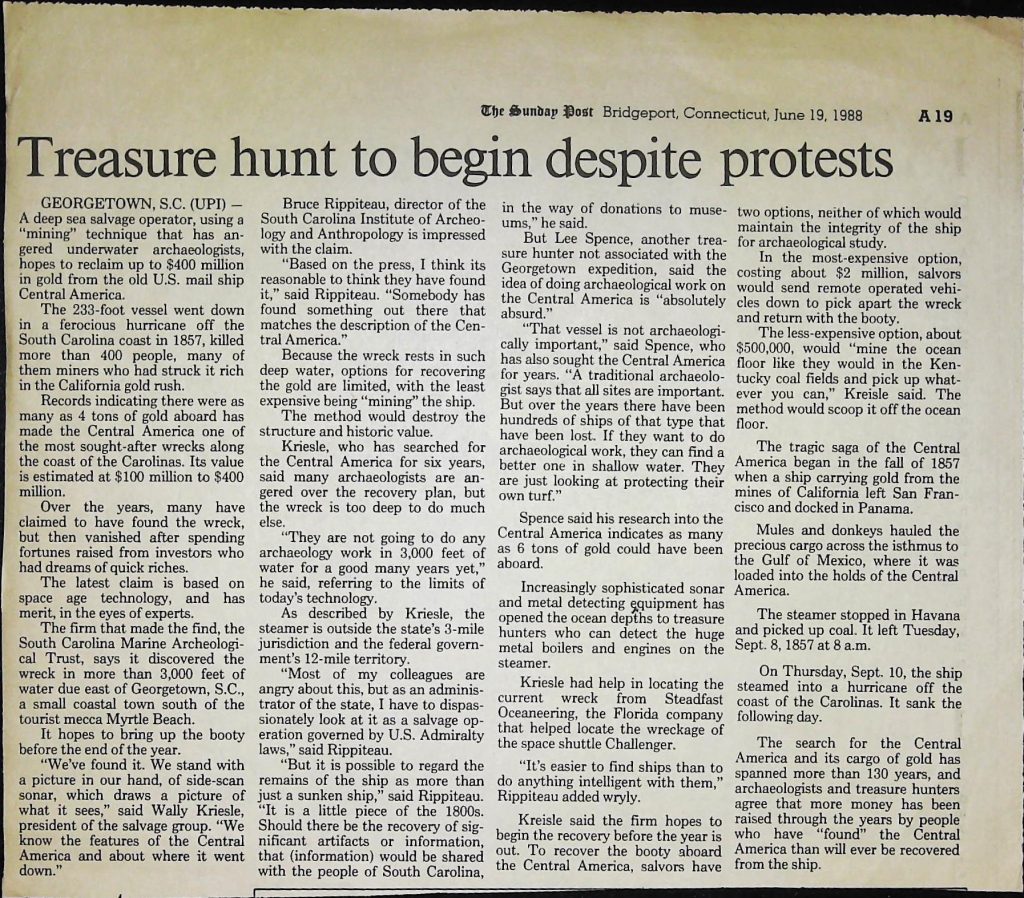
Treasure hunt to begin despite protests
GEORGETOWN, S.C. (UPI) -
A deep sea salvage operator, using a
"mining" technique that has an-
gered underwater archaeologists,
hopes to reclaim up to $400 million
in gold from the old U.S. mail ship
Central America.
The 233-foot vessel went down
in a ferocious hurricane off the
South Carolina coast in 1857, killed
more than 400 people, many of
in the California gold rush.
them miners who had struck it rich
Records indicating there were as
many as 4 tons of gold aboard has
made the Central America one of
the most sought-after wrecks along
the coast of the Carolinas. Its value
is estimated at $100 million to $400
million.
Over the years, many have
claimed to have found the wreck,
but then vanished after spending
fortunes raised from investors who
had dreams of quick riches.
The latest claim is based on
space age technology, and has
merit, in the eyes of experts.
The firm that made the find, the
South Carolina Marine Archeologi-
cal Trust, says it discovered the
wreck in more than 3,000 feet of
water due east of Georgetown, S.C.,
tourist mecca Myrtle Beach.
a small coastal town south of the
It hopes to bring up the booty
before the end of the year.
"We've found it. We stand with
a picture in our hand, of side-scan
sonar, which draws a picture of
what it sees," said Wally Kriesle,
president of the salvage group. "We
know the features of the Central
America and about where it went
down."
Bruce Rippiteau, director of the
South Carolina Institute of Archeo-
logy and Anthropology is impressed
with the claim.
"Based on the press, I think its
reasonable to think they have found
found something out there that
it," said Rippiteau. "Somebody has
matches the description of the Cen-
tral America.'
Because the wreck rests in such
deep water, options for recovering
expensive being "mining" the ship.
the gold are limited, with the least
The method would destroy the
structure and historic value.
Kriesle, who has searched for
the Central America for six years,
said many archaeologists are an-
gered over the recovery plan, but
the wreck is too deep to do much
else.
"They are not going to do any
archaeology work in 3,000 feet of
water for a good many years yet,"
he said, referring to the limits of
today's technology.
As described by Kriesle, the
steamer is outside the state's 3-mile
jurisdiction and the federal govern-
ment's 12-mile territory.
"Most of my colleagues are
angry about this, but as an adminis-
trator of the state, I have to dispas-
eration governed by U.S. Admiralty
sionately look at it as a salvage op-
laws," said Rippiteau.
"But it is possible to regard the
remains of the ship as more than
just a sunken ship," said Rippiteau.
"It is a little piece of the 1800s.
Should there be the recovery of sig-
nificant artifacts or information,
that (information) would be shared
with the people of South Carolina,
in the way of donations to muse-
ums," he said.
But Lee Spence, another trea-
sure hunter not associated with the
Georgetown expedition, said the
idea of doing archaeological work on
absurd."
the Central America is "absolutely
"That vessel is not archaeologi-
cally important," said Spence, who
has also sought the Central America
for years. "A traditional archaeolo-
gist says that all sites are important.
But over the years there have been
hundreds of ships of that type that
have been lost. If they want to do
archaeological work, they can find a
better one in shallow water. They
are just looking at protecting their
own turf."
Spence said his research into the
Central America indicates as many
as 6 tons of gold could have been
aboard.
Increasingly sophisticated sonar
and metal detecting equipment has
opened the ocean depths to treasure
hunters who can detect the huge
metal boilers and engines on the
steamer.
Kriesle had help in locating the
current wreck from Steadfast
Oceaneering, the Florida company
that helped locate the wreckage of
shuttle Challenger.
the space
do anything intelligent with them,"
"It's easier to find ships than to
Rippiteau added wryly.
Kreisle said the firm hopes to
begin the recovery before the year is
out. To recover the booty aboard
the Central America, salvors have
two options, neither of which would
maintain the integrity of the ship
for archaeological study.
In the most-expensive option,
costing about $2 million, salvors
would send remote operated vehi-
cles down to pick apart the wreck
and return with the booty.
The less-expensive option, about
[AD] $500,000, would "mine the ocean
floor like they would in the Ken-
tucky coal fields and pick up what-
ever you can," Kreisle said. The
method would scoop it off the ocean
floor.
The tragic saga of the Central
America began in the fall of 1857
when a ship carrying gold from the
mines of California left San Fran-
cisco and docked in Panama.
Mules and donkeys hauled the
precious cargo across the isthmus to
the Gulf of Mexico, where it was
loaded into the holds of the Central
America.
The steamer stopped in Havana
and picked up coal. It left Tuesday,
Sept. 8, 1857 at 8 a.m.
On Thursday, Sept. 10, the ship
steamed into a hurricane off the
coast of the Carolinas. It sank the
following day.
The search for the Central
America and its cargo of gold has
spanned more than 130 years, and
archaeologists and treasure hunters
agree that more money has been
raised through the years by people
who have "found" the Central
America than will ever be recovered
from the ship.

[PAGE BREAK]

BRIDS (AS YAW MAGEREA
TROP MACY M
40
NEW YORK POST BUSINESS WEDNESDAY, MAY 24, 2000
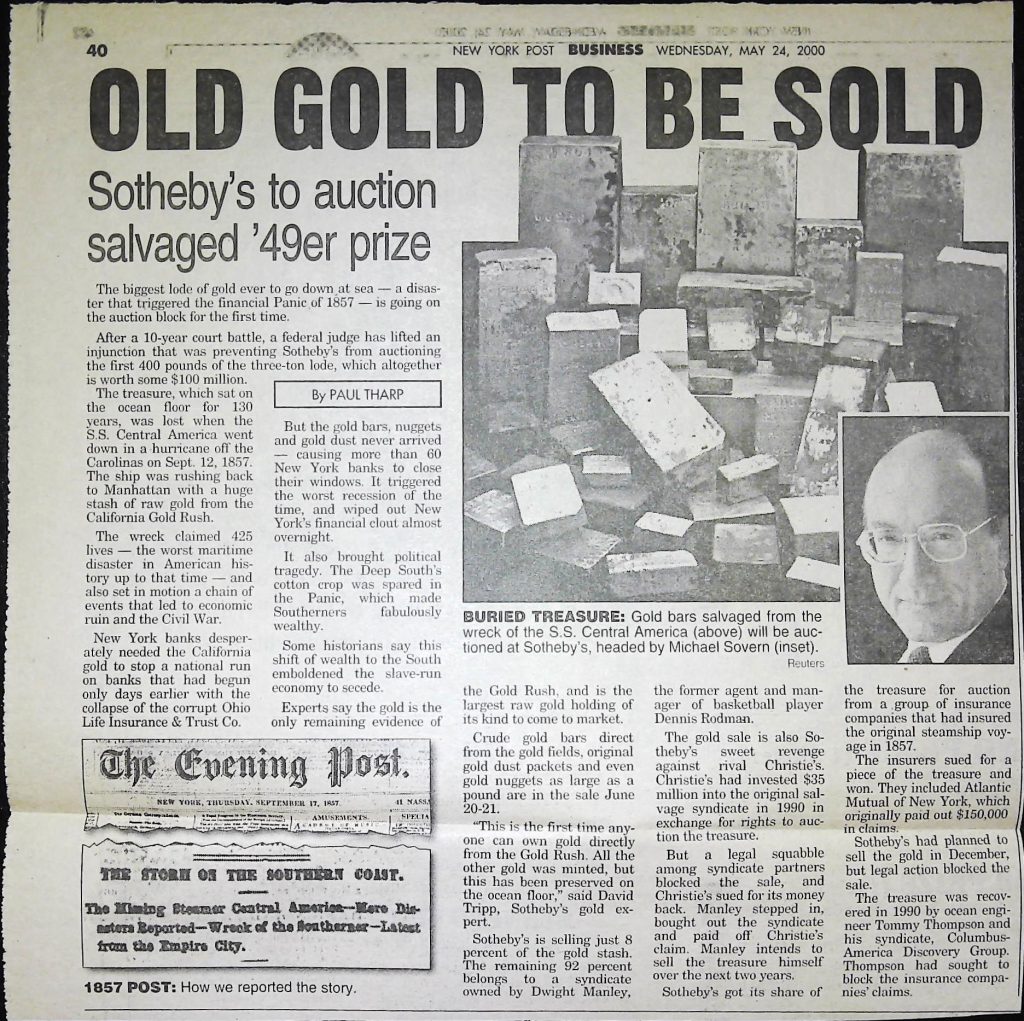
OLD GOLD TO BE SOLD
Sotheby's to auction
salvaged '49er prize
The biggest lode of gold ever to go down at sea - a disas-
ter that triggered the financial Panic of 1857. - is going on
the auction block for the first time.
After a 10-year court battle, a federal judge has lifted an
injunction that was preventing Sotheby's from auctioning
the first 400 pounds of the three-ton lode, which altogether
is worth some $100 million.
The treasure, which sat on
the ocean floor for 130
years, was lost when the
S.S. Central America went
down in a hurricane off the
Carolinas on Sept. 12, 1857.
The ship was rushing back
to Manhattan with a huge
stash of raw gold from the
California Gold Rush.
The wreck claimed 425
lives the worst maritime
disaster in American his-
tory up to that time and
also set in motion a chain of
events that led to economic
ruin and the Civil War.
New York banks desper-
ately needed the California
gold to stop a national run
on banks that had begun
only days earlier with the
collapse of the corrupt Ohio
Life Insurance & Trust Co.
By PAUL THARP
But the gold bars, nuggets
and gold dust never arrived
causing more than 60
New York banks to close
their windows. It triggered
the worst recession of the
time, and wiped out New
York's financial clout almost
overnight.
It also brought political
tragedy. The Deep South's
cotton crop was spared in
the Panic, which made
Southerners
wealthy.
fabulously
Some historians say this
shift of wealth to the South
emboldened the slave-run
economy to secede.
Experts say the gold is the
only remaining evidence of
The Evening Post.
NEW YORK, THURSDAY, SEPTEMBER 17, 1857.
AMUSEMENTS.
ACADRI
41 NASS
SPECIA
THE STORM ON THE SOUTHERN COAST.
The Miming Stemmar Central America-Mere Dis-
matera Reported-Wreck of the southerner-Latest
from the Empire City.
1857 POST: How we reported the story.
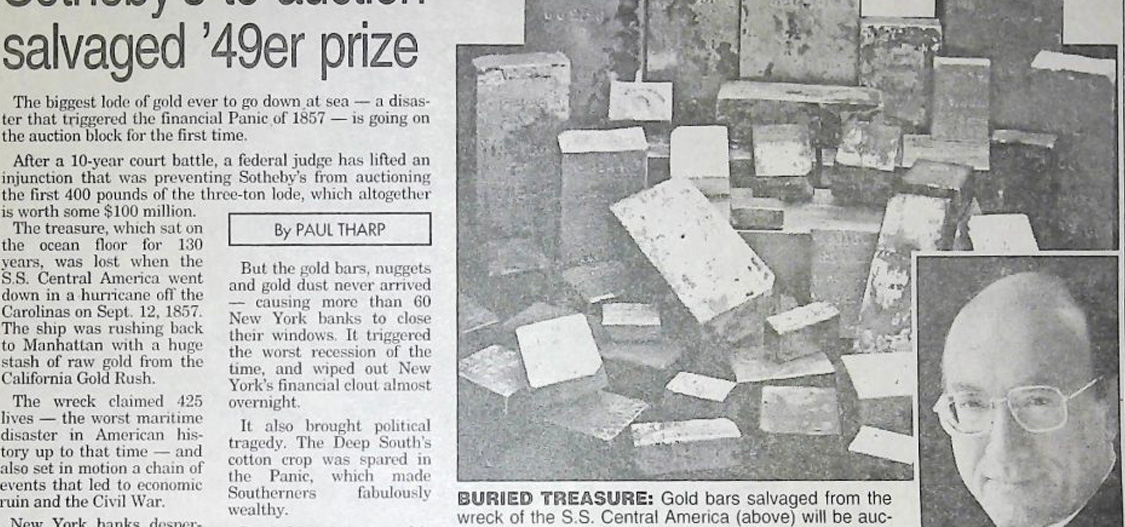
BURIED TREASURE: Gold bars salvaged from the
wreck of the S.S. Central America (above) will be auc-
tioned at Sotheby's, headed by Michael Sovern (inset).
the Gold Rush, and is the
largest raw gold holding of
its kind to come to market.
Crude gold bars direct
from the gold fields, original
gold dust packets and even
gold nuggets as large as a
pound are in the sale June
20-21.
"This is the first time any-
one can own gold directly
from the Gold Rush. All the
other gold was minted, but
this has been preserved on
the ocean floor," said David
Tripp, Sotheby's gold ex-
pert.
Sotheby's is selling just 8
percent of the gold stash.
The remaining 92 percent
belongs to a syndicate
owned by Dwight Manley,
Reuters
the former agent and man-
ager of basketball player
Dennis Rodman.
The gold sale is also So-
theby's sweet revenge
against rival Christie's.
Christie's had invested $35
million into the original sal-
vage syndicate in 1990 in
exchange for rights to auc-
tion the treasure.
But a legal squabble
among syndicate partners
blocked the sale, and
Christie's sued for its money
back. Manley stepped in,
bought out the syndicate
and paid off Christie's
claim. Manley intends to
sell the treasure himself
over the next two years.
Sotheby's got its share of
the treasure for auction
from a group of insurance
companies that had insured
the original steamship voy-
age in 1857.
The insurers sued for a
piece of the treasure and
won. They included Atlantic
Mutual of New York, which
originally paid out $150,000
in claims.
Sotheby's had planned to
sell the gold in December,
but legal action blocked the
sale.
The treasure was recov-
ered in 1990 by ocean engi-
neer Tommy Thompson and
his syndicate, Columbus-
America Discovery Group.
Thompson had sought to
block the insurance compa-
nies' claims.

[PAGE BREAK]

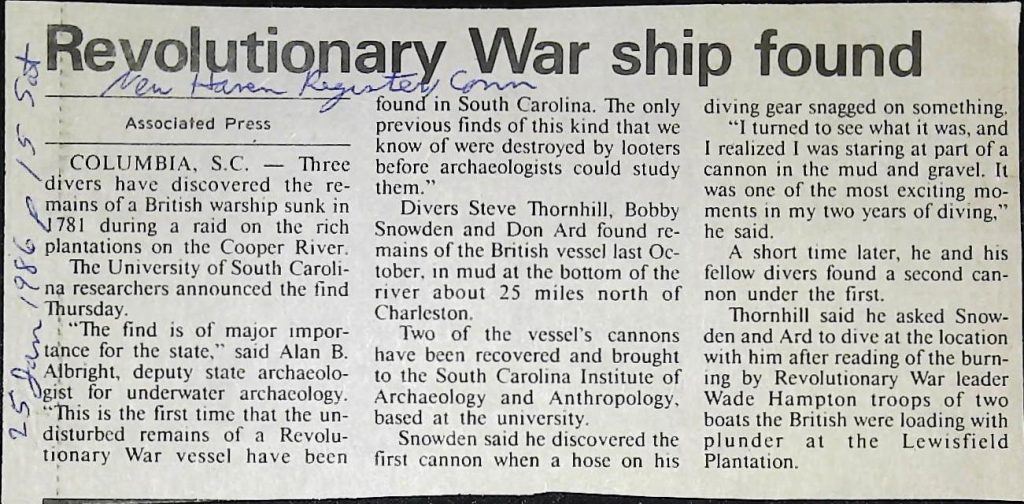
1986
Revolutionary War ship found
New
Associated Press
COLUMBIA, S.C. Three
divers have discovered the re-
mains of a British warship sunk in
781 during a raid on the rich
plantations on the Cooper River.
The University of South Caroli-
na researchers announced the find
Thursday.
"The find is of major impor-
tance for the state," said Alan B.
Albright, deputy state archaeolo-
gist for underwater archaeology.
"This is the first time that the un-
Ndisturbed remains of a Revolu-
tionary War vessel have been
Com
found in South Carolina. The only
previous finds of this kind that we
know of were destroyed by looters
before archaeologists could study
them."
Divers Steve Thornhill, Bobby
Snowden and Don Ard found re-
mains of the British vessel last Oc-
tober, in mud at the bottom of the
river about 25 miles north of
Charleston.
Two of the vessel's cannons
have been recovered and brought
to the South Carolina Institute of
Archaeology and Anthropology,
based at the university.
Snowden said he discovered the
first cannon when a hose on his
diving gear snagged on something,
"I turned to see what it was, and
I realized I was staring at part of a
cannon in the mud and gravel. It
was one of the most exciting mo-
ments in my two years of diving,"
he said.
A short time later, he and his
fellow divers found a second can-
non under the first.
Thornhill said he asked Snow-
den and Ard to dive at the location
with him after reading of the burn-
ing by Revolutionary War leader
Wade Hampton troops of two
boats the British were loading with
plunder at the Lewisfield
Plantation.

[PAGE BREAK]

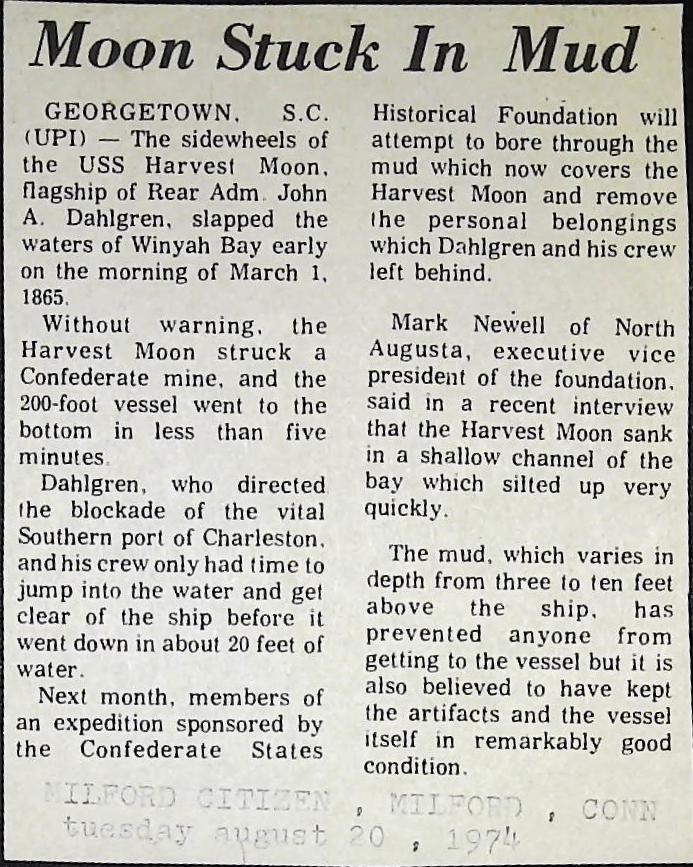
Moon Stuck In Mud
GEORGETOWN, S.C.
(UPI) The sidewheels of
the USS Harvest Moon.
flagship of Rear Adm. John
A. Dahlgren, slapped the
waters of Winyah Bay early
on the morning of March 1,
1865.
Without warning, the
Harvest Moon struck a
Confederate mine, and the
200-foot vessel went to the
bottom in less than five
minutes.
Dahlgren, who directed
the blockade of the vital
Southern port of Charleston,
and his crew only had time to
jump into the water and get
clear of the ship before it
went down in about 20 feet of
water.
Next month, members of
an expedition sponsored by
the Confederate States
MILFORD CITIZEN
Historical Foundation will
attempt to bore through the
mud which now covers the
Harvest Moon and remove
the personal belongings
which Dahlgren and his crew
left behind.
Mark Newell of North
Augusta, executive vice
president of the foundation.
said in a recent interview
that the Harvest Moon sank
in a shallow channel of the
bay which silted up very
quickly.
The mud, which varies in
depth from three to ten feet
above the ship, has
prevented anyone from
getting to the vessel but it is
also believed to have kept
the artifacts and the vessel
itself in remarkably good
condition.
MILFORD, CONN
tuesday august 20, 1974

[PAGE BREAK]

Dalik Gownstream.
ties Sa
19 July 1987 pose A13-02-4 New Haven Register, Sum
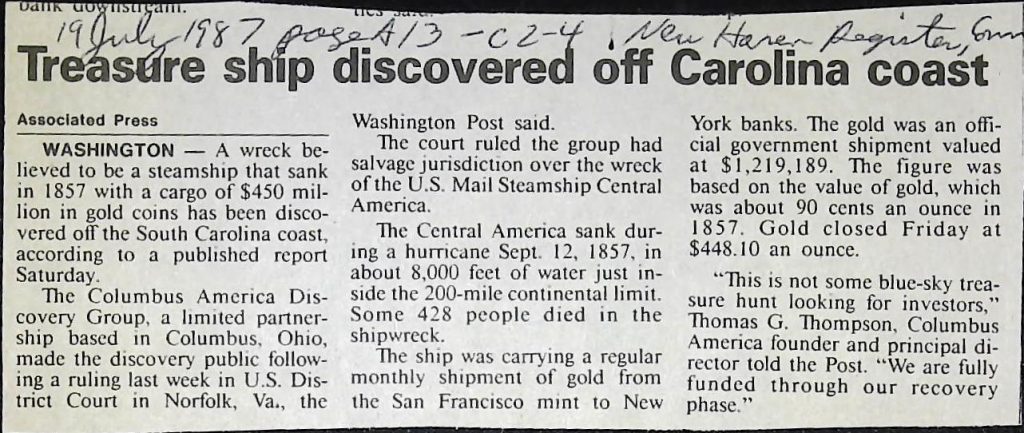
Treasure ship discovered off Carolina coast
Associated Press
WASHINGTON A wreck be-
lieved to be a steamship that sank
in 1857 with a cargo of $450 mil-
lion in gold coins has been disco-
vered off the South Carolina coast,
according to a published report
Saturday.
The Columbus America Dis-
covery Group, a limited partner-
ship based in Columbus, Ohio,
made the discovery public follow-
ing a ruling last week in U.S. Dis-
trict Court in Norfolk, Va., the
Washington Post said.
The court ruled the group had
salvage jurisdiction over the wreck
of the U.S. Mail Steamship Central
America.
The Central America sank dur-
ing a hurricane Sept. 12, 1857, in
about 8,000 feet of water just in-
side the 200-mile continental limit.
Some 428 people died in the
shipwreck.
The ship was carrying a regular
monthly shipment of gold from
the San Francisco mint to New
York banks. The gold was an offi-
cial government shipment valued
at $1,219,189. The figure was
based on the value of gold, which
was about 90 cents an ounce in
1857. Gold closed Friday at
[AD] $448.10 an ounce.
"This is not some blue-sky trea-
sure hunt looking for investors,"
Thomas G. Thompson, Columbus
America founder and principal di-
rector told the Post. "We are fully
funded through our recovery
phase."

[PAGE BREAK]

Page 2 New Haven Register, Friday, October 6, 1989
TODAY'S REGISTER
PEOPLE
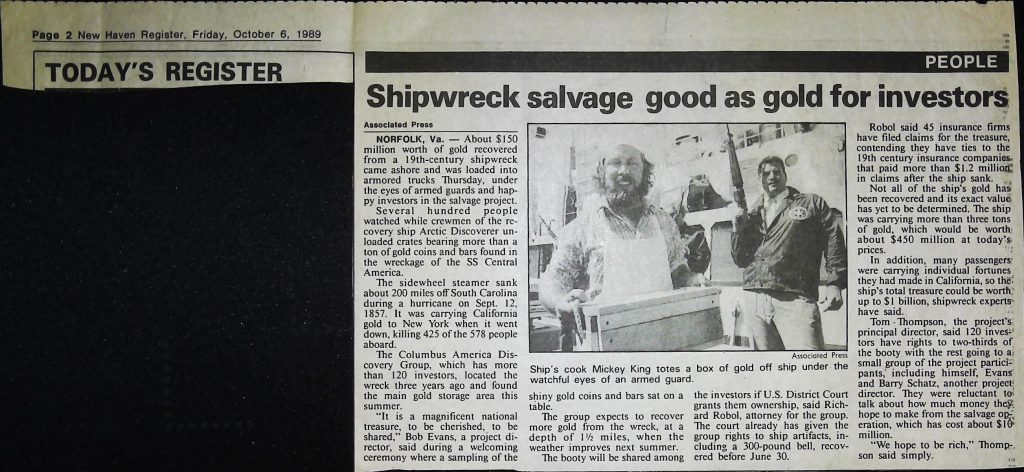
Shipwreck salvage good as gold for investors
Associated Press
NORFOLK, Va.- About $150
million worth of gold recovered
from a 19th-century shipwreck
came ashore and was loaded into
armored trucks Thursday, under
the eyes of armed guards and hap-
py investors in the salvage project.
Several hundred people
watched while crewmen of the re-
covery ship Arctic Discoverer un-
loaded crates bearing more than a
ton of gold coins and bars found in
the wreckage of the SS Central
America.
The sidewheel steamer sank
about 200 miles off South Carolina
during a hurricane on Sept. 12,
1857. It was carrying California
gold to New York when it went
down, killing 425 of the 578 people
aboard.
The Columbus America Dis-
covery Group, which has more
than 120 investors, located the
wreck three years ago and found
the main gold storage area this
summer.
"It is a magnificent national
treasure, to be cherished, to be
shared," Bob Evans, a project di-
rector, said during a welcoming
ceremony where a sampling of the
Associated Press
Ship's cook Mickey King totes a box of gold off ship under the
watchful eyes of an armed guard.
shiny gold coins and bars sat on a
table.
The group expects to recover
more gold from the wreck, at a
depth of 1½ miles, when the
weather improves next summer.
The booty will be shared among
the investors if U.S. District Court
grants them ownership, said Rich-
ard Robol, attorney for the group.
The court already has given the
group rights to ship artifacts, in-
cluding a 300-pound bell, recov-
ered before June 30.
Robol said 45 insurance firms
have filed claims for the treasure,
contending they have ties to the
19th century insurance companies
that paid more than $1.2 million
in claims after the ship sank.
Not all of the ship's gold has
been recovered and its exact value
has yet to be determined. The ship
was carrying more than three tons
of gold, which would be worth
about $450 million at today's
prices.
In addition, many passengers'
were carrying individual fortunes
they had made in California, so the
ship's total treasure could be worth
up to $1 billion, shipwreck experts
have said.
Tom Thompson, the project's
principal director, said 120 inves
tors have rights to two-thirds of
the booty with the rest going to a
small group of the project partici
pants, including himself, Evans
and Barry Schatz, another project
director. They were reluctant to
talk about how much money they
hope to make from the salvage op-
eration, which has cost about $10
million.
"We hope to be rich," Thomp-
son said simply.
138

Leave a Reply

Your email address will not be published. Required fields are marked *