Box 5
Folder 1. Treasure – Virginia
Item 1. Newspaper Clippings

Transcribed Text (OCR)
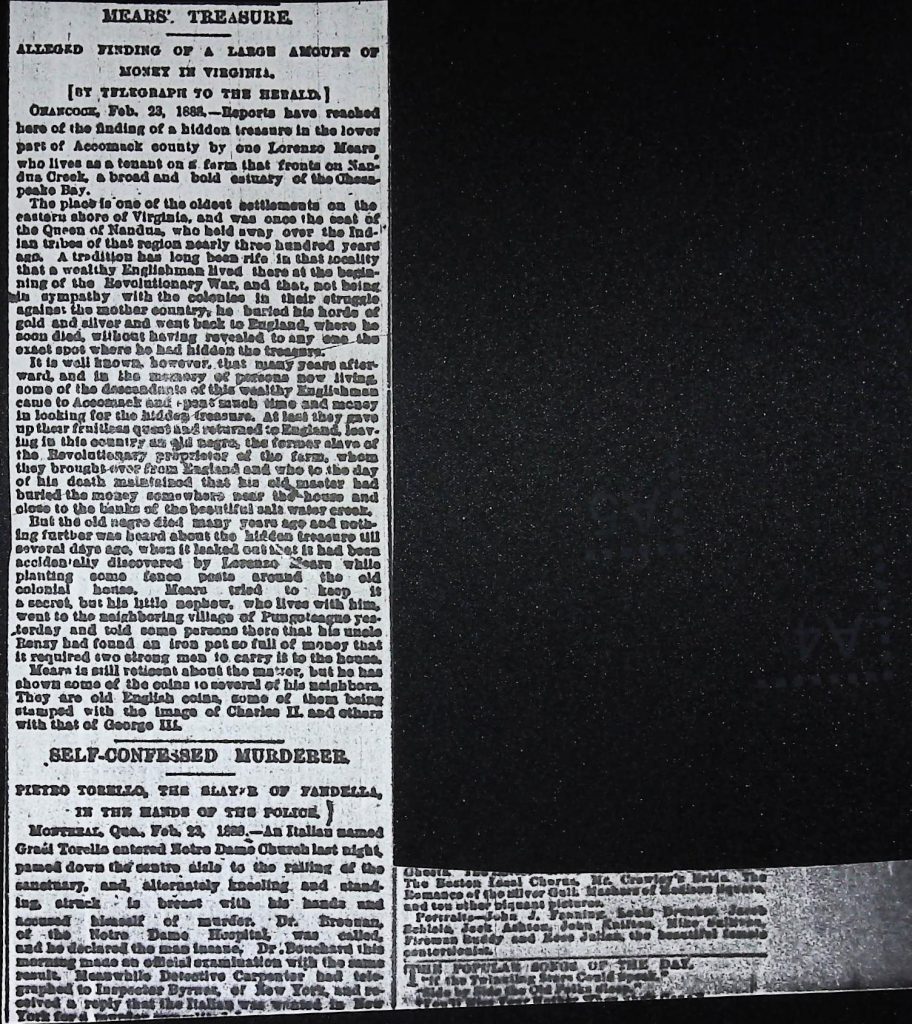
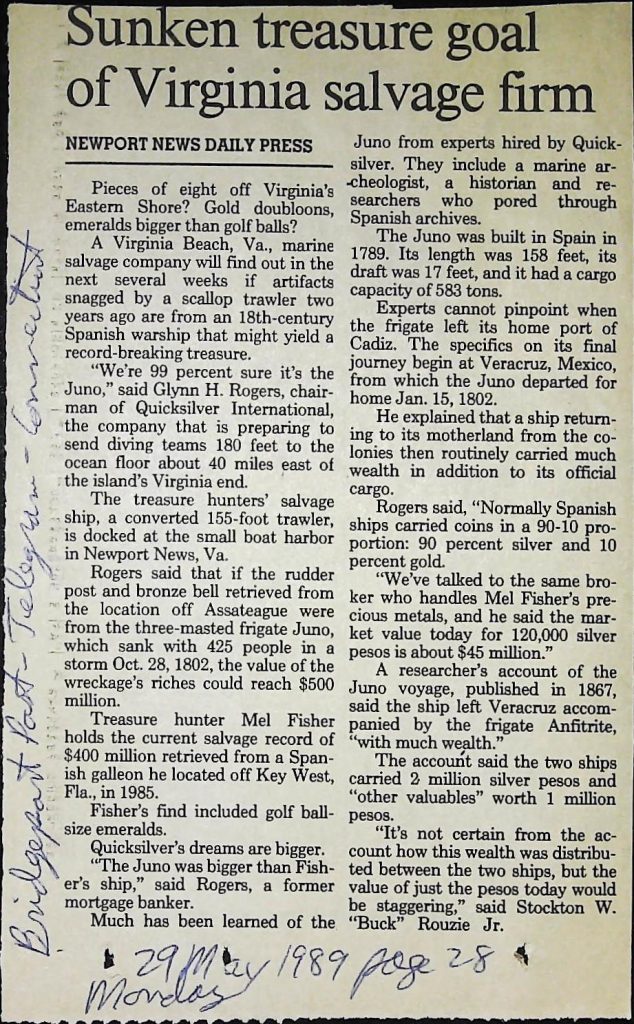
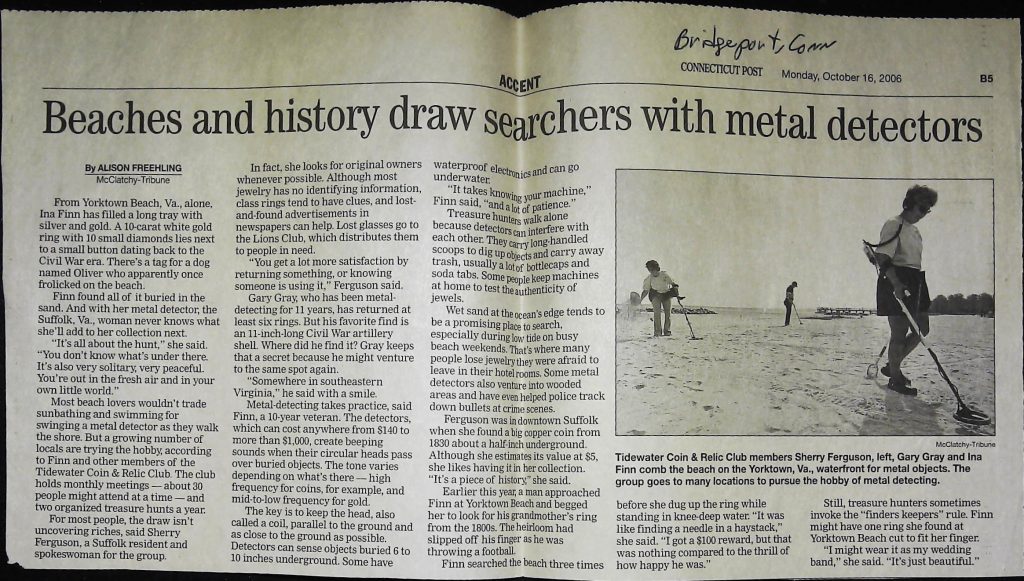
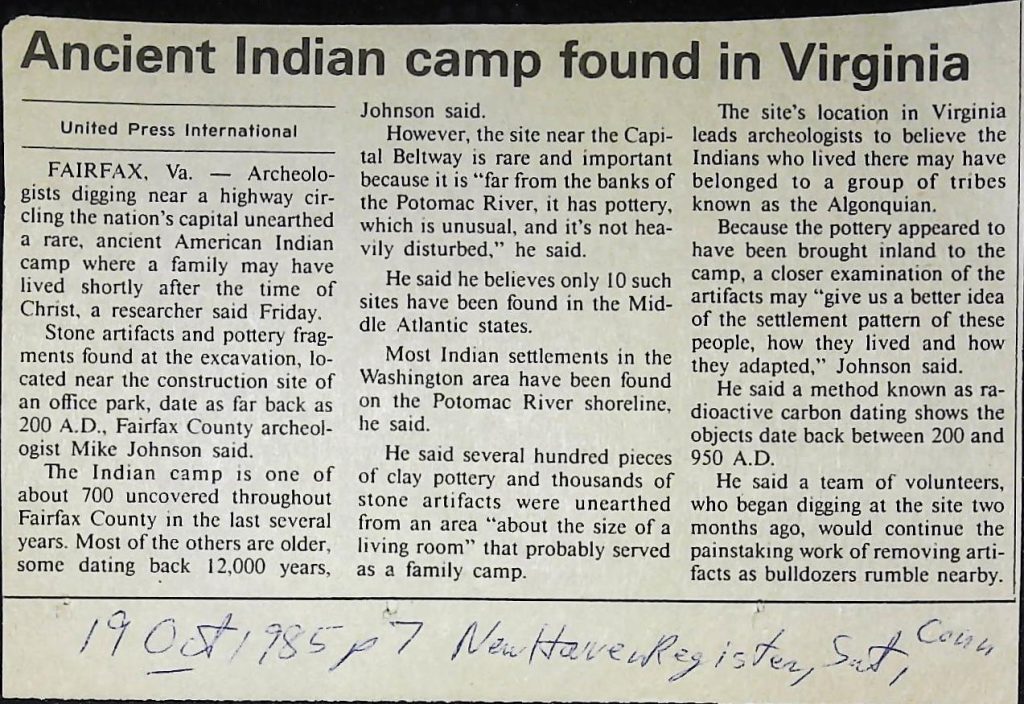
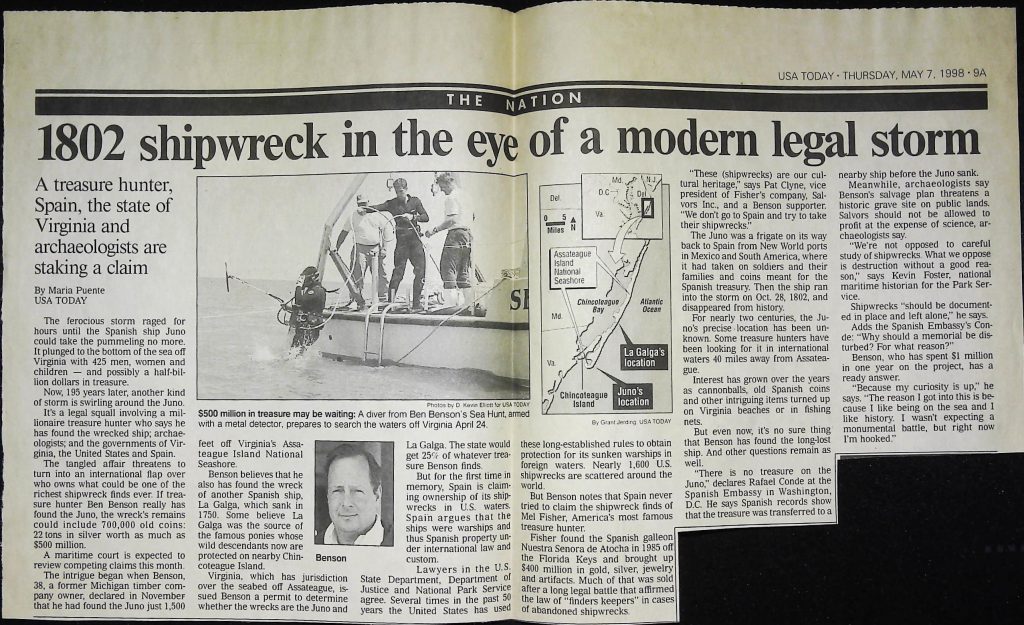
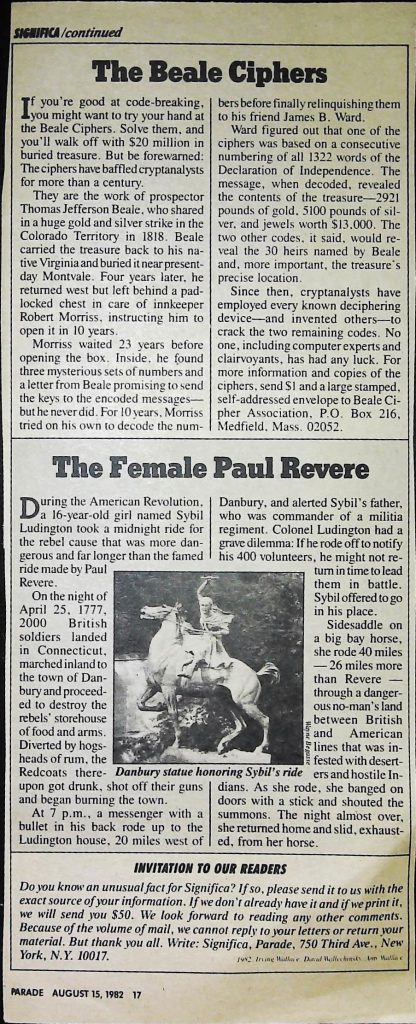
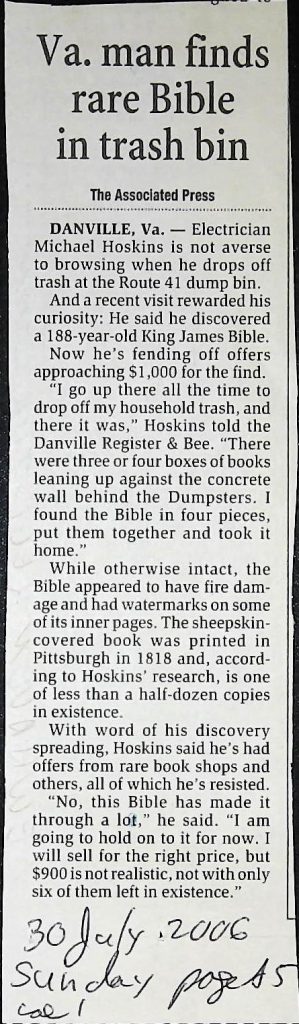
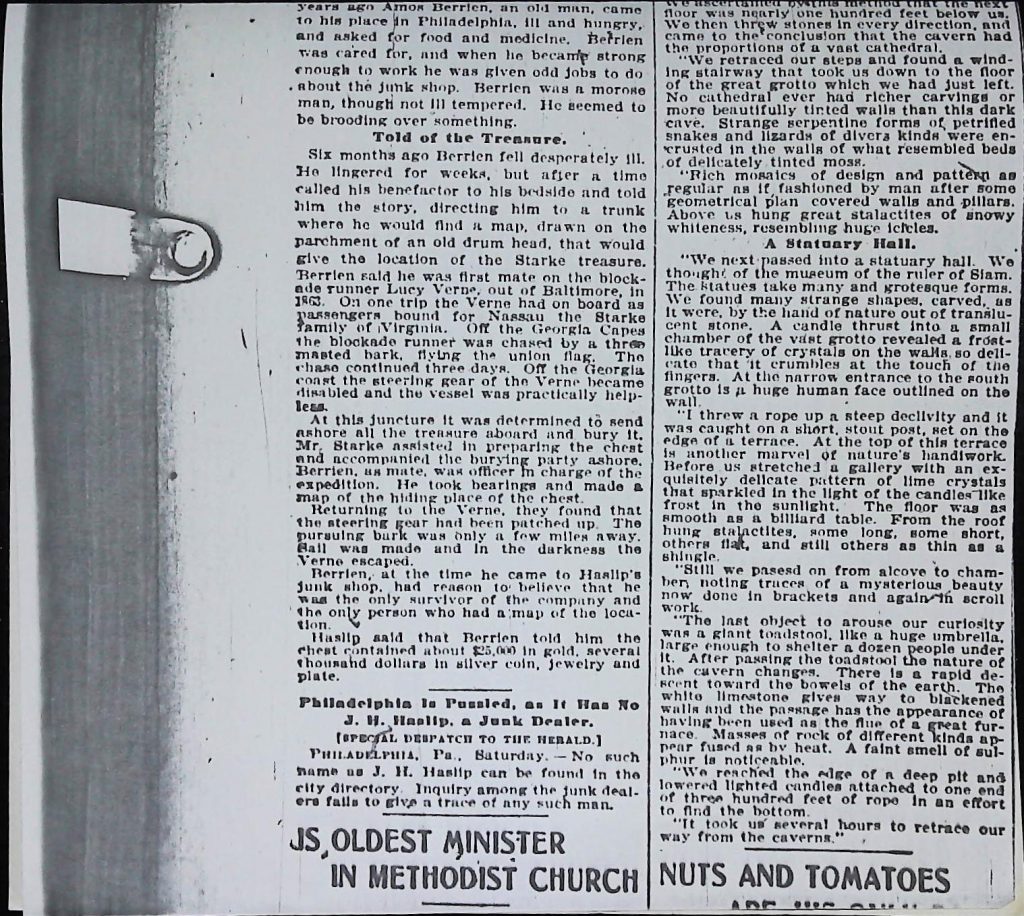
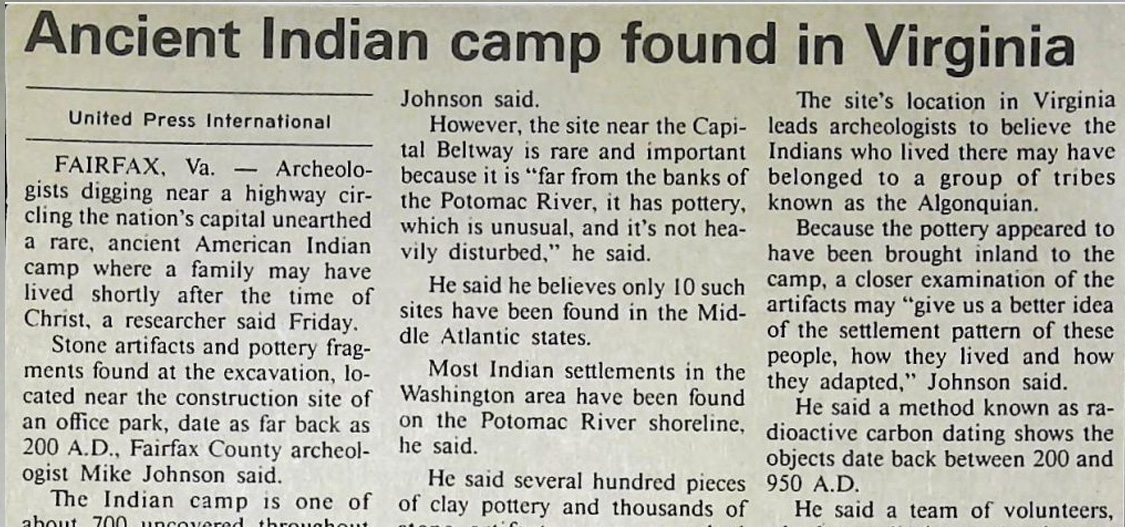
GARY MANGIACOPA ARCHIVE ============================================================ Title: B5F1I1 Slug: b5f1i1 Categories: Lost Treasure Source: https://garymangiacopraarchive.com/b5f1i1 Pages: 13 scanned, 13 extracted OCR: Google Vision API (document_text_detection) Processed: 2026-06-06 ============================================================ Vensach Hould Feb 24 p5. 51888 [PAGE BREAK] MEARS' TREASURE ALLEGED FINDING OF A LARGE AMOUNT OF MONEX IN VIRGINIA. [BY TELEGRAPH TO THE HERALD) OHANCOCK, Feb. 23, 1888,-eports have reached here of the Anding of a hidden treasure in the lower part of Accomack county by one Lorenzo Meare who lives as a tenant on & form that fronts on Nan dus Creek, a broad and bold estuary of the Chesa peake Bay. The place is one of the oldest t battlements on the eastern shore of Virginia, and was once the seat of the Queen of Nandua, who hold away over the Ind- ian tribes of that region nearly three hundred yeard aga. A tradition has long been rife in that socality that a wealthy Englishmen lived there at the begin- ning of the Revolutionary War, and that, not being in sympathy with the colonies in their struggle against the mother country, he buried his horde of gold and sliver and went back to England, where be soon died, without having revealed to any one the exact spot where he had hidden the treasury. It is well known, however, that many years after ward, and in the memory of persons now living some of the descendants of this wealthy Englishman came to Accomack and pant manob time and money In looking for the hidden treasure. At last they gave up their fruitless quant and returned to England, leav tug in this country as gld negre, the former clave of the Revolutionary proprietor of the farm, whom they brought-over from England and who to the day of his death maintained that his old master bad burled the money somewhere near the house and olose to the banks of the beautiful sals water creek. But the old negro died many years ago and noth Ing further was beard about the hidden treasure ul several days are, when it leaked out as is had been accidentally discovered by Lorenzo Nease while planting come fence poste around the old colonial bonse. Mears tried to keep is a secret, but his little nephew, who lives with him, went to the neighboring village of Pungoteague yes. torday and told come persons there that bis uncle. Rensy bad found an iron pot so full of money that is required two strong men to carry it to the house. Mearn is still reticent about the matror, but he has shown some of the coins 10 several of his neighbors. They are old English colon, come of them being stamped with the image of Charles II. and others with that of George IIL SELF-CONFESSED MURDERER PIETRO TOBELLO, THE BLAY B OF FANDELLA IN THE HANDS OF THE POLICE MONTREAL, Qua. Feb 24, 1888.-An Italian named Grail Torello entered Notre Dame Church last night pamed down the centro dale to the railing of the canctuary, and, alternately kneeling and stand- ing track to breast with bis hands and Agoumedhalf of murder. Dr. of the Notre Dame Hospital, was called, and he declared the mas insane, Dr.Bouchard this morning made sa chcial examination with the ins result. Meanwhile Detective Carpenter bad tele graphed to Inspector Byrne, or New York, and re- Colved a reply that the tallay was witted is York The Baston Ideal Chords t Romance of the liver all Mach and ton ather biguans platuren Portraits-John J. Fanning I Rchlola Jock Ashton, John Fireman Buddy and Rose Ja centeruenia POPVE [PAGE BREAK] Bridgeport Past - Telegram. Sunken treasure goal of Virginia salvage firm NEWPORT NEWS DAILY PRESS Pieces of eight off Virginia's emeralds bigger than golf balls? Eastern Shore? Gold doubloons, A Virginia Beach, Va., marine salvage company will find out in the snagged by a scallop trawler two next several weeks if artifacts years ago are from an 18th-century record-breaking treasure. Spanish warship that might yield a "We're 99 percent sure it's the Juno," said Glynn H. Rogers, chair- man of Quicksilver International, the company that is preparing to send diving teams 180 feet to the ocean floor about 40 miles east of the island's Virginia end. The treasure hunters' salvage ship, a converted 155-foot trawler, in Newport News, Va. is docked at the small boat harbor Rogers said that if the rudder post and bronze bell retrieved from the location off Assateague were from the three-masted frigate Juno, which sank with 425 people in a storm Oct. 28, 1802, the value of the wreckage's riches could reach $500 million. Treasure hunter Mel Fisher holds the current salvage record of [AD] $400 million retrieved from a Span- ish galleon he located off Key West, Fla., in 1985. Fisher's find included golf ball- size emeralds. Juno from experts hired by Quick- silver. They include a marine ar- -cheologist, a historian and re- searchers who pored through Spanish archives. The Juno was built in Spain in 1789. Its length was 158 feet, its draft was 17 feet, and it had a cargo capacity of 583 tons. Experts cannot pinpoint when the frigate left its home port of Cadiz. The specifics on its final journey begin at Veracruz, Mexico, from which the Juno departed for home Jan. 15, 1802. He explained that a ship return- ing to its motherland from the co- lonies then routinely carried much wealth in addition to its official cargo. Rogers said, "Normally Spanish ships carried coins in a 90-10 pro- portion: 90 percent silver and 10 percent gold. "We've talked to the same bro- ker who handles Mel Fisher's pre- cious metals, and he said the mar- ket value today for 120,000 silver pesos is about $45 million.' A researcher's account of the Juno voyage, published in 1867, said the ship left Veracruz accom- panied by the frigate Anfitrite, "with much wealth." The account said the two ships carried 2 million silver pesos and "other valuables" worth 1 million pesos. "It's not certain from the ac- count how this wealth was distribu- ted between the two ships, but the value of just the pesos today would be staggering," said Stockton W. Much has been learned of the "Buck" Rouzie Jr. Quicksilver's dreams are bigger. "The Juno was bigger than Fish- er's ship," said Rogers, a former mortgage banker. 29 Mordasy May 1989 pose 284 [PAGE BREAK] Bridgeport, Com ACCENT CONNECTICUT POST Monday, October 16, 2006 B5 Beaches and history draw searchers with metal detectors By ALISON FREEHLING McClatchy-Tribune From Yorktown Beach, Va., alone, Ina Finn has filled a long tray with silver and gold. A 10-carat white gold ring with 10 small diamonds lies next to a small button dating back to the Civil War era. There's a tag for a dog named Oliver who apparently once frolicked on the beach. Finn found all of it buried in the sand. And with her metal detector, the Suffolk, Va., woman never knows what she'll add to her collection next. "It's all about the hunt," she said. "You don't know what's under there. It's also very solitary, very peaceful. You're out in the fresh air and in your own little world." W Most beach lovers wouldn't trade sunbathing and swimming for swinging a metal detector as they walk the shore. But a growing number of locals are trying the hobby, according to Finn and other members of the Tidewater Coin & Relic Club. The club holds monthly meetings-about 30 people might attend at a time- and two organized treasure hunts a year. For most people, the draw isn't uncovering riches, said Sherry Ferguson, a Suffolk resident and spokeswoman for the group. In fact, she looks for original owners waterproof electronics and can go whenever possible. Although most jewelry has no identifying information, class rings tend to have clues, and lost- and-found advertisements in newspapers can help. Lost glasses go to the Lions Club, which distributes them to people in need. "You get a lot more satisfaction by returning something, or knowing someone is using it," Ferguson said. Gary Gray, who has been metal- detecting for 11 years, has returned at least six rings. But his favorite find is an 11-inch-long Civil War artillery shell. Where did he find it? Gray keeps that a secret because he might venture to the same spot again. "Somewhere in southeastern Virginia," he said with a smile. Metal-detecting takes practice, said Finn, a 10-year veteran. The detectors, which can cost anywhere from $140 to more than $1,000, create beeping sounds when their circular heads pass over buried objects. The tone varies depending on what's there-high frequency for coins, for example, and mid-to-low frequency for gold. The key is to keep the head, also called a coil, parallel to the ground and as close to the ground as possible. Detectors can sense objects buried 6 to 10 inches underground. Some have underwater. "It takes knowing your machine," Finn said, "and a lot of patience.' Treasure hunters walk alone because detectors can interfere with each other. They carry long-handled scoops to dig up objects and carry away trash, usually a lot of bottlecaps and soda tabs. Some people keep machines at home to test the authenticity of jewels. Wet sand at the ocean's edge tends to be a promising place to search, especially during low tide on busy beach weekends. That's where many people lose jewelry they were afraid to leave in their hotel rooms. Some metal detectors also venture into wooded areas and have even helped police track down bullets at crime scenes. Ferguson was in downtown Suffolk when she found a big copper coin from 1830 about a half-inch underground. Although she estimates its value at $5, she likes having it in her collection. "It's a piece of history," she said. Earlier this year, a man approached Finn at Yorktown Beach and begged her to look for his grandmother's ring from the 1800s. The heirloom had slipped off his finger as he was throwing a football. McClatchy-Tribune Tidewater Coin & Relic Club members Sherry Ferguson, left, Gary Gray and Ina Finn comb the beach on the Yorktown, Va., waterfront for metal objects. The group goes to many locations to pursue the hobby of metal detecting. 71 before she dug up the ring while standing in knee-deep water. "It was like finding a needle in a haystack," she said. "I got a $100 reward, but that was nothing compared to the thrill of Finn searched the beach three times how happy he was.' Still, treasure hunters sometimes invoke the "finders keepers" rule. Finn might have one ring she found at Yorktown Beach cut to fit her finger. "I might wear it as my wedding band," she said. "It's just beautiful." [PAGE BREAK] Ancient Indian camp found in Virginia United Press International FAIRFAX, Va. Archeolo- gists digging near a highway cir- cling the nation's capital unearthed a rare, ancient American Indian camp where a family may have lived shortly after the time of Christ, a researcher said Friday. Stone artifacts and pottery frag- ments found at the excavation, lo- cated near the construction site of an office park, date as far back as 200 A.D., Fairfax County archeol- ogist Mike Johnson said. The Indian camp is one of about 700 uncovered throughout Fairfax County in the last several years. Most of the others are older, some dating back 12,000 years, Johnson said. However, the site near the Capi- tal Beltway is rare and important because it is "far from the banks of the Potomac River, it has pottery, which is unusual, and it's not hea- vily disturbed," he said. He said he believes only 10 such sites have been found in the Mid- dle Atlantic states. Washington area have been found Most Indian settlements in the on the Potomac River shoreline, he said. He said several hundred pieces of clay pottery and thousands of stone artifacts were unearthed from an area "about the size of a living room" that probably served as a family camp. The site's location in Virginia leads archeologists to believe the Indians who lived there may have belonged to a group of tribes known as the Algonquian. Because the pottery appeared to have been brought inland to the camp, a closer examination of the artifacts may "give us a better idea of the settlement pattern of these people, how they lived and how they adapted," Johnson said. He said a method known as ra- dioactive carbon dating shows the objects date back between 200 and 950 A.D. He said a team of volunteers, who began digging at the site two months ago, would continue the painstaking work of removing arti- facts as bulldozers rumble nearby. 19 Oct 1785p7 New Have Register, Sat, Conn [PAGE BREAK] THE NATION USA TODAY THURSDAY, MAY 7, 1998.9A 1802 shipwreck in the eye of a modern legal storm A treasure hunter, Spain, the state of Virginia and archaeologists are staking a claim By Maria Puente USA TODAY The ferocious storm raged for hours until the Spanish ship Juno could take the pummeling no more. It plunged to the bottom of the sea off Virginia with 425 men, women and children and possibly a half-bil- lion dollars in treasure. Now, 195 years later, another kind of storm is swirling around the Juno. It's a legal squall involving a mil- lionaire treasure hunter who says he has found the wrecked ship; archae- ologists; and the governments of Vir- ginia, the United States and Spain. The tangled affair threatens to turn into an international flap over who owns what could be one of the richest shipwreck finds ever. If trea- sure hunter Ben Benson really has found the Juno, the wreck's remains could include 700,000 old coins: 22 tons in silver worth as much as [AD] $500 million. A maritime court is expected to review competing claims this month. The intrigue began when Benson, 38, a former Michigan timber com- pany owner, declared in November that he had found the Juno just 1,500 Md. DC- Del. Va. A Miles N Assateague Island National Seashore SI Chincoteague Bay Md. Va. Photos by D Kevin Elliott for USA TODAY Chincoteague Island [AD] $500 million in treasure may be waiting: A diver from Ben Benson's Sea Hunt, armed with a metal detector, prepares to search the waters off Virginia April 24. feet off Virginia's Assa- teague Island National Seashore. Benson believes that he also has found the wreck of another Spanish ship, La Galga, which sank in 1750. Some believe La Galga was the source of the famous ponies whose wild descendants now are protected on nearby Chin- coteague Island. Benson Virginia, which has jurisdiction over the seabed off Assateague, is- sued Benson a permit to determine whether the wrecks are the Juno and La Galga. The state would get 25% of whatever trea- sure Benson finds. But for the first time in memory, Spain is claim- ing ownership of its ship- wrecks in U.S. waters. Spain argues that the ships were warships and thus Spanish property un- der international law and custom. Lawyers in the U.S. State Department, Department of Justice and National Park Service agree. Several times in the past 50 years the United States has used Del Atlantic Ocean La Galga's location Juno's location By Grant Jerding, USA TODAY these long-established rules to obtain protection for its sunken warships in foreign waters. Nearly 1,600 U.S. shipwrecks are scattered around the world. But Benson notes that Spain never tried to claim the shipwreck finds of Mel Fisher, America's most famous treasure hunter. Fisher found the Spanish galleon Nuestra Senora de Atocha in 1985 off the Florida Keys and brought up [AD] $400 million in gold, silver, jewelry and artifacts. Much of that was sold after a long legal battle that affirmed the law of "finders keepers" in cases of abandoned shipwrecks. "These (shipwrecks) are our cul- tural heritage," says Pat Clyne, vice president of Fisher's company, Sal- vors Inc., and a Benson supporter. "We don't go to Spain and try to take their shipwrecks." The Juno was a frigate on its way back to Spain from New World ports in Mexico and South America, where it had taken on soldiers and their families and coins meant for the Spanish treasury. Then the ship ran into the storm on Oct. 28, 1802, and disappeared from history. For nearly two centuries, the Ju- no's precise location has been un- known. Some treasure hunters have been looking for it in international waters 40 miles away from Assatea- gue. Interest has grown over the years as cannonballs, old Spanish coins and other intriguing items turned up on Virginia beaches or in fishing nets. But even now, it's no sure thing that Benson has found the long-lost ship. And other questions remain as well. "There is no treasure on the Juno," declares Rafael Conde at the Spanish Embassy in Washington, D.C. He says Spanish records show that the treasure was transferred to a nearby ship before the Juno sank. Meanwhile, archaeologists say Benson's salvage plan threatens a historic grave site on public lands. Salvors should not be allowed to profit at the expense of science, ar- chaeologists say. "We're not opposed to careful study of shipwrecks. What we oppose is destruction without a good rea- son," says Kevin Foster, national maritime historian for the Park Ser- vice. Shipwrecks "should be document- ed in place and left alone," he says. Adds the Spanish Embassy's Con- de: "Why should a memorial be dis- turbed? For what reason?" Benson, who has spent $1 million in one year on the project, has a ready answer. "Because my curiosity is up," he says. "The reason I got into this is be cause I like being on the sea and I like history. I wasn't expecting a monumental battle, but right now I'm hooked." [PAGE BREAK] SIGNIFICA/continued The Beale Ciphers you're good at code-breaking, | you might want to try your hand at the Beale Ciphers. Solve them, and you'll walk off with $20 million in buried treasure. But be forewarned: The ciphers have baffled cryptanalysts for more than a century. They are the work of prospector Thomas Jefferson Beale, who shared in a huge gold and silver strike in the Colorado Territory in 1818. Beale carried the treasure back to his na- tive Virginia and buried it near present- day Montvale. Four years later, he returned west but left behind a pad- locked chest in care of innkeeper Robert Morriss, instructing him to open it in 10 years. Morriss waited 23 years before opening the box. Inside, he found three mysterious sets of numbers and a letter from Beale promising to send the keys to the encoded messages- but he never did. For 10 years, Morriss tried on his own to decode the num- bers before finally relinquishing them to his friend James B. Ward. Ward figured out that one of the ciphers was based on a consecutive numbering of all 1322 words of the Declaration of Independence. The message, when decoded, revealed the contents of the treasure-2921 pounds of gold. 5100 pounds of sil- ver, and jewels worth $13,000. The two other codes, it said, would re- veal the 30 heirs named by Beale and, more important, the treasure's precise location. Since then, cryptanalysts have employed every known deciphering device and invented others-to crack the two remaining codes. No one, including computer experts and clairvoyants, has had any luck. For more information and copies of the ciphers, send $1 and a large stamped, self-addressed envelope to Beale Ci- pher Association, P.O. Box 216, Medfield, Mass. 02052. The Female Paul Revere During the American Revolution. | 16-year-old girl named Sybil Ludington took a midnight ride for the rebel cause that was more dan- gerous and far longer than the famed ride made by Paul Revere. On the night of April 25, 1777, 2000 British soldiers landed in Connecticut, marched inland to the town of Dan- bury and proceed- ed to destroy the rebels' storehouse of food and arms. Diverted by hogs- heads of rum, the Danbury, and alerted Sybil's father, who was commander of a militia regiment. Colonel Ludington had a grave dilemma: If he rode off to notify his 400 volunteers, he might not re- Wayne Begasse turn in time to lead them in battle. Sybil offered to go in his place. Sidesaddle on a big bay horse, she rode 40 miles -26 miles more than Revere through a danger- ous no-man's land between British and American lines that was in- fested with desert- Redcoats there- Danbury statue honoring Sybil's ride ers and hostile In- upon got drunk, shot off their guns and began burning the town. At 7 p.m., a messenger with a bullet in his back rode up to the Ludington house, 20 miles west of dians. As she rode, she banged on doors with a stick and shouted the summons. The night almost over, she returned home and slid, exhaust- ed, from her horse. INVITATION TO OUR READERS Do you know an unusual fact for Significa? If so, please send it to us with the exact source of your information. If we don't already have it and if we print it, we will send you $50. We look forward to reading any other comments. Because of the volume of mail, we cannot reply to your letters or return your material. But thank you all. Write: Significa, Parade, 750 Third Ave., New York, N.Y. 10017. 1982. Irving Willen Davul Wallechinsky Ann Watc PARADE AUGUST 15, 1982 17 [PAGE BREAK] Va. man finds rare Bible in trash bin The Associated Press DANVILLE, Va. - Electrician Michael Hoskins is not averse to browsing when he drops off trash at the Route 41 dump bin. And a recent visit rewarded his curiosity: He said he discovered a 188-year-old King James Bible. Now he's fending off offers approaching $1,000 for the find. "I go up there all the time to drop off my household trash, and there it was," Hoskins told the Danville Register & Bee. "There were three or four boxes of books leaning up against the concrete wall behind the Dumpsters. I found the Bible in four pieces, put them together and took it home. While otherwise intact, the Bible appeared to have fire dam- age and had watermarks on some of its inner pages. The sheepskin- covered book was printed in Pittsburgh in 1818 and, accord- ing to Hoskins' research, is one of less than a half-dozen copies in existence. With word of his discovery spreading, Hoskins said he's had offers from rare book shops and others, all of which he's resisted. "No, this Bible has made it through a lot," he said. "I am going to hold on to it for now. I will sell for the right price, but [AD] $900 is not realistic, not with only six of them left in existence." 2006 30 July Sunday posets [PAGE BREAK] The study was designed to Va. man finds rare Bible in trash bin The Associated Press DANVILLE, Va. Electrician Michael Hoskins is not averse to browsing when he drops off trash at the Route 41 dump bin. And a recent visit rewarded his curiosity: He said he discovered a 188-year-old King James Bible. Now he's fending off offers approaching $1,000 for the find. "I go up there all the time to drop off my household trash, and home." there it was," Hoskins told the Danville Register & Bee. "There were three or four boxes of books leaning up against the concrete wall behind the Dumpsters. I found the Bible in four pieces, put them together and took it While otherwise intact, the Bible appeared to have fire dam- age and had watermarks on some of its inner pages. The sheepskin- covered book was printed in Pittsburgh in 1818 and, accord- ing to Hoskins' research, is one of less than a half-dozen copies in existence. With word of his discovery spreading, Hoskins said he's had offers from rare book shops and others, all of which he's resisted. "No, this Bible has made it through a lot," he said. "I am going to hold on to it for now. I will sell for the right price, but [AD] $900 is not realistic, not with only six of them left in existence." 'Sunday' NEW HAVEN REGISTER, CONN pose A5, call 30 July 2006- [PAGE BREAK] 2 N.V. Hould 12 QUEER STORY OF HIDDEN TREASURE Philadelphia Man Said to Have Dug It Up on Island Off Georgia Coast CAVE OF GIANTS IN CALIFORNIA Remarkable Cavern Found in Providence Mountains Is Explored. DIRECTED BY OLD SAILOR BEAUTIES BEYOND TELLING Money Was Buried There by Starkes of Virginia During the Civil War. [SPECIAL DESPATCH TO THE HERALD.] SAVANNAH, Ga., Saturday-Has the treas- ure of the Starke family, of Virginia, known to have been buried on Warsaw Island, thir- ty miles from this city, in 1863, been discov- ered? There is certain circumstantial evidence going to indicate that the treasure trove hus been found and taken by J. II. Haslip, who said he was a Philadelphia junk dealer, but nothing positive can be learned. Haslip was much in evidence here two weeks ago, ac- companied by a son. He talked freely, and gave the newspapers some good stories of sea chases, buried gold and the like. So talkative was he that the reporters made light of his narratives, which he said he had from an old Confederate blockade runner Great Cathedral-Like Room and Statuary Hall Are Among the Wonders. SEATTLE, Wash., Saturday.-A mammoth cave has been discovered in the heart of the Providence Mountains, Southeastern Califor- nia, which is named the "Cave of the Giants," and rivals in splendor and beauty other renowned caverns of the globe, If graphle descriptions are to be credited. George L. Berg. who discovered the cave and explored its recesses, has taken up his residence in Seattle. It was Mr. Berg's love for scenic beauty which took him into the Providence Mountains. Looking across the Fo Shea pass from Goldstone camp every evening at sunset there are outlined on the face of the immense limestone cliffs that form the northern wall of the pass two glant masks, formed by the contour of the rocks and the evening shades. boarded clant [PAGE BREAK] ne nad vefriended, And WHO, On his death bed, confided to him the secret of wealth hidden in the sands of Warsaw. Haslip camè provided with canvas bags and a steamer trunk in which to transport the recovered gold and plate. He made three trips to Warsaw Island. On the first two trips he declared that he verified certain landmarks shown in an old parchment drawing, alleged to have been made in Libby Prison, where the old Confederate was a guard after having left the navy. Haslip was enthusiastic after his second trip, and told the newspapers that he would have a sensation for them when he returned from the island again. But on his third return he arrived in the dead of night and took the train for Philadelphia at ten o'clock in the morning. He d not go to the hotel at which he had previously stopped, did not visit the newspaper offices, and did not even go to a restaurant for supper, notwithstand- ing that he must have been without food for five to seven hours. Had a Very Heavy Trunk. It appears he engaged a hack at the wharf and drove rapidly to the station with his Pon. The hackman who transferred them pays the two men had with them a small trunk that was so heavy it took both to lift it, and two canvas bags that would appar- ently hold about eight quarts each. He did not know the men, had never heard of treas- ure hunters and hence did not suspect any- thing At the station it was learned that a man had checked a small trunk to Philadel- phia as ordinary baggage, that the trunk was heavy and that the man had explained the weight by saying it contained scientific apparatus Persons who have visited War- Raw recently report the mysterious actions of two strangers there during the last two werks, but if they discovered any buried treasure nothing is known of it on the isl and Marks of digging have been found, but that is all In this cis the pecallar action of Haslip in allpping away in the middle of the nicht. without visiting hotel or restaurant, after having been so affable and talkative pre- viously, is regarded as favorable to the theory that he really had something to con- real He seemed to have lects with his head pillowed on the brow of the mountains and eyes closed in slumber. The other. face is that of a low browed, sallow cheeked and sullen Moor, with scraggy chin beard and mustache, gazing vacantly into space. The great limestone cave which has just been explored is underneath and back of these sentinels. The existence of the cave was revealed to Mr. Berg by an aborigine known as "Indlan Joe," who lived on the west slope of the Providence range. By markings on the ground he vividly described the entrance leading to great depths, where winged mon- sters lived. Describing his exploration of the cave with Charles Staubin Mr. Berg said:- "We found the cave as 'Indian Joe' had described it. Great spire-like peaks stand above the entrance, casting long dark shad- ows down the precipitous sides of the cañons. It was a long, hard climb to the large balcony at the entrance to the cave, which overhangs a deep cañon. Had to Turn Back. "Our first trip was stopped by declivities we dared not attempt to descend without ropes and grappling hooks, but we saw enough to prompt a second expedition. The Sunday following our first visit Stau- in and 1, accompanied by my wife, who is T expert mountain climber, returned to the cave, prepared to see more of it. This time We were equipped with hooks and ropes and an abundance of candles and a flash light camera. "We wound our way through one of the several corridors, a distance of hundreds of feet, coming on a main hall or grotto that leads due south. The last rays of daylight were soon left behind, and with miners' candles in our hands we went down a gradual slope. The floor was rough and sharp edged crystals of lime ground beneath our feet and cut our shoes. The roof soon disappeared from view and the walls, too. but they reappeared again further down to the width and height of an ordinary door. bringing us out on what appeared to be a small balcony. Our dim lights seemed like 4 mockery in the gloom that hung about us like a pall. Squeals of the Bats. "But we were not the only living things. Attracted by our lights, shadowy forms circled around our heads. We felt the flap of their wings before we discerned the dim outlines of the bats. These were the 'evil spirits that had scared Indian Joe' and drove him from the cave. The squeals of the startled creatures reverbrated through the grotto. The echo of our own, voices sounded like F 206/2 [PAGE BREAK] Haslip came provided with canvas bags other face is that of a low browed, BATO and a steamer trunk in which to transport the recovered gold and plate. He made three trips to Warsaw Island. On the first two trips he declared that ho verified certain Jandmarks shown in an old parchment drawing, alleged to have been made in .ibby Prison, where the old Confederate was a guard after having left the navy. Haslip was enthusiastic after his second trip, and told the newspapers that he would have a sensation for them when he returned from the island again. But on his third return he arrived in the dead of night and took the train for Philadelphia at ten o'clock in the morning. He d not go to the hotel at which he had previously stopped, did not visit the newspaper offices, and did not even go to a restaurant for supper, notwithstand- ing that he must have been without food for five to seven hours. Had a Very Heavy Trunk. It appears he engaged a hack at the wharf and drove rapidly to the station with his son. The hackman who transferred them says the two men had with them a small trunk that was so heavy it took both to lift it, and two canvas bags that would appar- ently hold about eight quarts each.. Ele did not know the men, had never heard of treus- ure hunters and hence did not suspect any- thing. At the station it was learned that a man had checked a small trunk to Philadel- phla as ordinary baggage, that the trunk was heavy and that the man had explained the weight by saying it contained scientific apparatus. Persons who have visited War- Baw recently report the mysterious actions of two strangers there during the last two weeks, but if they discovered any burled treasure nothing is known of it on the Isl- and. Marks of digging havo been found, but that is all. In this city the pecullar hction of Haslip in allpping away in the middle of the night, without visiting hotel or restauránt, after having been so affable and talkative pre- viously, is regarded as favorable to the theory that he really had something to con- real. He seemed to have plenty of money while here, and made no debts, hence there was no reason for him to run away. Haslip's story was to the effect that ten cheeked and sullen Moor, with scraggy chin beard and mustache, gazing vacantly into space. The great limestone cave which has just been explored is underneath and back of these sentinels. The existence of the cave was revealed to Mr. Borg by an aborigine known as "Indlan Joe," who lived on the west slope of the By markings on the Providence range. ground he vividly described the entrance leading to great depths, where winged mon- sters lived. Describing his exploration of the cave with Charles Staubin Mr. Berg Bald:- of the "We found the cave as 'Indian Joe' had described it. Great spire-like peaks stand above the entrance, casting long dark shad- ows down the precipitous sides cañons. It was a long, hard climb to the large balcony at the entrance to the cavo, which overhangs a deep cañon. Had to Turn Dack. "Our first trip was stopped by declivities we dared not attempt to descend without ropes and grappling hooks. but we Baw enough to prompt a second expedition. The Sunday following our first visit Stau- bin and 1, accompanied by my wife, who is THI expert mountain climber, returned to the cave, prepared to see more of it. This time We were equipped with hooks and ropes and an abundance of candles and a flash light camera. "We wound our way through one of the Beveral corridors, a distance of hundreds of feet, coming on a main hall or grotto that leads due south. The last rays of daylight were soon left behind, and with miners' candles In our hands we went down EL gradual slope. The floor was rough and sharp edged crystals of lime ground beneath our feet and cut our shoes. The roof soon disappeared from view and the walls, too. but they reappeared again further down to the width and height of an ordinary door, bringing us out on what appeared to be a small balcony. Our dim lights seemed like i mockery in the gloom that hung about us like a pall. Squeals of the Bats.. "But we were not the only living things. Attracted by our lights, shadowy forms circled around our heads. We felt the flap of their wings before we discerned the dim outlines of the bats. These were the 'evil spirits that had scared 'Indian Joe' and drove him from the cave. The squeals of the startled creatures reverbrated through the grotto. The echo of our own volces sounded like the clang of broken bells and gave us more of a start than the screams of the bats. "We took soundings of the place by drop- ping pebbles to see how far we would fall if we should step into the dark depths below [PAGE BREAK] years ago Amos Berrien, an old man, came to his place in Philadelphia, ill and hungry, and asked for food and medicine. Betrlen was cared for, and when he became strong enough to work he was given odd jobs to do . about the junk shop. Berrien was a moгose man, though not III tempered. He seemed to be brooding over something. Told of the Treasure. Six months ago Berrien fell desperately ill. He lingered for weeks, but after a time called his benefactor to his bedside and told him the story, directing him to a trunk where he would find a map, drawn on the parchment of an old drum head, that would give the location of the Starke treasure. Berrien sald he was first mate on the block- ade runner Lucy Verne, out of Baltimore, in 1863. On one trip the Verne had on board as passengers bound for Nassau the Starke family of Virginia. Off the Georgia Capes the blockade runner was chased by a thre masted bark, flying the union flag. The chase continued three days. Off the Georgia const the steering gear of the Verne became disabled and the vessel was practically help- less. At this juncture it was determined to send ashore all the treasure aboard and bury it. Mr. Starke assisted in preparing the chest and accompanied the burying party ashore. Berrien, us matе, was officer in charge of the expedition. He took bearings and made a map of the hiding place of the chest. Returning to the Verne, they found that the steering gear had been patched up. The pursuing burk was only a few miles away. Ball was made and In the darkness the Verne escaped. Berrien, at the time he came to Haslip's junk shop. had reason to believe that he was the only survivor of the company and the only person who had a map of the loca- tion. Haslip aald that Berrien told him the chest contained about $25,000 in gold, several thousand dollars in silver coin, jewelry and plate. Philadelphia la Pussled, as It Has No J. H. Haslip, a Junk Dealer. [SPECIAL DESPATCH TO THE HERALD.] PHILADELPHIA, Pa., Saturday. No such name no J. H. Haslip can be found in the city directory. Inquiry among the junk deal- ers falls to give a trace of any such man. JS OLDEST MINISTER We ascertamed by this method that the next floor was nearly one hundred feet below us. We then threw stones in every direction, and came to the conclusion that the cavern had the proportions of a vast cathedral. "We retraced our steps and found a wind- Ing stairway that took us down to the floor of the great grotto which we had just left. No cathedral ever had richer carvings or more beautifully tinted walls than this dark Strange serpentine forms of petrified snakes and lizards of divers kinds were en- crusted in the walls of what resembled beds of delicately tinted moss. cave. Rich mosaics of design and pattern as regular as if, fashioned by man after some geometrical plan covered walls and pillars. Above us hung great stalactites of snowy whiteness, resembling huge icfcles. A Statuary Hall. "We next passed into a statuary hall. We thought of the museum of the ruler of Siam. The statues take many and grotesque forms. We found many strange shapes, carved, as It were, by the hand of nature out of translu- cent stone. A candle thrust into a small chamber of the vast grotto revealed a frost- like tracery of crystals on the waИs, so dell- cate that it crumbles at the touch of the fingers. At the narrow entrance to the south grotto is a huge human face outlined on the wall. "I threw a rope up a steep declivity and it was caught on a short, stout post, set on the edge of a terrace. At the top of this terrace is another marvel of nature's handiwork. Before us stretched a gallery with an ex- quisitely dellcate pattern of lime crystals that sparkled in the light of the candles like frost in the sunlight. The floor was as smooth as a billiard table. From the roof hung stalactites, some long, some short, others flat, and still others as thin as a shingle. "Still we pasesd on from alcove to cham- ber, noting truces of a mysterious beauty now done in brackets and again th scroll work. "The last object to arouse our curiosity was a glant toadstool, Ilke a huge umbrella, large enough to shelter a dozen people under it. After passing the toadstool the nature of the cavern changes. There is a rapid de- scent toward the bowels of the earth. The white limestone gives way to blackened walls and the passage has the appearance of having been used as the flue of a great fur- Masses of rock of different kinds ap- pear fused as by heat. A faint smell of sul- phur la noticeable. лace. "We reached the edge of a deep plt and lowered lighted candles attached to one end of three hundred feet of rope in an effort to find the bottom. "It took us several hours to retrace our way from the caverns. IN METHODIST CHURCH NUTS AND TOMATOES