Box 6
Folder 23: Chatwin, Bruce – Patagonia Lake Cryptid
Item 1. Newspaper Clippings
Transcribed Text (OCR)
GARY MANGIACOPA ARCHIVE
============================================================
Title:      B6F23I1
Slug:       b6f23i1
Categories: Cryptozoology
Source:     https://garymangiacopraarchive.com/b6f23i1
Pages:      6 scanned, 6 extracted
OCR:        Google Vision API (document_text_detection)
Processed:  2026-06-06
============================================================

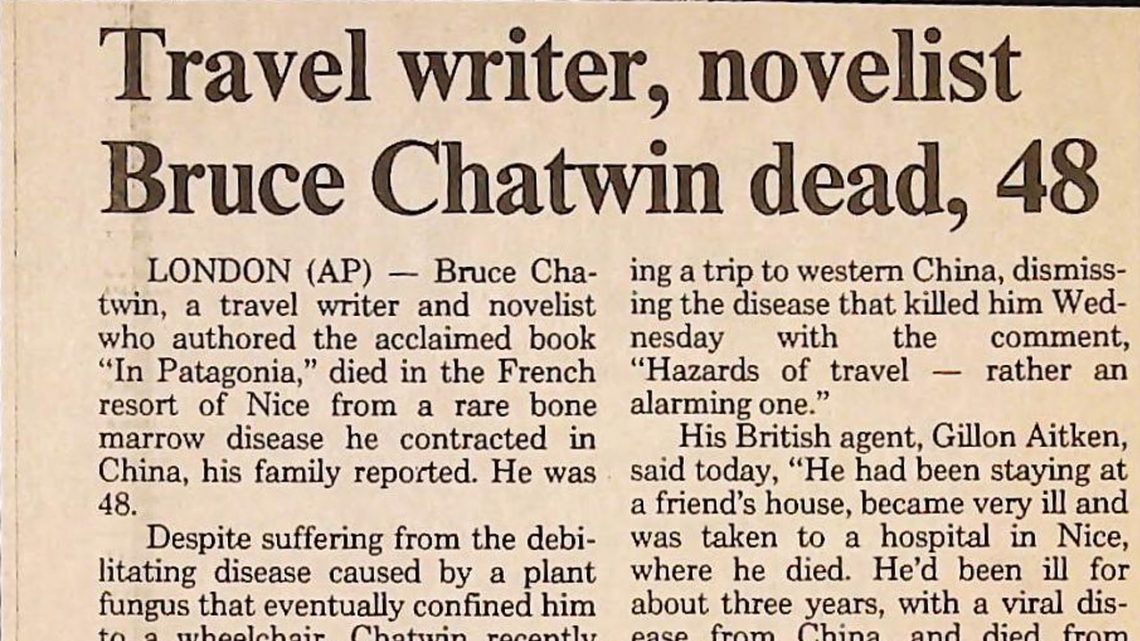
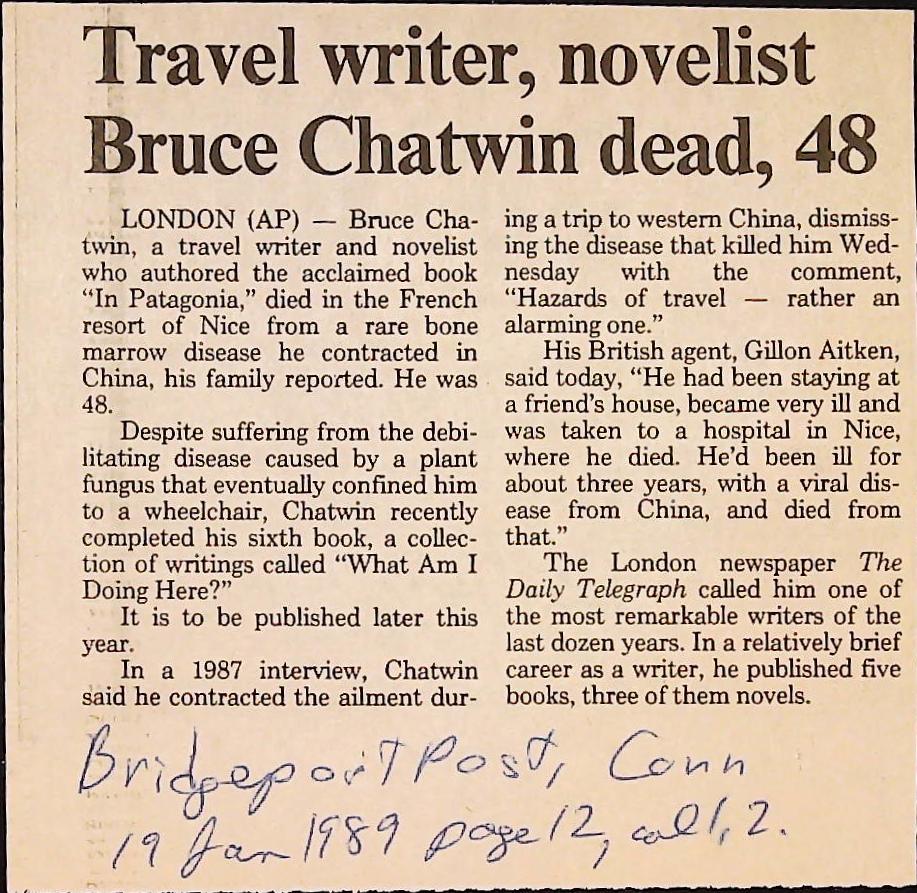
Travel writer, novelist
Bruce Chatwin dead, 48
LONDON (AP) Bruce Cha-
twin, a travel writer and novelist
who authored the acclaimed book
"In Patagonia," died in the French
resort of Nice from a rare bone
marrow disease he contracted in
China, his family reported. He was
48.
Despite suffering from the debi-
litating disease caused by a plant
fungus that eventually confined him
to a wheelchair, Chatwin recently
completed his sixth book, a collec-
tion of writings called "What Am I
Doing Here?"
ing a trip to western China, dismiss-
ing the disease that killed him Wed-
nesday with the
"Hazards of travel
alarming one."
comment,
rather an
His British agent, Gillon Aitken,
said today, "He had been staying at
a friend's house, became very ill and
was taken to a hospital in Nice,
where he died. He'd been ill for
about three years, with a viral dis-
ease from China, and died from
that."
The London newspaper The
Daily Telegraph called him one of
It is to be published later this the most remarkable writers of the
year.
last dozen years. In a relatively brief
career as a writer, he published five
books, three of them novels.
In a 1987 interview, Chatwin
said he contracted the ailment dur-
Bridgeport Post, Conn
19 Jan 1989 page 12, call, 2.

[PAGE BREAK]

Kennebec Jounal 20 Jan 1989 Page 20 Friday
August
Maine
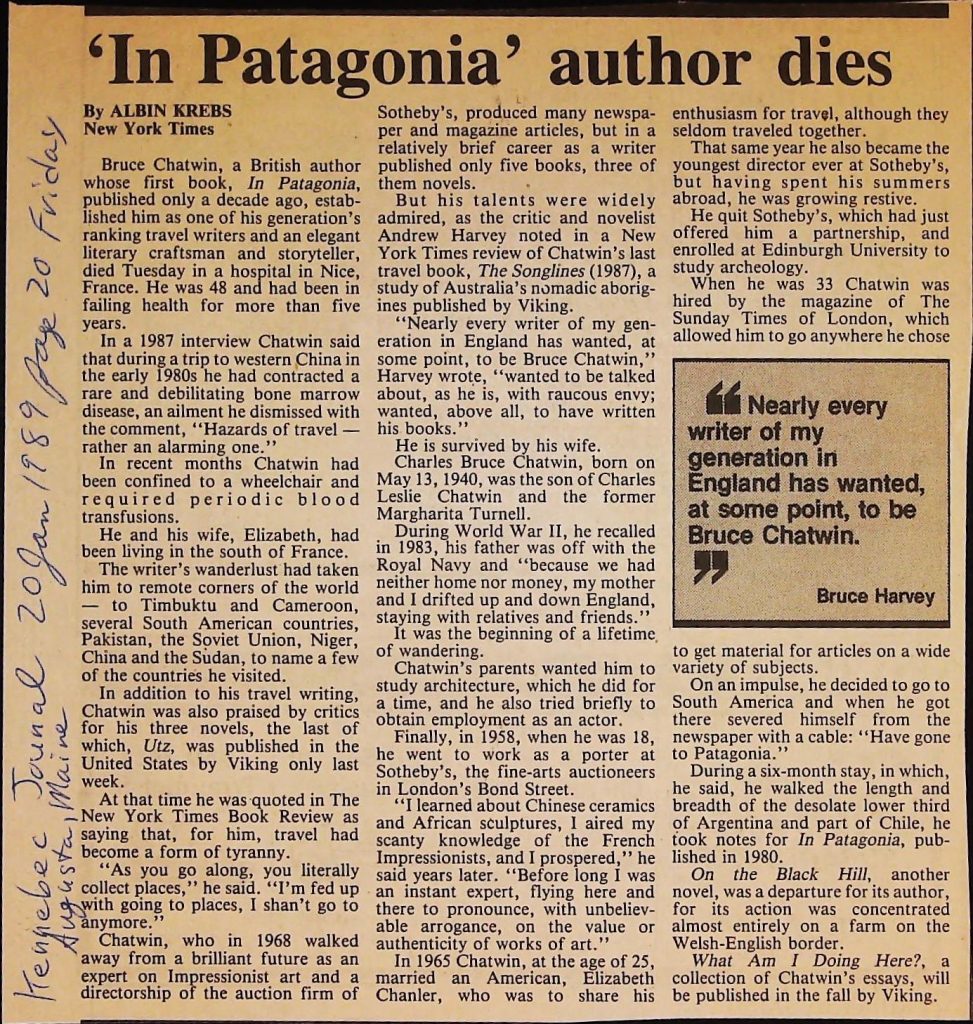
'In Patagonia' author dies
By ALBIN KREBS
New York Times
Bruce Chatwin, a British author
whose first book, In Patagonia,
published only a decade ago, estab-
lished him as one of his generation's
ranking travel writers and an elegant
literary craftsman and storyteller,
died Tuesday in a hospital in Nice,
France. He was 48 and had been in
failing health for more than five
years.
In a 1987 interview Chatwin said
that during a trip to western China in
the early 1980s he had contracted a
rare and debilitating bone marrow
disease, an ailment he dismissed with
the comment, "Hazards of travel -
rather an alarming one.
In recent months Chatwin had
been confined to a wheelchair and
required periodic blood
transfusions.
He and his wife, Elizabeth, had
been living in the south of France.
The writer's wanderlust had taken
him to remote corners of the world
to Timbuktu and Cameroon,
several South American countries,
Pakistan, the Soviet Union, Niger,
China and the Sudan, to name a few
of the countries he visited.
week.
In addition to his travel writing,
for his three novels, the last of
Chatwin was also praised by critics
which, Utz, was published in the
United States by Viking only last
At that time he was quoted in The
saying that, for him, travel had
New York Times Book Review as
become a form of tyranny.
"As you go along, you literally
collect places," he said. "I'm fed up
with going to places, I shan't go to
anymore."
Chatwin, who in 1968 walked
away from a brilliant future as an
expert on Impressionist art and a
directorship of the auction firm of
Sotheby's, produced many newspa-
per and magazine articles, but in a
relatively brief career as a writer
published only five books, three of
them novels.
But his talents were widely
admired, as the critic and novelist
Andrew Harvey noted in a New
York Times review of Chatwin's last
travel book, The Songlines (1987), a
study of Australia's nomadic aborig-
ines published by Viking.
"Nearly every writer of my gen-
eration in England has wanted, at
some point, to be Bruce Chatwin,"
Harvey wrote, "wanted to be talked
about, as he is, with raucous envy;
wanted, above all, to have written
his books.'
He is survived by his wife.
Charles Bruce Chatwin, born on
May 13, 1940, was the son of Charles
Leslie Chatwin and the former
Margharita Turnell.
During World War II, he recalled
in 1983, his father was off with the
Royal Navy and "because we had
neither home nor money, my mother
and I drifted up and down England,
staying with relatives and friends."
It was the beginning of a lifetime,
of wandering.
Chatwin's parents wanted him to
study architecture, which he did for
a time, and he also tried briefly to
obtain employment as an actor.
Finally, in 1958, when he was 18,
he went to work as a porter at
Sotheby's, the fine-arts auctioneers
in London's Bond Street.
"I learned about Chinese ceramics
and African sculptures, I aired my
scanty knowledge of the French
Impressionists, and I prospered," he
said years later. "Before long I was
an instant expert, flying here and
there to pronounce, with unbeliev-
able arrogance, on the value or
authenticity of works of art.'"
In 1965 Chatwin, at the age of 25,
married an American, Elizabeth
Chanler, who was to share his
enthusiasm for travel, although they
seldom traveled together.
That same year he also became the
youngest director ever at Sotheby's,
but having spent his summers
abroad, he was growing restive.
He quit Sotheby's, which had just
offered him a partnership, and
enrolled at Edinburgh University to
study archeology.
When he was 33 Chatwin was
hired by the magazine of The
Sunday Times of London, which
allowed him to go anywhere he chose
Nearly every
writer of my
generation in
England has wanted,
at some point, to be
Bruce Chatwin.
Bruce Harvey
to get material for articles on a wide
variety of subjects.
On an impulse, he decided to go to
South America and when he got
there severed himself from the
newspaper with a cable: "Have gone
to Patagonia.'
During a six-month stay, in which,
he said, he walked the length and
breadth of the desolate lower third
of Argentina and part of Chile, he
took notes for In Patagonia, pub-
lished in 1980.
On the Black Hill, another
novel, was a departure for its author,
for its action was concentrated
almost entirely on a farm on the
Welsh-English border.
What Am I Doing Here?, a
collection of Chatwin's essays, will
be published in the fall by Viking.

[PAGE BREAK]

PATAGONIA
Valdivia
Bahía Blanca
RÍO NEGRO
Rio Negro
S. Antonio Oeste
Carmen de Patagones
Puerto Montt
CHILOB
CHONOS,
Norquinco
Epuyen
Cholila Leleque
Esquel
Trevelin
Or
T
Arroyo Pescado
Río Pico
Z
VALLEY OF
THE MARTYRS
CHUBUT
Lage Muster L Colul Hup
Puerto Aisen Sarmiento
Pto Madryn
Gaimán
Chubut
Trelew
Peninsular Valdes
D
ARCHIPELAGO
Valle Huemeules
PE
SCHILE
Golfo de
Penas
Buenos Aires
PAMPA
DEC
CASTILLO
Perito Moreno
Paso Roballos
LChio
Lago Predes
ATLANTIC
Comodoro Rivadavia
OCEAN
Puerto Deseado
SANTA CRUZ
Lago S. Martin
San Julián
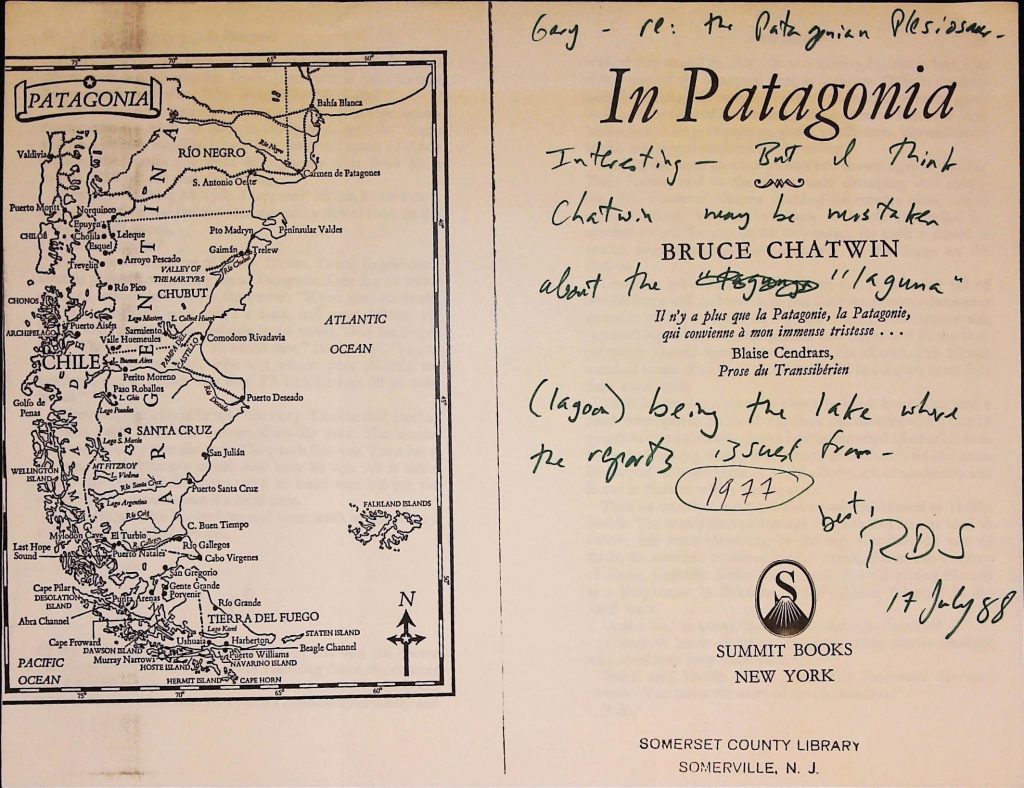
Gary
re: the Patagonian
Plesiosaur
In Patagonia
Interesting
Chatwin
But I think
may
be mistaken
BRUCE CHATWIN
about the aging "laguna
Il n'y a plus que la Patagonie, la Patagonie,
qui convienne à mon immense tristesse
Blaise Cendrars,
Prose du Transsibérien
(lagoon) being the lake where
the reports
13sult from-
Last Hope
Sound
WELLINGTON
ISLAND
MT FITZROY
Viedma
Rio Santa C
Lago Argentina
Cave El Turbio,
Rio Colg
Puerto Santa Cruz
FALKLAND ISLANDS
C. Buen Tiempo
Rio Gallegos
Puerto Natales-
Cabo Virgenes
Cape Pilar
DESOLATION
ISLAND
unta Arenas
San Gregorio
Gente Grande
Porvenir
N
Abra Channel'
Cape Froward
DAWSON ISLAND
PACIFIC
OCEAN
75°
Ushuaia
Murray Narrows /
HOSTE ISLAND
Rio Grande
TIERRA DEL FUEGO
Lago Kami
Harberton
STATEN ISLAND
Puerto Williams Beagle Channel
NAVARINO ISLAND
HERMIT ISLAND CAPE HORN
70°
65
60°
1977
but RDS
SUMMIT BOOKS
NEW YORK
17 July 88
SOMERSET COUNTY LIBRARY
SOMERVILLE, N. J.

[PAGE BREAK]

36
In Patagonia
came near. The bodies were not yet picked clean and their sexual
organs were in their mouths. Lewis Jones said to John Evans:
'Heaven hath saved thee, John, from a horrible death.'
They took up the remains and buried them. A marble monu-
ment marks the spot. Its name is Biddmyrd os syrfeddod "There
will be a myriad wonders '-a line from the hymn of Anne
Griffith, the mystic girl from Montgomery who lived on a
remote hill-farm and also died young.
...
'You're not looking for a job, I suppose?' Milton Evans asked.
It was lunch time and he presented me with a slab of meat on the
end of a small sword.
'Not particularly.'
Funny, you remind me of Bobby Dawes. Young Englishman,
same as yourself, wandering about Patagonia. One day he walks
up to an estancia and says to the owner: "If you give me work,
you're a saint, and your wife's a saint, and your children are
angels, and that dog's the best dog in the world." But the owner
says, "There is no work." "In which case," Bobby says, "you're
the son of a whore, your wife is a whore, your children are
monkeys, and if I catch that dog, I'll kick its arse till its nose
bleeds.'
> >
Milton laughed a lot as he told this story. Then he told another
he once heard from the Cooper sheep-dip man. The second
story was about a cure for scab. The punch line was 'Put a lump
of sugar in the sheep's mouth and suck its arse till it tastes
sweet.' He repeated the story twice to make sure I'd get the
point. I lied. I couldn't face it a third time.
I left Milton to his hay-making and went north of Esquel to a
small settlement called Epuyen.
18
HE NIGHT was hot and it was getting late and the owner
I shop
which also served as a bar. Señor Naitane was a small creased man
with unusually white skin. He eyed his customers nervously and
Arab Gauchos
37
wished they would go. His wife was waiting for him in bed. The
rooms around the courtyard were in darkness. Only in the shop
a single electric bulb smeared its thin yellow light over the green
walls and the lines of bottles and packets of maté. From the roof-
beams hung strings of peppers, garlic, saddle-trees, bits and spurs,
which cast jagged shadows on the ceiling.
Earlier, the eight gauchos present had shown signs of leaving.
Their horses, tied to the fence, were chomping and stamp-
ing. But whenever Naitane swabbed the counter clean, one of
them slammed down a wet glass or bottle and called for
another round. Naitane let his boy serve. He took a duster of
ostrich feathers and flicked, agitatedly, at the things on the
shelves.
Once you get a drunk gaucho in the saddle, he won't fall off
and his horse will get him home. But this presupposes a dangerous
moment while you seat him. Naitane thought this moment was
approaching. The youngest gaucho was bright red in the face,
propping himself against the bar on his elbows. His friends
watched to see if his legs would hold. All had knives stuck into
their waistbands.
Their leader was a scrawny rough in black bombachas and a
black shirt open to his navel. His chest was covered with a fuzz of
ginger hair and the same ginger bristles sprouted all over his face.
He had a few long, sharp, brown teeth and a shark's fin of a nose.
He moved with the grace of a well-oiled piece of machinery and
leered at Naitane with a teasing smile.
Then he crunched my hand and introduced himself as Teófilo
Breide. The words slurred through his teeth and he was hard to
follow, but from something he did say, I realized he was an
Arab; the nose had explained itself. Epuyen, in fact, was a colony
of Arabs, Christian Arabs, but whereas I could picture Naitane
as a shopkeeper in Palestine, Teófilo Breide belonged in the
black tents.
'And what,' he asked, 'is a gringito doing in Epuyen?'
I want to know about an American called Martin Sheffield
who lived here forty years back.'
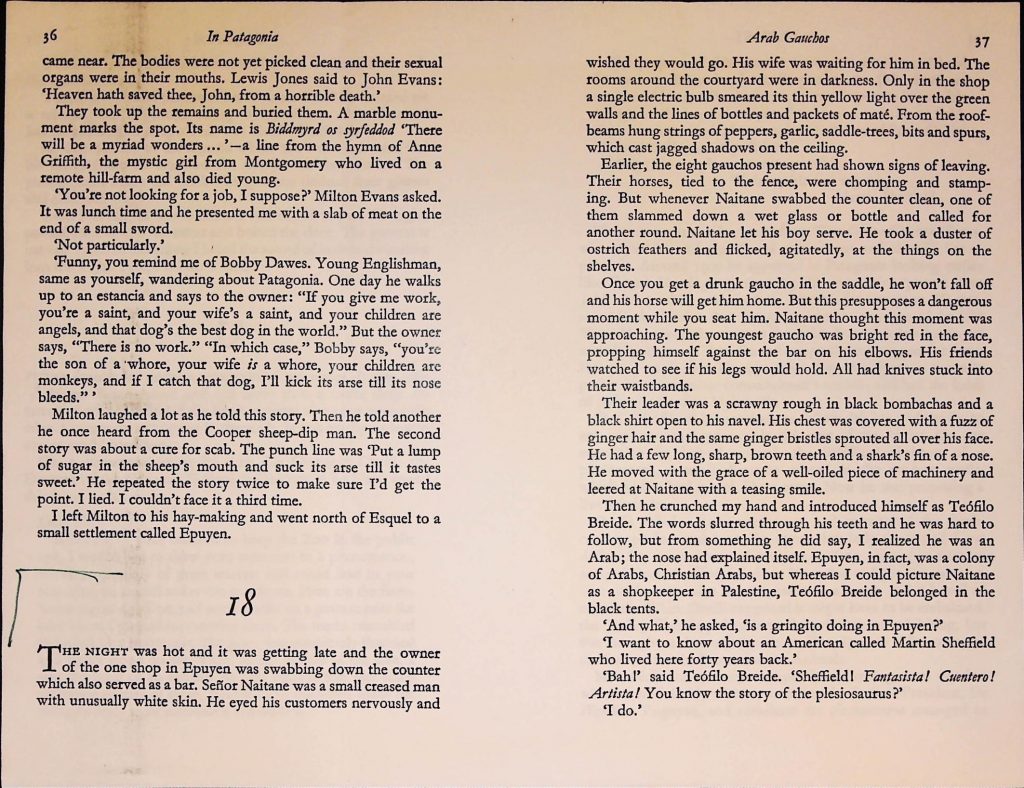
'Bah!' said Teófilo Breide. 'Sheffield! Fantasista! Cuentero!
Artista! You know the story of the plesiosaurus?"
'I do.'

[PAGE BREAK]

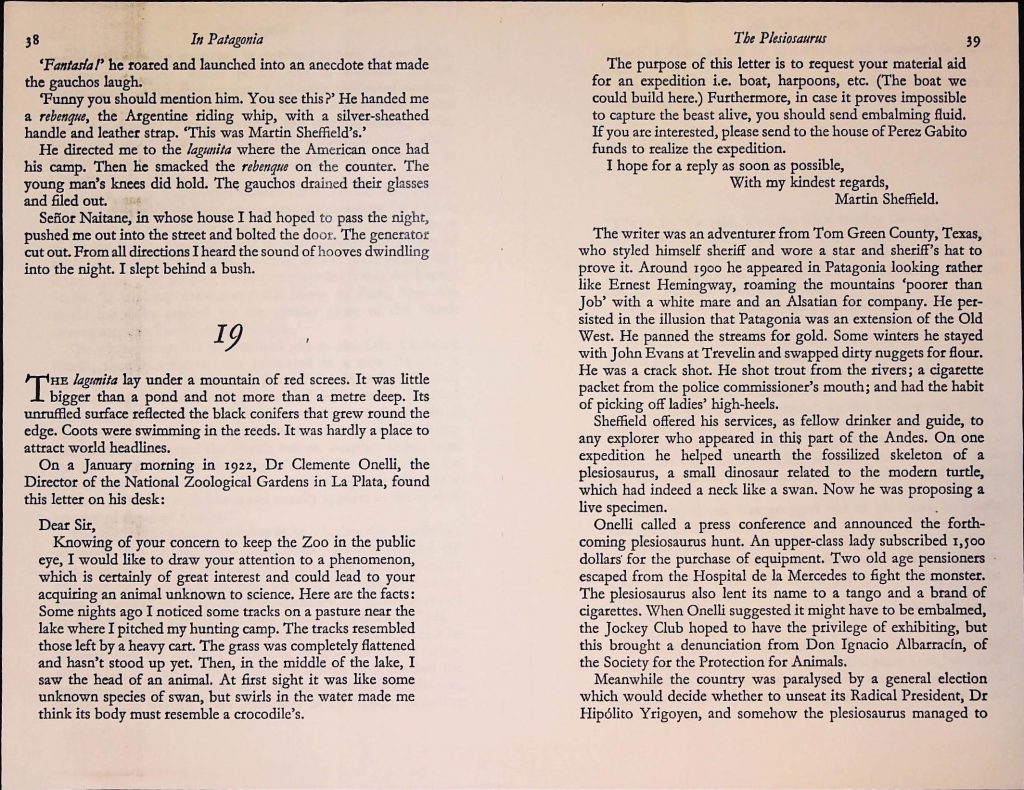
38
In Patagonia
'Fantasia!' he roared and launched into an anecdote that made
the gauchos laugh.
'Funny you should mention him. You see this?' He handed me
a rebenque, the Argentine riding whip, with a silver-sheathed
handle and leather strap. 'This was Martin Sheffield's.'
He directed me to the lagunita where the American once had
his camp. Then he smacked the rebenque on the counter. The
young man's knees did hold. The gauchos drained their glasses
and filed out.
Señor Naitane, in whose house I had hoped to pass the night,
pushed me out into the street and bolted the door. The generator
cut out. From all directions I heard the sound of hooves dwindling
into the night. I slept behind a bush.
T
19
HE lagunita lay under a mountain of red screes. It was little
bigger than a pond and not more than a metre deep. Its
unruffled surface reflected the black conifers that grew round the
edge. Coots were swimming in the reeds. It was hardly a place to
attract world headlines.
On a January morning in 1922, Dr Clemente Onelli, the
Director of the National Zoological Gardens in La Plata, found
this letter on his desk:
Dear Sir,
Knowing of your concern to keep the Zoo in the public
eye, I would like to draw your attention to a phenomenon,
which is certainly of great interest and could lead to your
acquiring an animal unknown to science. Here are the facts:
Some nights ago I noticed some tracks on a pasture near the
lake where I pitched my hunting camp. The tracks resembled
those left by a heavy cart. The grass was completely flattened
and hasn't stood up yet. Then, in the middle of the lake, I
saw the head of an animal. At first sight it was like some
unknown species of swan, but swirls in the water made me
think its body must resemble a crocodile's.
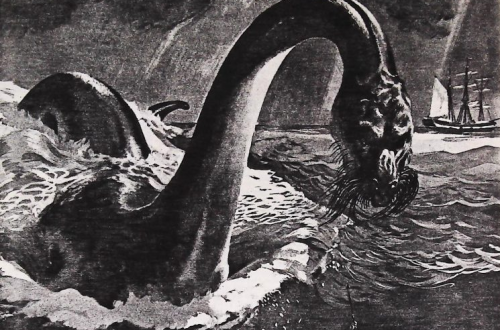
The Plesiosaurus
The purpose of this letter is to request your material aid
for an expedition i.e. boat, harpoons, etc. (The boat we
could build here.) Furthermore, in case it proves impossible
to capture the beast alive, you should send embalming fluid.
If you are interested, please send to the house of Perez Gabito
funds to realize the expedition.
I hope for a reply as soon as possible,
With my kindest regards,
Martin Sheffield.
39
The writer was an adventurer from Tom Green County, Texas,
who styled himself sheriff and wore a star and sheriff's hat to
prove it. Around 1900 he appeared in Patagonia looking rather
like Ernest Hemingway, roaming the mountains 'poorer than
Job' with a white mare and an Alsatian for company. He per-
sisted in the illusion that Patagonia was an extension of the Old
West. He panned the streams for gold. Some winters he stayed
with John Evans at Trevelin and swapped dirty nuggets for flour.
He was a crack shot. He shot trout from the rivers; a cigarette
packet from the police commissioner's mouth; and had the habit
of picking off ladies' high-heels.
Sheffield offered his services, as fellow drinker and guide, to
any explorer who appeared in this part of the Andes. On one
expedition he helped unearth the fossilized skeleton of a
plesiosaurus, a small dinosaur related to the modern turtle,
which had indeed a neck like a swan. Now he was proposing a
live specimen.
Onelli called a press conference and announced the forth-
coming plesiosaurus hunt. An upper-class lady subscribed 1,500
dollars for the purchase of equipment. Two old age pensioners
escaped from the Hospital de la Mercedes to fight the monster.
The plesiosaurus also lent its name to a tango and a brand of
cigarettes. When Onelli suggested it might have to be embalmed,
the Jockey Club hoped to have the privilege of exhibiting, but
this brought a denunciation from Don Ignacio Albarracín, of
the Society for the Protection for Animals.
Meanwhile the country was paralysed by a general election
which would decide whether to unseat its Radical President, Dr
Hipólito Yrigoyen, and somehow the plesiosaurus managed to

[PAGE BREAK]

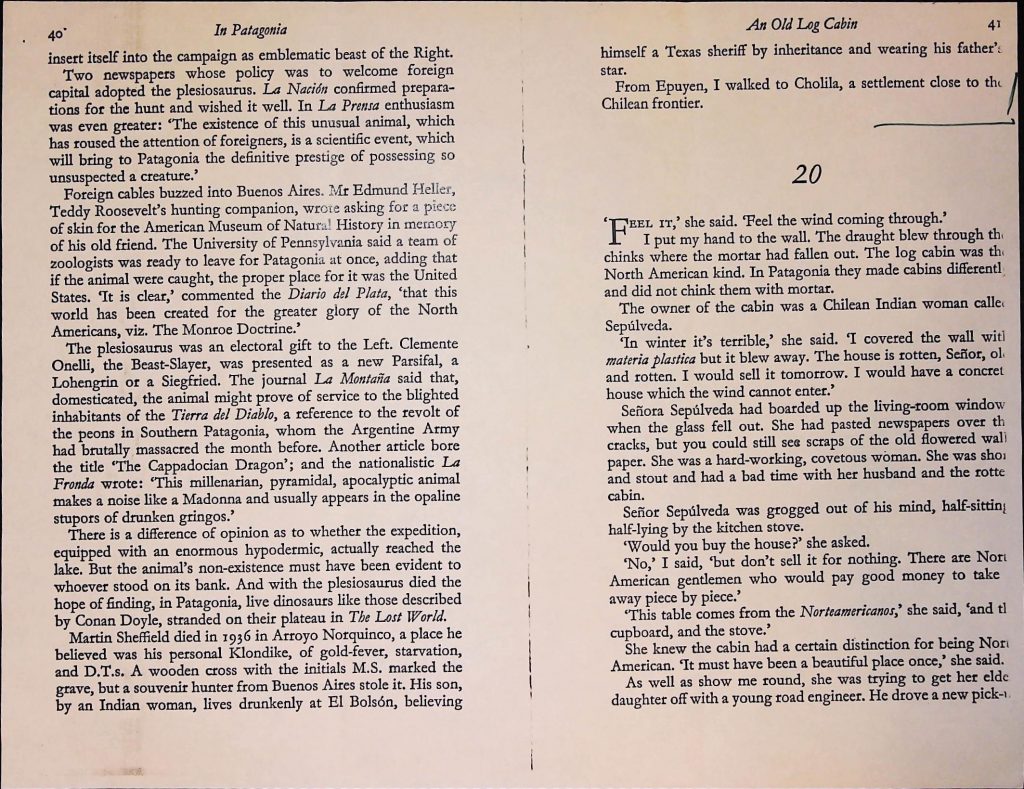
40°
In Patagonia
insert itself into the campaign as emblematic beast of the Right.
Two newspapers whose policy was to welcome foreign
capital adopted the plesiosaurus. La Nación confirmed prepara-
tions for the hunt and wished it well. In La Prensa enthusiasm
was even greater: "The existence of this unusual animal, which
has roused the attention of foreigners, is a scientific event, which
will bring to Patagonia the definitive prestige of possessing so
unsuspected a creature.'
Foreign cables buzzed into Buenos Aires. Mr Edmund Heller,
Teddy Roosevelt's hunting companion, wrote asking for a piece
of skin for the American Museum of Natural History in memory
of his old friend. The University of Pennsylvania said a team of
zoologists was ready to leave for Patagonia at once, adding that
if the animal were caught, the proper place for it was the United
States. It is clear,' commented the Diario del Plata, 'that this
world has been created for the greater glory of the North
Americans, viz. The Monroe Doctrine.'
The plesiosaurus was an electoral gift to the Left. Clemente
Onelli, the Beast-Slayer, was presented as a new Parsifal, a
Lohengrin or a Siegfried. The journal La Montaña said that,
domesticated, the animal might prove of service to the blighted
inhabitants of the Tierra del Diablo, a reference to the revolt of
the peons in Southern Patagonia, whom the Argentine Army
had brutally massacred the month before. Another article bore
the title 'The Cappadocian Dragon'; and the nationalistic La
Fronda wrote: "This millenarian, pyramidal, apocalyptic animal
makes a noise like a Madonna and usually appears in the opaline
stupors of drunken gringos.'
There is a difference of opinion as to whether the expedition,
equipped with an enormous hypodermic, actually reached the
lake. But the animal's non-existence must have been evident to
whoever stood on its bank. And with the plesiosaurus died the
hope of finding, in Patagonia, live dinosaurs like those described
by Conan Doyle, stranded on their plateau in The Lost World.
Martin Sheffield died in 1936 in Arroyo Norquinco, a place he
believed was his personal Klondike, of gold-fever, starvation,
and D.T.s. A wooden cross with the initials M.S. marked the
grave, but a souvenir hunter from Buenos Aires stole it. His son,
by an Indian woman, lives drunkenly at El Bolsón, believing
An Old Log Cabin
41
himself a Texas sheriff by inheritance and wearing his father's
star.
From Epuyen, I walked to Cholila, a settlement close to the
Chilean frontier.
F
20
EEL IT,' she said. 'Feel the wind coming through.'
I put my hand to the wall. The draught blew through the
chinks where the mortar had fallen out. The log cabin was th
North American kind. In Patagonia they made cabins differentl
and did not chink them with mortar.
The owner of the cabin was a Chilean Indian woman calle
Sepúlveda.
'In winter it's terrible,' she said. 'I covered the wall witl
materia plastica but it blew away. The house is rotten, Señor, ol
and rotten. I would sell it tomorrow. I would have a concret
house which the wind cannot enter.'
Señora Sepúlveda had boarded up the living-room window
when the glass fell out. She had pasted newspapers over th
cracks, but you could still see scraps of the old flowered wall
paper. She was a hard-working, covetous woman. She was sho
and stout and had a bad time with her husband and the rotte
cabin.
Señor Sepúlveda was grogged out of his mind, half-sitting
half-lying by the kitchen stove.
'Would you buy the house?' she asked.
'No,' I said, 'but don't sell it for nothing. There are Nort
American gentlemen who would pay good money to take
away piece by piece.'
"This table comes from the Norteamericanos,' she said, 'and tl
cupboard, and the stove.'
She knew the cabin had a certain distinction for being Nor
American. 'It must have been a beautiful place once,' she said.
As well as show me round, she was trying to get her elde
daughter off with a young road engineer. He drove a new pick-