Cryptozoology

B4F47I2

Box 4

Folder 47. Cryptid Whales Beaked Whale Meso Dlodon SP

Item 2. Newspaper Clippings

Transcribed Text (OCR)

GARY MANGIACOPA ARCHIVE
============================================================
Title:      B4F47I2
Slug:       b4f47i2
Categories: Cryptozoology
Source:     https://garymangiacopraarchive.com/b4f47i2
Pages:      2 scanned, 2 extracted
OCR:        Google Vision API (document_text_detection)
Processed:  2026-06-06
============================================================

C4
THE NEW YORK TIMES THE
ENVIRONMENT
TUESDAY, MAY 14, 1991
Some Say the Rockets' Red Glare
Is Eating Away at the Ozone Layer
By WILLIAM J. BROAD
UNDREDS of rockets roar
to life every year, some
trailing clouds of toxic ex-
haust that chew up the life-
protecting ozone shield high in the
atmosphere. How much ozone is de-
stroyed in this fashion is unknown,
and may be small compared with
indstrial pollution. But it is large
ic and public-interest groups.
enough to have worried some scientif-
For their part, rocket manufactur-
ers and users contend that the prob-
lem is insignificant and that the cost
of correcting it would far outweigh
the possible benefits.
The ozone is harmed by solid-fuel
rockets, whose exhausts often contain
large amounts of hydrochloric acid.
Chlorine, when released from the
acid, rapidly breaks down ozone mol-
ecules, letting more of the sun's ultra-
violet light penetrate the atmosphere
and raising the risk of skin cancer. In
contrast, the exhaust from liquid-fuel
rockets is typically composed of wa-
ter and carbon dioxide.
No one knows how many solid-fuel
rockets are fired each year, or how
many fly high enough to destroy
ozone. The United States Space Com-
mand, based in Colorado Springs,
Colo., which keeps tabs on global
rocket launchings of all types, esti-
mates that 500 to 600 rockets were
fired every year during the 1980's,
with the number peaking in 1989 at
1,500. These firings ranged from
space shuttles and large American
rockets to relatively small Scud mis-
siles, which are liquid fueled.
Despite the unknowns, some scien-
tists have concluded that the ozone
damage, though now perhaps slight,
is worrisome because of the trend to
increasing use of solid-fuel rockets
around the world. In March 1990, a
panel of the National Research Coun-
cil of the National Academy of Sci-
ences, which advises the Federal
Government, called for a switch to
liquid propellants, saying this would
eliminate rocket-born "pollution of
the atmosphere."
In June 1990, the signatories to the
Montreal Protocol, which seeks to
ban substances that deplete ozone,
directed the group's scientific el
The shuttle is the
main focus of debate
because of its huge
solid-fuel boosters.
cant part of the problem," said Allan
J. McDonald, vice president for space
operations of the Thiokol Corporation
in Brigham City, Utah, which makes
solid-fuel rockets. Among the general
public, he added, "there's an overre-
action leading toward hysteria.
Switching to new fuels, Mr. McDon-
ald said, would cost billions. "It would
be a waste," he said. "We ought to
spend that money cleaning up the
CFC problem." CFC's, or chlorofluo
rocarbons, are industrial chemicals
that constitute the chief cause of
ozone destruction.
The main focus of the rocket debate
is the shuttle, whose 149-foot tuin
boosters are the largest solid-fuel
rockets in the world. The National
Aeronautics and Space Administra
tion estimates that each shuttle flight
injects some 75 tons of chlorine into
the stratosphere, the ozone-rich layer
a dozen or so miles above the earth.
A different type of large booster
helps power the Titan 4, this com-
try's largest unmanned rocket. Its
twin boosters are 113 feet tall.
Dr. Michael J. Prather, an atno-
spheric scientist at NASA's Goddard
Institute in New York City, and his
colleagues have calculated that the
lofting of nine shuttles and six Titan
4's every year would add a mere 0.3
percent to the annual burden of
stratospheric chlorine, which in tum
would destroy far less than 1 percent
of the ozone there.
A Worrisome Trend in Rocket Emissions
In development
U.S.A.
Space
shuttle
boosters
149 ft.
Titan 4
boosters
113 ft.
"As a point source of pollution, the
shuttle is clearly large," Dr. Prather
said in an interview. "But compared
to any other industry-refrigeration,
foam blowing, solvents - it's small."
Shuttle's Benefits Cited
Nonetheless, some groups have at-
tacked the shuttle as a serious envi-
ronmental hazard, and the most caus-
All these rockets
Japan U.S.S.R. either have solid-
Europe
Arlane 4
boosters
39 ft.
H-2
rocket
80 ft.
Arlane 5*
rockets
98 ft.
tic criticism has come from the Sovi-
ets. Aleksandr I. Dunayev, head of the
Soviet space agency, Glavkosmos,
was quoted in a 1989 Russian publica-
tion, Literaturnaya Gazeta, as say-
ing, "About 300 launches of the shut-
tle each year would be a catastrophe
and the ozone would be completely
destroyed.'
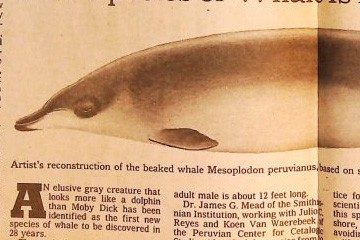
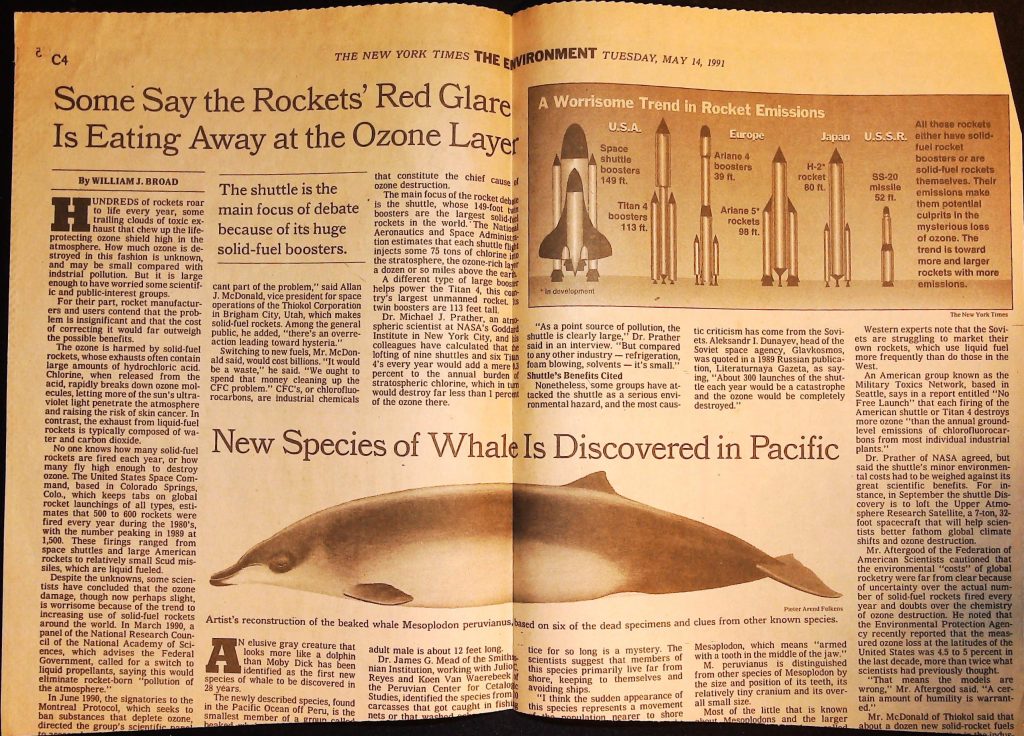
New Species of Whale Is Discovered in Pacific
Pieter Arend Folkens
Artist's reconstruction of the beaked whale Mesoplodon peruvianus, based on six of the dead specimens and clues from other known species.
A
N elusive gray creature that
looks more like a dolphin
than Moby Dick has been
identified as the first new
species of whale to be discovered in
28 years.
The newly described species, found
in the Pacific Ocean off Peru, is the
beaked
smallest member of a group called
adult male is about 12 feet long.
Dr. James G. Mead of the Smiths
nian Institution, working with Julio,
Reyes and Koen Van Waerebeek of
the Peruvian Center for Cetaloge
Studies, identified the species from 0
carcasses that got caught in fishing
nets or that washed
tice for so long is a mystery. The
scientists suggest that members of
this species primarily live far from
shore, keeping to themselves and
avoiding ships.
"I think the sudden appearance of
this species represents a movement
the population nearer to shore
Mesɔplodon, which means "armed
with a tooth in the middle of the jaw."
M. peruvianus is distinguished
from other species of Mesoplodon by
the size and position of its teeth, its
relatively tiny cranium and its over-
all small size.
Most of the little that is known
about Mesoplodons and the larger
od
SS-20
missile
52 ft.
fuel rocket
boosters or are
solid-fuel rockets
themselves. Their
emissions make
them potential
culprits in the
mysterious loss
of ozone. The
trend is toward
more and larger
rockets with more
emissions.
The New York Times
Western experts note that the Sovi-
ets are struggling to market their
own rockets, which use liquid fuel
more frequently than do those in the
West.
An American group known as the
Military Toxics Network, based in
Seattle, says in a report entitled "No
Free Launch" that each firing of the
American shuttle or Titan 4 destroys
more ozone "than the annual ground-
level emissions of chlorofluorocar-
bons from most individual industrial
plants."
Dr. Prather of NASA agreed, but
said the shuttle's minor environmen-
⚫tal costs had to be weighed against its
great scientific benefits. For in-
stance, in September the shuttle Dis-
covery is to loft the Upper Atmo-
sphere Research Satellite, a 7-ton, 32-
foot spacecraft that will help scien-
tists better fathom global climate
shifts and ozone destruction.
Mr. Aftergood of the Federation of
American Scientists cautioned that
the environmental "costs" of global
rocketry were far from clear because
of uncertainty over the actual num-
ber of solid-fuel rockets fired every
year and doubts over the chemistry
of ozone destruction. He noted that
the Environmental Protection Agen-
cy recently reported that the meas-
ured ozone loss at the latitudes of the
United States was 4.5 to 5 percent in
the last decade, more than twice what
scientists had previously thought.
"That means the models are
wrong," Mr. Aftergood said. "A cer-
tain amount of humility is warrant-
ed."
Mr. McDonald of Thiokol said that
about a dozen new solid-rocket fuels
indus

[PAGE BREAK]

parier
Caned
aned whales, for their distinctive
to assess damage from rockets. That dolphin-like snout. They are seen so
report is due in 1992.
Some See Hysteria
ozone
said
"It's appropriate to begin a transi-
tion now to cleaner propellants,"
Steven Aftergood, a specialist on
depletion with the Federation
of American Scientists, a private
group based in Washington. "There's
enough evidence of the danger."
But rocket makers and users dis-
"We're a very small, insignifi-
agree.
ly
rarely that it took scientists 15 years
to find enough specimens to feel con-
fident that they were members of a
previously unknown species.
Like other beaked whales, the new-
ly described species, Mesoplodon
peruvianus, has an elongated jaw,
few teeth and apparently feeds on
squid. The species appears to be uni-
formly gray on top, shading to lighter
gray on the underbelly. At birth, the
whale is about 5 feet long, and an
ashed ashore over the
Of the popu
last 15 years. They described their where they occasionally get caught
about
finding earlier this year in Marine up in fisheries and where they may family of toothed-whales came
Mammal Science, a journal of the wash up on the beach when they die,"
Society for Marine Mammology.
this
not
Two sightings of living whales of
species have been reported, but
confirmed, Dr. Mead said. The
whale's range and population are un-
known, but specimens recently found
along the Mexican coast may belong
to this species, he said.
First
Clue in 1976
Just how a type of whale, even a
relatively small one, could escape no-
Dr. Mead said.
The first clue that an undescribed
species of whale might be cruising
the Pacific came in 1976 when Dr.
Mead found a partial cranium and
vertebra in San Andes, Peru.
Remains from nine additional
whales were found from 1985 to 1989
on the central and southern Peruvian
coast. Taken together, the specimens
provide persuasive evidence of a dis-
species
tinct
of
the
genus
Ziphiidae has been learned from
stranded carcasses that have washed
ashore, Dr. Mead said. M. peruvianus
is the 13th species of Mesoplodon to
be identified, as well as the smallest.
Dr. Mead said that other species of
whale, yet to be described, are proba-
bly prowling remote parts of the
ocean. In 1987, scientists described
sightings in the eastern tropical Pa-
cific of a larger, distinctively colored
whale that could be another new spe-
cies of Mesoplodon.
were under investigation in the meds
try but that each had drawbacks.
Some were less powerful, some dan-
gerously explosive and some difficult
to handle. "We have alternatives," he
said, "but the amount of money to
develop them isn't worth the impact
it's going to have."
Mr. Aftergood disagreed, saying
the cleanliness of fuels "ought to be
an important factor in the selection of
the next generation of rockets," add-
ing, "It's just a matter of being envi-
ronmentally responsible.'

Leave a Reply

Your email address will not be published. Required fields are marked *